
Introduction to Key Concepts in Buddhism for RMPS
Introduction to Key Concepts in Buddhism for RMPS Teachers Dr Naomi Appleton University of Edinburgh, naomi. appleton@ed. ac. uk Dr Chris Jones University of Cambridge, cvj 20@cam. ac. uk Feb-Jun 2021
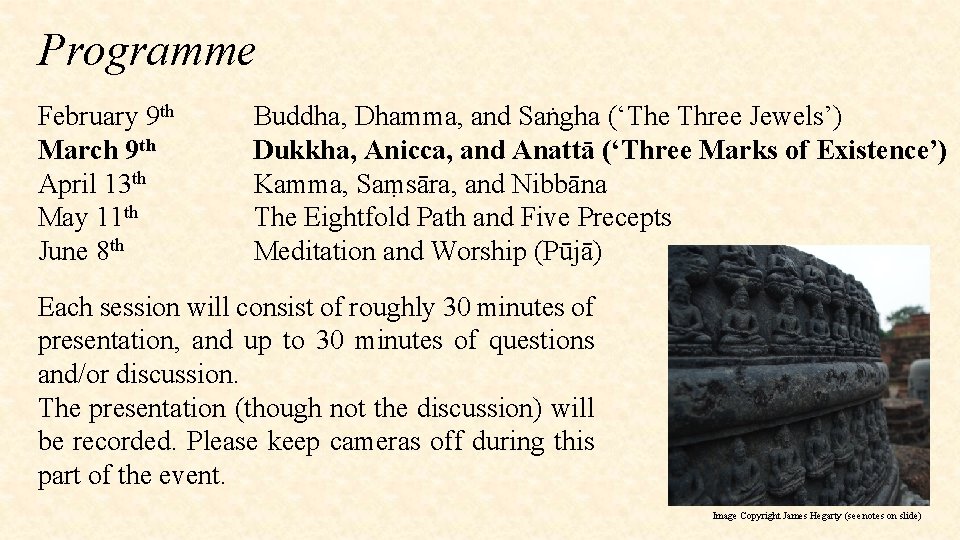
Programme February 9 th March 9 th April 13 th May 11 th June 8 th Buddha, Dhamma, and Saṅgha (‘The Three Jewels’) Dukkha, Anicca, and Anattā (‘Three Marks of Existence’) Kamma, Saṃsāra, and Nibbāna The Eightfold Path and Five Precepts Meditation and Worship (Pūjā) Each session will consist of roughly 30 minutes of presentation, and up to 30 minutes of questions and/or discussion. The presentation (though not the discussion) will be recorded. Please keep cameras off during this part of the event. Image Copyright James Hegarty (see notes on slide)
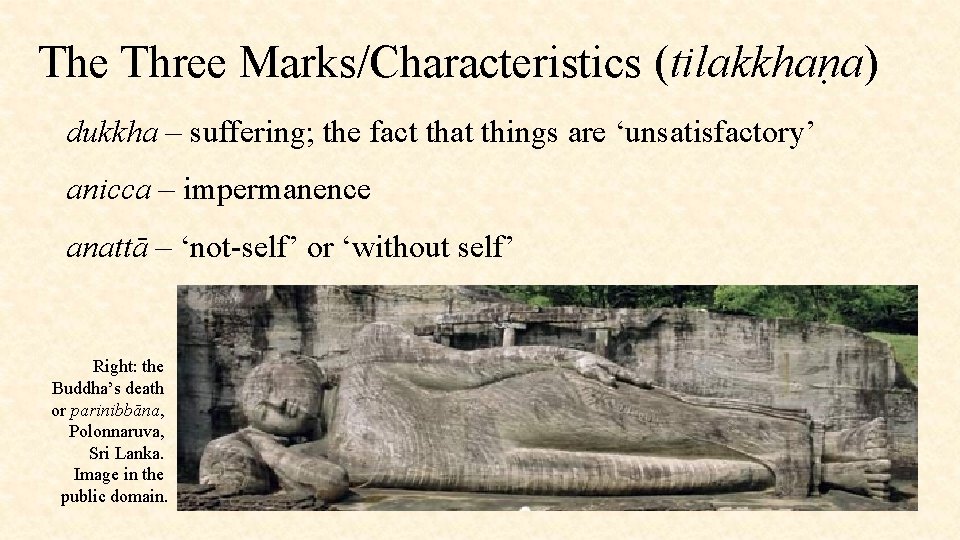
The Three Marks/Characteristics (tilakkhaṇa) dukkha – suffering; the fact that things are ‘unsatisfactory’ anicca – impermanence anattā – ‘not-self’ or ‘without self’ Right: the Buddha’s death or parinibbāna, Polonnaruva, Sri Lanka. Image in the public domain.

anicca – impermanence dukkha – suffering, unsatisfactory What is dukkha? • birth, aging and death • sorrow, lamentation, distress, etc (i. e. , forms of mental suffering) • proximity to what is not dear, separation from what is dear, not getting what you wish Image provided by the Wellcome collection: CC-BY-4. 0 (see notes to slide)
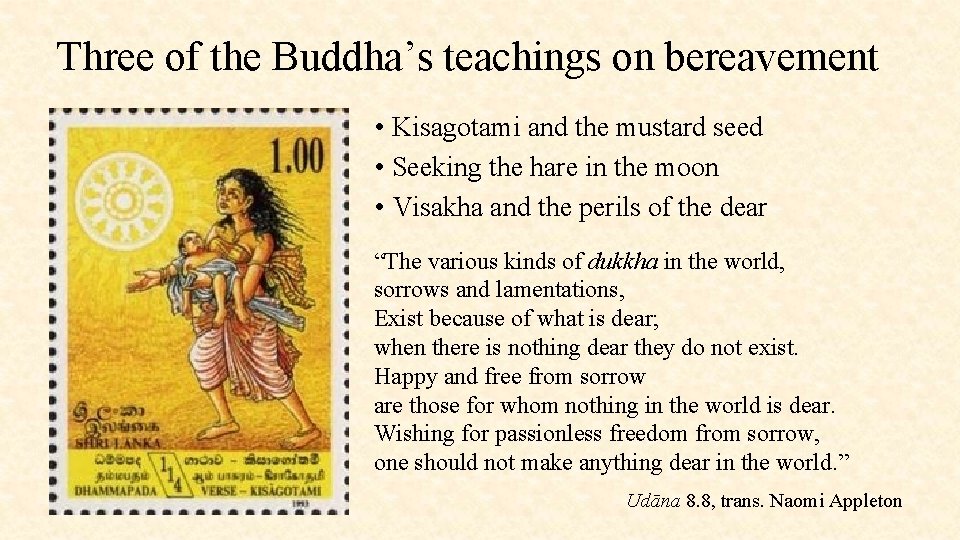
Three of the Buddha’s teachings on bereavement • Kisagotami and the mustard seed • Seeking the hare in the moon • Visakha and the perils of the dear “The various kinds of dukkha in the world, sorrows and lamentations, Exist because of what is dear; when there is nothing dear they do not exist. Happy and free from sorrow are those for whom nothing in the world is dear. Wishing for passionless freedom from sorrow, one should not make anything dear in the world. ” Udāna 8. 8, trans. Naomi Appleton
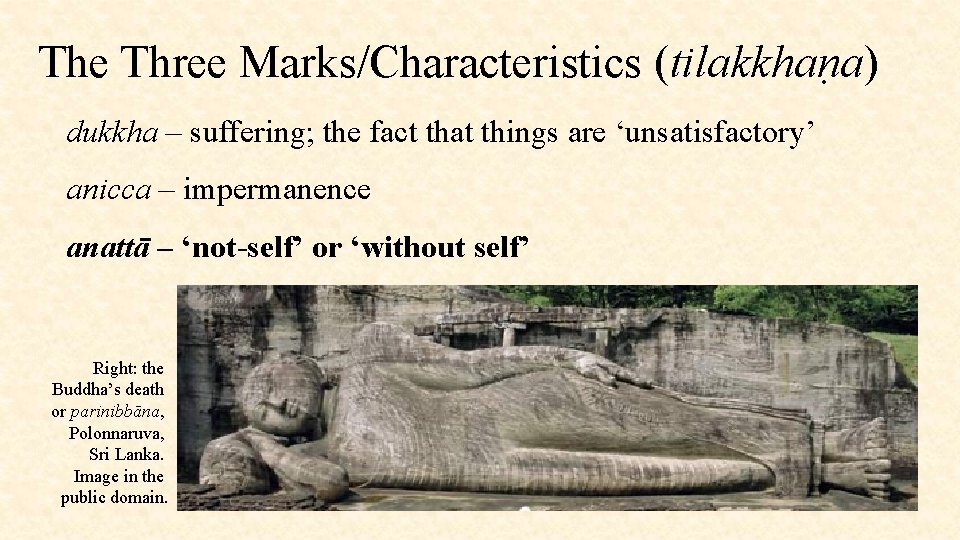
The Three Marks/Characteristics (tilakkhaṇa) dukkha – suffering; the fact that things are ‘unsatisfactory’ anicca – impermanence anattā – ‘not-self’ or ‘without self’ Right: the Buddha’s death or parinibbāna, Polonnaruva, Sri Lanka. Image in the public domain.
From the Milinda-pañha (‘The questions of the King Milinda’, in dialogue with the monk Nāgasena) The king asked: ‘Venerable Nāgasena, is it the case that one does not transmigrate, and yet one is reborn? Yes, your majesty, one does not transmigrate and yet one is reborn. How, venerable Nāgasena, is it that one does not transmigrate and yet one is reborn? Provide an analogy. Just as, your majesty, if someone kindled one lamp from another, is it indeed the case, majesty, that the lamp would transmigrate from the other lamp? Certainly not, venerable Sir. Indeed not, your majesty, one does not transmigrate, and yet one is reborn.
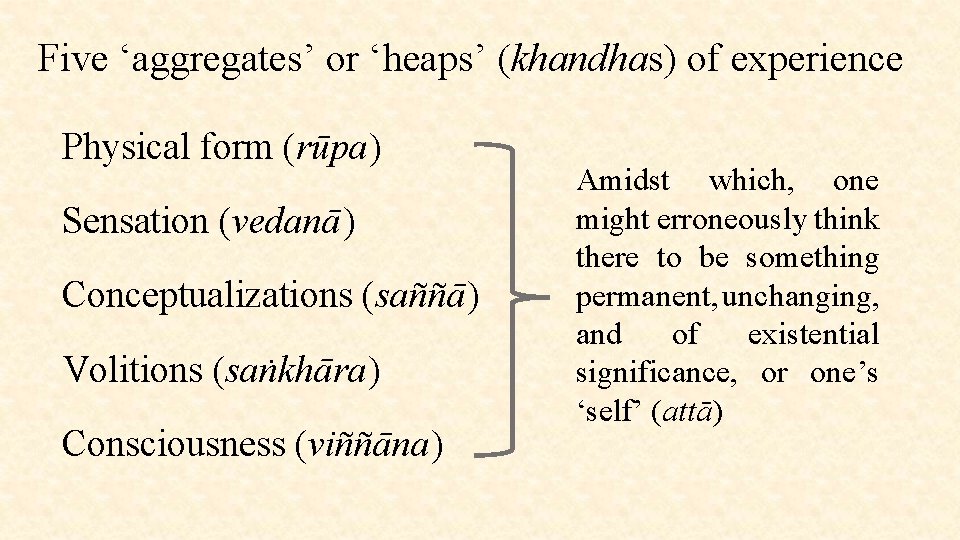
Five ‘aggregates’ or ‘heaps’ (khandhas) of experience Physical form (rūpa) Sensation (vedanā) Conceptualizations (saññā) Volitions (saṅkhāra) Consciousness (viññāna) Amidst which, one might erroneously think there to be something permanent, unchanging, and of existential significance, or one’s ‘self’ (attā)
![From the Anattalakkhaṇa-sutta (‘the discourse [sutta] the character [of things], being not the self’)](http://slidetodoc.com/presentation_image_h2/4ea9a9a8584c76c3e76c0dd5381b09a9/image-9.jpg "From the Anattalakkhaṇa-sutta (‘the discourse [sutta] the character [of things], being not the self’)")
From the Anattalakkhaṇa-sutta (‘the discourse [sutta] the character [of things], being not the self’) [The Buddha is seated with his first audience of monks, after having taught about the Four Truths, and asks his monks to interrogate the content of their experience…] Monks, how do you conceive it: is i) physical form […then, each in their turn, ii) sensation, iii) conceptualization, iv) volition and v) consciousness…] permanent or impermanent? …(The monks respond) Impermanent, venerable Sir. Now, is what is impermanent unsatisfactory (dukkha) or satisfactory/pleasing (sukha)? …Unsatisfactory, venerable Sir. Now, is what is impermanent, what is unsatisfactory, being subject to change, fit to be considered like this: ‘this is mine, this me, this is my self (attā)’? …It is not, venerable Sir…
- Slides: 9