
Introduction to Key Concepts in Buddhism for RMPS
Introduction to Key Concepts in Buddhism for RMPS Teachers Dr Naomi Appleton University of Edinburgh, naomi. appleton@ed. ac. uk Dr Chris Jones University of Cambridge, cvj 20@cam. ac. uk Feb-Jun 2021
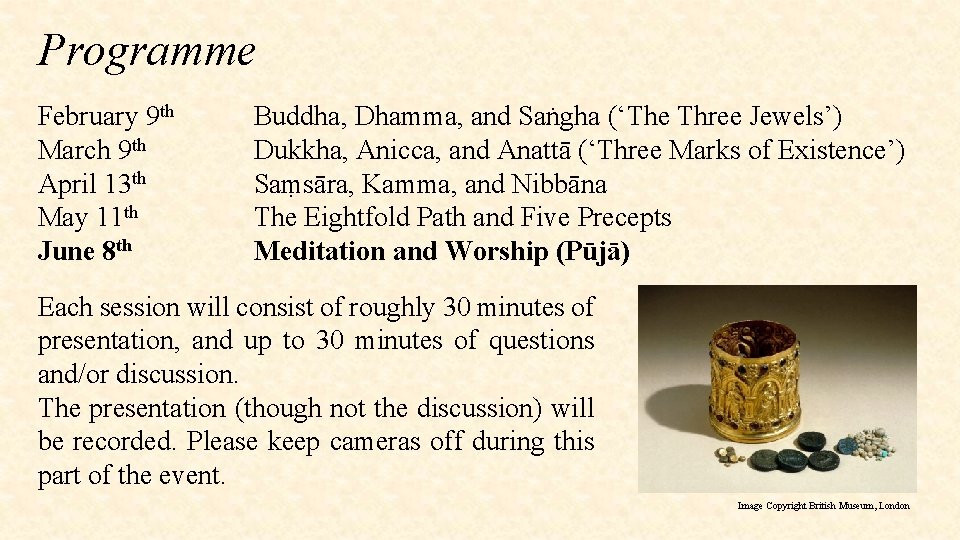
Programme February 9 th March 9 th April 13 th May 11 th June 8 th Buddha, Dhamma, and Saṅgha (‘The Three Jewels’) Dukkha, Anicca, and Anattā (‘Three Marks of Existence’) Saṃsāra, Kamma, and Nibbāna The Eightfold Path and Five Precepts Meditation and Worship (Pūjā) Each session will consist of roughly 30 minutes of presentation, and up to 30 minutes of questions and/or discussion. The presentation (though not the discussion) will be recorded. Please keep cameras off during this part of the event. Image Copyright British Museum, London

Some language of Buddhist ‘meditation’ terms are in Pāli, explained in accordance with Theravāda tradition bhāvanā – ‘bringing to being’; ‘cultivation’ samādhi – ‘concentration’ sati – ‘mindfulness’; ‘remembrance (in the sense of ‘keeping in mind’)’ samatha – ‘calming’: a specific kind of meditative practice vipassanā – ‘insight’: a specific kind of meditative practice jhāna – a heightened, pleasant state of consciousness that is achieved through samatha, and taken to be the basis for the practice of vipassanā
From the Nibbedhika-sutta (see our fourth session for original discussion of this material) [The Buddha is here explaining a number of core Buddhist teachings. . . ] ‘Monks, I say to you that kamma is intention; by intention, one does kamma through the body, speech and mind’ cetanā – ‘intention’; the character of the mind when thinking. This same idea put a little differently: …the activities that affect our futures (kamma) are the character of one’s thought (cetanā); by the character of thought (cetanā), one affects one’s future through the body, speech and mind’
![From the Satipaṭṭhāna-sutta (‘the discourse [sutta] on being established in mindfulness [sati]) Monks, this](http://slidetodoc.com/presentation_image_h2/100e9650fcc876157bf1c0affa275a50/image-5.jpg "From the Satipaṭṭhāna-sutta (‘the discourse [sutta] on being established in mindfulness [sati]) Monks, this")
From the Satipaṭṭhāna-sutta (‘the discourse [sutta] on being established in mindfulness [sati]) Monks, this is the direct path for the purification of beings, the surmounting of sorrow and lamentation, the disappearance of pain and grief, the attainment of the true way, the realization of nibbāna: the four kinds of establishing mindfulness… …a monk abides contemplating: 1) the body as a body… 2) feelings as feelings… 3) thoughts as thoughts… 4) mental phenomena as mental phenomena [including obstructions to meditative focus: desire, ill-will, doubt, sloth etc. ]. A Theravādin novice in meditation. Image available free via wikimedia commons (commons. wikimedia. org).
![From the Satipatthāṇa-sutta (‘the discourse [sutta] on being established in mindfulness [sati]) How, monks,](http://slidetodoc.com/presentation_image_h2/100e9650fcc876157bf1c0affa275a50/image-6.jpg "From the Satipatthāṇa-sutta (‘the discourse [sutta] on being established in mindfulness [sati]) How, monks,")
From the Satipatthāṇa-sutta (‘the discourse [sutta] on being established in mindfulness [sati]) How, monks, does a monk abide contemplating the body as a body? A monk, having gone to the forest or the root of a tree or to an empty hut, sits; having folded his legs, he sits straight and establishes mindfulness before him, mindful as he breathes in and breathes out. Breathing in long, he understands: ‘I breath in long’; or breathing out long, he understands: ‘I breathe out long’ [etc. ]… …again, monks, as though he were to see a corpse thrown aside in a charnel ground, being devoured by crows [and other animals], a monk compares this same body [of his] with it thus: ‘this body [of mine] is of the same nature, it will be like that, it is not exempt from that fate. ’
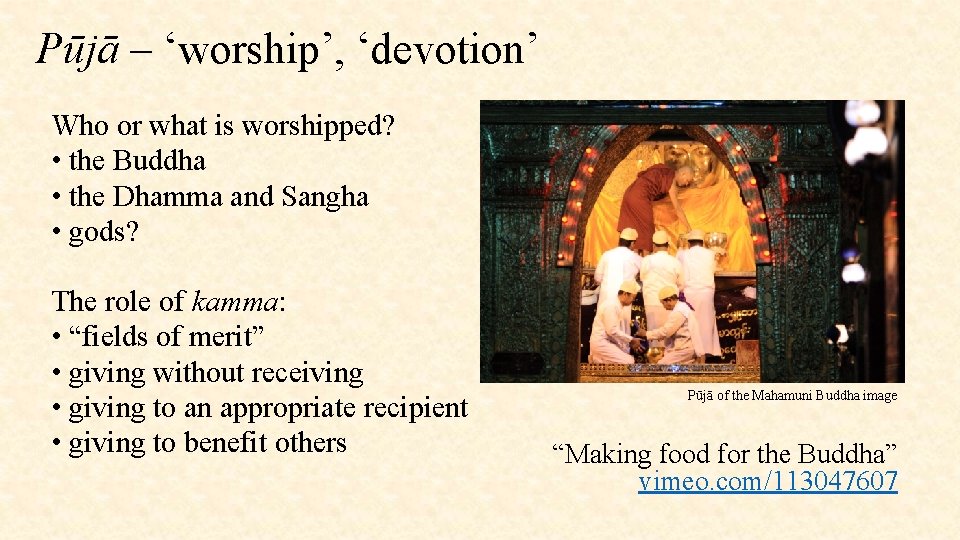
Pūjā – ‘worship’, ‘devotion’ Who or what is worshipped? • the Buddha • the Dhamma and Sangha • gods? The role of kamma: • “fields of merit” • giving without receiving • giving to an appropriate recipient • giving to benefit others Pūjā of the Mahamuni Buddha image “Making food for the Buddha” vimeo. com/113047607
![The Buddha’s relics [Monk: ] ‘Long is the time, lord of men, since we](http://slidetodoc.com/presentation_image_h2/100e9650fcc876157bf1c0affa275a50/image-8.jpg "The Buddha’s relics [Monk: ] ‘Long is the time, lord of men, since we")
The Buddha’s relics [Monk: ] ‘Long is the time, lord of men, since we have seen the Buddha. We lived a life without a master; there is nothing here for us to worship. ’ [King: ] ‘Did you not tell me, sir, that the Buddha has passed into nibbāna? ’ [Monk: ] ‘If we behold the relics, we behold the Buddha. ’ From the Mahāvaṃsa (c. C 5 th CE), reporting the arrival of some Buddhist relics to Sri Lanka Right: The thūpa (Sanskrit: stūpa) at Sarnath, near Varanasi, site of the Buddha’s first sermon.
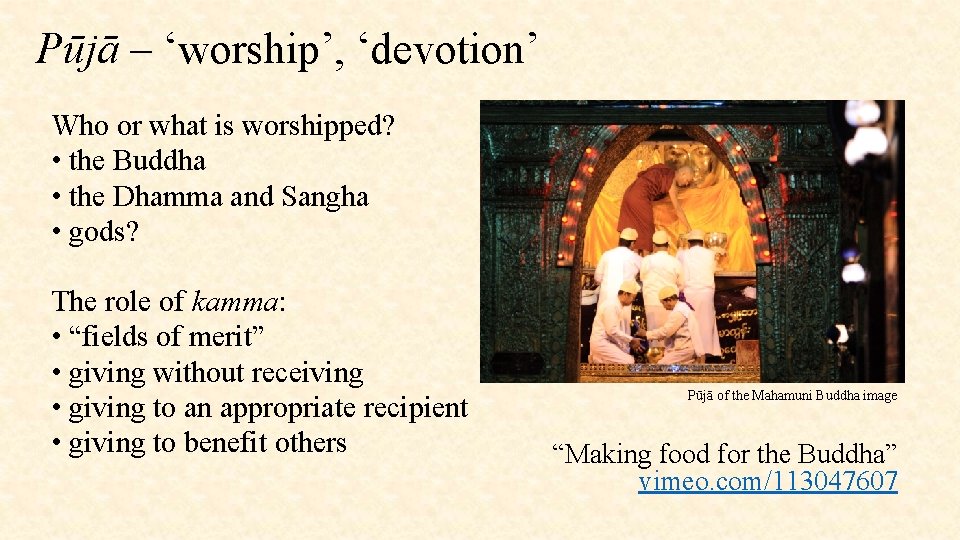
Pūjā – ‘worship’, ‘devotion’ Who or what is worshipped? • the Buddha • the Dhamma and Sangha • gods? The role of kamma: • “fields of merit” • giving without receiving • giving to an appropriate recipient • giving to benefit others Pūjā of the Mahamuni Buddha image “Making food for the Buddha” vimeo. com/113047607
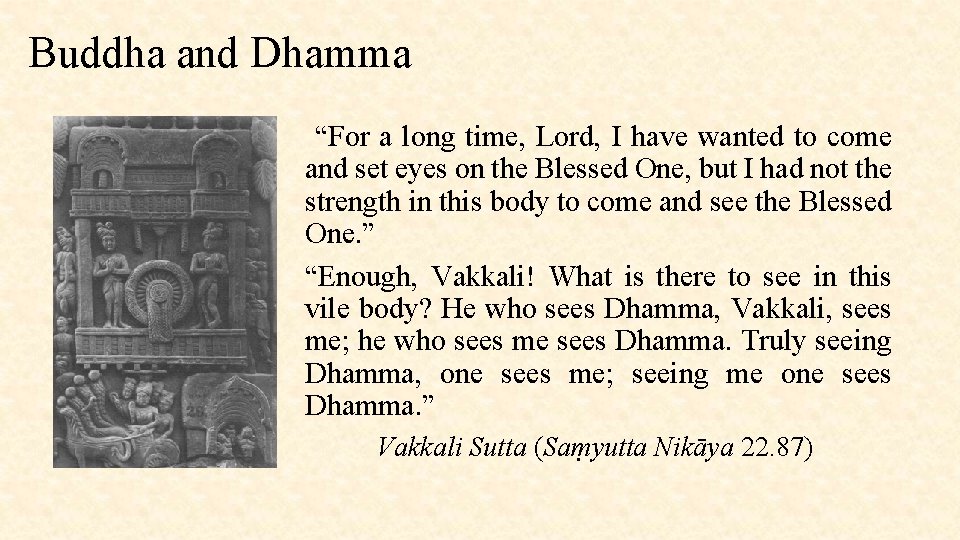
Buddha and Dhamma “For a long time, Lord, I have wanted to come and set eyes on the Blessed One, but I had not the strength in this body to come and see the Blessed One. ” “Enough, Vakkali! What is there to see in this vile body? He who sees Dhamma, Vakkali, sees me; he who sees me sees Dhamma. Truly seeing Dhamma, one sees me; seeing me one sees Dhamma. ” Vakkali Sutta (Saṃyutta Nikāya 22. 87)
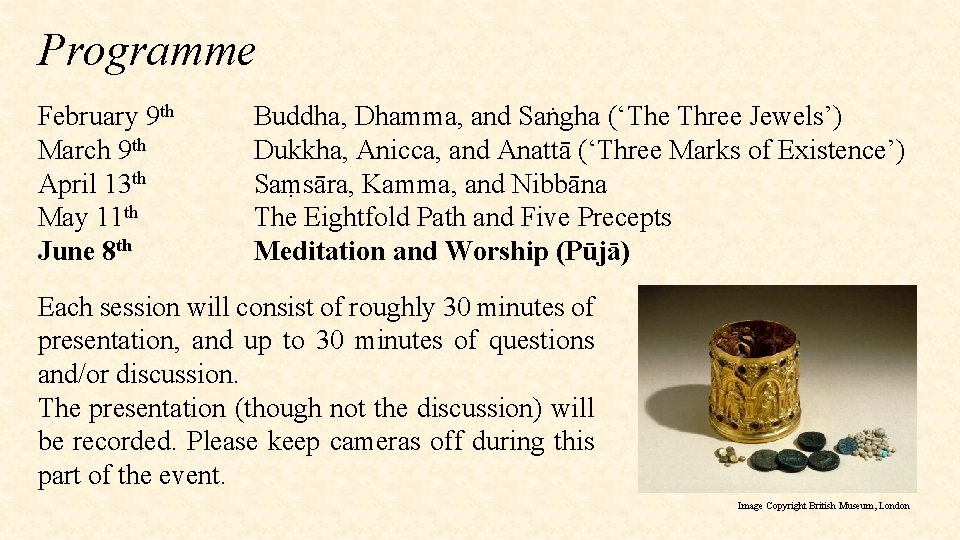
Programme February 9 th March 9 th April 13 th May 11 th June 8 th Buddha, Dhamma, and Saṅgha (‘The Three Jewels’) Dukkha, Anicca, and Anattā (‘Three Marks of Existence’) Saṃsāra, Kamma, and Nibbāna The Eightfold Path and Five Precepts Meditation and Worship (Pūjā) Each session will consist of roughly 30 minutes of presentation, and up to 30 minutes of questions and/or discussion. The presentation (though not the discussion) will be recorded. Please keep cameras off during this part of the event. Image Copyright British Museum, London
- Slides: 11