
Introduction to ISDN Prepared by Mehdi Kereshteh Payam
Introduction to ISDN Prepared by: ü Mehdi Kereshteh ü Payam Kaywan University of Science & Technology of Mazandaran 21/8/1384
What is ISDN? l l l ISDN - Integrated Services Digital Network Telephone services Telecommunication services Used for voice, image and data
ISDN protocols E - series for Telephone network and ISDN l I - series for ISDN concepts, aspects and interfaces l

Fundamentals l Types of channels – Bearer channel (B-channel=64 kb/s) clear pipe for data – Delta channel (D-channel, 16 kb/s or 64 kb/s) call signaling information: l l l who is calling type of calling what number

Fundamentals l Service types – Basic Rate Interface (2 B channels + 1 D channel (16 kb/s)) – Primary Rate Interface (30 B channels + 1 D channel (64 kb/s))
Advantages of ISDN l Digital – reliable connection l Speed – 128 kb/s (160 kb/s) for BRI – 1920 kb/s (2048 kb/s) for PRI l Fast call setup – 2 seconds

Advantages of ISDN (2) l Bandwidth on Demand – adding new channels to the bundle of channels l Multiple devices – phone, fax, PC, videoconferencing system, router, terminal adapter, . . each with its own sub-address
ISDN and OSI model Layer 1 - Physical l Layer 2 - Data Link l Layer 3 – Network l
Interfaces and Devices (1) l Interfaces – S/T (4 w) – U (2 w) l Devices – – NT 1 TE 1 - ISDN devices TE 2 - analog devices (need TA) TA - Terminal Adapter (rate adaptation (V. 110, V. 120)
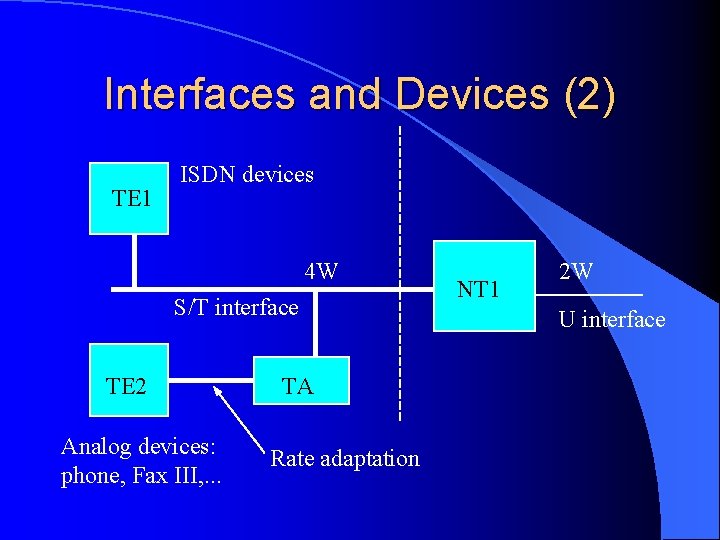
Interfaces and Devices (2) TE 1 ISDN devices 4 W S/T interface TE 2 Analog devices: phone, Fax III, . . . TA Rate adaptation NT 1 2 W U interface
ISDN Access Servers (1) l Digital modems (accepting analog and ISDN calls) – software busy-out feature 56 kbit/s technologies l Rate adaptation (V. 110, V. 120, . . ) l Compression (Stack, . . ) l Synchronous PPP (with CHAP/PAP authentication) l
ISDN Access Servers (2) l l PPP Multilink BACP (Bandwidth Allocation Control Protocol) l l l Controlling the number of B-channels per user D-channel based callback CLIP - Caller Line Identification Presentation
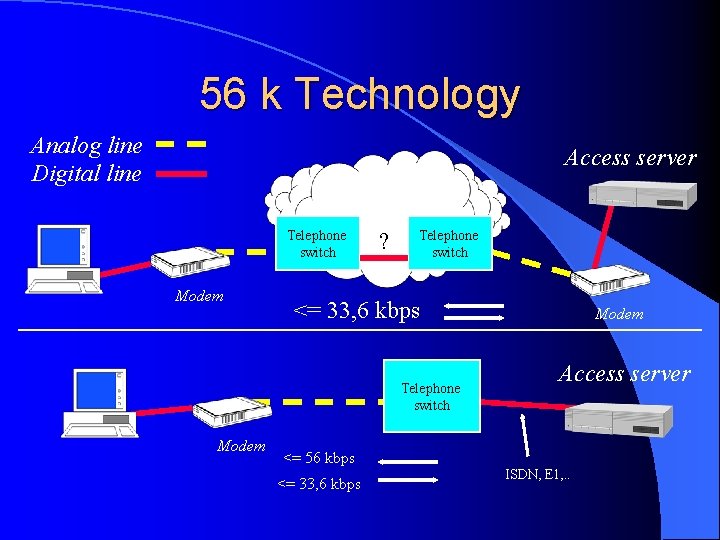
56 k Technology Analog line Digital line Access server Telephone switch Modem ? Telephone switch <= 33, 6 kbps Telephone switch Modem Access server <= 56 kbps <= 33, 6 kbps ISDN, E 1, . .
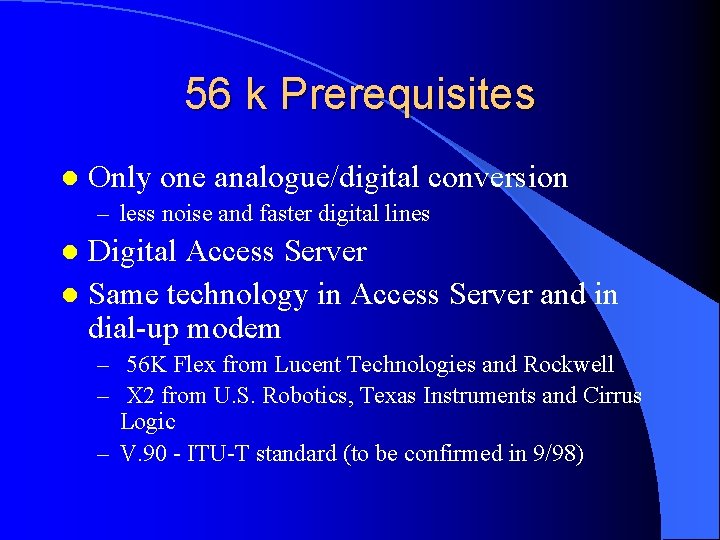
56 k Prerequisites l Only one analogue/digital conversion – less noise and faster digital lines Digital Access Server l Same technology in Access Server and in dial-up modem l – 56 K Flex from Lucent Technologies and Rockwell – X 2 from U. S. Robotics, Texas Instruments and Cirrus Logic – V. 90 - ITU-T standard (to be confirmed in 9/98)
56 k Considerations l 56 k not reached in reality – 45 kbps practical maximum l Cost for upgrading equipment to ITU-T standard
Using ISDN for IP Data Networks (1) l Characteristics – Speed – Fast call setup – Bandwidth on Demand
Using ISDN for IP Data Networks (2) l Modes of Usage – – Dial Up (LAN or host) Bandwidth on Demand Backup lines Permanent connections
Dial Up l Providers need: – subscribe for PRI connections or multiple BRI connections – ISDN Access Server
Dial Up l Users need for host connections: – subscribe for BRI connection – ISDN Adapter l Users need for LAN connections – subscribe for PRI or BRI connection – ISDN router (commercial, PC version with ISDN Adapter, . . )
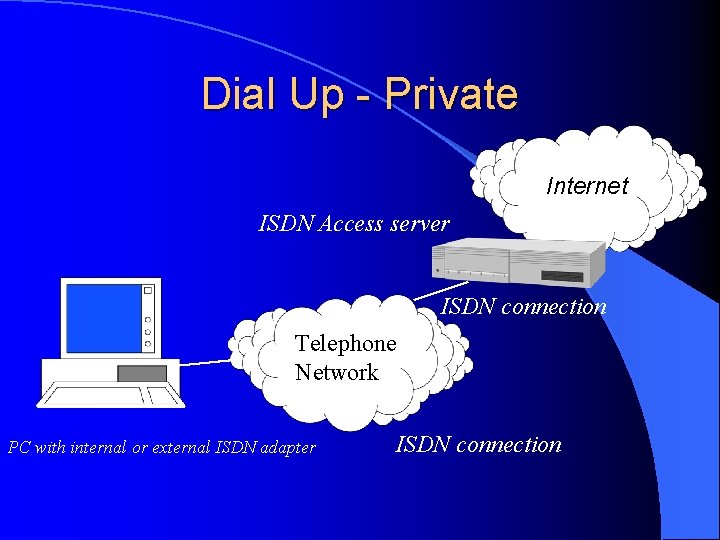
Dial Up - Private Internet ISDN Access server ISDN connection Telephone Network PC with internal or external ISDN adapter ISDN connection
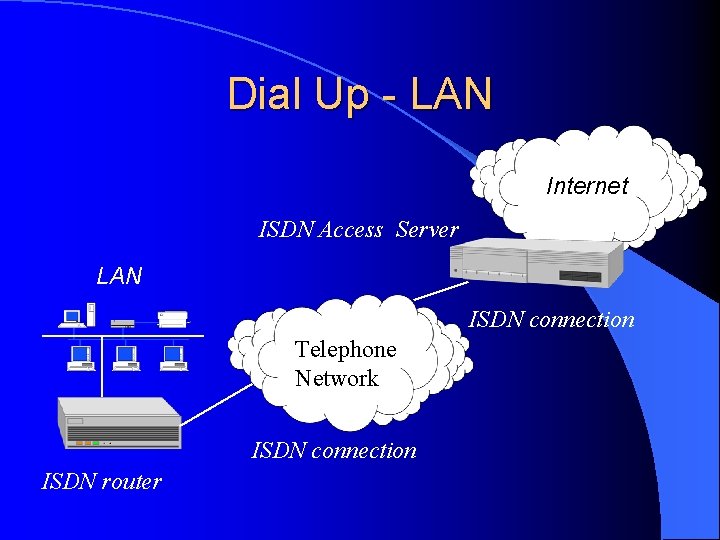
Dial Up - LAN Internet ISDN Access Server LAN ISDN connection Telephone Network ISDN connection ISDN router
ISDN Adapters Internal/external l Active/passive (for internal) l Integrated NT l Plug for telephone line l Integrated modem l Synchronous PPP (with CHAP/PAP authentication) l
ISDN Adapters 2 PPP Multilink l Rate adaption (V. 110, V. 120, . . ) l CAPI l Compression (Stac, …) l
ISDN Routers l l l l Integrated NT Plug for telephone line Integrated modem Synchronous PPP (with CHAP/PAP authentication) PPP Multilink Compression (Stac, …) Tariff management
Bandwidth on Demand Router to router connections l ISDN call setup when leased line overloaded l
Backup lines Router to router connections l ISDN call setup when leased line fails l
Equipment l ALL EQUIPMENT COMPATIBLE with existing national ISDN services – Test new equipment first
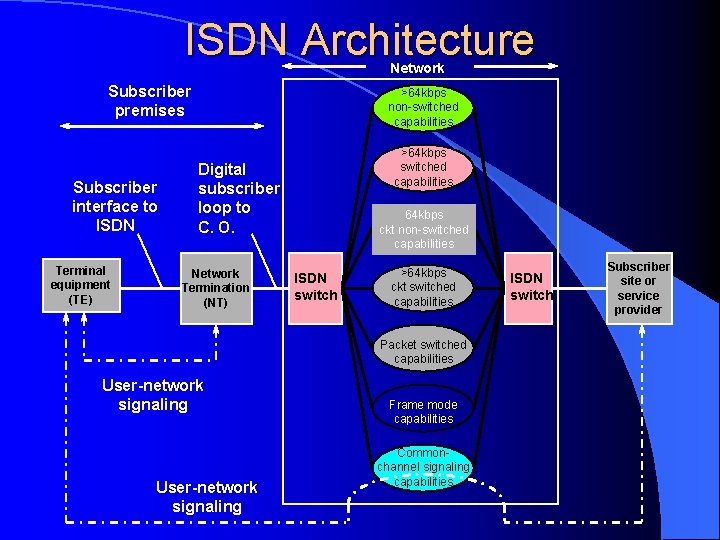
ISDN Architecture Network Subscriber premises Subscriber interface to ISDN Terminal equipment (TE) >64 kbps non-switched capabilities >64 kbps switched capabilities Digital subscriber loop to C. O. Network Termination (NT) 64 kbps ckt non-switched capabilities ISDN switch >64 kbps ckt switched capabilities Packet switched capabilities User-network signaling Frame mode capabilities Commonchannel signaling capabilities ISDN switch Subscriber site or service provider
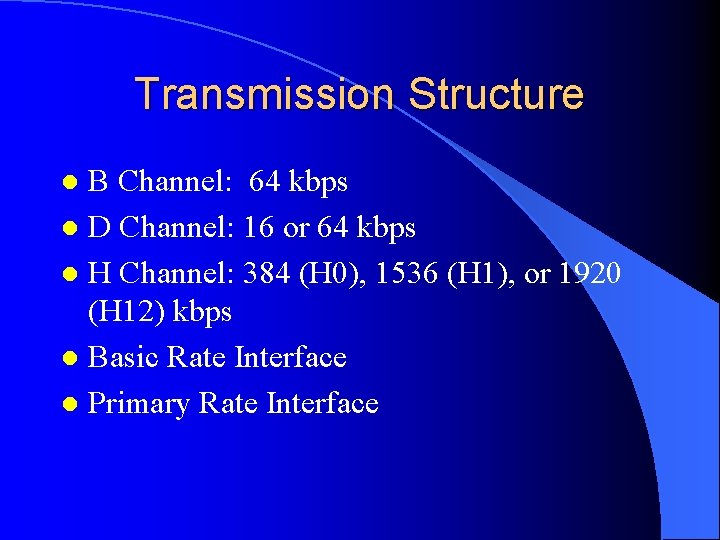
Transmission Structure B Channel: 64 kbps l D Channel: 16 or 64 kbps l H Channel: 384 (H 0), 1536 (H 1), or 1920 (H 12) kbps l Basic Rate Interface l Primary Rate Interface l
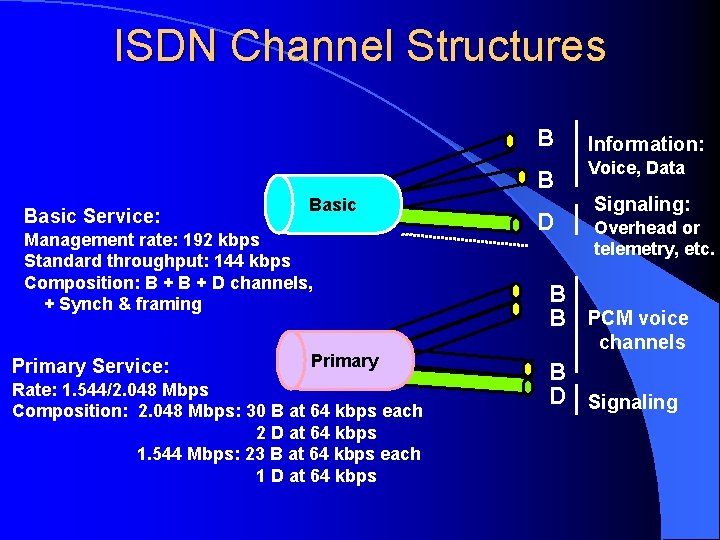
ISDN Channel Structures B B Basic Service: Basic Management rate: 192 kbps Standard throughput: 144 kbps Composition: B + D channels, + Synch & framing Primary Service: Primary Rate: 1. 544/2. 048 Mbps Composition: 2. 048 Mbps: 30 B at 64 kbps each 2 D at 64 kbps 1. 544 Mbps: 23 B at 64 kbps each 1 D at 64 kbps D Information: Voice, Data Signaling: Overhead or telemetry, etc. B B PCM voice channels B D Signaling
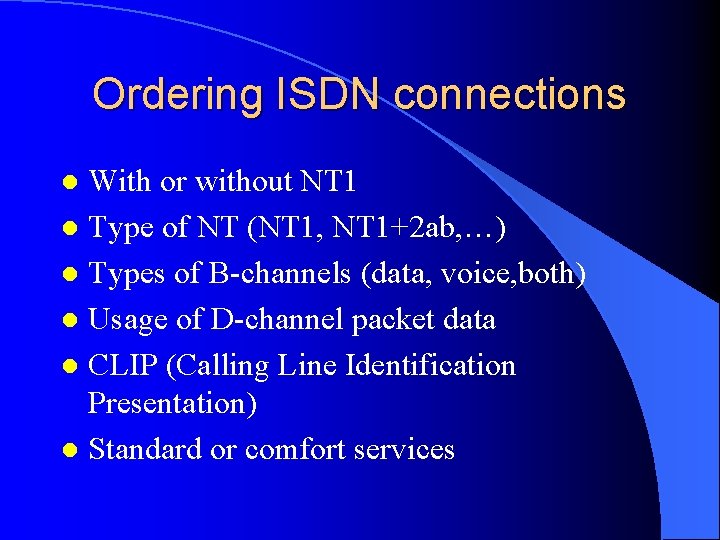
Ordering ISDN connections With or without NT 1 l Type of NT (NT 1, NT 1+2 ab, …) l Types of B-channels (data, voice, both) l Usage of D-channel packet data l CLIP (Calling Line Identification Presentation) l Standard or comfort services l
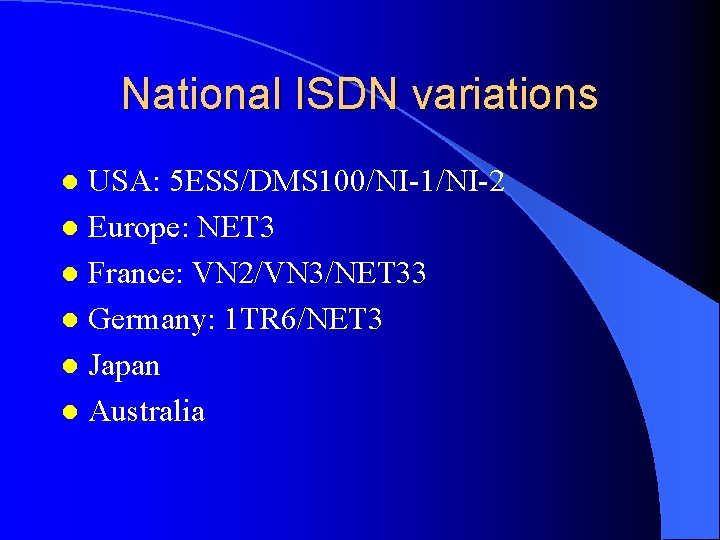
National ISDN variations USA: 5 ESS/DMS 100/NI-1/NI-2 l Europe: NET 3 l France: VN 2/VN 3/NET 33 l Germany: 1 TR 6/NET 3 l Japan l Australia l
References - URL’s l l l http: //www. alumni. caltech. edu/~dank/isdn/ for RFCs: http: //www. alumni. caltech. edu/~dank/isdn_ai. html#RFCS http: //www. data. com http: //www. pacbell. com/products/business/fastrak/ networking/isdn/info/isdn-guide http: //www. adtran. com/support/isu/mpfaq. html
- Slides: 33