
Introduction to International Investment Arbitration Conway Blake 10
Introduction to International Investment Arbitration Conway Blake 10 September 2019
Overview • History and Background of Investment Arbitration • Basic Structure of an Investment Treaty • Dispute Resolution • Investment Arbitration & Africa 2
History and Background of Investment Arbitration 3
Origins of Investment Protection • Early communities: foreign investors had no rights or legal capacity • Beginning of the modern era: protection of foreign investors’ rights to travel and trade • 19 th century: diplomatic protection • Throughout history there has been concern about fair treatment of foreign investors in domestic courts 4
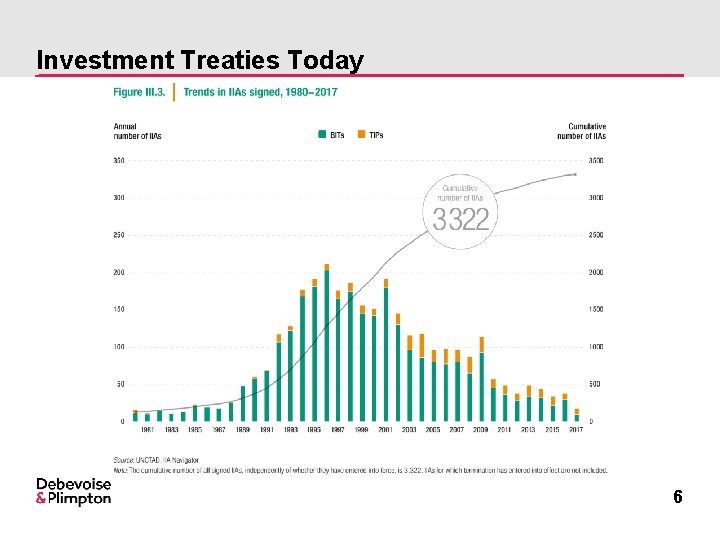
Developments After World War II • 1959: First bilateral investment treaty (“BIT”) between Germany and Pakistan (State-State dispute resolution mechanism) • 1965: Establishment of ICSID • 1981: Algiers Accords • 1990 s: Exponential increase of international investment agreements. Modern investment treaties (i) codify standards of protection and (ii) provide clear dispute resolution mechanisms 5
Investment Treaties Today 6
Basic Structure of an Investment Treaty 7
Scope of Bilateral Investment Treaties • In general, BITs cover investments by an investor of one country in the territory of the other country • The purpose of BITs is the promotion and protection of foreign investments • What is protected? – “Investment” is usually broadly defined to include any kind of asset – E. g. in the oil & gas field, for example, exploration and production rights qualify as “investments” 8
Scope of Bilateral Investment Treaties • Who is typically protected? – “Investor of a Contracting State” is usually defined to include: § Individuals who are nationals of the State; and § Companies organized under the laws of the State – Direct and indirect investors, even minority shareholders – Locally incorporated entities 9
What Legal Protections are Commonly Provided? • No Expropriation without Adequate Compensation • Fair and Equitable Treatment • Full Protection and Security • No Arbitrary or Discriminatory Measures • Most-Favored-Nation Treatment • National Treatment • Umbrella Clauses 10
Protection: No Expropriation without Compensation • A host State has the right to expropriate if the measure: – serves a public purpose; – is not discriminatory; and – is accompanied by prompt, adequate and effective compensation. • Expropriation can be ‘direct’ or ‘indirect’: – Von Pezold & Others v Republic of Zimbabwe, ICSID Case No. ARB/10/15. – Goetz v Burundi II, ICSID Case No ARB/01/2 (2001). 11
Protection: Fair and Equitable Treatment (FET) • The standard implies good faith, transparency, consistency and nondiscrimination. • Biwater Gauff v Tanzania ICSID Case No. ARB/05/22: “the purpose of the [FET] standard is to provide to international investments treatment that does not affect the basic expectations that were taken into account by the foreign investor to make the investment, as long as these expectations are reasonable and legitimate and have been relied upon by the investor to make the investment”. • Often, actions that amount to unlawful expropriation will also be considered a violation of FET, as was the case in Biwater Gauff – Occupation of the investor’s offices, revocation of tax exemptions previously granted to the investor, and deportation of the investor’s staff amounted to expropriation and a violation of FET. 12
Protection: Full Protection and Security • Host States have an obligation to take measures to protect certain investors and investments from negative actions that may affect those investors/investments. • Implies a State’s guarantee of stability in a secure environment (physical, commercial and legal). – American Manufacturing v DRC, ICSID Case No. ARB/93/1: investor’s commercial premises had been destroyed by soldiers of Congolese army. Tribunal found DRC responsible as it had failed to take any measure whatsoever to protect and secure the investment. 13
Dispute Resolution (ISDS) 14
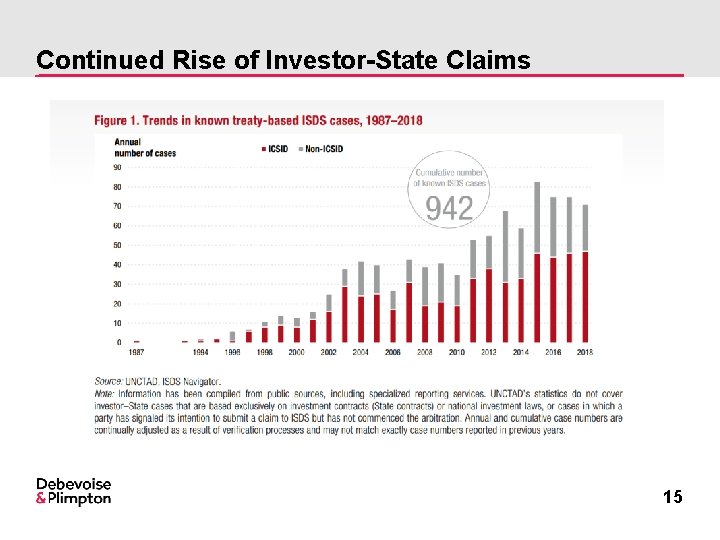
Continued Rise of Investor-State Claims 15
The Fundamental Requirement: Sources of Consent to Investment Arbitration • Treaties concluded between two or more States – Majority of BITs express consent on the part of the two contracting States to submit to an arbitral forum disputes that may arise for the benefit of nationals of the other State party to the treaty. – An investor is thus empowered to initiate arbitration proceedings against the State. • Local investment laws • Contracts (between the State and the investor) 16
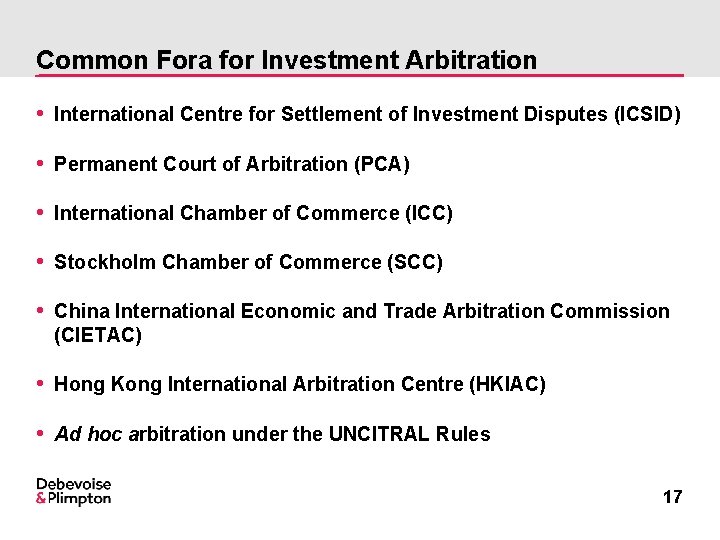
Common Fora for Investment Arbitration • International Centre for Settlement of Investment Disputes (ICSID) • Permanent Court of Arbitration (PCA) • International Chamber of Commerce (ICC) • Stockholm Chamber of Commerce (SCC) • China International Economic and Trade Arbitration Commission (CIETAC) • Hong Kong International Arbitration Centre (HKIAC) • Ad hoc arbitration under the UNCITRAL Rules 17
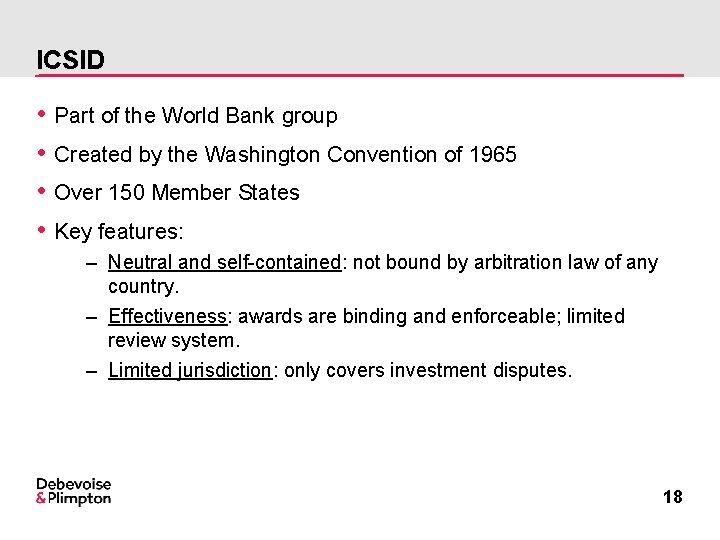
ICSID • • Part of the World Bank group Created by the Washington Convention of 1965 Over 150 Member States Key features: – Neutral and self-contained: not bound by arbitration law of any country. – Effectiveness: awards are binding and enforceable; limited review system. – Limited jurisdiction: only covers investment disputes. 18
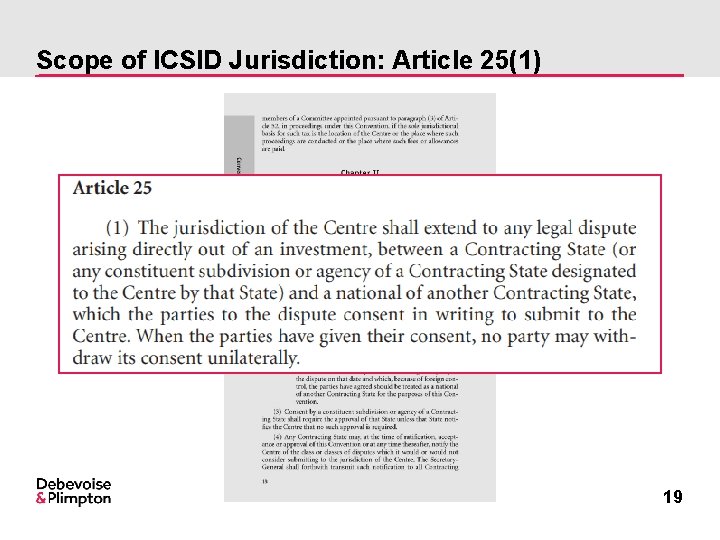
Scope of ICSID Jurisdiction: Article 25(1) 19
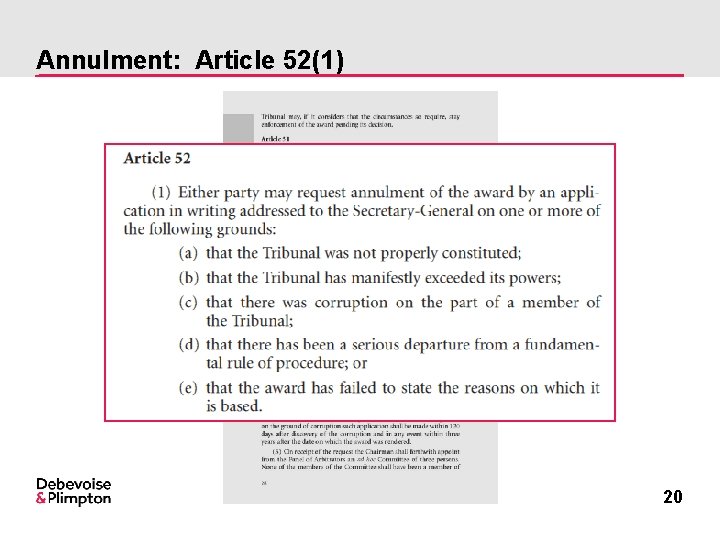
Annulment: Article 52(1) 20
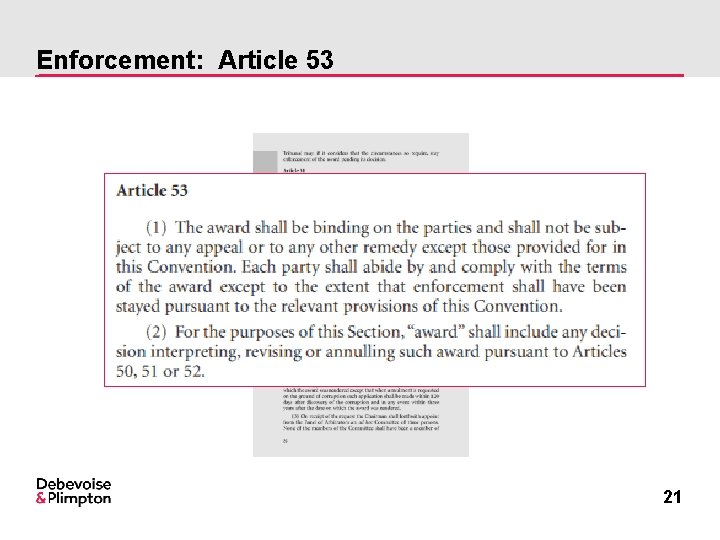
Enforcement: Article 53 21
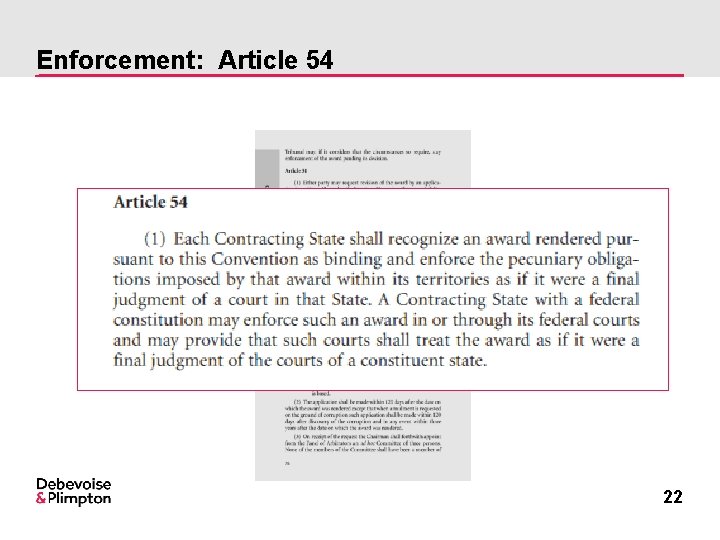
Enforcement: Article 54 22
Arbitration under the UNCITRAL Rules • Investor-state arbitration can also be conducted under the UNCITRAL Rules – 1976 – 2010 – 2013 (which incorporates the UNCITRAL Rules on Transparency for Treaty-based Investor-State Arbitration) • Several of the above mentioned institutions are able to administer arbitrations under the UNCITRAL Rules (e. g. , PCA, SCC, CIETAC, HKIAC) 23
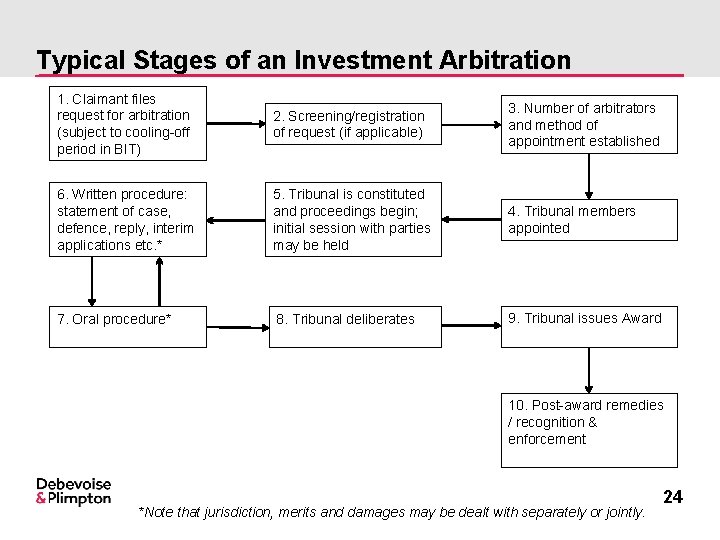
Typical Stages of an Investment Arbitration 1. Claimant files request for arbitration (subject to cooling-off period in BIT) 2. Screening/registration of request (if applicable) 3. Number of arbitrators and method of appointment established 6. Written procedure: statement of case, defence, reply, interim applications etc. * 5. Tribunal is constituted and proceedings begin; initial session with parties may be held 4. Tribunal members appointed 7. Oral procedure* 8. Tribunal deliberates 9. Tribunal issues Award 10. Post-award remedies / recognition & enforcement *Note that jurisdiction, merits and damages may be dealt with separately or jointly. 24
Investment Treaties & Africa 25
African Nations’ Investment Treaty Practice • African nations are currently party to 521 BITs that are in force (with a further approx. 450 that are not in force). • BITs can contain a variety of dispute resolution provisions: – Finland–Republic of Nigeria BIT: contains one provision permitting submission of dispute to local courts, an ICSID tribunal, or constitution of an ad hoc arbitration under UNCITRAL Rules. – Contrast with Canada–Republic of Guinea BIT (2015): contains 11 separate provisions setting out a detailed dispute resolution process. 26
A New Generation of African BITs? • Increasing focus on striking improved balance between interests of States and of investors; and on promotion of sustainable development: – recognition that parties should not compromise health, safety, or environmental standards to attract foreign investments, as in e. g. Cameroon–Canada BIT; – Obligations placed on investors to the effect that investors should strive to make “maximum feasible contributions to sustainable development” of the host State and local communities, e. g. in Morocco-Nigeria BIT. 27
Movement away from BITs? • Recently, African states have been reluctant to ratify new BITs – only 25 have come into force in the last 5 years. • Since 2008, South Africa has suspended negotiation of new BITs with non-African states and terminated a number of BITs with such states. • But cf. with the introduction of the SADC Model BIT in 2012. 28
The Belt and Road Initiative and Potential Disputes • Given the amount of investments and projects being made in relation to the BRI, disputes will be inevitable. • Disputes may arise in relation to the project itself, disputes between shareholders of joint-ventures, or the broader political environment (e. g. political instability, changes in regulations). • As many of the BRI investments would involve parties from different jurisdictions and legal backgrounds, arbitration may be the most natural and neutral mode of dispute resolution. 29

Questions? 30
Useful Sources • UNCTAD Investment Policy Hub (https: //investmentpolicy. unctad. org/international-investmentagreements) • ICSID website (https: //icsid. worldbank. org/en/) • italaw website (https: //www. italaw. com/) • Kluwer Arbitration (subscription needed http: //www. kluwerarbitration. com/) • Investor-State Law Guide (subscription needed https: //www. investorstatelawguide. com/) 31

Bios 32
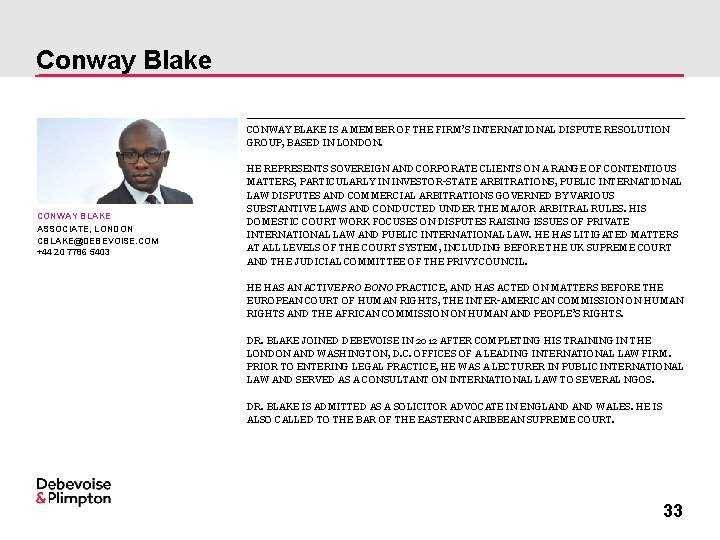
Conway Blake CONWAY BLAKE IS A MEMBER OF THE FIRM’S INTERNATIONAL DISPUTE RESOLUTION GROUP, BASED IN LONDON. CONWAY BLAKE ASSOCIATE, LONDON CBLAKE@DEBEVOISE. COM +44 20 7786 5403 HE REPRESENTS SOVEREIGN AND CORPORATE CLIENTS ON A RANGE OF CONTENTIOUS MATTERS, PARTICULARLY IN INVESTOR-STATE ARBITRATIONS, PUBLIC INTERNATIONAL LAW DISPUTES AND COMMERCIAL ARBITRATIONS GOVERNED BY VARIOUS SUBSTANTIVE LAWS AND CONDUCTED UNDER THE MAJOR ARBITRAL RULES. HIS DOMESTIC COURT WORK FOCUSES ON DISPUTES RAISING ISSUES OF PRIVATE INTERNATIONAL LAW AND PUBLIC INTERNATIONAL LAW. HE HAS LITIGATED MATTERS AT ALL LEVELS OF THE COURT SYSTEM, INCLUDING BEFORE THE UK SUPREME COURT AND THE JUDICIAL COMMITTEE OF THE PRIVY COUNCIL. HE HAS AN ACTIVE PRO BONO PRACTICE, AND HAS ACTED ON MATTERS BEFORE THE EUROPEAN COURT OF HUMAN RIGHTS, THE INTER-AMERICAN COMMISSION ON HUMAN RIGHTS AND THE AFRICAN COMMISSION ON HUMAN AND PEOPLE’S RIGHTS. DR. BLAKE JOINED DEBEVOISE IN 2012 AFTER COMPLETING HIS TRAINING IN THE LONDON AND WASHINGTON, D. C. OFFICES OF A LEADING INTERNATIONAL LAW FIRM. PRIOR TO ENTERING LEGAL PRACTICE, HE WAS A LECTURER IN PUBLIC INTERNATIONAL LAW AND SERVED AS A CONSULTANT ON INTERNATIONAL LAW TO SEVERAL NGOS. DR. BLAKE IS ADMITTED AS A SOLICITOR ADVOCATE IN ENGLAND WALES. HE IS ALSO CALLED TO THE BAR OF THE EASTERN CARIBBEAN SUPREME COURT. 33

Thank you! 34
- Slides: 34