
Introduction to Intelligent Systems Engineering E 500 II


- Slides: 32
Introduction to Intelligent Systems Engineering E 500 – II Cyberinfrastructure Clouds HPC Edge Computing ` Geoffrey Fox, August 30, 2017 gcf@indiana. edu, http: //www. dsc. soic. indiana. edu/, http: //spidal. org/ Digital Science Center Department of Intelligent Systems Engineering School of Informatics, Computing, and Engineering Digital Science Center Indiana University Bloomington 8/30/2017 1
Abstract • There are two important types of convergence that will shape the near-term future of computing sciences. • The first is the convergence between HPC, Cloud, and Edge platforms for science. The focus of this presentation • The second is the integration between Simulations and Big Data applications. • We believe understanding these trends is not just a matter of idle speculation but is important in particular to conceptualize and design future computing platforms for Science. • The Twister 2 paper presents our analysis of the convergence between simulations and big-data applications as well as selected research about managing the convergence between HPC, Cloud, and Edge platforms. 8/30/2017 2
Important Trends I • Data gaining in importance compared to simulations • Data analysis techniques changing with old and new applications • All forms of IT increasing in importance; both data and simulations increasing • Internet of Things and Edge Computing growing in importance • Exascale initiative driving large supercomputers • Use of public clouds increasing rapidly • Clouds becoming diverse with subsystems containing GPU’s, FPGA’s, high performance networks, storage, memory … • They have economies of scale; hard to compete with • Serverless (server hidden) computing attractive to user: “No server is easier to manage than no server” 8/30/2017 3
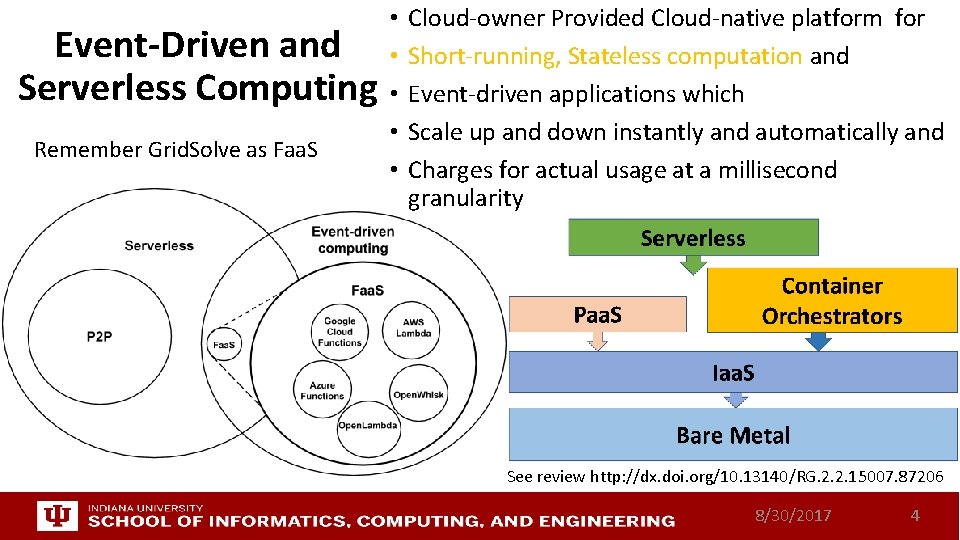
Event-Driven and Serverless Computing Remember Grid. Solve as Faa. S • • • Cloud-owner Provided Cloud-native platform for Short-running, Stateless computation and Event-driven applications which Scale up and down instantly and automatically and Charges for actual usage at a millisecond granularity See review http: //dx. doi. org/10. 13140/RG. 2. 2. 15007. 87206 8/30/2017 4
• Rich software stacks: Important Trends II • HPC for Parallel Computing • Apache for Big Data Software Stack ABDS including some edge computing (streaming data) • On general principles parallel and distributed computing have different requirements even if sometimes similar functionalities • Apache stack ABDS typically uses distributed computing concepts • For example, Reduce operation is different in MPI (Harp) and Spark • Big Data requirements are not clear but there a few key use types 1) Pleasingly parallel processing (including local machine learning LML) as of different tweets from different users with perhaps Map. Reduce style of statistics and visualizations; possibly Streaming 2) Database model with queries again supported by Map. Reduce for horizontal scaling 3) Global Machine Learning GML with single job using multiple nodes as classic parallel computing 4) Deep Learning certainly needs HPC – possibly only multiple small systems • Current workloads stress 1) and 2) and are suited to current clouds and to ABDS (no HPC) • This explains why Spark with poor GML performance is so successful 8/30/2017 5
Predictions/Assumptions • Supercomputers will be essential for large simulations and will run other applications • HPC Clouds or Next-Generation Commodity Systems will be a dominant force • Merge Cloud HPC and (support of) Edge computing • Clouds running in multiple giant datacenters offering all types of computing • Distributed data sources associated with device and Fog processing resources • Server-hidden computing for user pleasure • Support a distributed event-driven serverless dataflow computing model covering batch and streaming data • Needing parallel and distributed (Grid) computing ideas • Span Pleasingly Parallel to Data management to Global Machine Learning 8/30/2017 6
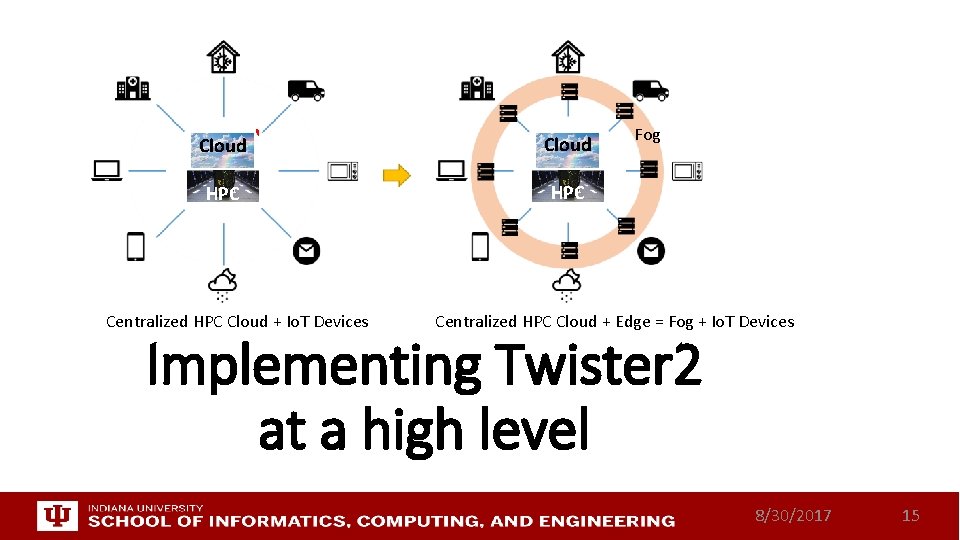
Convergence Points (Nexus) for HPC-Cloud-Edge- Big Data-Simulation • Nexus 1: Applications – Divide use cases into Data and Model and compare characteristics separately in these two components with 64 Convergence Diamonds (features) • Nexus 2: Software – High Performance Computing (HPC) Enhanced Big Data Stack HPC-ABDS. 21 Layers adding high performance runtime to Apache systems (Hadoop is fast!). Establish principles to get good performance from Java or C programming languages • Nexus 3: Hardware – Use Serverless Infrastructure as a Service Iaa. S and Dev. Ops (HPCCloud 2. 0) to automate deployment of event-driven software defined systems on hardware designed for functionality and performance e. g. appropriate disks, interconnect, memory • Deliver Solutions (wisdom) as a Service HPCCloud 3. 0 8/30/2017 7
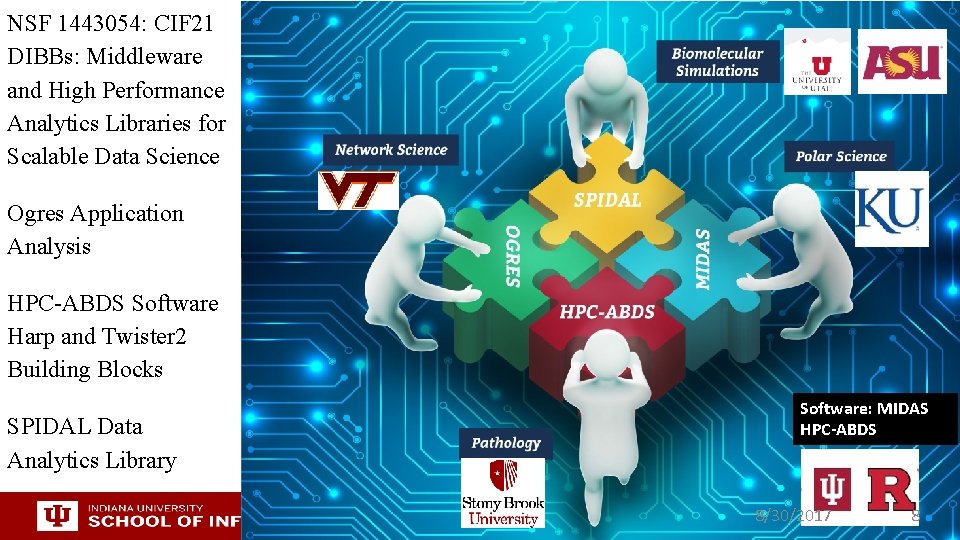
NSF 1443054: CIF 21 DIBBs: Middleware and High Performance Analytics Libraries for Scalable Data Science Ogres Application Analysis HPC-ABDS Software Harp and Twister 2 Building Blocks SPIDAL Data Analytics Library Software: MIDAS HPC-ABDS 8/30/2017 8
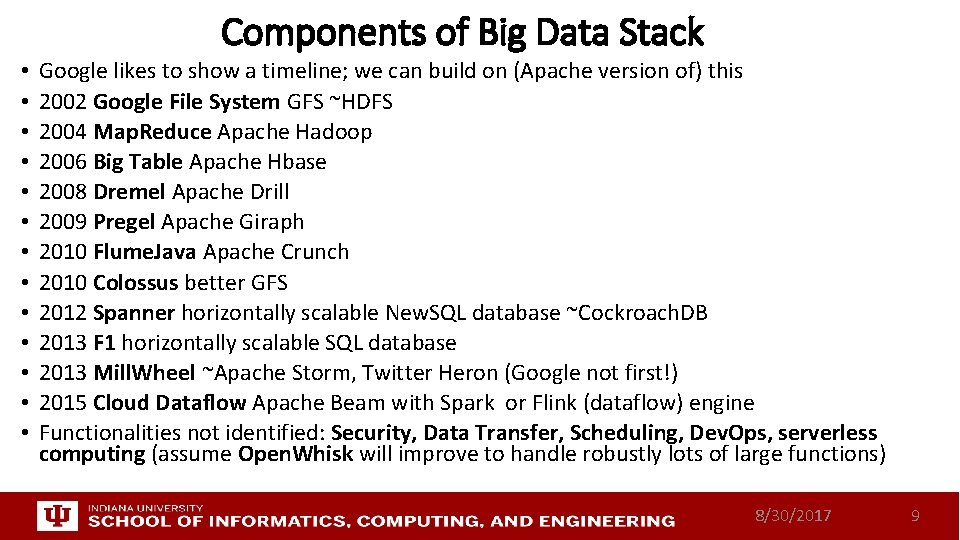
Components of Big Data Stack • • • • Google likes to show a timeline; we can build on (Apache version of) this 2002 Google File System GFS ~HDFS 2004 Map. Reduce Apache Hadoop 2006 Big Table Apache Hbase 2008 Dremel Apache Drill 2009 Pregel Apache Giraph 2010 Flume. Java Apache Crunch 2010 Colossus better GFS 2012 Spanner horizontally scalable New. SQL database ~Cockroach. DB 2013 F 1 horizontally scalable SQL database 2013 Mill. Wheel ~Apache Storm, Twitter Heron (Google not first!) 2015 Cloud Dataflow Apache Beam with Spark or Flink (dataflow) engine Functionalities not identified: Security, Data Transfer, Scheduling, Dev. Ops, serverless computing (assume Open. Whisk will improve to handle robustly lots of large functions) 8/30/2017 9
HPC-ABDS Integrated wide range of HPC and Big Data technologies. I gave up updating! 8/30/2017 10
64 Features in 4 views for Unified Classification of Big Data and Simulation Applications 41/51 Streaming 26/51 Pleasingly Parallel 25/51 Mapreduce 8/30/2017 11
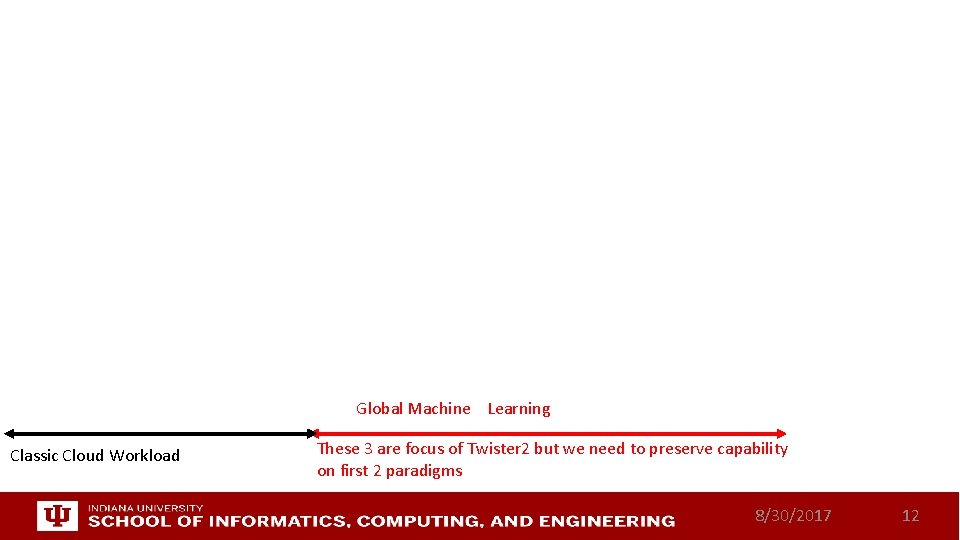
Global Machine Learning Classic Cloud Workload These 3 are focus of Twister 2 but we need to preserve capability on first 2 paradigms 8/30/2017 12
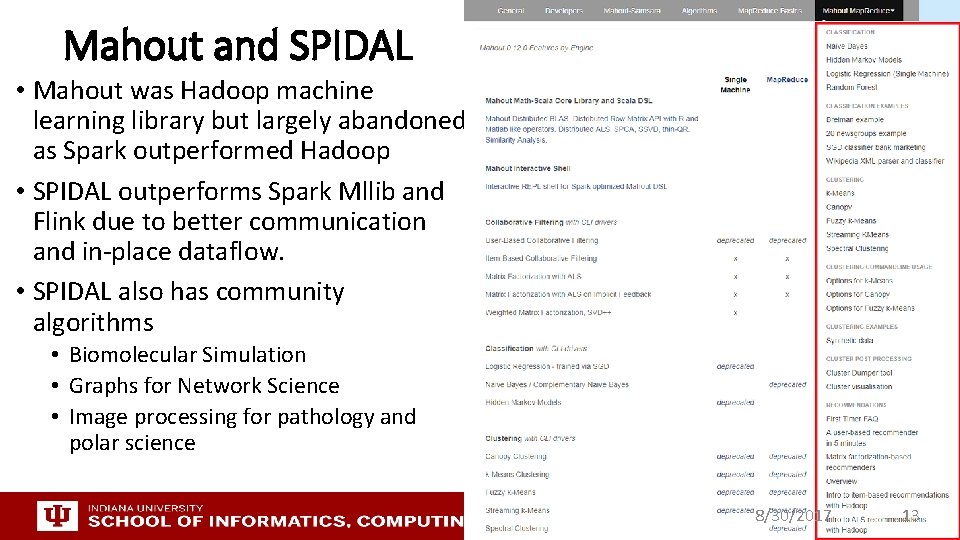
Mahout and SPIDAL • Mahout was Hadoop machine learning library but largely abandoned as Spark outperformed Hadoop • SPIDAL outperforms Spark Mllib and Flink due to better communication and in-place dataflow. • SPIDAL also has community algorithms • Biomolecular Simulation • Graphs for Network Science • Image processing for pathology and polar science 8/30/2017 13
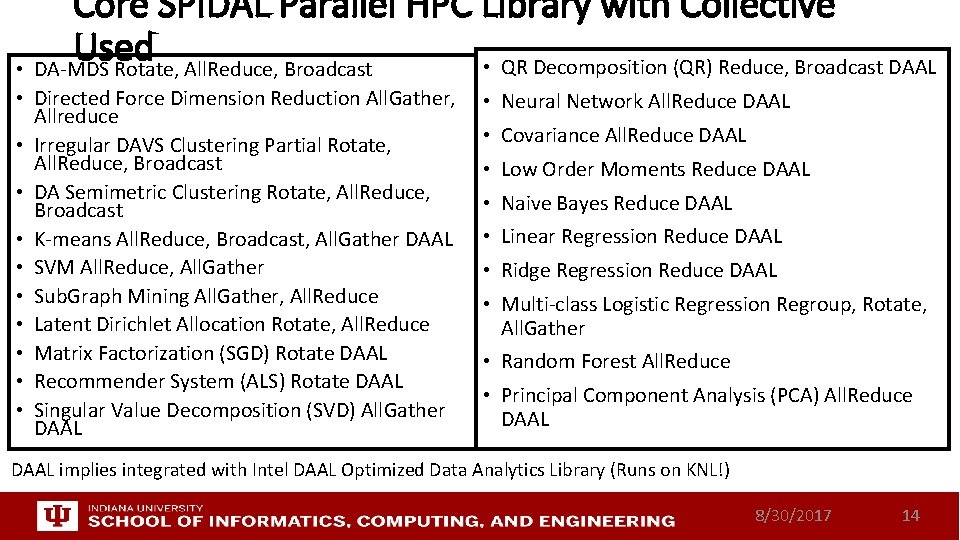
Core SPIDAL Parallel HPC Library with Collective Used • QR Decomposition (QR) Reduce, Broadcast DAAL • DA-MDS Rotate, All. Reduce, Broadcast • Directed Force Dimension Reduction All. Gather, Allreduce • Irregular DAVS Clustering Partial Rotate, All. Reduce, Broadcast • DA Semimetric Clustering Rotate, All. Reduce, Broadcast • K-means All. Reduce, Broadcast, All. Gather DAAL • SVM All. Reduce, All. Gather • Sub. Graph Mining All. Gather, All. Reduce • Latent Dirichlet Allocation Rotate, All. Reduce • Matrix Factorization (SGD) Rotate DAAL • Recommender System (ALS) Rotate DAAL • Singular Value Decomposition (SVD) All. Gather DAAL • Neural Network All. Reduce DAAL • Covariance All. Reduce DAAL • Low Order Moments Reduce DAAL • Naive Bayes Reduce DAAL • Linear Regression Reduce DAAL • Ridge Regression Reduce DAAL • Multi-class Logistic Regression Regroup, Rotate, All. Gather • Random Forest All. Reduce • Principal Component Analysis (PCA) All. Reduce DAAL implies integrated with Intel DAAL Optimized Data Analytics Library (Runs on KNL!) 8/30/2017 14
Cloud HPC HPC Centralized HPC Cloud + Io. T Devices Fog Centralized HPC Cloud + Edge = Fog + Io. T Devices Implementing Twister 2 at a high level 8/30/2017 15
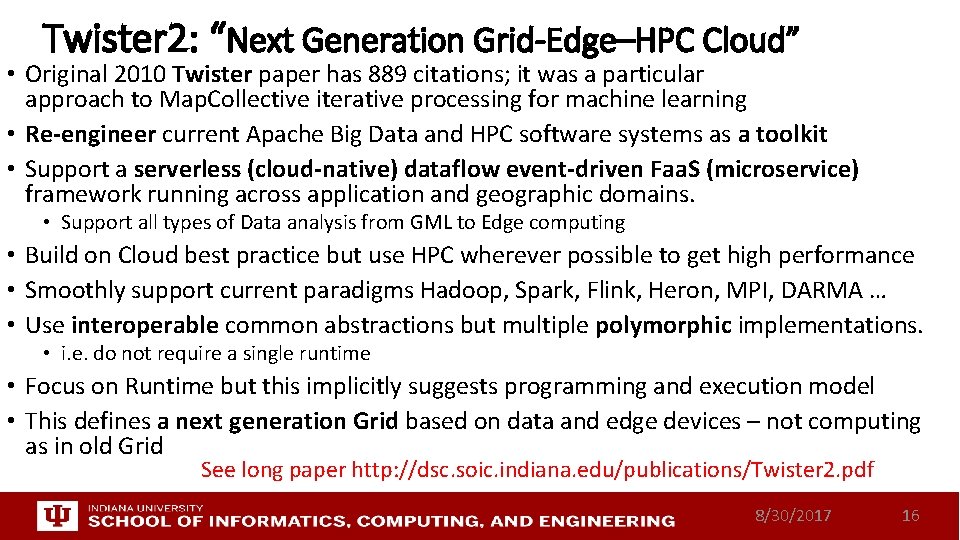
Twister 2: “Next Generation Grid-Edge–HPC Cloud” • Original 2010 Twister paper has 889 citations; it was a particular approach to Map. Collective iterative processing for machine learning • Re-engineer current Apache Big Data and HPC software systems as a toolkit • Support a serverless (cloud-native) dataflow event-driven Faa. S (microservice) framework running across application and geographic domains. • Support all types of Data analysis from GML to Edge computing • Build on Cloud best practice but use HPC wherever possible to get high performance • Smoothly support current paradigms Hadoop, Spark, Flink, Heron, MPI, DARMA … • Use interoperable common abstractions but multiple polymorphic implementations. • i. e. do not require a single runtime • Focus on Runtime but this implicitly suggests programming and execution model • This defines a next generation Grid based on data and edge devices – not computing as in old Grid See long paper http: //dsc. soic. indiana. edu/publications/Twister 2. pdf 8/30/2017 16
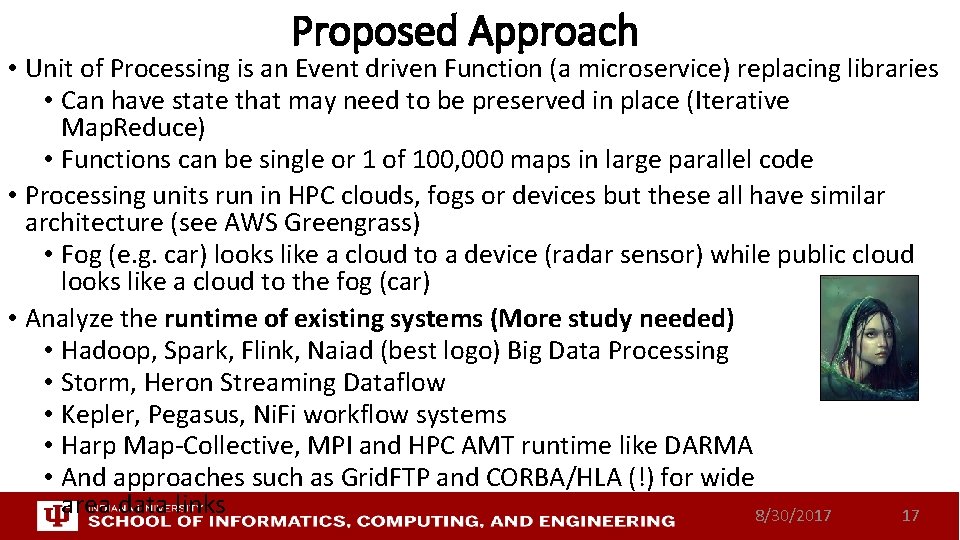
Proposed Approach • Unit of Processing is an Event driven Function (a microservice) replacing libraries • Can have state that may need to be preserved in place (Iterative Map. Reduce) • Functions can be single or 1 of 100, 000 maps in large parallel code • Processing units run in HPC clouds, fogs or devices but these all have similar architecture (see AWS Greengrass) • Fog (e. g. car) looks like a cloud to a device (radar sensor) while public cloud looks like a cloud to the fog (car) • Analyze the runtime of existing systems (More study needed) • Hadoop, Spark, Flink, Naiad (best logo) Big Data Processing • Storm, Heron Streaming Dataflow • Kepler, Pegasus, Ni. Fi workflow systems • Harp Map-Collective, MPI and HPC AMT runtime like DARMA • And approaches such as Grid. FTP and CORBA/HLA (!) for wide area data links 8/30/2017 17
Comparing Spark Flink and MPI On Global Machine Learning. Note this is not why Spark and Flink are successful 8/30/2017 18
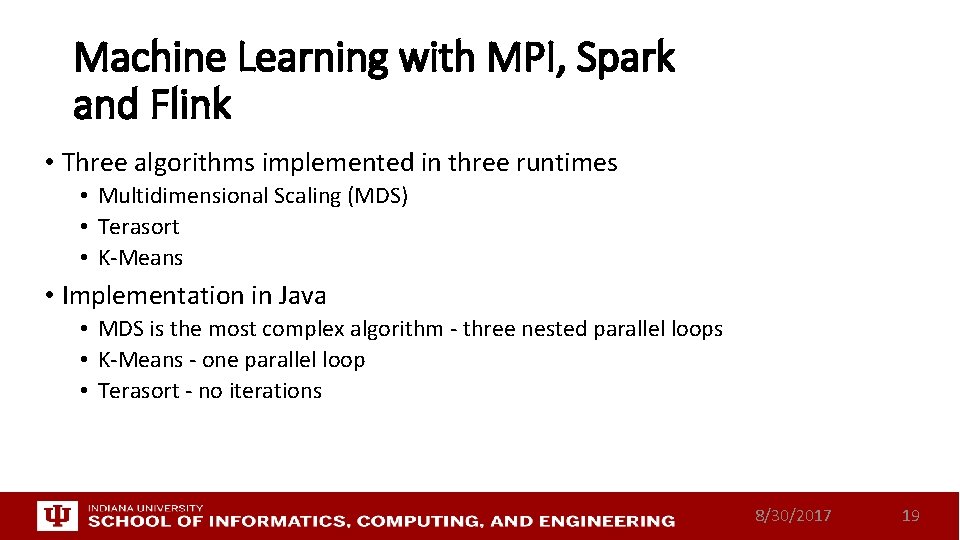
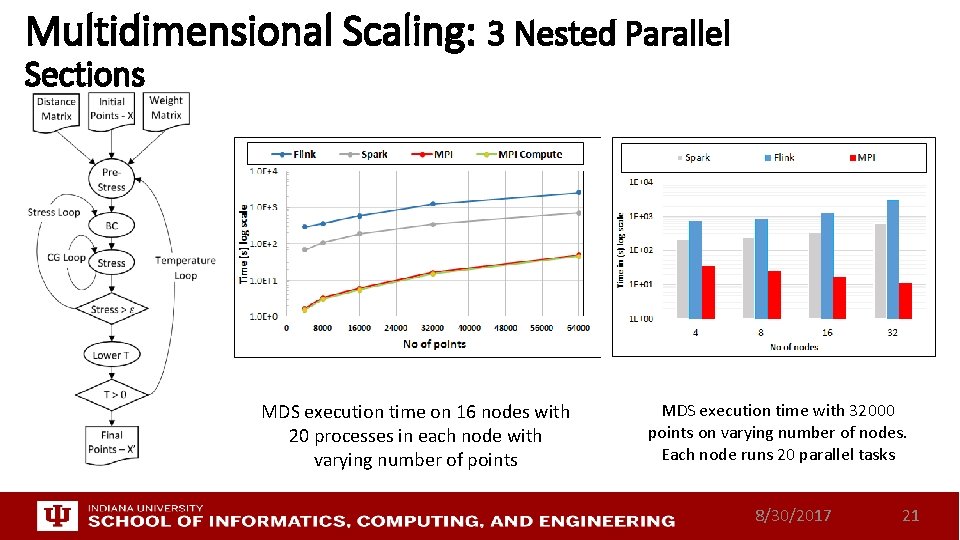
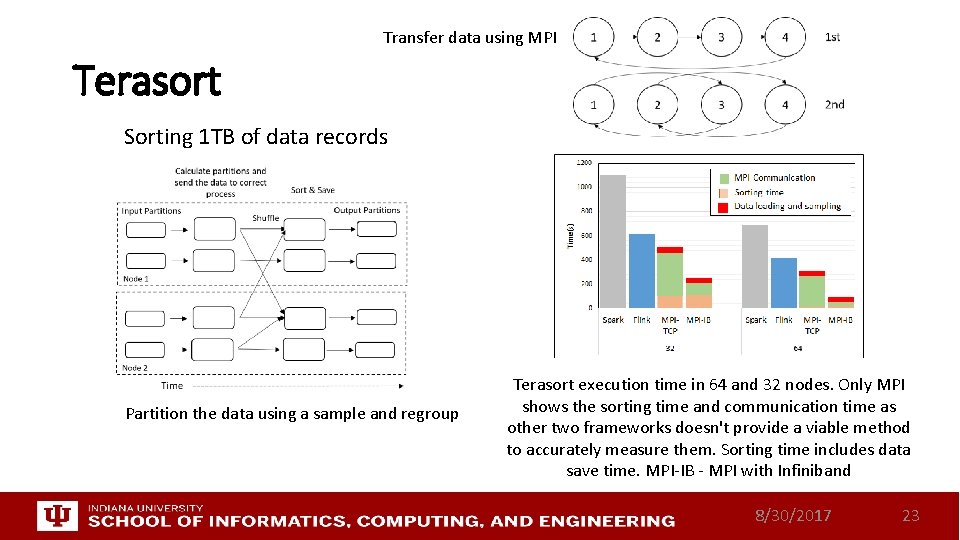
Machine Learning with MPI, Spark and Flink • Three algorithms implemented in three runtimes • Multidimensional Scaling (MDS) • Terasort • K-Means • Implementation in Java • MDS is the most complex algorithm - three nested parallel loops • K-Means - one parallel loop • Terasort - no iterations 8/30/2017 19
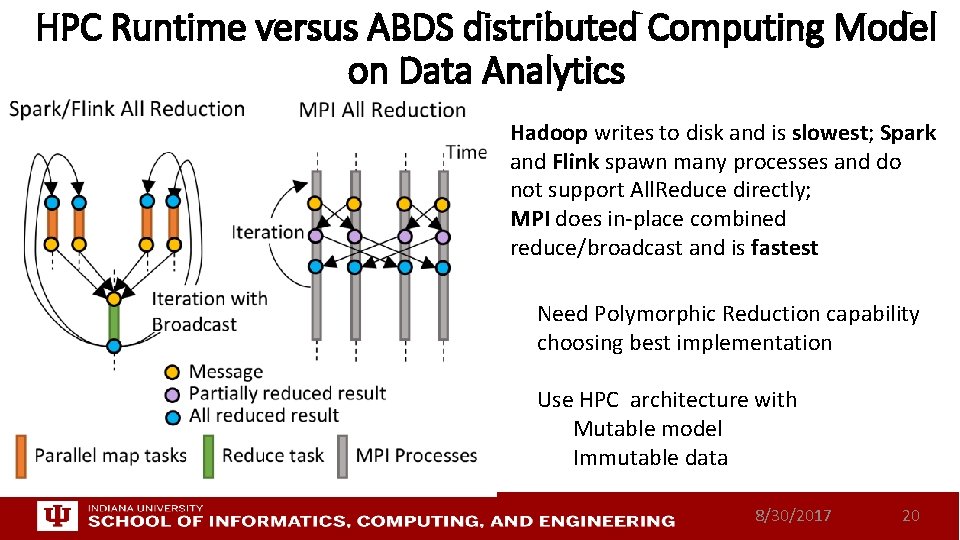
HPC Runtime versus ABDS distributed Computing Model on Data Analytics Hadoop writes to disk and is slowest; Spark and Flink spawn many processes and do not support All. Reduce directly; MPI does in-place combined reduce/broadcast and is fastest Need Polymorphic Reduction capability choosing best implementation Use HPC architecture with Mutable model Immutable data 8/30/2017 20
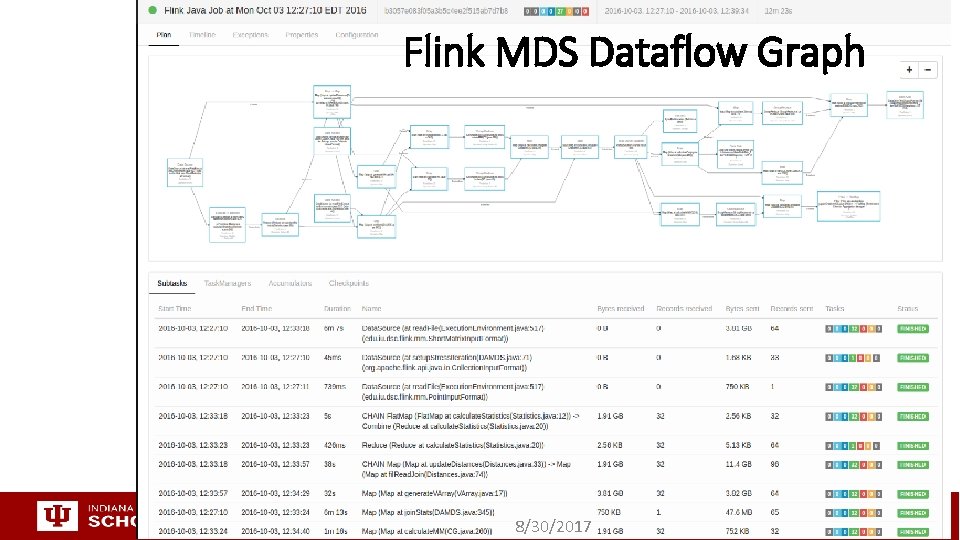
Multidimensional Scaling: 3 Nested Parallel Sections MDS execution time on 16 nodes with 20 processes in each node with varying number of points MDS execution time with 32000 points on varying number of nodes. Each node runs 20 parallel tasks 8/30/2017 21
Flink MDS Dataflow Graph 8/30/2017
Transfer data using MPI Terasort Sorting 1 TB of data records Partition the data using a sample and regroup Terasort execution time in 64 and 32 nodes. Only MPI shows the sorting time and communication time as other two frameworks doesn't provide a viable method to accurately measure them. Sorting time includes data save time. MPI-IB - MPI with Infiniband 8/30/2017 23
Implementing Twister 2 in detail 8/30/2017 24
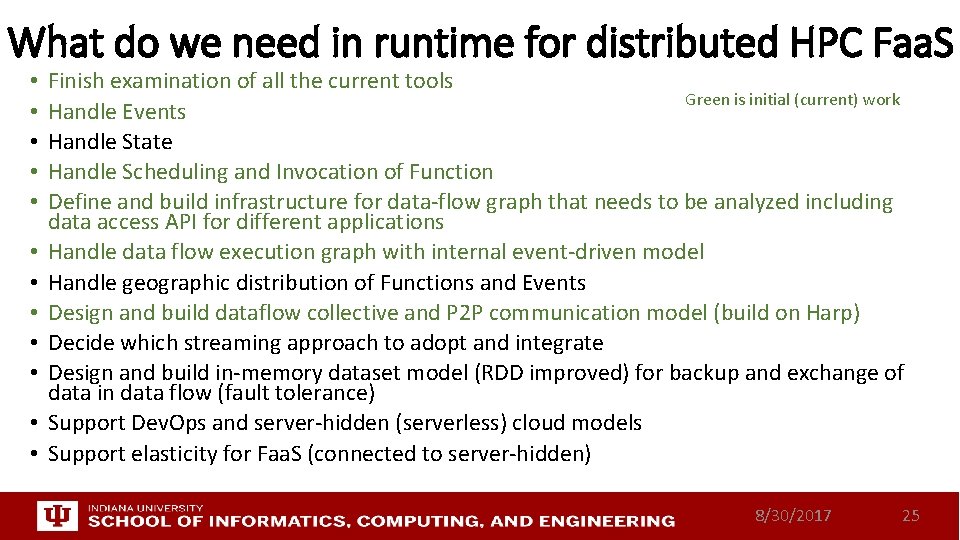
What do we need in runtime for distributed HPC Faa. S • • • Finish examination of all the current tools Green is initial (current) work Handle Events Handle State Handle Scheduling and Invocation of Function Define and build infrastructure for data-flow graph that needs to be analyzed including data access API for different applications Handle data flow execution graph with internal event-driven model Handle geographic distribution of Functions and Events Design and build dataflow collective and P 2 P communication model (build on Harp) Decide which streaming approach to adopt and integrate Design and build in-memory dataset model (RDD improved) for backup and exchange of data in data flow (fault tolerance) Support Dev. Ops and server-hidden (serverless) cloud models Support elasticity for Faa. S (connected to server-hidden) 8/30/2017 25
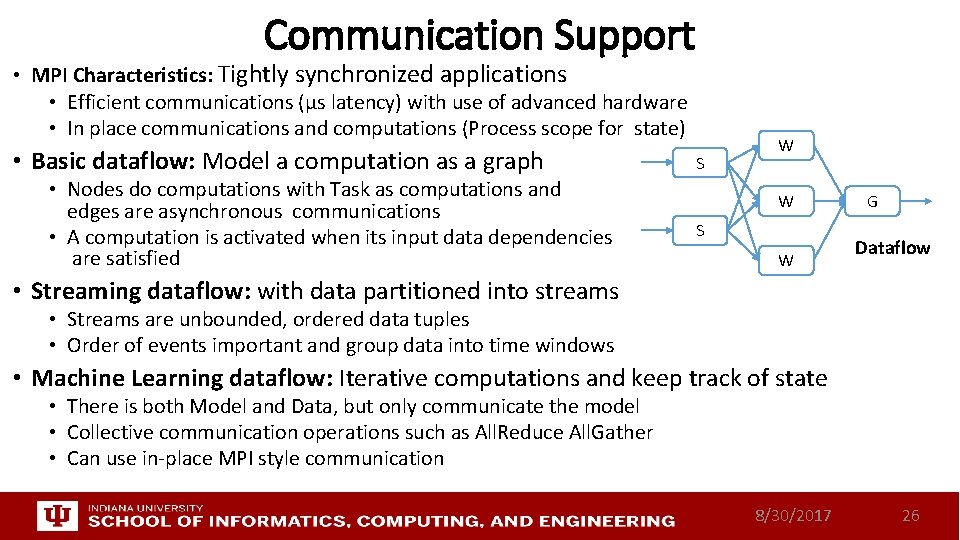
Communication Support • MPI Characteristics: Tightly synchronized applications • Efficient communications (µs latency) with use of advanced hardware • In place communications and computations (Process scope for state) • Basic dataflow: Model a computation as a graph • Nodes do computations with Task as computations and edges are asynchronous communications • A computation is activated when its input data dependencies are satisfied S W W S W G Dataflow • Streaming dataflow: with data partitioned into streams • Streams are unbounded, ordered data tuples • Order of events important and group data into time windows • Machine Learning dataflow: Iterative computations and keep track of state • There is both Model and Data, but only communicate the model • Collective communication operations such as All. Reduce All. Gather • Can use in-place MPI style communication 8/30/2017 26
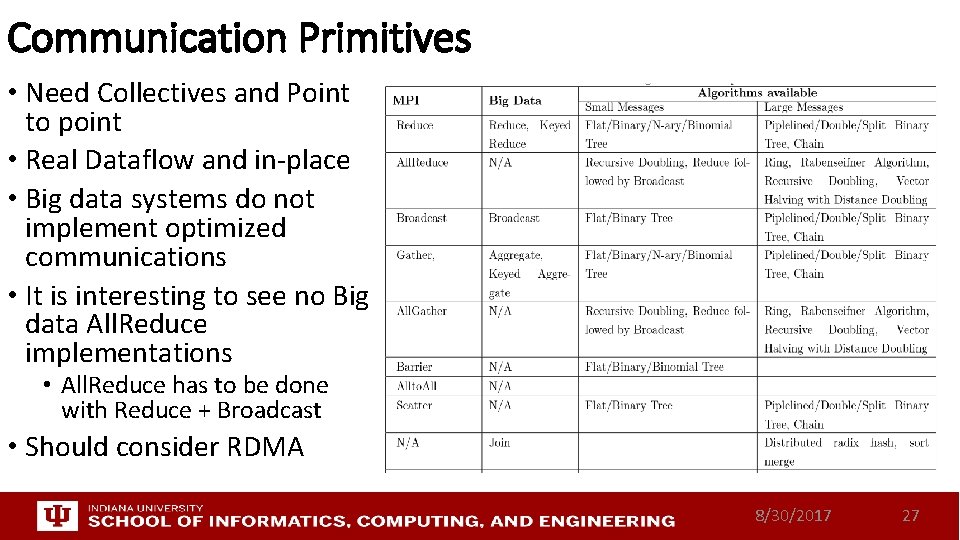
Communication Primitives • Need Collectives and Point to point • Real Dataflow and in-place • Big data systems do not implement optimized communications • It is interesting to see no Big data All. Reduce implementations • All. Reduce has to be done with Reduce + Broadcast • Should consider RDMA 8/30/2017 27
8/30/2017 28
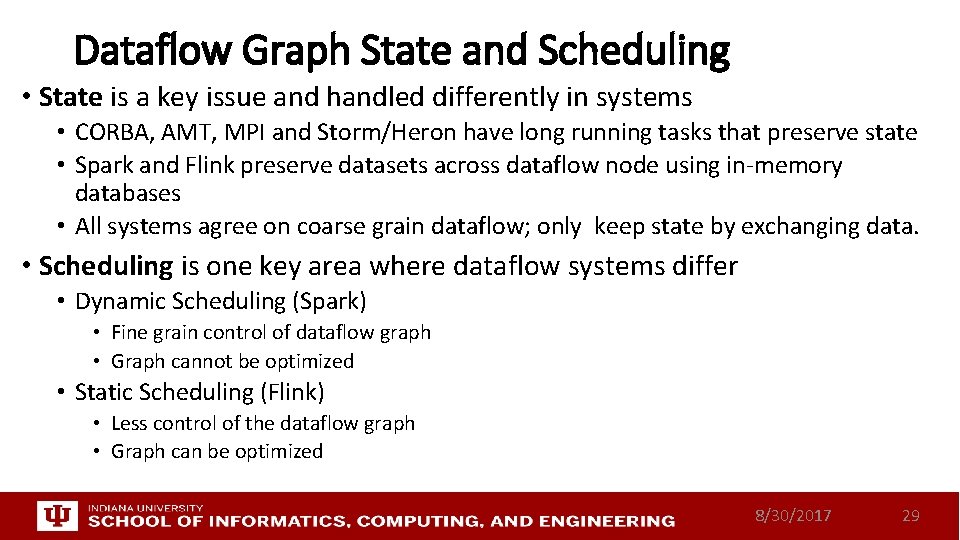
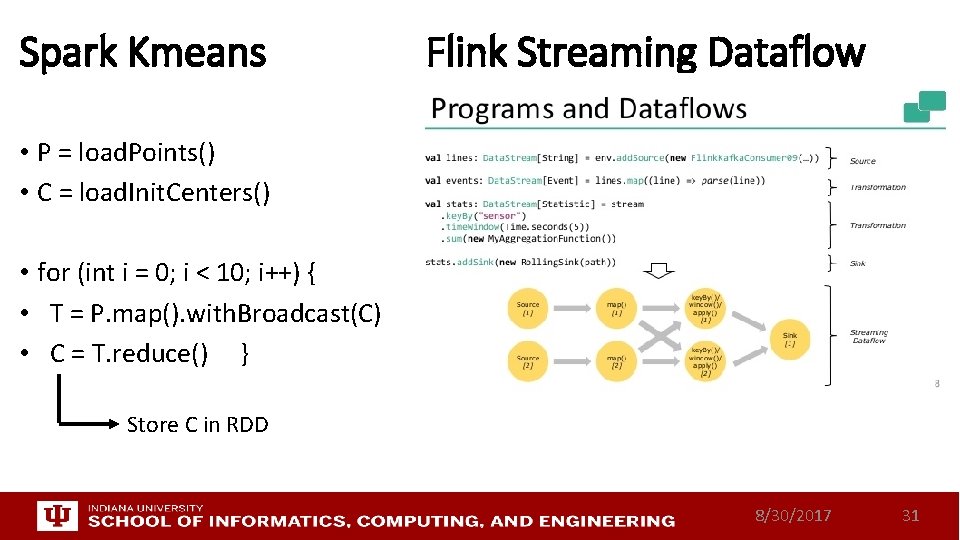
Dataflow Graph State and Scheduling • State is a key issue and handled differently in systems • CORBA, AMT, MPI and Storm/Heron have long running tasks that preserve state • Spark and Flink preserve datasets across dataflow node using in-memory databases • All systems agree on coarse grain dataflow; only keep state by exchanging data. • Scheduling is one key area where dataflow systems differ • Dynamic Scheduling (Spark) • Fine grain control of dataflow graph • Graph cannot be optimized • Static Scheduling (Flink) • Less control of the dataflow graph • Graph can be optimized 8/30/2017 29
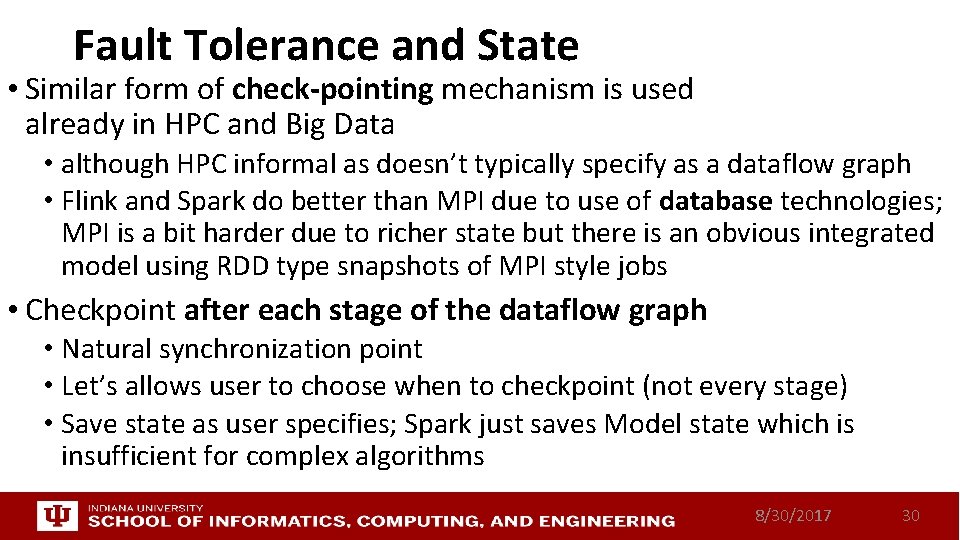
Fault Tolerance and State • Similar form of check-pointing mechanism is used already in HPC and Big Data • although HPC informal as doesn’t typically specify as a dataflow graph • Flink and Spark do better than MPI due to use of database technologies; MPI is a bit harder due to richer state but there is an obvious integrated model using RDD type snapshots of MPI style jobs • Checkpoint after each stage of the dataflow graph • Natural synchronization point • Let’s allows user to choose when to checkpoint (not every stage) • Save state as user specifies; Spark just saves Model state which is insufficient for complex algorithms 8/30/2017 30
Spark Kmeans Flink Streaming Dataflow • P = load. Points() • C = load. Init. Centers() • for (int i = 0; i < 10; i++) { • T = P. map(). with. Broadcast(C) • C = T. reduce() } Store C in RDD 8/30/2017 31
Summary of Twister 2: Next Generation HPC Cloud + Edge + Grid • We suggest an event driven computing model built around Cloud and HPC and spanning batch, streaming, and edge applications • Highly parallel on cloud; possibly sequential at the edge • Expand current technology of Faa. S (Function as a Service) and server-hidden (serverless) computing • We have built a high performance data analysis library SPIDAL • We have integrated HPC into many Apache systems with HPC-ABDS • We have done a very preliminary analysis of the different runtimes of Hadoop, Spark, Flink, Storm, Heron, Naiad, DARMA (HPC Asynchronous Many Task) • There are different technologies for different circumstances but can be unified by high level abstractions such as communication collectives • Need to be careful about treatment of state – more research needed See long paper http: //dsc. soic. indiana. edu/publications/Twister 2. pdf 8/30/2017 32