
Introduction to Intelligent Systems Engineering E 500 I



- Slides: 65
Introduction to Intelligent Systems Engineering E 500 - I Cyberinfrastructure Clouds HPC and a little Physics Geoffrey Fox August 28, 2017 gcf@indiana. edu http: //www. dsc. soic. indiana. edu/, http: //spidal. org/ http: //hpc-abds. org/kaleidoscope/ Department of Intelligent Systems Engineering School of Informatics, Computing, and Engineering Digital Science Center Indiana University Bloomington 8/28/2017 1
Introduction and History 8/28/2017 2
My Motivation for Research • Try to understand things and in particular try to understand how and why computers are useful • Started as an undergraduate with summer research • As a beginning Ph. D student, my supervisor told me “Geoffrey: nobody looks at data” • So I learnt particle physics theory so I could do high quality data analysis – Build models – Collect together data – Fit models to data – Called Phenomenology in those days but today might be called Data Science 8/28/2017 3
Phenomenology 1970 • Note this branch of physics – like some but not all fields – produces data which is essentially impossible to calculate but there are many underlying ideas that need to be respected in interpretation. • Characteristic of much of today’s big data • The basic tool of the phenomenologist is, first, the construction of simple models that embody important theoretical ideas, and then, the critical comparison of these models with all relevant experimental data. • It follows that a phenomenologist must combine a broad understanding of theory with a complete knowledge of current and future feasible experiments in order to allow him or her to interact meaningfully with both major branches of a science. • The impact of phenomenology is felt in both theory and experiment. Thus it can pinpoint unexpected experimental observations and so delineate areas where new theoretical ideas are needed. Further, it can suggest the most useful experiments to be done to test the latest theories. This is especially important in these barren days where funds are limited, experiments take many "physicist-years" to complete, and theories are multitudinous and complicated. 8/28/2017 4
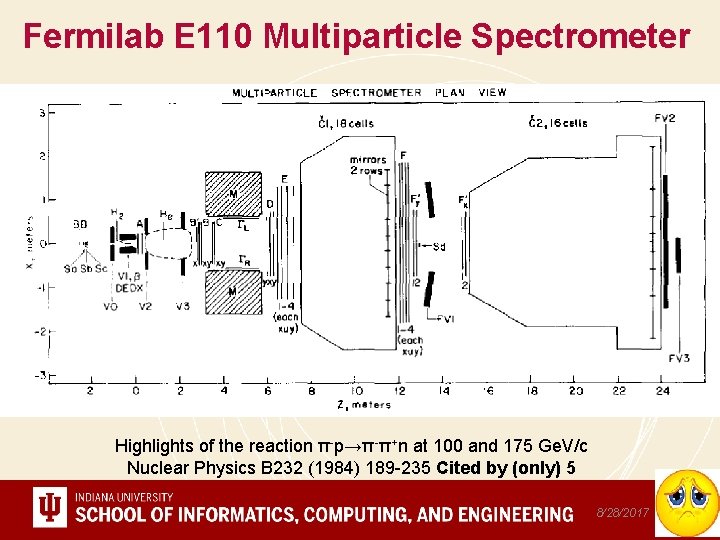
Fermilab E 110 Multiparticle Spectrometer Highlights of the reaction π-p→π-π+n at 100 and 175 Ge. V/c Nuclear Physics B 232 (1984) 189 -235 Cited by (only) 5 8/28/2017 5
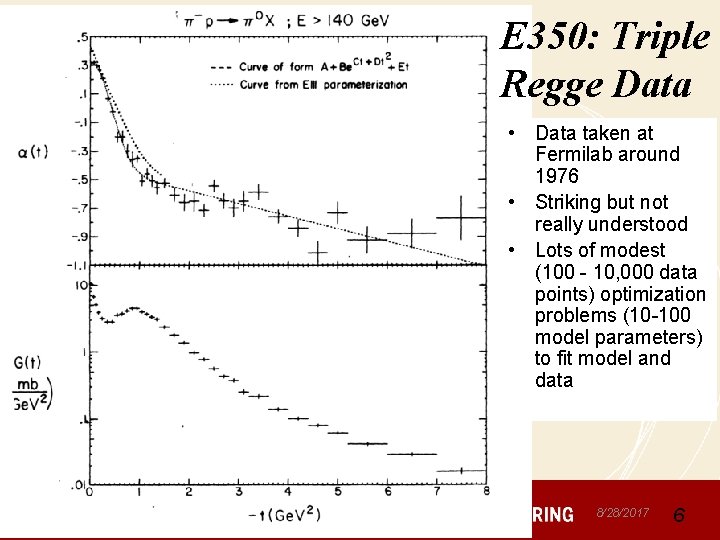
E 350: Triple Regge Data • Data taken at Fermilab around 1976 • Striking but not really understood • Lots of modest (100 - 10, 000 data points) optimization problems (10 -100 model parameters) to fit model and data 8/28/2017 6
More Erratic Success in Projects • Success: Worked with Feynman on making models for particle physics experiments but left area • Success Worked with Wolfram on model-independent measures of “event shapes” but left area – Observables for the analysis of event shapes in e+ e− annihilation and other processes 1259 citations • Worked with Wolfram on SMP – forerunner of Mathematica funded by my grant. A success for world but I left area • Realized parallel computers would work on computational physics after physics colloquium by Carver Mead explained why parallel hardware inevitable • Set up an application consortium developing codes and a collaboration with Caltech Computer Science and JPL to build machines • A success but funding such interdisciplinary work is a major challenge as is building hardware and software – still true!! 8/28/2017 7
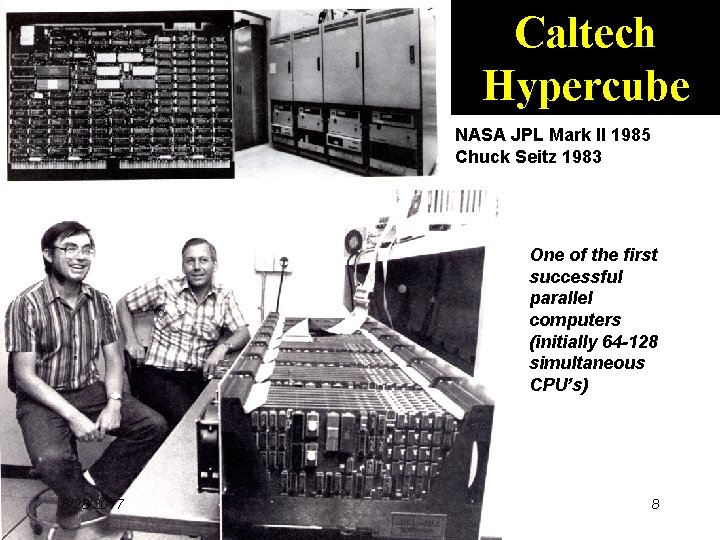
Caltech Hypercube NASA JPL Mark II 1985 Chuck Seitz 1983 One of the first successful parallel computers (initially 64 -128 simultaneous CPU’s) 8/28/2017 8
Principles of Interdisciplinary work? • It is essential • NSF never gives lots of money to one place (as I had at Caltech from Do. E) • Need to work with ~best people in a given field – Not so easy to identify – Best people willing to work with you are rarely at your home institution so need lots of travel • We should try to build interdisciplinary collaborations in Intelligent Systems Engineering 8/28/2017 9
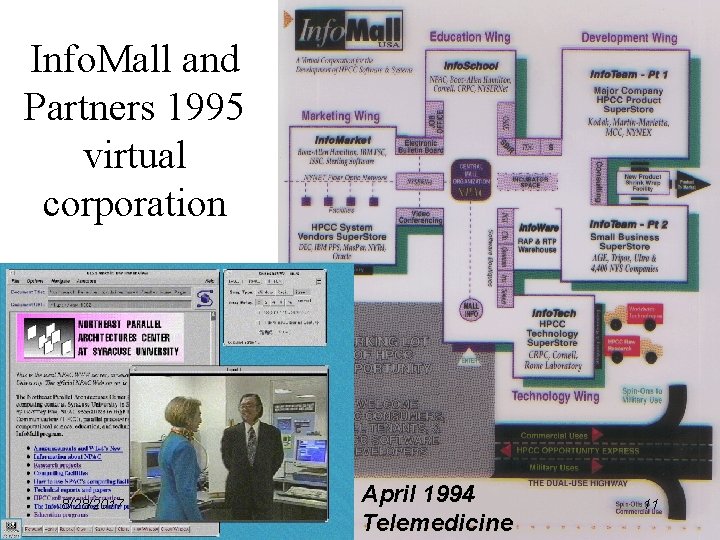
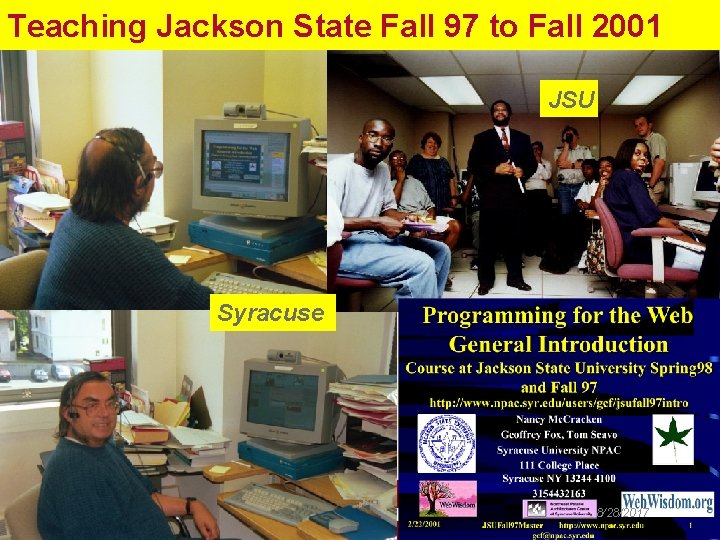
Extending studies of Parallel Computing • Original work in parallel computing nationally was all simulation oriented • Study of industry identified need for data intensive applications • A ~failed project Info. Mall tried to do this but probably before its time • Had similar structure to Internet / web 2. 0 today • Did put a lot of effort into messaging systems (Naradabrokering. org) and applications to synchronous distance education • We built good collaboration technology but Web. Ex, Adobe Connect etc. now do this – The quality of Internet around 1997 was not very good • I did correctly identify where good to use and built up strong contacts with Minority Serving Institutions • I taught many classes to MSI’s 8/28/2017 10
Info. Mall and Partners 1995 virtual corporation 8/28/2017 April 1994 Telemedicine 11
Teaching Jackson State Fall 97 to Fall 2001 JSU Syracuse 8/28/2017 12
What does ISE cover? • Intelligent Systems: Systems often present traditional Data …. . Information …. . Knowledge pipeline – where engineered hardware gathers data and they are converted to information. The intelligent system converts information to knowledge and is essential in a complete engineered system. – An example is self driving cars (drones) where lidar, camera, ultrasonic sensors use deep learning (intelligent system) for auto-pilot – Here ISE instruction includes machine-learning and clouds • Cyber-physical Systems: this refers to areas like robotics and the Internet of Things Io. T where 50 billion things are predicted by 2020. Many reports on Smart X (X=Cities to vehicles) are built on Io. T – This includes embedded systems, streaming data driven control • Modelling and Simulation: Several ISE fields involve increasing use of modelling and simulation as in nano (materials genome), bio (virtual tissue, molecular dynamics), CE (new computer designs) …. – Graduate and undergraduate modules being developed 8/28/2017 13
Parallel and Distributed Computing as Systems I • ISE has “systems” part of computer science and usually systems are built of parts but those parts have different characteristics in different ISE areas • Parallel computing is very special – you make the parts from a problem specified as whole – You divide world up into patches in order to simulate weather or climate – You divide data and cluster centers into parts in order to do clustering of points – The parts can be heterogenous in properties but are homogenous in style e. g. in weather, only has mesh points but the mesh points are much closer together and varying rapidly for the tornado • In distributed computing, the parts are given to you and as distributed are automatically separated; often parts have totally different functions – The robot and the backend cloud have very different functions • Both parallel and distributed systems can be large (you are use billions of mesh points and there are 20 billion thing in Io. T) 8/28/2017 14
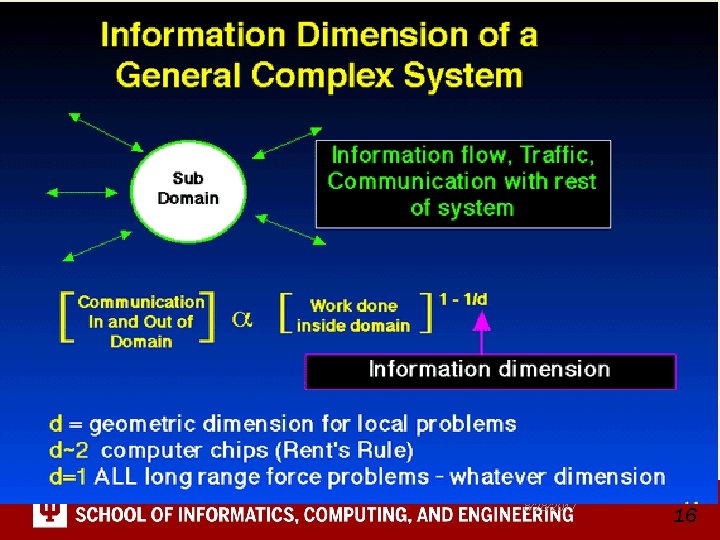
Parallel and Distributed Computing as Systems II • One is tempted to use same ideas and software for both parallel and distributed systems but often constraints are different – Parallel computing needs microsecond latency but – Distributed systems are milliseconds (light takes 5 ms to travel 1000 miles) by construction • One can decompose by sharding (chopping up a set of data) or by function (clean up data, cluster, visualize) – Sharded parts are closely connected; functional parts loosely connected/synchronized • Note on general principles, amount of communication (interaction) with outside world decreases as dimension decreases and as size increases (see next slide) • One typically optimizes performance or ease of use modulated by cost. 8/28/2017 15
8/28/2017 16
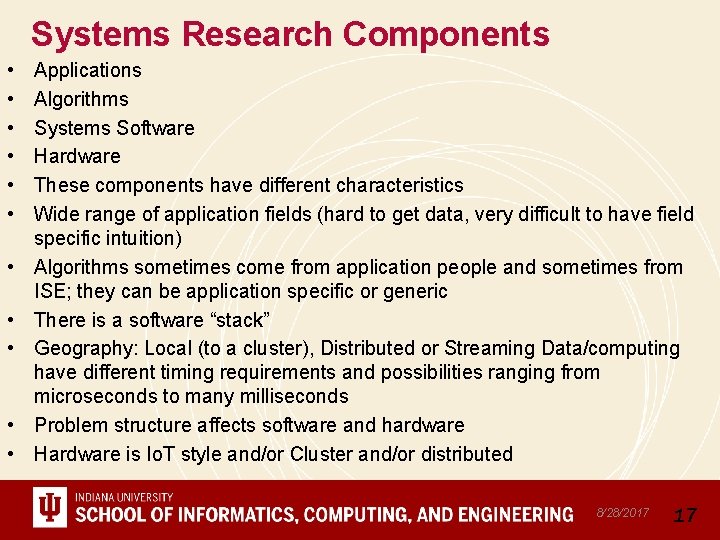
Systems Research Components • • • Applications Algorithms Systems Software Hardware These components have different characteristics Wide range of application fields (hard to get data, very difficult to have field specific intuition) Algorithms sometimes come from application people and sometimes from ISE; they can be application specific or generic There is a software “stack” Geography: Local (to a cluster), Distributed or Streaming Data/computing have different timing requirements and possibilities ranging from microseconds to many milliseconds Problem structure affects software and hardware Hardware is Io. T style and/or Cluster and/or distributed 8/28/2017 17
Cyberinfrastructure and Its Application Cyberinfrastructure Day Salish Kootenai College, Pablo MT August 2 2011 8/28/2017 18
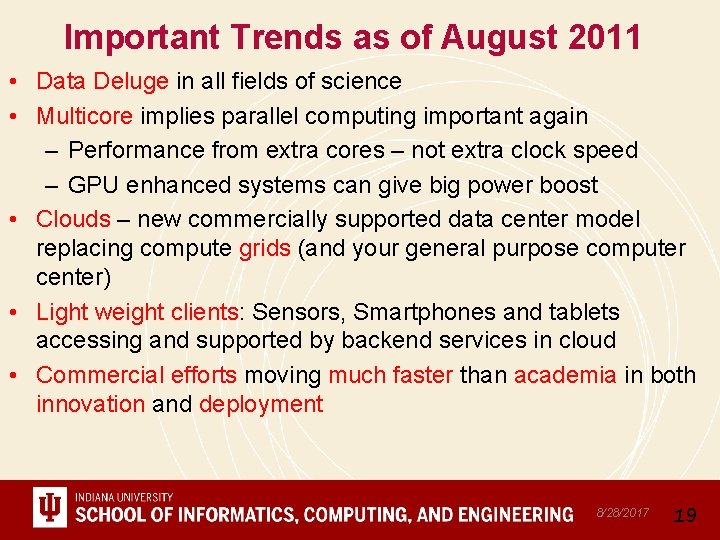
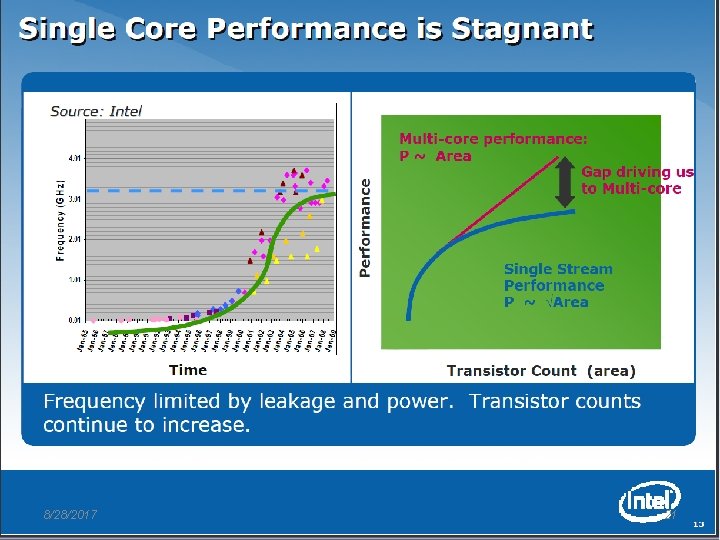
Important Trends as of August 2011 • Data Deluge in all fields of science • Multicore implies parallel computing important again – Performance from extra cores – not extra clock speed – GPU enhanced systems can give big power boost • Clouds – new commercially supported data center model replacing compute grids (and your general purpose computer center) • Light weight clients: Sensors, Smartphones and tablets accessing and supported by backend services in cloud • Commercial efforts moving much faster than academia in both innovation and deployment 8/28/2017 19
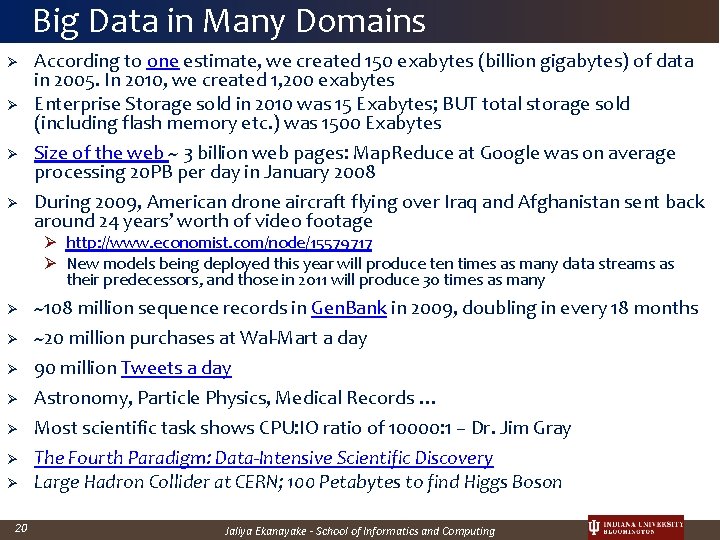
Big Data in Many Domains Ø Ø According to one estimate, we created 150 exabytes (billion gigabytes) of data in 2005. In 2010, we created 1, 200 exabytes Enterprise Storage sold in 2010 was 15 Exabytes; BUT total storage sold (including flash memory etc. ) was 1500 Exabytes Size of the web ~ 3 billion web pages: Map. Reduce at Google was on average processing 20 PB per day in January 2008 During 2009, American drone aircraft flying over Iraq and Afghanistan sent back around 24 years’ worth of video footage Ø http: //www. economist. com/node/15579717 Ø New models being deployed this year will produce ten times as many data streams as their predecessors, and those in 2011 will produce 30 times as many Ø Ø Ø Ø 20 ~108 million sequence records in Gen. Bank in 2009, doubling in every 18 months ~20 million purchases at Wal-Mart a day 90 million Tweets a day Astronomy, Particle Physics, Medical Records … Most scientific task shows CPU: IO ratio of 10000: 1 – Dr. Jim Gray The Fourth Paradigm: Data-Intensive Scientific Discovery Large Hadron Collider at CERN; 100 Petabytes to find Higgs Boson Jaliya Ekanayake - School of Informatics and Computing
8/28/2017 21
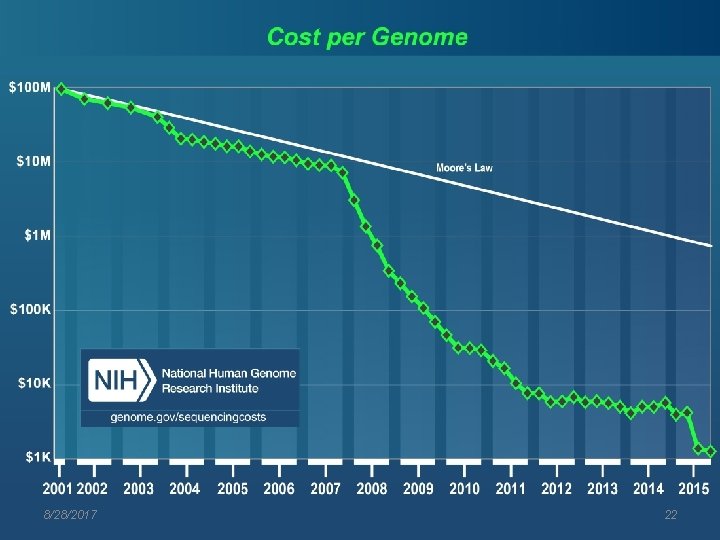
8/28/2017 22
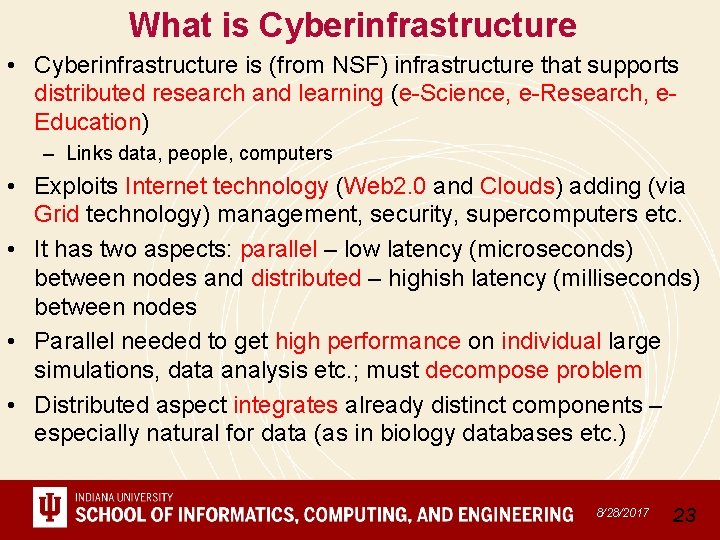
What is Cyberinfrastructure • Cyberinfrastructure is (from NSF) infrastructure that supports distributed research and learning (e-Science, e-Research, e. Education) – Links data, people, computers • Exploits Internet technology (Web 2. 0 and Clouds) adding (via Grid technology) management, security, supercomputers etc. • It has two aspects: parallel – low latency (microseconds) between nodes and distributed – highish latency (milliseconds) between nodes • Parallel needed to get high performance on individual large simulations, data analysis etc. ; must decompose problem • Distributed aspect integrates already distinct components – especially natural for data (as in biology databases etc. ) 8/28/2017 23
e-moreorlessanything • • • ‘e-Science is about global collaboration in key areas of science, and the next generation of infrastructure that will enable it. ’ from inventor of term John Taylor Director General of Research Councils UK, Office of Science and Technology e-Science is about developing tools and technologies that allow scientists to do ‘faster, better or different’ research Similarly e-Business captures the emerging view of corporations as dynamic virtual organizations linking employees, customers and stakeholders across the world. This generalizes to e-moreorlessanything including e-Digital. Library, e -Fine. Arts, e-Having. Fun and e-Education A deluge of data of unprecedented and inevitable size must be managed and understood. People (virtual organizations), computers, data (including sensors and instruments) must be linked via hardware and software networks 8/28/2017 24
The Span of Cyberinfrastructure • High definition videoconferencing linking people across the globe • Digital Library of music, curriculum, scientific papers • Flickr, Youtube, Amazon …. • Simulating a new battery design (exascale problem) • Sharing data from world’s telescopes • Using cloud to analyze your personal genome • Enabling all to be equal partners in creating knowledge and converting it to wisdom • Analyzing Tweets…documents to discover which stocks will crash; how disease is spreading; linguistic inference; ranking of institutions 8/28/2017 25
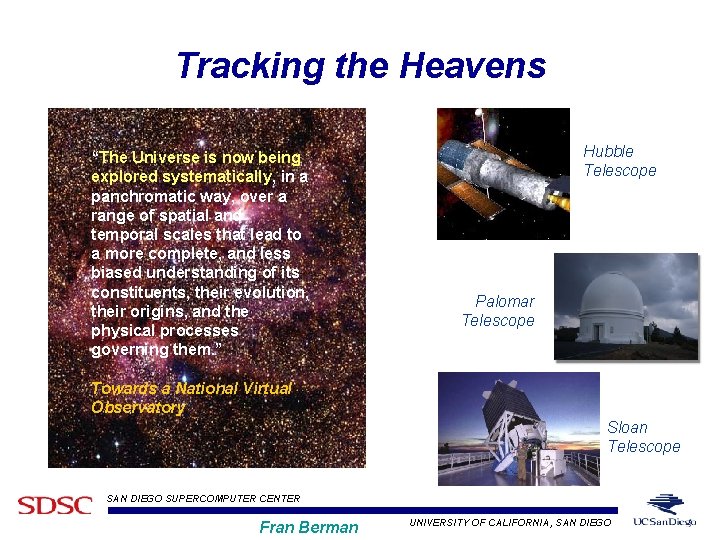
Tracking the Heavens “The Universe is now being explored systematically, in a panchromatic way, over a range of spatial and temporal scales that lead to a more complete, and less biased understanding of its constituents, their evolution, their origins, and the physical processes governing them. ” Hubble Telescope Palomar Telescope Towards a National Virtual Observatory Sloan Telescope SAN DIEGO SUPERCOMPUTER CENTER Fran Berman UNIVERSITY OF CALIFORNIA, SAN DIEGO
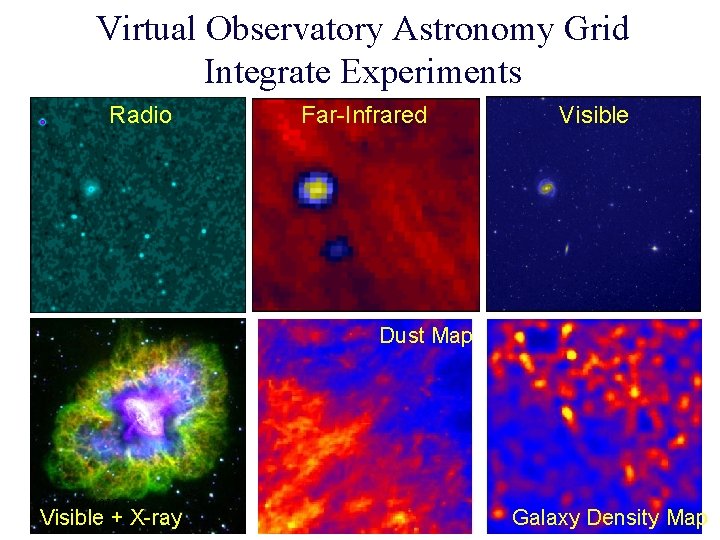
Virtual Observatory Astronomy Grid Integrate Experiments Radio Far-Infrared Visible Dust Map 8/28/2017 Visible + X-ray 27 Galaxy Density Map
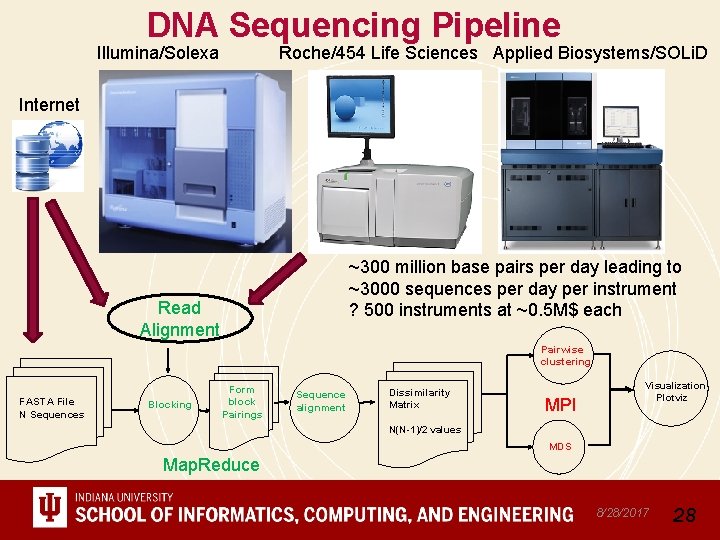
DNA Sequencing Pipeline Illumina/Solexa Roche/454 Life Sciences Applied Biosystems/SOLi. D Internet ~300 million base pairs per day leading to ~3000 sequences per day per instrument ? 500 instruments at ~0. 5 M$ each Read Alignment Pairwise clustering FASTA File N Sequences Blocking Form block Pairings Sequence alignment Dissimilarity Matrix MPI Visualization Plotviz N(N-1)/2 values MDS Map. Reduce 8/28/2017 28
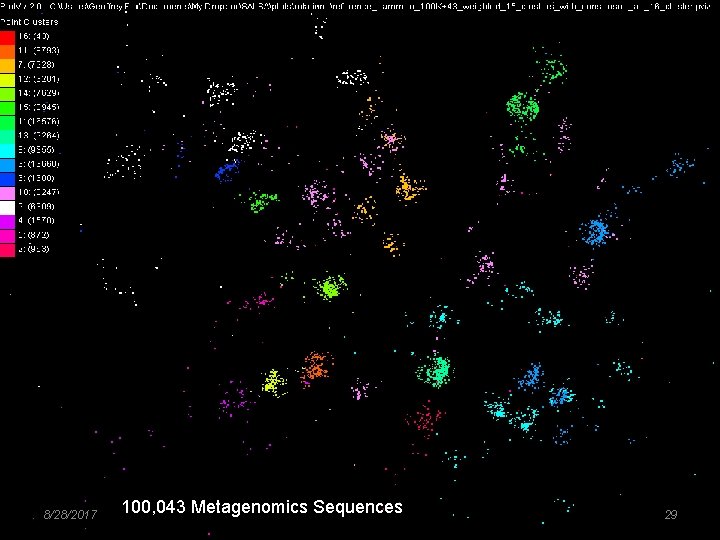
8/28/2017 100, 043 Metagenomics Sequences 29
Lightweight Cyberinfrastructure to support mobile Data gathering expeditions plus classic central resources (as a cloud) 8/28/2017 30
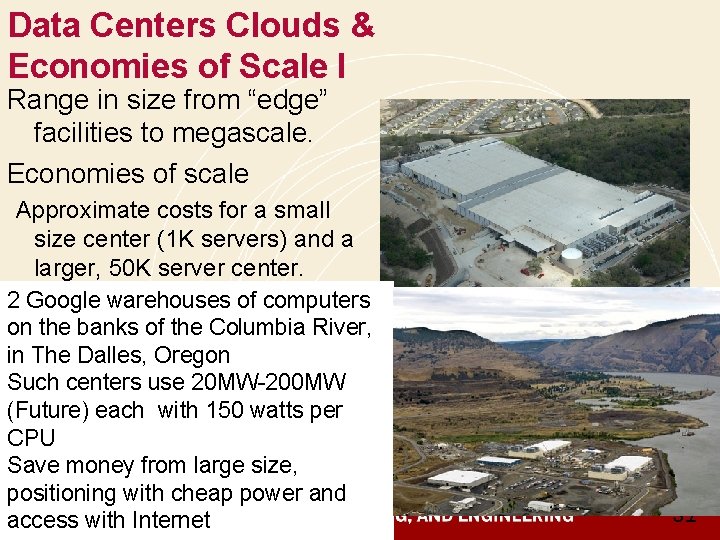
Data Centers Clouds & Economies of Scale I Range in size from “edge” facilities to megascale. Economies of scale Approximate costs for a small size center (1 K servers) and a larger, 50 K server center. 2 Google warehouses of computers Cost of in small in Large Ratio on. Technology the banks the Cost Columbia River, -sized Data Center. Oregon in The Dalles, Networkcenters $95 per Mbps/20 MW-200 MW $13 per Mbps/ 7. 1 Such use month (Future) each with 150 watts per Storage $2. 20 per GB/ $0. 40 per GB/ 5. 7 month CPU Administration ~140 from servers/ large >1000 Servers/ 7. 1 Save money size, Administrator positioning with cheap power and access with Internet Each data center is 11. 5 times the size of a football field 31
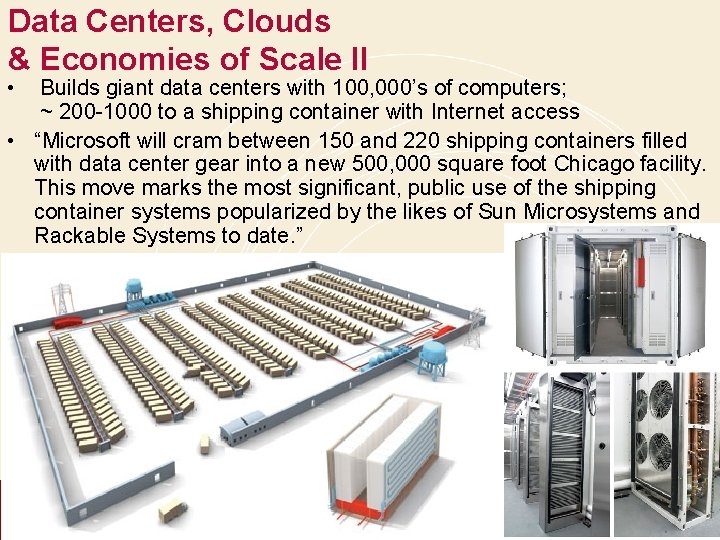
Data Centers, Clouds & Economies of Scale II • Builds giant data centers with 100, 000’s of computers; ~ 200 -1000 to a shipping container with Internet access • “Microsoft will cram between 150 and 220 shipping containers filled with data center gear into a new 500, 000 square foot Chicago facility. This move marks the most significant, public use of the shipping container systems popularized by the likes of Sun Microsystems and Rackable Systems to date. ” 32 8/28/2017 32
Grids MPI and Clouds • • • Grids are useful for managing distributed systems – Pioneered service model for Science – Developed importance of Workflow – Performance issues – communication latency – intrinsic to distributed systems – Can never run large differential equation based simulations or datamining Clouds can execute any job class that was good for Grids plus – More attractive due to platform plus elastic on-demand model – Map. Reduce easier to use than MPI for appropriate parallel jobs – Currently have performance limitations due to poor affinity (locality) for compute-compute (MPI) and Compute-data – These limitations are not “inevitable” and should gradually improve as in July 13 2010 Amazon Cluster announcement – Will probably never be best for most sophisticated parallel differential equation based simulations Classic Supercomputers (MPI Engines) run communication demanding differential equation based simulations – Map. Reduce and Clouds replaces MPI for other problems – Much more data processed today by Map. Reduce than MPI (Industry Informational Retrieval ~50 Petabytes per day) 8/28/2017 33
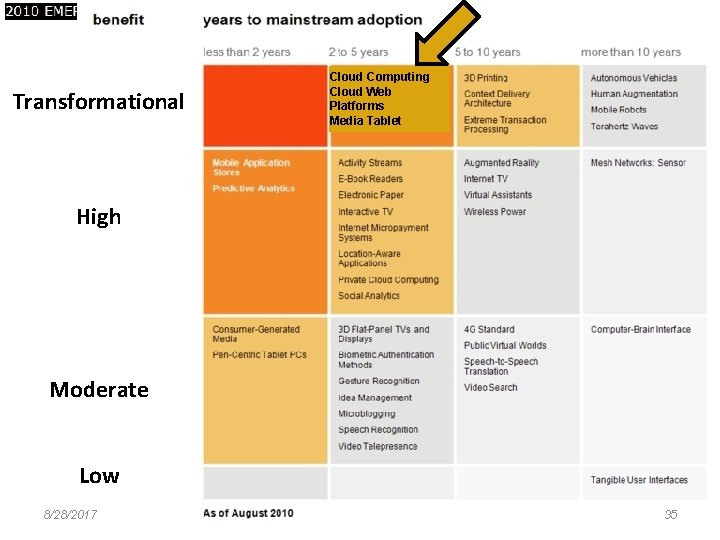
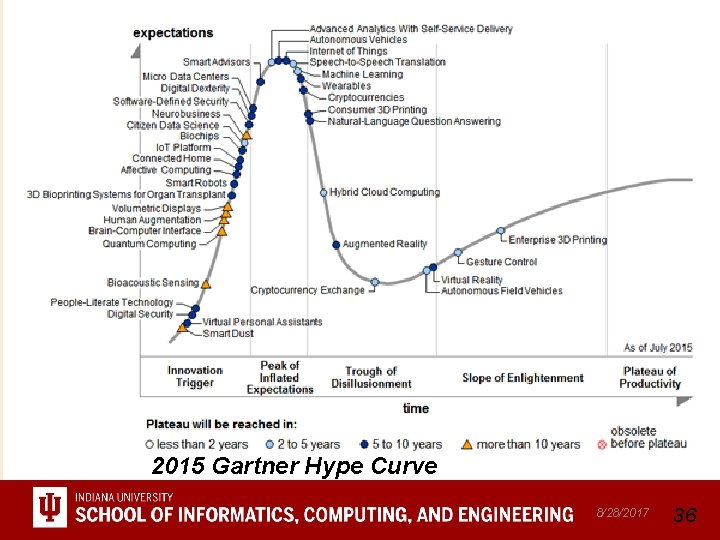
Clouds and Jobs • Clouds are a major industry thrust with a growing fraction of IT expenditure that IDC estimates will grow to $44. 2 billion direct investment in 2013 while 15% of IT investment in 2011 will be related to cloud systems with a 30% growth in public sector. • Gartner also rates cloud computing high on list of critical emerging technologies with for example “Cloud Computing” and “Cloud Web Platforms” rated as transformational (their highest rating for impact) in the next 2 -5 years. • Correspondingly there is and will continue to be major opportunities for new jobs in cloud computing with a recent European study estimating there will be 2. 4 million new cloud computing jobs in Europe alone by 2015. • Cloud computing is an attractive for projects focusing on workforce development. Note that the recently signed “America Competes Act” calls out the importance of economic development in broader impact of NSF projects 8/28/2017 34
Transformational Cloud Computing Cloud Web Platforms Media Tablet Gartner 2009 Hype Curve Clouds, Web 2. 0 Service Oriented Architectures High Moderate Low 8/28/2017 35
2015 Gartner Hype Curve 8/28/2017 36
8/28/2017 3737
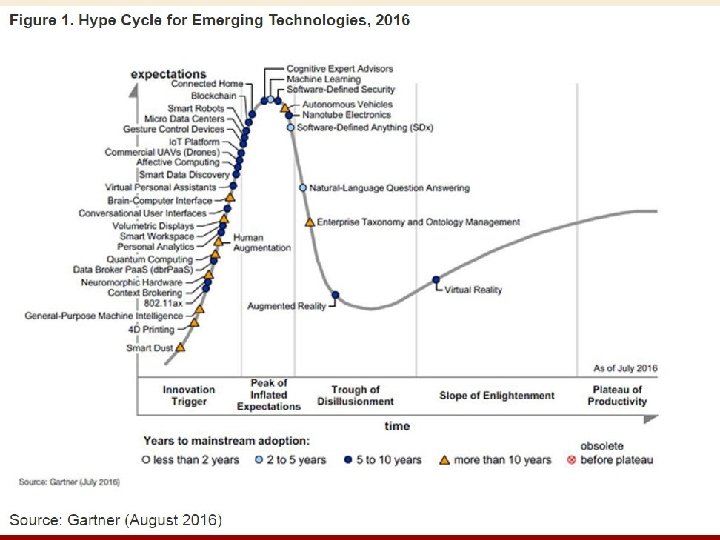
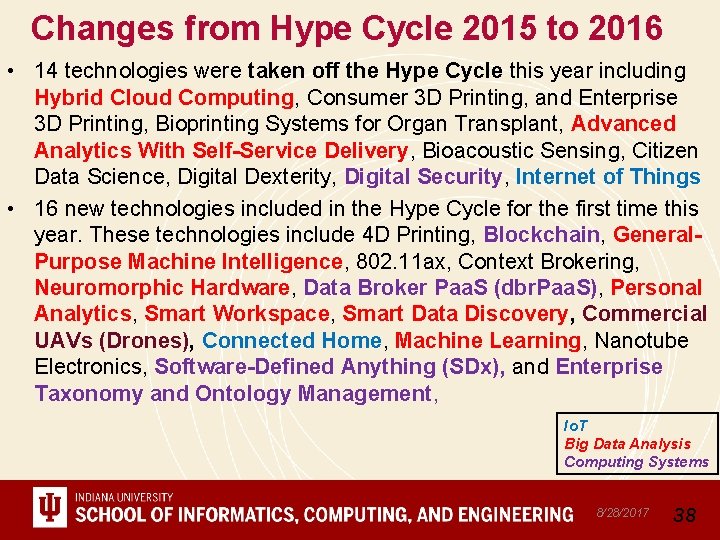
Changes from Hype Cycle 2015 to 2016 • 14 technologies were taken off the Hype Cycle this year including Hybrid Cloud Computing, Consumer 3 D Printing, and Enterprise 3 D Printing, Bioprinting Systems for Organ Transplant, Advanced Analytics With Self-Service Delivery, Bioacoustic Sensing, Citizen Data Science, Digital Dexterity, Digital Security, Internet of Things • 16 new technologies included in the Hype Cycle for the first time this year. These technologies include 4 D Printing, Blockchain, General. Purpose Machine Intelligence, 802. 11 ax, Context Brokering, Neuromorphic Hardware, Data Broker Paa. S (dbr. Paa. S), Personal Analytics, Smart Workspace, Smart Data Discovery, Commercial UAVs (Drones), Connected Home, Machine Learning, Nanotube Electronics, Software-Defined Anything (SDx), and Enterprise Taxonomy and Ontology Management, Io. T Big Data Analysis Computing Systems 8/28/2017 38
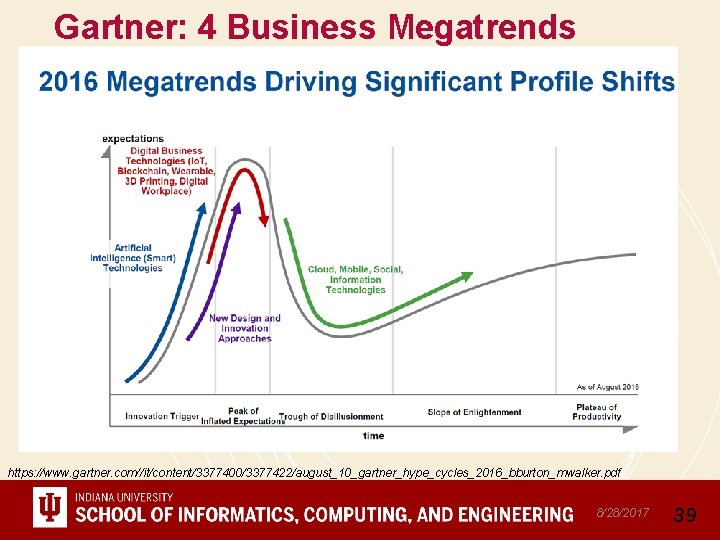
Gartner: 4 Business Megatrends https: //www. gartner. com//it/content/3377400/3377422/august_10_gartner_hype_cycles_2016_bburton_mwalker. pdf 8/28/2017 39
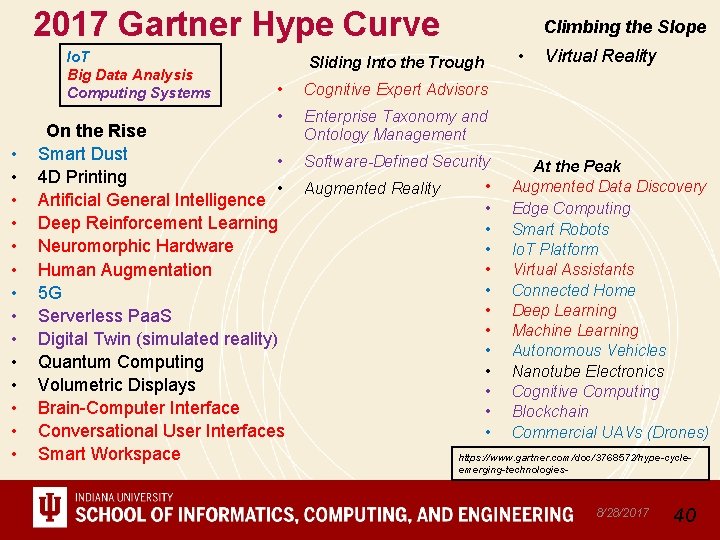
2017 Gartner Hype Curve Io. T Big Data Analysis Computing Systems • • • • Climbing the Slope • Sliding Into the Trough • Cognitive Expert Advisors • Enterprise Taxonomy and Ontology Management On the Rise Smart Dust • 4 D Printing • Artificial General Intelligence Deep Reinforcement Learning Neuromorphic Hardware Human Augmentation 5 G Serverless Paa. S Digital Twin (simulated reality) Quantum Computing Volumetric Displays Brain-Computer Interface Conversational User Interfaces Smart Workspace Software-Defined Security Augmented Reality • • • • Virtual Reality At the Peak Augmented Data Discovery Edge Computing Smart Robots Io. T Platform Virtual Assistants Connected Home Deep Learning Machine Learning Autonomous Vehicles Nanotube Electronics Cognitive Computing Blockchain Commercial UAVs (Drones) https: //www. gartner. com/doc/3768572/hype-cycleemerging-technologies- 8/28/2017 40
Clouds, HPC Clouds Simulations, Big Data 8/28/2017 41
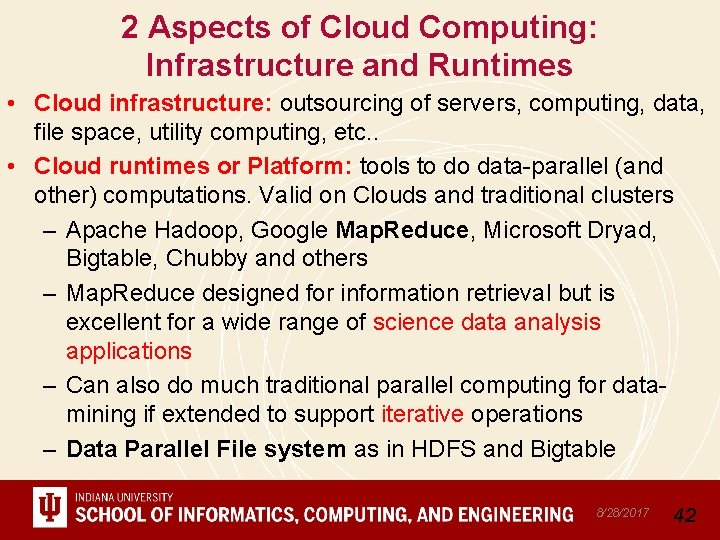
2 Aspects of Cloud Computing: Infrastructure and Runtimes • Cloud infrastructure: outsourcing of servers, computing, data, file space, utility computing, etc. . • Cloud runtimes or Platform: tools to do data-parallel (and other) computations. Valid on Clouds and traditional clusters – Apache Hadoop, Google Map. Reduce, Microsoft Dryad, Bigtable, Chubby and others – Map. Reduce designed for information retrieval but is excellent for a wide range of science data analysis applications – Can also do much traditional parallel computing for datamining if extended to support iterative operations – Data Parallel File system as in HDFS and Bigtable 8/28/2017 42
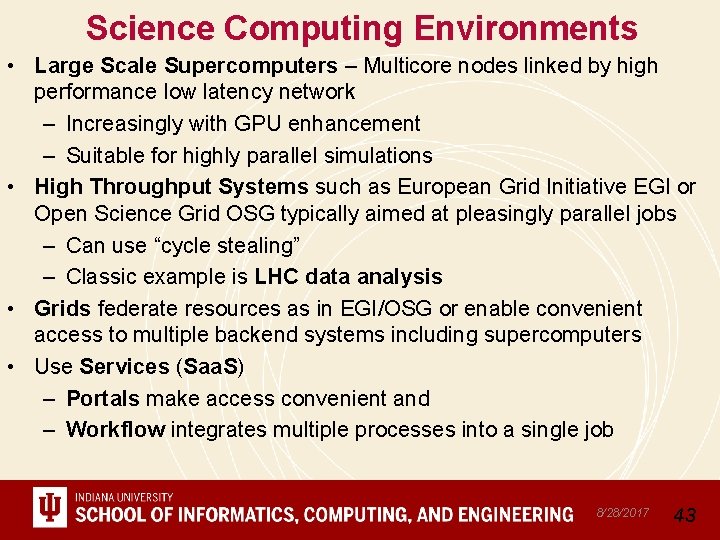
Science Computing Environments • Large Scale Supercomputers – Multicore nodes linked by high performance low latency network – Increasingly with GPU enhancement – Suitable for highly parallel simulations • High Throughput Systems such as European Grid Initiative EGI or Open Science Grid OSG typically aimed at pleasingly parallel jobs – Can use “cycle stealing” – Classic example is LHC data analysis • Grids federate resources as in EGI/OSG or enable convenient access to multiple backend systems including supercomputers • Use Services (Saa. S) – Portals make access convenient and – Workflow integrates multiple processes into a single job 8/28/2017 43
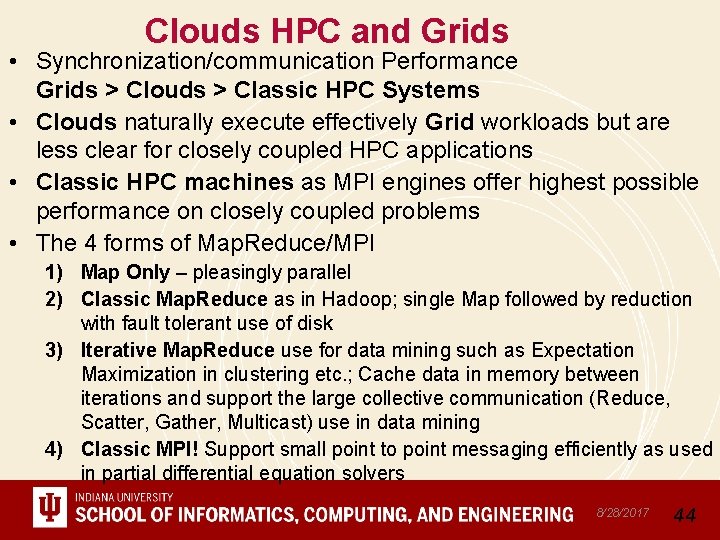
Clouds HPC and Grids • Synchronization/communication Performance Grids > Clouds > Classic HPC Systems • Clouds naturally execute effectively Grid workloads but are less clear for closely coupled HPC applications • Classic HPC machines as MPI engines offer highest possible performance on closely coupled problems • The 4 forms of Map. Reduce/MPI 1) Map Only – pleasingly parallel 2) Classic Map. Reduce as in Hadoop; single Map followed by reduction with fault tolerant use of disk 3) Iterative Map. Reduce use for data mining such as Expectation Maximization in clustering etc. ; Cache data in memory between iterations and support the large collective communication (Reduce, Scatter, Gather, Multicast) use in data mining 4) Classic MPI! Support small point to point messaging efficiently as used in partial differential equation solvers 8/28/2017 44
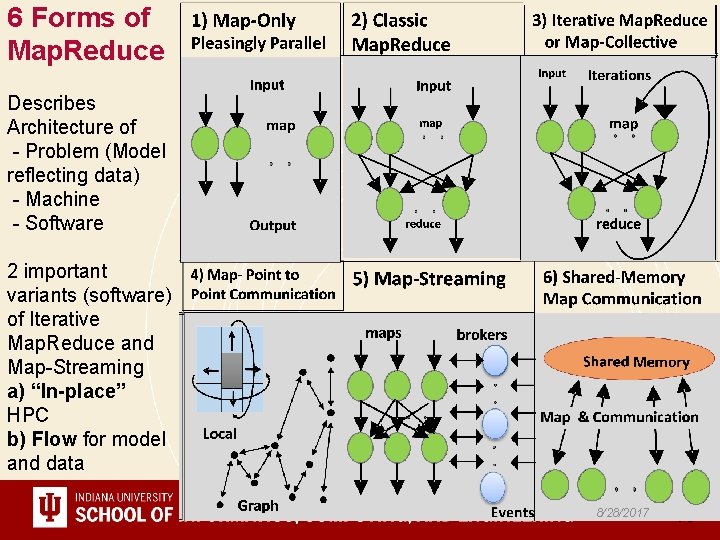
6 Forms of Map. Reduce Describes Architecture of - Problem (Model reflecting data) - Machine - Software 2 important variants (software) of Iterative Map. Reduce and Map-Streaming a) “In-place” HPC b) Flow for model and data 8/28/2017 45
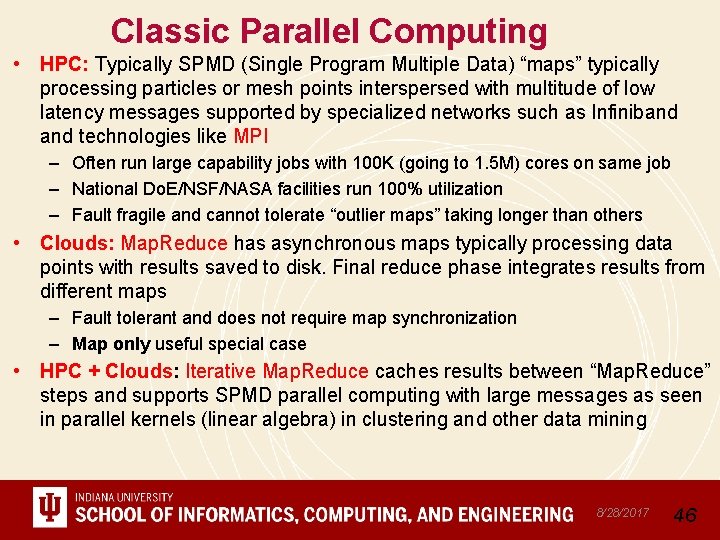
Classic Parallel Computing • HPC: Typically SPMD (Single Program Multiple Data) “maps” typically processing particles or mesh points interspersed with multitude of low latency messages supported by specialized networks such as Infiniband technologies like MPI – Often run large capability jobs with 100 K (going to 1. 5 M) cores on same job – National Do. E/NSF/NASA facilities run 100% utilization – Fault fragile and cannot tolerate “outlier maps” taking longer than others • Clouds: Map. Reduce has asynchronous maps typically processing data points with results saved to disk. Final reduce phase integrates results from different maps – Fault tolerant and does not require map synchronization – Map only useful special case • HPC + Clouds: Iterative Map. Reduce caches results between “Map. Reduce” steps and supports SPMD parallel computing with large messages as seen in parallel kernels (linear algebra) in clustering and other data mining 8/28/2017 46
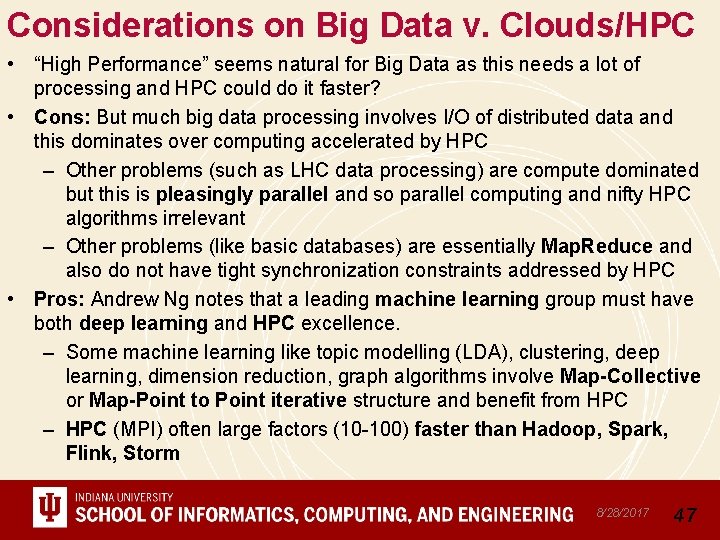
Considerations on Big Data v. Clouds/HPC • “High Performance” seems natural for Big Data as this needs a lot of processing and HPC could do it faster? • Cons: But much big data processing involves I/O of distributed data and this dominates over computing accelerated by HPC – Other problems (such as LHC data processing) are compute dominated but this is pleasingly parallel and so parallel computing and nifty HPC algorithms irrelevant – Other problems (like basic databases) are essentially Map. Reduce and also do not have tight synchronization constraints addressed by HPC • Pros: Andrew Ng notes that a leading machine learning group must have both deep learning and HPC excellence. – Some machine learning like topic modelling (LDA), clustering, deep learning, dimension reduction, graph algorithms involve Map-Collective or Map-Point to Point iterative structure and benefit from HPC – HPC (MPI) often large factors (10 -100) faster than Hadoop, Spark, Flink, Storm 8/28/2017 47
Why HPC Cloud architectures? • • Exascale simulations needed as have differential equation based models that need small space and time steps and this leads to numerical formulations that need the memory and compute power of an exascale machine to solve individual problems (capability computing) Big data problems do not have differential operators and it is not obvious that you need a full exascale system to address a single Big Data problem Rather you will be running lots of jobs that are sometimes pleasingly parallel/Map. Reduce (Cloud) and sometimes small to medium size HPC jobs which in aggregate are exascale (HPC Cloud) (capacity computing) – Deep learning doesn’t exhibit massive parallelism due to stochastic gradient descent using small mini-batches of training data – But deep learning does use small accelerator enhanced HPC clusters. Note modest size clusters need all the software, hardware and algorithm expertise of HPC. Systems designed for exascale HPC simulations, should be well suited for HPC cloud if I/O handled correctly (as it is in traditional clouds) HPCCloud 2. 0 uses Dev. Ops to automate deployment on cloud or HPCCloud 3. 0 uses Saa. S to deliver Wisdom/Insight as a Service 8/28/2017 48
Comparison of Data Analytics with Simulation 8/28/2017 49
Structure of Applications • Real-time (streaming) data is increasingly common in scientific and engineering research, and it is ubiquitous in commercial Big Data (e. g. , social network analysis, recommender systems and consumer behavior classification) – So far little use of commercial and Apache technology in analysis of scientific streaming data • Pleasingly parallel applications important in science (long tail) and data communities • Commercial-Science application differences: Search and recommender engines have different structure to deep learning, clustering, topic models, graph analyses such as subgraph mining – Latter very sensitive to communication and can be hard to parallelize – Search typically not as important in Science as in commercial use as search volume scales by number of users • Should discuss data and model separately – Term data often used rather sloppily and often refers to model 8/28/2017 50
Comparison of Data Analytics with Simulation I • Simulations (models) produce big data as visualization of results – they are data source – Or consume often smallish data to define a simulation problem – HPC simulation in (weather) data assimilation is data + model • Pleasingly parallel often important in both • Both are often SPMD and BSP • Non-iterative Map. Reduce is major big data paradigm – not a common simulation paradigm except where “Reduce” summarizes pleasingly parallel execution as in some Monte Carlos • Big Data often has large collective communication – Classic simulation has a lot of smallish point-to-point messages – Motivates Map. Collective model • Simulations characterized often by difference or differential operators leading to nearest neighbor sparsity • Some important data analytics can be sparse as in Page. Rank and “Bag of words” algorithms but many involve full matrix algorithm 8/28/2017 51
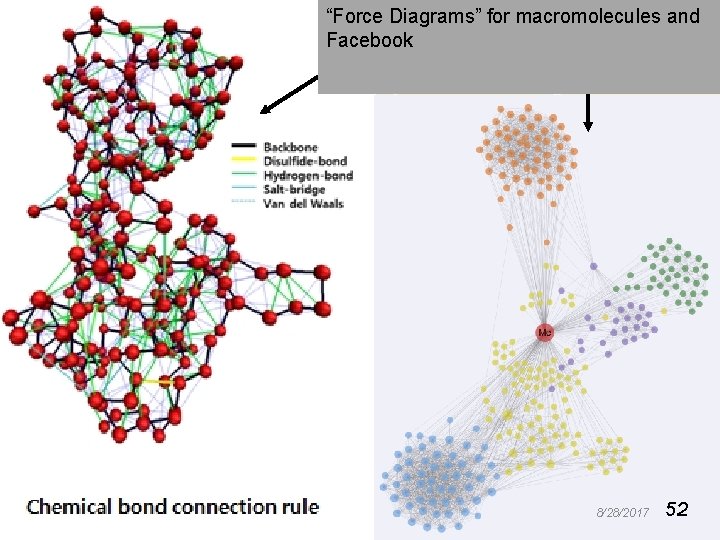
“Force Diagrams” for macromolecules and Facebook 8/28/2017 52 52
Comparison of Data Analytics with Simulation II • There are similarities between some graph problems and particle simulations with a particular cutoff force. – Both are Map. Point-to-Point problem architecture • Note many big data problems are “long range force” (as in gravitational simulations) as all points are linked. – Easiest to parallelize. Often full matrix algorithms – e. g. in DNA sequence studies, distance (i, j) defined by BLAST, Smith-Waterman, etc. , between all sequences i, j. – Opportunity for “fast multipole” ideas in big data. See NRC report • Current Ogres/Diamonds do not have facets to designate underlying hardware: GPU v. Many-core (Xeon Phi) v. Multi-core as these define how maps processed; they keep map-X structure fixed; maybe should change as ability to exploit vector or SIMD parallelism could be a model facet. 8/28/2017 53
Comparison of Data Analytics with Simulation III • • • In image-based deep learning, neural network weights are block sparse (corresponding to links to pixel blocks) but can be formulated as full matrix operations on GPUs and MPI in blocks. In HPC benchmarking, Linpack being challenged by a new sparse conjugate gradient benchmark HPCG, while I am diligently using non- sparse conjugate gradient solvers in clustering and Multi-dimensional scaling. Simulations tend to need high precision and very accurate results – partly because of differential operators Big Data problems often don’t need high accuracy as seen in trend to low precision (16 or 32 bit) deep learning networks – There are no derivatives and the data has inevitable errors Note parallel machine learning (GML not LML) can benefit from HPC style interconnects and architectures as seen in GPU-based deep learning – So commodity clouds not necessarily best but modern clouds fine 8/28/2017 54
Implications of Big Data Requirements • “Atomic” Job Size: Very large jobs are critical aspects of leading edge simulation, whereas much data analysis is pleasing parallel and involves many quite small jobs. The latter follows from event structure of much observational science. – Accelerators produce a stream of particle collisions; telescopes, light sources or remote sensing a stream of images. The many events produced by modern instruments implies data analysis is a computationally intense problem but can be broken up into many quite small jobs. – Similarly the long tail of science produces streams of events from a multitude of small instruments • Why use HPC machines to analyze data and how large are they? Some scientific data has been analyzed on HPC machines because the responsible organizations had such machines often purchased to satisfy simulation requirements. Whereas high end simulation requires HPC style machines, that is typically not true for data analysis; that is done on HPC machines because they are available 8/28/2017 55
Who uses What Software • HPC/Science use of Big Data Technology now: Some aspects of the Big Data stack are being adopted by the HPC community: Docker and Deep Learning are two examples. • Big Data use of HPC: The Big Data community has used (small) HPC clusters for deep learning, and it uses GPUs and FPGAs for training deep learning systems • Docker v. Open. Stack(hypervisor): Docker (or equivalent) is quite likely to be the virtualization approach of choice (compared to say Open. Stack) for both data and simulation applications. Open. Stack is more complex than Docker and only clearly needed if you share at core level whereas large scale simulations and data analysis seem to just need node level sharing. – Parallel computing almost implies sharing at node not core level • Science use of Big Data: Some fraction of the scientific community uses Big Data style analysis tools (Hadoop, Spark, Cassandra, Hbase …. ) 8/28/2017 56
Choosing Languages • Language choice C++, Fortran, Java, Scala, Python, R, Matlab needs thought. This is a mixture of technical and social issues. • Java Grande was a 1997 -2000 activity to make Java run fast and web site still there! http: //www. javagrande. org/ • Basic Java now much better but object structure, dynamic memory allocation and Garbage collection have their overheads • Java virtual machine JVM dominant Big Data environment? • One can mix languages quite efficiently – Java MPI as binding to C++ version excellent • Scripting languages Python, R, Matlab address different requirements than Java, C++ …. 8/28/2017 57
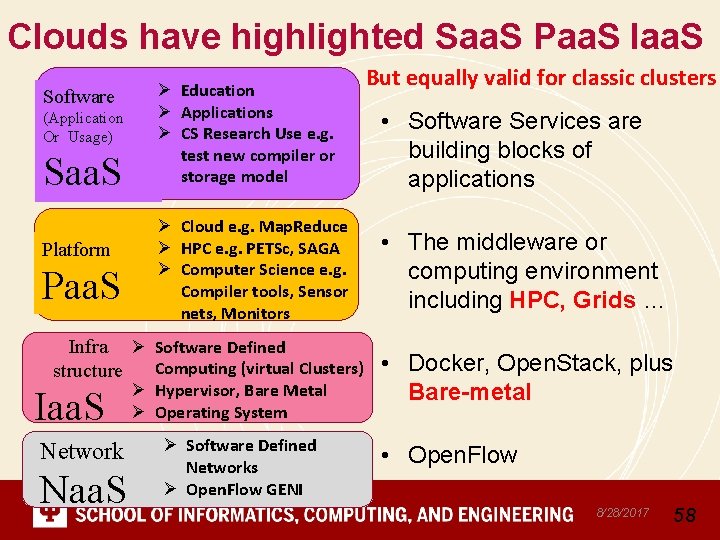
Clouds have highlighted Saa. S Paa. S Iaa. S Software (Application Or Usage) Saa. S Platform Paa. S Ø Education Ø Applications Ø CS Research Use e. g. test new compiler or storage model Ø Cloud e. g. Map. Reduce Ø HPC e. g. PETSc, SAGA Ø Computer Science e. g. Compiler tools, Sensor nets, Monitors Infra Ø Software Defined Computing (virtual Clusters) structure Iaa. S Network Naa. S Ø Hypervisor, Bare Metal Ø Operating System Ø Software Defined Networks Ø Open. Flow GENI But equally valid for classic clusters • Software Services are building blocks of applications • The middleware or computing environment including HPC, Grids … • Docker, Open. Stack, plus Bare-metal • Open. Flow 8/28/2017 58
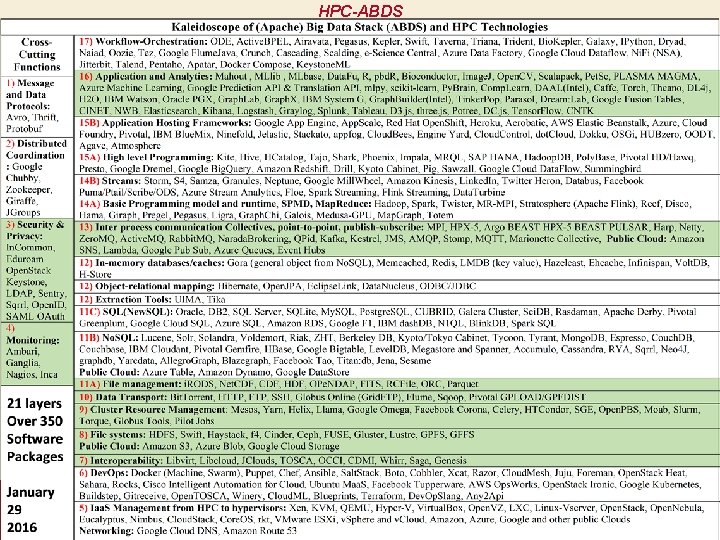
HPC-ABDS 8/28/2017 59
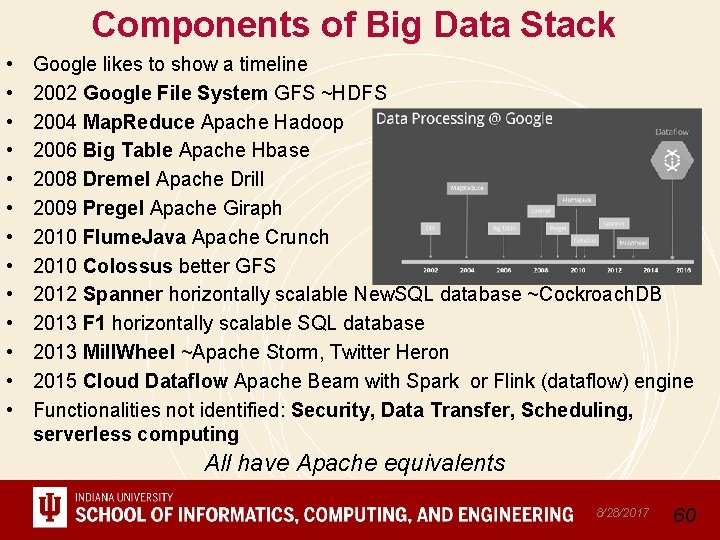
Components of Big Data Stack • • • • Google likes to show a timeline 2002 Google File System GFS ~HDFS 2004 Map. Reduce Apache Hadoop 2006 Big Table Apache Hbase 2008 Dremel Apache Drill 2009 Pregel Apache Giraph 2010 Flume. Java Apache Crunch 2010 Colossus better GFS 2012 Spanner horizontally scalable New. SQL database ~Cockroach. DB 2013 F 1 horizontally scalable SQL database 2013 Mill. Wheel ~Apache Storm, Twitter Heron 2015 Cloud Dataflow Apache Beam with Spark or Flink (dataflow) engine Functionalities not identified: Security, Data Transfer, Scheduling, serverless computing All have Apache equivalents 8/28/2017 60
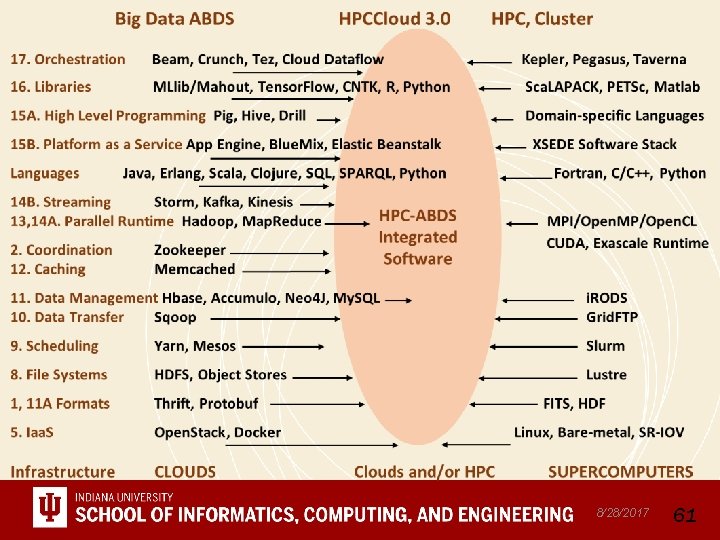
8/28/2017 61
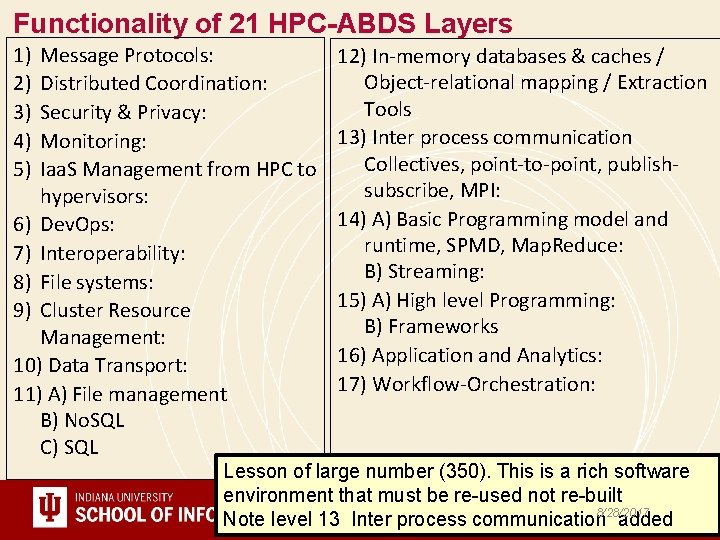
Functionality of 21 HPC-ABDS Layers 1) 2) 3) 4) 5) Message Protocols: Distributed Coordination: Security & Privacy: Monitoring: Iaa. S Management from HPC to hypervisors: 6) Dev. Ops: 7) Interoperability: 8) File systems: 9) Cluster Resource Management: 10) Data Transport: 11) A) File management B) No. SQL C) SQL 12) In-memory databases & caches / Object-relational mapping / Extraction Tools 13) Inter process communication Collectives, point-to-point, publishsubscribe, MPI: 14) A) Basic Programming model and runtime, SPMD, Map. Reduce: B) Streaming: 15) A) High level Programming: B) Frameworks 16) Application and Analytics: 17) Workflow-Orchestration: Lesson of large number (350). This is a rich software environment that must be re-used not re-built 8/28/2017 Note level 13 Inter process communication added 62
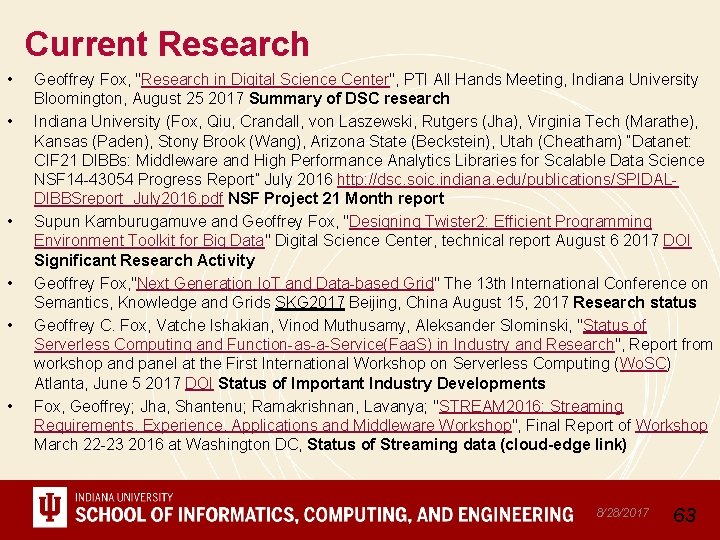
Current Research • • • Geoffrey Fox, "Research in Digital Science Center", PTI All Hands Meeting, Indiana University Bloomington, August 25 2017 Summary of DSC research Indiana University (Fox, Qiu, Crandall, von Laszewski, Rutgers (Jha), Virginia Tech (Marathe), Kansas (Paden), Stony Brook (Wang), Arizona State (Beckstein), Utah (Cheatham) “Datanet: CIF 21 DIBBs: Middleware and High Performance Analytics Libraries for Scalable Data Science NSF 14 -43054 Progress Report” July 2016 http: //dsc. soic. indiana. edu/publications/SPIDALDIBBSreport_July 2016. pdf NSF Project 21 Month report Supun Kamburugamuve and Geoffrey Fox, "Designing Twister 2: Efficient Programming Environment Toolkit for Big Data" Digital Science Center, technical report August 6 2017 DOI Significant Research Activity Geoffrey Fox, "Next Generation Io. T and Data-based Grid" The 13 th International Conference on Semantics, Knowledge and Grids SKG 2017 Beijing, China August 15, 2017 Research status Geoffrey C. Fox, Vatche Ishakian, Vinod Muthusamy, Aleksander Slominski, "Status of Serverless Computing and Function-as-a-Service(Faa. S) in Industry and Research", Report from workshop and panel at the First International Workshop on Serverless Computing (Wo. SC) Atlanta, June 5 2017 DOI Status of Important Industry Developments Fox, Geoffrey; Jha, Shantenu; Ramakrishnan, Lavanya; "STREAM 2016: Streaming Requirements, Experience, Applications and Middleware Workshop", Final Report of Workshop March 22 -23 2016 at Washington DC, Status of Streaming data (cloud-edge link) 8/28/2017 63
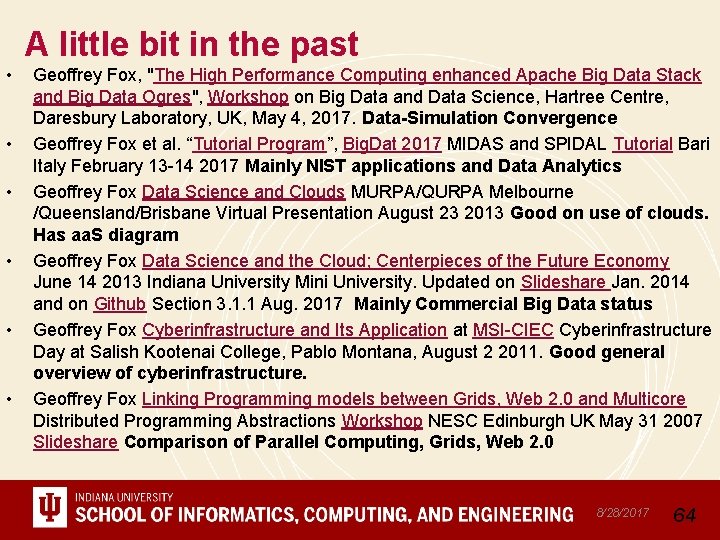
A little bit in the past • • • Geoffrey Fox, "The High Performance Computing enhanced Apache Big Data Stack and Big Data Ogres", Workshop on Big Data and Data Science, Hartree Centre, Daresbury Laboratory, UK, May 4, 2017. Data-Simulation Convergence Geoffrey Fox et al. “Tutorial Program”, Big. Dat 2017 MIDAS and SPIDAL Tutorial Bari Italy February 13 -14 2017 Mainly NIST applications and Data Analytics Geoffrey Fox Data Science and Clouds MURPA/QURPA Melbourne /Queensland/Brisbane Virtual Presentation August 23 2013 Good on use of clouds. Has aa. S diagram Geoffrey Fox Data Science and the Cloud; Centerpieces of the Future Economy June 14 2013 Indiana University Mini University. Updated on Slideshare Jan. 2014 and on Github Section 3. 1. 1 Aug. 2017 Mainly Commercial Big Data status Geoffrey Fox Cyberinfrastructure and Its Application at MSI-CIEC Cyberinfrastructure Day at Salish Kootenai College, Pablo Montana, August 2 2011. Good general overview of cyberinfrastructure. Geoffrey Fox Linking Programming models between Grids, Web 2. 0 and Multicore Distributed Programming Abstractions Workshop NESC Edinburgh UK May 31 2007 Slideshare Comparison of Parallel Computing, Grids, Web 2. 0 8/28/2017 64
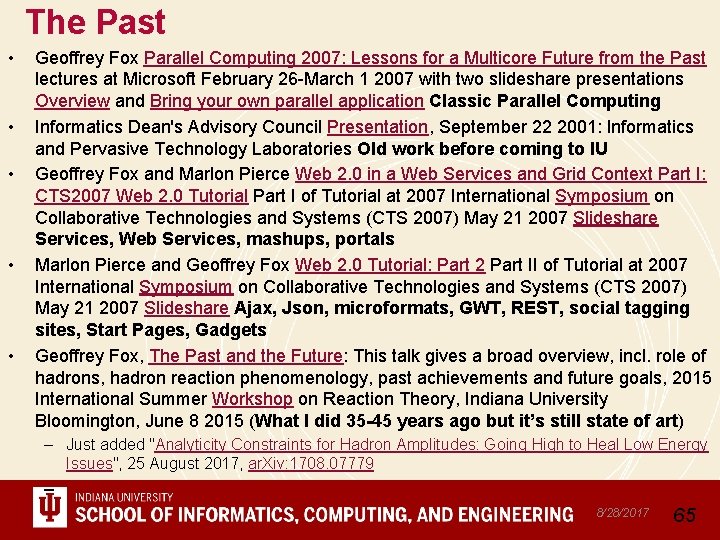
The Past • • • Geoffrey Fox Parallel Computing 2007: Lessons for a Multicore Future from the Past lectures at Microsoft February 26 -March 1 2007 with two slideshare presentations Overview and Bring your own parallel application Classic Parallel Computing Informatics Dean's Advisory Council Presentation, September 22 2001: Informatics and Pervasive Technology Laboratories Old work before coming to IU Geoffrey Fox and Marlon Pierce Web 2. 0 in a Web Services and Grid Context Part I: CTS 2007 Web 2. 0 Tutorial Part I of Tutorial at 2007 International Symposium on Collaborative Technologies and Systems (CTS 2007) May 21 2007 Slideshare Services, Web Services, mashups, portals Marlon Pierce and Geoffrey Fox Web 2. 0 Tutorial: Part 2 Part II of Tutorial at 2007 International Symposium on Collaborative Technologies and Systems (CTS 2007) May 21 2007 Slideshare Ajax, Json, microformats, GWT, REST, social tagging sites, Start Pages, Gadgets Geoffrey Fox, The Past and the Future: This talk gives a broad overview, incl. role of hadrons, hadron reaction phenomenology, past achievements and future goals, 2015 International Summer Workshop on Reaction Theory, Indiana University Bloomington, June 8 2015 (What I did 35 -45 years ago but it’s still state of art) – Just added "Analyticity Constraints for Hadron Amplitudes: Going High to Heal Low Energy Issues", 25 August 2017, ar. Xiv: 1708. 07779 – 8/28/2017 65