
INTRODUCTION TO INTELLIGENCE General intelligence Multiple Intelligences Triarchic
- Slides: 45
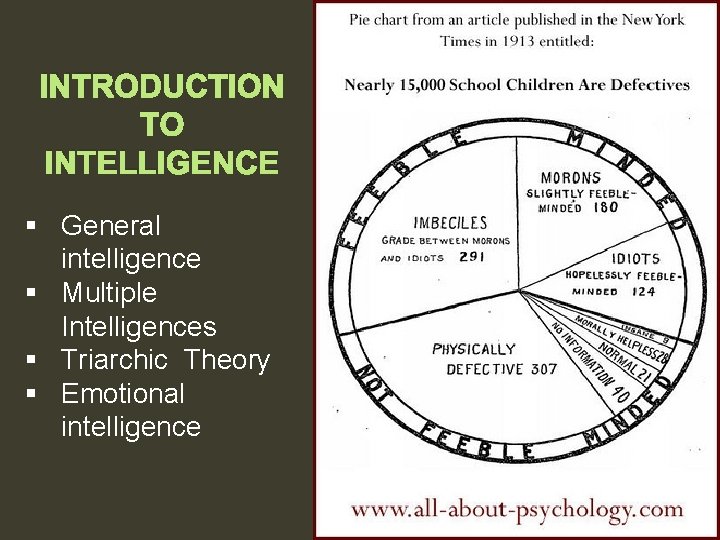
INTRODUCTION TO INTELLIGENCE § General intelligence § Multiple Intelligences § Triarchic Theory § Emotional intelligence
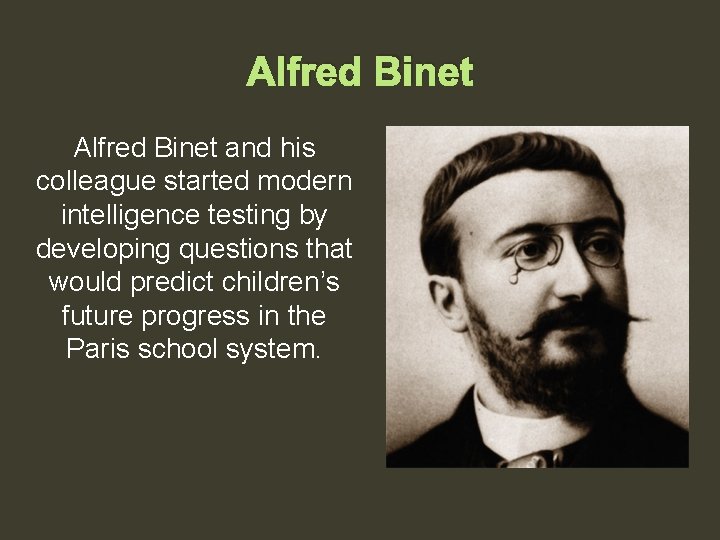
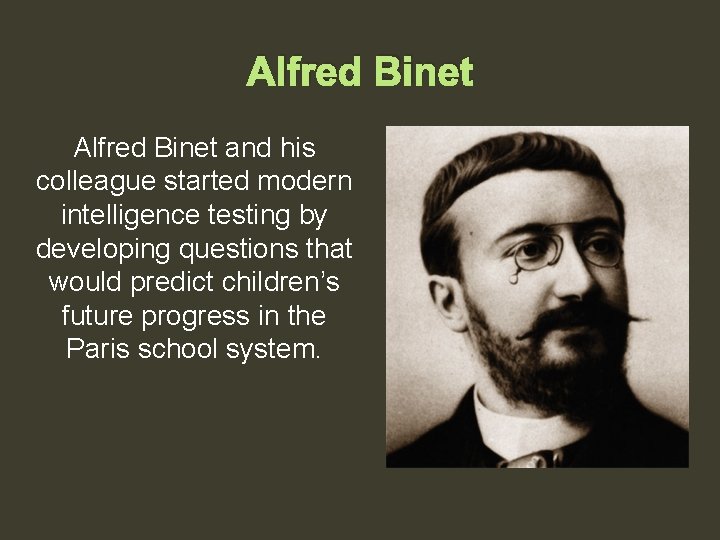
Alfred Binet and his colleague started modern intelligence testing by developing questions that would predict children’s future progress in the Paris school system.
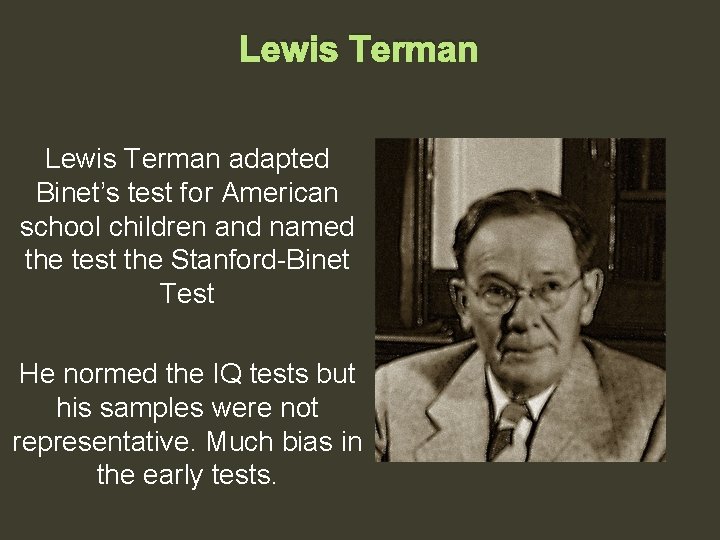
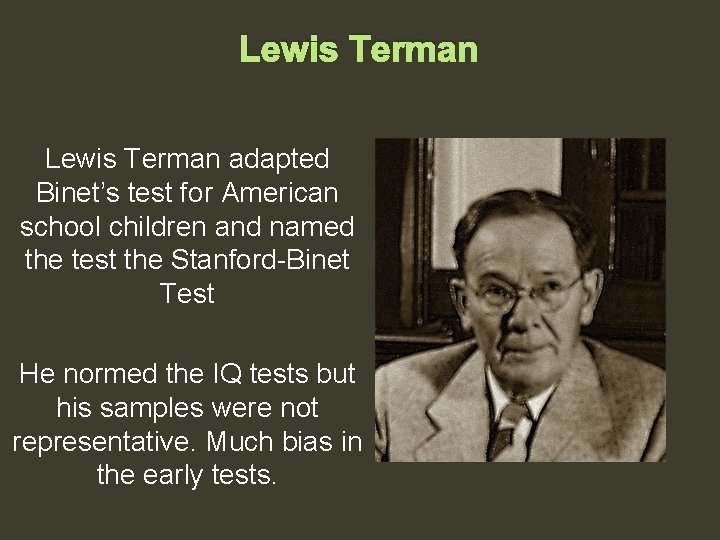
Lewis Terman adapted Binet’s test for American school children and named the test the Stanford-Binet Test He normed the IQ tests but his samples were not representative. Much bias in the early tests.
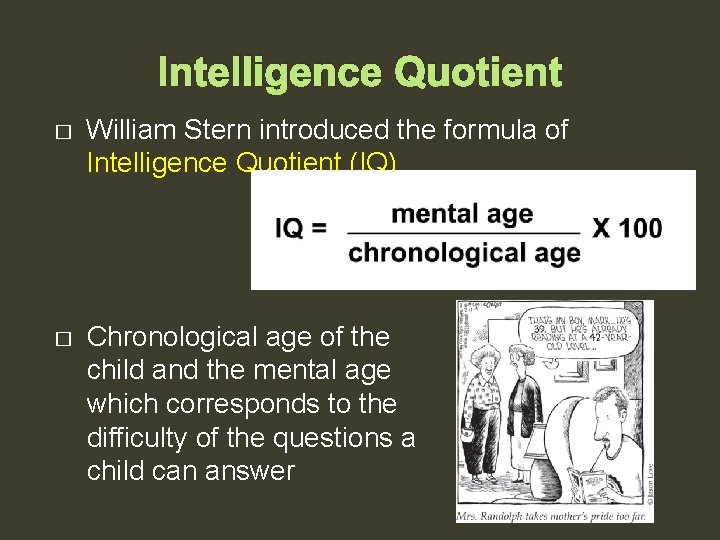
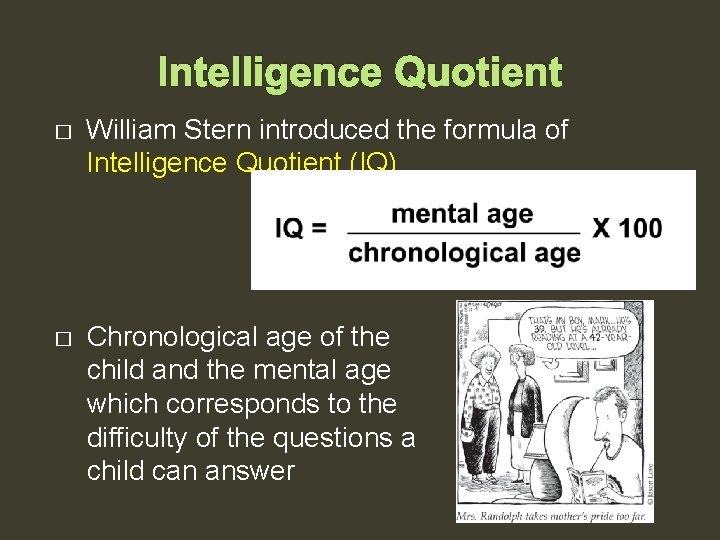
Intelligence Quotient � William Stern introduced the formula of Intelligence Quotient (IQ) � Chronological age of the child and the mental age which corresponds to the difficulty of the questions a child can answer
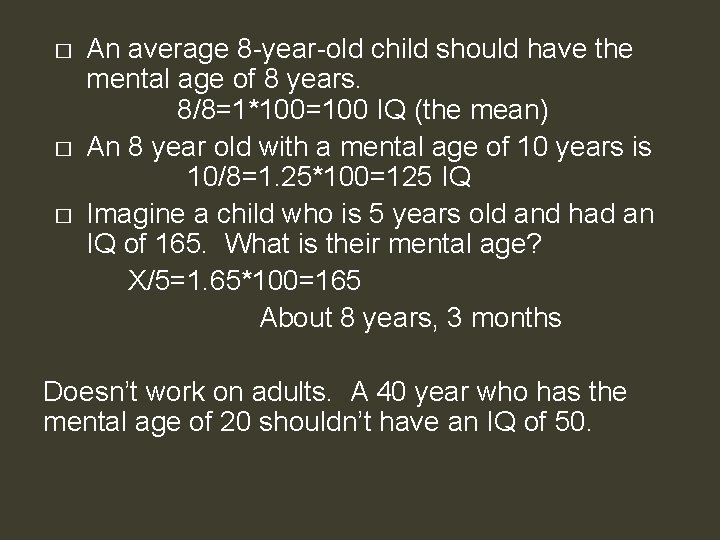
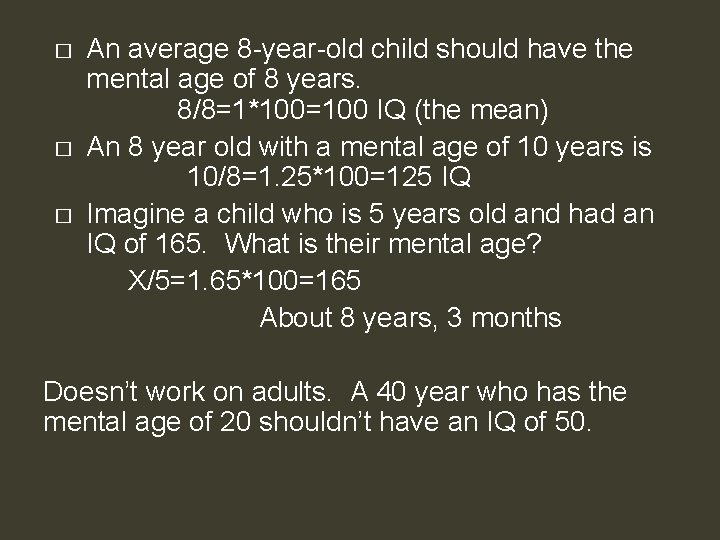
� � � An average 8 -year-old child should have the mental age of 8 years. 8/8=1*100=100 IQ (the mean) An 8 year old with a mental age of 10 years is 10/8=1. 25*100=125 IQ Imagine a child who is 5 years old and had an IQ of 165. What is their mental age? X/5=1. 65*100=165 About 8 years, 3 months Doesn’t work on adults. A 40 year who has the mental age of 20 shouldn’t have an IQ of 50.
What is Intelligence? Intelligence (in all cultures) is the ability to learn from experience, solve problems, and use knowledge to adapt to new situations. Psychologists believe that intelligence is a concept and not a “thing. ” In research studies, intelligence is whatever the intelligence tests measure … which tends to be school smarts.
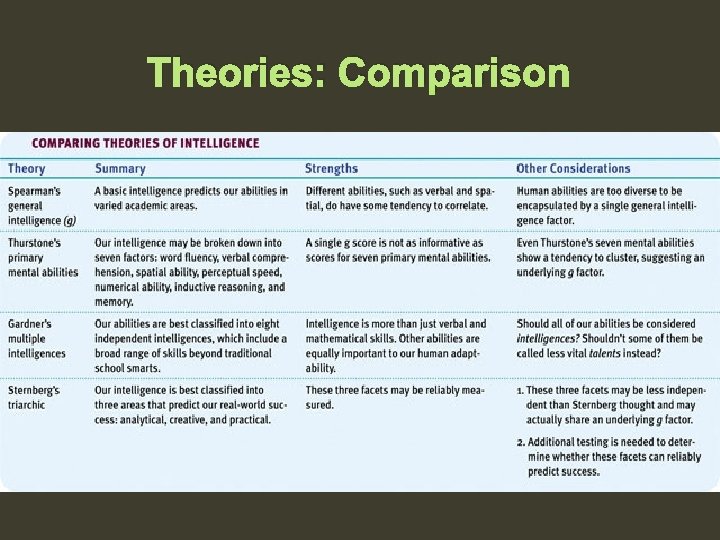
General Intelligence Spearman proposed that general intelligence (g), is linked to many clusters that can be analyzed by factor analysis. “G FACTOR” For example, people who do well on vocabulary do well on paragraph comprehension, a cluster that helps define verbal intelligence.
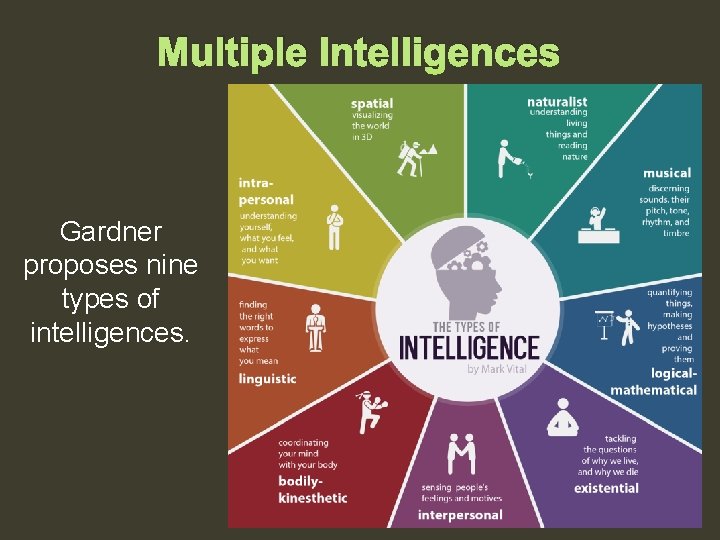
“First a word about “MI theory. ” On the basis of research in several disciplines, including the study of how human capacities are represented in the brain, I developed the idea that each of us has a number of relatively independent mental faculties, which can be termed our “multiple intelligences. ” The basic idea is simplicity itself. A belief in a single intelligence assumes that we have one central, allpurpose computer—and it determines how well we perform in every sector of life. In contrast, a belief in multiple intelligences assumes that we have a number of relatively autonomous computers—one that computes linguistic information, another spatial information, another musical information, another information about other people, and so on. I estimate that human beings have 7 to 10 distinct intelligences (see www. multipleintelligencesoasis. org). -Howard Gardiner 8
Multiple Intelligences Gardner proposes nine types of intelligences.
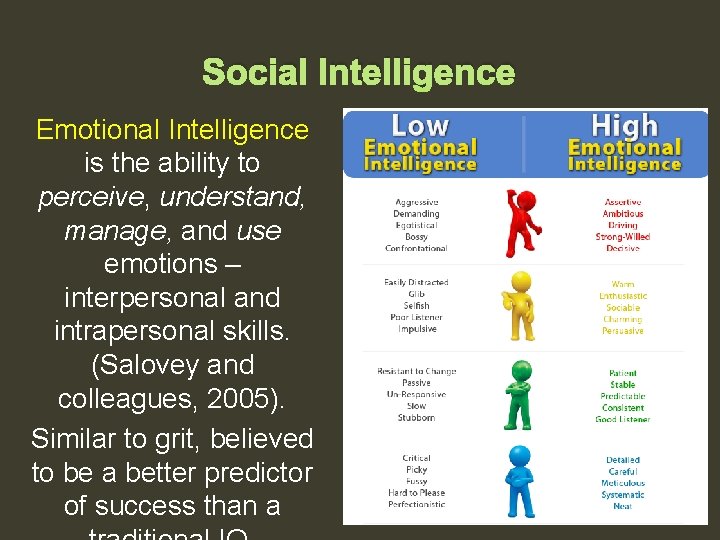
Social Intelligence Emotional Intelligence is the ability to perceive, understand, manage, and use emotions – interpersonal and intrapersonal skills. (Salovey and colleagues, 2005). Similar to grit, believed to be a better predictor of success than a
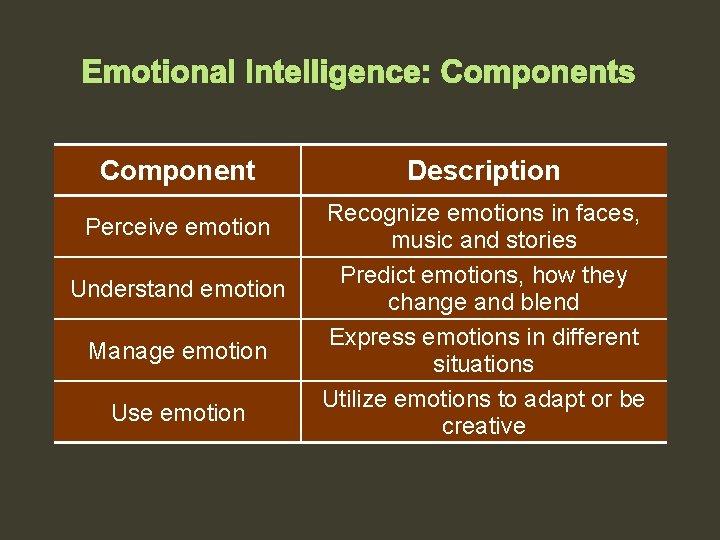
Emotional Intelligence: Components Component Perceive emotion Understand emotion Manage emotion Use emotion Description Recognize emotions in faces, music and stories Predict emotions, how they change and blend Express emotions in different situations Utilize emotions to adapt or be creative
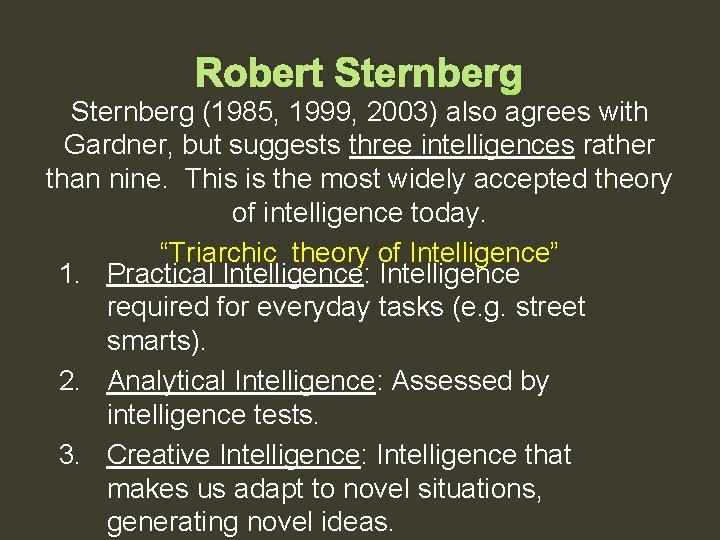
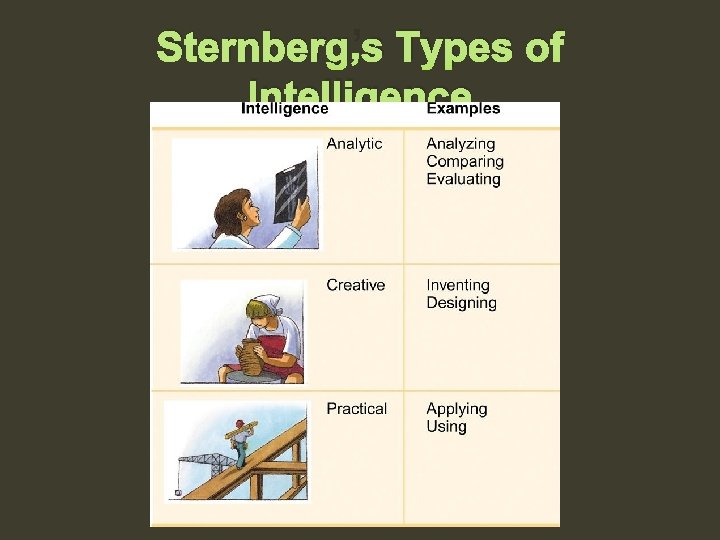
Robert Sternberg (1985, 1999, 2003) also agrees with Gardner, but suggests three intelligences rather than nine. This is the most widely accepted theory of intelligence today. “Triarchic theory of Intelligence” 1. Practical Intelligence: Intelligence required for everyday tasks (e. g. street smarts). 2. Analytical Intelligence: Assessed by intelligence tests. 3. Creative Intelligence: Intelligence that makes us adapt to novel situations, generating novel ideas.
Sternberg’s Types of Intelligence
Theories: Comparison
Is Intelligence a Predictor of Success? � � College entry, degree program. Grit more important. � Passion and perseverance of long-term goals. � 10 -Year Rule – peak after intense practice 15
Intelligence and Creativity is the ability to produce ideas that are both novel and valuable. 1. 2. 3. 4. 5. Expertise: A well developed knowledge base. Imaginative Thinking: The ability to see things in novel ways. Adventuresome Personality: Seeks new experiences rather than following the pack. Intrinsic Motivation: Motivated to be creative from within. A Creative Environment: Creativity blooms in creative and supportive environment.
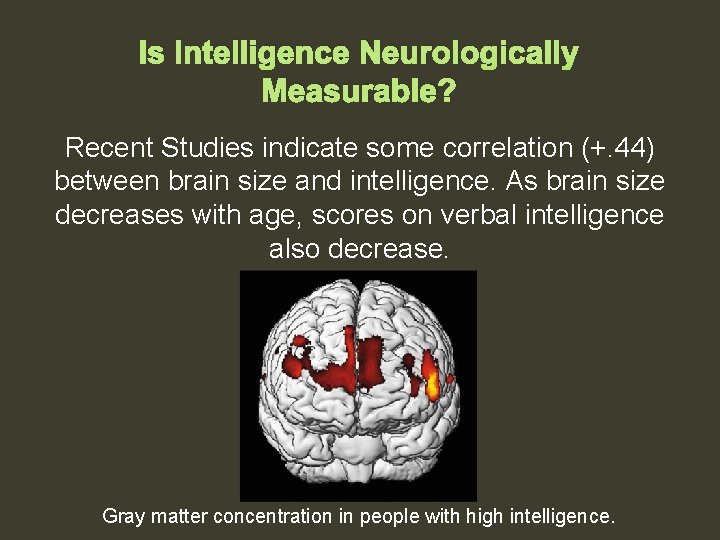
Is Intelligence Neurologically Measurable? Recent Studies indicate some correlation (+. 44) between brain size and intelligence. As brain size decreases with age, scores on verbal intelligence also decrease. Gray matter concentration in people with high intelligence.
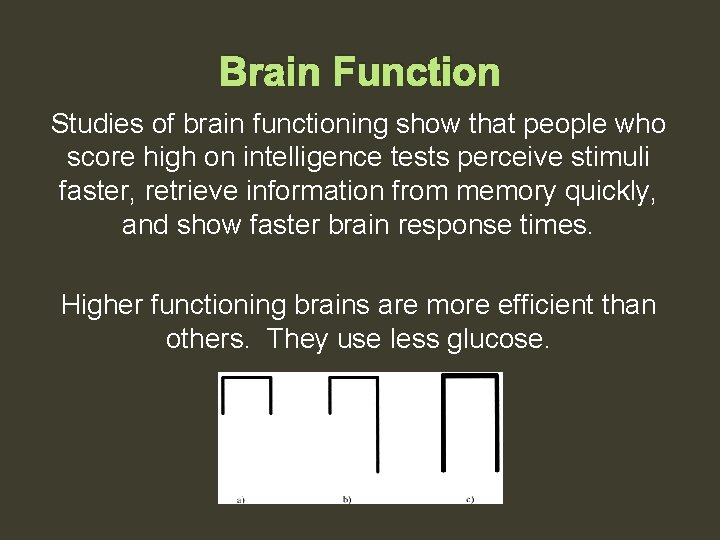
Brain Function Studies of brain functioning show that people who score high on intelligence tests perceive stimuli faster, retrieve information from memory quickly, and show faster brain response times. Higher functioning brains are more efficient than others. They use less glucose.
ASSESSING INTELLIGENCE -Assessing intelligence (know the people and the types of tests) -Achievement vs. Aptitude -Standardization and the Normal curve (be able to draw it on the AP EXAM) -Reliability -Validity
1. Which number should come next in the pattern? 37, 34, 31, 28 2. Find the answer that best completes the analogy: Book is to Reading as Fork is to: a. Drawing b. writing c. stirring d. eating 3. Find two words, one from each group, that are the closest in meaning: Group A talkative, job, ecstatic Group B angry, wind, loquacious a. talkative and wind b. job and angry c. talkative and loquacious d. ecstatic and angry 4. Which of the following can be arranged into a 5 -letter English word? a. H R G S T b. R I L S A c. T O O M T d. W Q R G S 5. What number best completes the analogy: 8: 4 as 10: a. 3 b. 7 c. 24 d. 5 20
Assessing Intelligence Psychologists define intelligence testing as a method for assessing an individual’s mental aptitudes and comparing them with others using numerical scores.
Alfred Binet and his colleague started modern intelligence testing by developing questions that would predict children’s future progress in the Paris school system.
Lewis Terman adapted Binet’s test for American school children and named the test the Stanford-Binet Test He normed the IQ tests but his samples were not representative. Much bias in the early tests.
Intelligence Quotient � William Stern introduced the formula of Intelligence Quotient (IQ) � Chronological age of the child and the mental age which corresponds to the difficulty of the questions a child can answer
� � � An average 8 -year-old child should have the mental age of 8 years. 8/8=1*100=100 IQ (the mean) An 8 year old with a mental age of 10 years is 10/8=1. 25*100=125 IQ Imagine a child who is 5 years old and had an IQ of 165. What is their mental age? X/5=1. 65*100=165 About 8 years, 3 months Doesn’t work on adults. A 40 year who has the mental age of 20 shouldn’t have an IQ of 50.
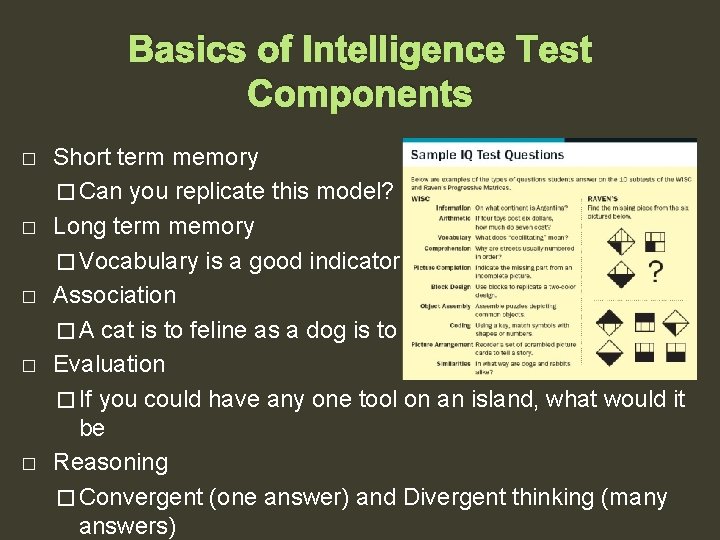
Basics of Intelligence Test Components � � � Short term memory � Can you replicate this model? Long term memory � Vocabulary is a good indicator Association � A cat is to feline as a dog is to …. Evaluation � If you could have any one tool on an island, what would it be Reasoning � Convergent (one answer) and Divergent thinking (many answers)
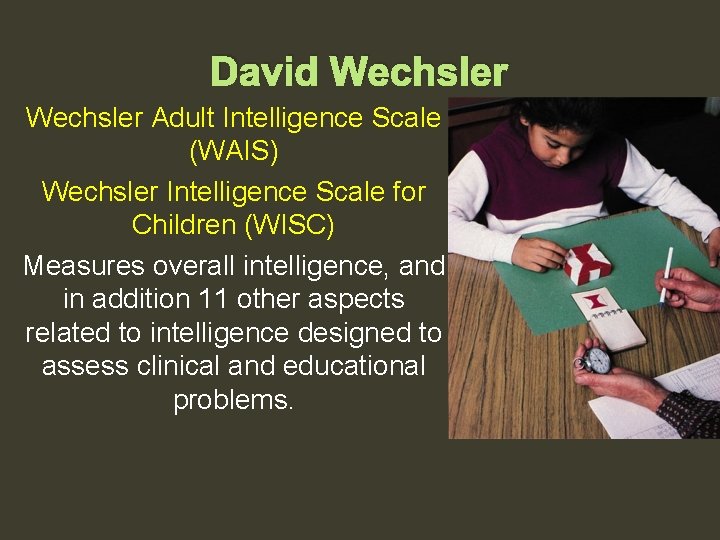
David Wechsler Adult Intelligence Scale (WAIS) Wechsler Intelligence Scale for Children (WISC) Measures overall intelligence, and in addition 11 other aspects related to intelligence designed to assess clinical and educational problems.
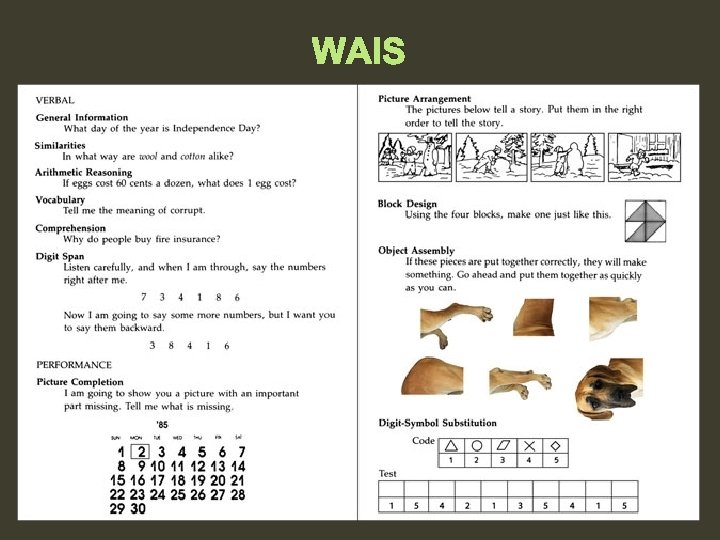
WAIS
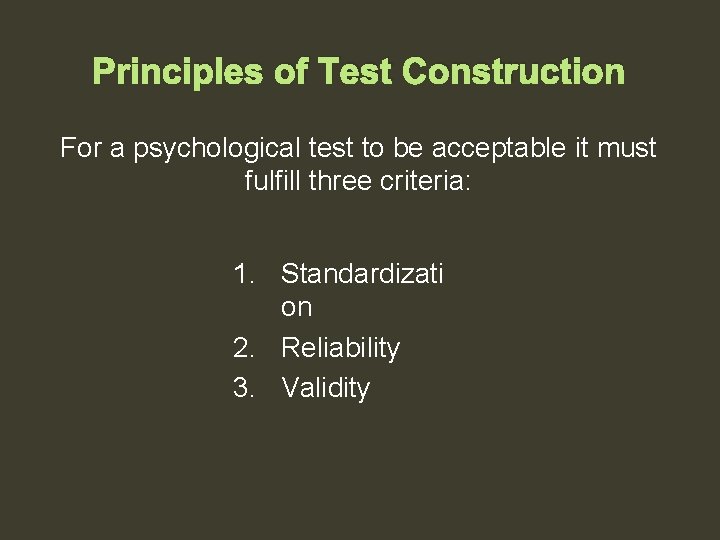
Principles of Test Construction For a psychological test to be acceptable it must fulfill three criteria: 1. Standardizati on 2. Reliability 3. Validity
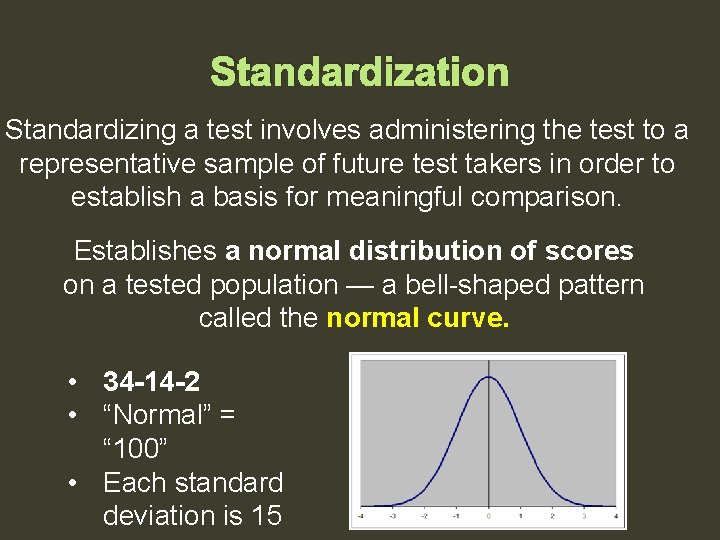
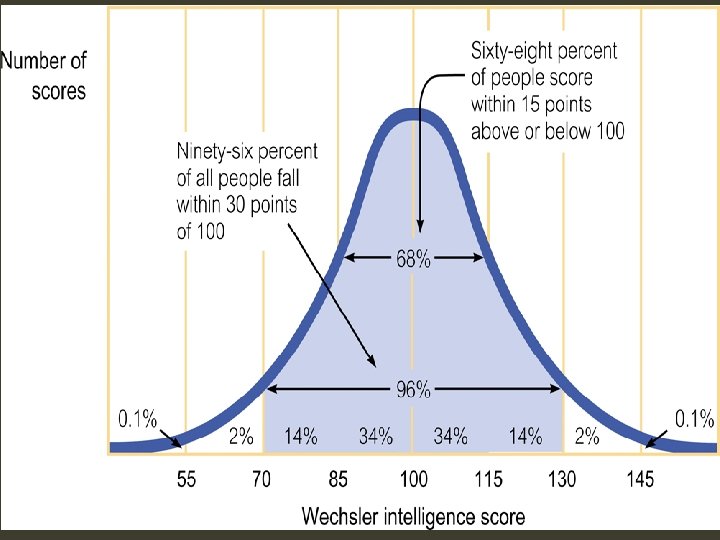
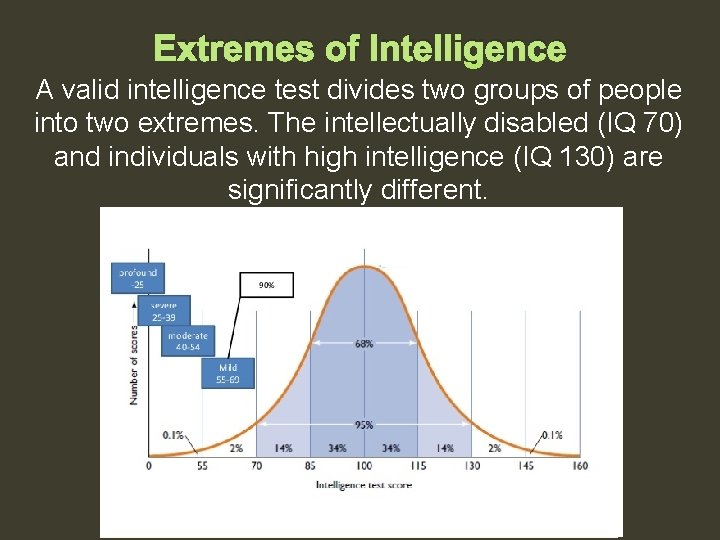
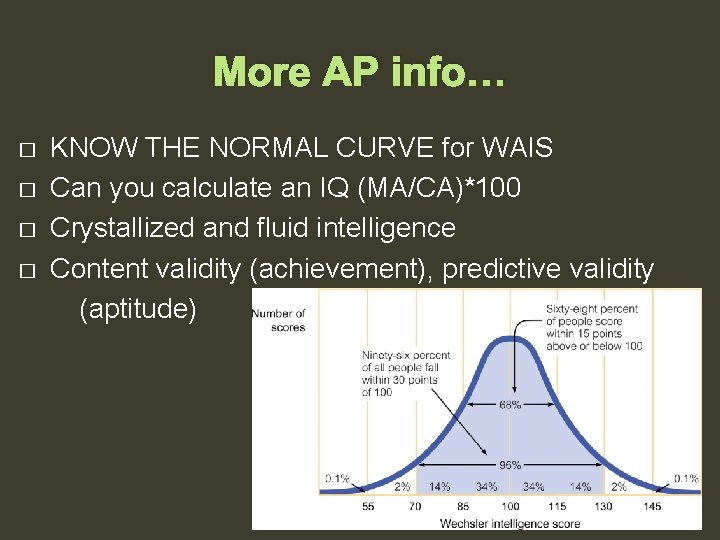
Standardization Standardizing a test involves administering the test to a representative sample of future test takers in order to establish a basis for meaningful comparison. Establishes a normal distribution of scores on a tested population — a bell-shaped pattern called the normal curve. • 34 -14 -2 • “Normal” = “ 100” • Each standard deviation is 15
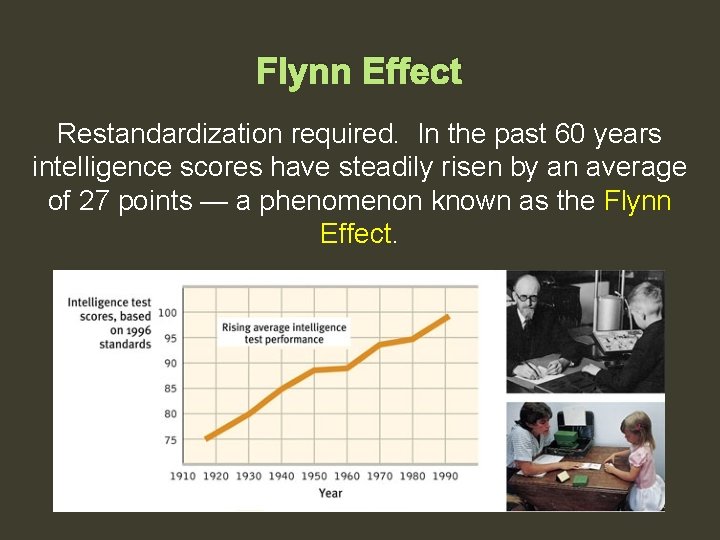
Flynn Effect Restandardization required. In the past 60 years intelligence scores have steadily risen by an average of 27 points — a phenomenon known as the Flynn Effect.
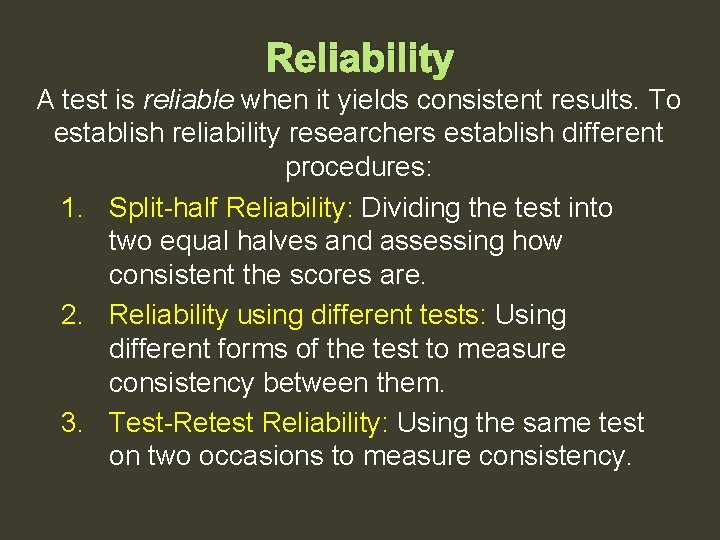
Reliability A test is reliable when it yields consistent results. To establish reliability researchers establish different procedures: 1. Split-half Reliability: Dividing the test into two equal halves and assessing how consistent the scores are. 2. Reliability using different tests: Using different forms of the test to measure consistency between them. 3. Test-Retest Reliability: Using the same test on two occasions to measure consistency.
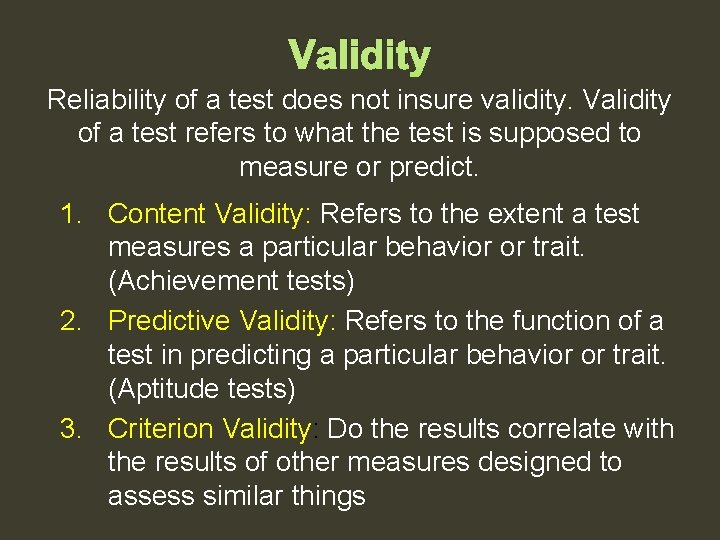
Validity Reliability of a test does not insure validity. Validity of a test refers to what the test is supposed to measure or predict. 1. Content Validity: Refers to the extent a test measures a particular behavior or trait. (Achievement tests) 2. Predictive Validity: Refers to the function of a test in predicting a particular behavior or trait. (Aptitude tests) 3. Criterion Validity: Do the results correlate with the results of other measures designed to assess similar things
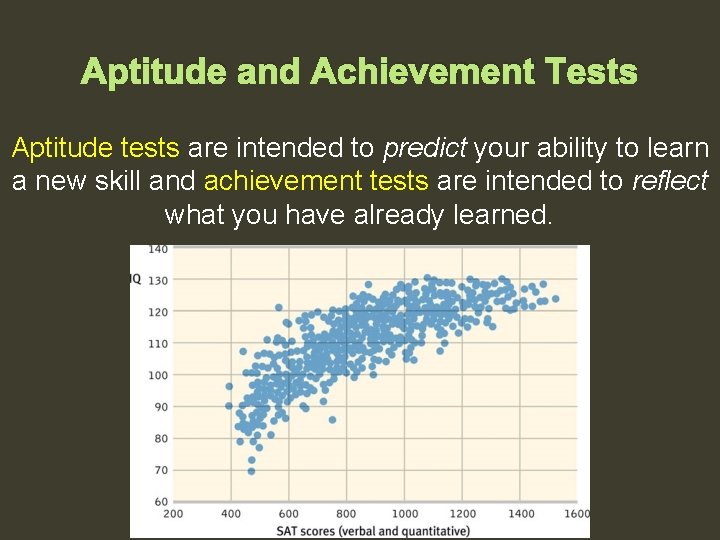
Aptitude and Achievement Tests Aptitude tests are intended to predict your ability to learn a new skill and achievement tests are intended to reflect what you have already learned.
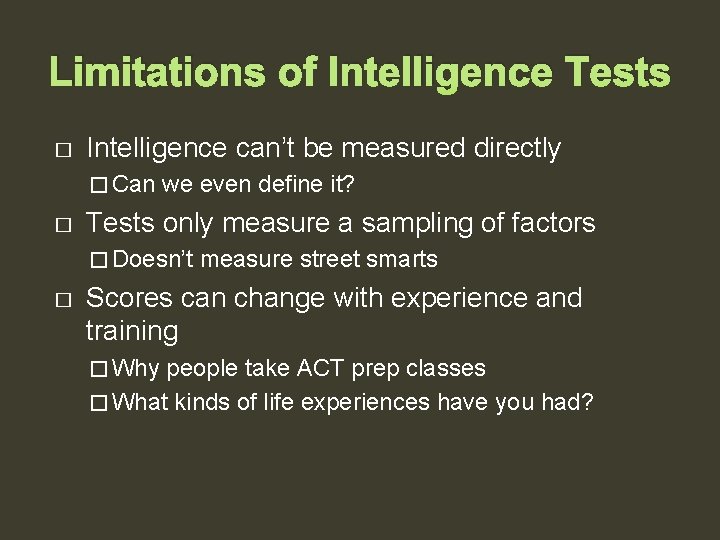
Limitations of Intelligence Tests � Intelligence can’t be measured directly � Can � we even define it? Tests only measure a sampling of factors � Doesn’t � measure street smarts Scores can change with experience and training � Why people take ACT prep classes � What kinds of life experiences have you had?
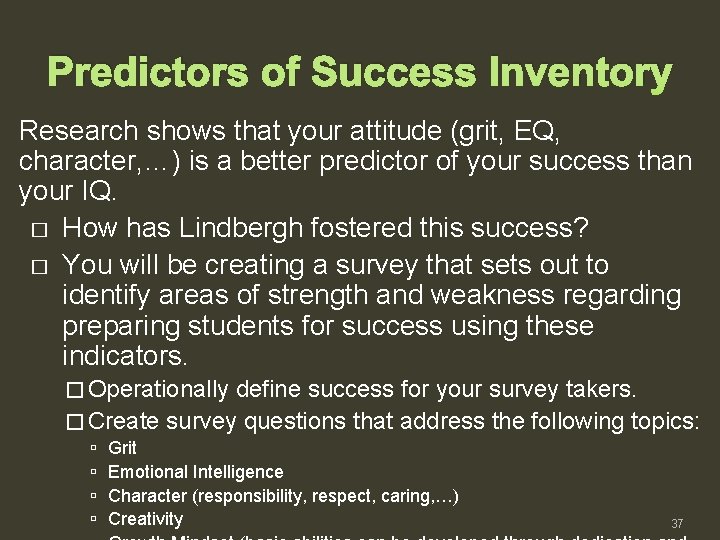
Predictors of Success Inventory Research shows that your attitude (grit, EQ, character, …) is a better predictor of your success than your IQ. � How has Lindbergh fostered this success? � You will be creating a survey that sets out to identify areas of strength and weakness regarding preparing students for success using these indicators. � Operationally define success for your survey takers. � Create survey questions that address the following topics: Grit Emotional Intelligence Character (responsibility, respect, caring, …) Creativity 37
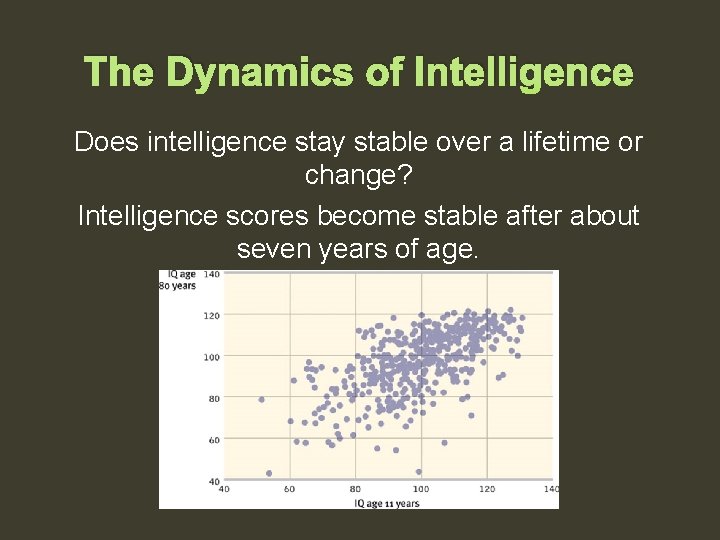
The Dynamics of Intelligence Does intelligence stay stable over a lifetime or change? Intelligence scores become stable after about seven years of age.
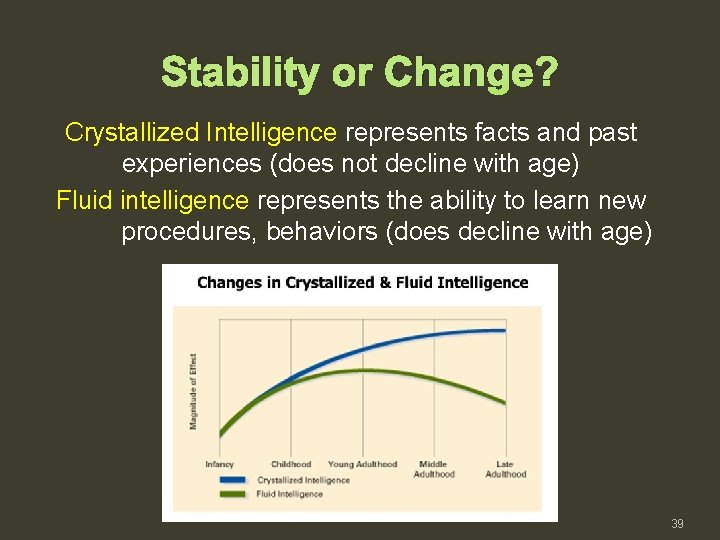
Stability or Change? Crystallized Intelligence represents facts and past experiences (does not decline with age) Fluid intelligence represents the ability to learn new procedures, behaviors (does decline with age) 39
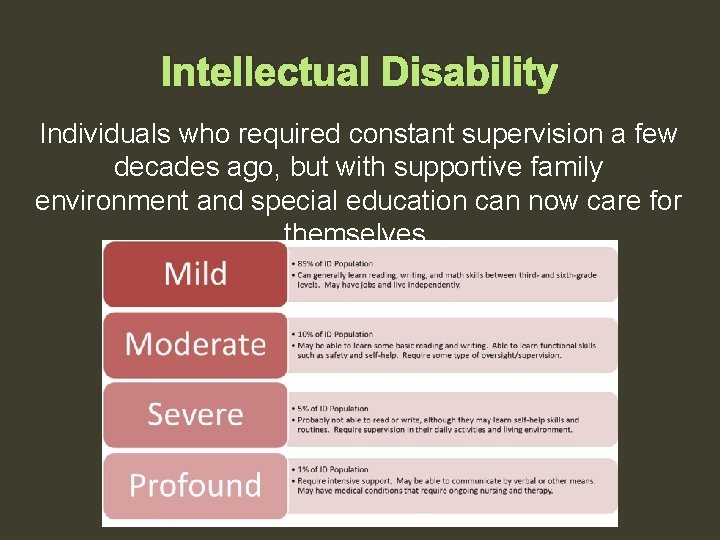
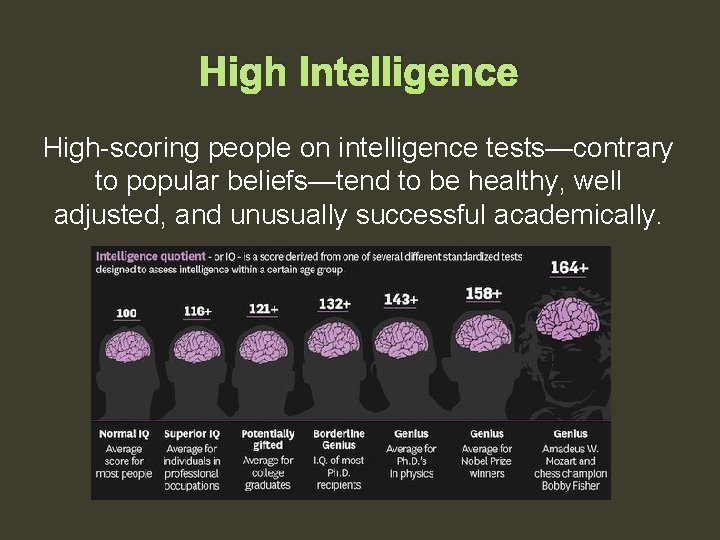
Extremes of Intelligence A valid intelligence test divides two groups of people into two extremes. The intellectually disabled (IQ 70) and individuals with high intelligence (IQ 130) are significantly different.
Intellectual Disability Individuals who required constant supervision a few decades ago, but with supportive family environment and special education can now care for themselves.
High Intelligence High-scoring people on intelligence tests—contrary to popular beliefs—tend to be healthy, well adjusted, and unusually successful academically.
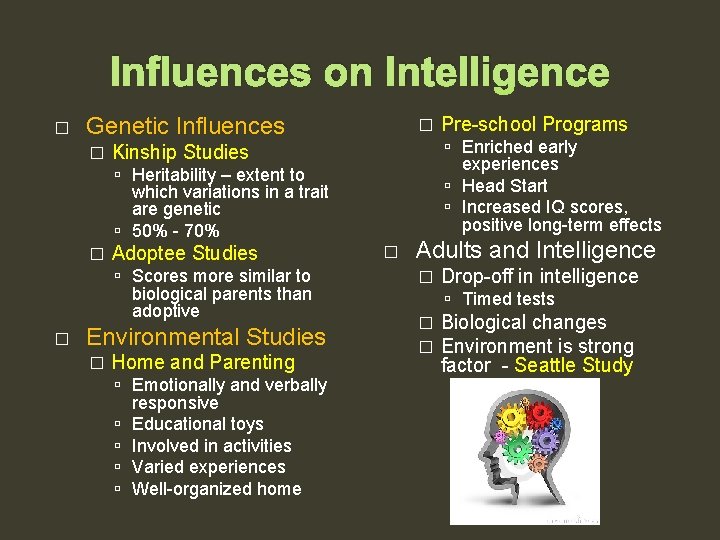
Influences on Intelligence � Genetic Influences � � Enriched early experiences Head Start Increased IQ scores, positive long-term effects Kinship Studies Heritability – extent to which variations in a trait are genetic 50% - 70% � Adoptee Studies Scores more similar to biological parents than adoptive � Environmental Studies � Home and Parenting Emotionally and verbally responsive Educational toys Involved in activities Varied experiences Well-organized home Pre-school Programs � Adults and Intelligence � Drop-off in intelligence Timed tests � � Biological changes Environment is strong factor - Seattle Study
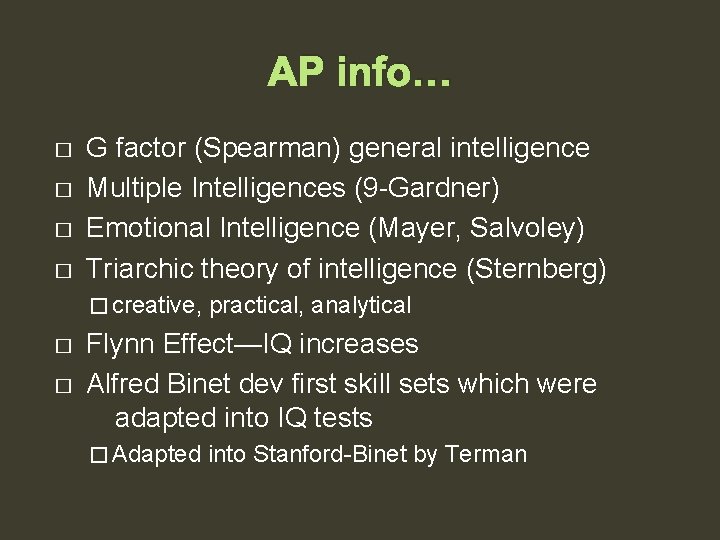
AP info… � � G factor (Spearman) general intelligence Multiple Intelligences (9 -Gardner) Emotional Intelligence (Mayer, Salvoley) Triarchic theory of intelligence (Sternberg) � creative, � � practical, analytical Flynn Effect—IQ increases Alfred Binet dev first skill sets which were adapted into IQ tests � Adapted into Stanford-Binet by Terman
More AP info… � � KNOW THE NORMAL CURVE for WAIS Can you calculate an IQ (MA/CA)*100 Crystallized and fluid intelligence Content validity (achievement), predictive validity (aptitude)