
INTRODUCTION TO INTEGERS ILLUSTRATING INTEGERS The University of




- Slides: 41
INTRODUCTION TO INTEGERS ILLUSTRATING INTEGERS The University of Texas at Dallas
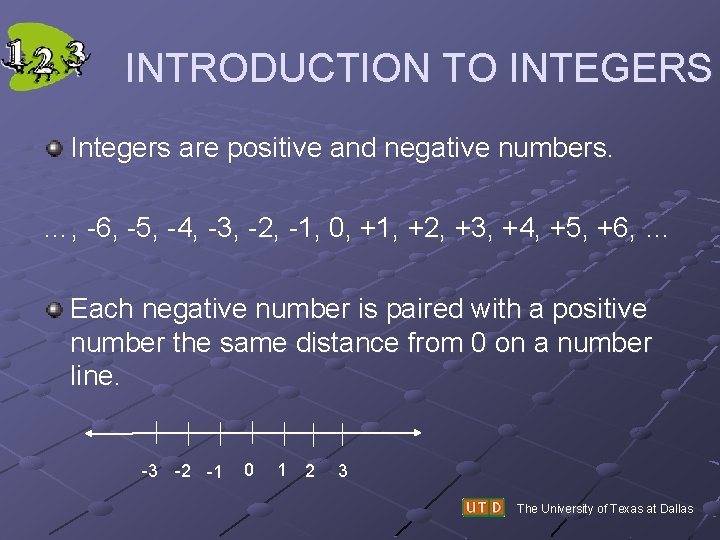
INTRODUCTION TO INTEGERS Integers are positive and negative numbers. …, -6, -5, -4, -3, -2, -1, 0, +1, +2, +3, +4, +5, +6, … Each negative number is paired with a positive number the same distance from 0 on a number line. -3 -2 -1 0 1 2 3 The University of Texas at Dallas
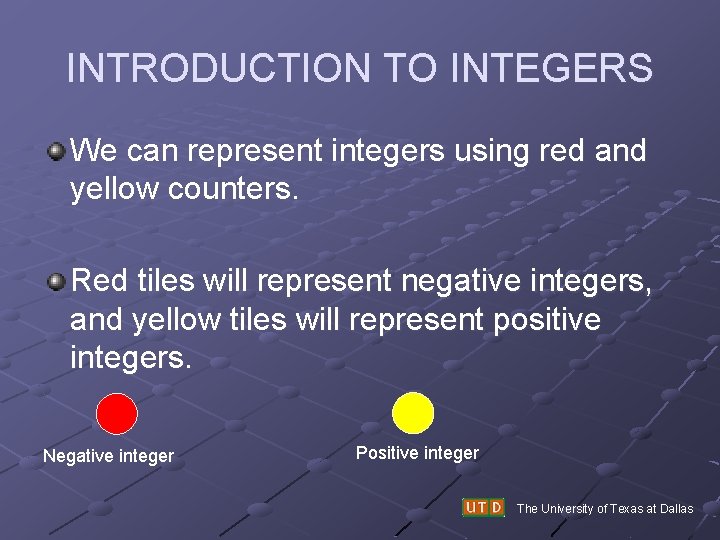
INTRODUCTION TO INTEGERS We can represent integers using red and yellow counters. Red tiles will represent negative integers, and yellow tiles will represent positive integers. Negative integer Positive integer The University of Texas at Dallas
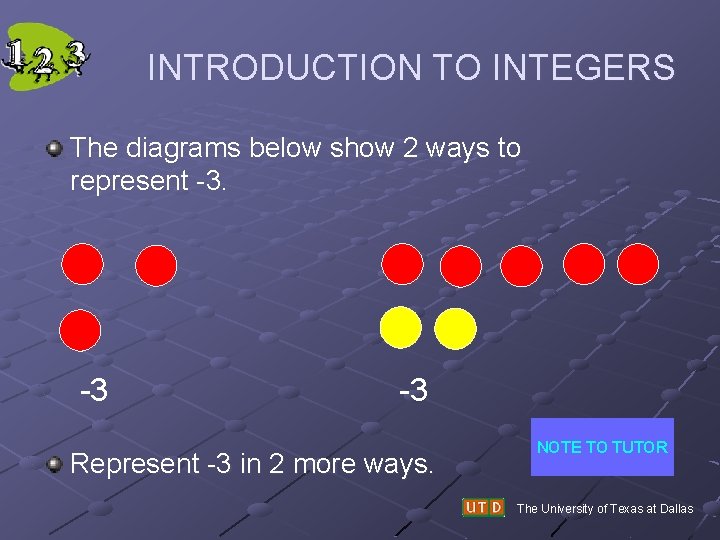
INTRODUCTION TO INTEGERS The diagrams below show 2 ways to represent -3. -3 -3 Represent -3 in 2 more ways. NOTE TO TUTOR The University of Texas at Dallas
INTRODUCTION TO INTEGERS Students may represent -3 by using 3 red tiles and any number of groups of +1 and -1 tiles The University of Texas at Dallas
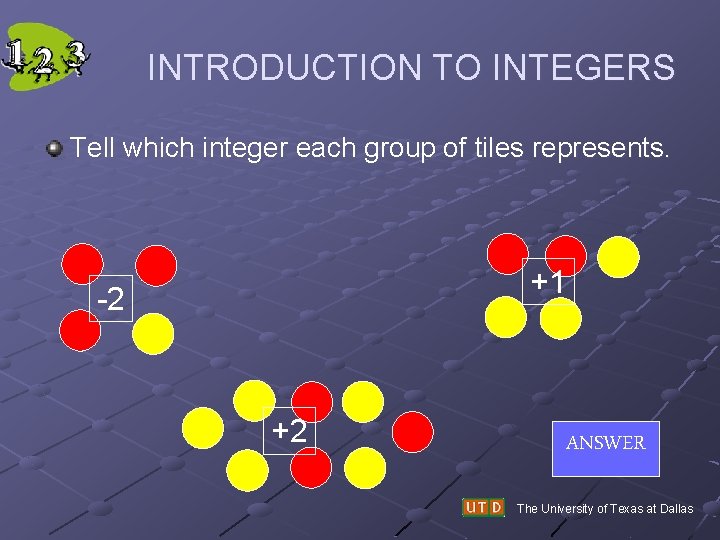
INTRODUCTION TO INTEGERS Tell which integer each group of tiles represents. +1 -2 +2 ANSWER The University of Texas at Dallas
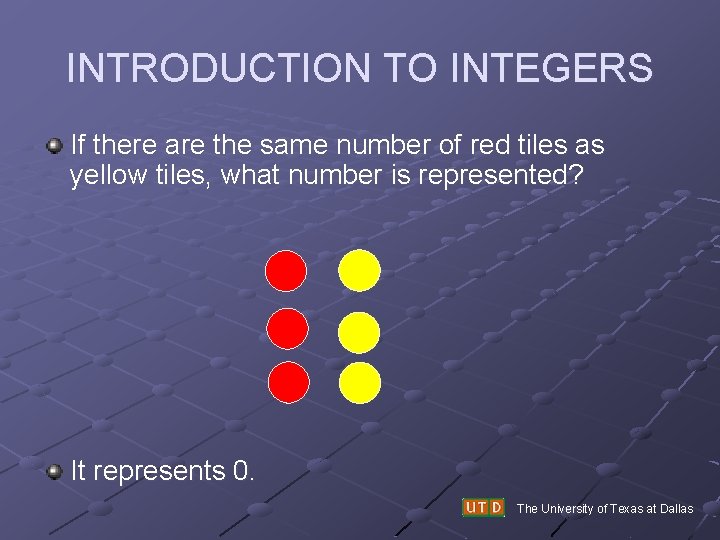
INTRODUCTION TO INTEGERS If there are the same number of red tiles as yellow tiles, what number is represented? It represents 0. The University of Texas at Dallas
ADDITION AND SUBTRACTION The University of Texas at Dallas
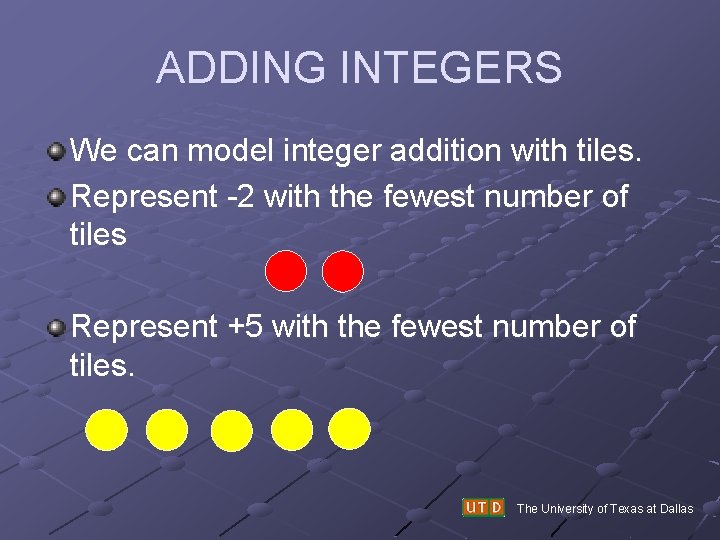
ADDING INTEGERS We can model integer addition with tiles. Represent -2 with the fewest number of tiles Represent +5 with the fewest number of tiles. The University of Texas at Dallas
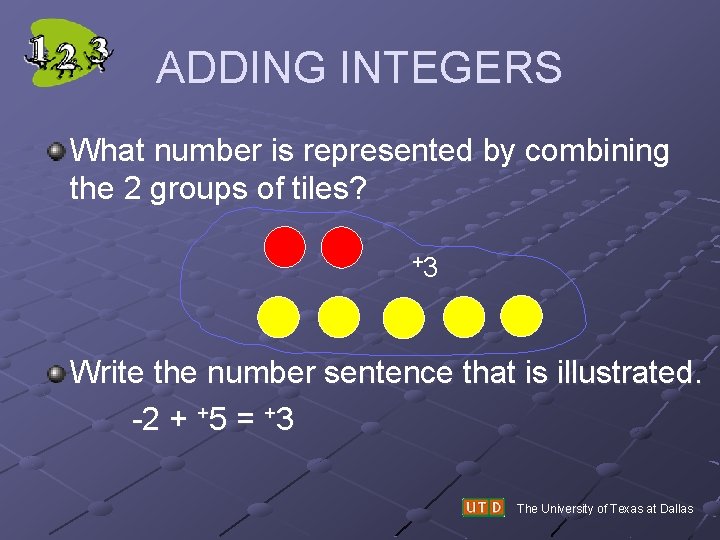
ADDING INTEGERS What number is represented by combining the 2 groups of tiles? +3 Write the number sentence that is illustrated. -2 + +5 = +3 The University of Texas at Dallas
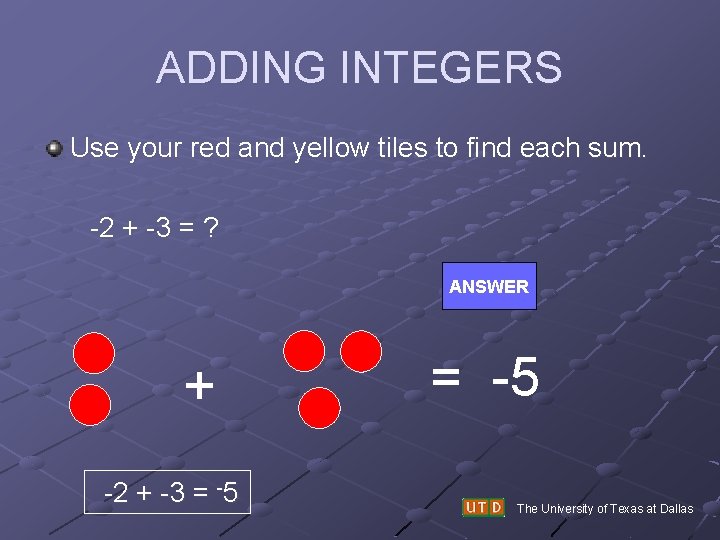
ADDING INTEGERS Use your red and yellow tiles to find each sum. -2 + -3 = ? ANSWER + -2 + -3 = -5 The University of Texas at Dallas
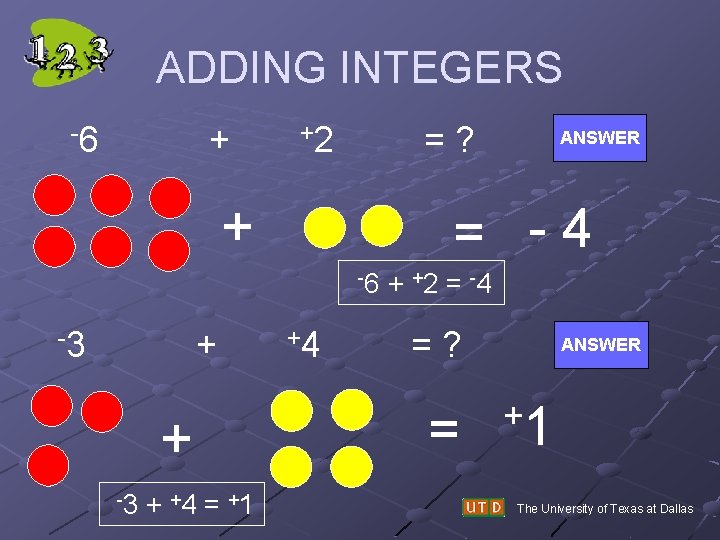
ADDING INTEGERS -6 + +2 =? + = -4 -6 -3 + +4 = +1 ANSWER +4 + + 2 = -4 =? = ANSWER +1 The University of Texas at Dallas
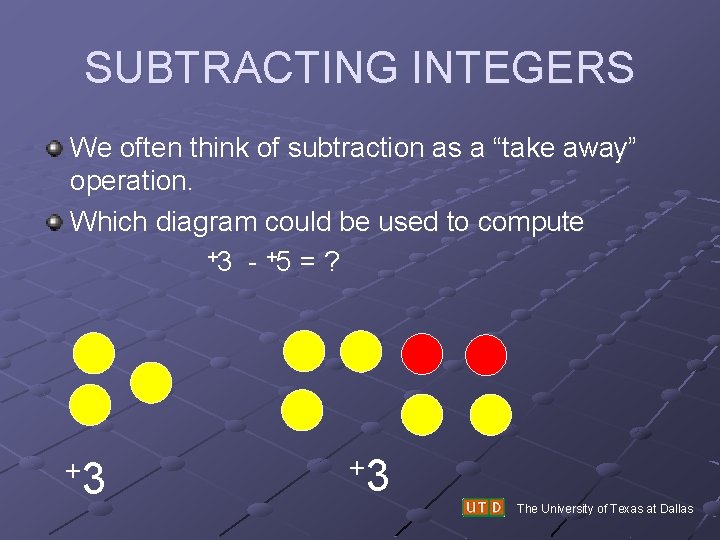
SUBTRACTING INTEGERS We often think of subtraction as a “take away” operation. Which diagram could be used to compute +3 - +5 = ? +3 +3 The University of Texas at Dallas
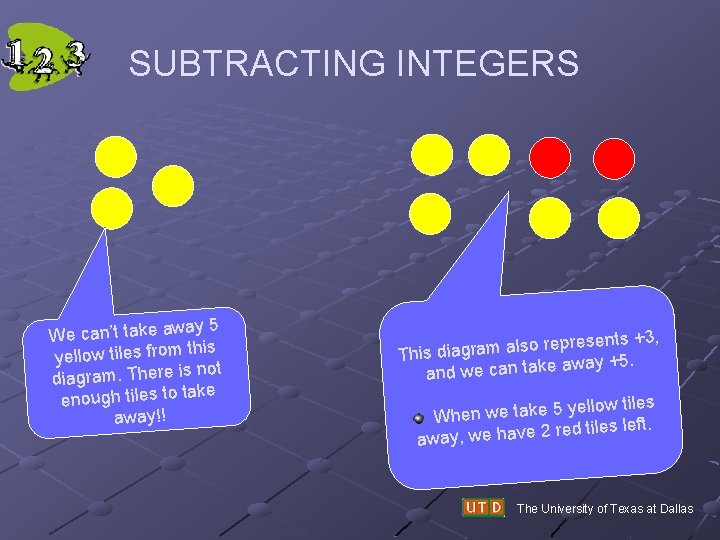
SUBTRACTING INTEGERS ay 5 We can’t take aw this yellow tiles from not diagram. There is ke enough tiles to ta away!! ents +3, s re p re o ls a m ra This diag away +5. e k ta n a c e w d n a yellow tiles When we take 5 d tiles left. re 2 e v a h e w , y awa The University of Texas at Dallas
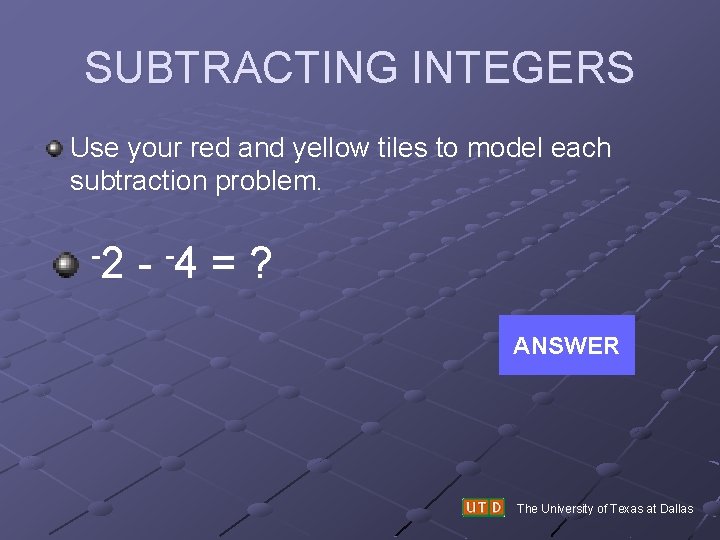
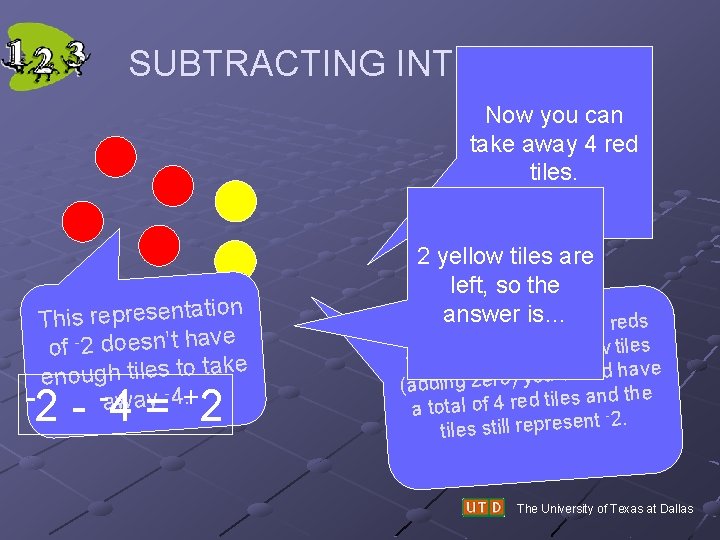
SUBTRACTING INTEGERS Use your red and yellow tiles to model each subtraction problem. -2 - -4 = ? ANSWER The University of Texas at Dallas
SUBTRACTING INTEGERS Now you can take away 4 red tiles. on This representati - 2 doesn’t have f o e k ta to s le ti h g u o en. -away -4+ 2 - 4= 2 2 yellow tiles are left, so the answer is…more reds Now if you add 2 tiles w o ll e y re o m 2 d tiles an have ld u o w u o y ) ro e z (adding d the n a s le ti d re 4 f o a total t -2. n e s re p re ll ti s s tile The University of Texas at Dallas
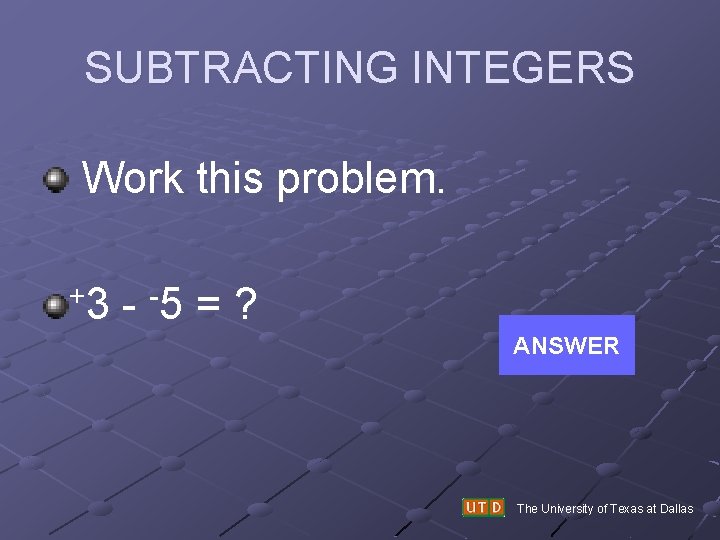
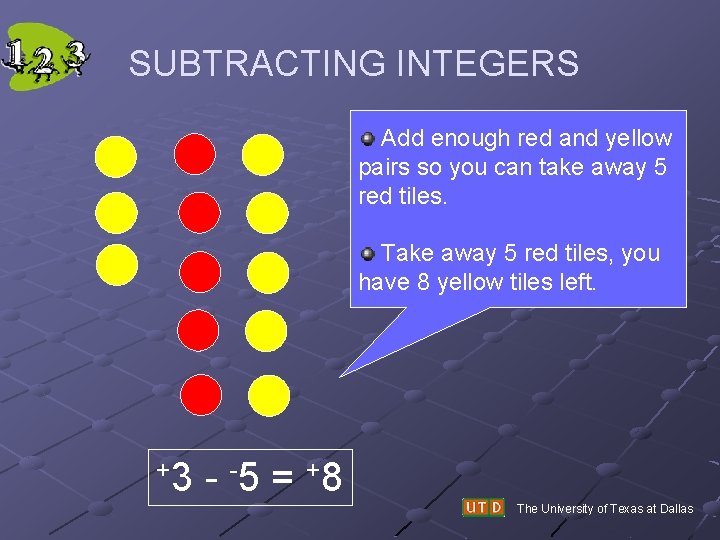
SUBTRACTING INTEGERS Work this problem. +3 - -5 = ? ANSWER The University of Texas at Dallas
SUBTRACTING INTEGERS Add enough red and yellow pairs so you can take away 5 red tiles. Take away 5 red tiles, you have 8 yellow tiles left. +3 - -5 = + 8 The University of Texas at Dallas
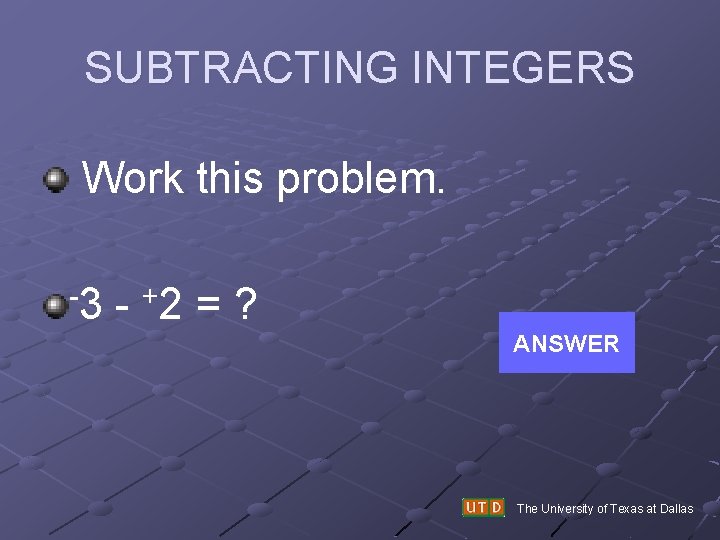
SUBTRACTING INTEGERS Work this problem. -3 - +2 = ? ANSWER The University of Texas at Dallas
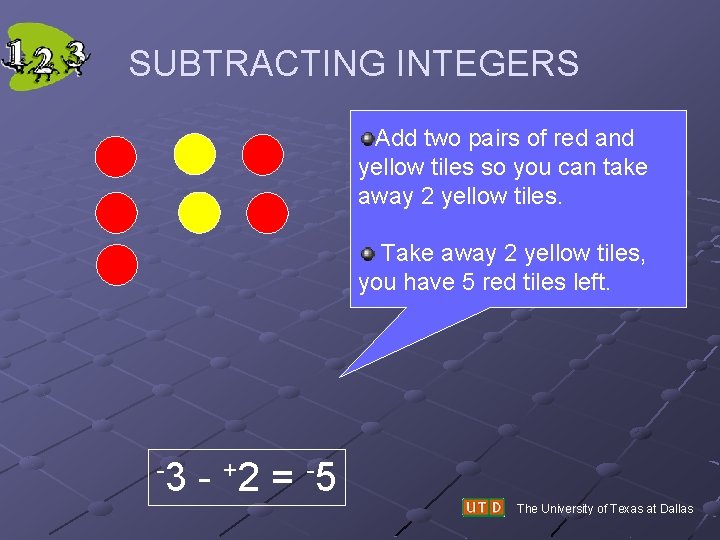
SUBTRACTING INTEGERS Add two pairs of red and yellow tiles so you can take away 2 yellow tiles. Take away 2 yellow tiles, you have 5 red tiles left. -3 - + 2 = -5 The University of Texas at Dallas
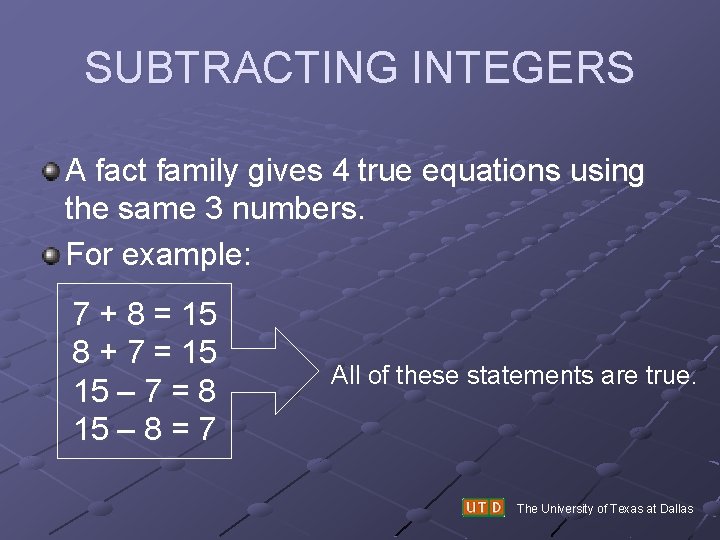
SUBTRACTING INTEGERS A fact family gives 4 true equations using the same 3 numbers. For example: 7 + 8 = 15 8 + 7 = 15 15 – 7 = 8 15 – 8 = 7 All of these statements are true. The University of Texas at Dallas
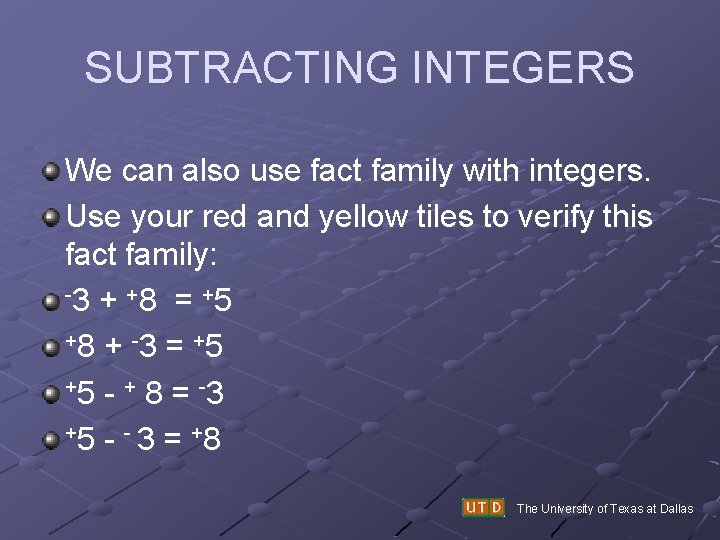
SUBTRACTING INTEGERS We can also use fact family with integers. Use your red and yellow tiles to verify this fact family: -3 + + 8 = + 5 + 8 + -3 = + 5 - + 8 = -3 +5 - - 3 = +8 The University of Texas at Dallas
INTEGERS AND MULTIPLICATION The University of Texas at Dallas
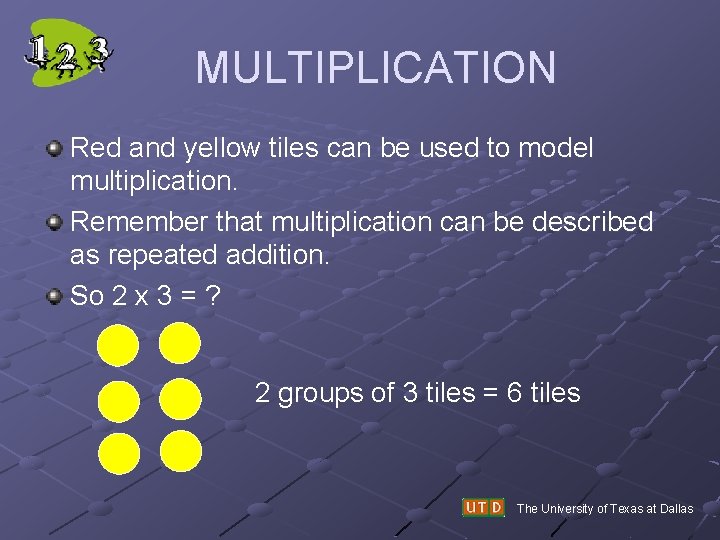
MULTIPLICATION Red and yellow tiles can be used to model multiplication. Remember that multiplication can be described as repeated addition. So 2 x 3 = ? 2 groups of 3 tiles = 6 tiles The University of Texas at Dallas
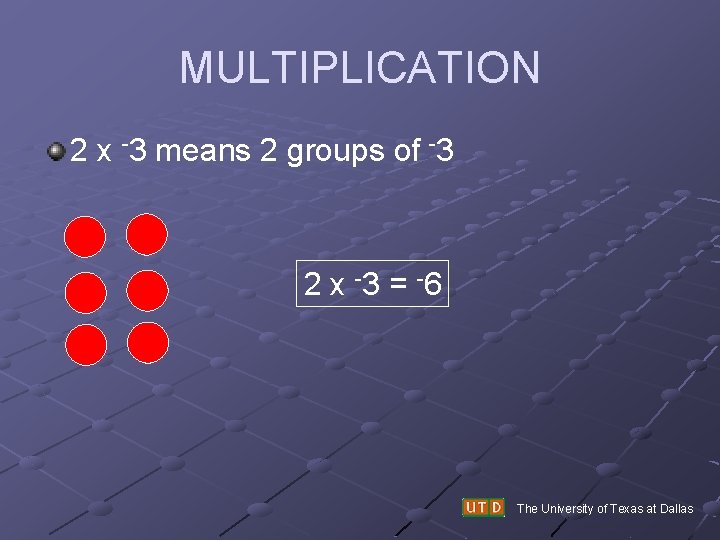
MULTIPLICATION 2 x -3 means 2 groups of -3 2 x -3 = -6 The University of Texas at Dallas
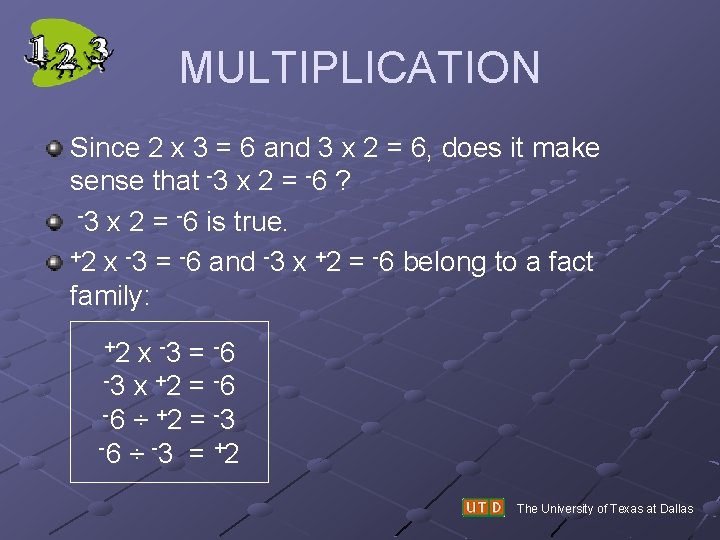
MULTIPLICATION Since 2 x 3 = 6 and 3 x 2 = 6, does it make sense that -3 x 2 = -6 ? -3 x 2 = -6 is true. +2 x -3 = -6 and -3 x +2 = -6 belong to a fact family: +2 x -3 = -6 -3 x + 2 = -6 -6 ÷ + 2 = -3 -6 ÷ -3 = + 2 The University of Texas at Dallas
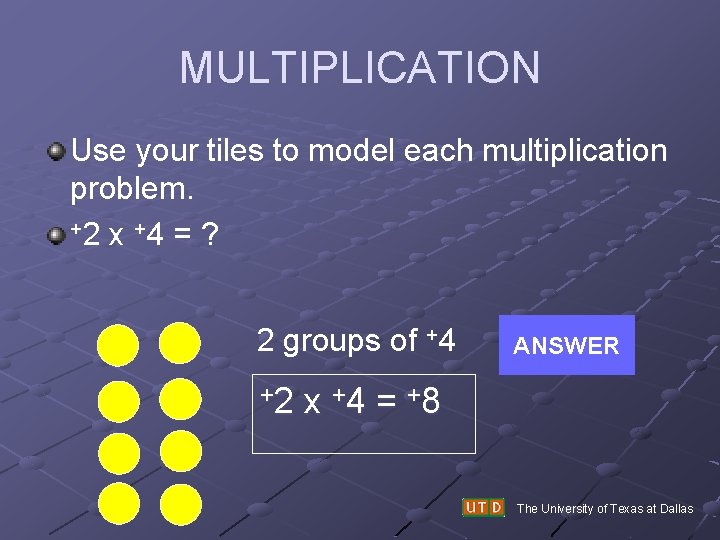
MULTIPLICATION Use your tiles to model each multiplication problem. +2 x +4 = ? 2 groups of +4 +2 ANSWER x +4 = +8 The University of Texas at Dallas
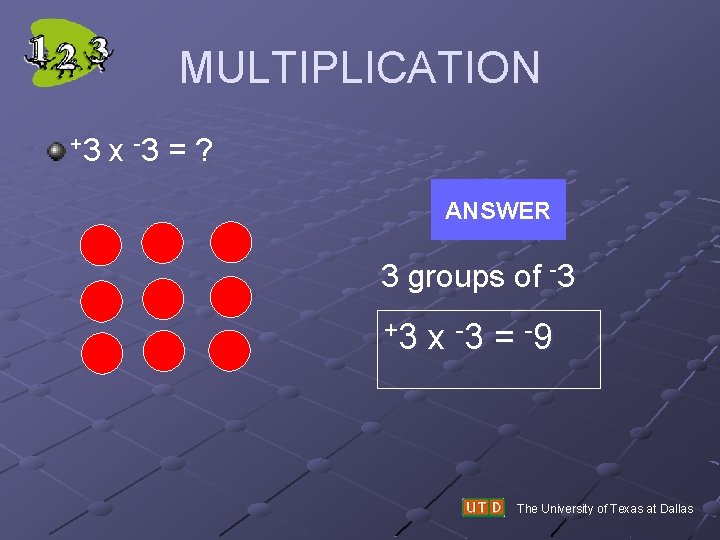
MULTIPLICATION +3 x -3 = ? ANSWER 3 groups of -3 +3 x -3 = -9 The University of Texas at Dallas
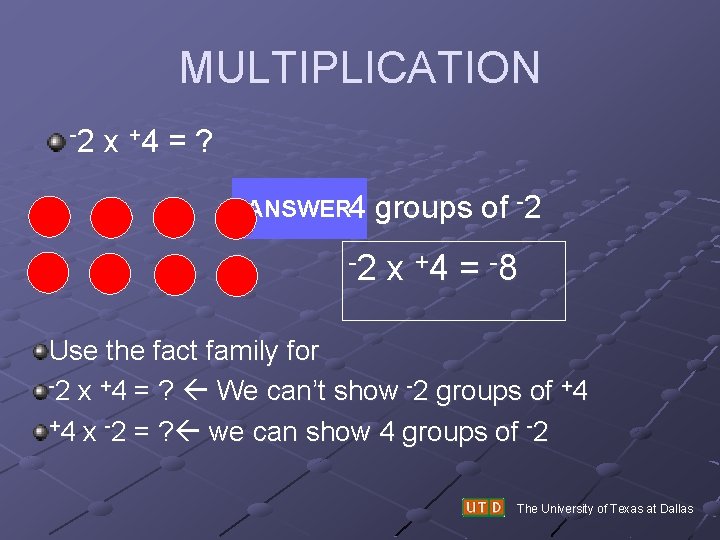
MULTIPLICATION -2 x +4 = ? ANSWER 4 groups of -2 -2 x + 4 = -8 Use the fact family for -2 x +4 = ? We can’t show -2 groups of +4 +4 x -2 = ? we can show 4 groups of -2 The University of Texas at Dallas
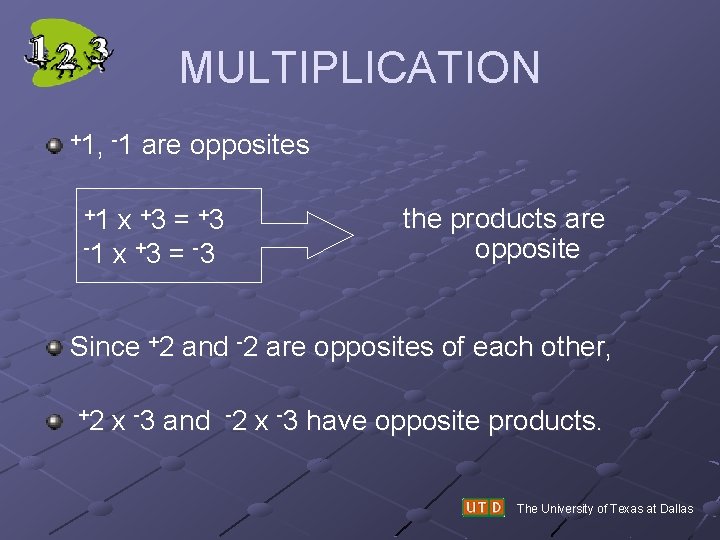
MULTIPLICATION +1, -1 +1 are opposites x +3 = +3 -1 x + 3 = -3 the products are opposite Since +2 and -2 are opposites of each other, +2 x -3 and -2 x -3 have opposite products. The University of Texas at Dallas
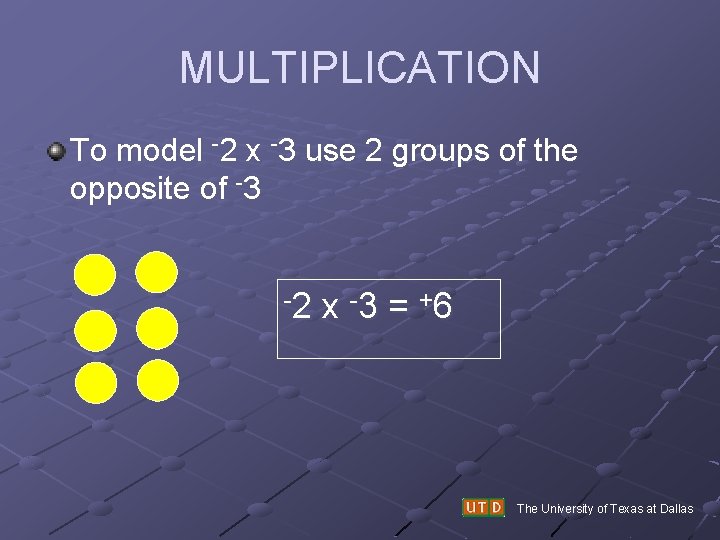
MULTIPLICATION To model -2 x -3 use 2 groups of the opposite of -3 -2 x -3 = + 6 The University of Texas at Dallas
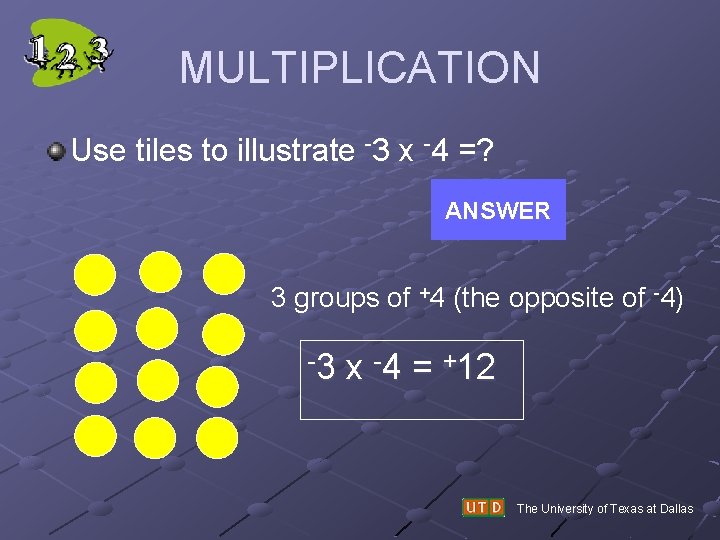
MULTIPLICATION Use tiles to illustrate -3 x -4 =? ANSWER 3 groups of +4 (the opposite of -4) -3 x -4 = +12 The University of Texas at Dallas
INTEGERS AND DIVISION The University of Texas at Dallas
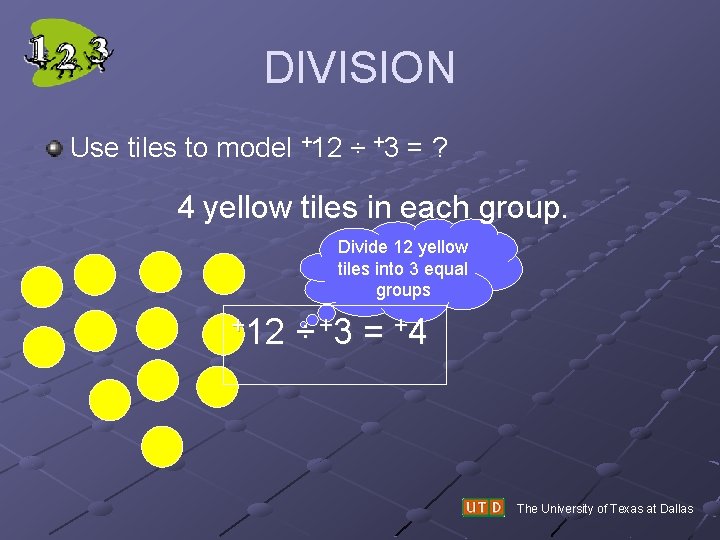
DIVISION Use tiles to model +12 ÷ +3 = ? 4 yellow tiles in each group. Divide 12 yellow tiles into 3 equal groups +12 ÷ +3 = +4 The University of Texas at Dallas
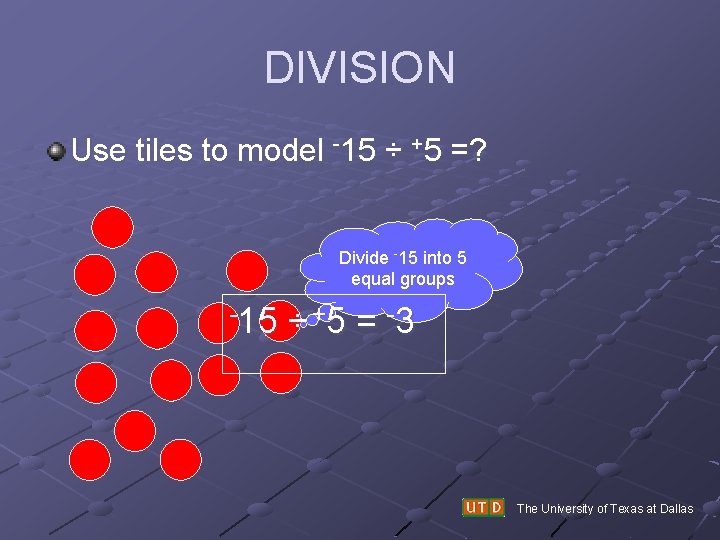
DIVISION Use tiles to model -15 ÷ +5 =? Divide -15 into 5 equal groups -15 ÷ + 5 = -3 The University of Texas at Dallas
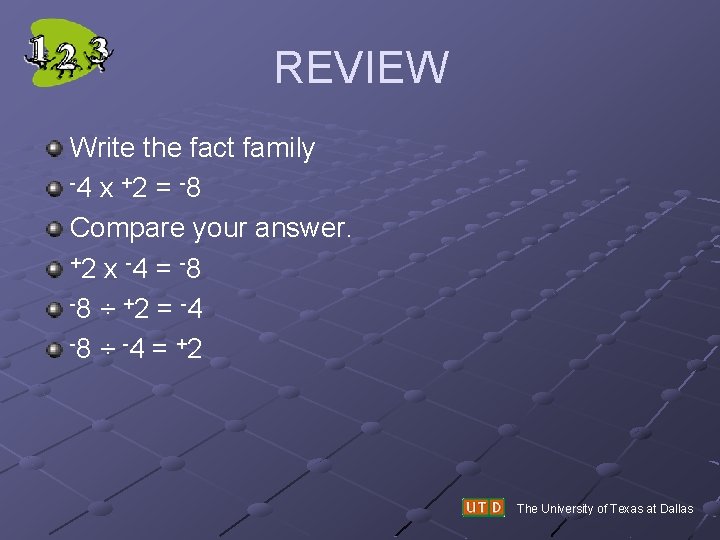
REVIEW Write the fact family -4 x + 2 = -8 Compare your answer. + 2 x -4 = -8 -8 ÷ + 2 = -4 -8 ÷ -4 = + 2 The University of Texas at Dallas
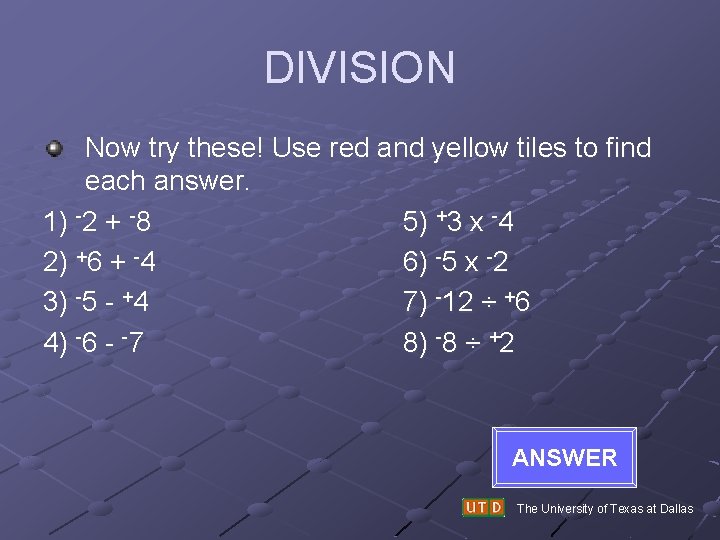
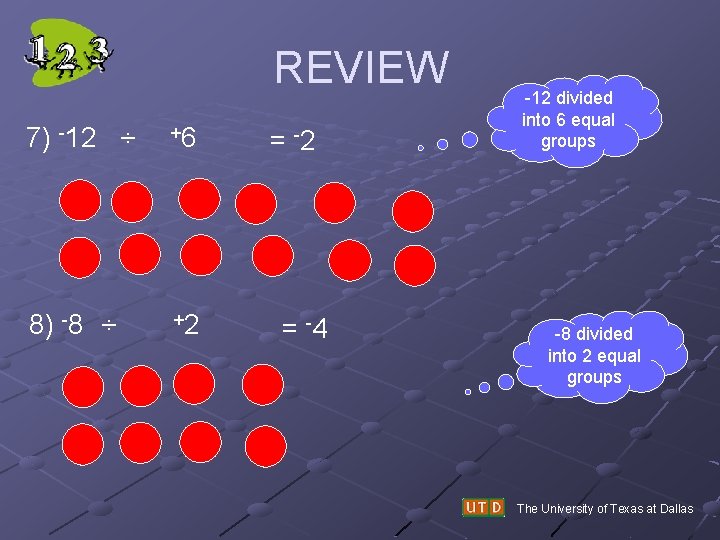
DIVISION Now try these! Use red and yellow tiles to find each answer. 1) -2 + -8 5) +3 x -4 2) +6 + -4 6) -5 x -2 3) -5 - +4 7) -12 ÷ +6 4) -6 - -7 8) -8 ÷ +2 ANSWER The University of Texas at Dallas
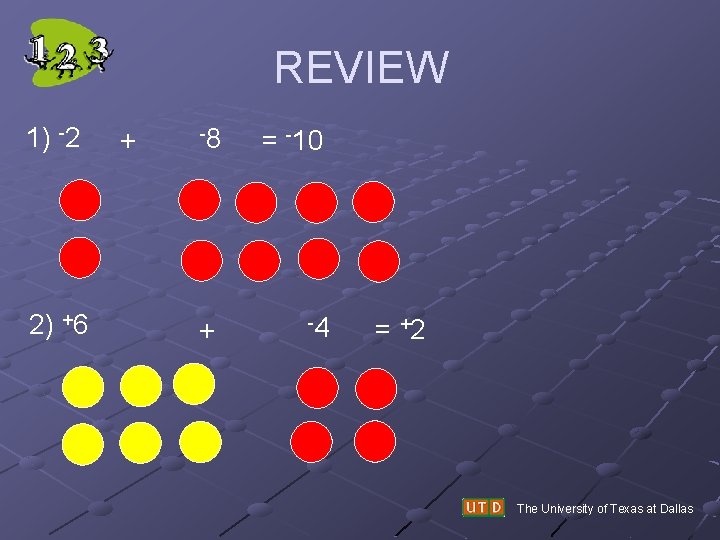
REVIEW 1) -2 2) +6 + -8 + = -10 -4 = +2 The University of Texas at Dallas
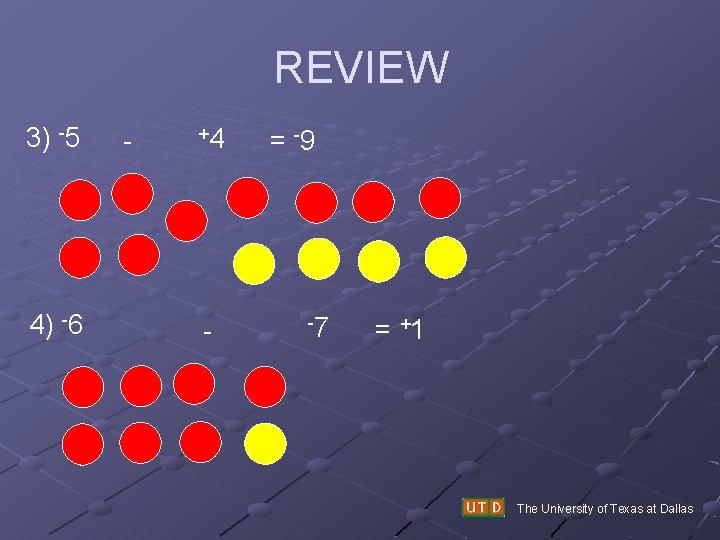
REVIEW 3) -5 4) -6 - +4 - = -9 -7 = +1 The University of Texas at Dallas
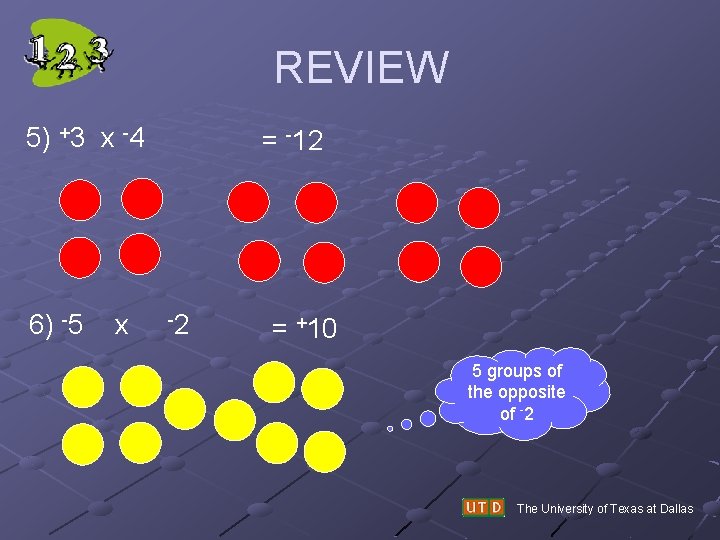
REVIEW 5) +3 x -4 6) -5 x = -12 -2 = +10 5 groups of the opposite of -2 The University of Texas at Dallas
REVIEW 7) -12 ÷ +6 8) -8 ÷ +2 = -4 -12 divided into 6 equal groups -8 divided into 2 equal groups The University of Texas at Dallas