
Introduction to Integer Programming Modeling and Methods Michael

![Example Formulations Warehouse location: n stores, m possible warehouses; cost k[j] to open warehouse](https://slidetodoc.com/presentation_image_h2/c706da4bdcfe492a4baebd291ce00060/image-6.jpg "Example Formulations Warehouse location: n stores, m possible warehouses; cost k[j] to open warehouse")
![Warehouse Formulation Variables x[i, j] = 1 if store i served by warehouse j;](https://slidetodoc.com/presentation_image_h2/c706da4bdcfe492a4baebd291ce00060/image-7.jpg "Warehouse Formulation Variables x[i, j] = 1 if store i served by warehouse j;")
![Warehouse Formulation n Constraints: sum_j x[i, j] = 1 for all i sum_i x[i,](https://slidetodoc.com/presentation_image_h2/c706da4bdcfe492a4baebd291ce00060/image-8.jpg "Warehouse Formulation n Constraints: sum_j x[i, j] = 1 for all i sum_i x[i,")
![Dual example Sum_i x[i, j]-y[j] <= 0 Suppose facility j* has cost 10 and](https://slidetodoc.com/presentation_image_h2/c706da4bdcfe492a4baebd291ce00060/image-16.jpg "Dual example Sum_i x[i, j]-y[j] <= 0 Suppose facility j* has cost 10 and")

![“Real Version” of Gomory Cuts y+ sum_j ajxj =d Let d=[d]+f; let aj=[aj] +](https://slidetodoc.com/presentation_image_h2/c706da4bdcfe492a4baebd291ce00060/image-61.jpg "“Real Version” of Gomory Cuts y+ sum_j ajxj =d Let d=[d]+f; let aj=[aj] +")
- Slides: 70
Introduction to Integer Programming Modeling and Methods Michael Trick Carnegie Mellon University CPAI-OR School, Le Croisic 2002
Some History n Integer Programming goes back a long way: n n Schrijver takes it back to ancient times (linear diophantine equations), Euler (1748), Monge (1784) and much more. “Proper” study began in the 1950 s n n n Dantzig (1951): linear programming Gomery (1958): cutting planes Land Doig (1960): branch and bound Survey books practically every five years since Tremendous practical success in last 10 -15 years
Scope n n This talk will not be comprehensive! Attempt to get across main concepts of integer programming n n Relaxations Primal Heuristics Branch and Bound Cutting Planes
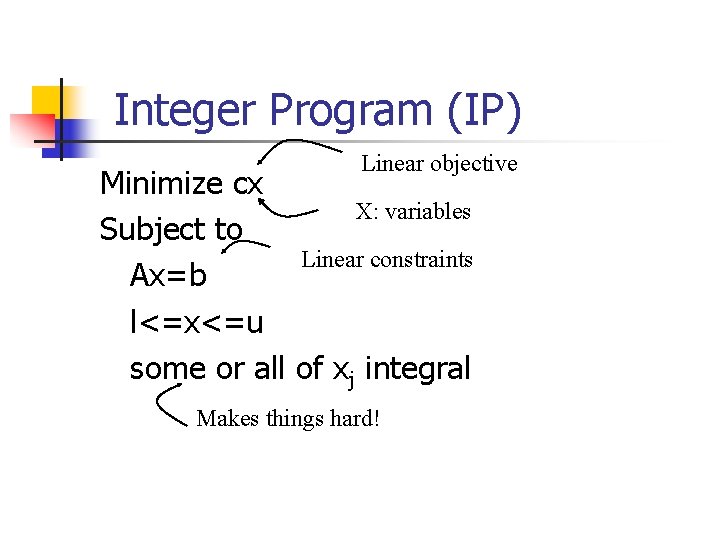
Integer Program (IP) Linear objective Minimize cx X: variables Subject to Linear constraints Ax=b l<=x<=u some or all of xj integral Makes things hard!
Rules of the Game n n n Must put in that form! Seems limiting, but 50 years of experience gives “tricks of the trade” Many formulations for same problem
Example Formulations Warehouse location: n stores, m possible warehouses; cost k[j] to open warehouse m; cost c[i, j] to handle store i out of warehouse j. Minimize the total opening costs plus handling costs Subject to Each store assigned to one open warehouse
Warehouse Formulation Variables x[i, j] = 1 if store i served by warehouse j; 0 otherwise y[j] = 1 if warehouse j open; 0 otherwise Objective Minimize sum_j k[j]y[j]+sum_i, j c[i, j]x[i, j]
Warehouse Formulation n Constraints: sum_j x[i, j] = 1 for all i sum_i x[i, j] <= ny[j] for all j
Binary Integer Programs n n n Restrict variables to be 0 -1 Many specialized methods OR people are real good at formulating difficult problems within these restrictions
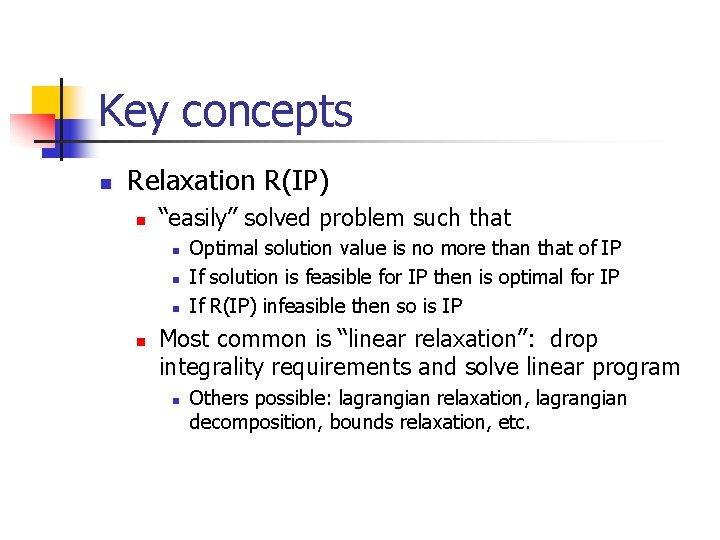
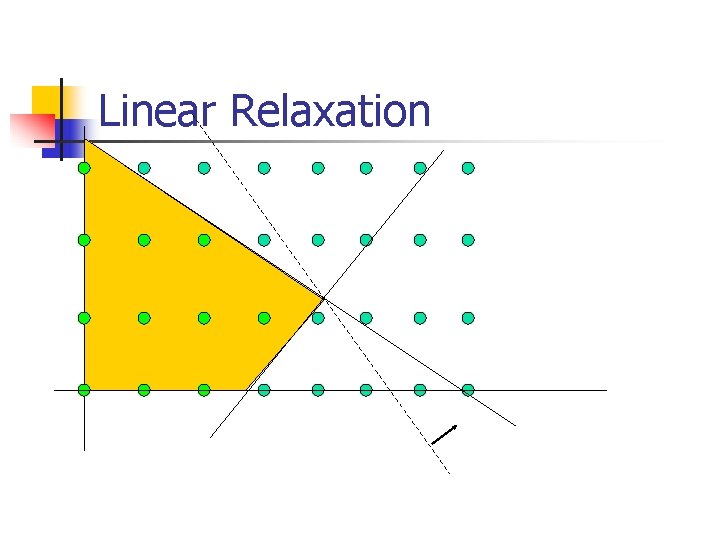
Key concepts n Relaxation R(IP) n “easily” solved problem such that n n Optimal solution value is no more than that of IP If solution is feasible for IP then is optimal for IP If R(IP) infeasible then so is IP Most common is “linear relaxation”: drop integrality requirements and solve linear program n Others possible: lagrangian relaxation, lagrangian decomposition, bounds relaxation, etc.
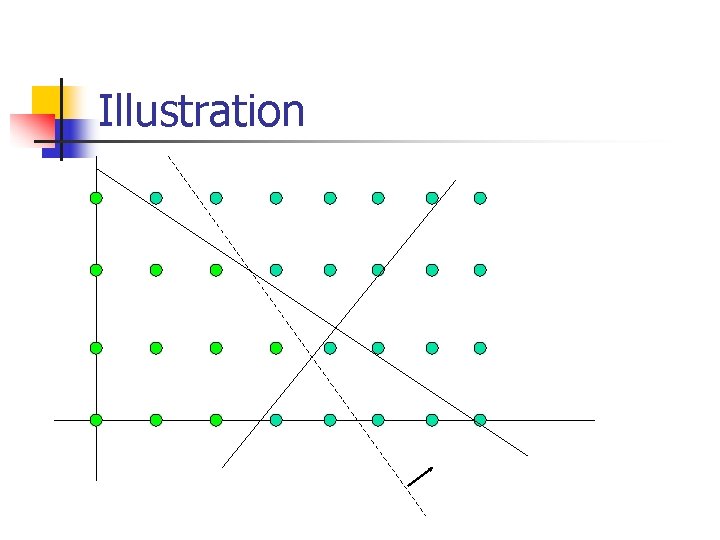
Illustration
Linear Relaxation
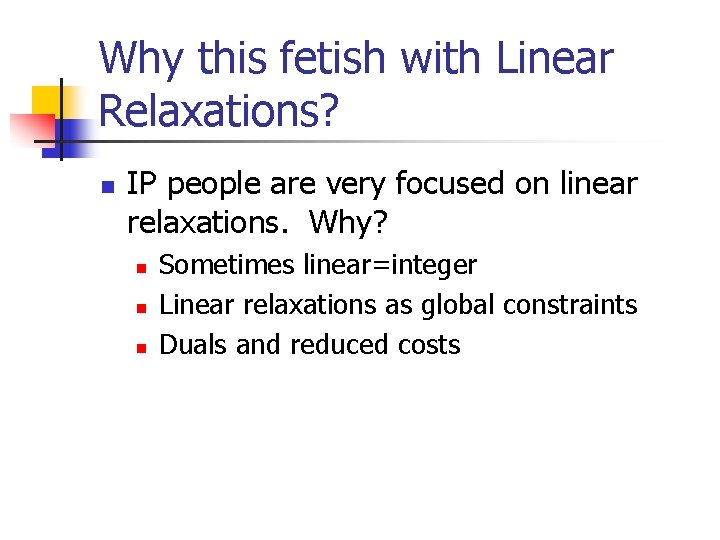
Why this fetish with Linear Relaxations? n IP people are very focused on linear relaxations. Why? n n n Sometimes linear=integer Linear relaxations as global constraints Duals and reduced costs
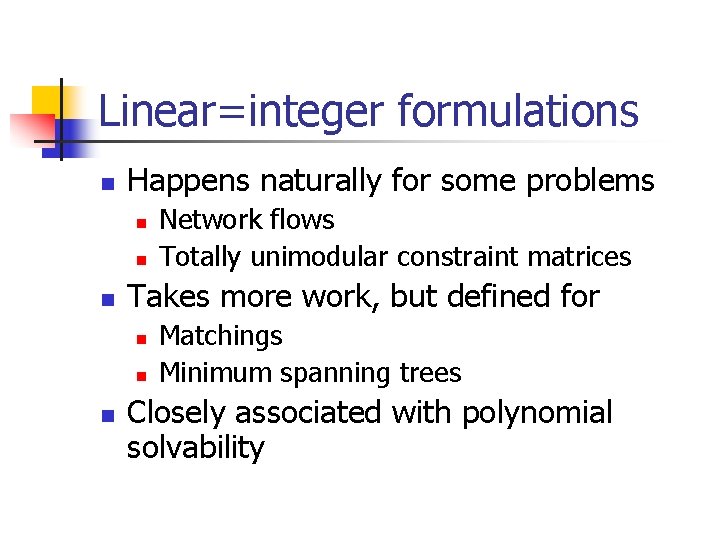
Linear=integer formulations n Happens naturally for some problems n n n Takes more work, but defined for n n n Network flows Totally unimodular constraint matrices Matchings Minimum spanning trees Closely associated with polynomial solvability
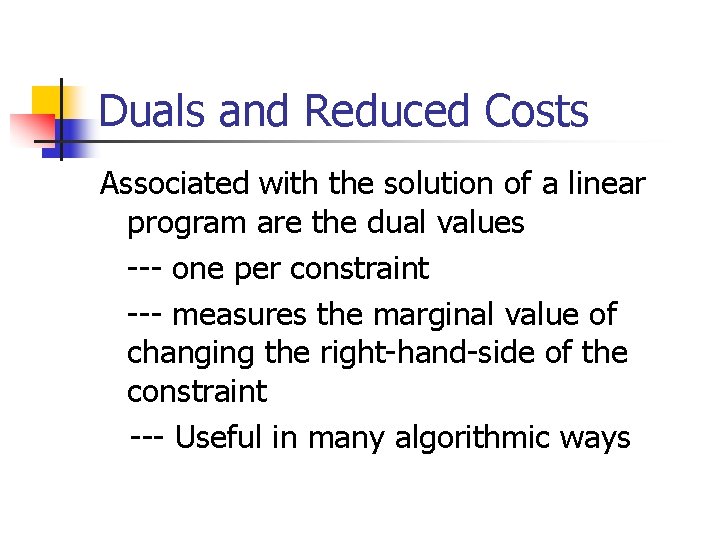
Duals and Reduced Costs Associated with the solution of a linear program are the dual values --- one per constraint --- measures the marginal value of changing the right-hand-side of the constraint --- Useful in many algorithmic ways
Dual example Sum_i x[i, j]-y[j] <= 0 Suppose facility j* has cost 10 and y*[j*] = 0. The dual value of this constraint is 4. What cost must facility j* have to be appealing? Answer: no more than 10 -4=6.
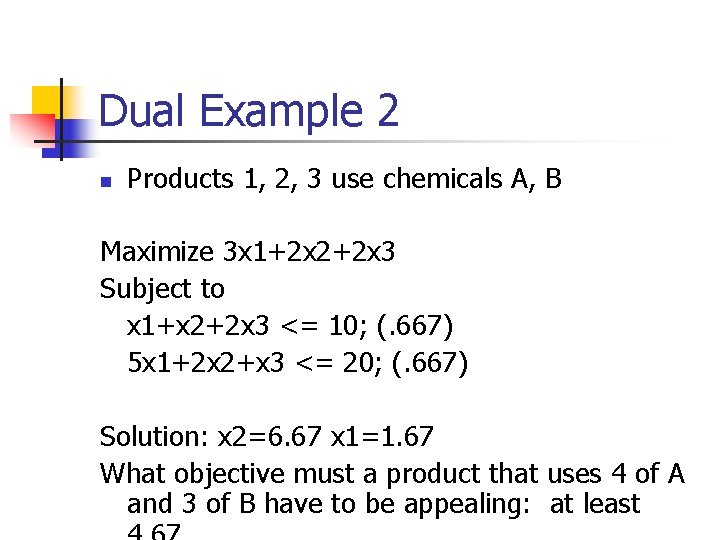
Dual Example 2 n Products 1, 2, 3 use chemicals A, B Maximize 3 x 1+2 x 2+2 x 3 Subject to x 1+x 2+2 x 3 <= 10; (. 667) 5 x 1+2 x 2+x 3 <= 20; (. 667) Solution: x 2=6. 67 x 1=1. 67 What objective must a product that uses 4 of A and 3 of B have to be appealing: at least
Final advantage of linear relaxations: Global n Linear relaxations are n n n Relatively easy to solve: huge advances in 15 years Incorporate “global” information Often provide good bounds and guidelines for integer program n n Variables with very bad reduced cost likely not in optimal integer solution Rounding doesn’t always work, but often gets good feasible solutions
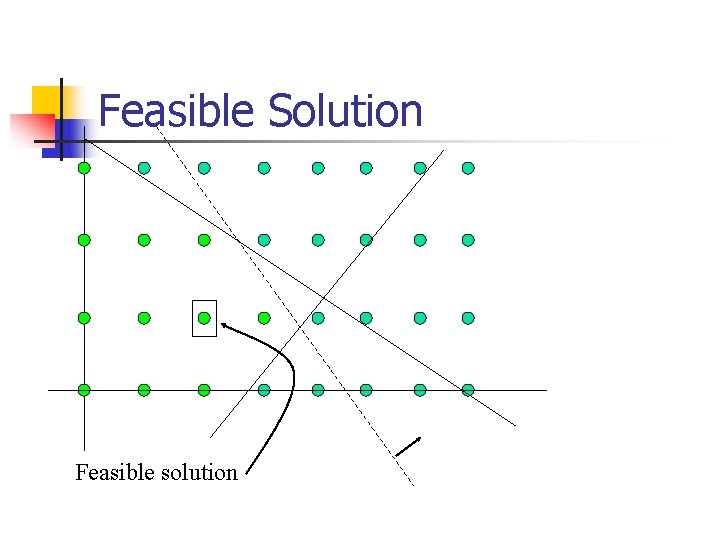
Feasible solutions n Solutions that satisfy all the constraints but might not be optimal n n n Generally found by heuristics Can be problem specific Must have value greater than or equal to optimal value (for minimizing)
Feasible Solution Feasible solution
Fundamental Branch and Bound Algorithm Solve relaxation to get x* If infeasible, then IP infeasible Else If x* feasible to IP, then x* optimal to IP Else create new problems IP 1 and IP 2 by branching; solve recursively, stop if prove subproblem cannot be optimal to IP (bounding)
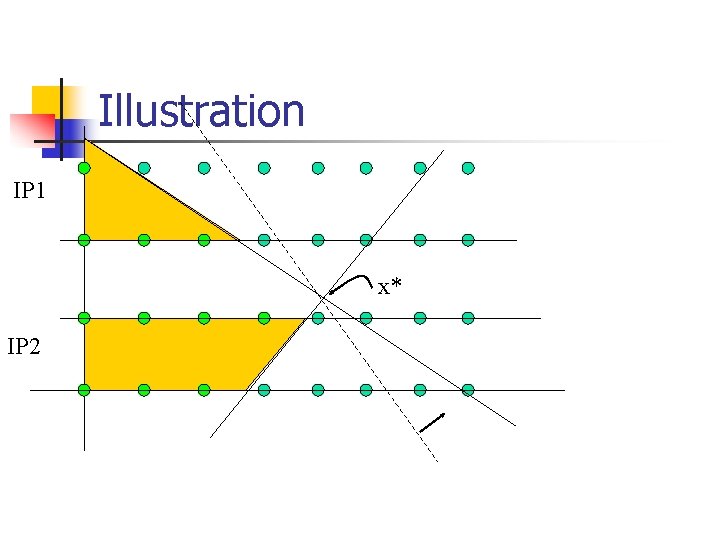
Branching n Create two or more subproblems IP 1, IP 2, … IPn such that n n n Every feasible solution to IP appears in at least one (often exactly one) of IP 1, IP 2, … IPn x* is infeasible to each of R(IP 1), R(IP 2), … R(IPn) For linear relaxation, can choose a fraction xj* and have one problem with xj <=[xj] and the other with xj >= [xj]+1 ([x]: round down of x)
Illustration IP 1 x* IP 2
Bounding n Along way, we may find solution x’ that is feasible to IP. If any subproblem has relaxation value c* >= cx’ then we can prune that subproblem: it cannot contain the optimal solution. There is no sense continuing on that subproblem.
Stopping n n Technique can stop early with solution within a provable percentage of optimal (compare to be relaxation value) Can also modify to generate all solutions (do not prune on ties)
How to make work better? n n n Better formulations Better relaxations (cuts) Better feasible solutions (heuristics)
Formulations n n Different formulations of integer programs may act very differently: their relaxations might have radically different bounds “Good Formulation” of integer program: provides a better relaxation value (all else being equal).
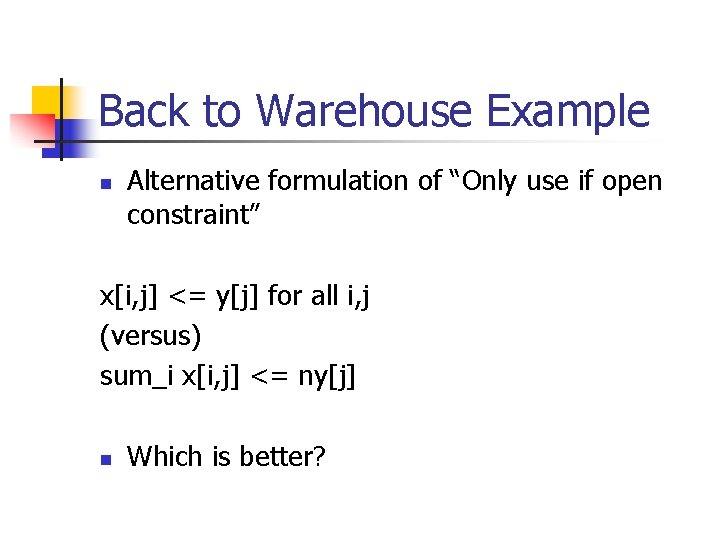
Back to Warehouse Example n Alternative formulation of “Only use if open constraint” x[i, j] <= y[j] for all i, j (versus) sum_i x[i, j] <= ny[j] n Which is better?
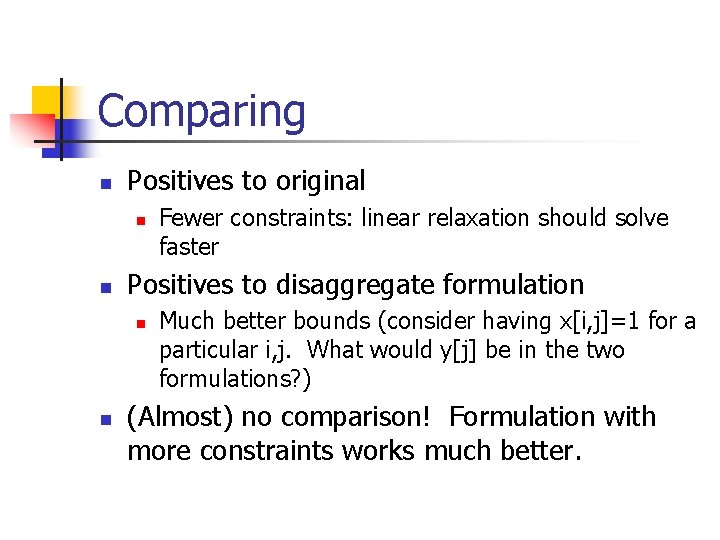
Comparing n Positives to original n n Positives to disaggregate formulation n n Fewer constraints: linear relaxation should solve faster Much better bounds (consider having x[i, j]=1 for a particular i, j. What would y[j] be in the two formulations? ) (Almost) no comparison! Formulation with more constraints works much better.
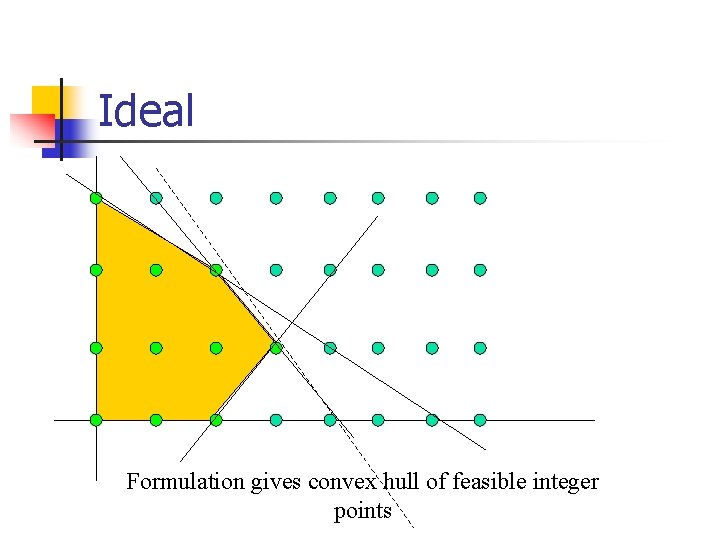
Ideal Formulation gives convex hull of feasible integer points
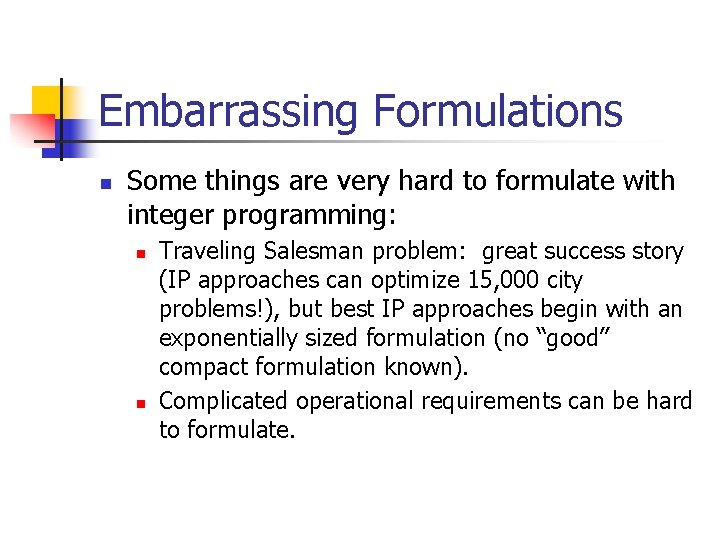
Embarrassing Formulations n Some things are very hard to formulate with integer programming: n n Traveling Salesman problem: great success story (IP approaches can optimize 15, 000 city problems!), but best IP approaches begin with an exponentially sized formulation (no “good” compact formulation known). Complicated operational requirements can be hard to formulate.
Further approaches n Branch and Price n n Formulations with exponential number of variables with complexity in generating “good” variables (see Nemhauser): heavy use of dual values Branch and Cut n Improving formulations by adding additional constraints to “cut off” linear relaxation solutions (more later)
Algorithmic Details Preprocessing n. Primal Heuristics n. Branching n. Cut Generation n
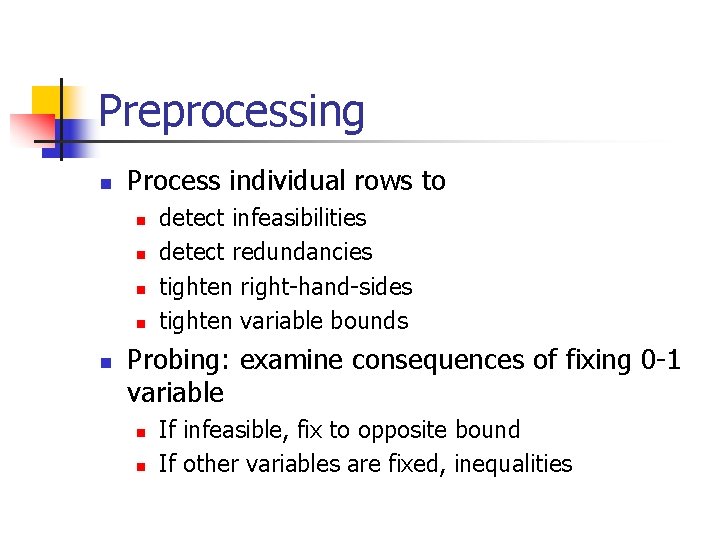
Preprocessing n Process individual rows to n n n detect infeasibilities detect redundancies tighten right-hand-sides tighten variable bounds Probing: examine consequences of fixing 0 -1 variable n n If infeasible, fix to opposite bound If other variables are fixed, inequalities
Preprocessing n Much like simple Constraint Programming
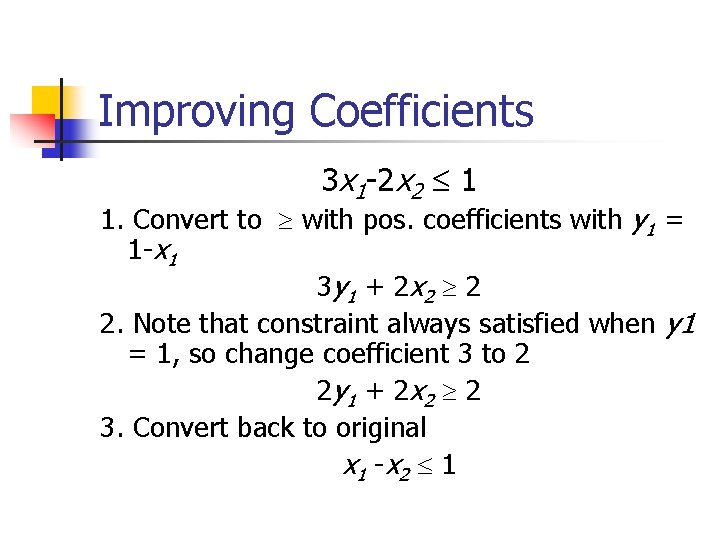
Improving Coefficients 3 x 1 -2 x 2 1 1. Convert to with pos. coefficients with y 1 = 1 -x 1 3 y 1 + 2 x 2 2 2. Note that constraint always satisfied when y 1 = 1, so change coefficient 3 to 2 2 y 1 + 2 x 2 2 3. Convert back to original x 1 - x 2 1
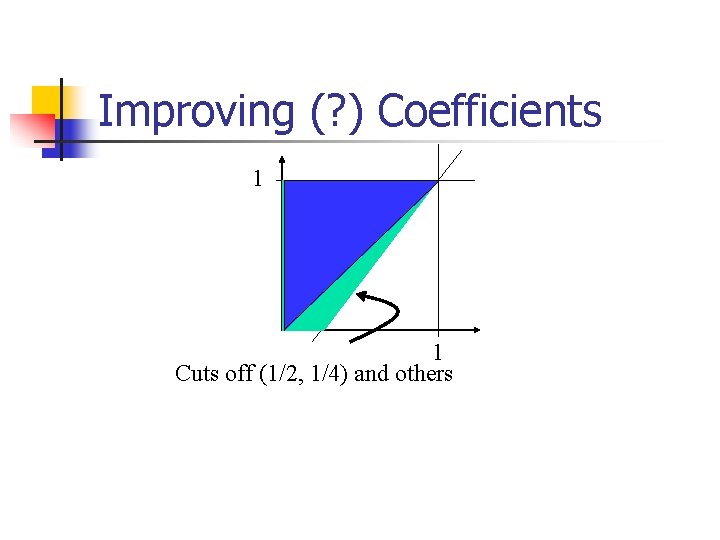
Improving (? ) Coefficients 1 1 Cuts off (1/2, 1/4) and others
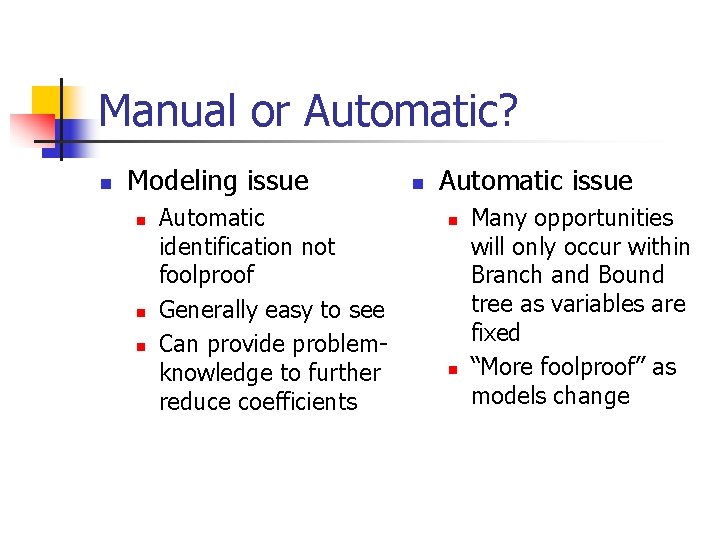
Manual or Automatic? n Modeling issue n n n Automatic identification not foolproof Generally easy to see Can provide problemknowledge to further reduce coefficients n Automatic issue n n Many opportunities will only occur within Branch and Bound tree as variables are fixed “More foolproof” as models change
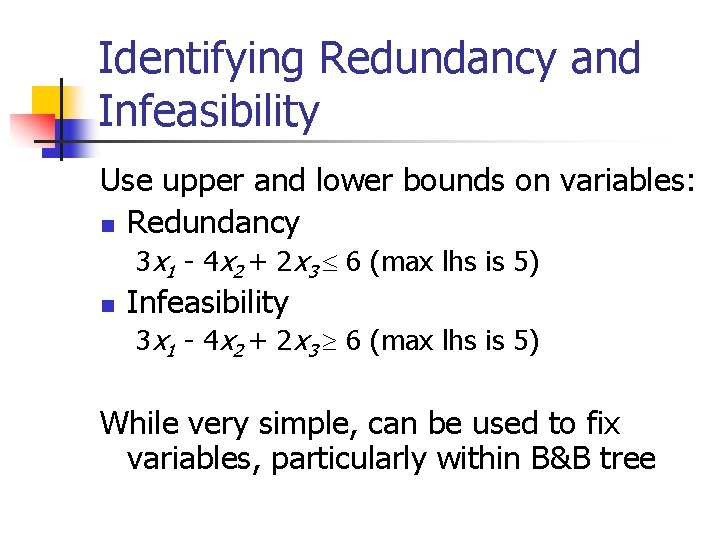
Identifying Redundancy and Infeasibility Use upper and lower bounds on variables: n Redundancy 3 x 1 - 4 x 2 + 2 x 3 6 (max lhs is 5) n Infeasibility 3 x 1 - 4 x 2 + 2 x 3 6 (max lhs is 5) While very simple, can be used to fix variables, particularly within B&B tree
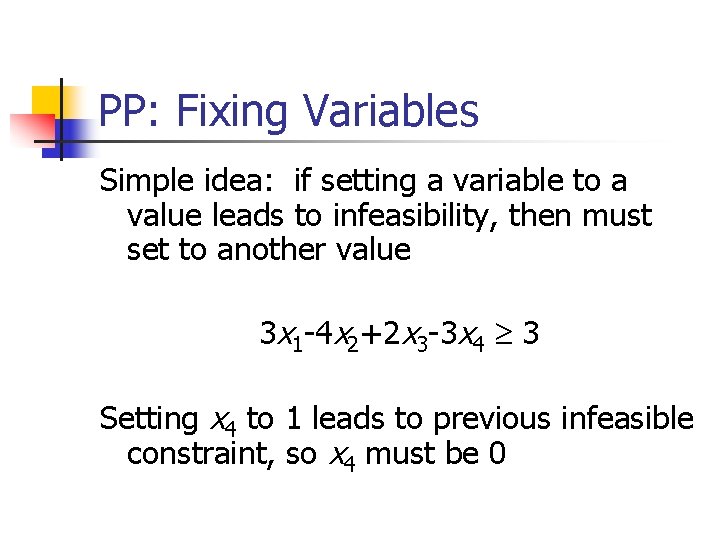
PP: Fixing Variables Simple idea: if setting a variable to a value leads to infeasibility, then must set to another value 3 x 1 -4 x 2+2 x 3 -3 x 4 3 Setting x 4 to 1 leads to previous infeasible constraint, so x 4 must be 0
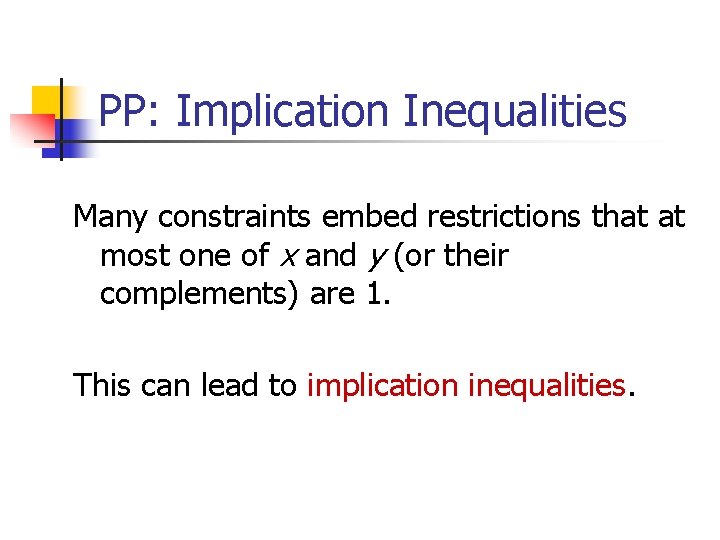
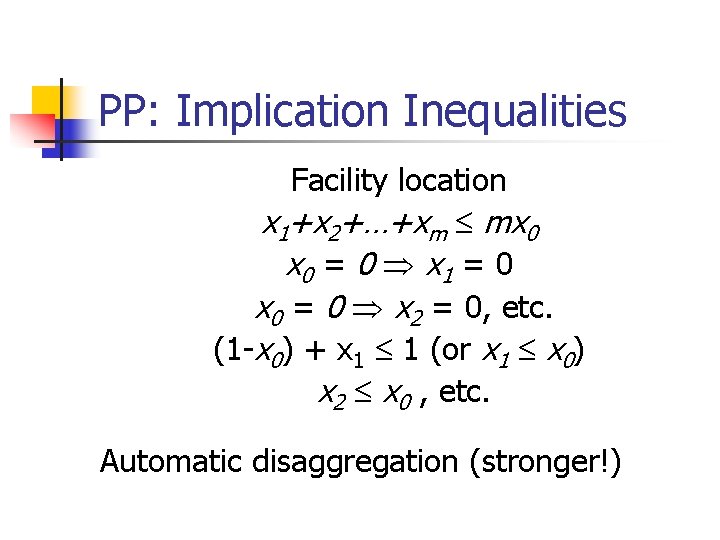
PP: Implication Inequalities Many constraints embed restrictions that at most one of x and y (or their complements) are 1. This can lead to implication inequalities.
PP: Implication Inequalities Facility location x 1+x 2+…+xm mx 0 = 0 x 1 = 0 x 0 = 0 x 2 = 0, etc. (1 -x 0) + x 1 1 (or x 1 x 0) x 2 x 0 , etc. Automatic disaggregation (stronger!)
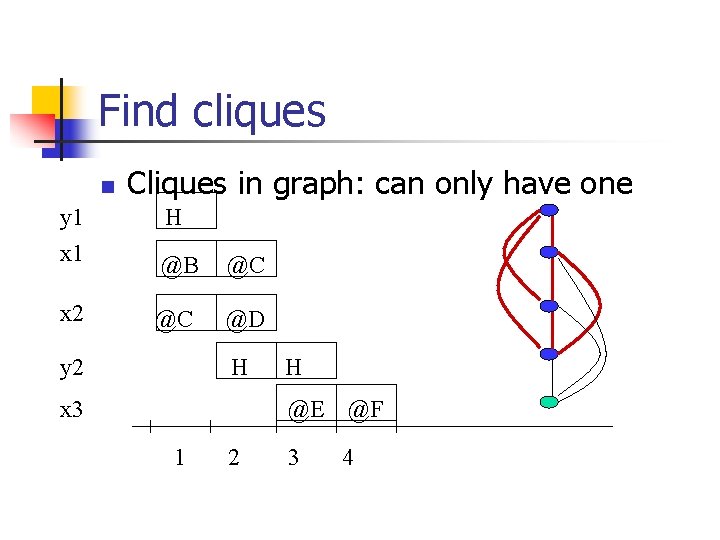
PP: Clique Inequalities These inequalities found by “probing” (fix variable and deduce implications). These simple inequalities can be strengthened by combining mutually exclusive variables into a single constraint. Resulting clique inequalities are very “strong” when many variables combined.
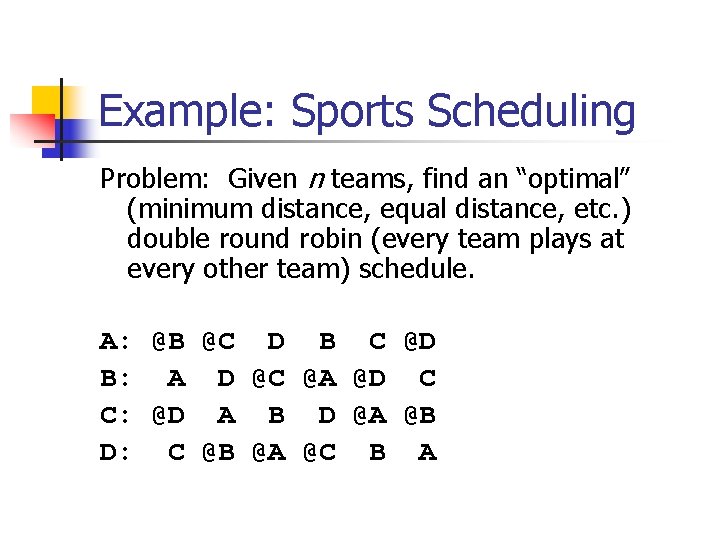
Example: Sports Scheduling Problem: Given n teams, find an “optimal” (minimum distance, equal distance, etc. ) double round robin (every team plays at every other team) schedule. A: @B @C D B C @D B: A D @C @A @D C C: @D A B D @A @B D: C @B @A @C B A
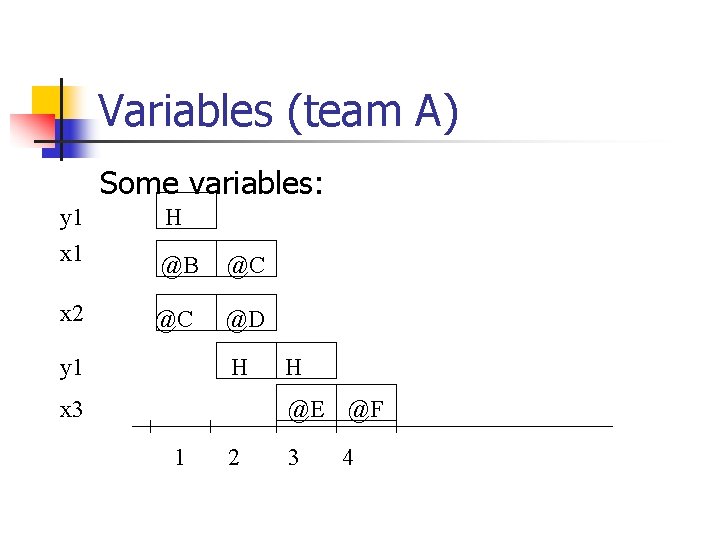
Sports Scheduling Many formulations (not wholly satisfactory) One method: One variable for every “home stand” (series of home games) and “away trip” (series of away games).
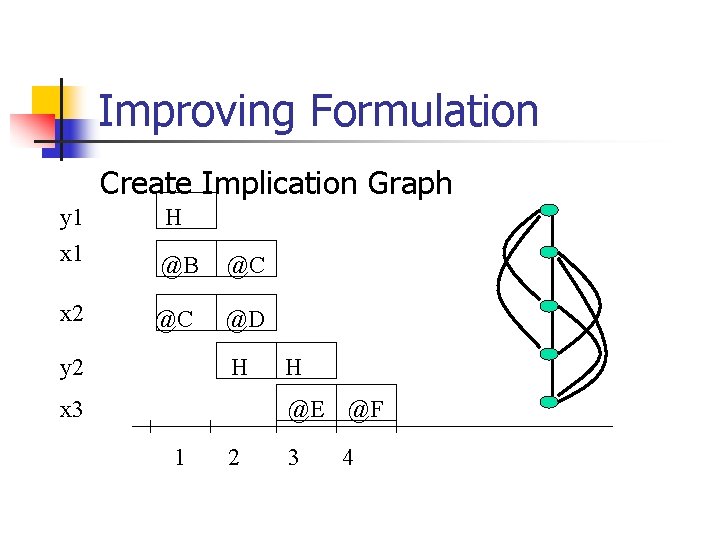
Variables (team A) Some variables: y 1 x 1 H @B @C x 2 @C @D y 1 H x 3 H @E @F 1 2 3 4
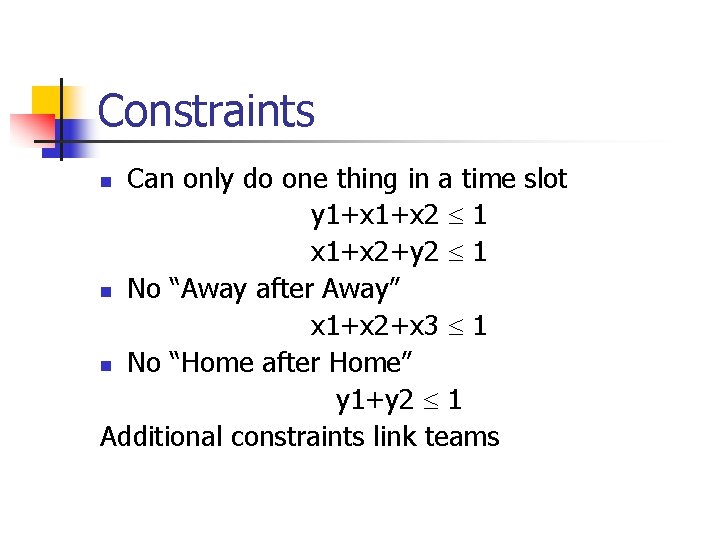
Constraints Can only do one thing in a time slot y 1+x 2 1 x 1+x 2+y 2 1 n No “Away after Away” x 1+x 2+x 3 1 n No “Home after Home” y 1+y 2 1 Additional constraints link teams n
Improving Formulation Create Implication Graph y 1 x 1 H @B @C x 2 @C @D y 2 H x 3 H @E @F 1 2 3 4
Find cliques n Cliques in graph: can only have one y 1 x 1 H @B @C x 2 @C @D y 2 H x 3 H @E @F 1 2 3 4
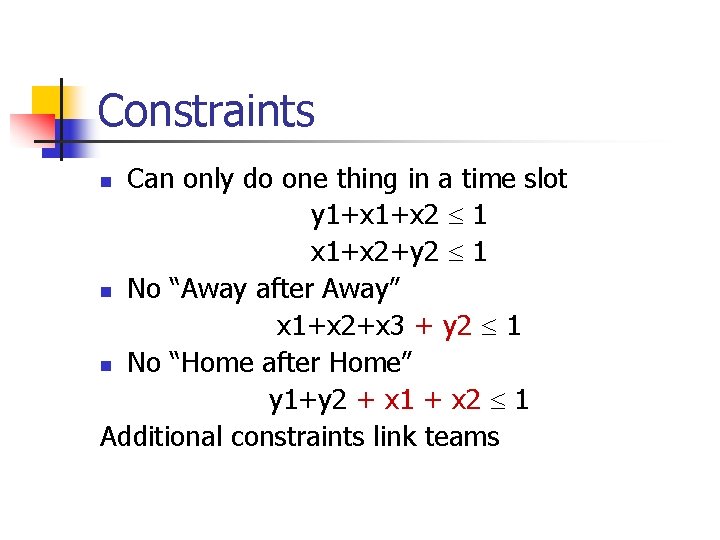
Constraints Can only do one thing in a time slot y 1+x 2 1 x 1+x 2+y 2 1 n No “Away after Away” x 1+x 2+x 3 + y 2 1 n No “Home after Home” y 1+y 2 + x 1 + x 2 1 Additional constraints link teams n
Clique Inequalities n n Resulting formulation is much tighter (turns formulation from hopeless to possible) Idea generalized to variables and their complements Can be found automatically, but may be a huge number (and clique generally hard) On divide of “automatic” and “manual” modeling issue
Primal Heuristics n n n Feasible solutions at B&B nodes can greatly decrease the solution time Most common: problem-specific heuristics embedded with B&B Some general purpose heuristics: LP Diving, Pivot and Complement
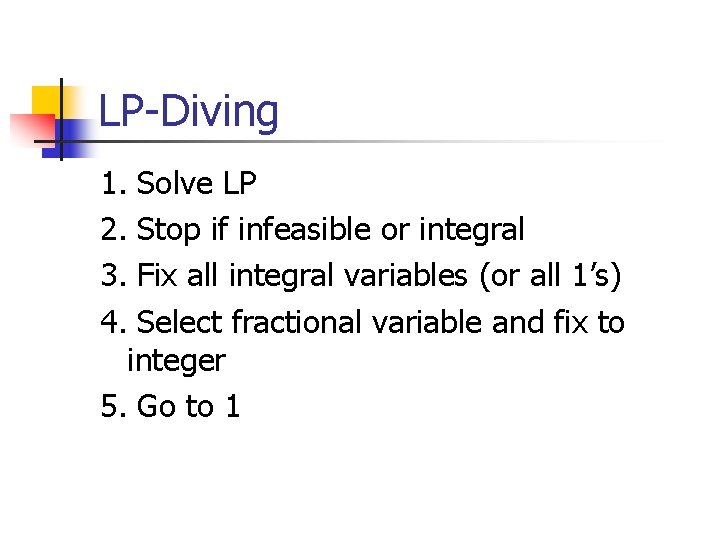
LP-Diving 1. Solve LP 2. Stop if infeasible or integral 3. Fix all integral variables (or all 1’s) 4. Select fractional variable and fix to integer 5. Go to 1
Branching n n Two decisions: which B&B node to branch on and how to divide into two problems Node selection n Depth First: try for integral solution Best Bound: explore “appealing” nodes Adaptive: Depth First first, then best bound
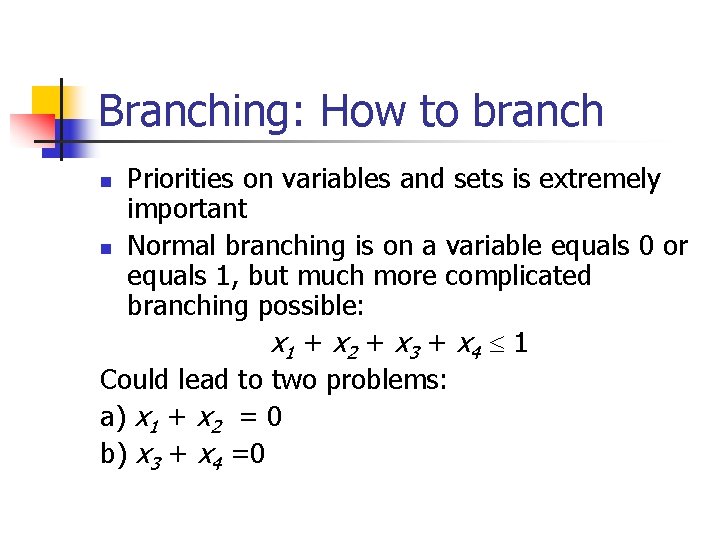
Branching: How to branch Priorities on variables and sets is extremely important n Normal branching is on a variable equals 0 or equals 1, but much more complicated branching possible: x 1 + x 2 + x 3 + x 4 1 Could lead to two problems: a) x 1 + x 2 = 0 b) x 3 + x 4 =0 n
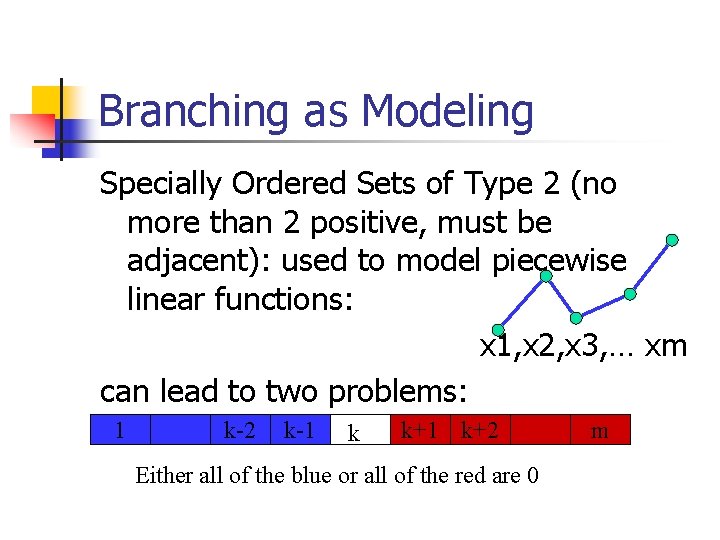
Branching as Modeling Specially Ordered Sets of Type 2 (no more than 2 positive, must be adjacent): used to model piecewise linear functions: x 1, x 2, x 3, … xm can lead to two problems: 1 k-2 k-1 k k+1 k+2 Either all of the blue or all of the red are 0 m
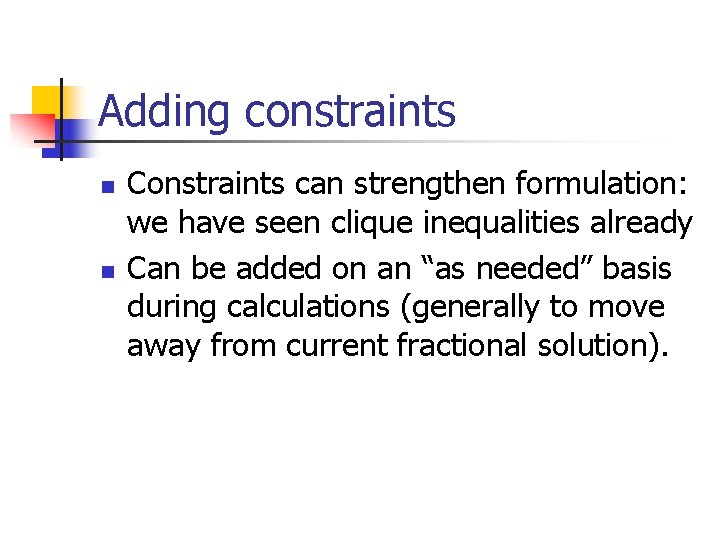
Adding constraints n n Constraints can strengthen formulation: we have seen clique inequalities already Can be added on an “as needed” basis during calculations (generally to move away from current fractional solution).
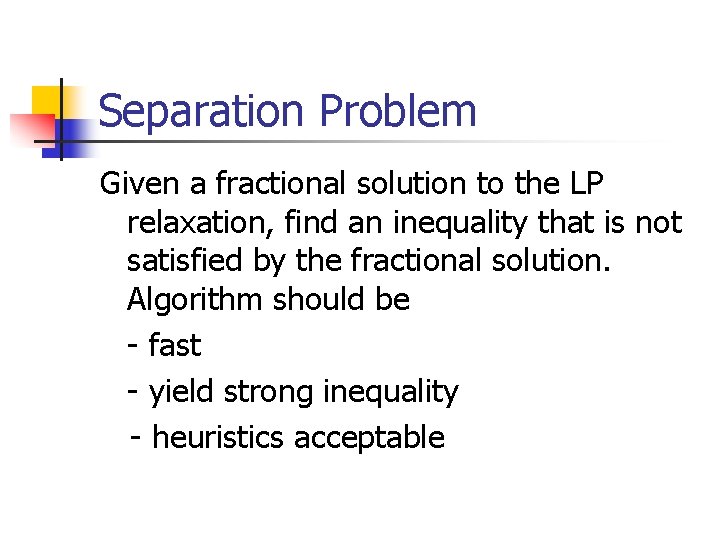
Separation Problem Given a fractional solution to the LP relaxation, find an inequality that is not satisfied by the fractional solution. Algorithm should be - fast - yield strong inequality - heuristics acceptable
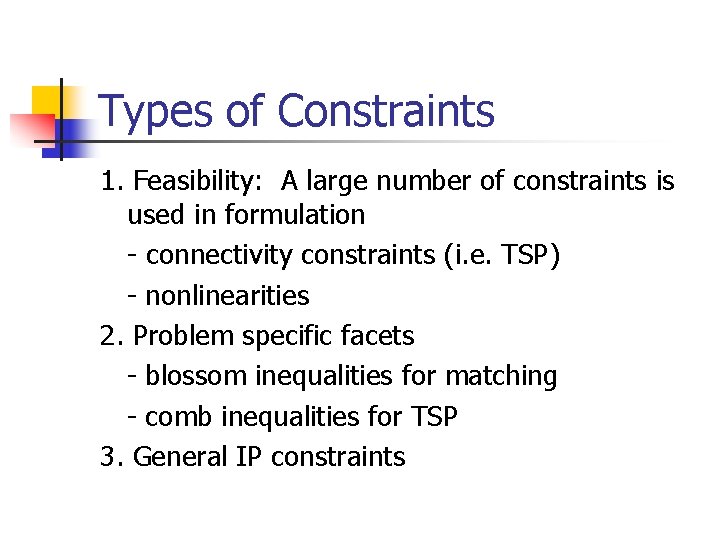
Types of Constraints 1. Feasibility: A large number of constraints is used in formulation - connectivity constraints (i. e. TSP) - nonlinearities 2. Problem specific facets - blossom inequalities for matching - comb inequalities for TSP 3. General IP constraints
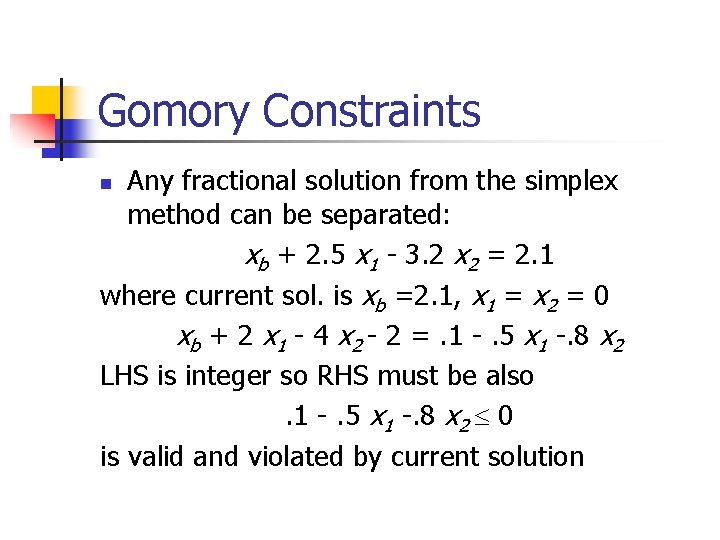
Gomory Constraints Any fractional solution from the simplex method can be separated: xb + 2. 5 x 1 - 3. 2 x 2 = 2. 1 where current sol. is xb =2. 1, x 1 = x 2 = 0 xb + 2 x 1 - 4 x 2 - 2 =. 1 -. 5 x 1 -. 8 x 2 LHS is integer so RHS must be also. 1 -. 5 x 1 -. 8 x 2 0 is valid and violated by current solution n
“Real Version” of Gomory Cuts y+ sum_j ajxj =d Let d=[d]+f; let aj=[aj] + fj t=y+sum_(j: fj<=f) [aj]xj + sum_(j: fj>f) ([aj]+1)xj So d-t = sum_(j: fj<=f) fjxj+sum_(j: fj>f) (fj-1)xj Either t<=[d] => sum_(j: fj<=f) fjxj >= f t>=[d]+1 => sum_(j: fj>f) (1 -fj)xj >= 1 -f Divide through to get RHS of 1 in each case. Result gives sum(j: fj<=f) (fj/f)xj + sum(j: fj>f) (1 -fj)/(1 -f)xj >= 1
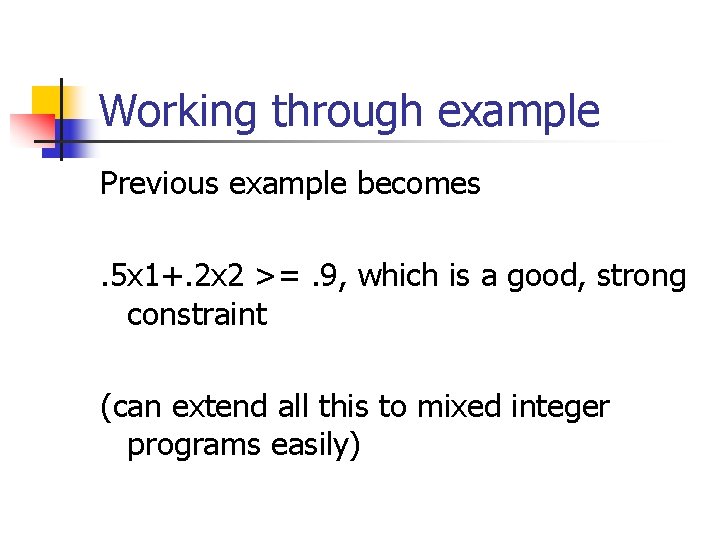
Working through example Previous example becomes. 5 x 1+. 2 x 2 >=. 9, which is a good, strong constraint (can extend all this to mixed integer programs easily)
Gomory Constraints (modeling) n Are we done? Very good to have available but likely not the only tool in the arsenal.
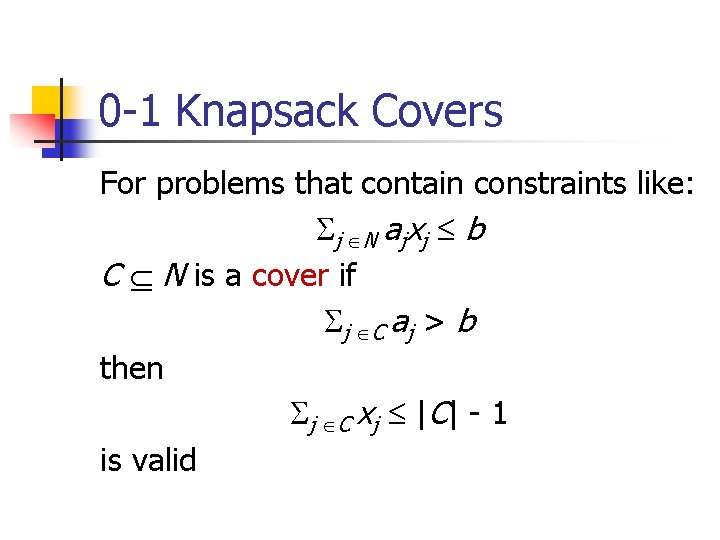
0 -1 Knapsack Covers For problems that contain constraints like: j N a j xj b C N is a cover if j C a j > b then j C xj | C | - 1 is valid
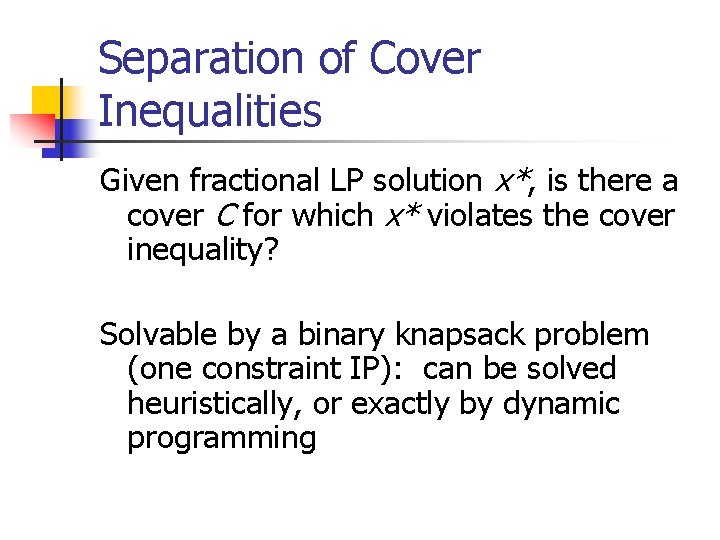
Separation of Cover Inequalities Given fractional LP solution x*, is there a cover C for which x* violates the cover inequality? Solvable by a binary knapsack problem (one constraint IP): can be solved heuristically, or exactly by dynamic programming
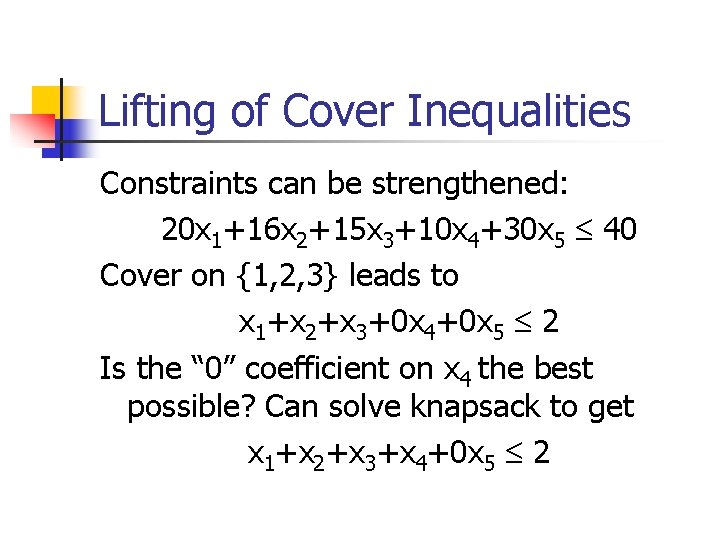
Lifting of Cover Inequalities Constraints can be strengthened: 20 x 1+16 x 2+15 x 3+10 x 4+30 x 5 40 Cover on {1, 2, 3} leads to x 1+x 2+x 3+0 x 4+0 x 5 2 Is the “ 0” coefficient on x 4 the best possible? Can solve knapsack to get x 1+x 2+x 3+x 4+0 x 5 2
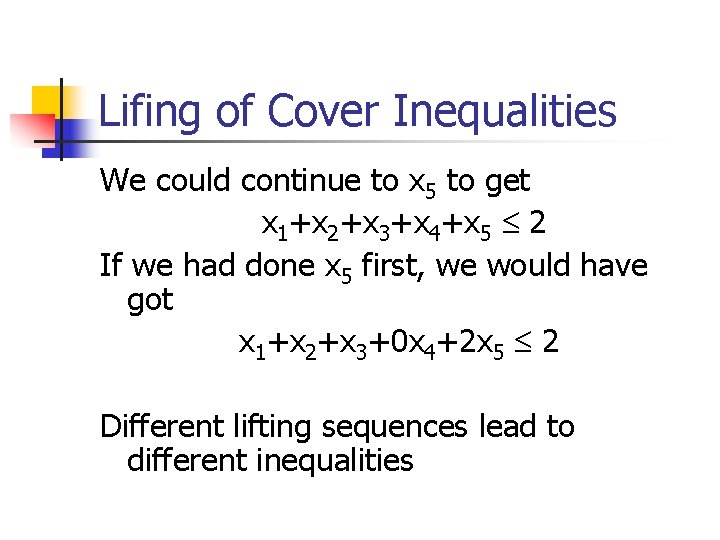
Lifing of Cover Inequalities We could continue to x 5 to get x 1+x 2+x 3+x 4+x 5 2 If we had done x 5 first, we would have got x 1+x 2+x 3+0 x 4+2 x 5 2 Different lifting sequences lead to different inequalities
Modeling implications n n n Cover inequalities generally part of the software, rather than the modeling (but if software has capability, do not include in model). Decision is whether to use the inequalities or not essentially numerical question Lifting is extremely important, as is relationship of covers in subproblems to full problem
Conclusions n n n There is lots to integer programming! Interesting interplay between formulations and algorithms Much intelligence embedded in software, making formulations a bit more “fool-proof”
Papers to Read Progress in Linear Programming Based Branch and Bound Algorithms: An exposition, Ellis Johnson, George Nemhauser, and Martin Savelsbergh MIP: Theory and Practice – Closing the Gap, Robert Bixby, Mary Fenelon, Zonghao Gue, Ed Rothberg, and Roland Wunderling