
INTRODUCTION TO INSTRUMENTATION SYSTEM Look into a whole
- Slides: 11
INTRODUCTION TO INSTRUMENTATION SYSTEM • Look into a whole instrumentation system • Example 1: Biomedical Instrumentation • Principles associated to the biomedical field • Focus on non-invasive techniques • Biopotential • Electric Field associated to the electrochemical activity of a certain class of cells and give information of the activity of the organs they are part of
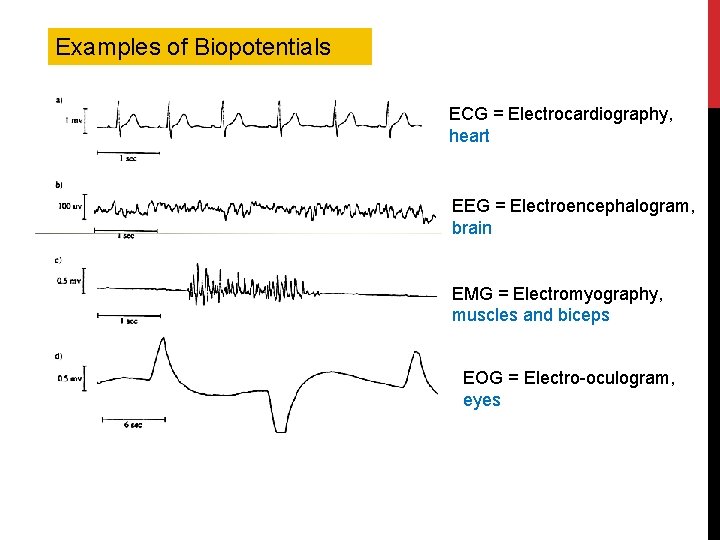
Examples of Biopotentials ECG = Electrocardiography, heart EEG = Electroencephalogram, brain EMG = Electromyography, muscles and biceps EOG = Electro-oculogram, eyes
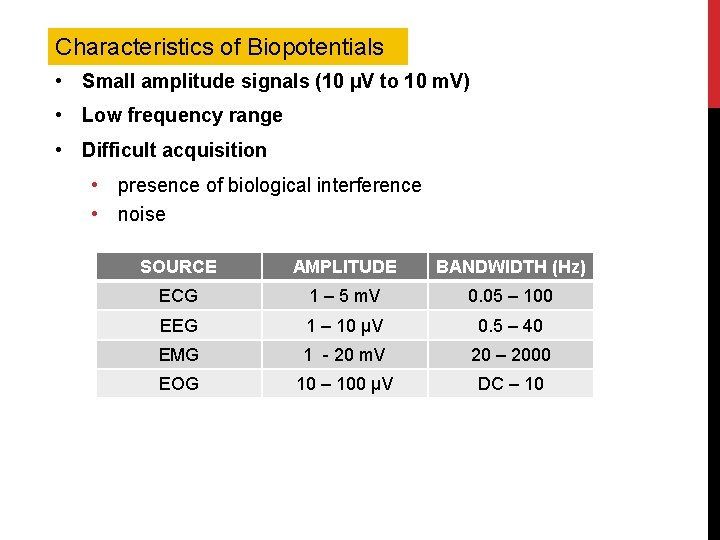
Characteristics of Biopotentials • Small amplitude signals (10 µV to 10 m. V) • Low frequency range • Difficult acquisition • presence of biological interference • noise SOURCE AMPLITUDE BANDWIDTH (Hz) ECG 1 – 5 m. V 0. 05 – 100 EEG 1 – 10 µV 0. 5 – 40 EMG 1 - 20 m. V 20 – 2000 EOG 10 – 100 µV DC – 10
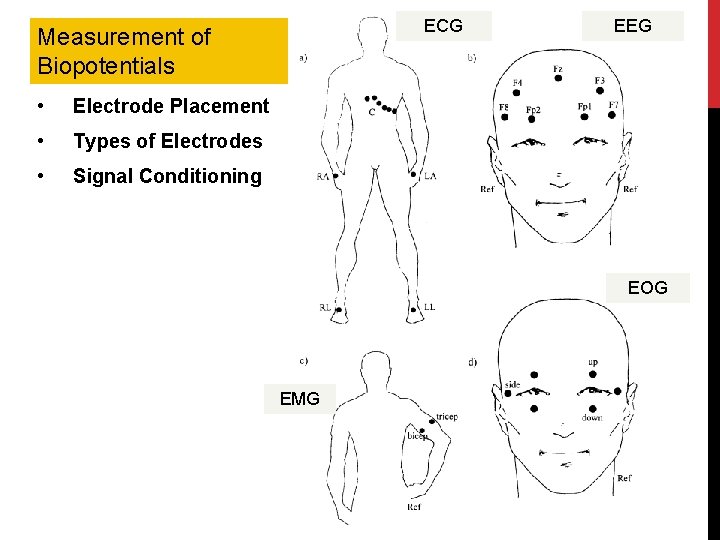
ECG Measurement of Biopotentials • Electrode Placement • Types of Electrodes • Signal Conditioning EEG EOG EMG
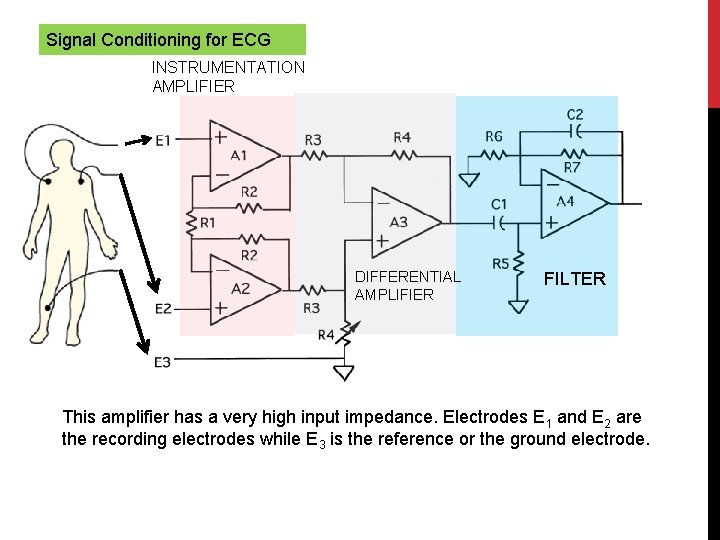
Signal Conditioning for ECG INSTRUMENTATION AMPLIFIER DIFFERENTIAL AMPLIFIER FILTER This amplifier has a very high input impedance. Electrodes E 1 and E 2 are the recording electrodes while E 3 is the reference or the ground electrode.
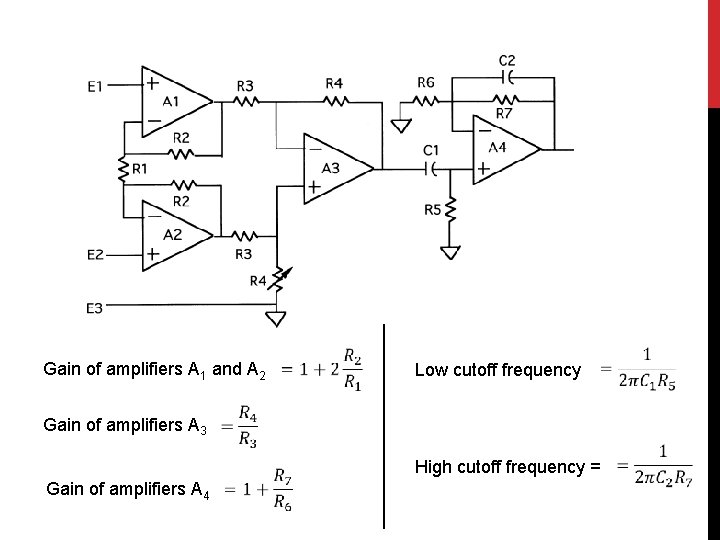
Gain of amplifiers A 1 and A 2 Gain of amplifiers A 3 Gain of amplifiers A 4 Low cutoff frequency High cutoff frequency =
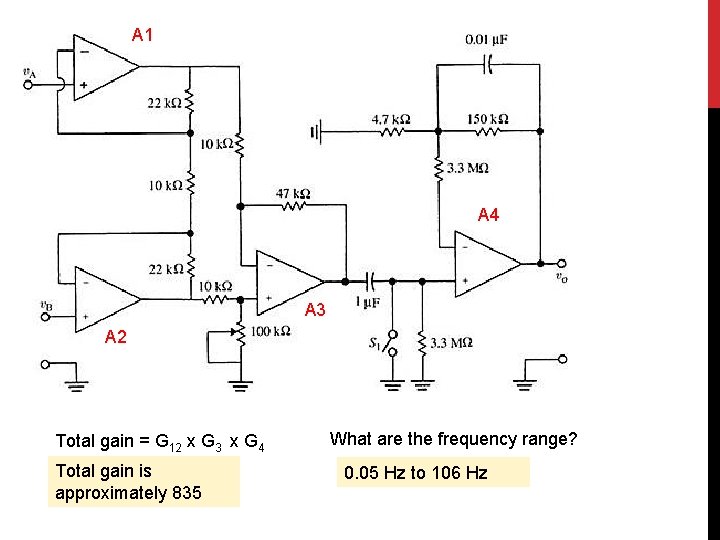
A 1 A 4 A 3 A 2 Total gain = G 12 x G 3 x G 4 Total gain is approximately 835 What are the frequency range? 0. 05 Hz to 106 Hz
INTRODUCTION TO INSTRUMENTATION SYSTEM • Example 2: Optical and Optoelectronics Sensors and Measurements • Principles of measurement used in optical and optoelectronics sensors • Focus on non contact and non-invasive techniques
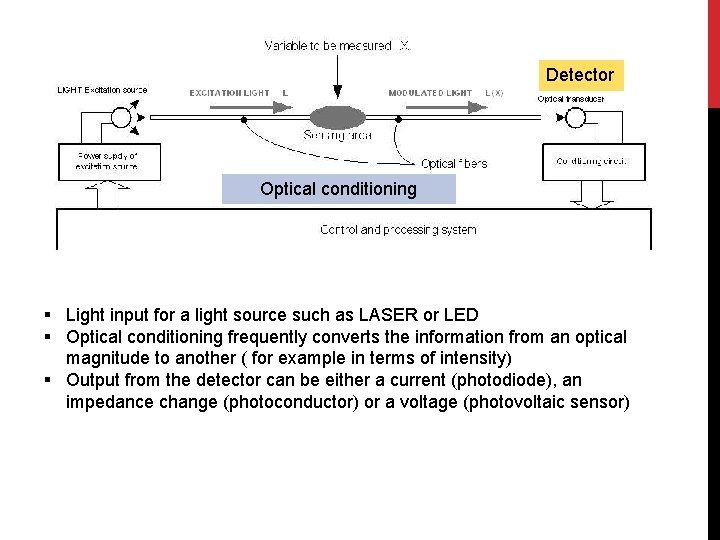
Detector Optical conditioning § Light input for a light source such as LASER or LED § Optical conditioning frequently converts the information from an optical magnitude to another ( for example in terms of intensity) § Output from the detector can be either a current (photodiode), an impedance change (photoconductor) or a voltage (photovoltaic sensor)
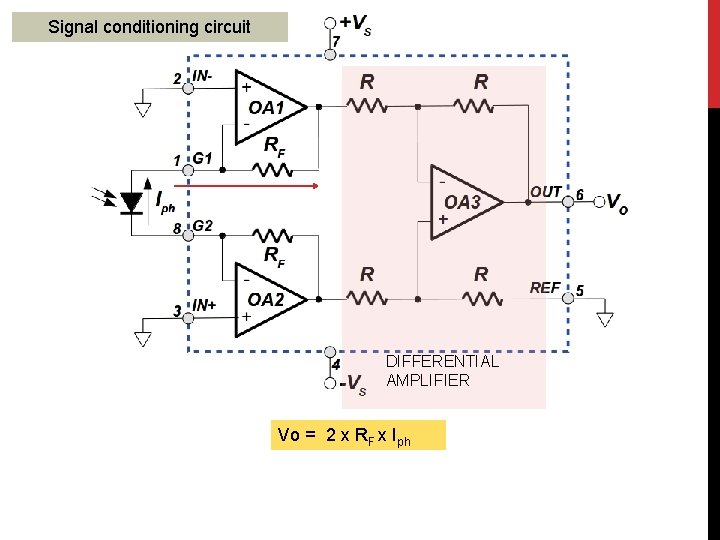
Signal conditioning circuit DIFFERENTIAL AMPLIFIER Vo = 2 x RF x Iph
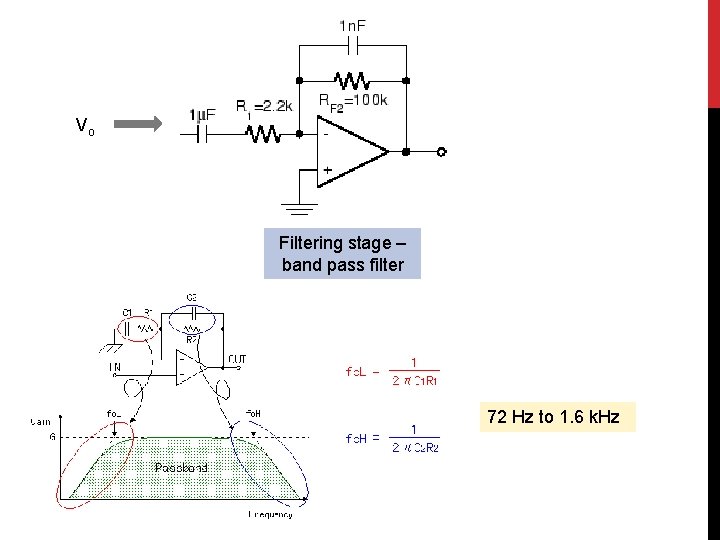
Vo Filtering stage – band pass filter 72 Hz to 1. 6 k. Hz