
Introduction to Instructional Design An Overview Learning Objectives
Introduction to Instructional Design An Overview
Learning Objectives (1 of 3) Upon completing this lesson, the learner should be able to: 1. 2. 3. 4. 5. 2 Tell what a system is. Recognize systems from real world experiences. Demonstrate why systems are important. Identify what instructional systems design is. Interpret systems in the design of instruction and training, including Dick and Carey, Kemp, Hannifin and Peck, and ADDIE. Introduction to ISD: An Overview
Learning Objectives (2 of 3) 6. List the five phases of ADDIE. State what each phase of ADDIE represents. 8. Explain why it is necessary to use ADDIE on the VA ADDIE contract. 9. Define Bloom’s taxonomy. 10. Choose three examples of when Bloom’s taxonomy was used in real world experiences. 7. 3 Introduction to ISD: An Overview
Learning Objectives (3 of 3) 11. Prescribe a measurable verb from Bloom’s taxonomy to achieve the desired performance or learning outcome. 12. Analyze why and how the design of learning and training is enhanced by using Bloom’s taxonomy. 13. Identify trends in the Instructional Systems Design profession. 4 Introduction to ISD: An Overview
Topics to be Covered �What is Instructional Systems Design (or ISD)? �Why Use Instructional Systems Design in Designing Training and Learning? �What is ADDIE? �Bloom’s Taxonomy and Instructional Design �Wrap Up and Evaluation 5 Introduction to ISD: An Overview
Topic One What is Instructional Systems Design (or ISD)? 6 Introduction to ISD: An Overview
Learning Objective Upon completing this topic, you will be able to explain what instructional systems design means. 7 Introduction to ISD: An Overview
What is a System? Activity In your own words, write down the definition of system? 8 Introduction to ISD: An Overview
What is a System View a 2: 17 minute video on the definition of a system. 9 Introduction to ISD: An Overview
What is a System? 10 Introduction to ISD: An Overview
Identify Real World Systems Activity �Recognize real world systems. �Discuss real world systems. �Provide examples of something that is not a system. 11 Introduction to ISD: An Overview
Miracle on the Hudson View of a 3: 14 minute video of a system that resulted in a successful outcome. 12 Introduction to ISD: An Overview
Why are Systems Important? 13 Introduction to ISD: An Overview
The Chernobyl Accident View a 10: 09 minute video of a system that failed. 14 Introduction to ISD: An Overview
15 Introduction to ISD: An Overview
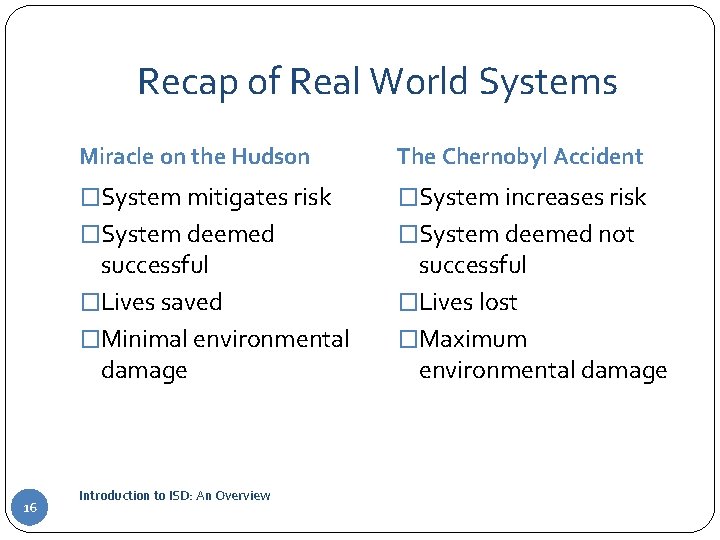
Recap of Real World Systems Miracle on the Hudson The Chernobyl Accident �System mitigates risk �System increases risk �System deemed not successful �Lives saved �Minimal environmental damage 16 Introduction to ISD: An Overview successful �Lives lost �Maximum environmental damage
What is Instructional Systems Design? (1 of 2) Use of a systems approach to designing learning. 17 Introduction to ISD: An Overview
What is Instructional Systems Design? (2 of 2) A systems approach is a “procedure used by instructional designers to create instruction. Each step requires input from prior steps and provides input to the next step. Evaluation provides feedback that is used to revise instruction until it meets the original need or specification” (Dick and Carey, et al, 2009). 18 Introduction to ISD: An Overview
ISD Overview View a 11: 26 minute video on ISD. 19 Introduction to ISD: An Overview
20 Introduction to ISD: An Overview
ISD Activity § Discuss what ISD is. § Explain how ISD principles are applied on the VA ADDIE contract or task orders. 21 Introduction to ISD: An Overview
Recap üRecap of “What is ISD”? 22 Introduction to ISD: An Overview
Restating Learning Objective Upon completing this topic, you should be able to explain what instructional systems design means. 23 Introduction to ISD: An Overview
Topic Two Why Use ISD in Designing Training and Learning? 24 Introduction to ISD: An Overview
Learning Objective Upon completing this topic, you will be able to identify four models in the design of learning and training: Dick and Carey, Kemp, Hannifin and Peck, and ADDIE. 25 Introduction to ISD: An Overview
Why Use ISD Models? �Provides a mechanism for assessing an organization’s training or learning needs. �Enables a systematic approach to determining training or learning needs. �Facilitates the ability to meet the desired specifications of the training or learning. �Can be cost effective. 26 Introduction to ISD: An Overview
Why Use ISD? Activity List two other reasons why ISD models would be used by an organization. 27 Introduction to ISD: An Overview
Four ISD Models �Dick and Carey (linear with nine steps) �Kemp (circular with nine steps) �Hannafin and Peck (three linear phases with a evaluations of every phase) �ADDIE (five phases in the process that are non-linear; the bases of most ISD models) 28 Introduction to ISD: An Overview
ISD Models �Used to systematically design training and learning. �Differ in nuance but not in overall approach. �Involve evaluating or assessing each step of the design process. �Allow a visual representation of the design and development process. �Serve as a mechanism for collaboration among designers, developers, graphic artists, and others. 29 Introduction to ISD: An Overview
Components of the Systems Approach Model (1 of 3) ü Identify Instructional Goal(s) ü Conduct Instructional Analysis ü Analyze Learners and Contexts 30 Introduction to ISD: An Overview
Components of the Systems Approach Model (2 of 3) ü Write Performance Objectives ü Develop Assessment Instruments ü Develop Instructional Strategy ü Develop and Select Instructional Materials 31 Introduction to ISD: An Overview
Components of the Systems Approach Model (3 of 3) ü Design and Conduct Formative Evaluation of Instruction ü Revise Instruction ü Design and Conduct Summative Evaluation 32 Introduction to ISD: An Overview
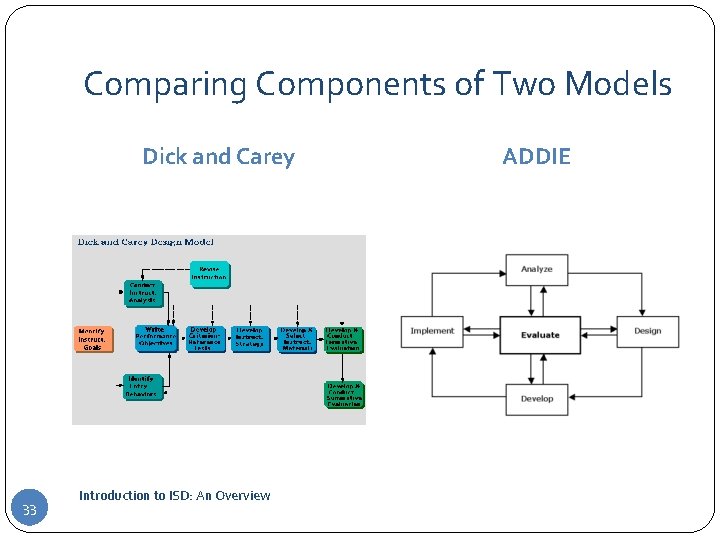
Comparing Components of Two Models Dick and Carey 33 Introduction to ISD: An Overview ADDIE
Recap ü Recap of “Why ISD is Necessary”? ü Recap of ISD models. 34 Introduction to ISD: An Overview
Restating Learning Objective Upon completing this topic, you should be able to identify four instructional design models and explain why a systematic approach is important to the design of learning and training. 35 Introduction to ISD: An Overview
Topic Three What is ADDIE? 36 Introduction to ISD: An Overview
Learning Objective Upon completing this topic, the learner will be able to state what the five phases of ADDIE are and why these phases are necessary for the systematic design of learning and training. 37 Introduction to ISD: An Overview
What is ADDIE? �ADDIE is an instructional design model. �The acronym ADDIE stands for: A ssess Design Develop Implement Evaluate 38 Introduction to ISD: An Overview
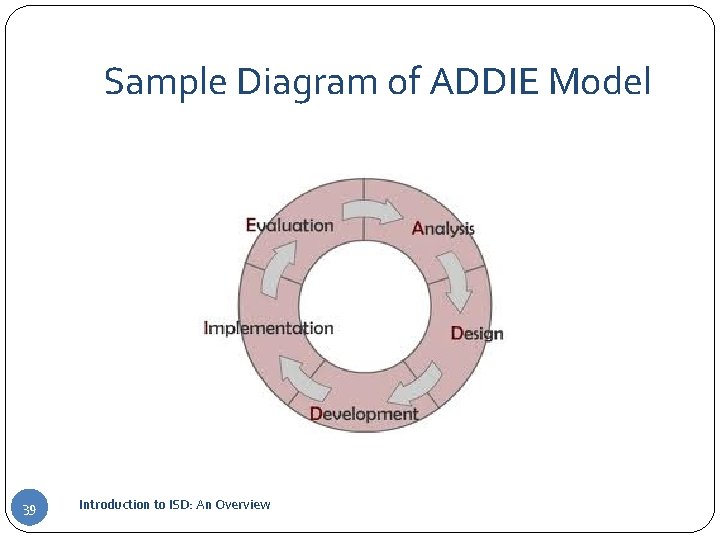
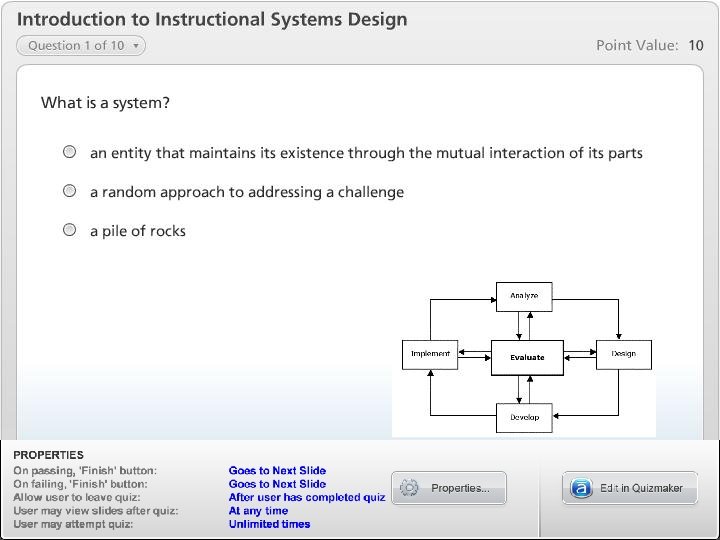
Sample Diagram of ADDIE Model 39 Introduction to ISD: An Overview
Diagram of ADDIE Activity �Draw a diagram of the ADDIE model as you conceive the process. 40 Introduction to ISD: An Overview
Review of Statement of Work (SOW) The contractor is required to utilize the VA EES Storyboard format (sample attached). The Instructional Designer/team shall review the Government Furnished Material and work with the VA subject matter advisors to confirm and refine the course Terminal Objectives as well as the Scalable Content Object (SCO) level enabling objectives to include instructional design options, image treatment options, multimedia options to achieve SCO level enabling objectives, and overall strategy to achieve the defined terminal objectives of Lesson (Section). 41 Introduction to ISD: An Overview
Deciphering the SOW Activity 1. Review the SOW and compare it with the five phases of ADDIE. 2. Determine the phases of ADDIE that are applicable in this SOW. 3. Discuss the advantages and disadvantages of the SOW as they relate to ADDIE. 42 Introduction to ISD: An Overview
Recap üRecap of “What is ADDIE”? 43 Introduction to ISD: An Overview
Restating Learning Objective Upon completing this topic, the learner should be able to state what the five phases of ADDIE are and why these phases are necessary for the systematic design of learning and training. 44 Introduction to ISD: An Overview
Topic Four Bloom’s Taxonomy 45 Introduction to ISD: An Overview
Learning Objective Upon completing this topic, the learner will be able to apply measurable verbs from Bloom’s taxonomy of learning domains to a desired learning or performance outcome. 46 Introduction to ISD: An Overview
What is Bloom’s Taxonomy? �Known more formally as “Bloom’s Taxonomy of Learning Domains. ” �“A framework for classifying student learning outcomes according to [Bloom’s] view on the complexity of different kinds of skills” (Dick and Carey et al. , 2009). 47 Introduction to ISD: An Overview
Learning Domains �Cognitive: mental skills (Knowledge) �Affective: growth in feelings or emotional areas (Attitude) �Psychomotor: manual or physical skills (Skills) 48 Introduction to ISD: An Overview
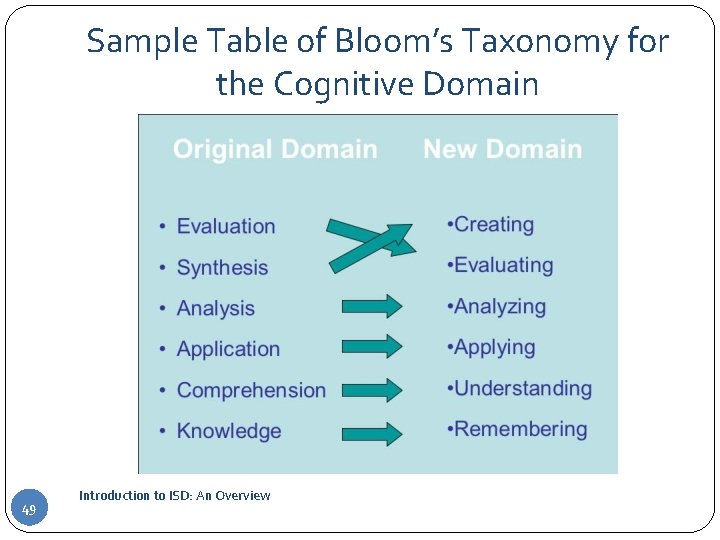
Sample Table of Bloom’s Taxonomy for the Cognitive Domain 49 Introduction to ISD: An Overview
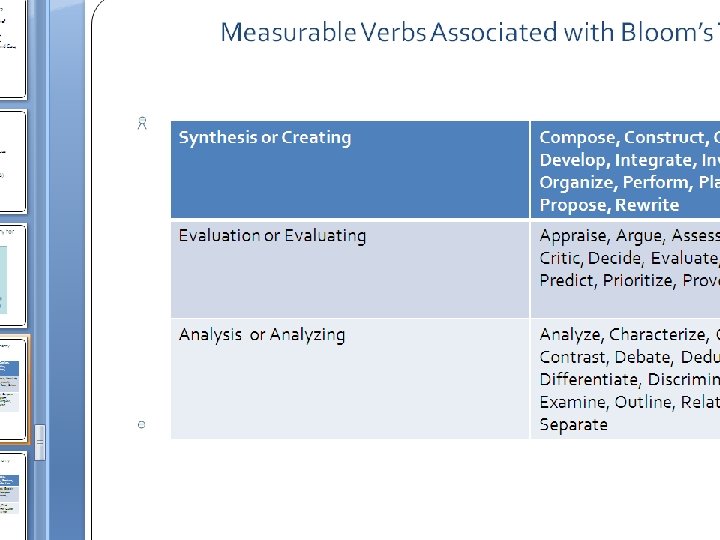
Measurable Verbs Associated with Bloom’s Taxonomy 50 Synthesis or Creating Compose, Construct, Create, Design, Develop, Integrate, Invent, Make, Organize, Perform, Plan, Produce, Propose, Rewrite Evaluation or Evaluating Appraise, Argue, Assess, Choose, Conclude, Critic, Decide, Evaluate, Judge, Justify, Predict, Prioritize, Prove, Rank, Rate, Select Analysis or Analyzing Analyze, Characterize, Classify, Compare, Contrast, Debate, Deduce, Diagram, Differentiate, Discriminate, Distinguish, Examine, Outline, Relate, Research, Separate Introduction to ISD: An Overview
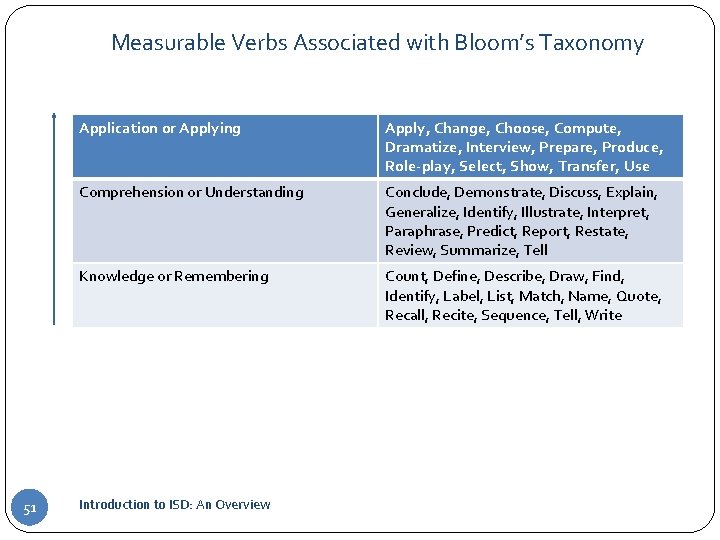
Measurable Verbs Associated with Bloom’s Taxonomy 51 Application or Applying Apply, Change, Choose, Compute, Dramatize, Interview, Prepare, Produce, Role-play, Select, Show, Transfer, Use Comprehension or Understanding Conclude, Demonstrate, Discuss, Explain, Generalize, Identify, Illustrate, Interpret, Paraphrase, Predict, Report, Restate, Review, Summarize, Tell Knowledge or Remembering Count, Define, Describe, Draw, Find, Identify, Label, List, Match, Name, Quote, Recall, Recite, Sequence, Tell, Write Introduction to ISD: An Overview
Interactive Media Assign a group of verbs to the appropriate category of the cognitive learning domain on the following screen. 52 Introduction to ISD: An Overview
53 Introduction to ISD: An Overview
Bloom’s Taxonomy and Learning Objectives �Learning objectives state what the learner should be able to do after completing the module, lesson, or topic. �Learning objectives must be measurable. �Learning objectives should state a condition and a behavior. 54 Introduction to ISD: An Overview
Examples of Learning Objectives Upon completing this training, the learner will be able to: 1. Identify what a statement of work is. 2. Interpret a statement of work. 3. Apply VA ADDIE to a statement of work. 4. Compare the statement of work with the VA ADDIE model. 5. Perform each task in the statement of work. 6. Evaluate each task performed in the statement of work. 55 Introduction to ISD: An Overview
Real World Examples �Discuss and listen to real world examples of when Bloom’s taxonomy was applied. 56 Introduction to ISD: An Overview
Recap ü Explain the importance of Bloom’s Taxonomy of Learning Domains. 57 Introduction to ISD: An Overview
Restating Learning Outcome Upon completing this topic, the learner should be able to apply measurable verbs from Bloom’s taxonomy of learning domains to the to a desired learning or performance outcome from the cognitive domain. 58 Introduction to ISD: An Overview
Topic Five Wrap Up and Evaluation 59 Introduction to ISD: An Overview
Learning Objective Upon completing this topic, the learner will be able to identify current trends in ISD and complete the assessment. 60 Introduction to ISD: An Overview
Current Trends in ISD �Generate a list of current trends in ISD. �Discuss list. 61 Introduction to ISD: An Overview
Listen to Podcast �Listen to a podcast of “Creating a Culture of Motivation, ” T & D (September 2011), p. 46. 62 Introduction to ISD: An Overview
63 Introduction to ISD: An Overview
Recap of Learning Objectives (1 of 2) Upon completing this lesson, the learner should be able to: 1. 2. 3. 4. 5. 64 Tell what a system is. Recognize systems from real world experiences. Demonstrate why systems are important. Identify what instructional systems design is. Interpret systems in the design of instruction and training, including Dick and Carey, Kemp, Hannifin and Peck, and ADDIE. Introduction to ISD: An Overview
Recap of Learning Objectives (2 of 2) 6. List the five phases of ADDIE. State what each phase of ADDIE represents. 8. Explain why it is necessary to use ADDIE on the VA ADDIE contract. 9. Define Bloom’s taxonomy. 10. Choose three examples of when Bloom’s taxonomy was used in real world experiences. 7. 65 Introduction to ISD: An Overview
Recap of Learning Objectives (3 of 3) 11. Prescribe a measurable verb from Bloom’s taxonomy to achieve the desired performance or learning outcome. 12. Analyze why and how the design of learning and training is enhanced by using Bloom’s taxonomy. 13. Identify trends in the Instructional Systems Design profession. 66 Introduction to ISD: An Overview
Evaluation Complete the formative assessment to evaluate how well you have achieved the learning objectives for this lesson. 67 Introduction to ISD: An Overview
Conclusion You have successfully completed the lesson “Introduction to Instructional Design: An Overview. ” Thank you! 69 Introduction to ISD: An Overview
- Slides: 69