
Introduction to Information Retrival Slides are adapted from



- Slides: 41
Introduction to Information Retrival Slides are adapted from stanford CS 276
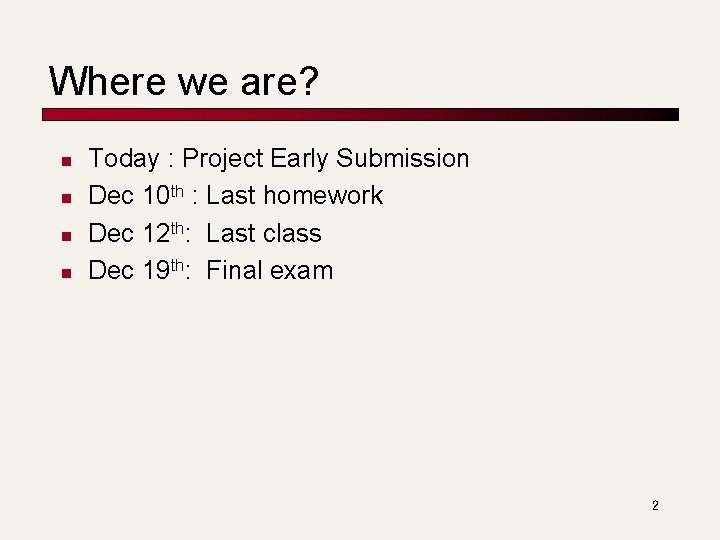
Where we are? n n Today : Project Early Submission Dec 10 th : Last homework Dec 12 th: Last class Dec 19 th: Final exam 2
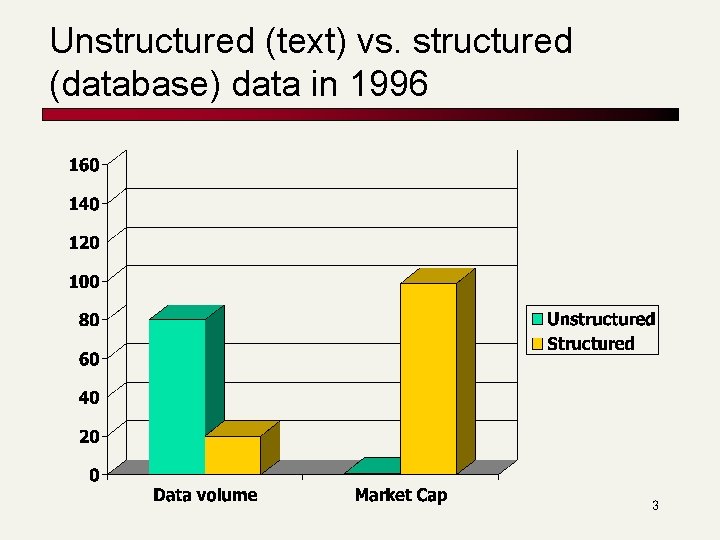
Unstructured (text) vs. structured (database) data in 1996 3
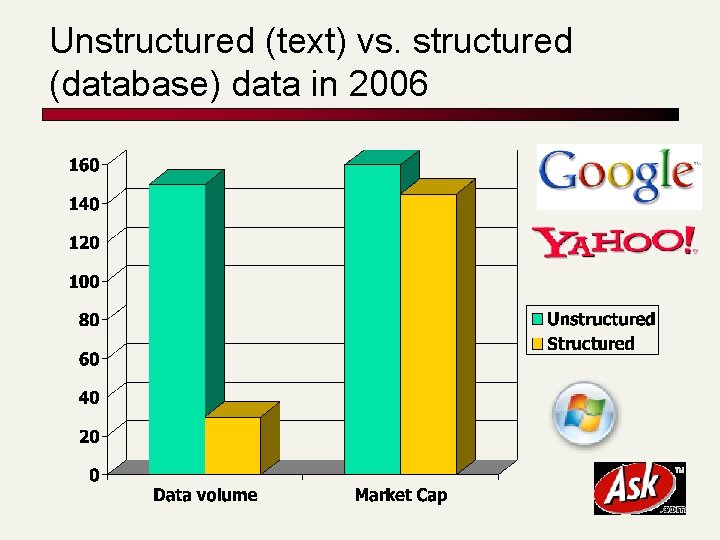
Unstructured (text) vs. structured (database) data in 2006 4
Unstructured data in 1680 n n Which plays of Shakespeare contain the words Brutus AND Caesar but NOT Calpurnia? One could grep all of Shakespeare’s plays for Brutus and Caesar, then strip out lines containing Calpurnia? n n Slow (for large corpora) NOT Calpurnia is non-trivial Other operations (e. g. , find the word Romans near countrymen) not feasible Ranked retrieval (best documents to return) n Later lectures 5
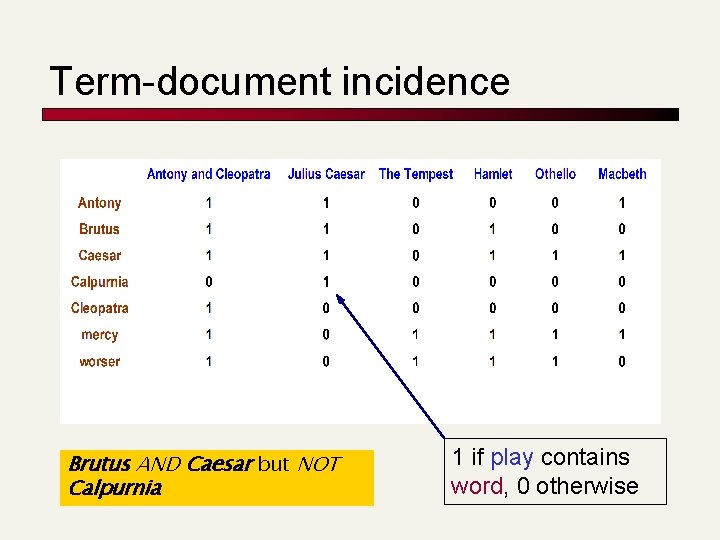
Term-document incidence Brutus AND Caesar but NOT Calpurnia 1 if play contains word, 0 otherwise
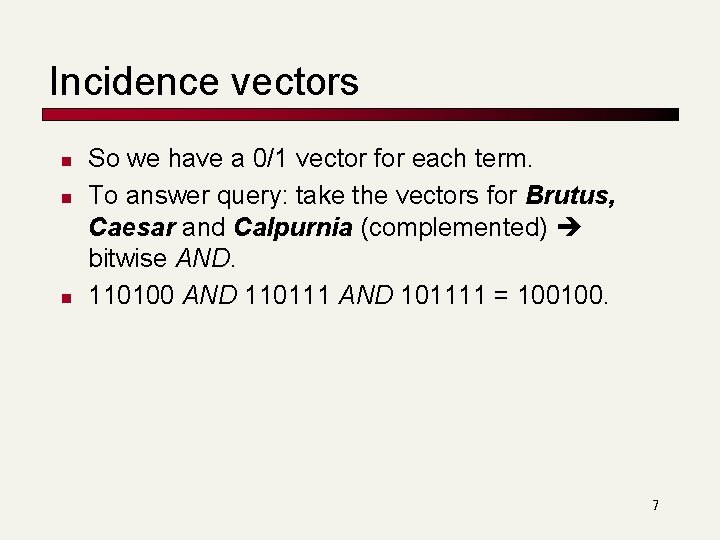
Incidence vectors n n n So we have a 0/1 vector for each term. To answer query: take the vectors for Brutus, Caesar and Calpurnia (complemented) bitwise AND. 110100 AND 110111 AND 101111 = 100100. 7
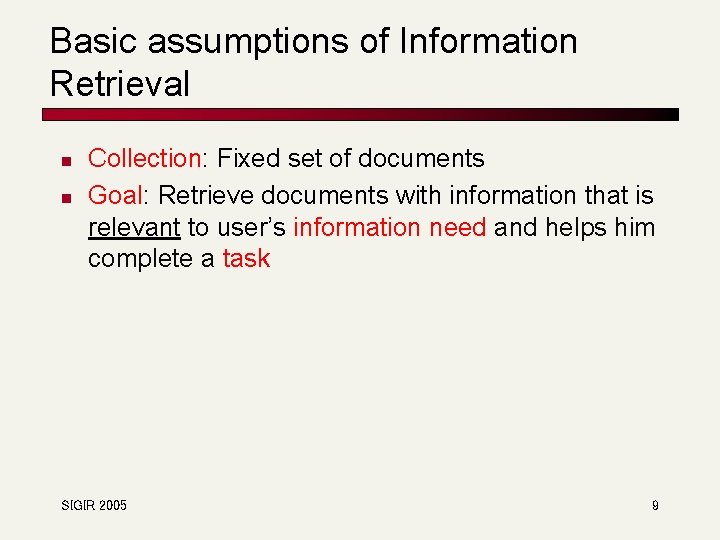
Basic assumptions of Information Retrieval n n Collection: Fixed set of documents Goal: Retrieve documents with information that is relevant to user’s information need and helps him complete a task SIGIR 2005 9
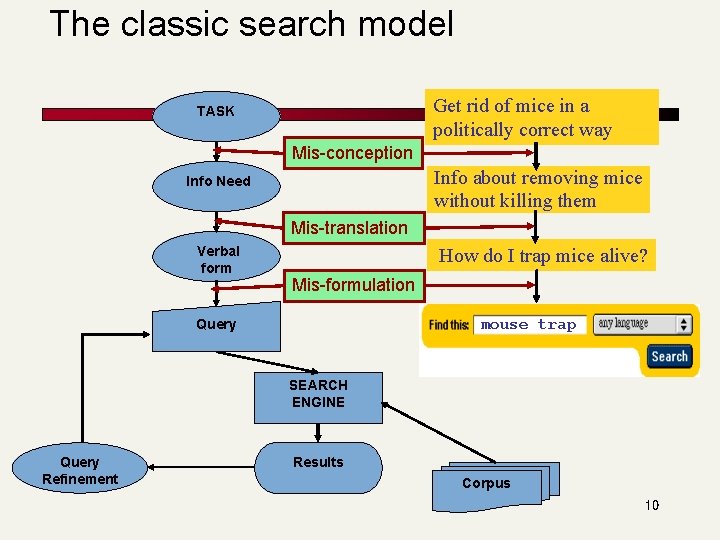
The classic search model Get rid of mice in a politically correct way TASK Mis-conception Info about removing mice without killing them Info Need Mis-translation Verbal form How do I trap mice alive? Mis-formulation Query mouse trap SEARCH ENGINE Query Refinement Results Corpus 10
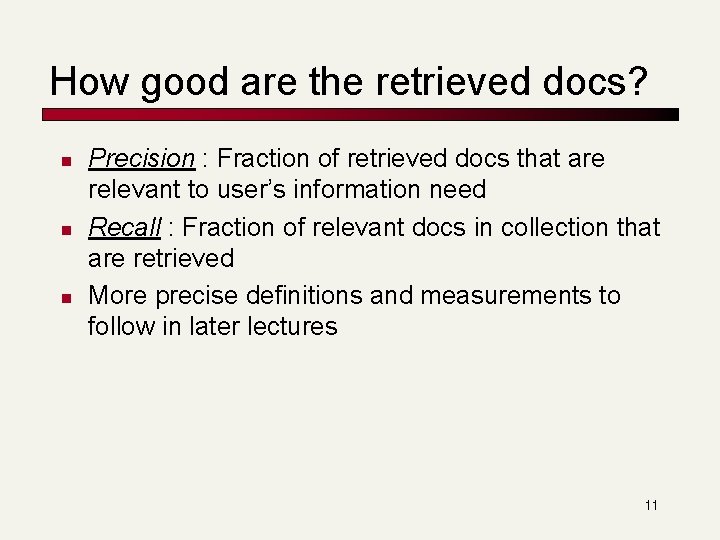
How good are the retrieved docs? n n n Precision : Fraction of retrieved docs that are relevant to user’s information need Recall : Fraction of relevant docs in collection that are retrieved More precise definitions and measurements to follow in later lectures 11
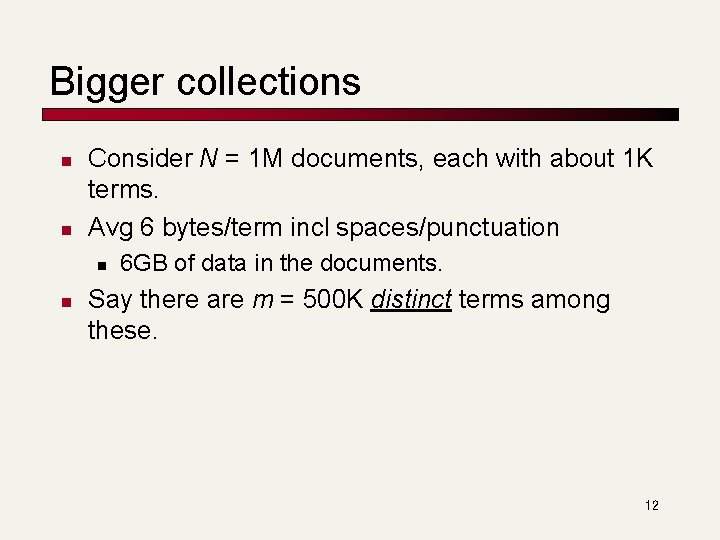
Bigger collections n n Consider N = 1 M documents, each with about 1 K terms. Avg 6 bytes/term incl spaces/punctuation n n 6 GB of data in the documents. Say there are m = 500 K distinct terms among these. 12
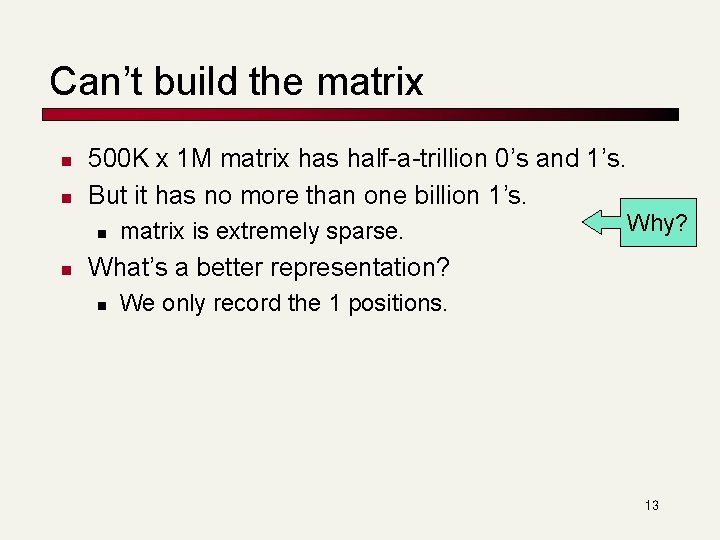
Can’t build the matrix n n 500 K x 1 M matrix has half-a-trillion 0’s and 1’s. But it has no more than one billion 1’s. n n matrix is extremely sparse. Why? What’s a better representation? n We only record the 1 positions. 13
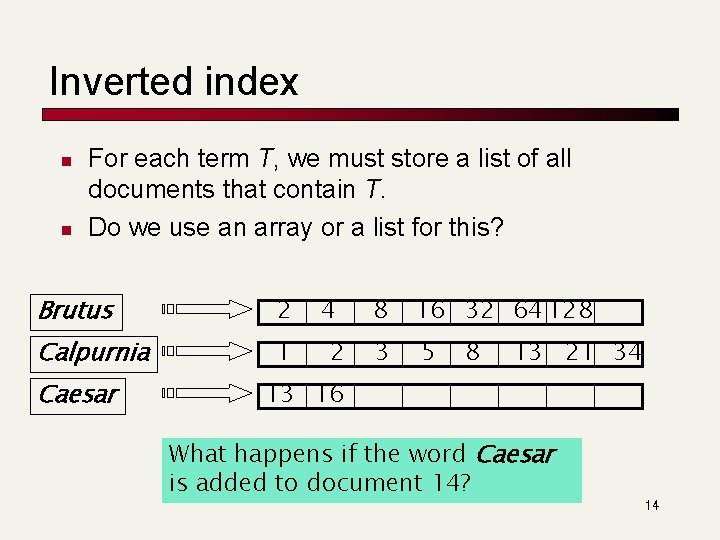
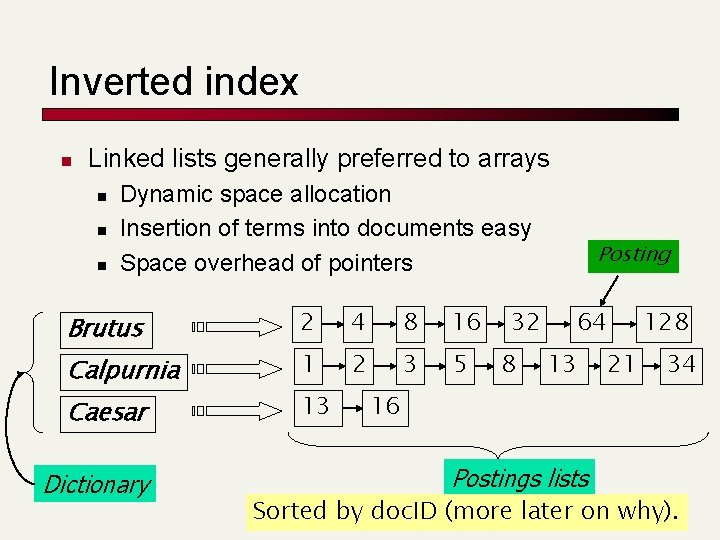
Inverted index n n For each term T, we must store a list of all documents that contain T. Do we use an array or a list for this? Brutus 2 Calpurnia 1 Caesar 4 2 8 16 32 64 128 3 5 8 13 21 34 13 16 What happens if the word Caesar is added to document 14? 14
Inverted index n Linked lists generally preferred to arrays n n n Dynamic space allocation Insertion of terms into documents easy Space overhead of pointers Brutus Calpurnia Caesar Dictionary 2 4 8 16 1 2 3 5 13 32 8 Posting 64 13 21 128 34 16 Postings lists 15 Sorted by doc. ID (more later on why).
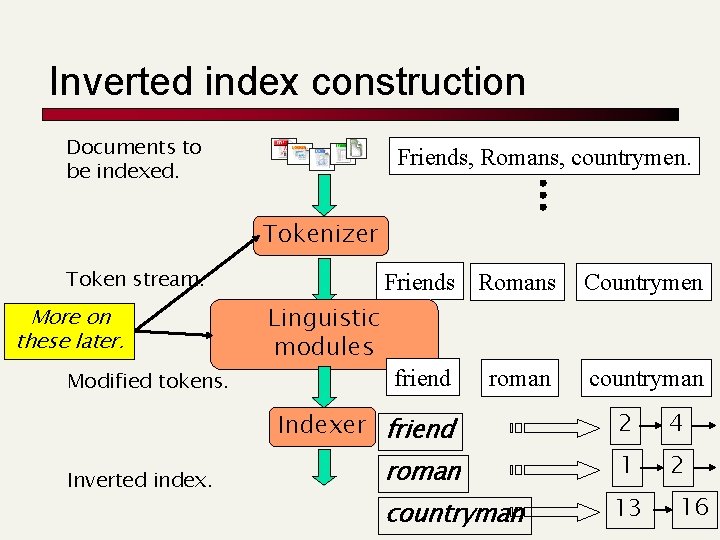
Inverted index construction Documents to be indexed. Friends, Romans, countrymen. Tokenizer Token stream. More on these later. Modified tokens. Friends Romans Linguistic modules friend roman Indexer friend Inverted index. roman countryman Countrymen countryman 2 4 1 2 13 16
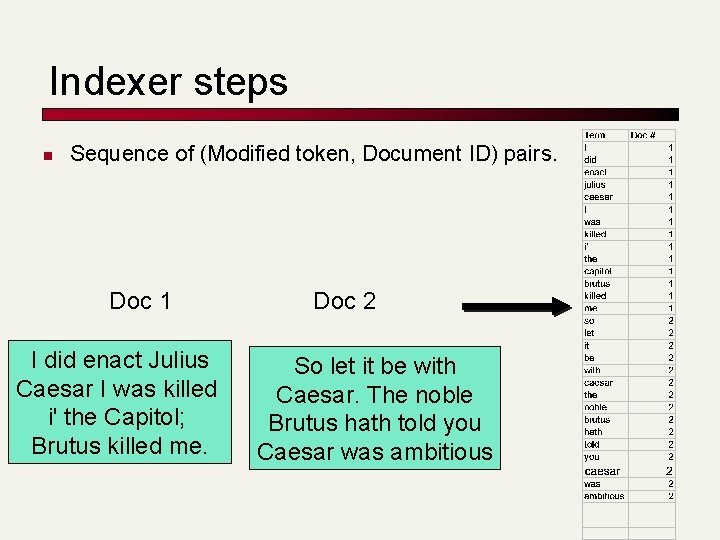
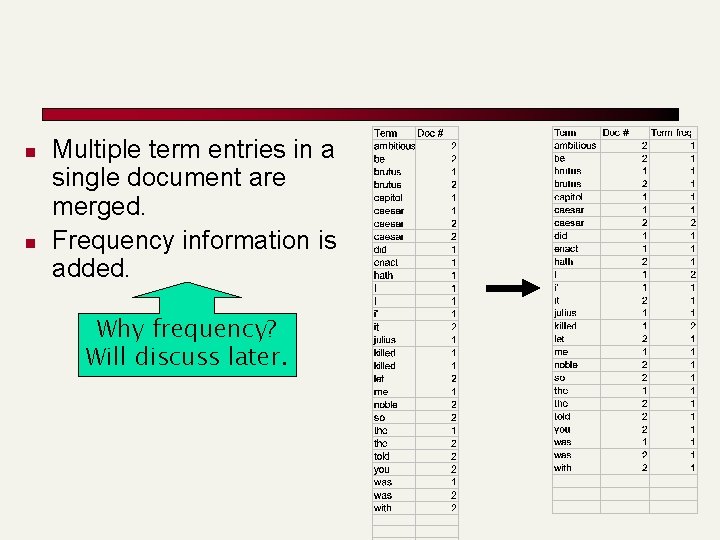
Indexer steps n Sequence of (Modified token, Document ID) pairs. Doc 1 I did enact Julius Caesar I was killed i' the Capitol; Brutus killed me. Doc 2 So let it be with Caesar. The noble Brutus hath told you Caesar was ambitious
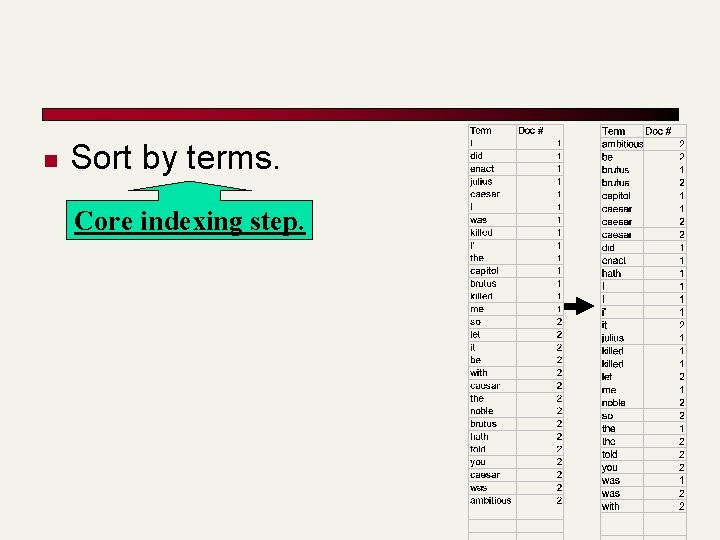
n Sort by terms. Core indexing step.
n n Multiple term entries in a single document are merged. Frequency information is added. Why frequency? Will discuss later.
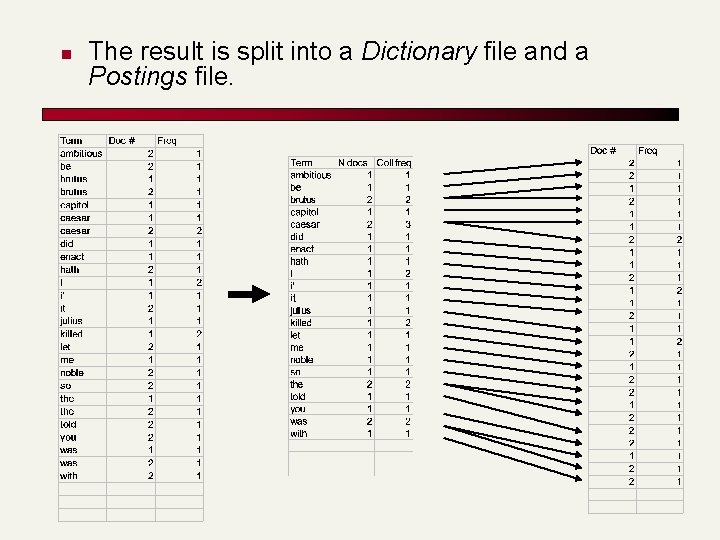
n The result is split into a Dictionary file and a Postings file.
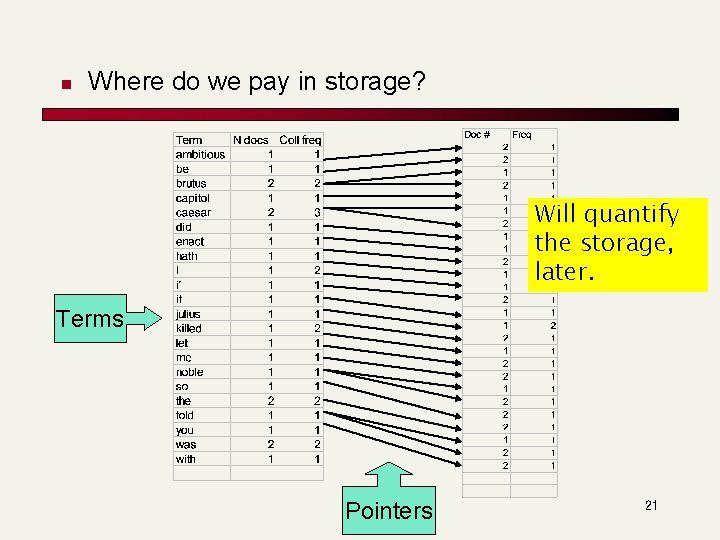
n Where do we pay in storage? Will quantify the storage, later. Terms Pointers 21
The index we just built n Today’s How do we process a query? focus n Later - what kinds of queries can we process? 22
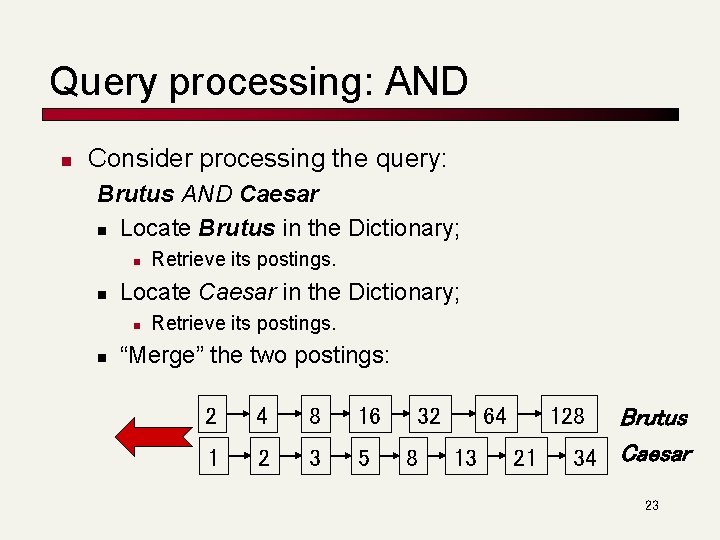
Query processing: AND n Consider processing the query: Brutus AND Caesar n Locate Brutus in the Dictionary; n n Locate Caesar in the Dictionary; n n Retrieve its postings. “Merge” the two postings: 2 4 8 16 1 2 3 5 32 8 64 13 128 21 Brutus 34 Caesar 23
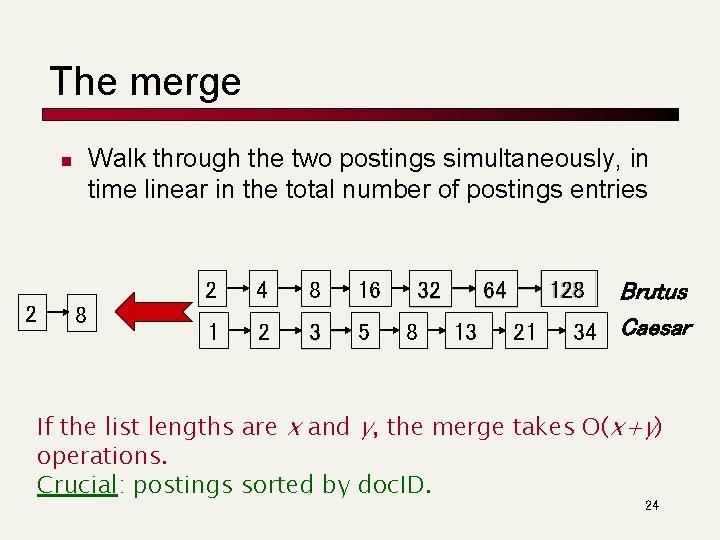
The merge Walk through the two postings simultaneously, in time linear in the total number of postings entries n 2 8 2 4 8 16 1 2 3 5 32 8 13 Brutus 34 Caesar 128 64 21 If the list lengths are x and y, the merge takes O(x+y) operations. Crucial: postings sorted by doc. ID. 24
Boolean queries: Exact match n The Boolean Retrieval model is being able to ask a query that is a Boolean expression: n Boolean Queries are queries using AND, OR and NOT to join query terms n n Views each document as a set of words Is precise: document matches condition or not. Primary commercial retrieval tool for 3 decades. Professional searchers (e. g. , lawyers) still like Boolean queries: n You know exactly what you’re getting. 25
Boolean queries: More general merges n Exercise: Adapt the merge for the queries: Brutus AND NOT Caesar Brutus OR NOT Caesar Can we still run through the merge in time O(x+y)? What can we achieve? 28
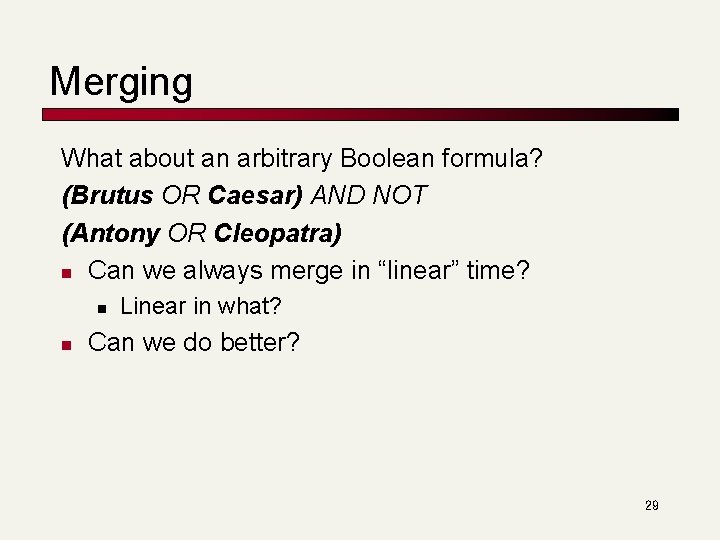
Merging What about an arbitrary Boolean formula? (Brutus OR Caesar) AND NOT (Antony OR Cleopatra) n Can we always merge in “linear” time? n n Linear in what? Can we do better? 29
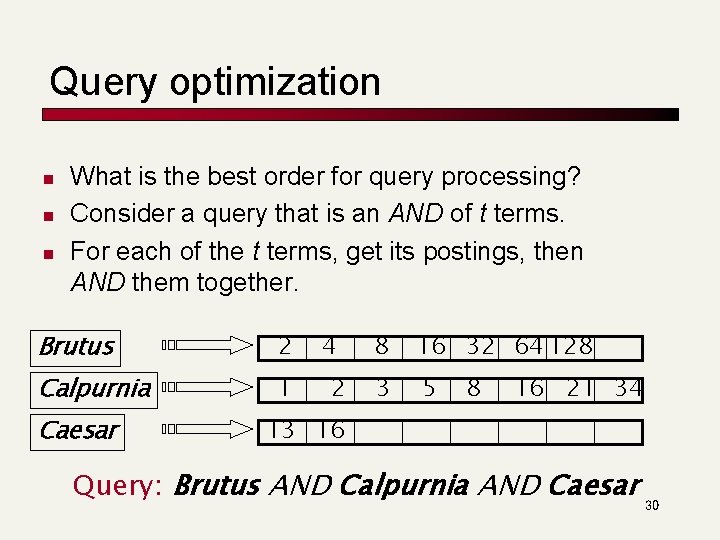
Query optimization n What is the best order for query processing? Consider a query that is an AND of t terms. For each of the t terms, get its postings, then AND them together. Brutus 2 Calpurnia 1 Caesar 4 2 8 16 32 64 128 3 5 8 16 21 34 13 16 Query: Brutus AND Calpurnia AND Caesar 30
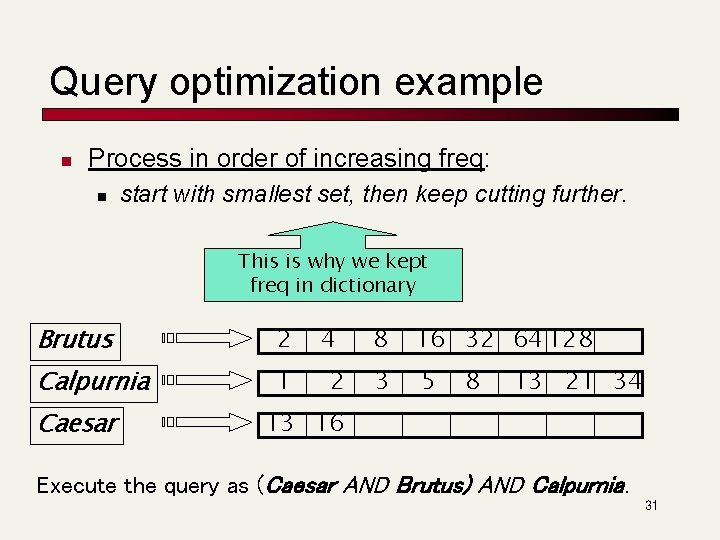
Query optimization example n Process in order of increasing freq: n start with smallest set, then keep cutting further. This is why we kept freq in dictionary Brutus 2 Calpurnia 1 Caesar 4 2 8 16 32 64 128 3 5 8 13 21 34 13 16 Execute the query as (Caesar AND Brutus) AND Calpurnia. 31
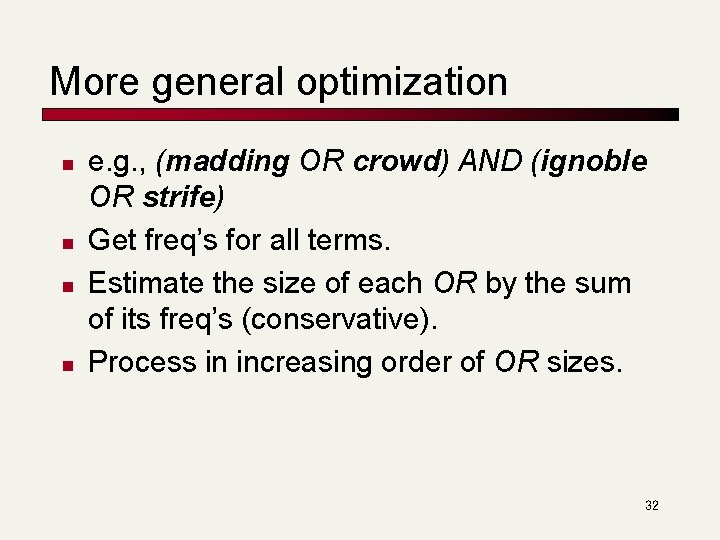
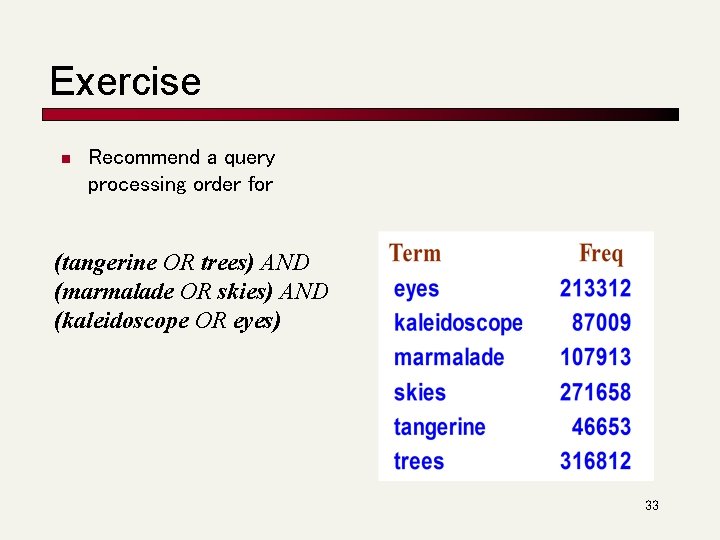
More general optimization n n e. g. , (madding OR crowd) AND (ignoble OR strife) Get freq’s for all terms. Estimate the size of each OR by the sum of its freq’s (conservative). Process in increasing order of OR sizes. 32
Exercise n Recommend a query processing order for (tangerine OR trees) AND (marmalade OR skies) AND (kaleidoscope OR eyes) 33
Query processing exercises n n n If the query is friends AND romans AND (NOT countrymen), how could we use the freq of countrymen? Exercise: Extend the merge to an arbitrary Boolean query. Can we always guarantee execution in time linear in the total postings size? Hint: Begin with the case of a Boolean formula query: in this, each query term appears only once in the query. 34
What’s ahead in IR? Beyond term search n What about phrases? n n Proximity: Find Gates NEAR Microsoft. n n University of Kentucky Need index to capture position information in docs. More later. Zones in documents: Find documents with (author = Ullman) AND (text contains automata). 36
Evidence accumulation n 1 vs. 0 occurrence of a search term n n 2 vs. 1 occurrence 3 vs. 2 occurrences, etc. Usually more seems better Need term frequency information in docs 37
Ranking search results n n Boolean queries give inclusion or exclusion of docs. Often we want to rank/group results n n Need to measure proximity from query to each doc. Need to decide whether docs presented to user are singletons, or a group of docs covering various aspects of the query. 38
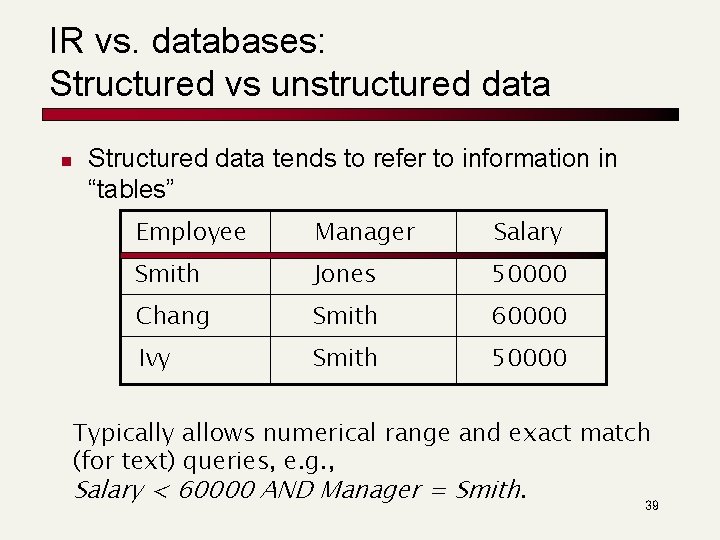
IR vs. databases: Structured vs unstructured data n Structured data tends to refer to information in “tables” Employee Manager Salary Smith Jones 50000 Chang Smith 60000 Ivy Smith 50000 Typically allows numerical range and exact match (for text) queries, e. g. , Salary < 60000 AND Manager = Smith. 39
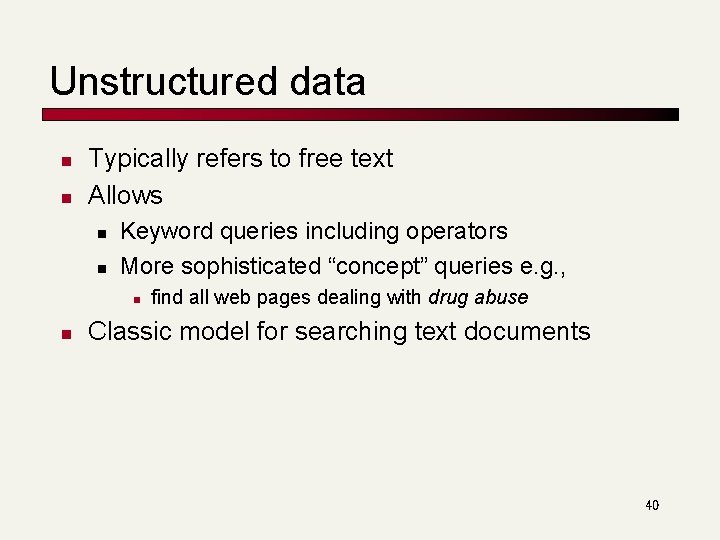
Unstructured data n n Typically refers to free text Allows n n Keyword queries including operators More sophisticated “concept” queries e. g. , n n find all web pages dealing with drug abuse Classic model for searching text documents 40
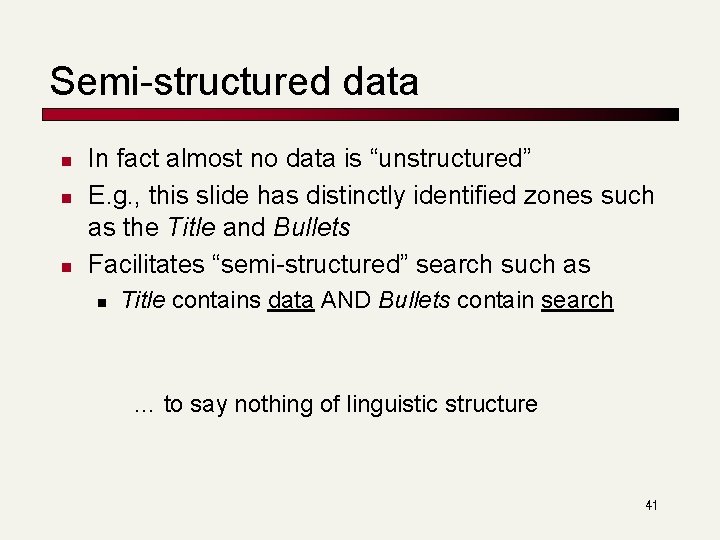
Semi-structured data n n n In fact almost no data is “unstructured” E. g. , this slide has distinctly identified zones such as the Title and Bullets Facilitates “semi-structured” search such as n Title contains data AND Bullets contain search … to say nothing of linguistic structure 41
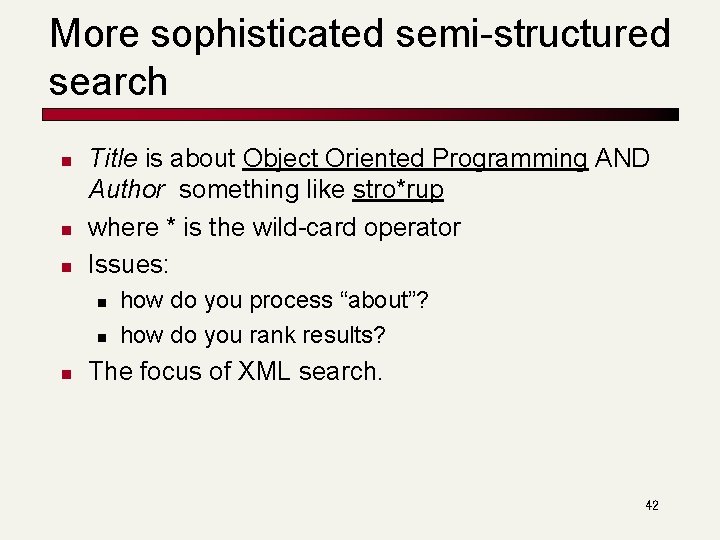
More sophisticated semi-structured search n n n Title is about Object Oriented Programming AND Author something like stro*rup where * is the wild-card operator Issues: n n n how do you process “about”? how do you rank results? The focus of XML search. 42
Clustering and classification n n Given a set of docs, group them into clusters based on their contents. Given a set of topics, plus a new doc D, decide which topic(s) D belongs to. 43
The web and its challenges n n n Unusual and diverse documents Unusual and diverse users, queries, information needs Beyond terms, exploit ideas from social networks n n link analysis, clickstreams. . . How do search engines work? And how can we make them better? 44
More sophisticated information retrieval n n n Cross-language information retrieval Question answering Summarization Text mining … 45