
Introduction to Information Retrieval Text Classification and Nave

- Slides: 16
Introduction to Information Retrieval Text Classification and Naïve Bayes Chris Manning, Pandu Nayak and Prabhakar Raghavan
Introduction to Information Retrieval Ch. 13 Text Classification - Topics to Do § § § § Need for Text Classification Importance of Classification Text Classification Problem Classification Methods Naïve Bayes (NB) Classification Variants of NB Feature Selection with Methods Evaluation of Text Classification
Introduction to Information Retrieval Ch. 13 Text Classification § The path from IR to text classification: § You have an information need to monitor, say: § Developments in Sensor Networks § You want to rerun an appropriate query periodically to find news items on this topic § You will be sent new documents that are found § I. e. , it’s not ranking but classification (relevant vs. not relevant) § Standing queries – Periodically executed on collection over time
Importance of Classification § Sentiment Detection § Email Sorting § Vertical Search Engine 4
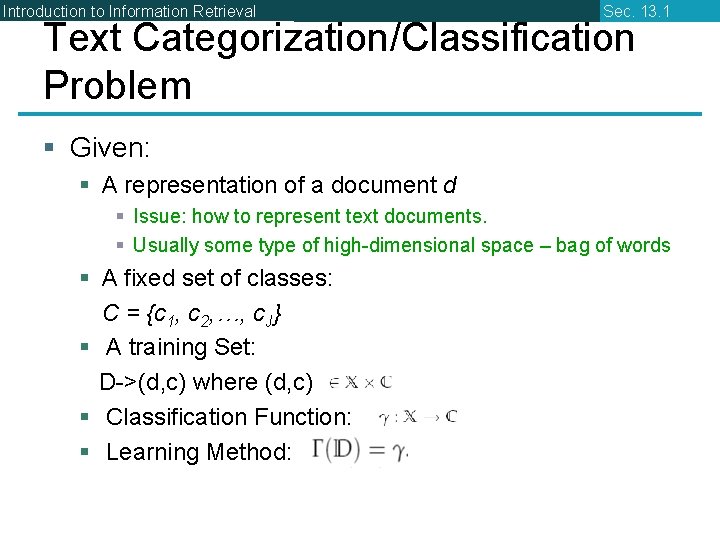
Introduction to Information Retrieval Sec. 13. 1 Text Categorization/Classification Problem § Given: § A representation of a document d § Issue: how to represent text documents. § Usually some type of high-dimensional space – bag of words § A fixed set of classes: C = {c 1, c 2, …, c. J} § A training Set: D->(d, c) where (d, c) § Classification Function: § Learning Method:
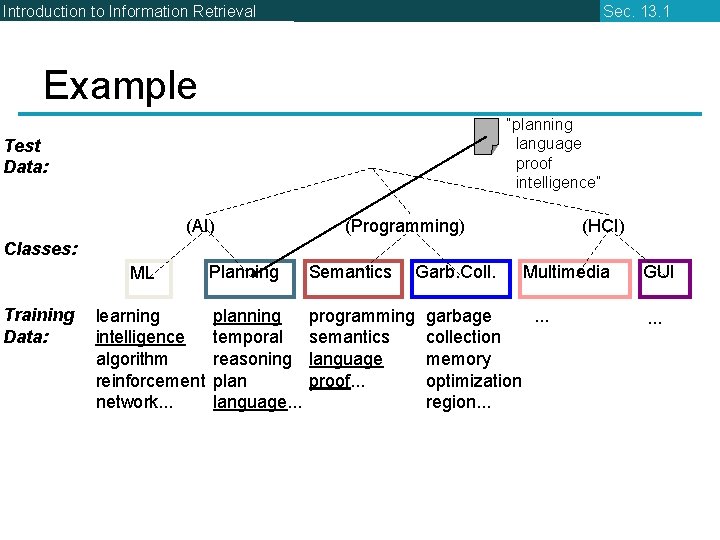
Sec. 13. 1 Introduction to Information Retrieval Example “planning language proof intelligence” Test Data: (AI) (Programming) (HCI) Classes: ML Training Data: learning intelligence algorithm reinforcement network. . . Planning Semantics Garb. Coll. planning temporal reasoning plan language. . . programming semantics language proof. . . Multimedia garbage. . . collection memory optimization region. . . GUI. . .
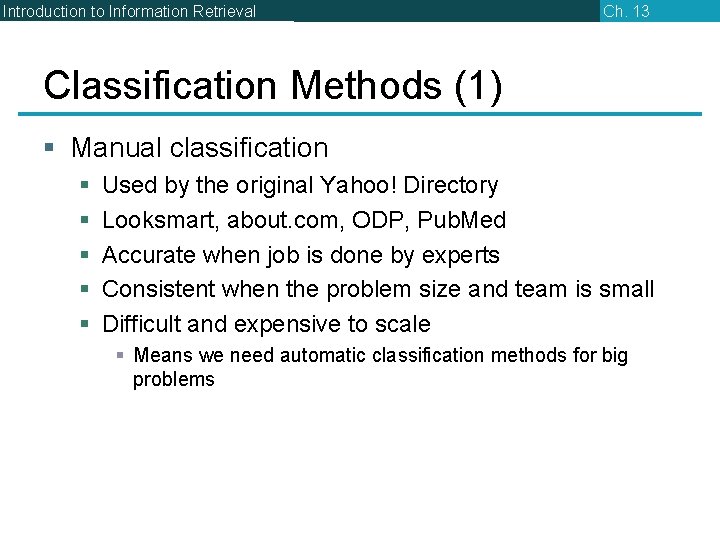
Introduction to Information Retrieval Ch. 13 Classification Methods (1) § Manual classification § § § Used by the original Yahoo! Directory Looksmart, about. com, ODP, Pub. Med Accurate when job is done by experts Consistent when the problem size and team is small Difficult and expensive to scale § Means we need automatic classification methods for big problems
Introduction to Information Retrieval Ch. 13 Classification Methods (2) § Hand-coded rule-based classifiers § One technique used by new agencies, intelligence agencies, etc. § Widely deployed in government and enterprise § Vendors provide “IDE” for writing such rules
Introduction to Information Retrieval Ch. 13 Classification Methods (2) § Hand-coded rule-based classifiers § Commercial systems have complex query languages § Accuracy is can be high if a rule has been carefully refined over time by a subject expert § Building and maintaining these rules is expensive
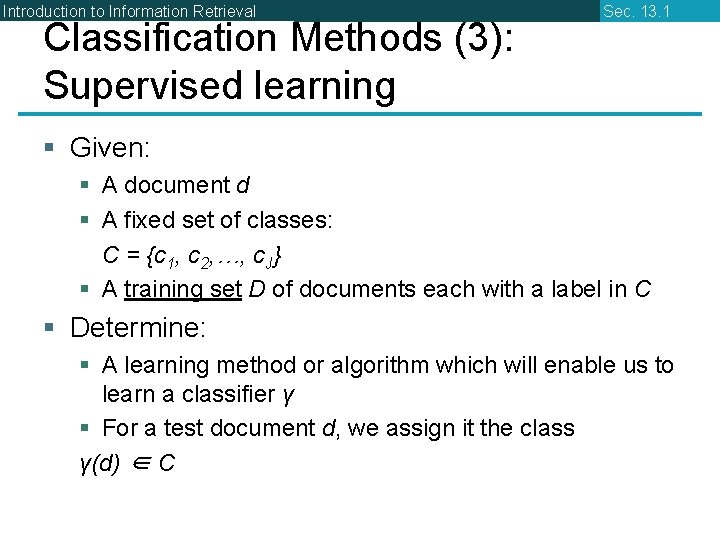
Introduction to Information Retrieval Classification Methods (3): Supervised learning Sec. 13. 1 § Given: § A document d § A fixed set of classes: C = {c 1, c 2, …, c. J} § A training set D of documents each with a label in C § Determine: § A learning method or algorithm which will enable us to learn a classifier γ § For a test document d, we assign it the class γ(d) ∈ C
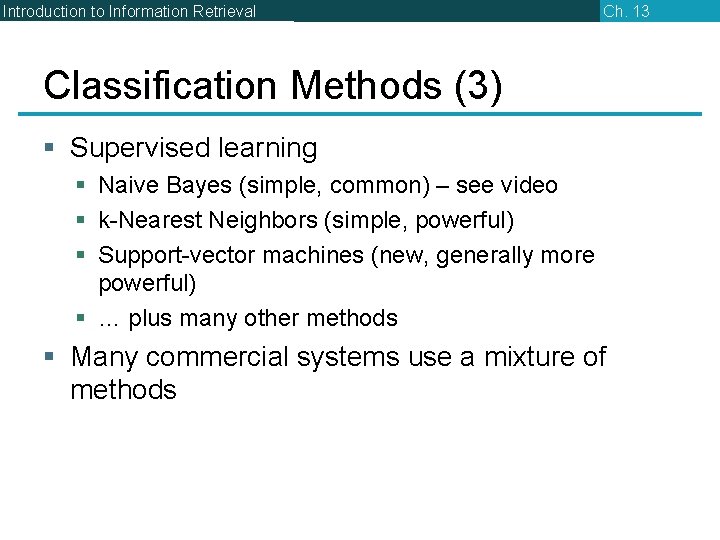
Introduction to Information Retrieval Ch. 13 Classification Methods (3) § Supervised learning § Naive Bayes (simple, common) – see video § k-Nearest Neighbors (simple, powerful) § Support-vector machines (new, generally more powerful) § … plus many other methods § Many commercial systems use a mixture of methods
Naïve Bayes (NB) Classification 12
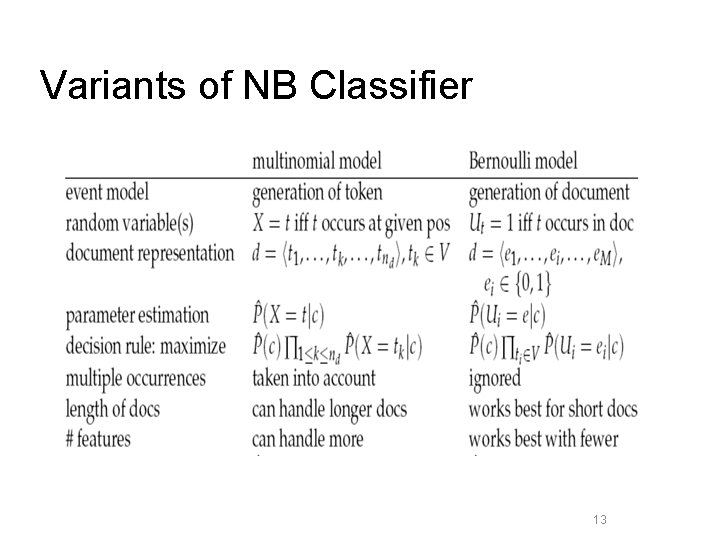
Variants of NB Classifier 13
Introduction to Information Retrieval Sec. 13. 5 Feature Selection: Why? § Text collections have a large number of features § 10, 000 – 1, 000 unique words … and more § Selection may make a particular classifier feasible § Some classifiers can’t deal with 1, 000 features § Reduces training time § Training time for some methods is quadratic or worse in the number of features § Makes runtime models smaller and faster § Can improve generalization (performance) § Eliminates noise features § Avoids overfitting
Introduction to Information Retrieval Feature Selection: Frequency § The simplest feature selection method: § Just use the commonest terms § No particular foundation § But it make sense why this works § They’re the words that can be well-estimated and are most often available as evidence § In practice, this is often 90% as good as better methods § Smarter feature selection – future lecture
Introduction to Information Retrieval Sec. 13. 6 Evaluating Categorization § Evaluation must be done on test data that are independent of the training data § Sometimes use cross-validation (averaging results over multiple training and test splits of the overall data) § Easy to get good performance on a test set that was available to the learner during training (e. g. , just memorize the test set) § Measures: precision, recall, F 1, classification accuracy § Classification accuracy: r/n where n is the total number of test docs and r is the number of test docs correctly classified