
Introduction to Information Retrieval Lecture 15 Text Classification


- Slides: 31
Introduction to Information Retrieval Lecture 15: Text Classification & Naive Bayes 1
Introduction to Information Retrieval A text classification task: Email spam filtering From: ‘‘’’ <takworlld@hotmail. com> Subject: real estate is the only way. . . gem oalvgkay Anyone can buy real estate with no money down Stop paying rent TODAY ! There is no need to spend hundreds or even thousands for similar courses I am 22 years old and I have already purchased 6 properties using the methods outlined in this truly INCREDIBLE ebook. Change your life NOW ! ========================= Click Below to order: http: //www. wholesaledaily. com/sales/nmd. htm ========================= How would you write a program that would automatically detect and delete this type of message? 2
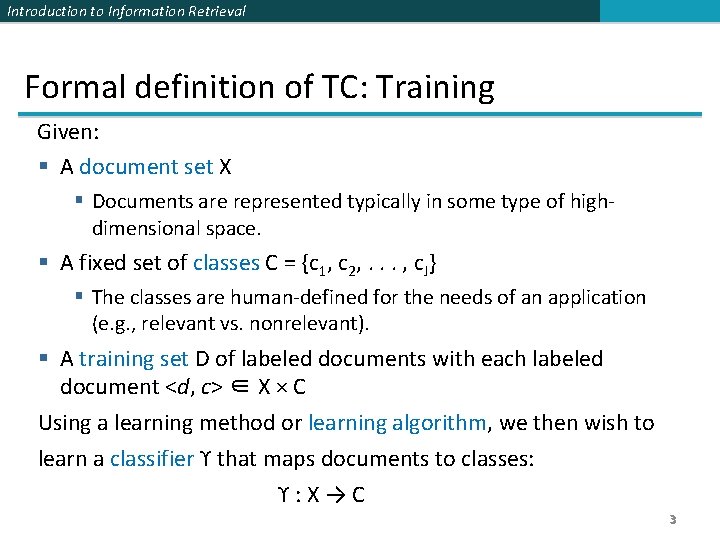
Introduction to Information Retrieval Formal definition of TC: Training Given: § A document set X § Documents are represented typically in some type of highdimensional space. § A fixed set of classes C = {c 1, c 2, . . . , c. J} § The classes are human-defined for the needs of an application (e. g. , relevant vs. nonrelevant). § A training set D of labeled documents with each labeled document <d, c> ∈ X × C Using a learning method or learning algorithm, we then wish to learn a classifier ϒ that maps documents to classes: ϒ: X→C 3
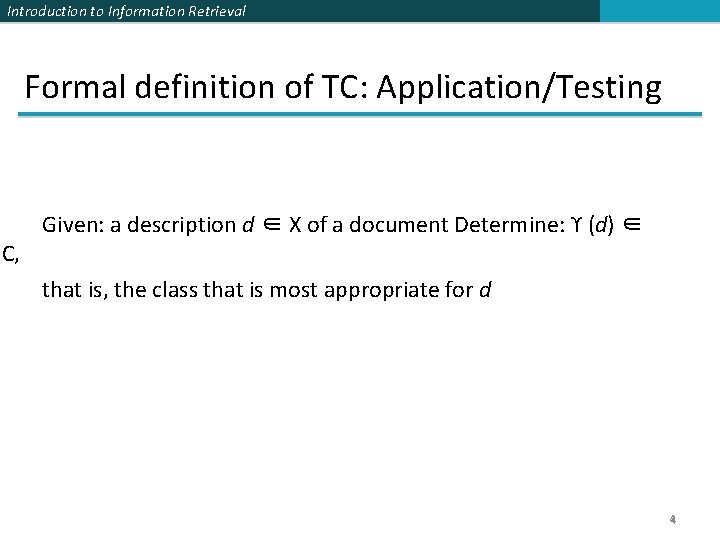
Introduction to Information Retrieval Formal definition of TC: Application/Testing C, Given: a description d ∈ X of a document Determine: ϒ (d) ∈ that is, the class that is most appropriate for d 4
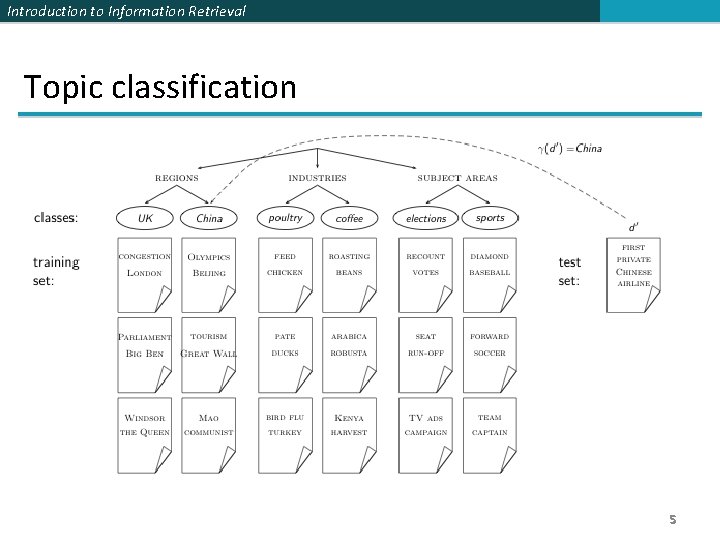
Introduction to Information Retrieval Topic classification 5
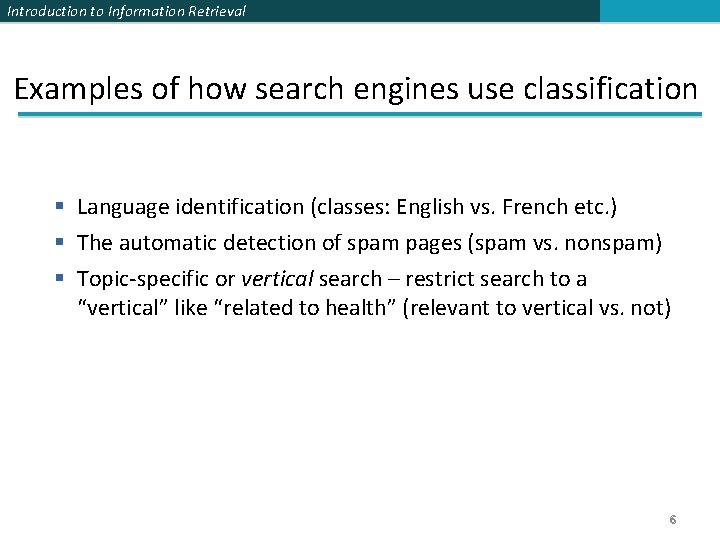
Introduction to Information Retrieval Examples of how search engines use classification § Language identification (classes: English vs. French etc. ) § The automatic detection of spam pages (spam vs. nonspam) § Topic-specific or vertical search – restrict search to a “vertical” like “related to health” (relevant to vertical vs. not) 6
Introduction to Information Retrieval Classification methods: Statistical/Probabilistic § This was our definition of the classification problem – text classification as a learning problem § (i) Supervised learning of a the classification function ϒ and (ii) its application to classifying new documents § We will look at doing this using Naive Bayes § requires hand-classified training data § But this manual classification can be done by non-experts. 7
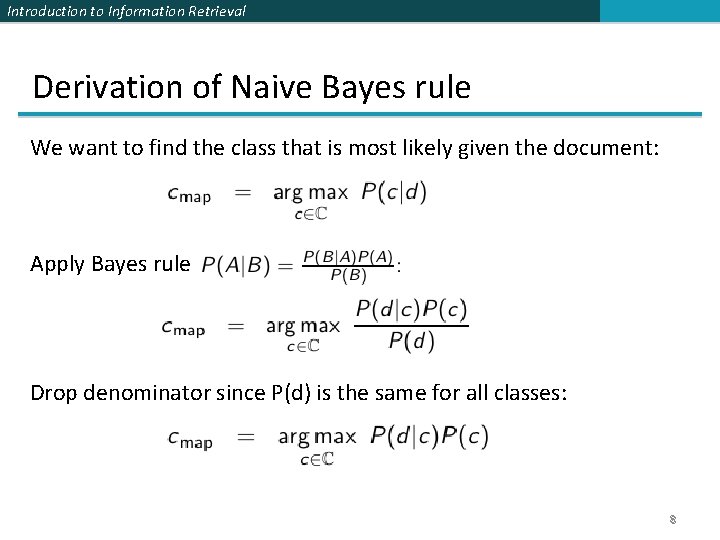
Introduction to Information Retrieval Derivation of Naive Bayes rule We want to find the class that is most likely given the document: Apply Bayes rule Drop denominator since P(d) is the same for all classes: 8
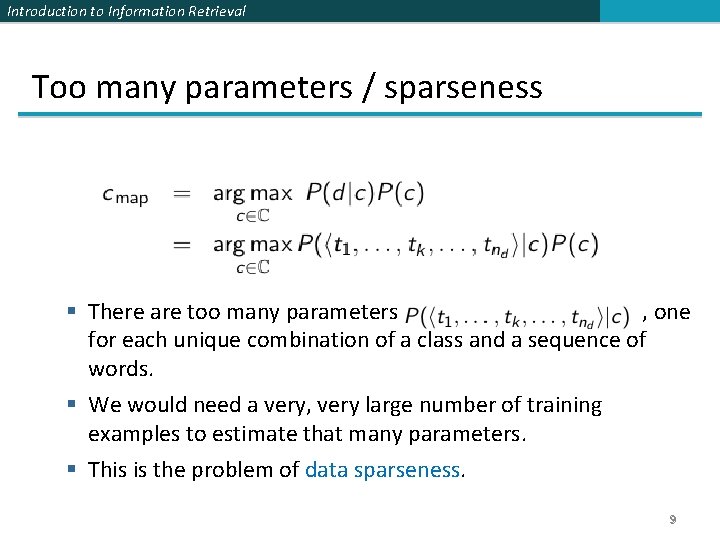
Introduction to Information Retrieval Too many parameters / sparseness § There are too many parameters , one for each unique combination of a class and a sequence of words. § We would need a very, very large number of training examples to estimate that many parameters. § This is the problem of data sparseness. 9
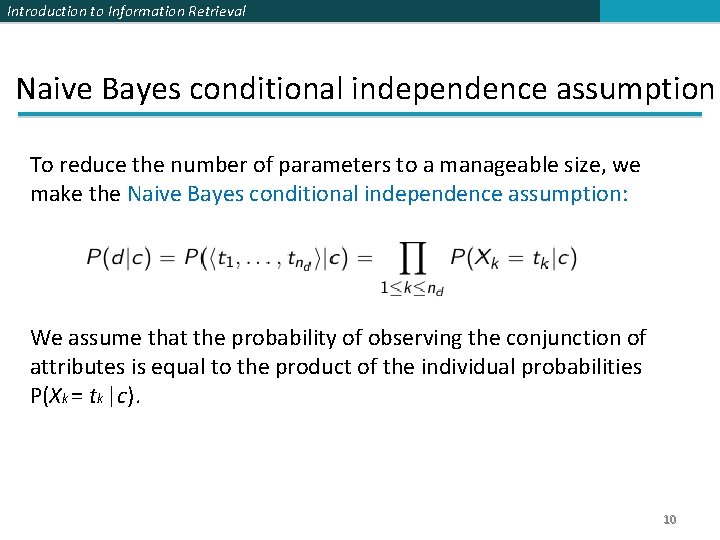
Introduction to Information Retrieval Naive Bayes conditional independence assumption To reduce the number of parameters to a manageable size, we make the Naive Bayes conditional independence assumption: We assume that the probability of observing the conjunction of attributes is equal to the product of the individual probabilities P(Xk = tk |c). 10
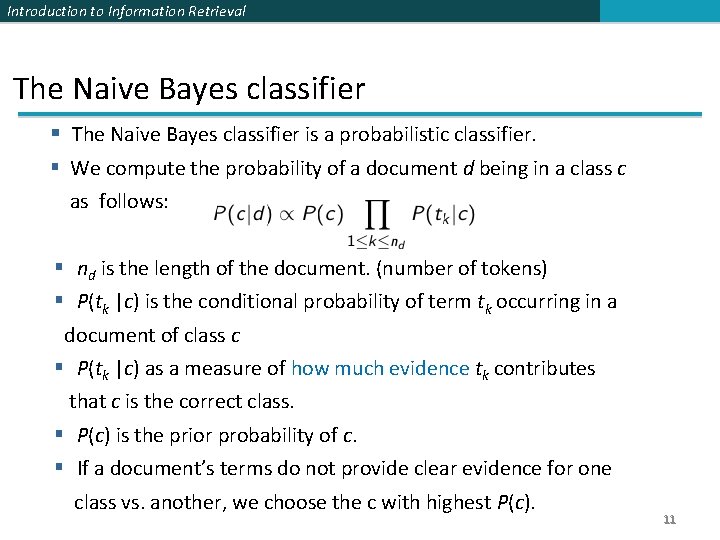
Introduction to Information Retrieval The Naive Bayes classifier § The Naive Bayes classifier is a probabilistic classifier. § We compute the probability of a document d being in a class c as follows: § nd is the length of the document. (number of tokens) § P(tk |c) is the conditional probability of term tk occurring in a document of class c § P(tk |c) as a measure of how much evidence tk contributes that c is the correct class. § P(c) is the prior probability of c. § If a document’s terms do not provide clear evidence for one class vs. another, we choose the c with highest P(c). 11
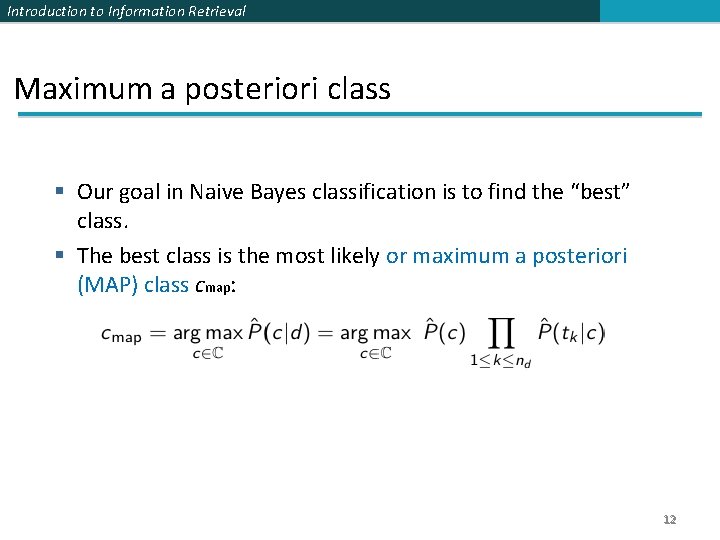
Introduction to Information Retrieval Maximum a posteriori class § Our goal in Naive Bayes classification is to find the “best” class. § The best class is the most likely or maximum a posteriori (MAP) class cmap: 12
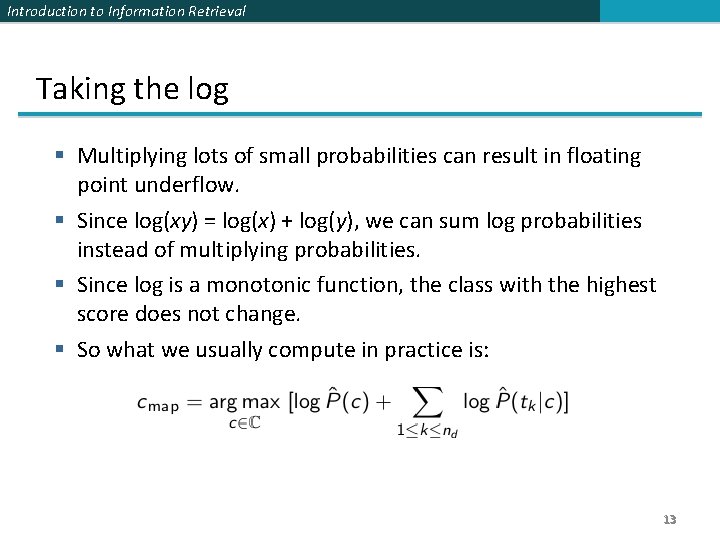
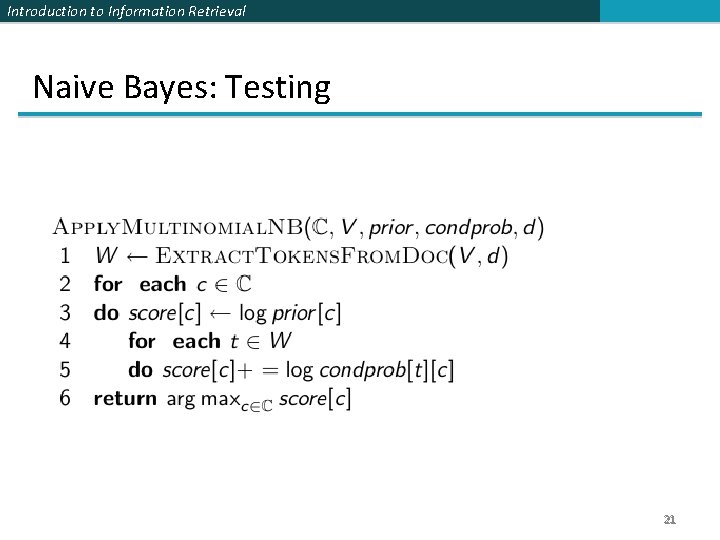
Introduction to Information Retrieval Taking the log § Multiplying lots of small probabilities can result in floating point underflow. § Since log(xy) = log(x) + log(y), we can sum log probabilities instead of multiplying probabilities. § Since log is a monotonic function, the class with the highest score does not change. § So what we usually compute in practice is: 13
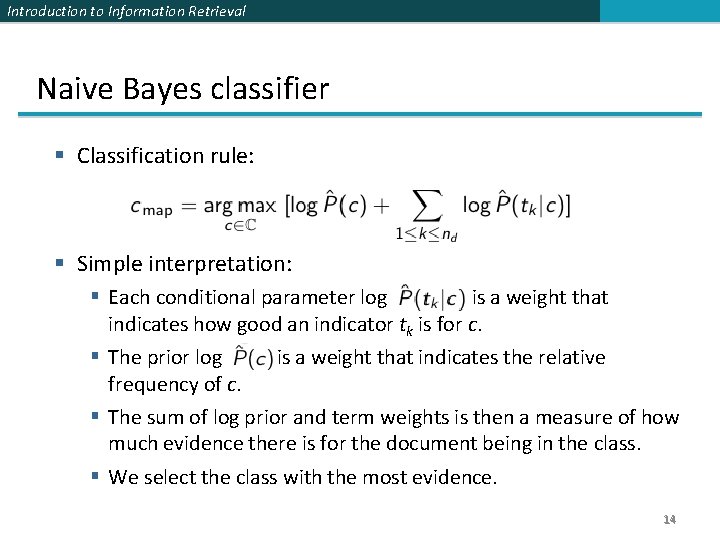
Introduction to Information Retrieval Naive Bayes classifier § Classification rule: § Simple interpretation: § Each conditional parameter log is a weight that indicates how good an indicator tk is for c. § The prior log is a weight that indicates the relative frequency of c. § The sum of log prior and term weights is then a measure of how much evidence there is for the document being in the class. § We select the class with the most evidence. 14
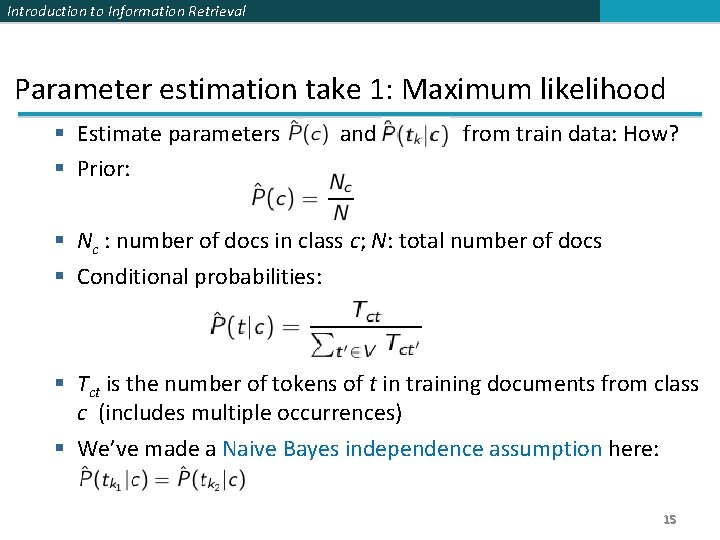
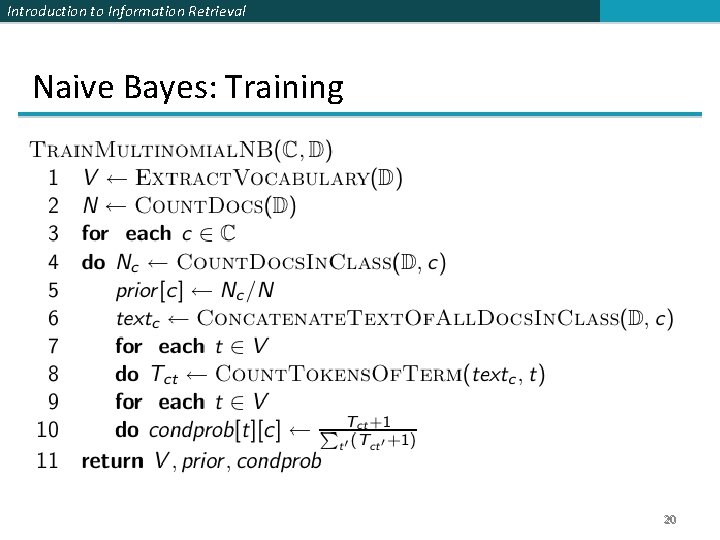
Introduction to Information Retrieval Parameter estimation take 1: Maximum likelihood § Estimate parameters § Prior: and from train data: How? § Nc : number of docs in class c; N: total number of docs § Conditional probabilities: § Tct is the number of tokens of t in training documents from class c (includes multiple occurrences) § We’ve made a Naive Bayes independence assumption here: 15
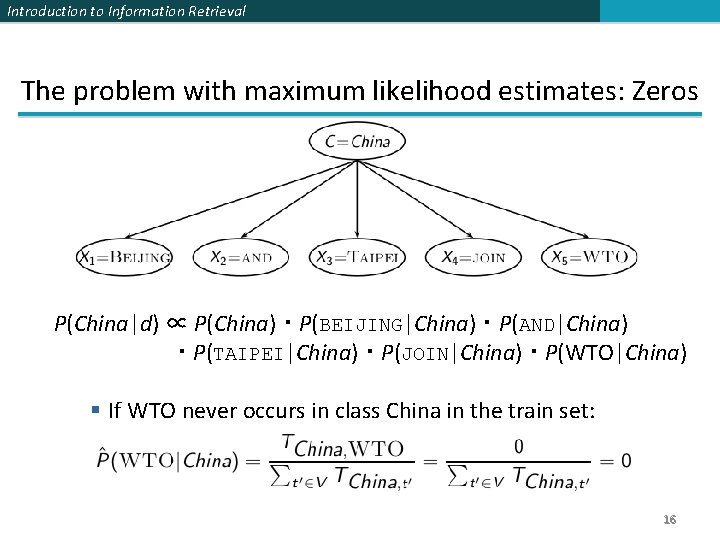
Introduction to Information Retrieval The problem with maximum likelihood estimates: Zeros P(China|d) ∝ P(China) ・ P(BEIJING|China) ・ P(AND|China) ・ P(TAIPEI|China) ・ P(JOIN|China) ・ P(WTO|China) § If WTO never occurs in class China in the train set: 16
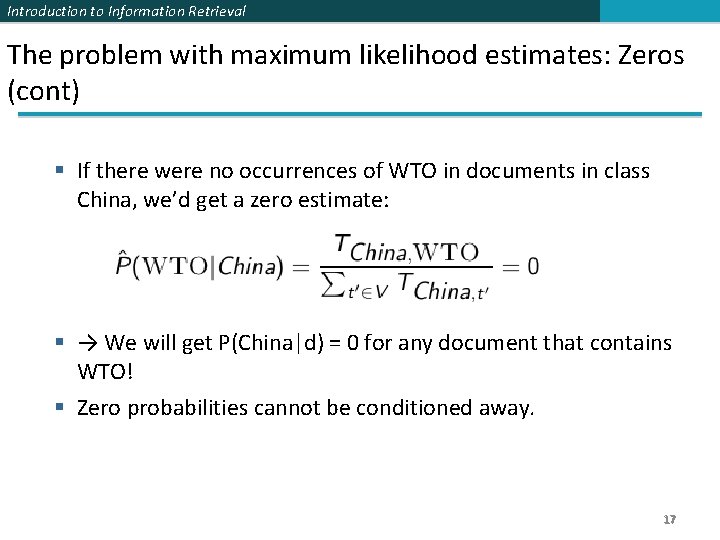
Introduction to Information Retrieval The problem with maximum likelihood estimates: Zeros (cont) § If there were no occurrences of WTO in documents in class China, we’d get a zero estimate: § → We will get P(China|d) = 0 for any document that contains WTO! § Zero probabilities cannot be conditioned away. 17
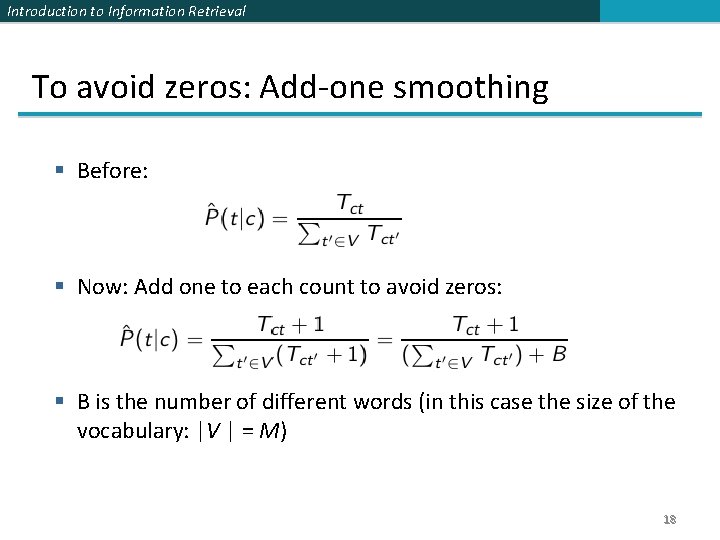
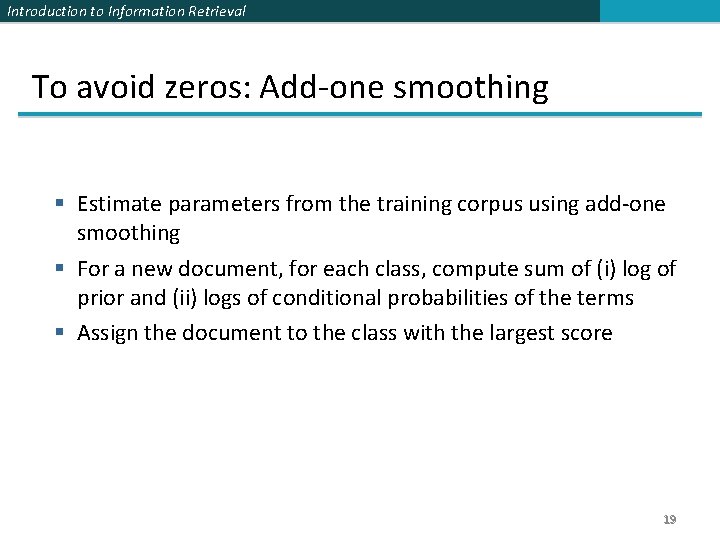
Introduction to Information Retrieval To avoid zeros: Add-one smoothing § Before: § Now: Add one to each count to avoid zeros: § B is the number of different words (in this case the size of the vocabulary: |V | = M) 18
Introduction to Information Retrieval To avoid zeros: Add-one smoothing § Estimate parameters from the training corpus using add-one smoothing § For a new document, for each class, compute sum of (i) log of prior and (ii) logs of conditional probabilities of the terms § Assign the document to the class with the largest score 19
Introduction to Information Retrieval Naive Bayes: Training 20
Introduction to Information Retrieval Naive Bayes: Testing 21
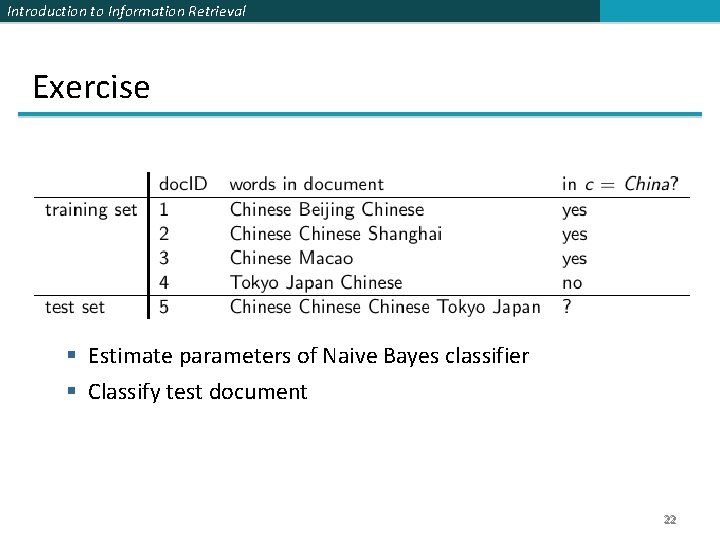
Introduction to Information Retrieval Exercise § Estimate parameters of Naive Bayes classifier § Classify test document 22
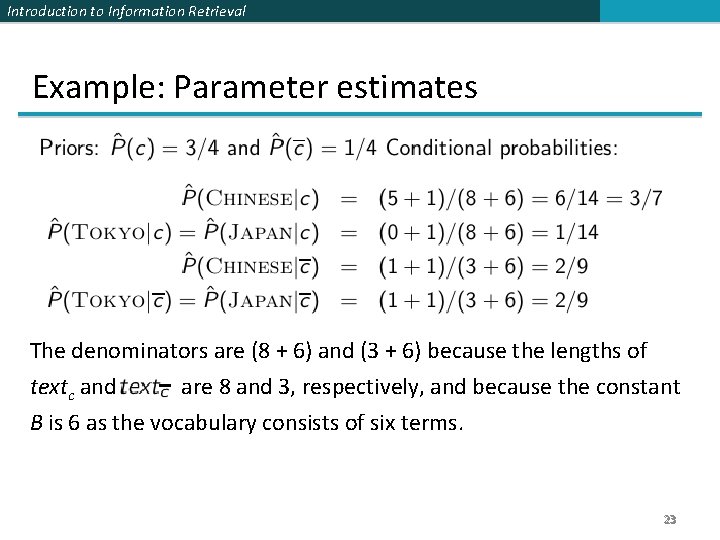
Introduction to Information Retrieval Example: Parameter estimates The denominators are (8 + 6) and (3 + 6) because the lengths of textc and are 8 and 3, respectively, and because the constant B is 6 as the vocabulary consists of six terms. 23
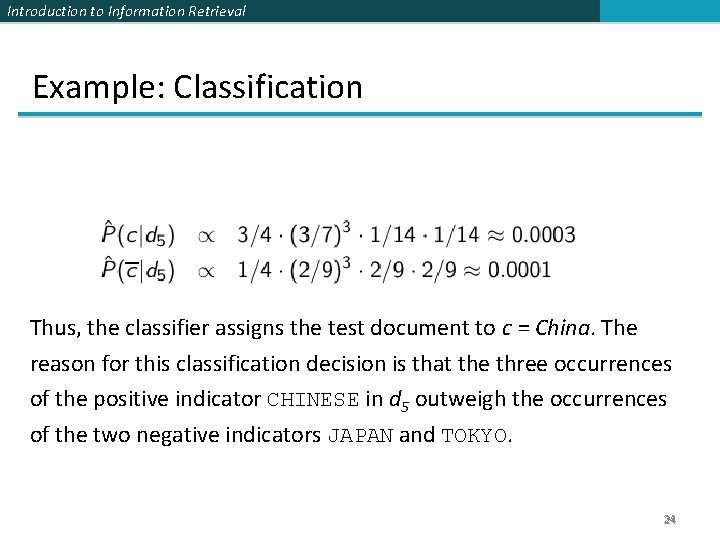
Introduction to Information Retrieval Example: Classification Thus, the classifier assigns the test document to c = China. The reason for this classification decision is that the three occurrences of the positive indicator CHINESE in d 5 outweigh the occurrences of the two negative indicators JAPAN and TOKYO. 24
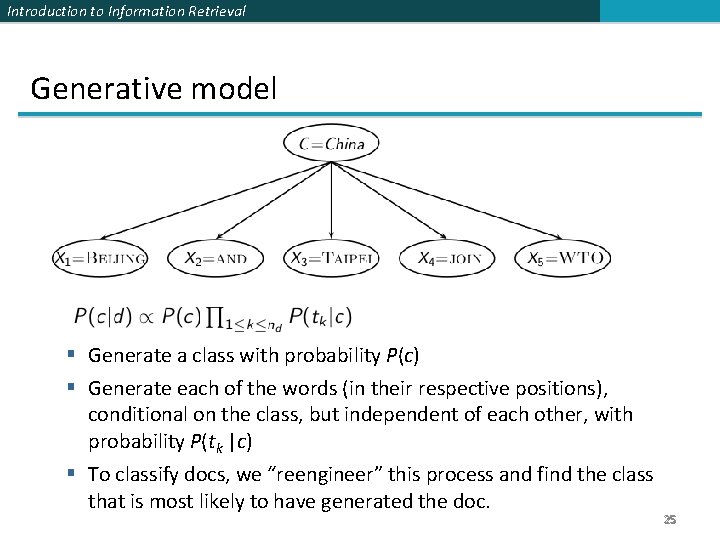
Introduction to Information Retrieval Generative model § Generate a class with probability P(c) § Generate each of the words (in their respective positions), conditional on the class, but independent of each other, with probability P(tk |c) § To classify docs, we “reengineer” this process and find the class that is most likely to have generated the doc. 25
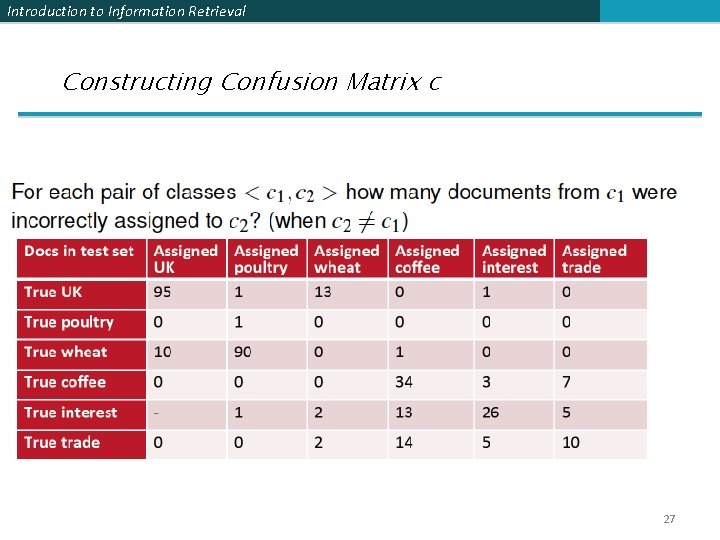
Introduction to Information Retrieval Evaluating classification § Evaluation must be done on test data that are independent of the training data (usually a disjoint set of instances). § It’s easy to get good performance on a test set that was available to the learner during training (e. g. , just memorize the test set). § Measures: Precision, recall, F 1, classification accuracy 26
Introduction to Information Retrieval Constructing Confusion Matrix c 27
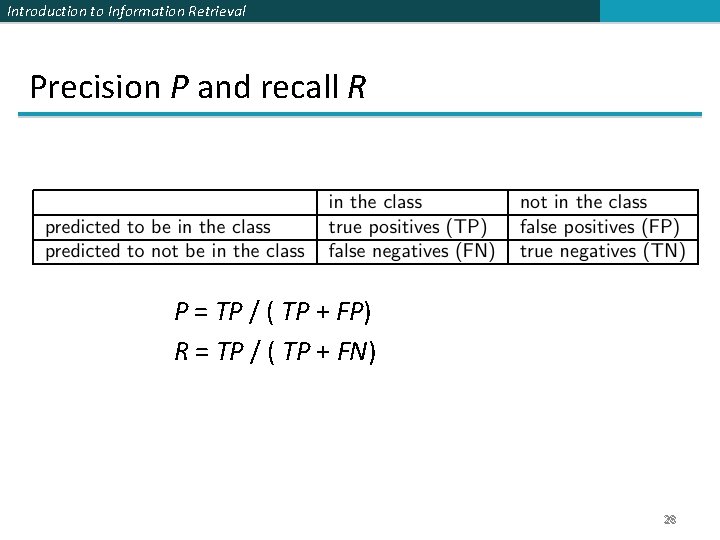
Introduction to Information Retrieval Precision P and recall R P = TP / ( TP + FP) R = TP / ( TP + FN) 28
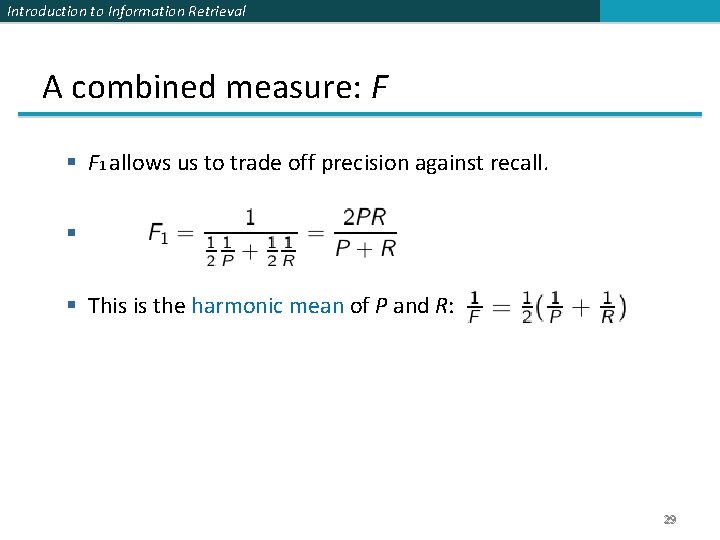
Introduction to Information Retrieval A combined measure: F § F 1 allows us to trade off precision against recall. § § This is the harmonic mean of P and R: 29
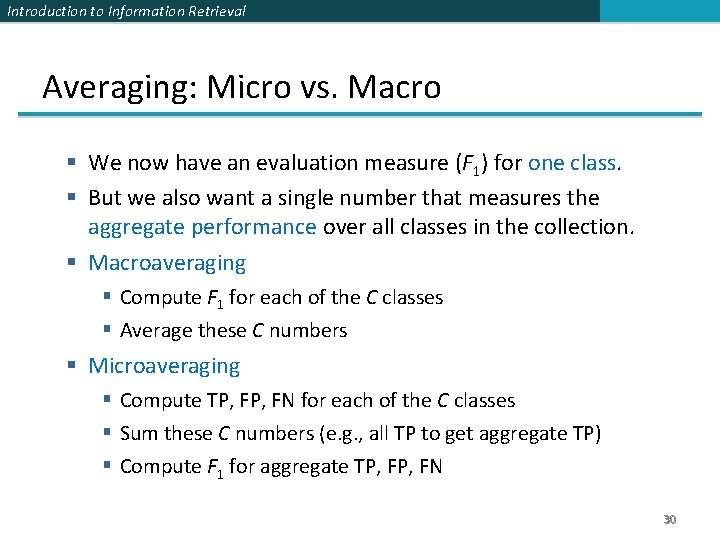
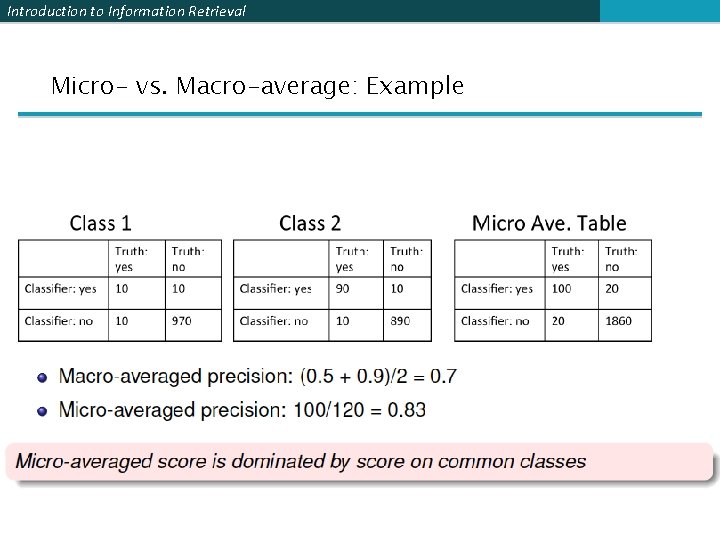
Introduction to Information Retrieval Averaging: Micro vs. Macro § We now have an evaluation measure (F 1) for one class. § But we also want a single number that measures the aggregate performance over all classes in the collection. § Macroaveraging § Compute F 1 for each of the C classes § Average these C numbers § Microaveraging § Compute TP, FN for each of the C classes § Sum these C numbers (e. g. , all TP to get aggregate TP) § Compute F 1 for aggregate TP, FN 30
Introduction to Information Retrieval Micro- vs. Macro-average: Example 31