
Introduction to Information Retrieval Hinrich Schtze and Christina


- Slides: 67
Introduction to Information Retrieval Hinrich Schütze and Christina Lioma Lecture 14: Vector Space Classification 1
Introduction to Information Retrieval Overview ❶ Recap ❷ Feature selection ❸ Intro vector space classification ❹ Rocchio ❺ k. NN ❻ Linear classifiers ❼ > two classes 2
Introduction to Information Retrieval Outline ❶ Recap ❷ Feature selection ❸ Intro vector space classification ❹ Rocchio ❺ k. NN ❻ Linear classifiers ❼ > two classes 3
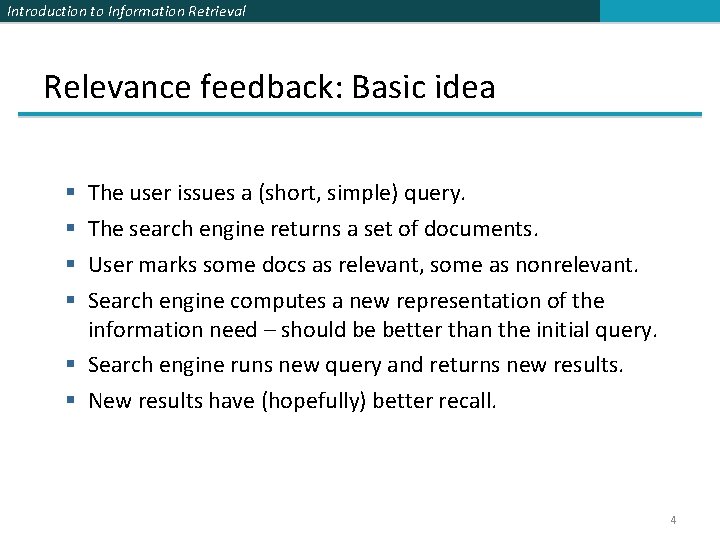
Introduction to Information Retrieval Relevance feedback: Basic idea The user issues a (short, simple) query. The search engine returns a set of documents. User marks some docs as relevant, some as nonrelevant. Search engine computes a new representation of the information need – should be better than the initial query. § Search engine runs new query and returns new results. § New results have (hopefully) better recall. § § 4
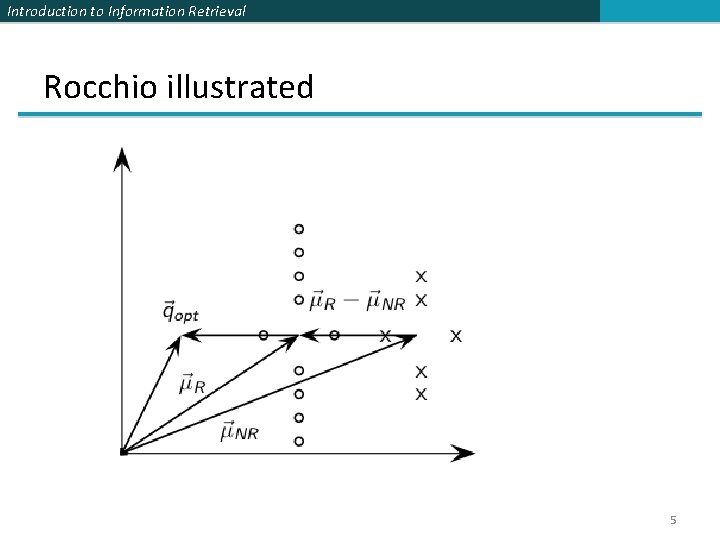
Introduction to Information Retrieval Rocchio illustrated 5
Introduction to Information Retrieval Take-away today § Feature selection for text classification: How to select a subset of available dimensions § Vector space classification: Basic idea of doing textclassification for documents that are represented as vectors § Rocchio classifier: Rocchio relevance feedback idea applied to text classification § k nearest neighbor classification § Linear classifiers § More than two classes 6
Introduction to Information Retrieval Outline ❶ Recap ❷ Feature selection ❸ Intro vector space classification ❹ Rocchio ❺ k. NN ❻ Linear classifiers ❼ > two classes 7
Introduction to Information Retrieval Feature selection § In text classification, we usually represent documents in a high-dimensional space, with each dimension corresponding to a term. § In this lecture: axis = dimension = word = term = feature § Many dimensions correspond to rare words. § Rare words can mislead the classifier. § Rare misleading features are called noise features. § Eliminating noise features from the representation increases efficiency and effectiveness of text classification. § Eliminating features is called feature selection. 8
Introduction to Information Retrieval Example for a noise feature § Let’s say we’re doing text classification for the class China. § Suppose a rare term, say ARACHNOCENTRIC, has no information about China. . . §. . . but all instances of ARACHNOCENTRIC happen to occur in § China documents in our training set. § Then we may learn a classifier that incorrectly interprets ARACHNOCENTRIC as evidence for the class China. § Such an incorrect generalization from an accidental property of the training set is called overfitting. § Feature selection reduces overfitting and improves the § accuracy of the classifier. 9
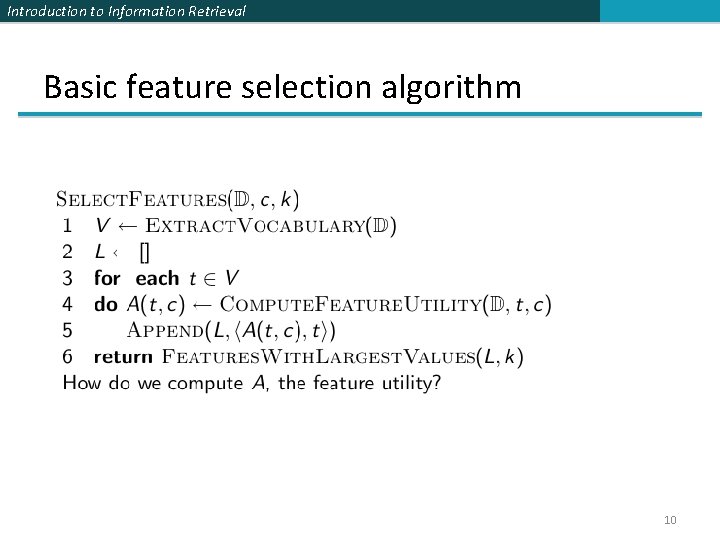
Introduction to Information Retrieval Basic feature selection algorithm 10
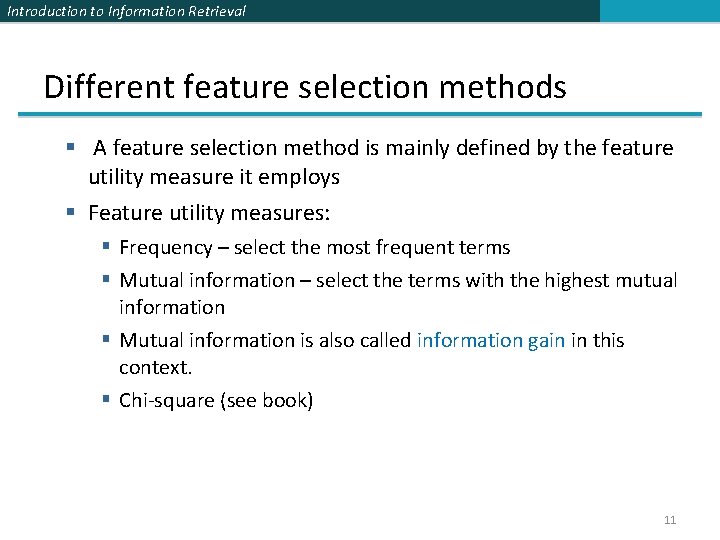
Introduction to Information Retrieval Different feature selection methods § A feature selection method is mainly defined by the feature utility measure it employs § Feature utility measures: § Frequency – select the most frequent terms § Mutual information – select the terms with the highest mutual information § Mutual information is also called information gain in this context. § Chi-square (see book) 11
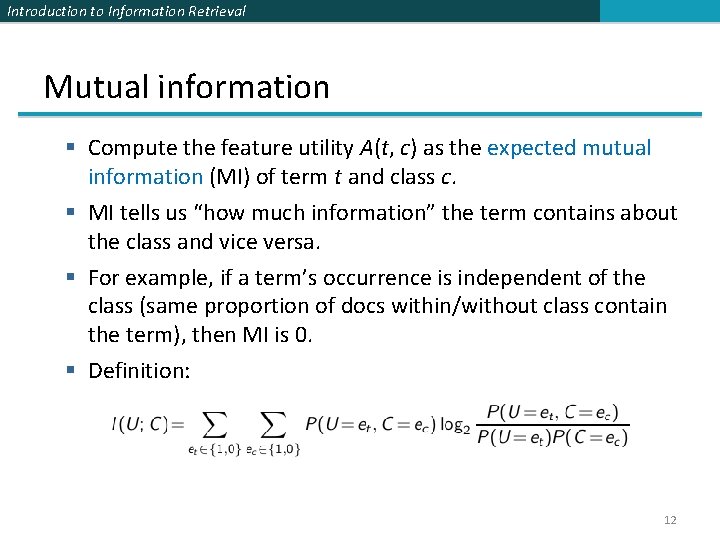
Introduction to Information Retrieval Mutual information § Compute the feature utility A(t, c) as the expected mutual information (MI) of term t and class c. § MI tells us “how much information” the term contains about the class and vice versa. § For example, if a term’s occurrence is independent of the class (same proportion of docs within/without class contain the term), then MI is 0. § Definition: 12
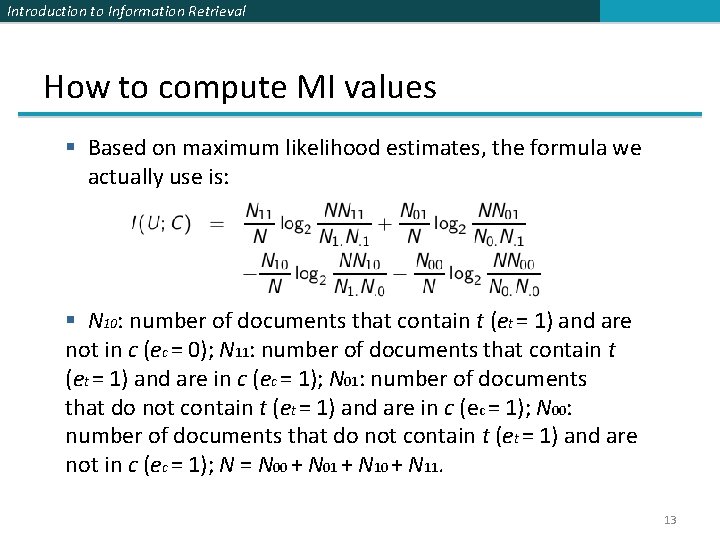
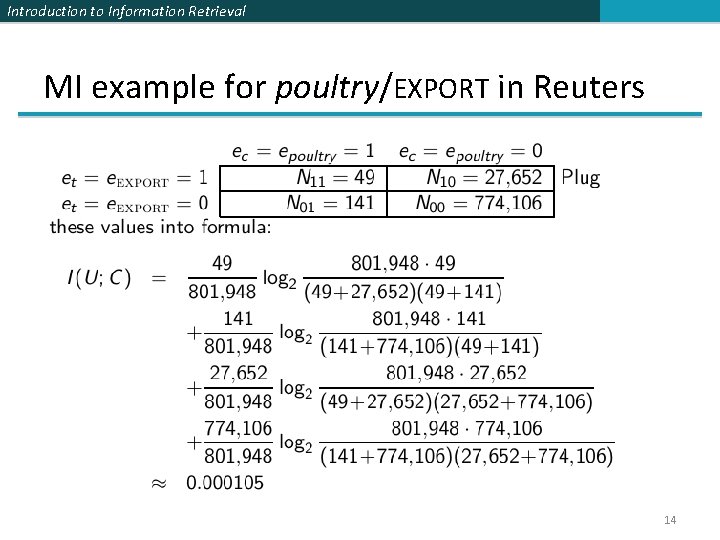
Introduction to Information Retrieval How to compute MI values § Based on maximum likelihood estimates, the formula we actually use is: § N 10: number of documents that contain t (et = 1) and are not in c (ec = 0); N 11: number of documents that contain t (et = 1) and are in c (ec = 1); N 01: number of documents that do not contain t (et = 1) and are in c (ec = 1); N 00: number of documents that do not contain t (et = 1) and are not in c (ec = 1); N = N 00 + N 01 + N 10 + N 11. 13
Introduction to Information Retrieval MI example for poultry/EXPORT in Reuters 14
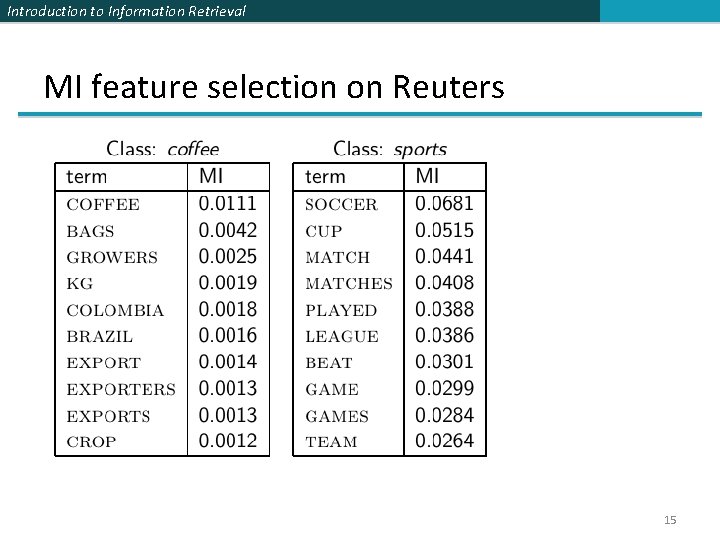
Introduction to Information Retrieval MI feature selection on Reuters 15
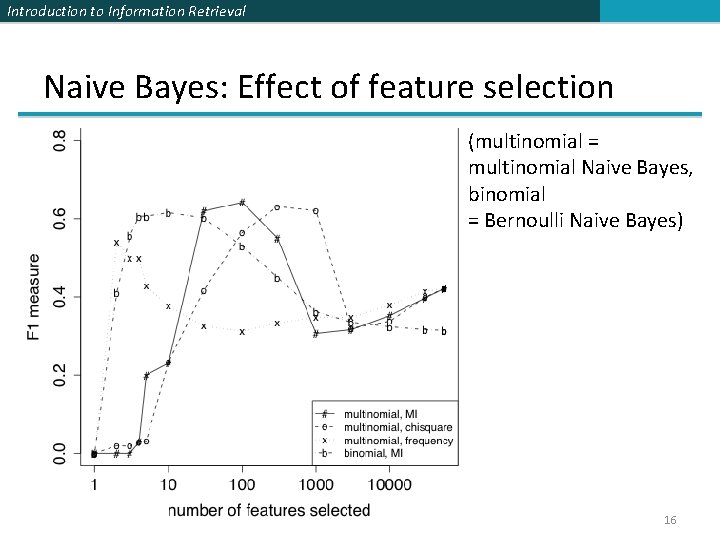
Introduction to Information Retrieval Naive Bayes: Effect of feature selection (multinomial = multinomial Naive Bayes, binomial = Bernoulli Naive Bayes) 16
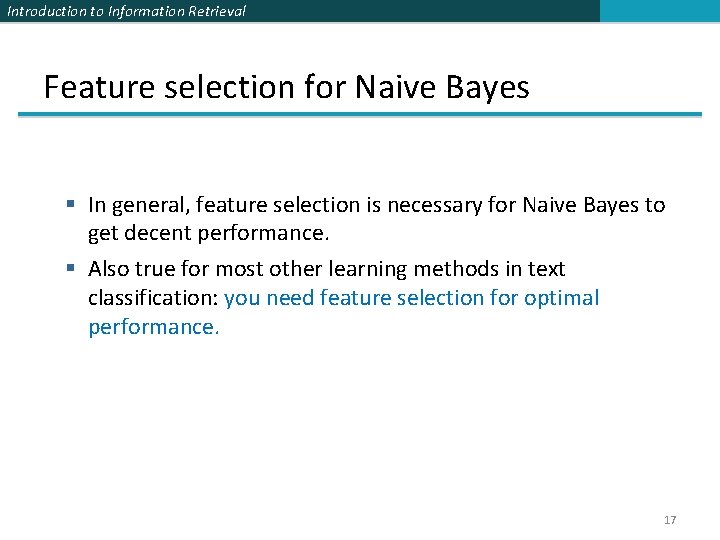
Introduction to Information Retrieval Feature selection for Naive Bayes § In general, feature selection is necessary for Naive Bayes to get decent performance. § Also true for most other learning methods in text classification: you need feature selection for optimal performance. 17
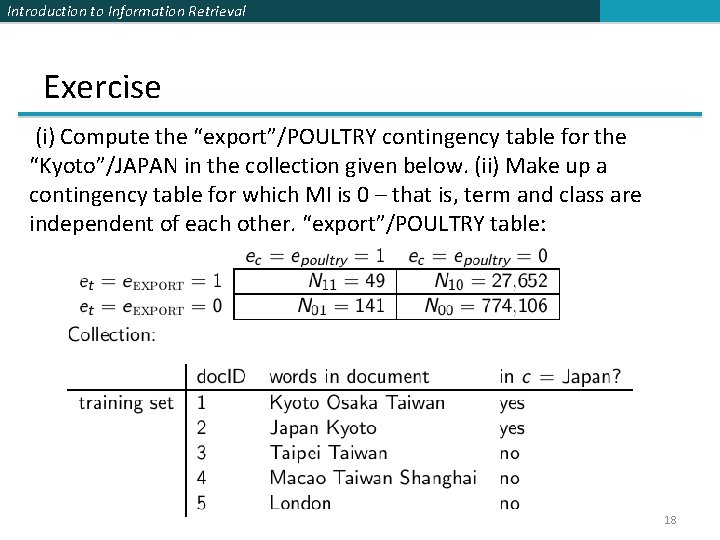
Introduction to Information Retrieval Exercise (i) Compute the “export”/POULTRY contingency table for the “Kyoto”/JAPAN in the collection given below. (ii) Make up a contingency table for which MI is 0 – that is, term and class are independent of each other. “export”/POULTRY table: 18
Introduction to Information Retrieval Outline ❶ Recap ❷ Feature selection ❸ Intro vector space classification ❹ Rocchio ❺ k. NN ❻ Linear classifiers ❼ > two classes 19
Introduction to Information Retrieval Recall vector space representation § § § Each document is a vector, one component for each term. Terms are axes. High dimensionality: 100, 000 s of dimensions Normalize vectors (documents) to unit length How can we do classification in this space? 20
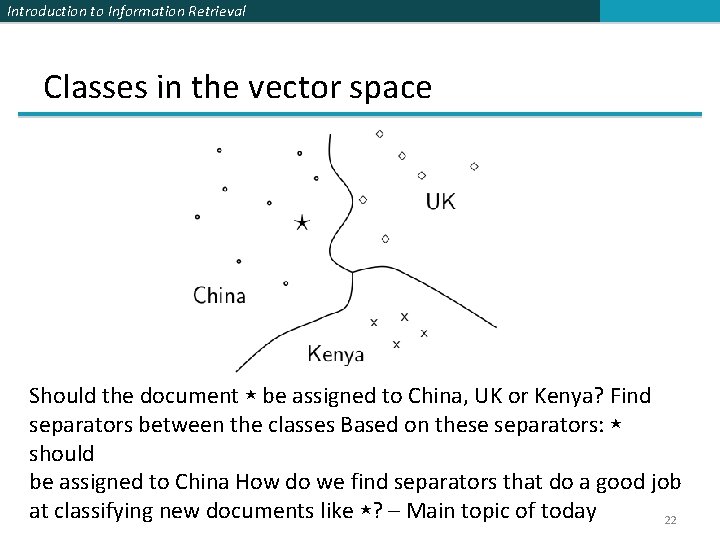
Introduction to Information Retrieval Vector space classification § As before, the training set is a set of documents, each labeled with its class. § In vector space classification, this set corresponds to a labeled set of points or vectors in the vector space. § Premise 1: Documents in the same class form a contiguous region. § Premise 2: Documents from different classes don’t overlap. § We define lines, surfaces, hypersurfaces to divide regions. 21
Introduction to Information Retrieval Classes in the vector space Should the document ⋆ be assigned to China, UK or Kenya? Find separators between the classes Based on these separators: ⋆ should be assigned to China How do we find separators that do a good job at classifying new documents like ⋆? – Main topic of today 22
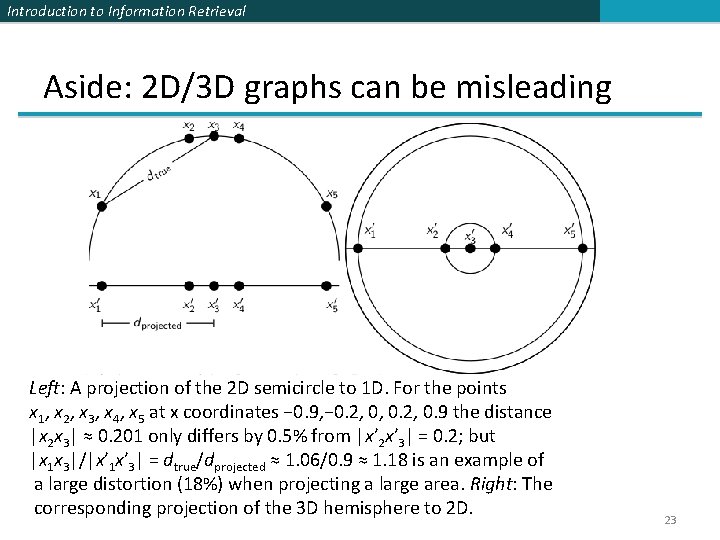
Introduction to Information Retrieval Aside: 2 D/3 D graphs can be misleading Left: A projection of the 2 D semicircle to 1 D. For the points x 1, x 2, x 3, x 4, x 5 at x coordinates − 0. 9, − 0. 2, 0, 0. 2, 0. 9 the distance |x 2 x 3| ≈ 0. 201 only differs by 0. 5% from |x′ 2 x′ 3| = 0. 2; but |x 1 x 3|/|x′ 1 x′ 3| = dtrue/dprojected ≈ 1. 06/0. 9 ≈ 1. 18 is an example of a large distortion (18%) when projecting a large area. Right: The corresponding projection of the 3 D hemisphere to 2 D. 23
Introduction to Information Retrieval Outline ❶ Recap ❷ Feature selection ❸ Intro vector space classification ❹ Rocchio ❺ k. NN ❻ Linear classifiers ❼ > two classes 24
Introduction to Information Retrieval Relevance feedback § In relevance feedback, the user marks documents as relevant/nonrelevant. § Relevant/nonrelevant can be viewed as classes or categories. § For each document, the user decides which of these two classes is correct. § The IR system then uses these class assignments to build a better query (“model”) of the information need. . . §. . . and returns better documents. § Relevance feedback is a form of text classification. 25
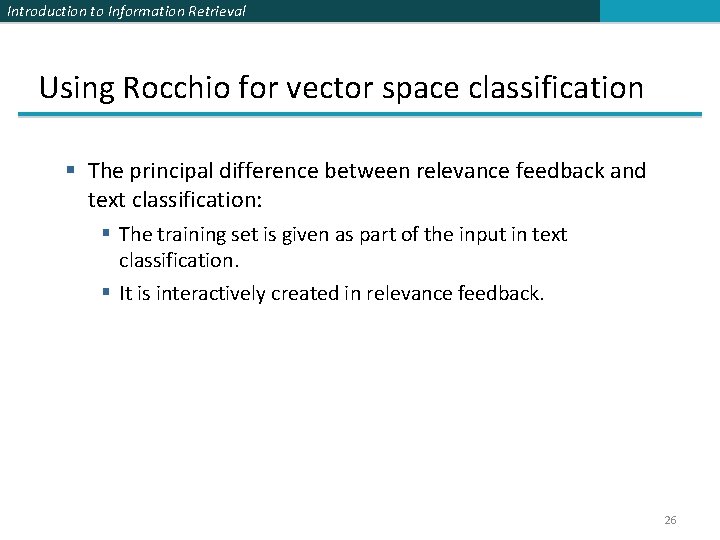
Introduction to Information Retrieval Using Rocchio for vector space classification § The principal difference between relevance feedback and text classification: § The training set is given as part of the input in text classification. § It is interactively created in relevance feedback. 26
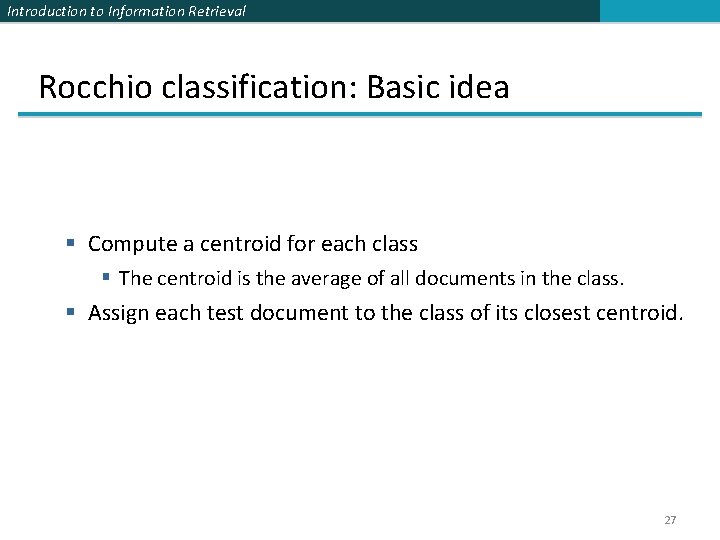
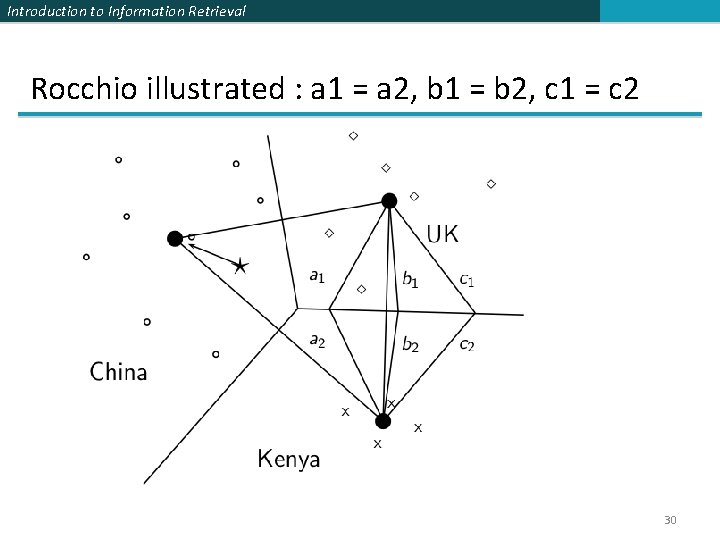
Introduction to Information Retrieval Rocchio classification: Basic idea § Compute a centroid for each class § The centroid is the average of all documents in the class. § Assign each test document to the class of its closest centroid. 27
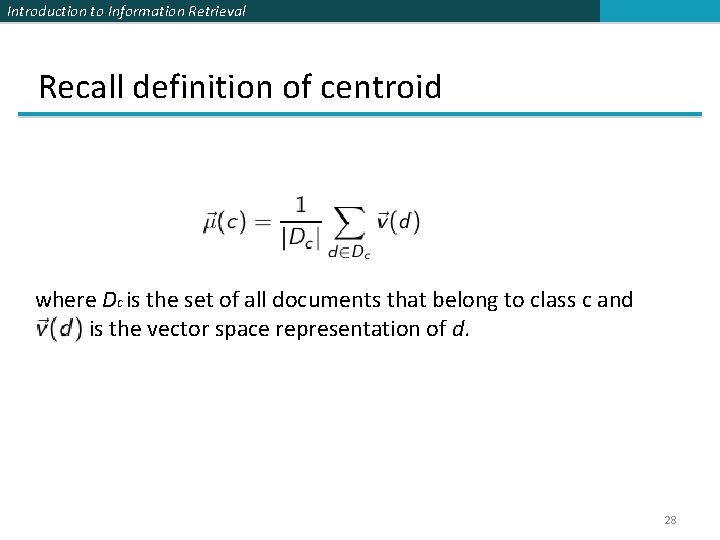
Introduction to Information Retrieval Recall definition of centroid where Dc is the set of all documents that belong to class c and is the vector space representation of d. 28
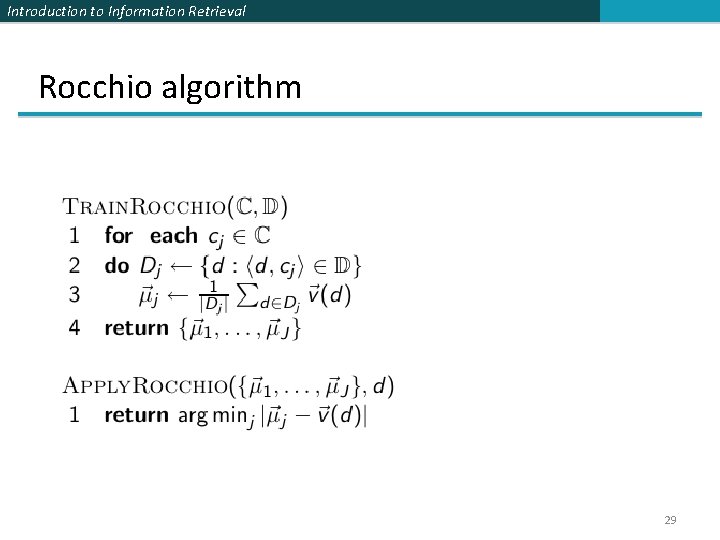
Introduction to Information Retrieval Rocchio algorithm 29
Introduction to Information Retrieval Rocchio illustrated : a 1 = a 2, b 1 = b 2, c 1 = c 2 30
Introduction to Information Retrieval Rocchio properties § Rocchio forms a simple representation for each class: the centroid § We can interpret the centroid as the prototype of the class. § Classification is based on similarity to / distance from centroid/prototype. § Does not guarantee that classifications are consistent with the training data! 31
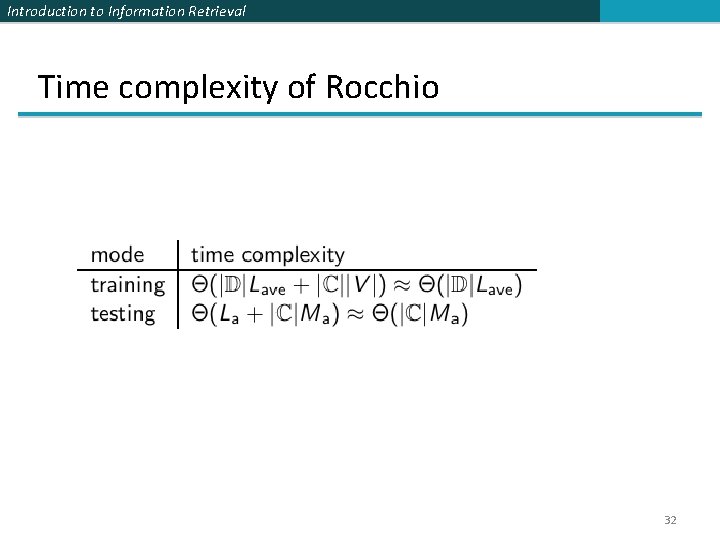
Introduction to Information Retrieval Time complexity of Rocchio 32
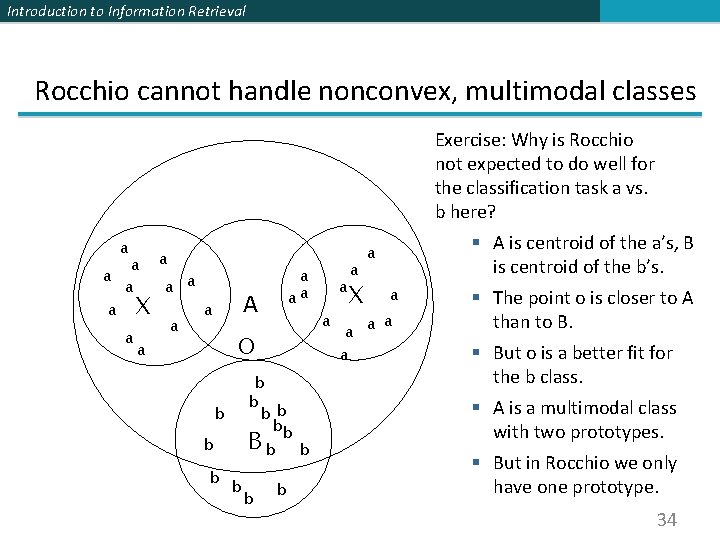
Introduction to Information Retrieval Rocchio vs. Naive Bayes § In many cases, Rocchio performs worse than Naive Bayes. § One reason: Rocchio does not handle nonconvex, multimodal classes correctly. 33
Introduction to Information Retrieval Rocchio cannot handle nonconvex, multimodal classes Exercise: Why is Rocchio not expected to do well for the classification task a vs. b here? a a a X a a aa A a O a B b b a b X a a b b bb b a a § A is centroid of the a’s, B is centroid of the b’s. a a § The point o is closer to A than to B. § But o is a better fit for the b class. § A is a multimodal class with two prototypes. § But in Rocchio we only have one prototype. 34
Introduction to Information Retrieval Outline ❶ Recap ❷ Feature selection ❸ Intro vector space classification ❹ Rocchio ❺ k. NN ❻ Linear classifiers ❼ > two classes 35
Introduction to Information Retrieval k. NN classification § k. NN classification is another vector space classification method. § It also is very simple and easy to implement. § k. NN is more accurate (in most cases) than Naive Bayes and Rocchio. § If you need to get a pretty accurate classifier up and running in a short time. . . §. . . and you don’t care about efficiency that much. . . §. . . use k. NN. 36
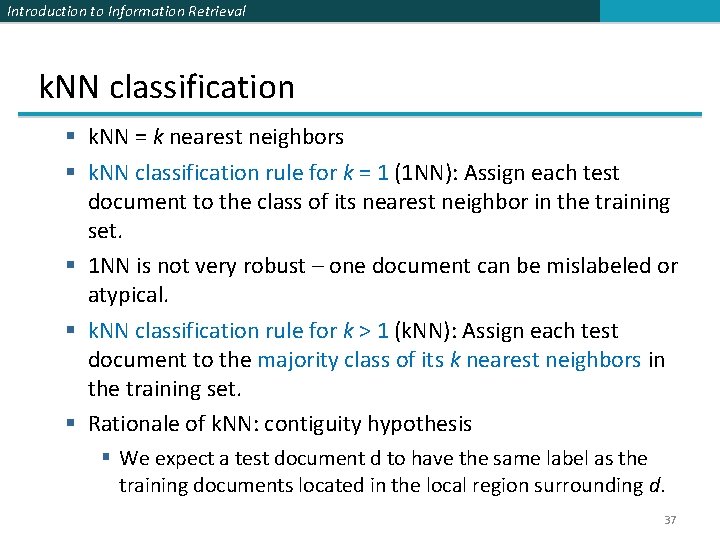
Introduction to Information Retrieval k. NN classification § k. NN = k nearest neighbors § k. NN classification rule for k = 1 (1 NN): Assign each test document to the class of its nearest neighbor in the training set. § 1 NN is not very robust – one document can be mislabeled or atypical. § k. NN classification rule for k > 1 (k. NN): Assign each test document to the majority class of its k nearest neighbors in the training set. § Rationale of k. NN: contiguity hypothesis § We expect a test document d to have the same label as the training documents located in the local region surrounding d. 37
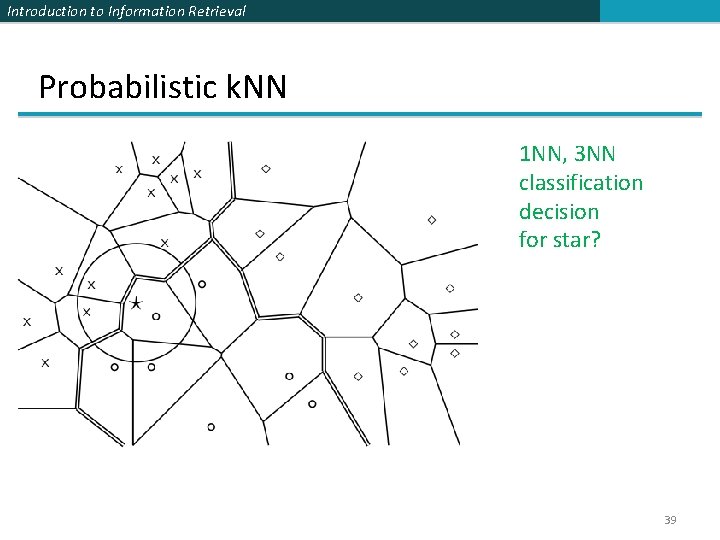
Introduction to Information Retrieval Probabilistic k. NN § Probabilistic version of k. NN: P(c|d) = fraction of k neighbors of d that are in c § k. NN classification rule for probabilistic k. NN: Assign d to class c with highest P(c|d) 38
Introduction to Information Retrieval Probabilistic k. NN 1 NN, 3 NN classification decision for star? 39
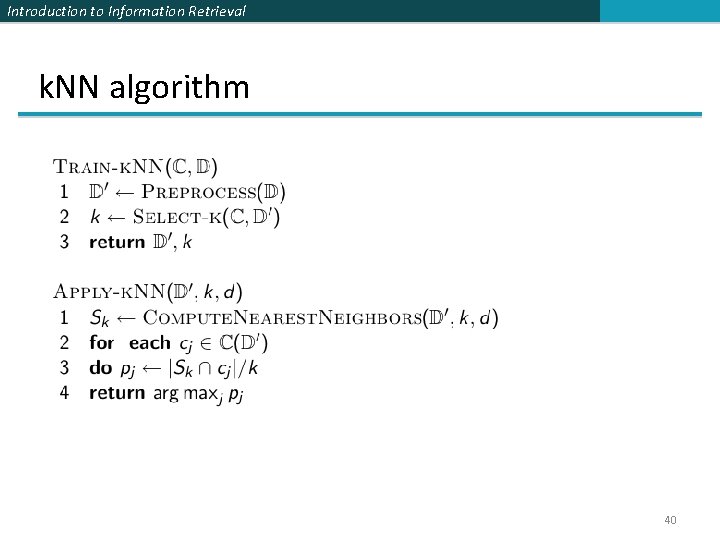
Introduction to Information Retrieval k. NN algorithm 40
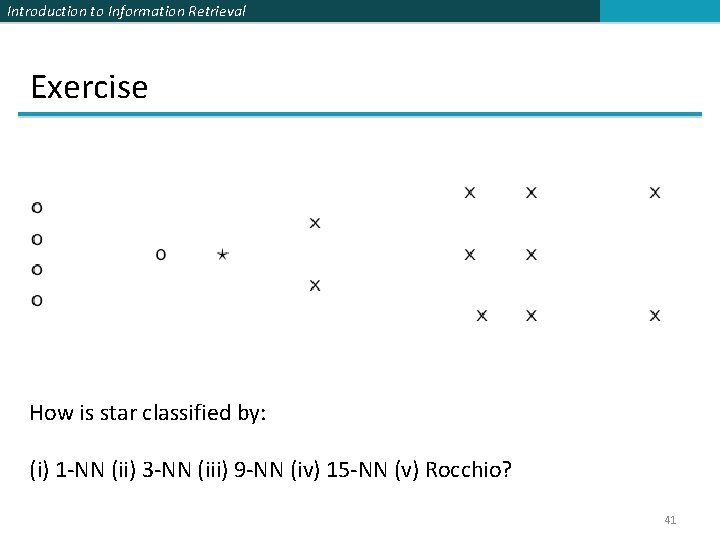
Introduction to Information Retrieval Exercise How is star classified by: (i) 1 -NN (ii) 3 -NN (iii) 9 -NN (iv) 15 -NN (v) Rocchio? 41
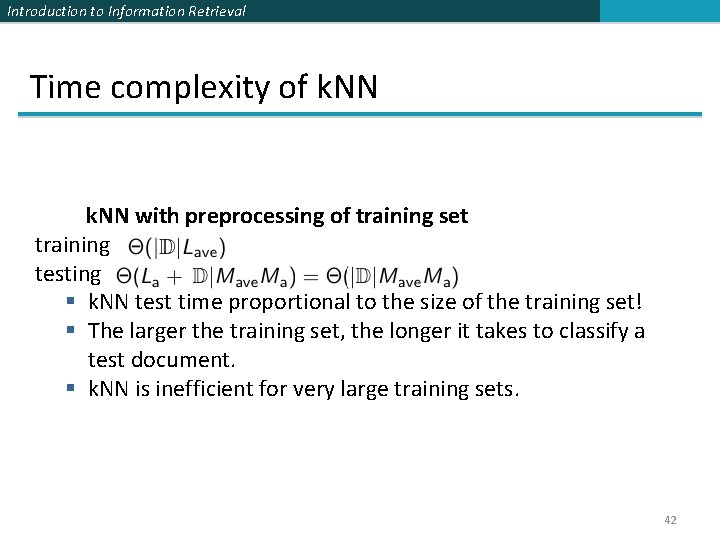
Introduction to Information Retrieval Time complexity of k. NN with preprocessing of training set training testing § k. NN test time proportional to the size of the training set! § The larger the training set, the longer it takes to classify a test document. § k. NN is inefficient for very large training sets. 42
Introduction to Information Retrieval k. NN: Discussion § No training necessary § But linear preprocessing of documents is as expensive as training Naive Bayes. § We always preprocess the training set, so in reality training time of k. NN is linear. § k. NN is very accurate if training set is large. § Optimality result: asymptotically zero error if Bayes rate is zero. § But k. NN can be very inaccurate if training set is small. 43
Introduction to Information Retrieval Outline ❶ Recap ❷ Feature selection ❸ Intro vector space classification ❹ Rocchio ❺ k. NN ❻ Linear classifiers ❼ > two classes 44
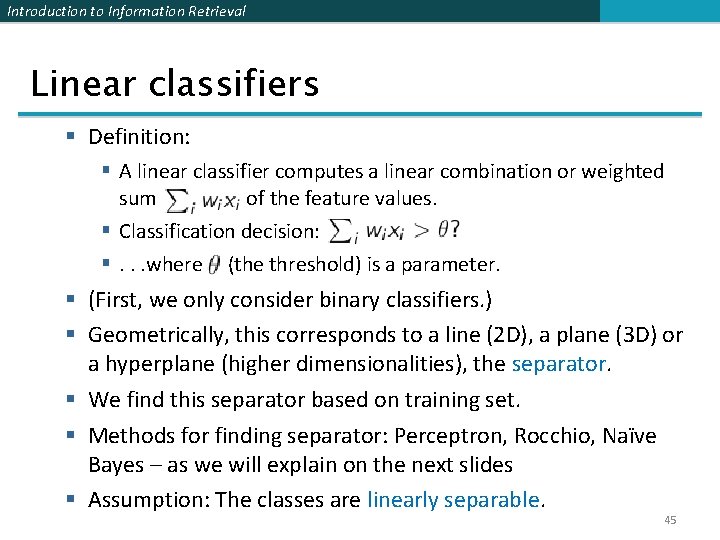
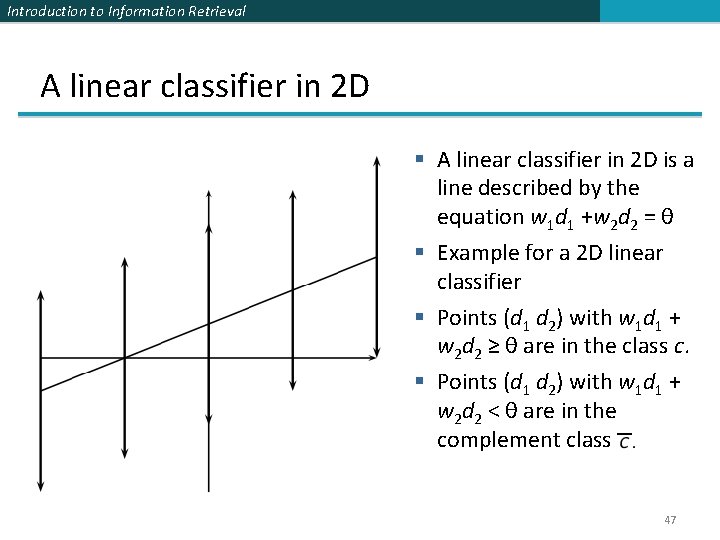
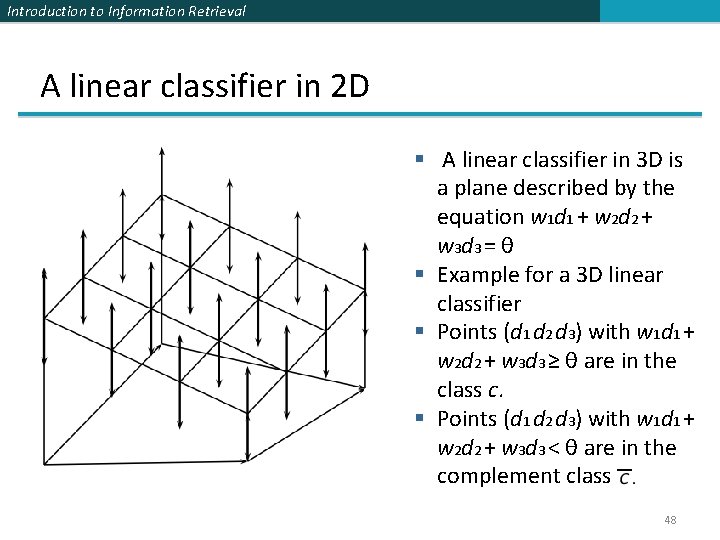
Introduction to Information Retrieval Linear classifiers § Definition: § A linear classifier computes a linear combination or weighted sum of the feature values. § Classification decision: §. . . where (the threshold) is a parameter. § (First, we only consider binary classifiers. ) § Geometrically, this corresponds to a line (2 D), a plane (3 D) or a hyperplane (higher dimensionalities), the separator. § We find this separator based on training set. § Methods for finding separator: Perceptron, Rocchio, Naïve Bayes – as we will explain on the next slides § Assumption: The classes are linearly separable. 45
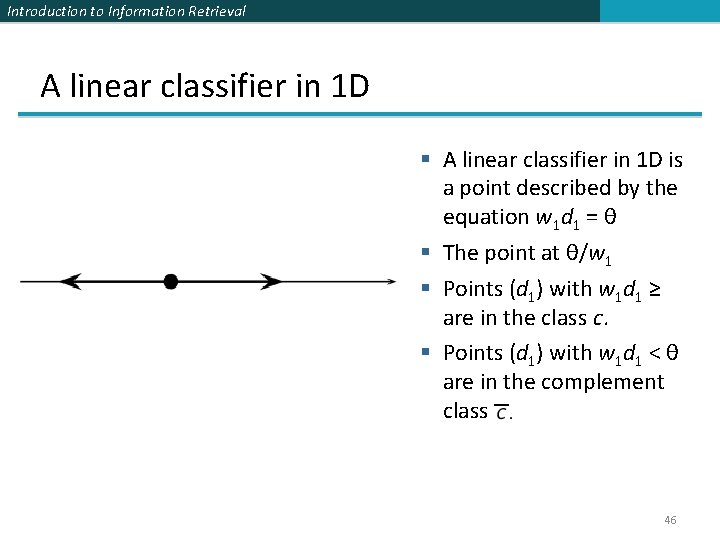
Introduction to Information Retrieval A linear classifier in 1 D § A linear classifier in 1 D is a point described by the equation w 1 d 1 = θ § The point at θ/w 1 § Points (d 1) with w 1 d 1 ≥ are in the class c. § Points (d 1) with w 1 d 1 < θ are in the complement class 46
Introduction to Information Retrieval A linear classifier in 2 D § A linear classifier in 2 D is a line described by the equation w 1 d 1 +w 2 d 2 = θ § Example for a 2 D linear classifier § Points (d 1 d 2) with w 1 d 1 + w 2 d 2 ≥ θ are in the class c. § Points (d 1 d 2) with w 1 d 1 + w 2 d 2 < θ are in the complement class 47
Introduction to Information Retrieval A linear classifier in 2 D § A linear classifier in 3 D is a plane described by the equation w 1 d 1 + w 2 d 2 + w 3 d 3 = θ § Example for a 3 D linear classifier § Points (d 1 d 2 d 3) with w 1 d 1 + w 2 d 2 + w 3 d 3 ≥ θ are in the class c. § Points (d 1 d 2 d 3) with w 1 d 1 + w 2 d 2 + w 3 d 3 < θ are in the complement class 48
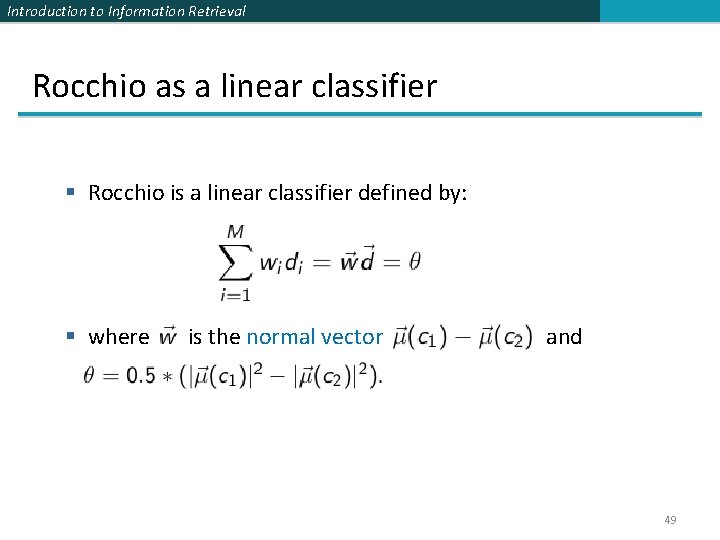
Introduction to Information Retrieval Rocchio as a linear classifier § Rocchio is a linear classifier defined by: § where is the normal vector and 49
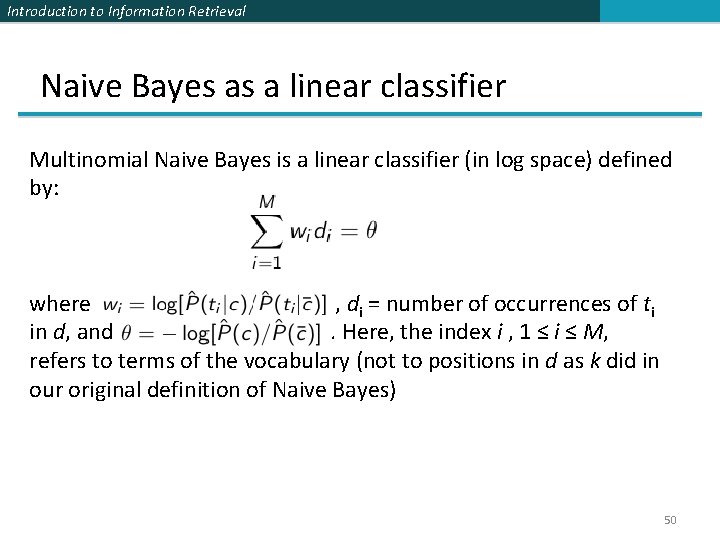
Introduction to Information Retrieval Naive Bayes as a linear classifier Multinomial Naive Bayes is a linear classifier (in log space) defined by: where , di = number of occurrences of ti in d, and. Here, the index i , 1 ≤ i ≤ M, refers to terms of the vocabulary (not to positions in d as k did in our original definition of Naive Bayes) 50
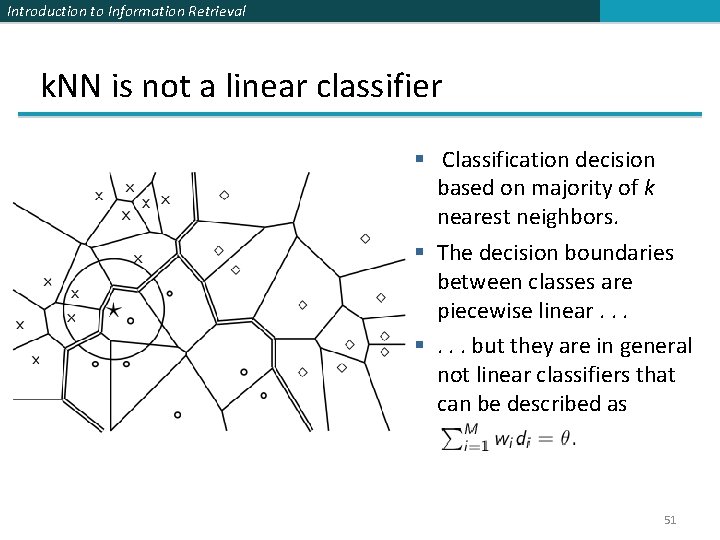
Introduction to Information Retrieval k. NN is not a linear classifier § Classification decision based on majority of k nearest neighbors. § The decision boundaries between classes are piecewise linear. . . §. . . but they are in general not linear classifiers that can be described as 51
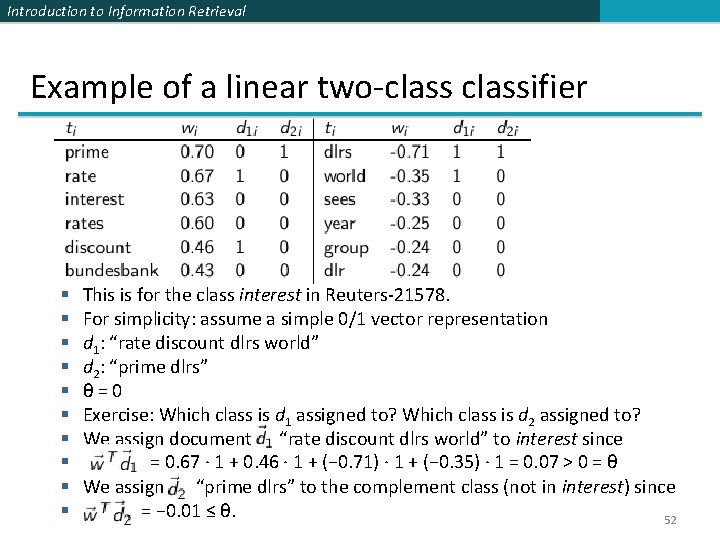
Introduction to Information Retrieval Example of a linear two-classifier § § § § § This is for the class interest in Reuters-21578. For simplicity: assume a simple 0/1 vector representation d 1: “rate discount dlrs world” d 2: “prime dlrs” θ=0 Exercise: Which class is d 1 assigned to? Which class is d 2 assigned to? We assign document “rate discount dlrs world” to interest since = 0. 67 · 1 + 0. 46 · 1 + (− 0. 71) · 1 + (− 0. 35) · 1 = 0. 07 > 0 = θ. We assign “prime dlrs” to the complement class (not in interest) since = − 0. 01 ≤ θ. 52
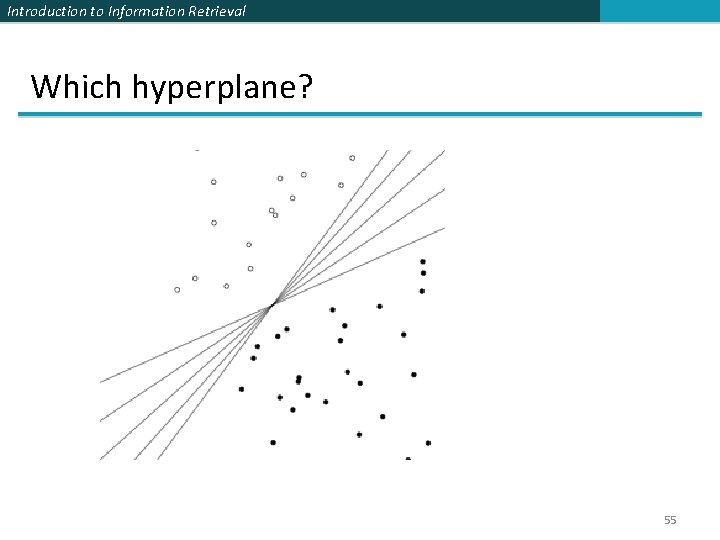
Introduction to Information Retrieval Which hyperplane? 53
Introduction to Information Retrieval Learning algorithms for vector space classification § In terms of actual computation, there are two types of learning algorithms. § (i) Simple learning algorithms that estimate the parameters of the classifier directly from the training data, often in one linear pass. § Naive Bayes, Rocchio, k. NN are all examples of this. § (ii) Iterative algorithms § Support vector machines § Perceptron (example available as PDF on website: http: //ifnlp. org/ir/pdf/p. pdf) § The best performing learning algorithms usually require iterative learning. 54
Introduction to Information Retrieval Which hyperplane? 55
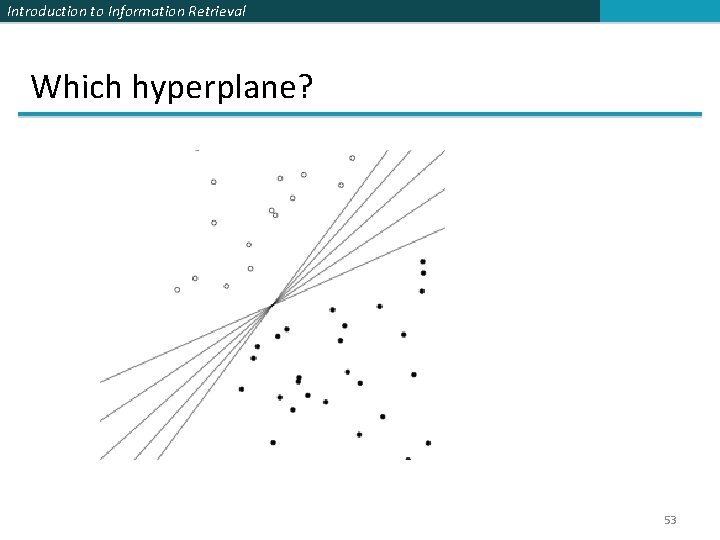
Introduction to Information Retrieval Which hyperplane? § For linearly separable training sets: there are infinitely many separating hyperplanes. § They all separate the training set perfectly. . . §. . . but they behave differently on test data. § Error rates on new data are low for some, high for others. § How do we find a low-error separator? § Perceptron: generally bad; Naive Bayes, Rocchio: ok; linear SVM: good 56
Introduction to Information Retrieval Linear classifiers: Discussion § Many common text classifiers are linear classifiers: Naive Bayes, Rocchio, logistic regression, linear support vector machines etc. § Each method has a different way of selecting the separating hyperplane § Huge differences in performance on test documents § Can we get better performance with more powerful nonlinear classifiers? § Not in general: A given amount of training data may suffice for estimating a linear boundary, but not for estimating a more complex nonlinear boundary. 57
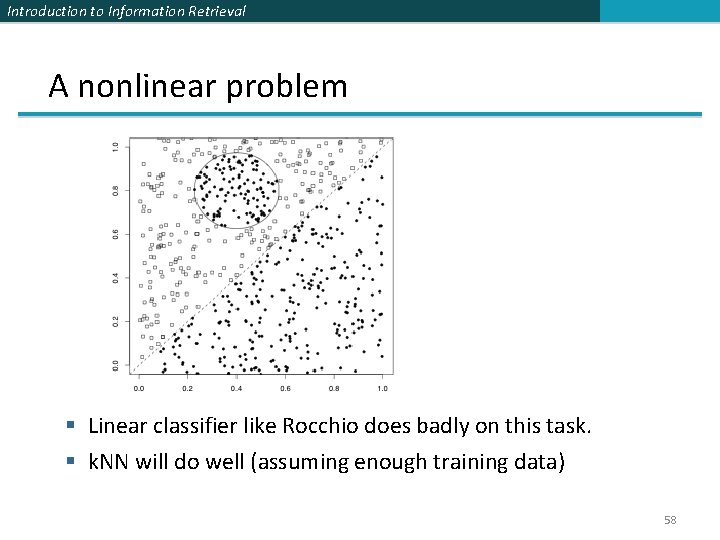
Introduction to Information Retrieval A nonlinear problem § Linear classifier like Rocchio does badly on this task. § k. NN will do well (assuming enough training data) 58
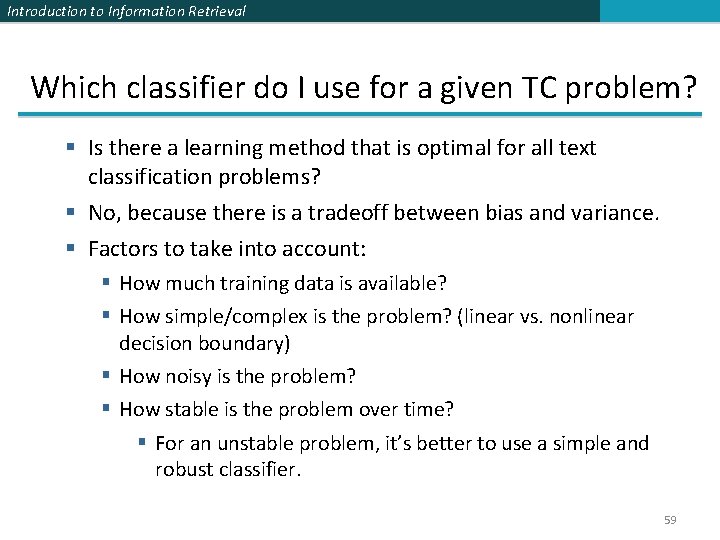
Introduction to Information Retrieval Which classifier do I use for a given TC problem? § Is there a learning method that is optimal for all text classification problems? § No, because there is a tradeoff between bias and variance. § Factors to take into account: § How much training data is available? § How simple/complex is the problem? (linear vs. nonlinear decision boundary) § How noisy is the problem? § How stable is the problem over time? § For an unstable problem, it’s better to use a simple and robust classifier. 59
Introduction to Information Retrieval Outline ❶ Recap ❷ Feature selection ❸ Intro vector space classification ❹ Rocchio ❺ k. NN ❻ Linear classifiers ❼ > two classes 60
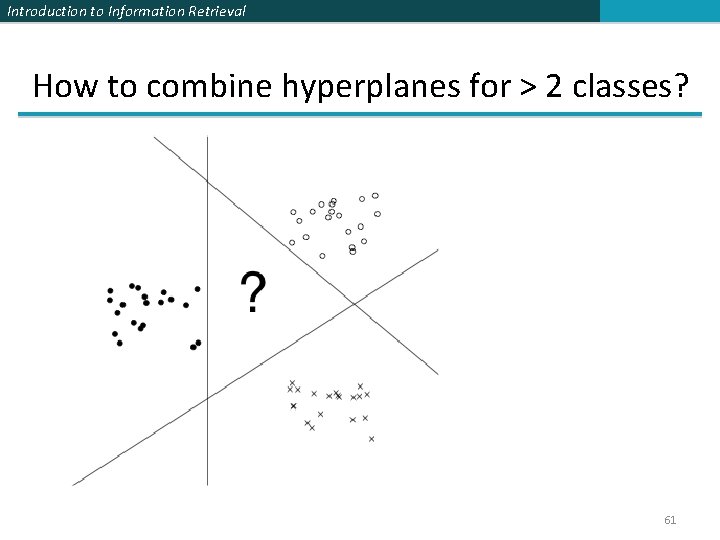
Introduction to Information Retrieval How to combine hyperplanes for > 2 classes? 61
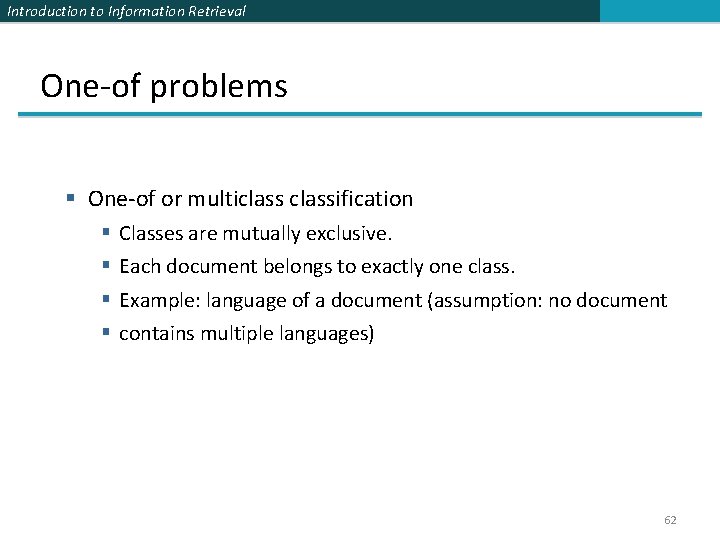
Introduction to Information Retrieval One-of problems § One-of or multiclassification § § Classes are mutually exclusive. Each document belongs to exactly one class. Example: language of a document (assumption: no document contains multiple languages) 62
Introduction to Information Retrieval One-of classification with linear classifiers § Combine two-class linear classifiers as follows for one-of classification: § Run each classifier separately § Rank classifiers (e. g. , according to score) § Pick the class with the highest score 63
Introduction to Information Retrieval Any-of problems § Any-of or multilabel classification § A document can be a member of 0, 1, or many classes. § A decision on one class leaves decisions open on all other classes. § A type of “independence” (but not statistical independence) § Example: topic classification § Usually: make decisions on the region, on the subject area, on the industry and so on “independently” 64
Introduction to Information Retrieval Any-of classification with linear classifiers § Combine two-class linear classifiers as follows for any-of classification: § Simply run each two-classifier separately on the test document and assign document accordingly 65
Introduction to Information Retrieval Take-away today § Feature selection for text classification: How to select a subset of available dimensions § Vector space classification: Basic idea of doing text classification for documents that are represented as vectors § Rocchio classifier: Rocchio relevance feedback idea applied to text classification § k nearest neighbor classification § Linear classifiers § More than two classes 66
Introduction to Information Retrieval Resources § Chapter 13 of IIR (feature selection) § Chapter 14 of IIR § Resources at http: //ifnlp. org/ir § Perceptron example § General overview of text classification: Sebastiani (2002) § Text classification chapter on decision tress and perceptrons: Manning & Schütze (1999) § One of the best machine learning textbooks: Hastie, Tibshirani & Friedman (2003) 67