
Introduction to Information Retrieval CS 276 Information Retrieval


- Slides: 47
Introduction to Information Retrieval CS 276: Information Retrieval and Web Search Text Classification 1 Chris Manning and Pandu Nayak
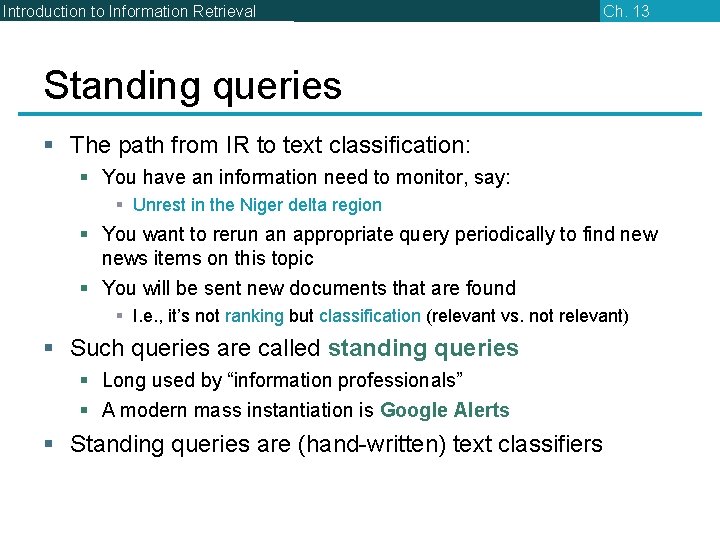
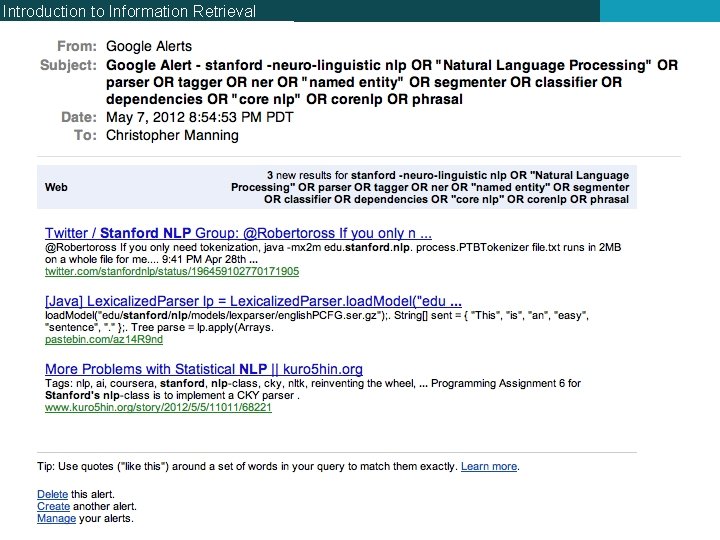
Introduction to Information Retrieval Ch. 13 Standing queries § The path from IR to text classification: § You have an information need to monitor, say: § Unrest in the Niger delta region § You want to rerun an appropriate query periodically to find news items on this topic § You will be sent new documents that are found § I. e. , it’s not ranking but classification (relevant vs. not relevant) § Such queries are called standing queries § Long used by “information professionals” § A modern mass instantiation is Google Alerts § Standing queries are (hand-written) text classifiers
Introduction to Information Retrieval 3
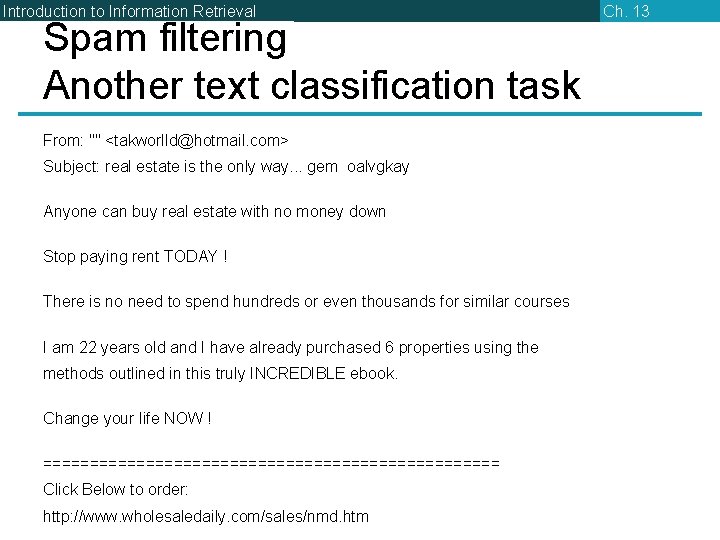
Introduction to Information Retrieval Spam filtering Another text classification task From: "" <takworlld@hotmail. com> Subject: real estate is the only way. . . gem oalvgkay Anyone can buy real estate with no money down Stop paying rent TODAY ! There is no need to spend hundreds or even thousands for similar courses I am 22 years old and I have already purchased 6 properties using the methods outlined in this truly INCREDIBLE ebook. Change your life NOW ! ========================= Click Below to order: http: //www. wholesaledaily. com/sales/nmd. htm Ch. 13
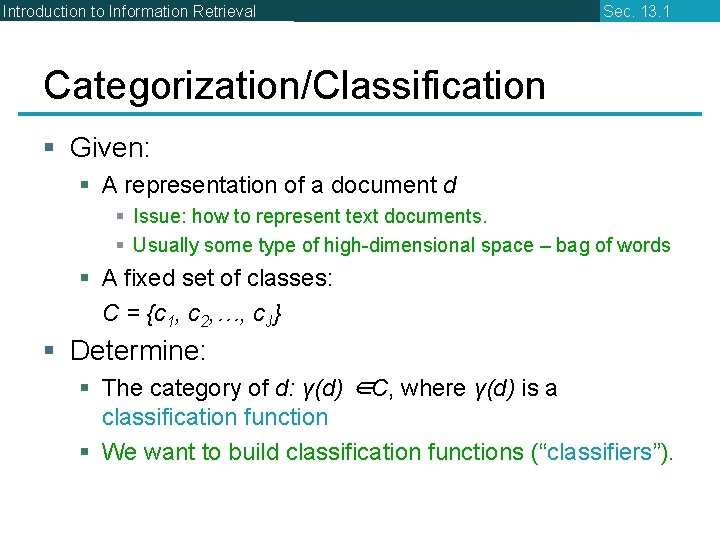
Introduction to Information Retrieval Sec. 13. 1 Categorization/Classification § Given: § A representation of a document d § Issue: how to represent text documents. § Usually some type of high-dimensional space – bag of words § A fixed set of classes: C = {c 1, c 2, …, c. J} § Determine: § The category of d: γ(d) ∈C, where γ(d) is a classification function § We want to build classification functions (“classifiers”).
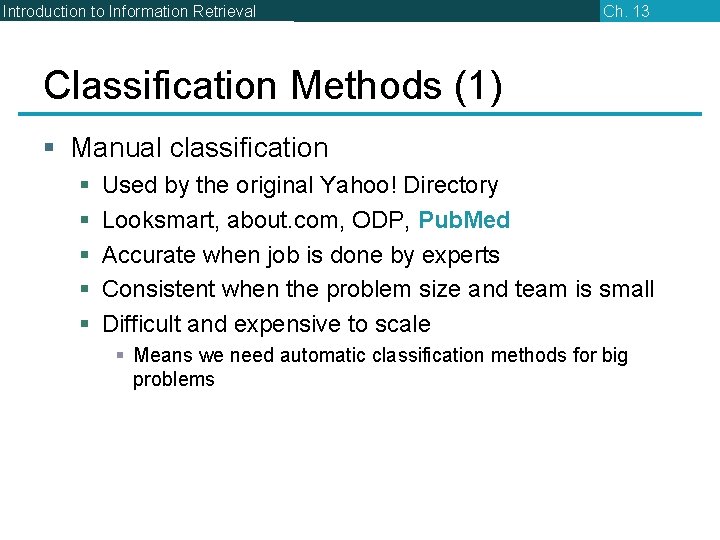
Introduction to Information Retrieval Ch. 13 Classification Methods (1) § Manual classification § § § Used by the original Yahoo! Directory Looksmart, about. com, ODP, Pub. Med Accurate when job is done by experts Consistent when the problem size and team is small Difficult and expensive to scale § Means we need automatic classification methods for big problems
Introduction to Information Retrieval Ch. 13 Classification Methods (2) § Hand-coded rule-based classifiers § One technique used by news agencies, intelligence agencies, etc. § Widely deployed in government and enterprise § Vendors provide “IDE” for writing such rules
Introduction to Information Retrieval Ch. 13 Classification Methods (2) § Hand-coded rule-based classifiers § Commercial systems have complex query languages § Accuracy can be high if a rule has been carefully refined over time by a subject expert § Building and maintaining these rules is expensive
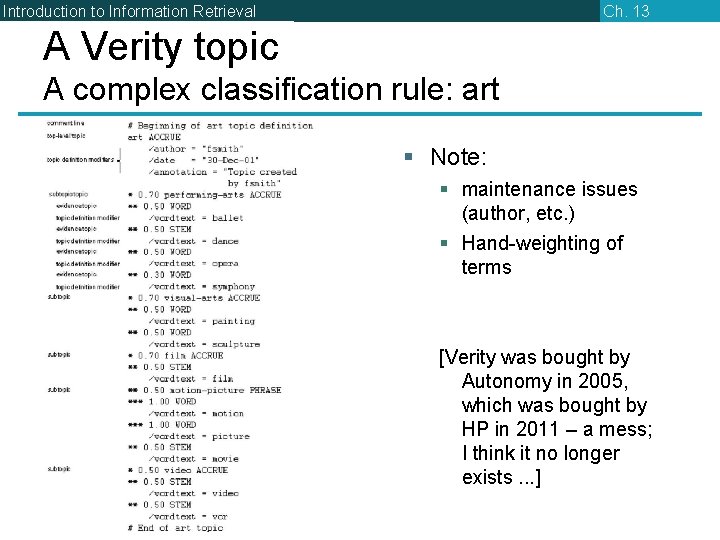
Ch. 13 Introduction to Information Retrieval A Verity topic A complex classification rule: art § Note: § maintenance issues (author, etc. ) § Hand-weighting of terms [Verity was bought by Autonomy in 2005, which was bought by HP in 2011 – a mess; I think it no longer exists. . . ]
11
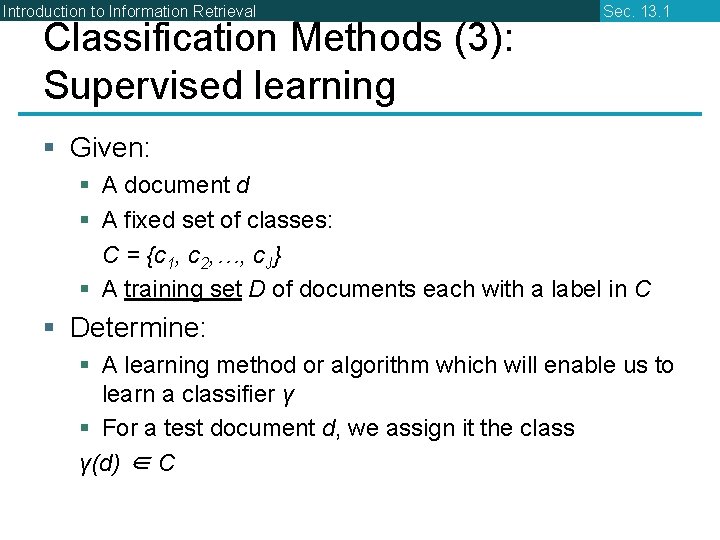
Introduction to Information Retrieval Classification Methods (3): Supervised learning Sec. 13. 1 § Given: § A document d § A fixed set of classes: C = {c 1, c 2, …, c. J} § A training set D of documents each with a label in C § Determine: § A learning method or algorithm which will enable us to learn a classifier γ § For a test document d, we assign it the class γ(d) ∈ C
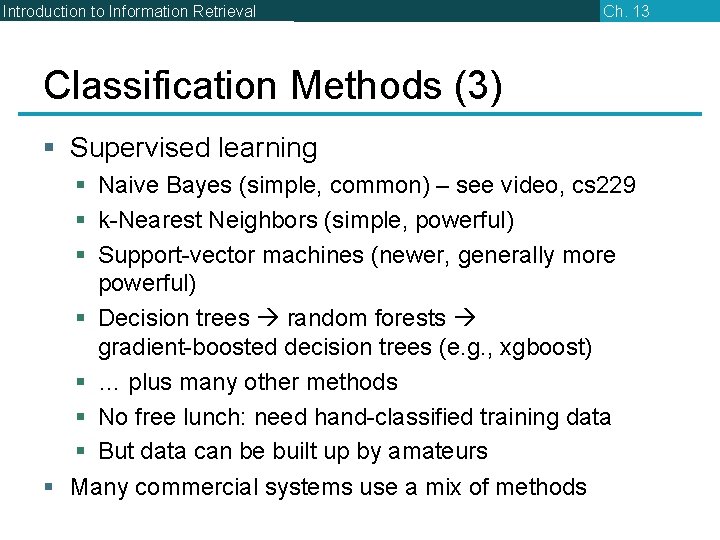
Introduction to Information Retrieval Ch. 13 Classification Methods (3) § Supervised learning § Naive Bayes (simple, common) – see video, cs 229 § k-Nearest Neighbors (simple, powerful) § Support-vector machines (newer, generally more powerful) § Decision trees random forests gradient-boosted decision trees (e. g. , xgboost) § … plus many other methods § No free lunch: need hand-classified training data § But data can be built up by amateurs § Many commercial systems use a mix of methods
Introduction to Information Retrieval Features § Supervised learning classifiers can use any sort of feature § URL, email address, punctuation, capitalization, dictionaries, network features § In the simplest bag of words view of documents § We use only word features § we use all of the words in the text (not a subset)
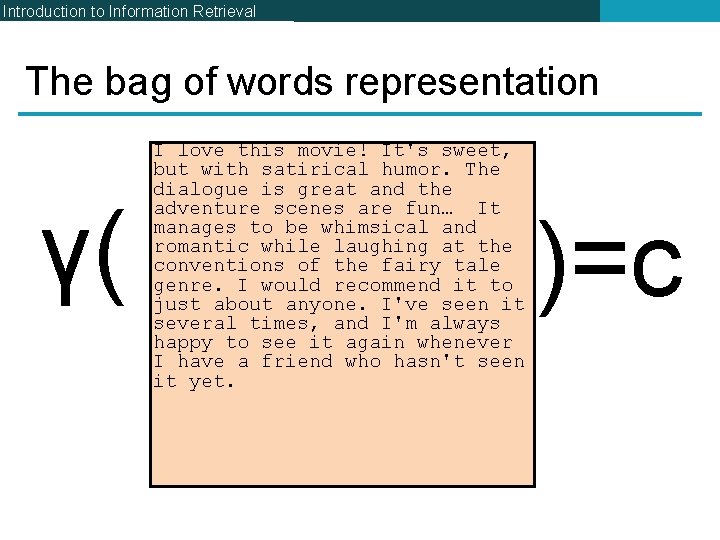
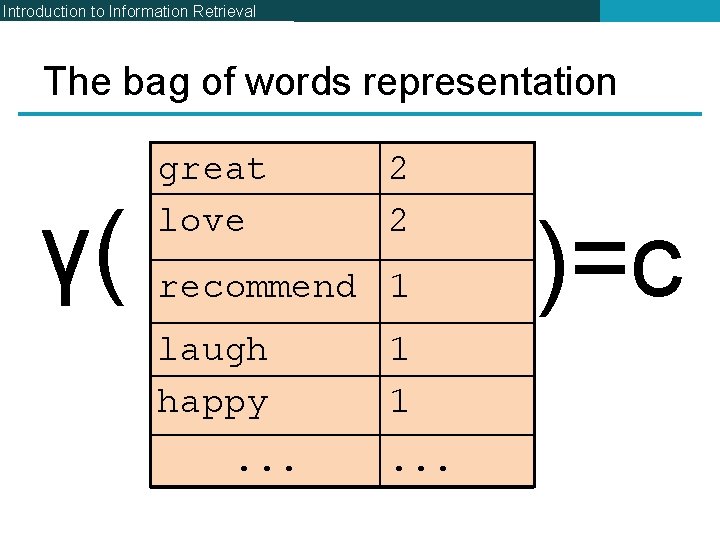
Introduction to Information Retrieval The bag of words representation γ( I love this movie! It's sweet, but with satirical humor. The dialogue is great and the adventure scenes are fun… It manages to be whimsical and romantic while laughing at the conventions of the fairy tale genre. I would recommend it to just about anyone. I've seen it several times, and I'm always happy to see it again whenever I have a friend who hasn't seen it yet. )=c
Introduction to Information Retrieval The bag of words representation γ( great love 2 2 recommend 1 laugh happy. . . 1 1. . . )=c
Introduction to Information Retrieval Sec. 13. 5 Feature Selection: Why? § Text collections have a large number of features § 10, 000 – 1, 000 unique words … and more § Selection may make a particular classifier feasible § Some classifiers can’t deal with 1, 000 features § Reduces training time § Training time for some methods is quadratic or worse in the number of features § Makes runtime models smaller and faster § Can improve generalization (performance) § Eliminates noise features § Avoids overfitting
Introduction to Information Retrieval Feature Selection: Frequency § The simplest feature selection method: § Just use the commonest terms § No particular foundation § But it make sense why this works § They’re the words that can be well-estimated and are most often available as evidence § In practice, this is often 90% as good as better methods § Smarter feature selection: § chi-squared, etc.
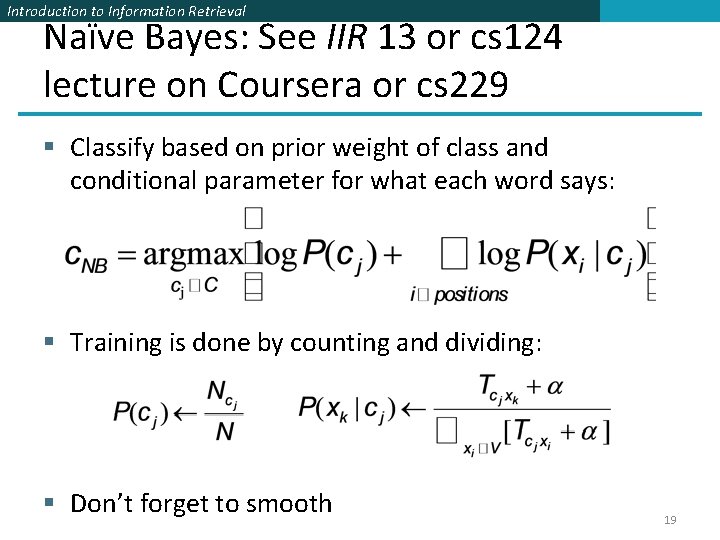
Introduction to Information Retrieval Naïve Bayes: See IIR 13 or cs 124 lecture on Coursera or cs 229 § Classify based on prior weight of class and conditional parameter for what each word says: § Training is done by counting and dividing: § Don’t forget to smooth 19
Introduction to Information Retrieval Spam. Assassin § Naïve Bayes has found a home in spam filtering § Paul Graham’s A Plan for Spam § Widely used in spam filters § But many features beyond words: § black hole lists, etc. § particular hand-crafted text patterns
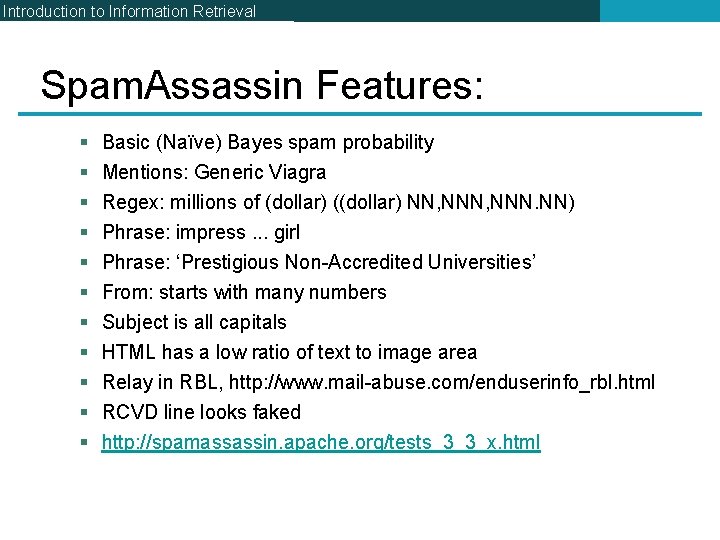
Introduction to Information Retrieval Spam. Assassin Features: § § § Basic (Naïve) Bayes spam probability Mentions: Generic Viagra Regex: millions of (dollar) ((dollar) NN, NNN. NN) Phrase: impress. . . girl Phrase: ‘Prestigious Non-Accredited Universities’ From: starts with many numbers Subject is all capitals HTML has a low ratio of text to image area Relay in RBL, http: //www. mail-abuse. com/enduserinfo_rbl. html RCVD line looks faked http: //spamassassin. apache. org/tests_3_3_x. html
Introduction to Information Retrieval Naive Bayes is Not So Naive § Very fast learning and testing (basically just count words) § Low storage requirements § Very good in domains with many equally important features § More robust to irrelevant features than many learning methods Irrelevant features cancel out without affecting results
Introduction to Information Retrieval Naive Bayes is Not So Naive § More robust to concept drift (changing class definition over time) § Naive Bayes won 1 st and 2 nd place in KDD-CUP 97 competition out of 16 systems Goal: Financial services industry direct mail response prediction: Predict if the recipient of mail will actually respond to the advertisement – 750, 000 records. § A good dependable baseline for text classification (but not the best)!
Introduction to Information Retrieval Sec. 13. 6 Evaluating Categorization § Evaluation must be done on test data that are independent of the training data § Sometimes use cross-validation (averaging results over multiple training and test splits of the overall data) § Easy to get good performance on a test set that was available to the learner during training (e. g. , just memorize the test set)
Introduction to Information Retrieval Sec. 13. 6 Evaluating Categorization § Measures: precision, recall, F 1, classification accuracy § Classification accuracy: r/n where n is the total number of test docs and r is the number of test docs correctly classified
Introduction to Information Retrieval Sec. 14. 1 Remember: Vector Space Representation § Each document is a vector, one component for each term (= word). § Normally normalize vectors to unit length. § High-dimensional vector space: § Terms are axes § 10, 000+ dimensions, or even 100, 000+ § Docs are vectors in this space § How can we do classification in this space? 28
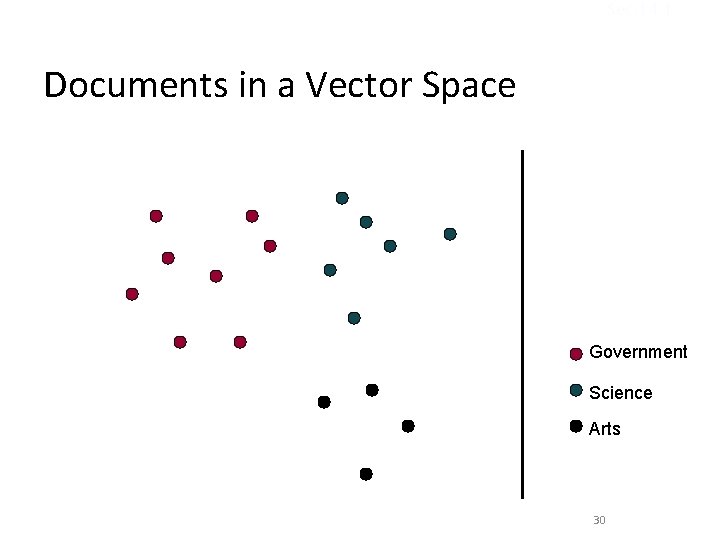
Introduction to Information Retrieval Classification Using Vector Spaces § In vector space classification, training set corresponds to a labeled set of points (equivalently, vectors) § Premise 1: Documents in the same class form a contiguous region of space § Premise 2: Documents from different classes don’t overlap (much) § Learning a classifier: build surfaces to delineate classes in the space
Sec. 14. 1 Documents in a Vector Space Government Science Arts 30
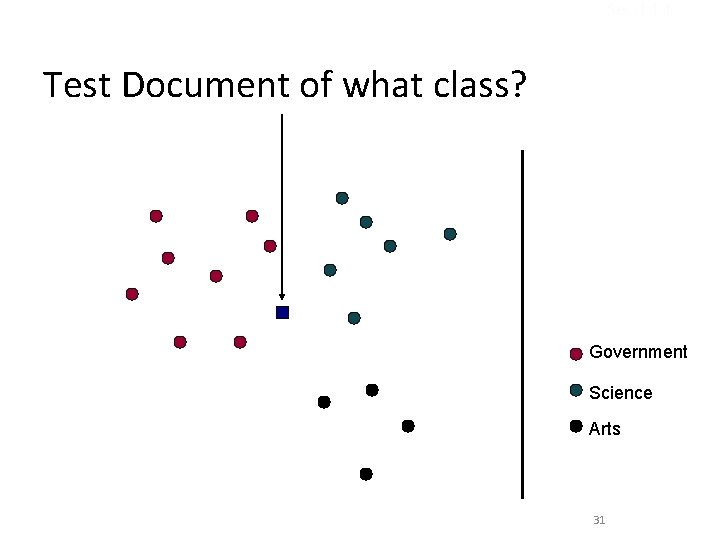
Sec. 14. 1 Test Document of what class? Government Science Arts 31
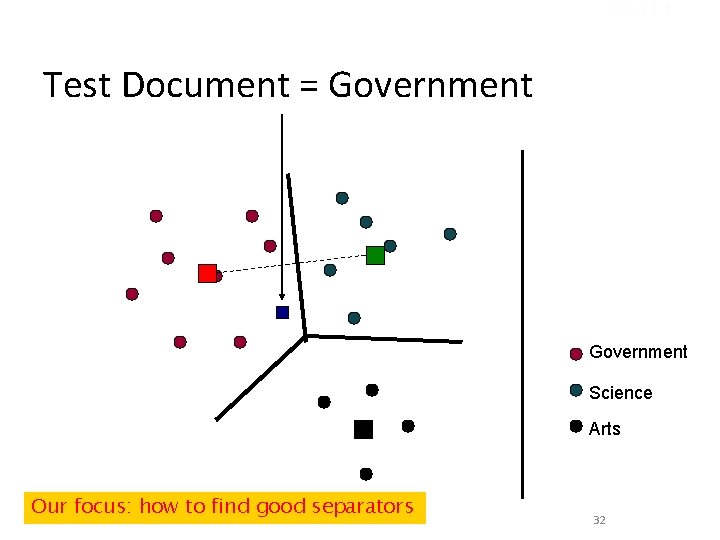
Sec. 14. 1 Test Document = Government Science Arts Our focus: how to find good separators 32
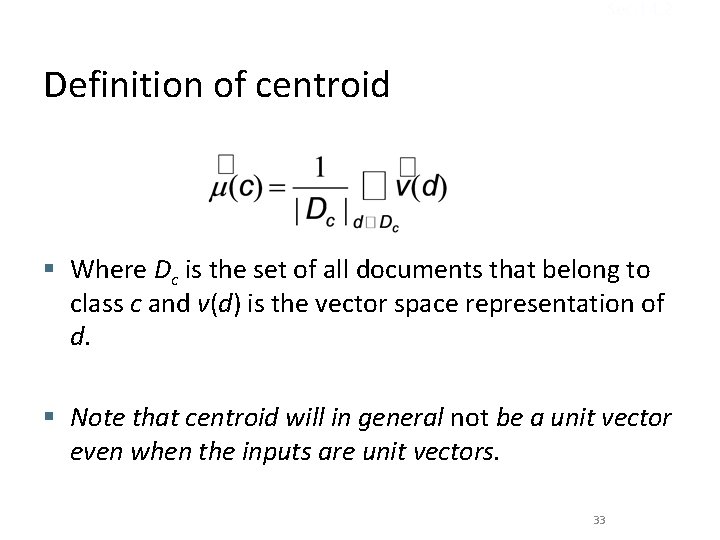
Sec. 14. 2 Definition of centroid § Where Dc is the set of all documents that belong to class c and v(d) is the vector space representation of d. § Note that centroid will in general not be a unit vector even when the inputs are unit vectors. 33
Sec. 14. 2 Rocchio classification § Rocchio forms a simple representative for each class: the centroid/prototype § Classification: nearest prototype/centroid § It does not guarantee that classifications are consistent with the given training data Why not? 34
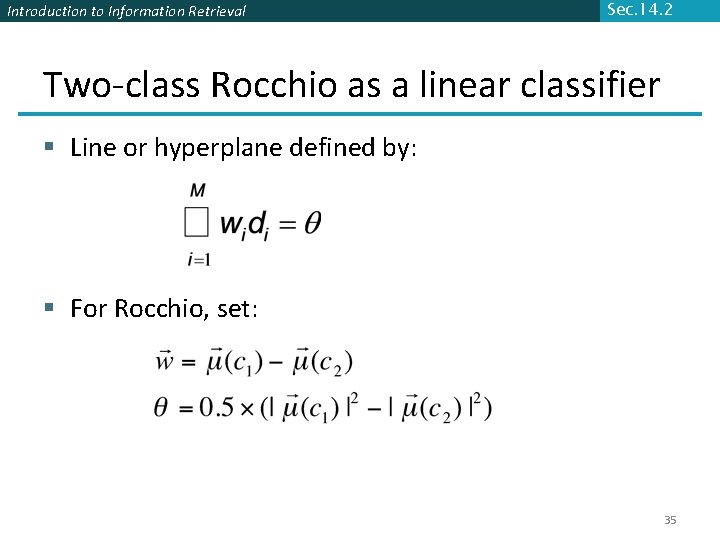
Introduction to Information Retrieval Sec. 14. 2 Two-class Rocchio as a linear classifier § Line or hyperplane defined by: § For Rocchio, set: 35
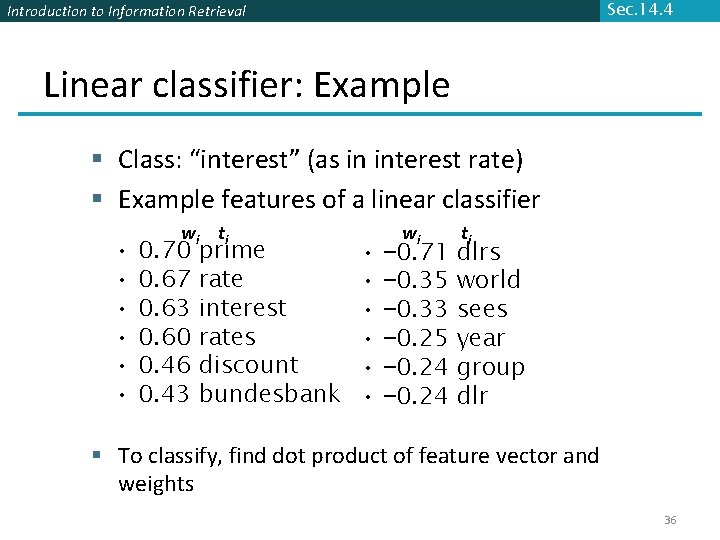
Sec. 14. 4 Introduction to Information Retrieval Linear classifier: Example § Class: “interest” (as in interest rate) § Example features of a linear classifier • • • wi t i 0. 70 0. 67 0. 63 0. 60 0. 46 0. 43 prime rate interest rates discount bundesbank • • • wi − 0. 71 − 0. 35 − 0. 33 − 0. 25 − 0. 24 ti dlrs world sees year group dlr § To classify, find dot product of feature vector and weights 36
Sec. 14. 2 Rocchio classification § A simple form of Fisher’s linear discriminant § Little used outside text classification § It has been used quite effectively for text classification § But in general worse than Naïve Bayes § Again, cheap to train and test documents 37
Introduction to Information Retrieval Sec. 14. 3 k Nearest Neighbor Classification § k. NN = k Nearest Neighbor § To classify a document d: § Define k-neighborhood as the k nearest neighbors of d § Pick the majority class label in the kneighborhood § For larger k can roughly estimate P(c|d) as #(c)/k 38
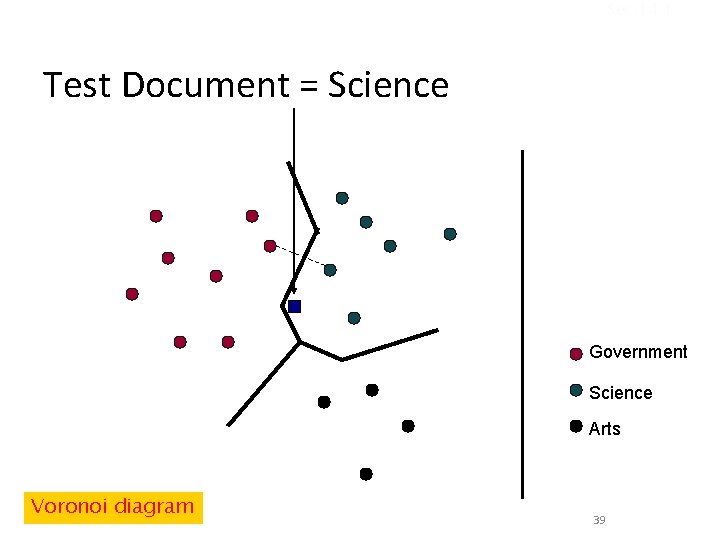
Sec. 14. 1 Test Document = Science Government Science Arts Voronoi diagram 39
Sec. 14. 3 Nearest-Neighbor Learning § Learning: just store the labeled training examples D § Testing instance x (under 1 NN): § Compute similarity between x and all examples in D. § Assign x the category of the most similar example in D. § Does not compute anything beyond storing the examples § Also called: § Case-based learning § Memory-based learning § Lazy learning § Rationale of k. NN: contiguity hypothesis 40
Sec. 14. 3 k Nearest Neighbor § Using only the closest example (1 NN) is subject to errors due to: § A single atypical example. § Noise (i. e. , an error) in the category label of a single training example. § More robust: find the k examples and return the majority category of these k § k is typically odd to avoid ties; 3 and 5 are most common 41
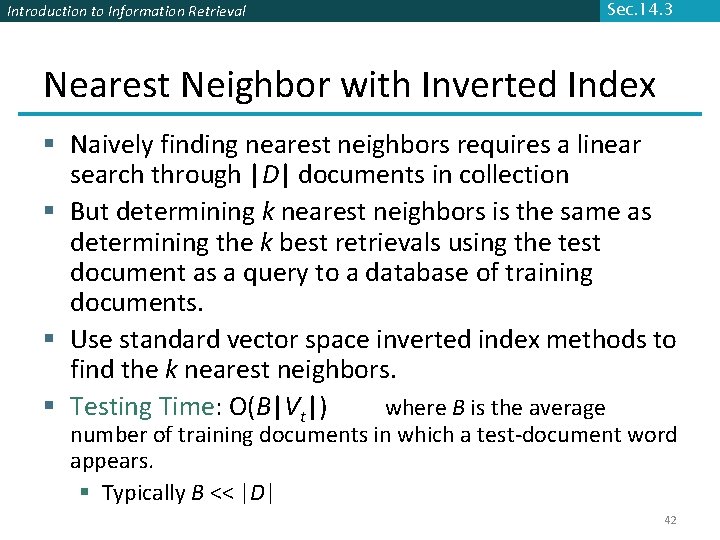
Introduction to Information Retrieval Sec. 14. 3 Nearest Neighbor with Inverted Index § Naively finding nearest neighbors requires a linear search through |D| documents in collection § But determining k nearest neighbors is the same as determining the k best retrievals using the test document as a query to a database of training documents. § Use standard vector space inverted index methods to find the k nearest neighbors. § Testing Time: O(B|Vt|) where B is the average number of training documents in which a test-document word appears. § Typically B << |D| 42
Introduction to Information Retrieval Sec. 14. 3 k. NN: Discussion § No feature selection necessary § No training necessary § Scales well with large number of classes § Don’t need to train n classifiers for n classes § Classes can influence each other § Small changes to one class can have ripple effect § Done naively, very expensive at test time § In most cases it’s more accurate than NB or Rocchio § As the amount of data goes to infinity, it has to be a great classifier! – it’s “Bayes optimal” 43
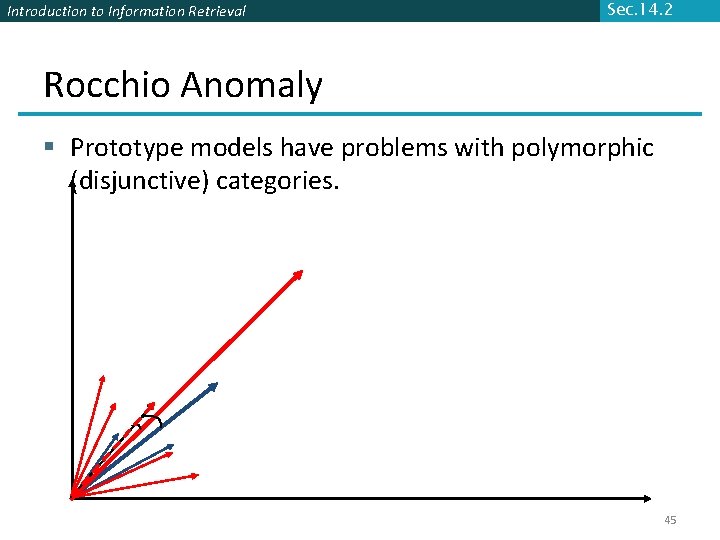
Introduction to Information Retrieval Sec. 14. 2 Rocchio Anomaly § Prototype models have problems with polymorphic (disjunctive) categories. 45
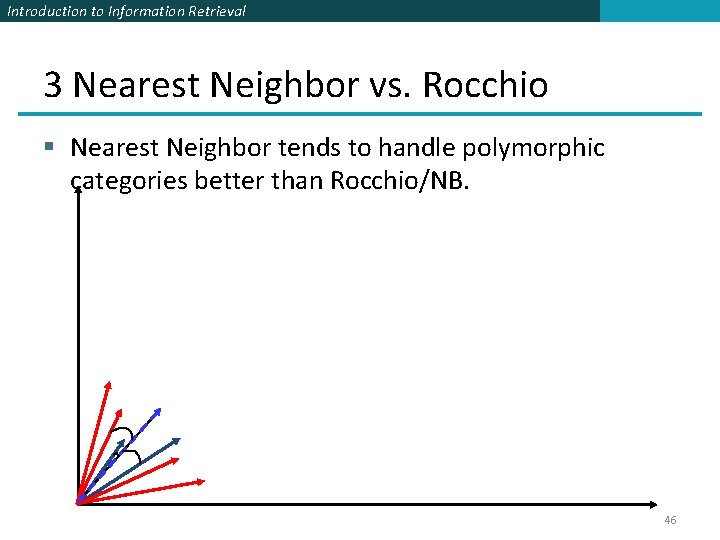
Introduction to Information Retrieval 3 Nearest Neighbor vs. Rocchio § Nearest Neighbor tends to handle polymorphic categories better than Rocchio/NB. 46
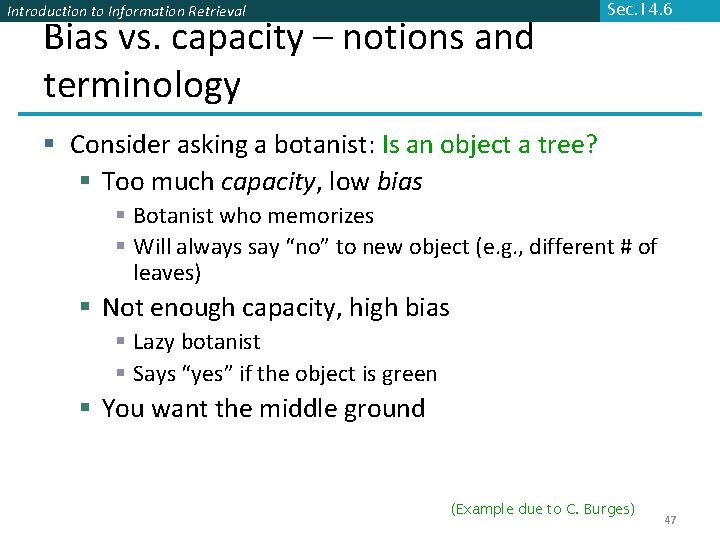
Introduction to Information Retrieval Bias vs. capacity – notions and terminology Sec. 14. 6 § Consider asking a botanist: Is an object a tree? § Too much capacity, low bias § Botanist who memorizes § Will always say “no” to new object (e. g. , different # of leaves) § Not enough capacity, high bias § Lazy botanist § Says “yes” if the object is green § You want the middle ground (Example due to C. Burges) 47
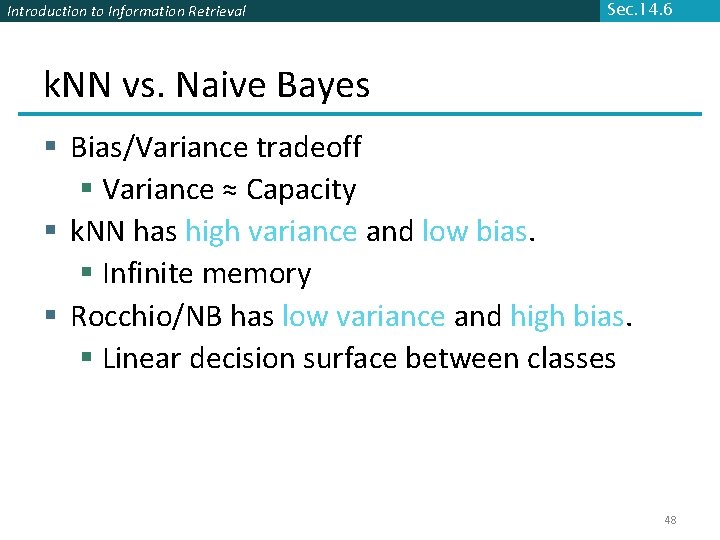
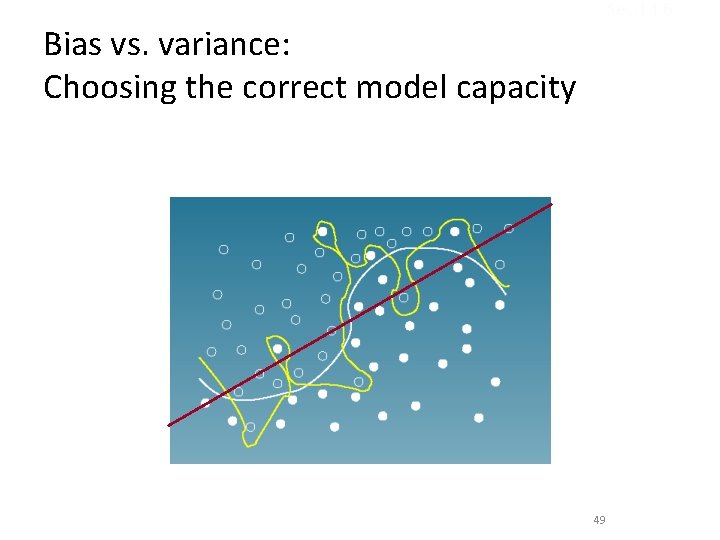
Introduction to Information Retrieval Sec. 14. 6 k. NN vs. Naive Bayes § Bias/Variance tradeoff § Variance ≈ Capacity § k. NN has high variance and low bias. § Infinite memory § Rocchio/NB has low variance and high bias. § Linear decision surface between classes 48
Sec. 14. 6 Bias vs. variance: Choosing the correct model capacity 49
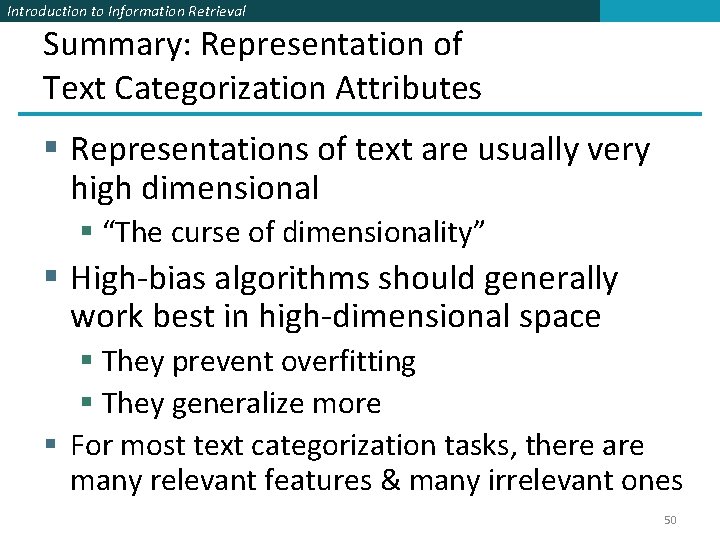
Introduction to Information Retrieval Summary: Representation of Text Categorization Attributes § Representations of text are usually very high dimensional § “The curse of dimensionality” § High-bias algorithms should generally work best in high-dimensional space § They prevent overfitting § They generalize more § For most text categorization tasks, there are many relevant features & many irrelevant ones 50
Introduction to Information Retrieval Which classifier do I use for a given text classification problem? § Is there a learning method that is optimal for all text classification problems? § No, because there is a tradeoff between bias and variance. § Factors to take into account: § How much training data is available? § How simple/complex is the problem? (linear vs. nonlinear decision boundary) § How noisy is the data? § How stable is the problem over time? § For an unstable problem, it’s better to use a simple and robust classifier. 51