
Introduction to Information Retrieval CS 276 Information Retrieval


- Slides: 51
Introduction to Information Retrieval CS 276: Information Retrieval and Web Search Basic inverted index construction
Introduction to Information Retrieval Ch. 4 Index construction § How do we construct an index? § What strategies can we use with limited main memory?
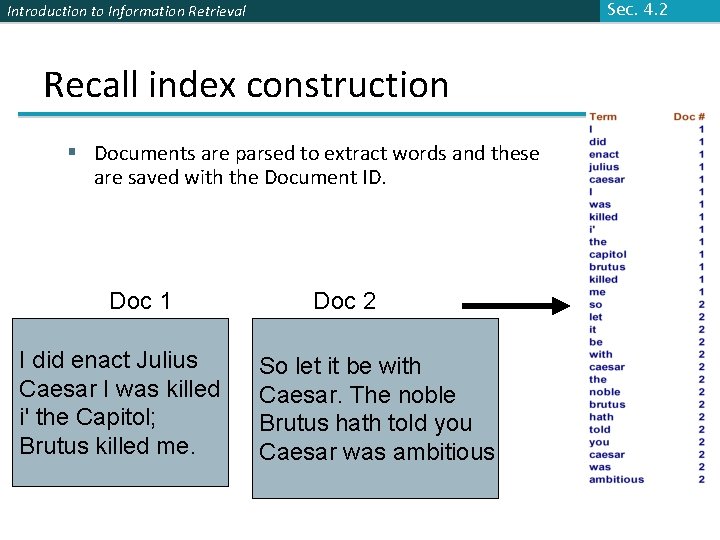
Sec. 4. 2 Introduction to Information Retrieval Recall index construction § Documents are parsed to extract words and these are saved with the Document ID. Doc 1 I did enact Julius Caesar I was killed i' the Capitol; Brutus killed me. Doc 2 So let it be with Caesar. The noble Brutus hath told you Caesar was ambitious
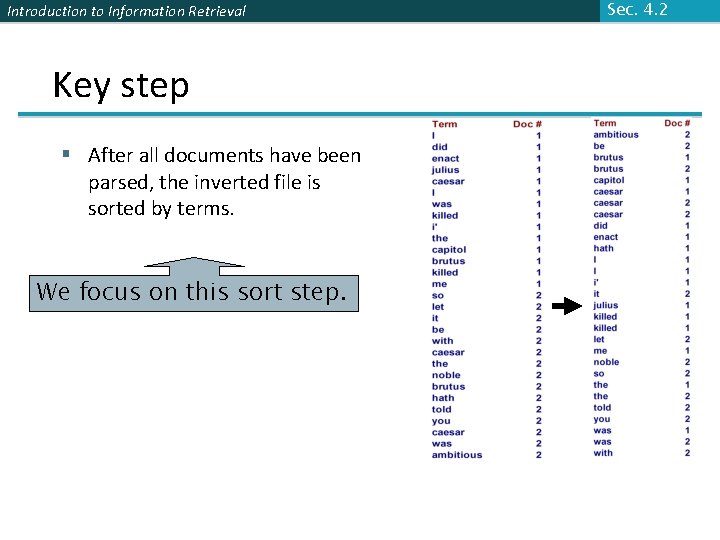
Introduction to Information Retrieval Key step § After all documents have been parsed, the inverted file is sorted by terms. We focus on this sort step. Sec. 4. 2
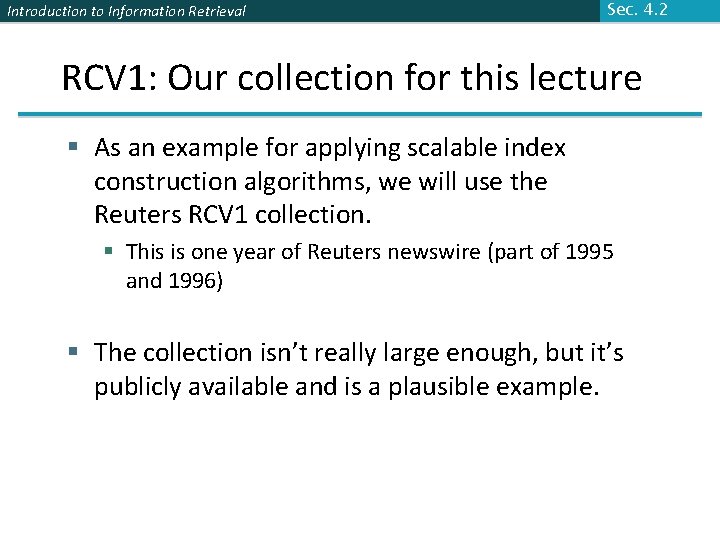
Introduction to Information Retrieval Sec. 4. 2 RCV 1: Our collection for this lecture § As an example for applying scalable index construction algorithms, we will use the Reuters RCV 1 collection. § This is one year of Reuters newswire (part of 1995 and 1996) § The collection isn’t really large enough, but it’s publicly available and is a plausible example.
Introduction to Information Retrieval A Reuters RCV 1 document Sec. 4. 2
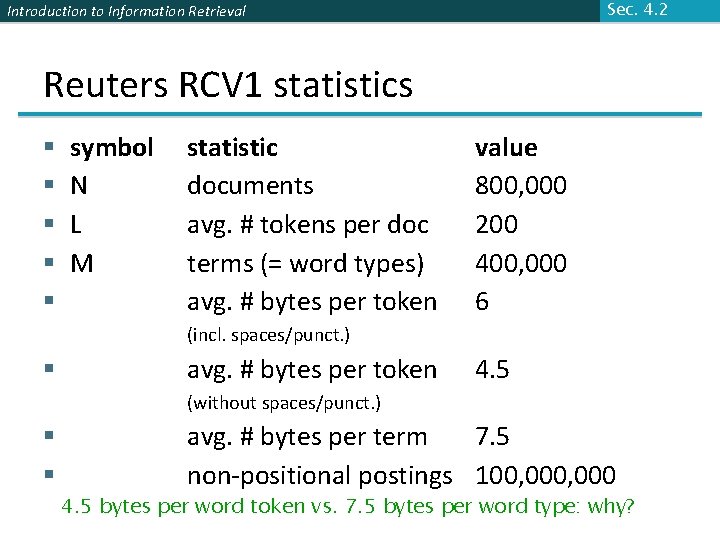
Sec. 4. 2 Introduction to Information Retrieval Reuters RCV 1 statistics § § § symbol N L M statistic documents avg. # tokens per doc terms (= word types) avg. # bytes per token value 800, 000 200 400, 000 6 (incl. spaces/punct. ) § avg. # bytes per token 4. 5 (without spaces/punct. ) § § avg. # bytes per term 7. 5 non-positional postings 100, 000 4. 5 bytes per word token vs. 7. 5 bytes per word type: why?
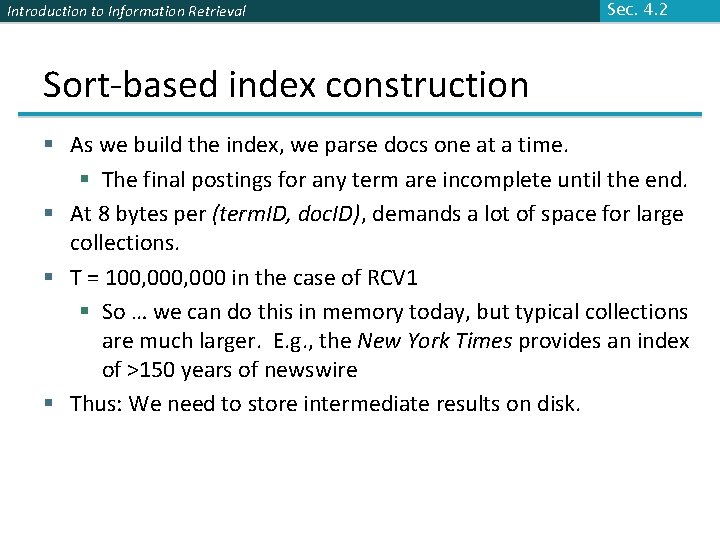
Introduction to Information Retrieval Sec. 4. 2 Sort-based index construction § As we build the index, we parse docs one at a time. § The final postings for any term are incomplete until the end. § At 8 bytes per (term. ID, doc. ID), demands a lot of space for large collections. § T = 100, 000 in the case of RCV 1 § So … we can do this in memory today, but typical collections are much larger. E. g. , the New York Times provides an index of >150 years of newswire § Thus: We need to store intermediate results on disk.
Introduction to Information Retrieval Sec. 4. 2 Scaling index construction § In-memory index construction does not scale § Can’t stuff entire collection into memory, sort, then write back § How can we construct an index for very large collections? § Taking into account hardware constraints. . . § Memory, disk, speed, etc. § Let’s review some hardware basics
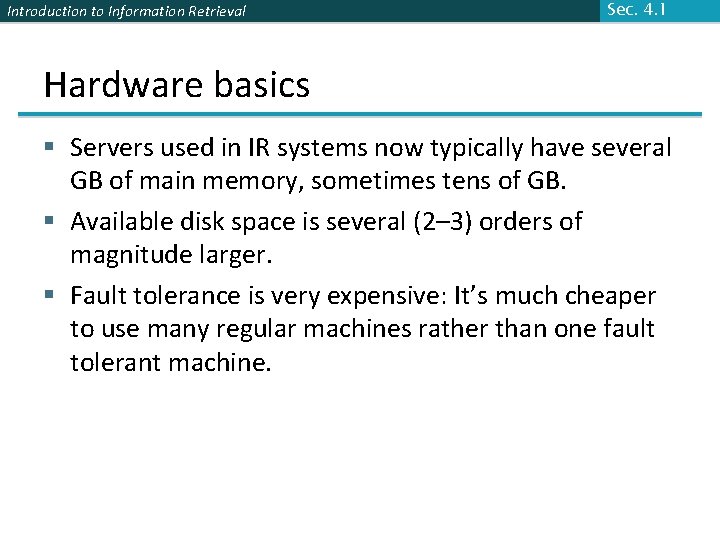
Introduction to Information Retrieval Sec. 4. 1 Hardware basics § Servers used in IR systems now typically have several GB of main memory, sometimes tens of GB. § Available disk space is several (2– 3) orders of magnitude larger. § Fault tolerance is very expensive: It’s much cheaper to use many regular machines rather than one fault tolerant machine.
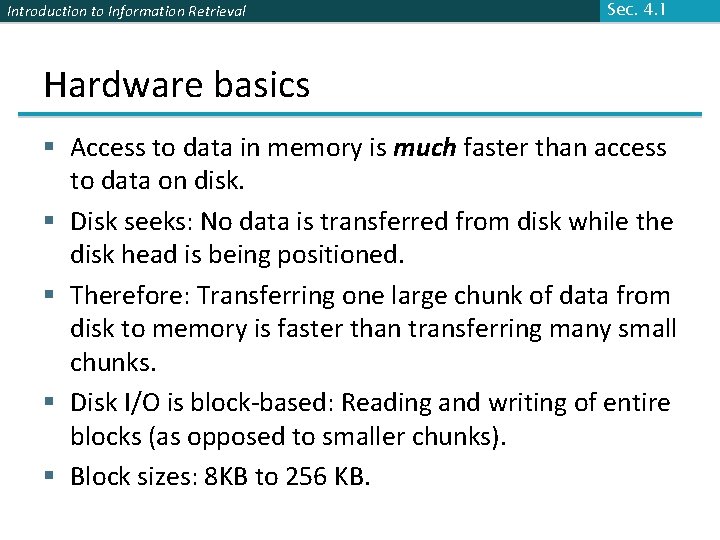
Introduction to Information Retrieval Sec. 4. 1 Hardware basics § Access to data in memory is much faster than access to data on disk. § Disk seeks: No data is transferred from disk while the disk head is being positioned. § Therefore: Transferring one large chunk of data from disk to memory is faster than transferring many small chunks. § Disk I/O is block-based: Reading and writing of entire blocks (as opposed to smaller chunks). § Block sizes: 8 KB to 256 KB.
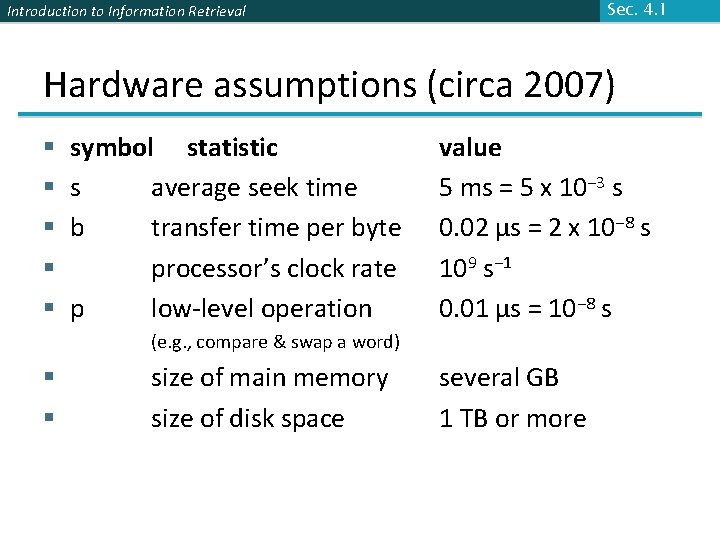
Sec. 4. 1 Introduction to Information Retrieval Hardware assumptions (circa 2007) § § § symbol statistic s average seek time b transfer time per byte processor’s clock rate p low-level operation value 5 ms = 5 x 10− 3 s 0. 02 μs = 2 x 10− 8 s 109 s− 1 0. 01 μs = 10− 8 s (e. g. , compare & swap a word) § § size of main memory size of disk space several GB 1 TB or more
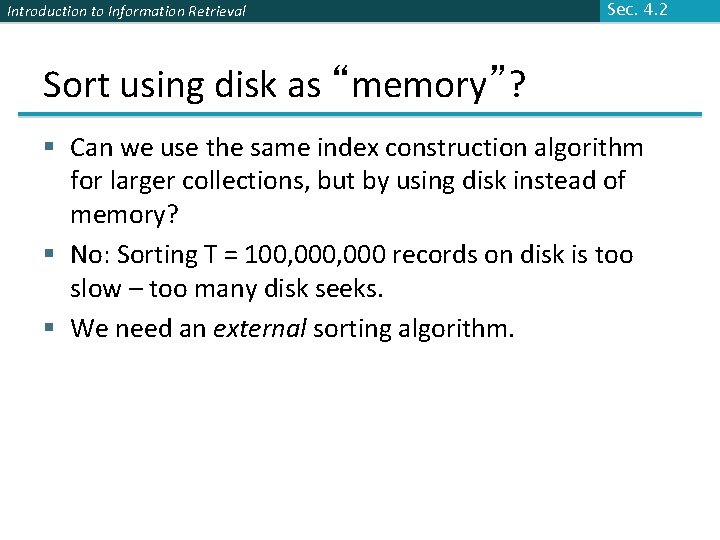
Introduction to Information Retrieval Sec. 4. 2 Sort using disk as “memory”? § Can we use the same index construction algorithm for larger collections, but by using disk instead of memory? § No: Sorting T = 100, 000 records on disk is too slow – too many disk seeks. § We need an external sorting algorithm.
Introduction to Information Retrieval CS 276: Information Retrieval and Web Search External memory indexing
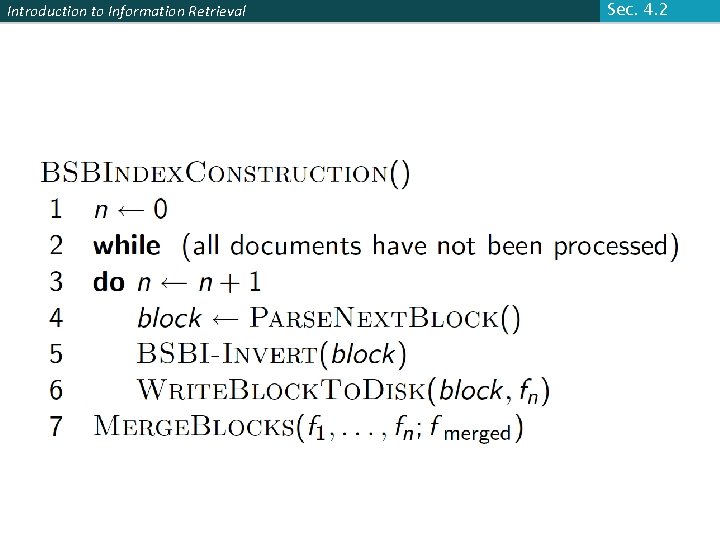
Introduction to Information Retrieval BSBI: Blocked sort-based Indexing (Sorting with fewer disk seeks) § § Sec. 4. 2 8 -byte records (term. ID, doc. ID) These are generated as we parse docs Must now sort 100 M such 8 -byte records by term. ID Define a Block ~ 10 M such records § Can easily fit a couple into memory § Will have 10 such blocks to start with § Basic idea of algorithm: § Accumulate postings for each block, sort, write to disk § Then merge the blocks into one long sorted order
Introduction to Information Retrieval Sec. 4. 2
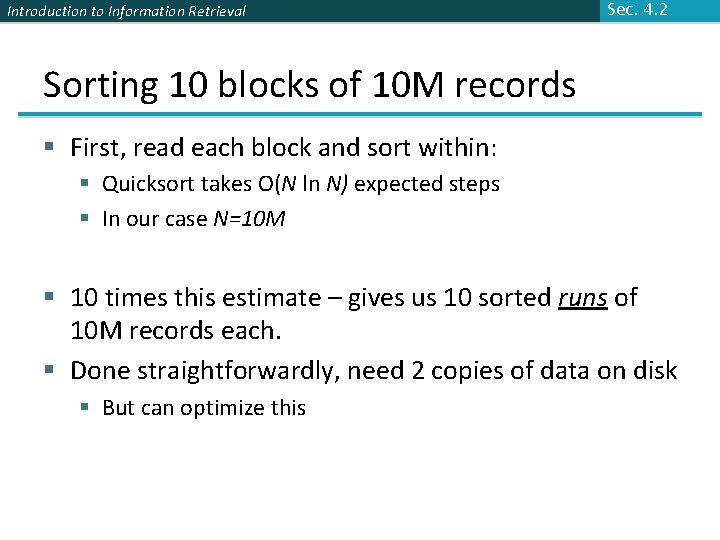
Introduction to Information Retrieval Sec. 4. 2 Sorting 10 blocks of 10 M records § First, read each block and sort within: § Quicksort takes O(N ln N) expected steps § In our case N=10 M § 10 times this estimate – gives us 10 sorted runs of 10 M records each. § Done straightforwardly, need 2 copies of data on disk § But can optimize this
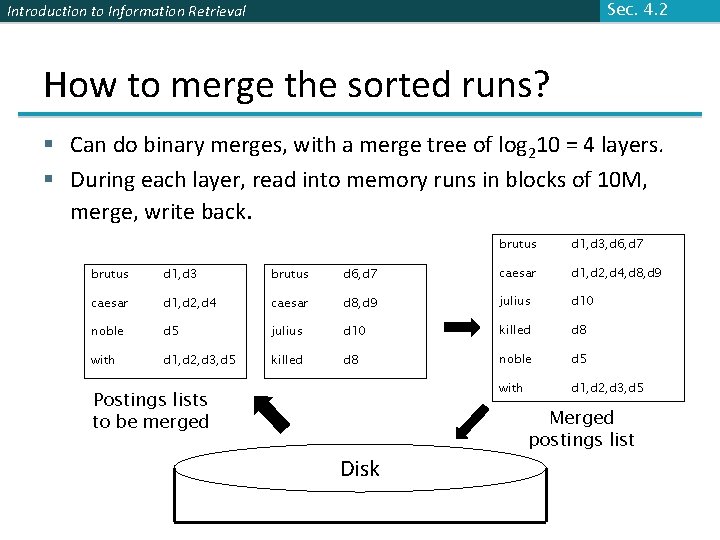
Sec. 4. 2 Introduction to Information Retrieval How to merge the sorted runs? § Can do binary merges, with a merge tree of log 210 = 4 layers. § During each layer, read into memory runs in blocks of 10 M, merge, write back. brutus d 1, d 3, d 6, d 7 brutus d 1, d 3 brutus d 6, d 7 caesar d 1, d 2, d 4, d 8, d 9 caesar d 1, d 2, d 4 caesar d 8, d 9 julius d 10 noble d 5 julius d 10 killed d 8 with d 1, d 2, d 3, d 5 killed d 8 noble d 5 with d 1, d 2, d 3, d 5 Postings lists to be merged Disk Merged postings list
Introduction to Information Retrieval Sec. 4. 2 How to merge the sorted runs? § But it is more efficient to do a multi-way merge, where you are reading from all blocks simultaneously § Open all block files simultaneously and maintain a read buffer for each one and a write buffer for the output file § In each iteration, pick the lowest term. ID that hasn’t been processed using a priority queue § Merge all postings lists for that term. ID and write it out § Providing you read decent-sized chunks of each block into memory and then write out a decent-sized output chunk, then you’re not killed by disk seeks
Introduction to Information Retrieval Sec. 4. 3 Remaining problem with sort-based algorithm § Our assumption was: we can keep the dictionary in memory. § We need the dictionary (which grows dynamically) in order to implement a term to term. ID mapping.
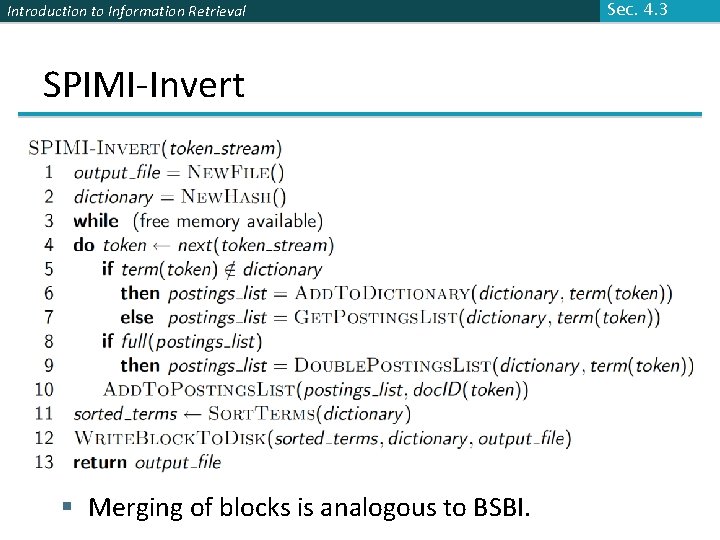
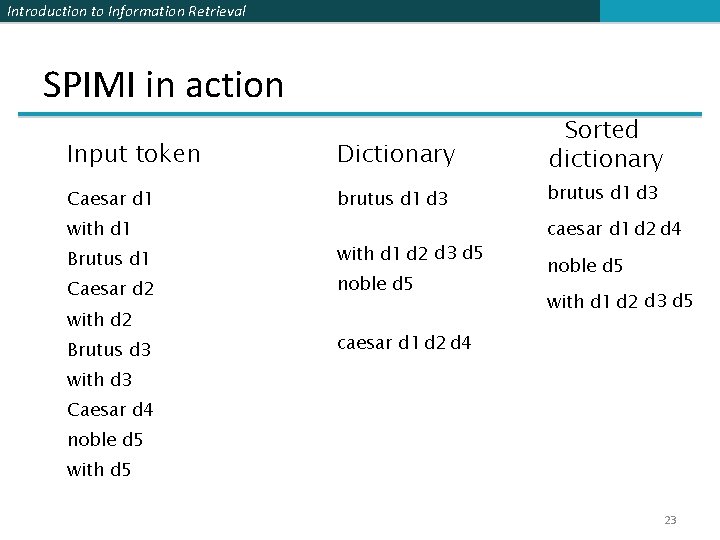
Introduction to Information Retrieval SPIMI: Single-pass in-memory indexing Sec. 4. 3 § Key idea 1: Generate separate dictionaries for each block – no need to maintain term-term. ID mapping across blocks. § Key idea 2: Don’t sort. Accumulate postings in postings lists as they occur. § With these two ideas we can generate a complete inverted index for each block. § These separate indexes can then be merged into one big index.
Introduction to Information Retrieval SPIMI-Invert § Merging of blocks is analogous to BSBI. Sec. 4. 3
Introduction to Information Retrieval SPIMI in action Input token Dictionary Sorted dictionary Caesar d 1 brutus d 1 d 3 with d 1 Brutus d 1 Caesar d 2 with d 2 Brutus d 3 with d 1 d 2 d 3 d 5 noble d 5 caesar d 1 d 2 d 4 noble d 5 with d 1 d 2 d 3 d 5 caesar d 1 d 2 d 4 with d 3 Caesar d 4 noble d 5 with d 5 23
Introduction to Information Retrieval Sec. 4. 3 SPIMI: Compression § Compression makes SPIMI even more efficient. § Compression of terms § Compression of postings § More on this later … Original publication on SPIMI: Heinz and Zobel (2003)
Introduction to Information Retrieval CS 276: Information Retrieval and Web Search Distributed indexing
Introduction to Information Retrieval Sec. 4. 4 Distributed indexing § For web-scale indexing (don’t try this at home!): must use a distributed computing cluster § Individual machines are fault-prone § Can unpredictably slow down or fail § How do we exploit such a pool of machines?
Introduction to Information Retrieval Web search engine data centers § Web search data centers (Google, Bing, Baidu) mainly contain commodity machines. § Data centers are distributed around the world. § Estimate: Google ~1 million servers, 3 million processors/cores (Gartner 2007) Sec. 4. 4
Introduction to Information Retrieval Sec. 4. 4 Massive data centers § If in a non-fault-tolerant system with 1000 nodes, each node has 99. 9% uptime, what is the uptime of the entire system? § Answer: 37% - meaning, 63% of the time one or more servers is down. § Exercise: Calculate the number of servers failing per minute for an installation of 1 million servers.
Introduction to Information Retrieval Sec. 4. 4 Distributed indexing § Maintain a master machine directing the indexing job – considered “safe”. § Break up indexing into sets of (parallel) tasks. § Master machine assigns each task to an idle machine from a pool.
Introduction to Information Retrieval Sec. 4. 4 Parallel tasks § We will use two sets of parallel tasks § Parsers § Inverters § Break the input document collection into splits § Each split is a subset of documents (corresponding to blocks in BSBI/SPIMI)
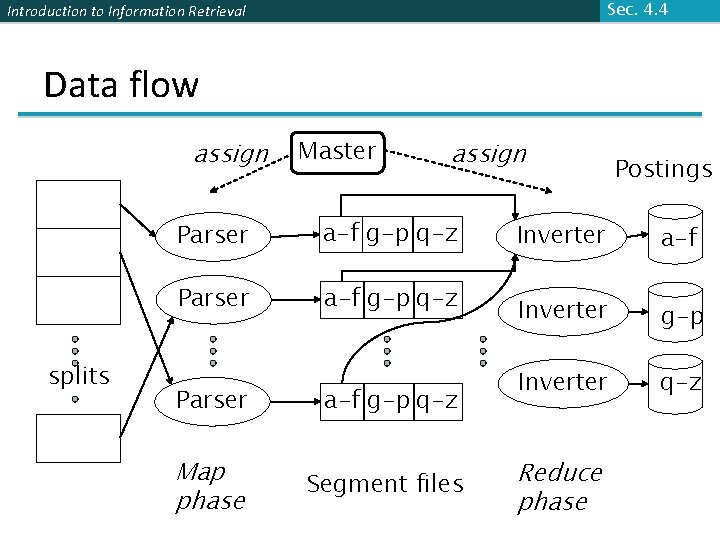
Sec. 4. 4 Introduction to Information Retrieval Data flow assign splits Master assign Parser a-f g-p q-z Map phase Segment files Postings Inverter a-f Inverter g-p Inverter q-z Reduce phase
Introduction to Information Retrieval Sec. 4. 4 Parsers § Master assigns a split to an idle parser machine § Parser reads a document at a time and emits (term, doc) pairs § Parser writes pairs into j partitions § Example: Each partition is for a range of terms’ first letters § (e. g. , a-f, g-p, q-z) – here j = 3. § Now to complete the index inversion
Introduction to Information Retrieval Sec. 4. 4 Inverters § An inverter collects all (term, doc) pairs (= postings) for one term-partition. § Sorts and writes to postings lists
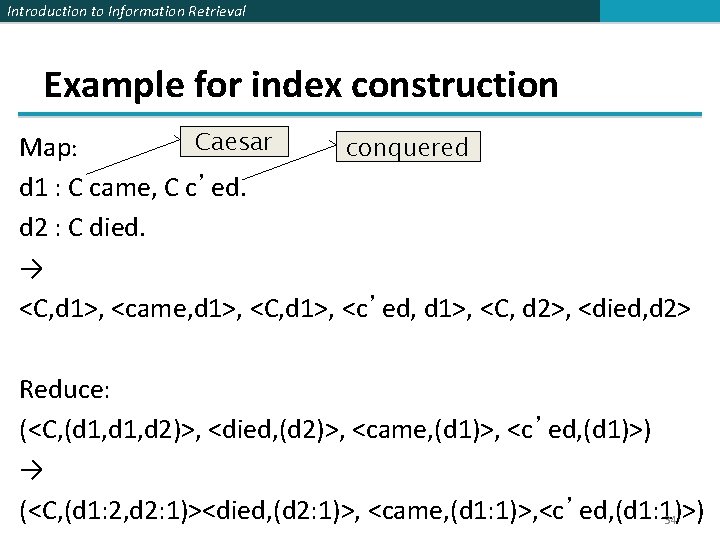
Introduction to Information Retrieval Example for index construction Caesar conquered Map: d 1 : C came, C c’ed. d 2 : C died. → <C, d 1>, <came, d 1>, <C, d 1>, <c’ed, d 1>, <C, d 2>, <died, d 2> Reduce: (<C, (d 1, d 2)>, <died, (d 2)>, <came, (d 1)>, <c’ed, (d 1)>) → (<C, (d 1: 2, d 2: 1)><died, (d 2: 1)>, <came, (d 1: 1)>, <c’ed, (d 1: 1)>) 34
Introduction to Information Retrieval Sec. 4. 4 Index construction § Index construction was just one phase. § Another phase: transforming a term-partitioned index into a document-partitioned index. § Term-partitioned: one machine handles a subrange of terms § Document-partitioned: one machine handles a subrange of documents § As we’ll discuss in the web part of the course, most search engines use a document-partitioned index … better load balancing, etc.
Introduction to Information Retrieval Sec. 4. 4 Map. Reduce § The index construction algorithm we just described is an instance of Map. Reduce. § Map. Reduce (Dean and Ghemawat 2004) is a robust and conceptually simple framework for distributed computing … § … without having to write code for the distribution part. § They describe the Google indexing system (ca. 2002) as consisting of a number of phases, each implemented in Map. Reduce.
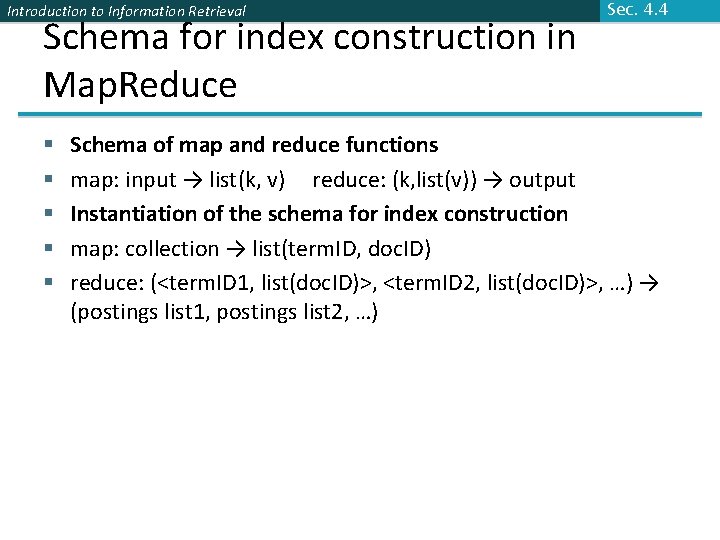
Introduction to Information Retrieval Schema for index construction in Map. Reduce § § § Sec. 4. 4 Schema of map and reduce functions map: input → list(k, v) reduce: (k, list(v)) → output Instantiation of the schema for index construction map: collection → list(term. ID, doc. ID) reduce: (<term. ID 1, list(doc. ID)>, <term. ID 2, list(doc. ID)>, …) → (postings list 1, postings list 2, …)
Introduction to Information Retrieval CS 276: Information Retrieval and Web Search Dynamic indexing
Introduction to Information Retrieval Sec. 4. 5 Dynamic indexing § Up to now, we have assumed that collections are static. § They rarely are: § Documents come in over time and need to be inserted. § Documents are deleted and modified. § This means that the dictionary and postings lists have to be modified: § Postings updates for terms already in dictionary § New terms added to dictionary
Introduction to Information Retrieval Sec. 4. 5 Simplest approach § § Maintain “big” main index New docs go into “small” auxiliary index Search across both, merge results Deletions § Invalidation bit-vector for deleted docs § Filter docs output on a search result by this invalidation bit -vector § Periodically, re-index into one main index
Introduction to Information Retrieval Sec. 4. 5 Issues with main and auxiliary indexes § Problem of frequent merges – you touch stuff a lot § Poor performance during merge § Actually: § Merging of the auxiliary index into the main index is efficient if we keep a separate file for each postings list. § Merge is the same as a simple append. § But then we would need a lot of files – inefficient for OS. § Assumption for the rest of the lecture: The index is one big file. § In reality: Use a scheme somewhere in between (e. g. , split very large postings lists, collect postings lists of length 1 in one file etc. )
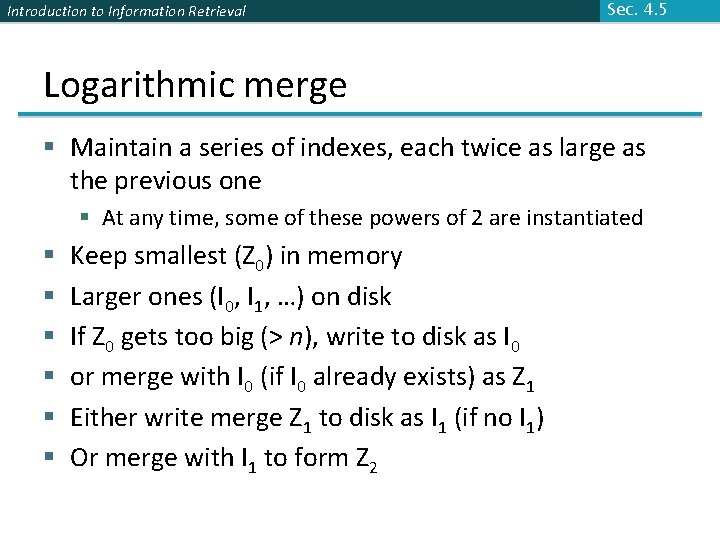
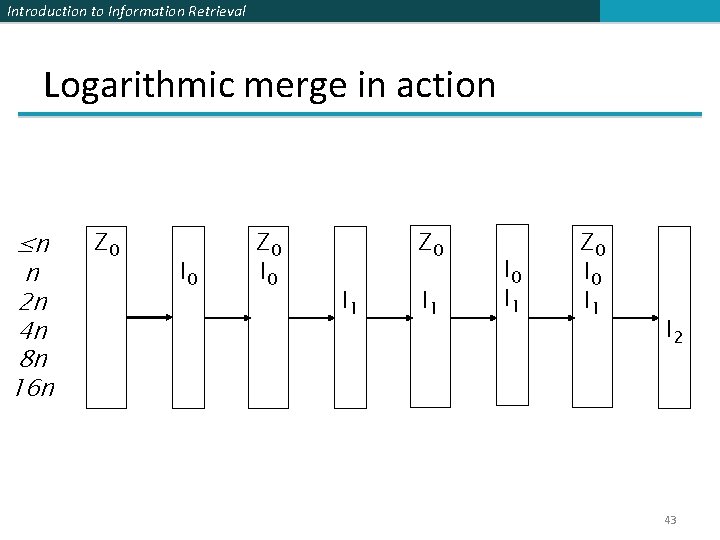
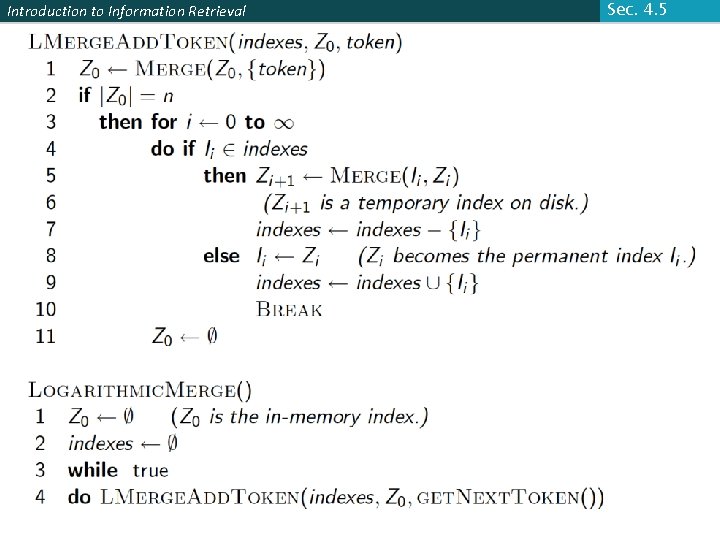
Introduction to Information Retrieval Sec. 4. 5 Logarithmic merge § Maintain a series of indexes, each twice as large as the previous one § At any time, some of these powers of 2 are instantiated § § § Keep smallest (Z 0) in memory Larger ones (I 0, I 1, …) on disk If Z 0 gets too big (> n), write to disk as I 0 or merge with I 0 (if I 0 already exists) as Z 1 Either write merge Z 1 to disk as I 1 (if no I 1) Or merge with I 1 to form Z 2
Introduction to Information Retrieval Logarithmic merge in action ≤n n 2 n 4 n 8 n 16 n Z 0 I 0 Z 0 I 1 I 0 I 1 Z 0 I 1 I 2 43
Introduction to Information Retrieval Sec. 4. 5
Introduction to Information Retrieval Sec. 4. 5 Logarithmic merge § Auxiliary and main index: § T/n merges where T is # of postings and n is size of auxiliary § Index construction time is O(T 2/n) as in the worst case a posting is touched T/n times § Logarithmic merge: Each posting is merged at most O(log (T/n)) times, so complexity is O(T log (T/n)) § So logarithmic merge is much more efficient for index construction § But query processing now requires the merging of O(log (T/n)) indexes § Whereas it is O(1) if you just have a main and auxiliary index
Introduction to Information Retrieval Sec. 4. 5 Further issues with multiple indexes § Collection-wide statistics are hard to maintain § E. g. , when we speak of spell-correction: which of several corrected alternatives do we present to the user? § We may want to pick the one with the most hits § How do we maintain the top ones with multiple indexes and invalidation bit vectors? § One possibility: ignore everything but the main index for such ordering § Will see more such statistics used in results ranking
Introduction to Information Retrieval Sec. 4. 5 Dynamic indexing at search engines § All the large search engines now do dynamic indexing § Their indices have frequent incremental changes § News items, blogs, new topical web pages § But (sometimes/typically) they also periodically reconstruct the index from scratch § Query processing is then switched to the new index, and the old index is deleted
Introduction to Information Retrieval Earlybird: Real-time search at Twitter § Requirements for real-time search § § Low latency, high throughput query evaluation High ingestion rate and immediate data availability Concurrent reads and writes of the index Dominance of temporal signal 48
Introduction to Information Retrieval Earlybird: Index organization § Earlybird consists of multiple index segments § Each segment is relatively small, holding up to 223 tweets § Each posting in a segment is a 32 bit word: 24 bits for the tweet id and 8 bits for the position in the tweet § Only one segment can be written to at any given time § Small enough to be in memory § New postings are simply appended to the postings list § But the postings list is traversed backwards to prioritize newer tweets § The remaining segments are optimized for read-only § Postings sorted in reverse chronological order (newest first) 49
Introduction to Information Retrieval Sec. 4. 5 Other sorts of indexes § Positional indexes § Same sort of sorting problem … just larger Why? § Building character n-gram indexes: § As text is parsed, enumerate n-grams. § For each n-gram, need pointers to all dictionary terms containing it – the “postings”
Introduction to Information Retrieval Ch. 4 Resources for today’s lecture § Chapter 4 of IIR § MG Chapter 5 § Original publication on Map. Reduce: Dean and Ghemawat (2004) § Original publication on SPIMI: Heinz and Zobel (2003) § Earlybird: Busch et al, ICDE 2012