
INTRODUCTION TO INFORMAL SETTLEMENT UPGRADING MODULE 9 BUILDING
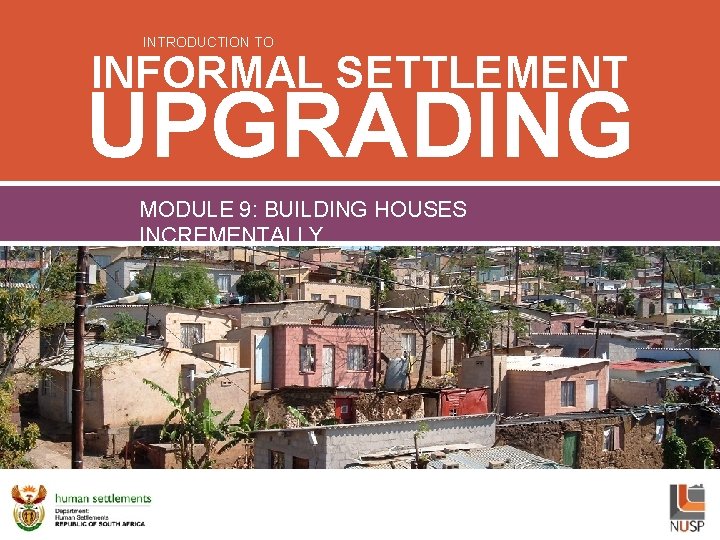
INTRODUCTION TO INFORMAL SETTLEMENT UPGRADING MODULE 9: BUILDING HOUSES INCREMENTALLY
INTRODUCTION TO INFORMAL SETTLEMENT UPGRADING BUILDING HOUSES INCREMENTALLY Module purpose This module will provide you with an understanding of the incremental approach to housing consolidation (i. e. providing better houses for people to live in), and explain what municipalities can do to support people to upgrade their houses, so that this approach can be built into plans to develop sustainable human settlements. The overall purpose is to enable you to encourage and support incremental housing processes in order to help households build better homes. 12
INTRODUCTION TO INFORMAL SETTLEMENT UPGRADING BUILDING HOUSES INCREMENTALLY Learning Outcomes After completing this module you should be able to: • Recognise incremental approaches to housing as viable options for housing transformation; • Recognise that there are different forms of incremental upgrading processes, with a focus on the potential of self-build processes; • Describe a range of ways in which municipalities can provide support for housing improvements; • Support people-centred approaches with regard to housing provision and improvement; • Identify the various support systems and service providers in housing provision and improvement. 12
INTRODUCTION TO INFORMAL SETTLEMENT UPGRADING BUILDING HOUSES INCREMENTALLY 12 Module content 1. Incremental housing 2. What factors affect a household’s ability to consolidate their house? 3. Supporting housing consolidation
INTRODUCTION TO INFORMAL SETTLEMENT UPGRADING BUILDING HOUSES INCREMENTALLY 1. Incremental housing What is incremental housing? • Incremental housing is a step-by-step process of building and upgrading a house. • It is a process whereby households build and extend their houses on an ad hoc basis in response to their needs and the availability of resources. → The essential element of incremental housing is that it enables households to respond to their own priorities and needs, and to have a greater level of authority over their own housing solutions. 12

INTRODUCTION TO INFORMAL SETTLEMENT UPGRADING BUILDING HOUSES INCREMENTALLY 12 People are doing it for themselves • South Africa’s national programme for helping poor households to access housing is based on the premise that the government must build a house for each household. • However in South Africa, and all over the world, poor people are building their own houses. • As shown in the 2011 Census there were 1. 25 million households in informal settlements and a further 700 000 in backyards. • While these structures are informal, they provide shelter and represent a significant personal investment. → Generally, when people start to improve their dwellings they manage the improvements themselves, and they do the upgrades incrementally.
INTRODUCTION TO INFORMAL SETTLEMENT UPGRADING BUILDING HOUSES INCREMENTALLY 12 Activity 9. 1: People are doing it for themselves • Type of activity: Group work • Timing: 30 minutes • Purpose of the activity: To recognise people’s creativity and the ways in which people house themselves and incrementally improve their own housing. • Instructions: The facilitator will give you an album of photographs of houses that people have built for themselves in informal settlements. – What does each picture say to you? – Write a few comments on each picture in the Participants Manual
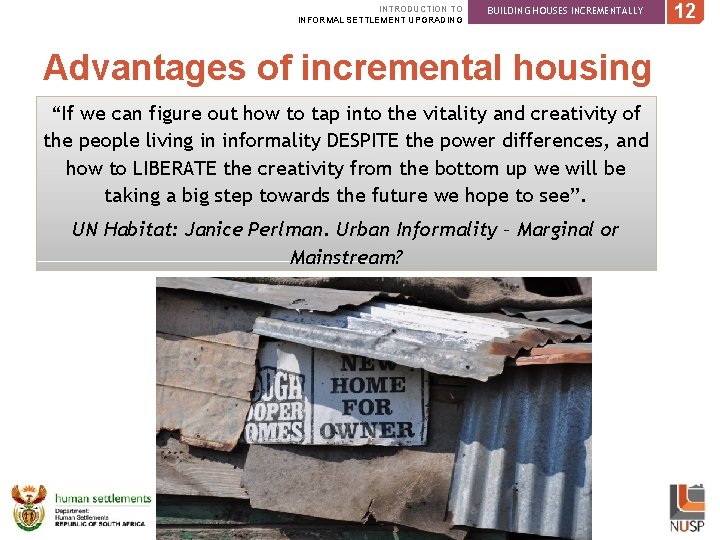
INTRODUCTION TO INFORMAL SETTLEMENT UPGRADING BUILDING HOUSES INCREMENTALLY Advantages of incremental housing “If we can figure out how to tap into the vitality and creativity of the people living in informality DESPITE the power differences, and how to LIBERATE the creativity from the bottom up we will be taking a big step towards the future we hope to see”. UN Habitat: Janice Perlman. Urban Informality – Marginal or Mainstream? 12
INTRODUCTION TO INFORMAL SETTLEMENT UPGRADING BUILDING HOUSES INCREMENTALLY 12 Advantages of incremental housing cont. • It enables households to invest constantly in improving their living conditions, as and when they are able to afford it. • Households are improving their housing circumstances rather than waiting in poor conditions until a house is delivered by government. • It enables government to use its funds to improve services and social and community facilities • It is needs-oriented, being specific to the site and user. • The house can be designed for flexibility. • No mortgage or formal credit is usually involved or required. • Having a regular wage income is not a requirement to build a house incrementally.
INTRODUCTION TO INFORMAL SETTLEMENT UPGRADING BUILDING HOUSES INCREMENTALLY 12 Activity 9. 2: The case for incremental housing • • Type of activity: Pair work Timing: 5 minutes Purpose: To reinforce the case for incremental housing. Instructions: List as many reasons as you can why incremental housing and self-build options for informal settlements must be encouraged.
INTRODUCTION TO INFORMAL SETTLEMENT UPGRADING BUILDING HOUSES INCREMENTALLY 12 Will incremental housing become more significant? • • • There is increasing recognition of the growing pressure on the funds available for human settlement. As a result there is now increasing emphasis on informal settlement upgrading, and the need to develop mechanisms and approaches for the building or consolidation of houses within informal settlement upgrading projects. Incremental housing approaches are further supported by the National Development Plan which indicates the following: Large amounts of money have been spent on the housing sector, but major problems remain. The system of state-provided housing has benefited many poor households, but may have undermined the incentive for people to upgrade their own housing circumstances and may have increased a dependency on the state for the supply of private goods. A national discussion is required on the future funding of housing in South Africa, and on the respective roles of the state, the private sector and individual households in providing housing and creating integrated and sustainable human settlements. (NDP p 270)
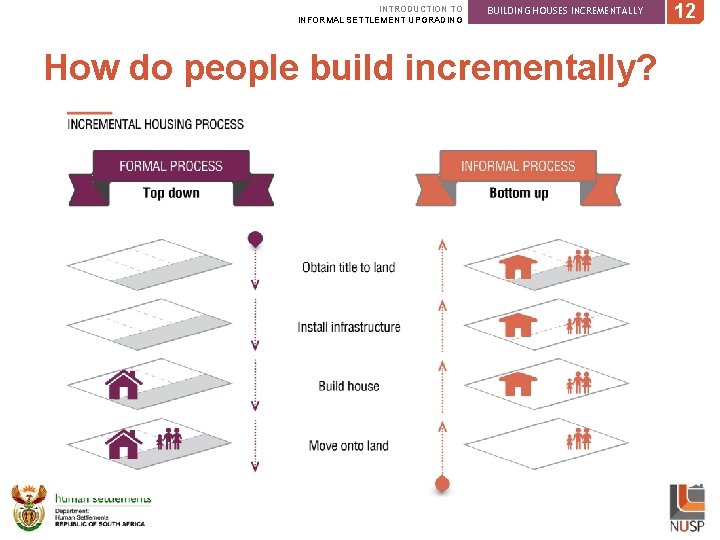
INTRODUCTION TO INFORMAL SETTLEMENT UPGRADING BUILDING HOUSES INCREMENTALLY How do people build incrementally? 12
INTRODUCTION TO INFORMAL SETTLEMENT UPGRADING BUILDING HOUSES INCREMENTALLY 12 Ways in which households build incrementally • Self-build: The households build the house themselves, often with the help of family members in a process called sweat equity • Local contractors: The household accumulates materials and contracts a local builder, generally on a labour only basis, in stages, as resources allow. • Community build: This is a process where the community as a group access materials and build the houses. This is called the People’s Housing Process and enables access to a certain level of government subsidy.
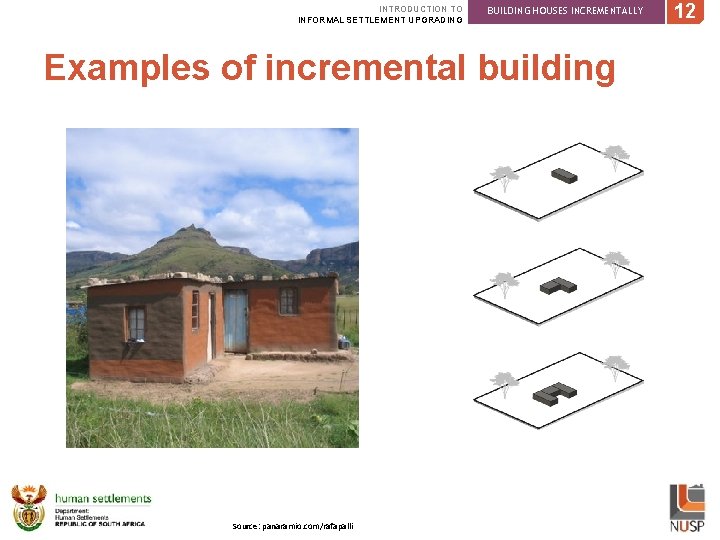
INTRODUCTION TO INFORMAL SETTLEMENT UPGRADING BUILDING HOUSES INCREMENTALLY Examples of incremental building Source: panaramio. com/rafapalli 12
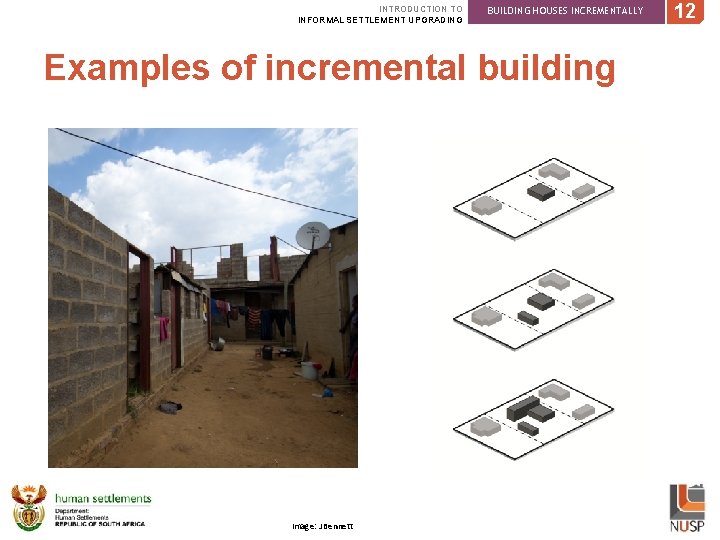
INTRODUCTION TO INFORMAL SETTLEMENT UPGRADING BUILDING HOUSES INCREMENTALLY Examples of incremental building Image: J Bennett 12

INTRODUCTION TO INFORMAL SETTLEMENT UPGRADING BUILDING HOUSES INCREMENTALLY Examples of incremental building Image: C Morgado 12
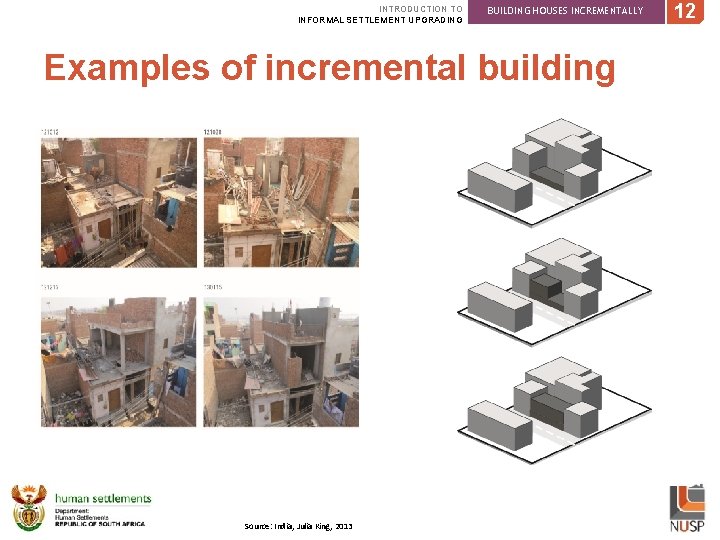
INTRODUCTION TO INFORMAL SETTLEMENT UPGRADING BUILDING HOUSES INCREMENTALLY Examples of incremental building Source: India, Julia King, 2013 12
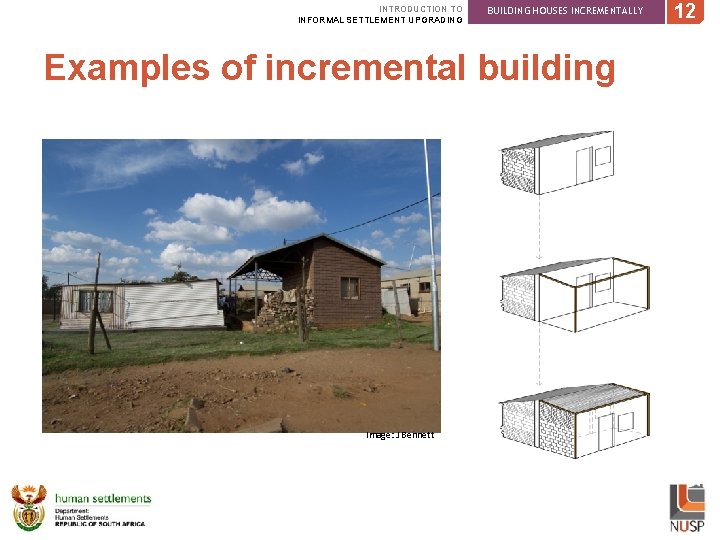
INTRODUCTION TO INFORMAL SETTLEMENT UPGRADING BUILDING HOUSES INCREMENTALLY Examples of incremental building Image: J Bennett 12
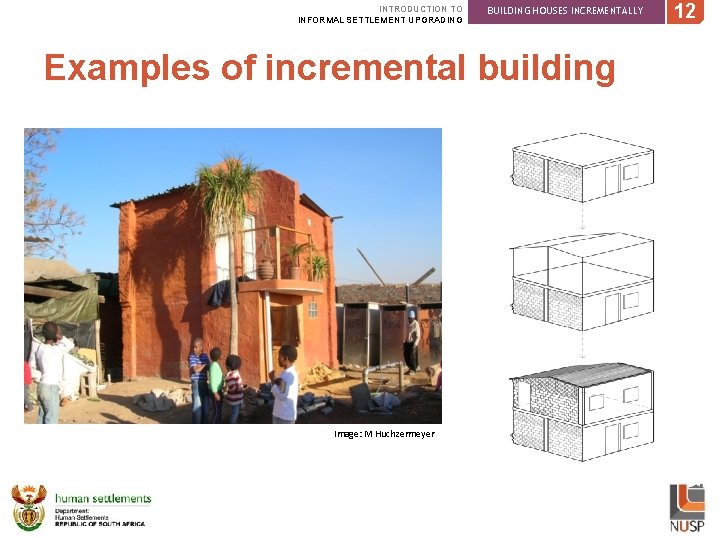
INTRODUCTION TO INFORMAL SETTLEMENT UPGRADING BUILDING HOUSES INCREMENTALLY Examples of incremental building Image: M Huchzermeyer 12

INTRODUCTION TO INFORMAL SETTLEMENT UPGRADING BUILDING HOUSES INCREMENTALLY Examples of incremental building Image: J Bennett 12

INTRODUCTION TO INFORMAL SETTLEMENT UPGRADING BUILDING HOUSES INCREMENTALLY Examples of incremental building Image: L Krige 12
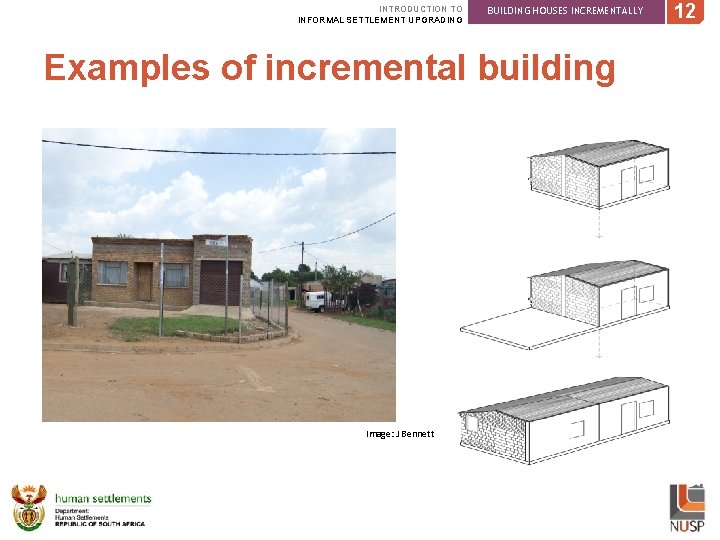
INTRODUCTION TO INFORMAL SETTLEMENT UPGRADING BUILDING HOUSES INCREMENTALLY Examples of incremental building Image: J Bennett 12
INTRODUCTION TO INFORMAL SETTLEMENT UPGRADING BUILDING HOUSES INCREMENTALLY 2. What factors affect a household’s ability to consolidate their house? Activity 9. 3: Factors that affect incremental upgrading • Type of Activity: Pair work • Timing: 5 minutes • Purpose: To think about factors that affect a household’s ability to upgrade their house. • Instructions: In your pairs, discuss the following question: – What will affect people regarding investing in their houses and incrementally improving them? 12
INTRODUCTION TO INFORMAL SETTLEMENT UPGRADING BUILDING HOUSES INCREMENTALLY Factors that encourage self-build • The extent to which the household needs a house as opposed to temporary shelter. • Tenure security • Knowledge of housing processes • The extent to which the households thinks there is the potential of securing alternative housing, particularly a fully subsidised house. • The extent to which town planning and building regulations and constraints can be overcome or simplified. • The extent to which there is government investment in the area 12
INTRODUCTION TO INFORMAL SETTLEMENT UPGRADING BUILDING HOUSES INCREMENTALLY Affordability of housing improvements Affordability can be facilitated by the following: • Availability of a subsidy • Savings • Disposable income • Credit availability • Household and community contributions 12
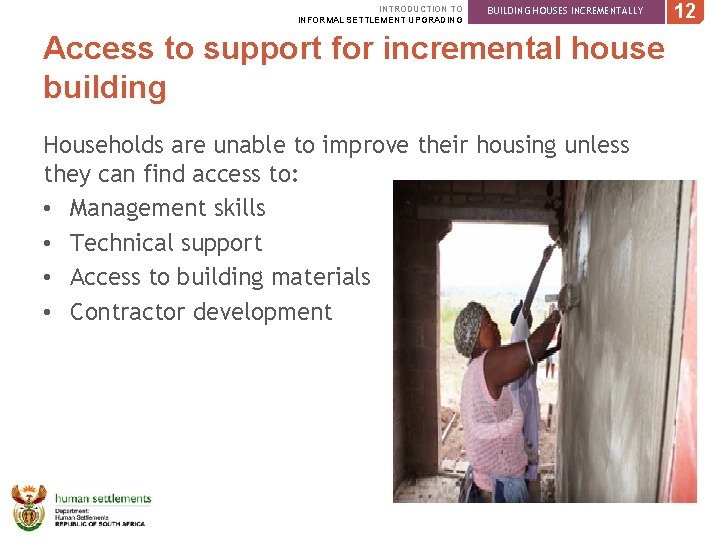
INTRODUCTION TO INFORMAL SETTLEMENT UPGRADING BUILDING HOUSES INCREMENTALLY Access to support for incremental house building Households are unable to improve their housing unless they can find access to: • Management skills • Technical support • Access to building materials • Contractor development 12
INTRODUCTION TO INFORMAL SETTLEMENT UPGRADING BUILDING HOUSES INCREMENTALLY 12 Actors (and roles) in incremental home building The following people or groups play important roles in the process of building houses incrementally • Households • Government • Community Organisations • Non-profit/ Community Resource Organisations • Private Sector
INTRODUCTION TO INFORMAL SETTLEMENT UPGRADING BUILDING HOUSES INCREMENTALLY 12 Activity 9. 4: The risks of incremental housing • Type of Activity: Individual • Timing: 5 minutes • Purpose: To identify the disadvantages or risks of selfbuild incremental housing. • Instructions: Write down in the Participants Manual all the disadvantages or risks of self-build incremental housing and self-build that you can think of.

INTRODUCTION TO INFORMAL SETTLEMENT UPGRADING BUILDING HOUSES INCREMENTALLY Challenges in incremental housing building 12 • Orientation: The house is not oriented on the site to maximise sunlight and allow future expansion • Fire safety: The house is built with flammable materials or too close to other structures • Floor to ceiling heights: These are too low which negatively affects comfort and ventilation • Ventilation: Windows and doors are not located so as to ensure proper ventilation of the dwelling • Durability: The house is built with materials that do not last → One of the roles of the municipality is to support households to avoid these disadvantages and overcome the factors that limit households from upgrading their homes.
INTRODUCTION TO INFORMAL SETTLEMENT UPGRADING BUILDING HOUSES INCREMENTALLY 3. Supporting housing consolidation Options for the municipality Provide enabling urban planning and management • Land tenure security: • Town planning layouts and house design • The type of design • Municipal assistance • Building regulations 12
INTRODUCTION TO INFORMAL SETTLEMENT UPGRADING BUILDING HOUSES INCREMENTALLY How Municipalities can support incremental self-build Provide enabling urban planning and management • Encourage household investment in housing • Facilitate access to finance • Provide technical support • Facilitate access to building materials. 12
INTRODUCTION TO INFORMAL SETTLEMENT UPGRADING BUILDING HOUSES INCREMENTALLY How Municipalities can support incremental self-build Encourage household investment in housing • Political and community support • Protecting prior investment in housing • Knowledge and capacity development • Arranged homebuilding programmes • Income generation 12
INTRODUCTION TO INFORMAL SETTLEMENT UPGRADING BUILDING HOUSES INCREMENTALLY How Municipalities can support incremental self-build Facilitate access to finance • Borrowing from family; • Revolving credit stokvel finance; • Materials supplier credit, which is credit provided on building materials purchases; • Informal money lenders; • Small loans/credit; • Employer loans. Facilitate connections between the households and reputable financial institutions 12
INTRODUCTION TO INFORMAL SETTLEMENT UPGRADING BUILDING HOUSES INCREMENTALLY How Municipalities can support incremental self-build Provide household technical support • Information-sharing regarding building norms and standards and approval processes. • Potential innovative building options to assist consolidation such as shared walls. • Advice on house placement on sites. • Determining boundaries and dispute resolution support. • House design and costing • Household construction management support 12
INTRODUCTION TO INFORMAL SETTLEMENT UPGRADING BUILDING HOUSES INCREMENTALLY How Municipalities can support incremental self-build Local construction sector capacity development • Training and development of local house building capacity • Materials manufacture/assembly and supply 12

INTRODUCTION TO INFORMAL SETTLEMENT UPGRADING BUILDING HOUSES INCREMENTALLY 12 Dealing with building regulations Currently there are no appropriate regulations in place to effectively enable incremental housing processes. Municipalities need to find innovative approaches that can overcome this obstacle. Some of these approaches include: • Innovative zoning approaches • Primary building rights • Town planning, building standards and controls • Structured programme approaches
INTRODUCTION TO INFORMAL SETTLEMENT UPGRADING BUILDING HOUSES INCREMENTALLY The Enhanced People’s Housing Process (EPHP) • EPHP can only be applied when there approved community resource organisations (CROs). • The EPHP is made up of four different forms of funding: – – Capital funding Capacity building fund Community contributions/equity Bridging finance • The EPHP promotes the use of housing support centres as part of providing household technical support. 12
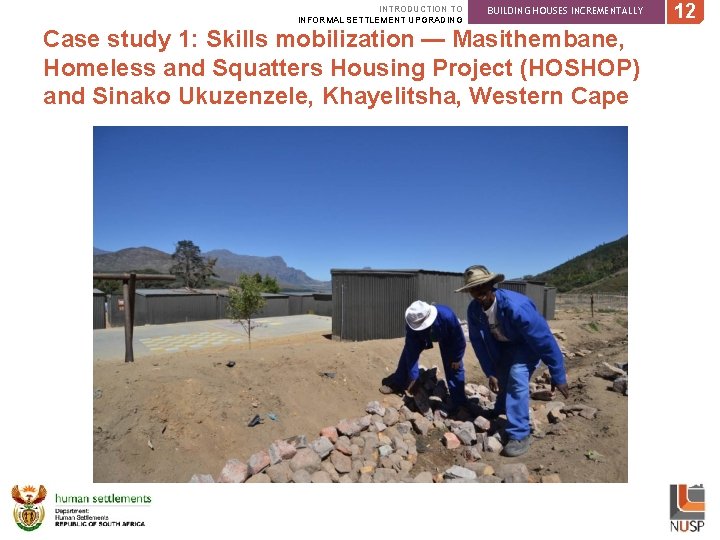
INTRODUCTION TO INFORMAL SETTLEMENT UPGRADING BUILDING HOUSES INCREMENTALLY Case study 1: Skills mobilization — Masithembane, Homeless and Squatters Housing Project (HOSHOP) and Sinako Ukuzenzele, Khayelitsha, Western Cape 12
INTRODUCTION TO INFORMAL SETTLEMENT UPGRADING BUILDING HOUSES INCREMENTALLY Activity 9. 6: What did you gain? • Type of activity: Group work • Timing: 15 minutes • Purpose: To stimulate thinking and action to support housing consolidation. • Instructions: In your groups, draw up a list of possible actions you can take to support people in the informal settlements you know to upgrade their houses. 12
- Slides: 39