
INTRODUCTION TO INFECTION CONTROL ICNO Infection Control Unit
![STANDARD PRECAUTION 1. Hand hygiene 2. Use personal protective equipment [PPE] 3. Proper cleaning](https://slidetodoc.com/presentation_image_h2/55b574752a3a50ad022c184989686b2b/image-12.jpg "STANDARD PRECAUTION 1. Hand hygiene 2. Use personal protective equipment [PPE] 3. Proper cleaning")
- Slides: 14
INTRODUCTION TO INFECTION CONTROL ICNO Infection Control Unit, Teaching Hospital, Jaffna.
What is infection control? Infection control is a series of procedures and guidelines to prevent hospital associated infection. [H. A. I]
Hospital acquired infections § Acquired by patients during their stay in the hospital § Neither present nor incubating at the time the patient was admitted to the health care facility and may appear even after the patient is discharged § Symptoms appear usually 48 -72 hours after admission
Sources of infections § Endogenous – due to organisms in own flora. Eg: group B streptococcal infections § Exogenous – infections acquired from outside. (Cross infections/HAI) -Infected or colonized patients/staff -Contaminated equipment/ medication -Environment – surfaces, air, food, water 4
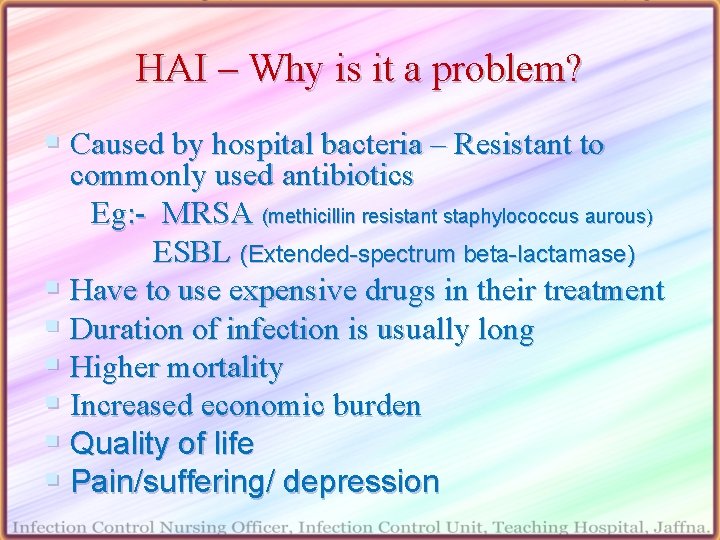
HAI – Why is it a problem? § Caused by hospital bacteria – Resistant to commonly used antibiotics Eg: - MRSA (methicillin resistant staphylococcus aurous) ESBL (Extended-spectrum beta-lactamase) § Have to use expensive drugs in their treatment § Duration of infection is usually long § Higher mortality § Increased economic burden § Quality of life § Pain/suffering/ depression
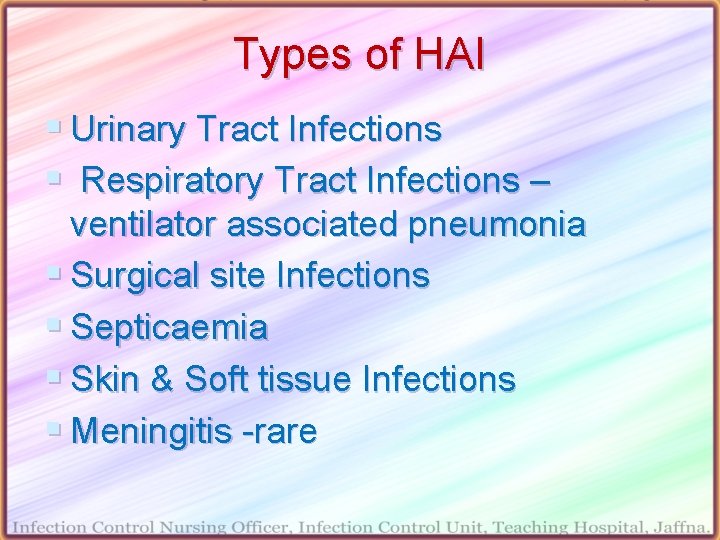
Types of HAI § Urinary Tract Infections § Respiratory Tract Infections – ventilator associated pneumonia § Surgical site Infections § Septicaemia § Skin & Soft tissue Infections § Meningitis -rare
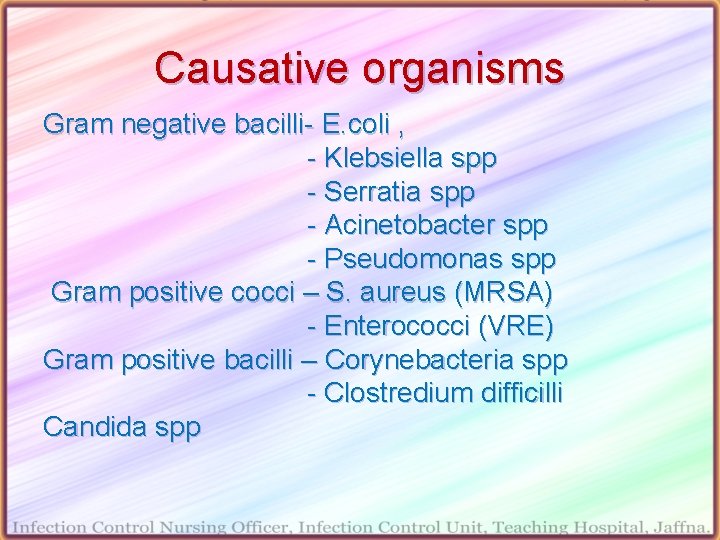
Causative organisms Gram negative bacilli- E. coli , - Klebsiella spp - Serratia spp - Acinetobacter spp - Pseudomonas spp Gram positive cocci – S. aureus (MRSA) - Enterococci (VRE) Gram positive bacilli – Corynebacteria spp - Clostredium difficilli Candida spp
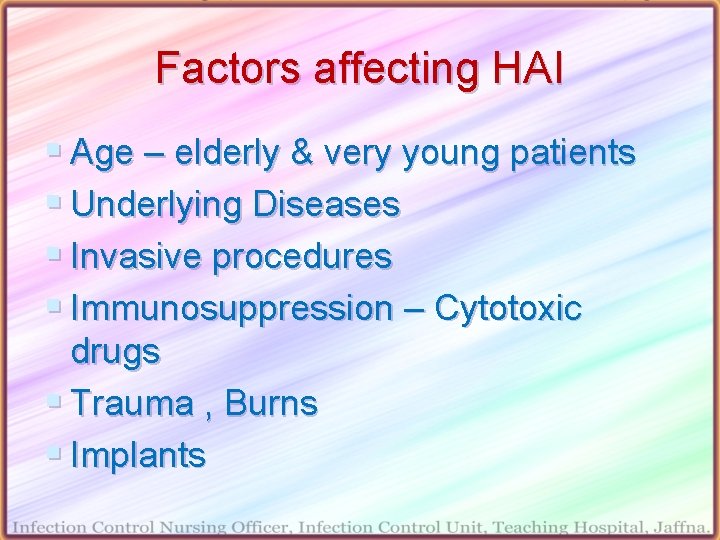
Factors affecting HAI § Age – elderly & very young patients § Underlying Diseases § Invasive procedures § Immunosuppression – Cytotoxic drugs § Trauma , Burns § Implants
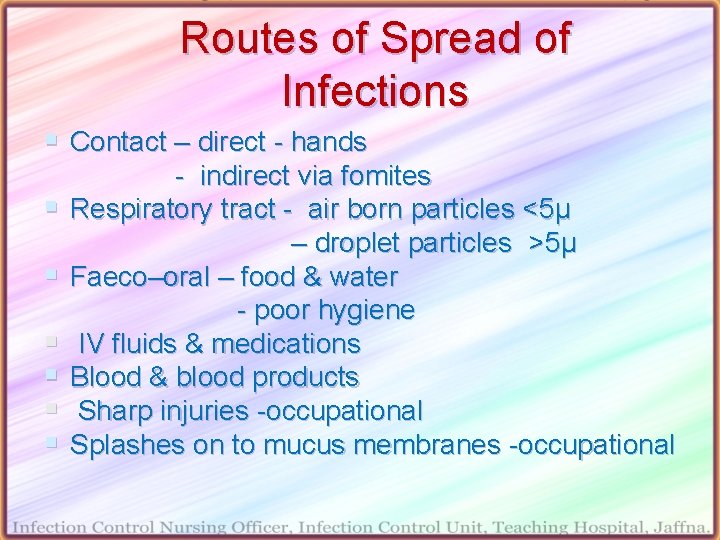
Routes of Spread of Infections § Contact – direct - hands § § § - indirect via fomites Respiratory tract - air born particles <5µ – droplet particles > 5µ Faeco–oral – food & water - poor hygiene IV fluids & medications Blood & blood products Sharp injuries -occupational Splashes on to mucus membranes -occupational
How are these infections transmitted? H. A. I may be transmitted by health care workers to patients, from patient to patient and from patient to health care workers.
Prevention of Hospital Infections Many of these infection can be controlled following a set of very simple practical guidelines called stranded precaution. § Elimination of source of infection § Interruption of transmission § Enhancing the host ability to resist infection
STANDARD PRECAUTION 1. Hand hygiene 2. Use personal protective equipment [PPE] 3. Proper cleaning disinfection and sterilization of patient care equipment. 4. Environmental cleaning and disinfection when necessary. 5. Proper handling of linen. 6. Proper waste disposal. 7. Proper handing and disposal of sharps. 8. Occupational Health
SPECIFIC MEASURES • • • Facilities for hand washing and drying Adequate space Ventilation Isolation facilities Health care workers with out infection. Infection surveillance Antibiotic policy Liaison with infection control team Health education of staff, patients and visitors
THANK YOU ICNO Infection Control Unit, Teaching Hospital, Jaffna.