
Introduction to Infant and Early Childhood Mental Health

- Slides: 49
Introduction to Infant and Early Childhood Mental Health Division of Child and Family Services Early Childhood Mental Health Services 1
Training Goals At the end of this training, you will be able to: 1. Define infant mental health 2. Recognize mental health issues of young children 3. Know how infant mental health issues are assessed and treated 4. Understand how to access services in your community to address mental health and developmental needs of young children 2
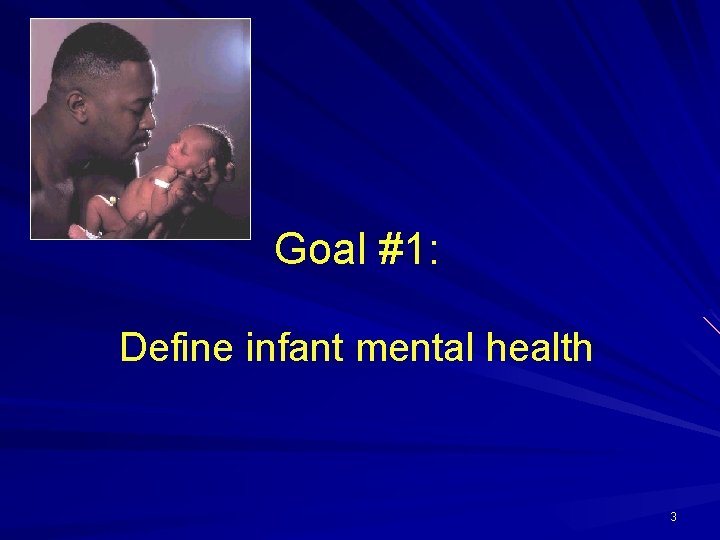
Goal #1: Define infant mental health 3
Definition of Infant Mental Health Infancy is technically the period “without language”, which is the first year of life Infant mental health covers a broader age range, and there is no universal definition In Nevada, Early Childhood Mental Health Services serves children birth – seven years and their families 4
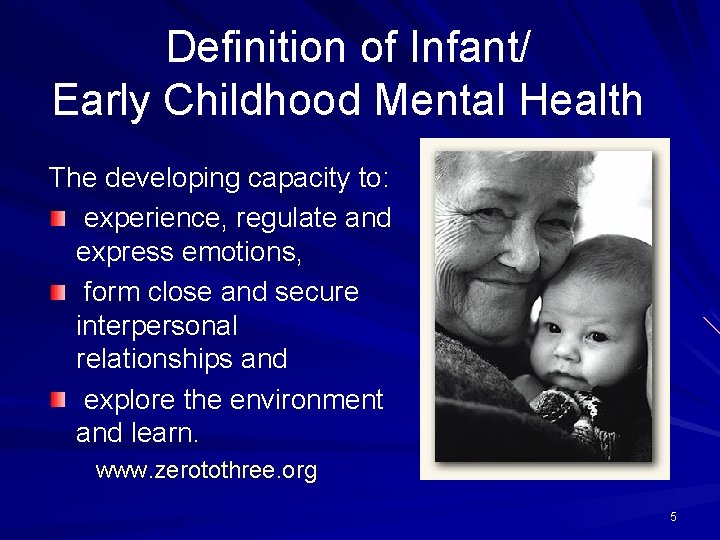
Definition of Infant/ Early Childhood Mental Health The developing capacity to: experience, regulate and express emotions, form close and secure interpersonal relationships and explore the environment and learn. www. zerotothree. org 5
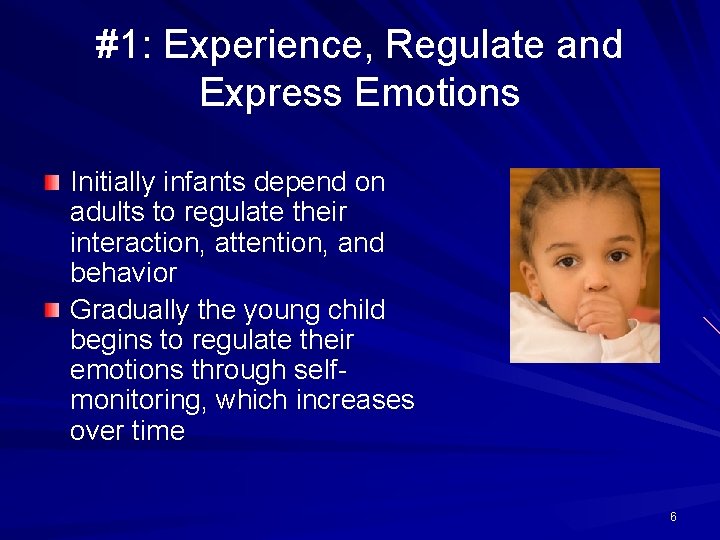
#1: Experience, Regulate and Express Emotions Initially infants depend on adults to regulate their interaction, attention, and behavior Gradually the young child begins to regulate their emotions through selfmonitoring, which increases over time 6
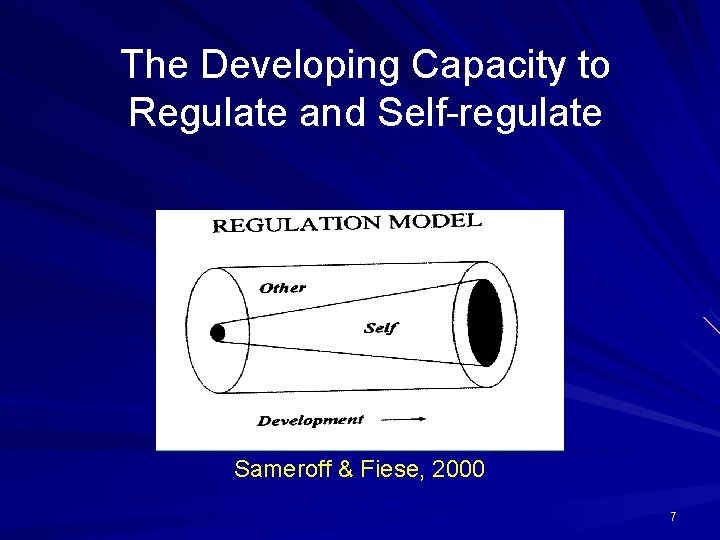
The Developing Capacity to Regulate and Self-regulate Sameroff & Fiese, 2000 7
Basics of State Regulation in Infancy Infant Behavioral States Cry Fuss Alert Waking Activity Drowsy Active Sleep Quiet Sleep 8
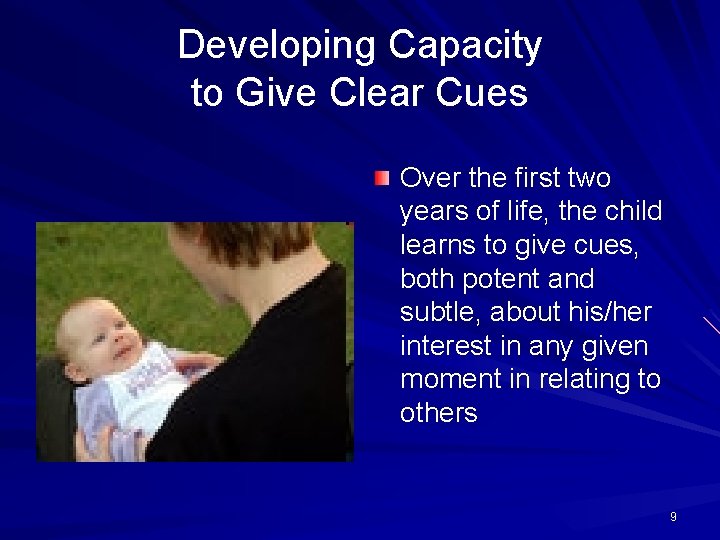
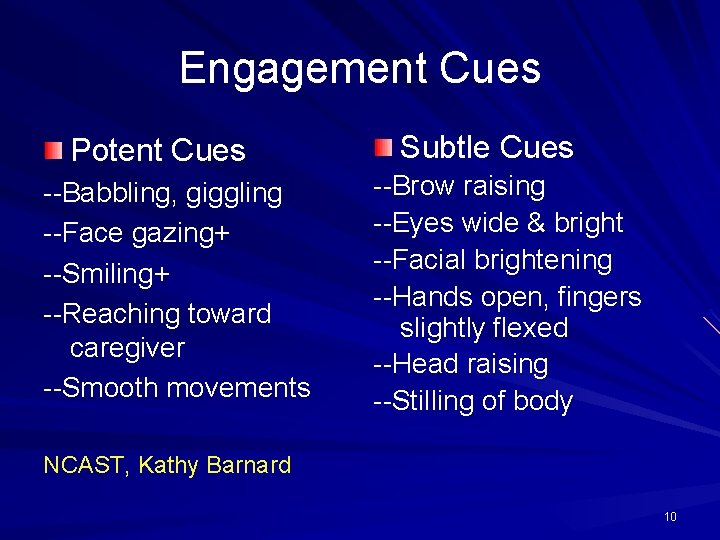
Developing Capacity to Give Clear Cues Over the first two years of life, the child learns to give cues, both potent and subtle, about his/her interest in any given moment in relating to others 9
Engagement Cues Potent Cues --Babbling, giggling --Face gazing+ --Smiling+ --Reaching toward caregiver --Smooth movements Subtle Cues --Brow raising --Eyes wide & bright --Facial brightening --Hands open, fingers slightly flexed --Head raising --Stilling of body NCAST, Kathy Barnard 10
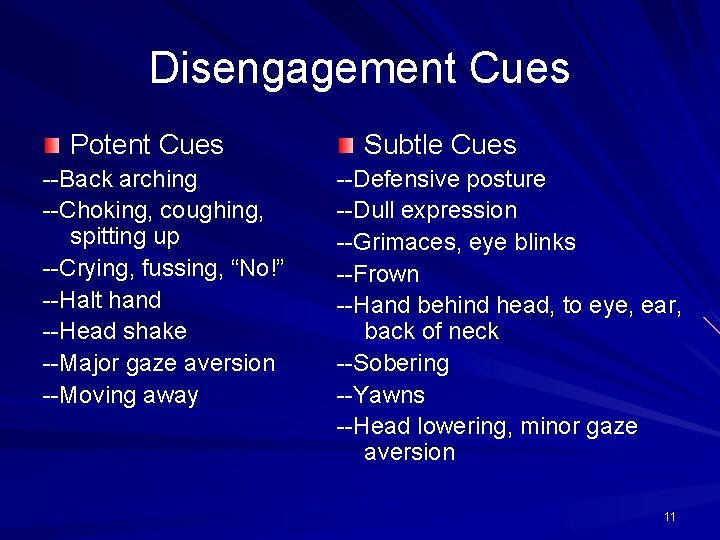
Disengagement Cues Potent Cues --Back arching --Choking, coughing, spitting up --Crying, fussing, “No!” --Halt hand --Head shake --Major gaze aversion --Moving away Subtle Cues --Defensive posture --Dull expression --Grimaces, eye blinks --Frown --Hand behind head, to eye, ear, back of neck --Sobering --Yawns --Head lowering, minor gaze aversion 11
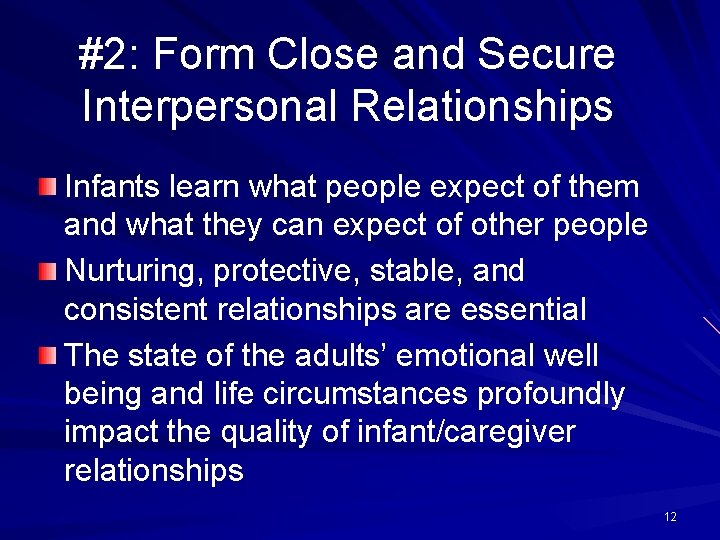
#2: Form Close and Secure Interpersonal Relationships Infants learn what people expect of them and what they can expect of other people Nurturing, protective, stable, and consistent relationships are essential The state of the adults’ emotional well being and life circumstances profoundly impact the quality of infant/caregiver relationships 12
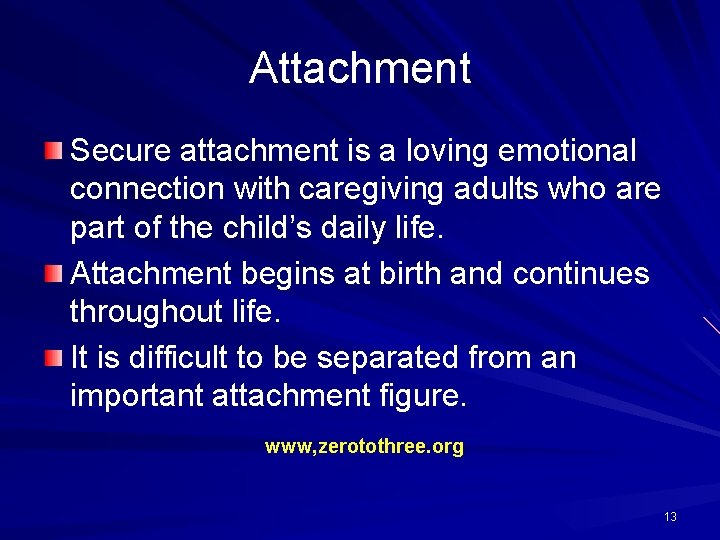
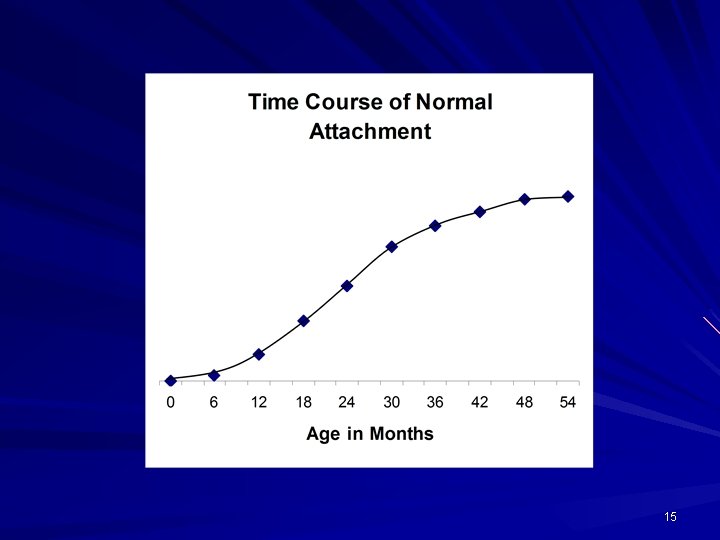
Attachment Secure attachment is a loving emotional connection with caregiving adults who are part of the child’s daily life. Attachment begins at birth and continues throughout life. It is difficult to be separated from an important attachment figure. www, zerotothree. org 13
Through this attachment, the child: Learns to depend on people to meet his/her needs Seeks comfort when distressed Learns to express love/affection Relies on the caregiver as a safe base from which to explore the environment Develops in the areas of emotionality, social behavior, language and cognition 14
15
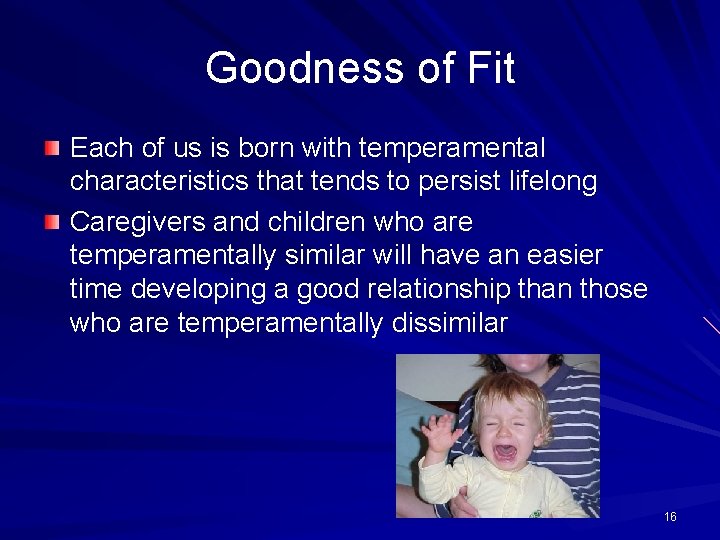
Goodness of Fit Each of us is born with temperamental characteristics that tends to persist lifelong Caregivers and children who are temperamentally similar will have an easier time developing a good relationship than those who are temperamentally dissimilar 16
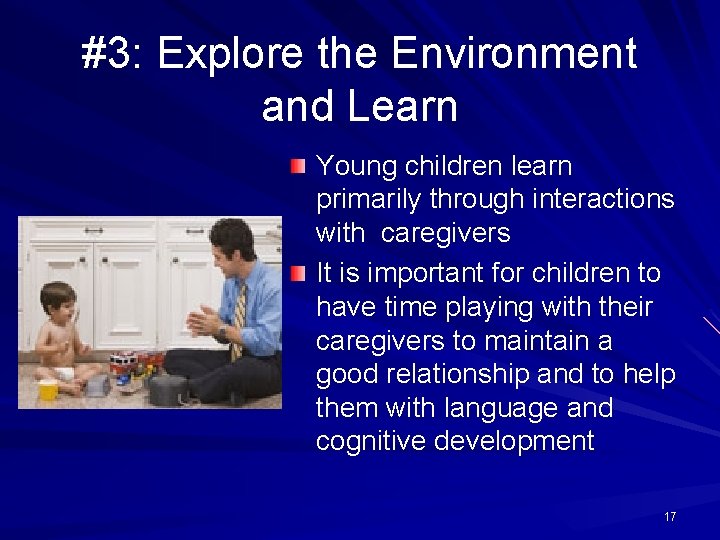
#3: Explore the Environment and Learn Young children learn primarily through interactions with caregivers It is important for children to have time playing with their caregivers to maintain a good relationship and to help them with language and cognitive development 17
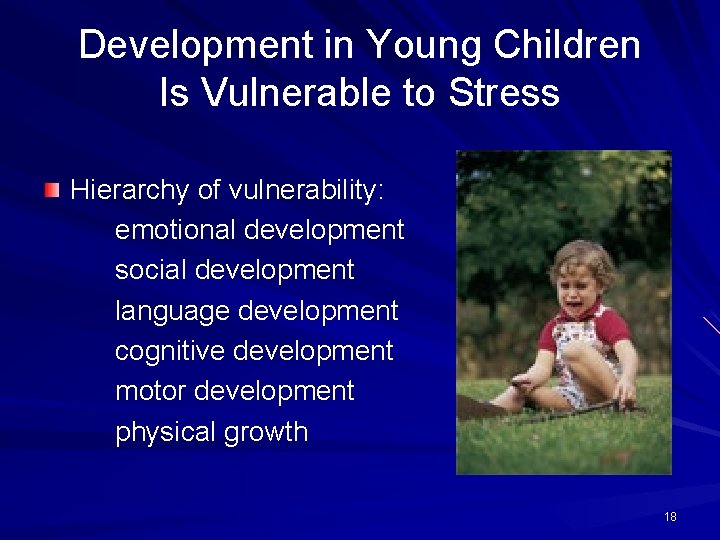
Development in Young Children Is Vulnerable to Stress Hierarchy of vulnerability: emotional development social development language development cognitive development motor development physical growth 18
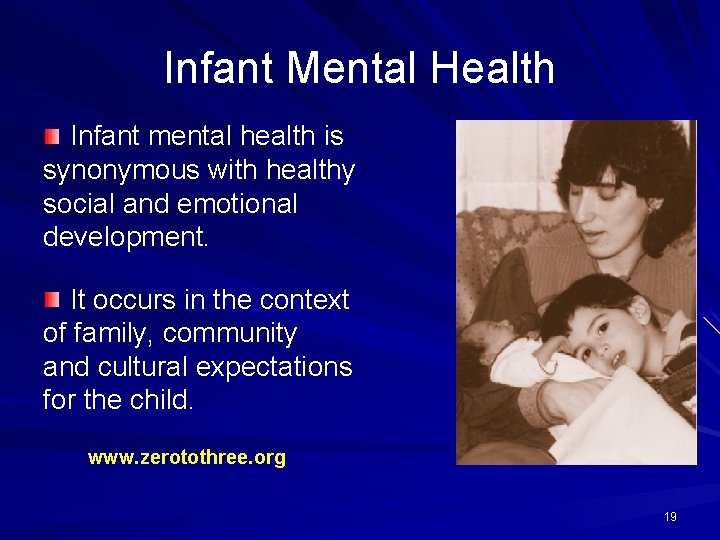
Infant Mental Health Infant mental health is synonymous with healthy social and emotional development. It occurs in the context of family, community and cultural expectations for the child. www. zerotothree. org 19
Goal #2: Recognize mental health issues of young children 20
Facts about Mental Health of Young Children Young children are about as likely to have mental health issues as are older children and adults In very young children, mental health issues are most often expressed as difficulties with eating, sleeping, and regulation of behavioral states 21
As children become older, they increasingly express mental health issues as more recognizable difficulties with moods and behaviors If mental health issues are left untreated, children often begin to show more general delays in the areas of social/emotional functioning, language, cognition and even motor and physical development 22
How Do I Recognize the Need for Mental Health Treatment? Issue is pervasive, meaning it occurs across settings Issue is persistent, meaning it occurs more days than not for 2 -4 weeks Issue has a negative impact on a child’s daily functioning 23
Overview of Common Mental Health Issues Sleeping Disorders Eating Disorders Attention Deficit Hyperactivity Disorder (ADHD) Post Traumatic Stress Disorder (PTSD) Deprivation/Maltreatment Disorder (DMD), Reactive Attachment Disorder (RAD) and Disinhibited Social Engagement Disorder (DSED). Depression 24
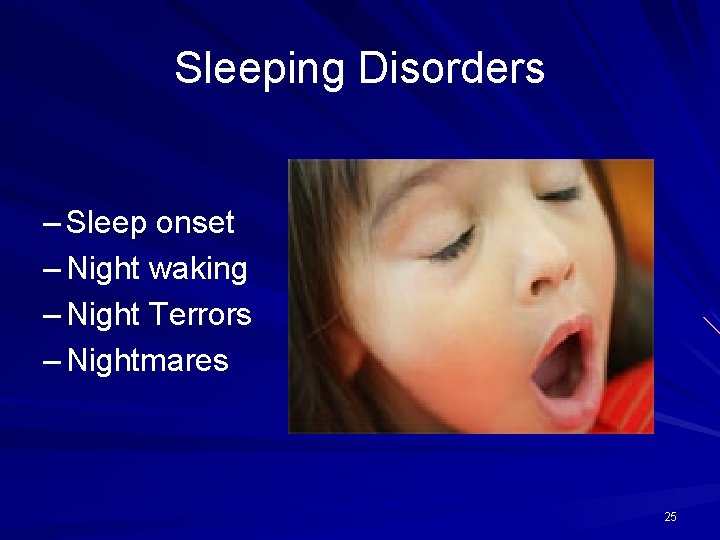
Sleeping Disorders – Sleep onset – Night waking – Night Terrors – Nightmares 25
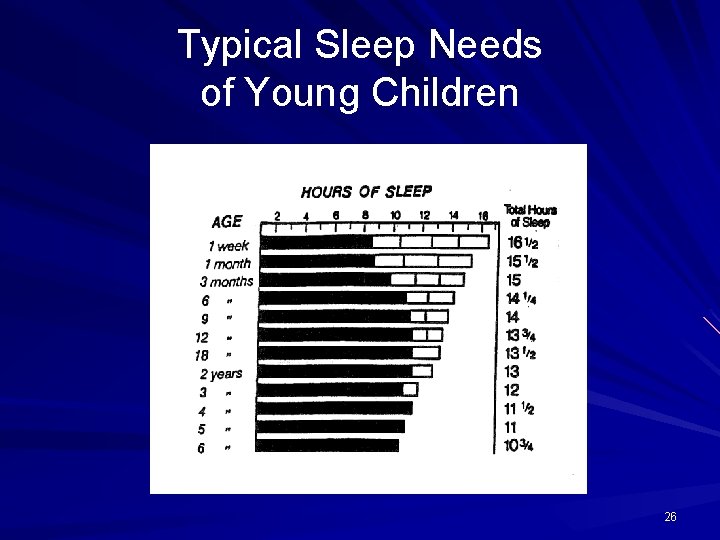
Typical Sleep Needs of Young Children 26
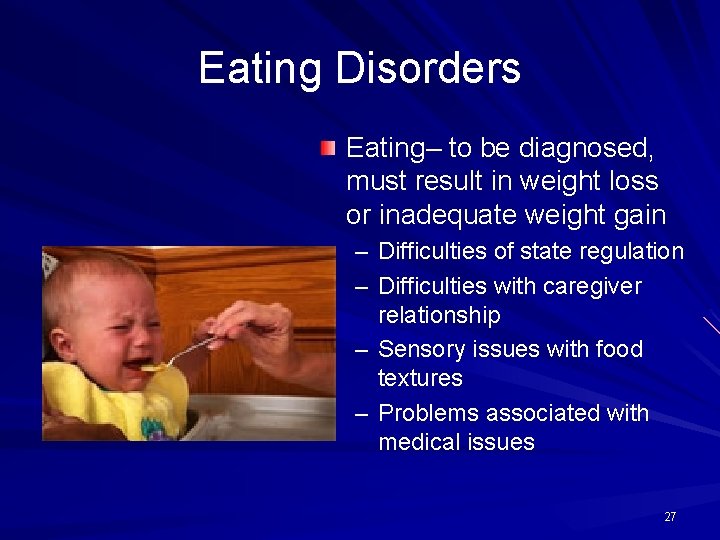
Eating Disorders Eating– to be diagnosed, must result in weight loss or inadequate weight gain – Difficulties of state regulation – Difficulties with caregiver relationship – Sensory issues with food textures – Problems associated with medical issues 27
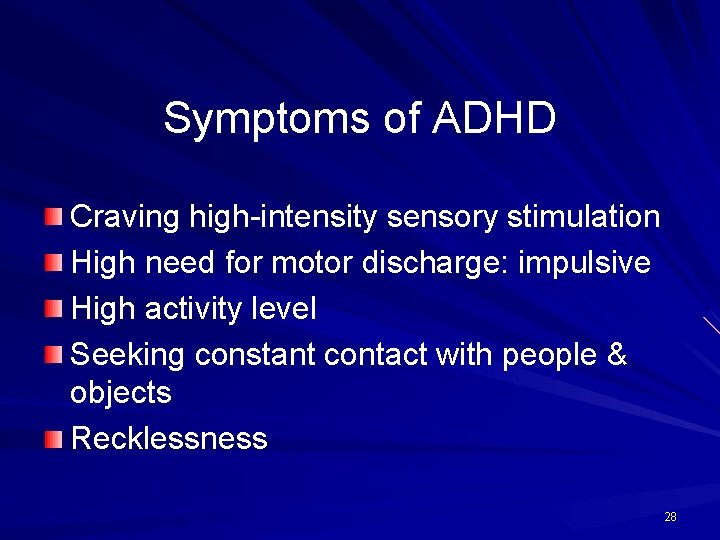
Symptoms of ADHD Craving high-intensity sensory stimulation High need for motor discharge: impulsive High activity level Seeking constant contact with people & objects Recklessness 28
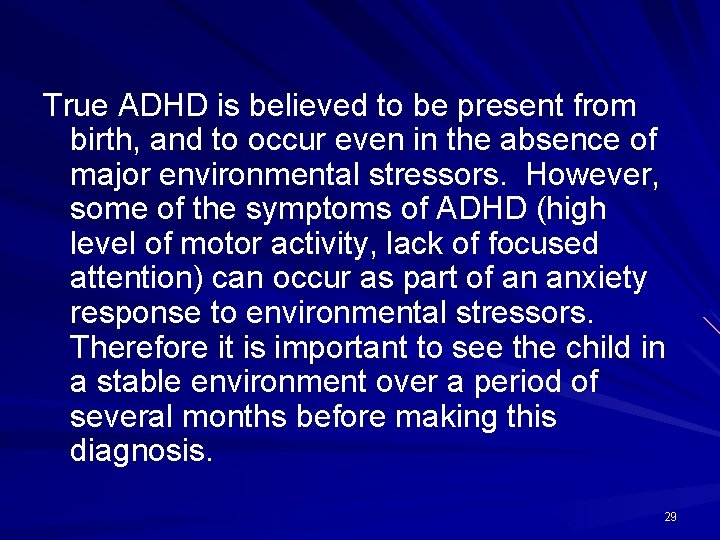
True ADHD is believed to be present from birth, and to occur even in the absence of major environmental stressors. However, some of the symptoms of ADHD (high level of motor activity, lack of focused attention) can occur as part of an anxiety response to environmental stressors. Therefore it is important to see the child in a stable environment over a period of several months before making this diagnosis. 29
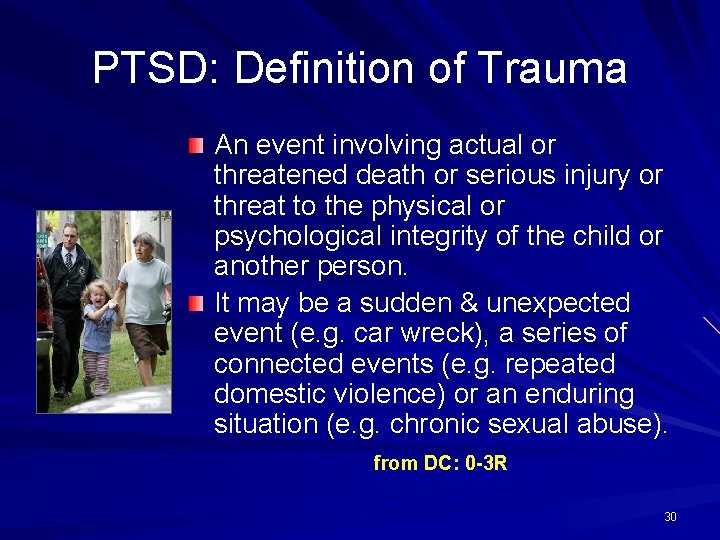
PTSD: Definition of Trauma An event involving actual or threatened death or serious injury or threat to the physical or psychological integrity of the child or another person. It may be a sudden & unexpected event (e. g. car wreck), a series of connected events (e. g. repeated domestic violence) or an enduring situation (e. g. chronic sexual abuse). from DC: 0 -3 R 30
Symptoms of PTSD reliving the trauma, in children often through post-traumatic play avoiding reminders of the trauma intense emotional responses to reminders of the trauma maintaining hypervigilance, startling easily numbing of affect difficulties falling and staying asleep, nightmares 31
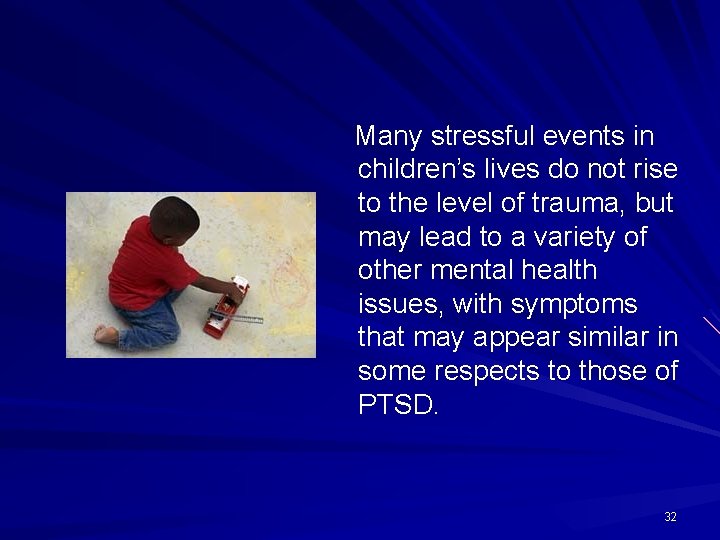
Many stressful events in children’s lives do not rise to the level of trauma, but may lead to a variety of other mental health issues, with symptoms that may appear similar in some respects to those of PTSD. 32
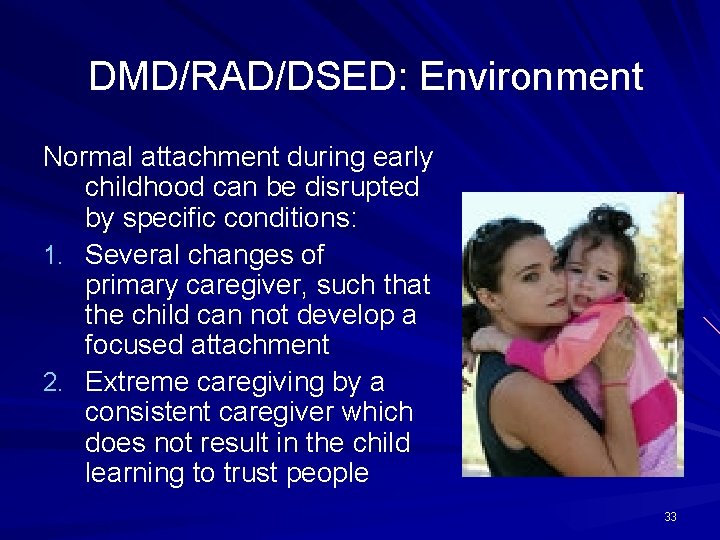
DMD/RAD/DSED: Environment Normal attachment during early childhood can be disrupted by specific conditions: 1. Several changes of primary caregiver, such that the child can not develop a focused attachment 2. Extreme caregiving by a consistent caregiver which does not result in the child learning to trust people 33
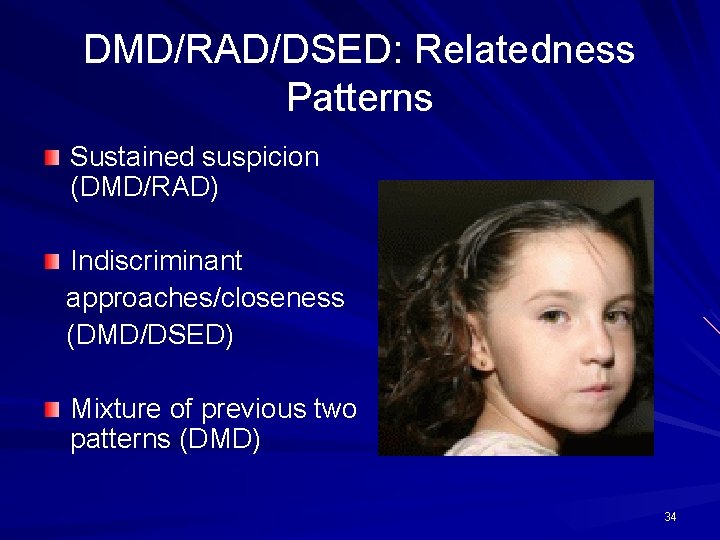
DMD/RAD/DSED: Relatedness Patterns Sustained suspicion (DMD/RAD) Indiscriminant approaches/closeness (DMD/DSED) Mixture of previous two patterns (DMD) 34
Attachment Issues Can Be Associated with Poor Outcomes Increased risk of juvenile (and adult) justice involvement Difficulties coping with stress Increased risk of dangerous behaviors Problematic peer relationships Reduced likelihood of maintaining a stable, loving relationship with an adult partner Poor parenting skills 35
Symptoms of Depression Change in mood– can be either depressed or irritable Loss of interest in many activities Persistent, at least some of the time uncoupled from sad/upsetting experiences Pervasive across activities, settings or relationships Symptoms cause child distress, impair functioning or impede development 36
Goal #3: Know how infant mental health issues are assessed and treated 37
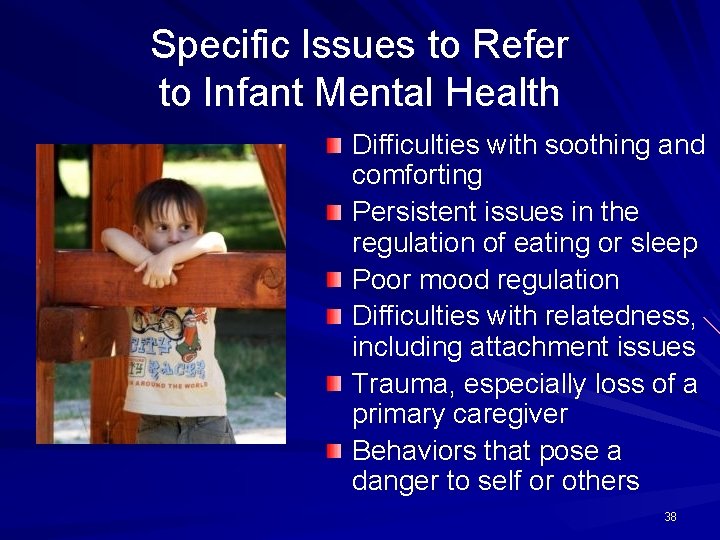
Specific Issues to Refer to Infant Mental Health Difficulties with soothing and comforting Persistent issues in the regulation of eating or sleep Poor mood regulation Difficulties with relatedness, including attachment issues Trauma, especially loss of a primary caregiver Behaviors that pose a danger to self or others 38
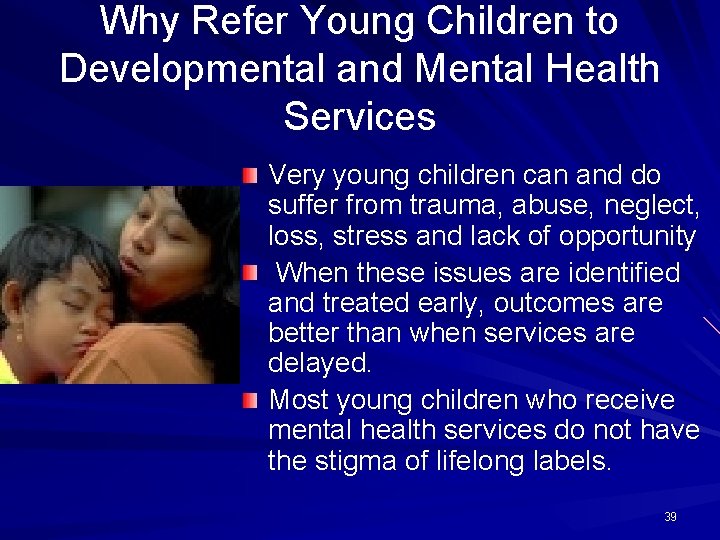
Why Refer Young Children to Developmental and Mental Health Services Very young children can and do suffer from trauma, abuse, neglect, loss, stress and lack of opportunity When these issues are identified and treated early, outcomes are better than when services are delayed. Most young children who receive mental health services do not have the stigma of lifelong labels. 39
How to Refer a Child for Services In Nevada, Child and Family Teams (CFT’s) make decisions about what services a child needs. If you think a child in your care needs services, you must begin with your DFS caseworker, and ask for a CFT to discuss the need for services. 40
Evaluation typically involves several sessions Parent interviews for family history Direct observation & reports of family interaction/functioning Direct observation & reports of child’s characteristics & development, including areas of concern General assessment of child: ability to regulate mood and self-soothe, relatedness, sensory function, motor tone and motor planning 41
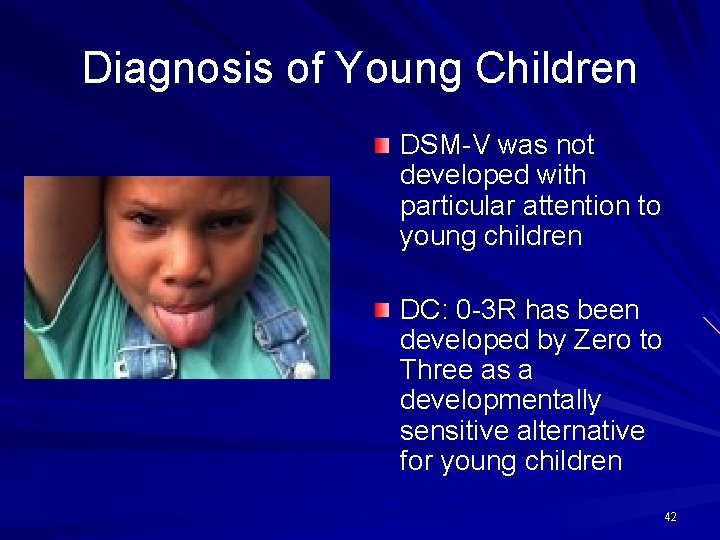
Diagnosis of Young Children DSM-V was not developed with particular attention to young children DC: 0 -3 R has been developed by Zero to Three as a developmentally sensitive alternative for young children 42
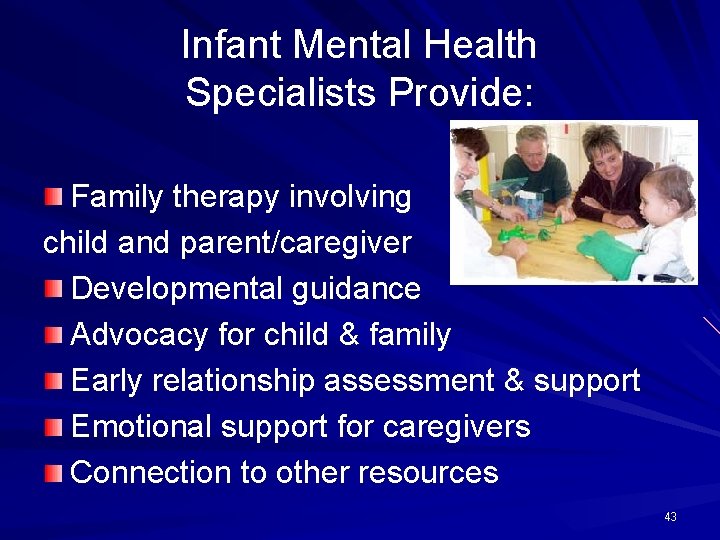
Infant Mental Health Specialists Provide: Family therapy involving child and parent/caregiver Developmental guidance Advocacy for child & family Early relationship assessment & support Emotional support for caregivers Connection to other resources 43
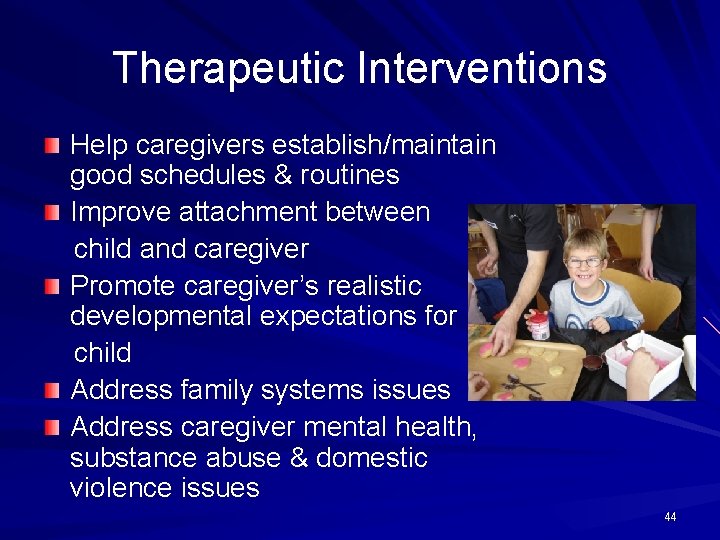
Therapeutic Interventions Help caregivers establish/maintain good schedules & routines Improve attachment between child and caregiver Promote caregiver’s realistic developmental expectations for child Address family systems issues Address caregiver mental health, substance abuse & domestic violence issues 44
The Importance of a Family Approach to Treatment Children learn in relationships Relationships with caregivers are the most important relationships children have until their teenage years Changes in the structure of the environment and the behavior of important caregivers toward the child contribute most to changes in the child’s behavior and/or mood 45
Additional Therapeutic Services Basic Skills Training (BST) Psychosocial Rehabilitation (PSR) Day Treatment and After School Services Psychiatric Medications Partial Hospitalization Psychiatric Hospitalization 46
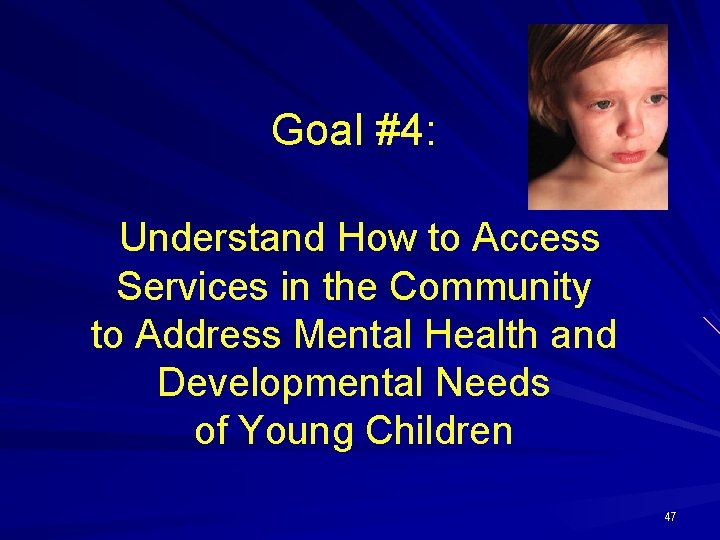
Goal #4: Understand How to Access Services in the Community to Address Mental Health and Developmental Needs of Young Children 47
Resources for Young Children in Clark County Mental Health Services -- Early Childhood Mental Health, DCFS if fee-for-service Medicaid or uninsured 486 -7764 -- Medicaid HMO’s and private insurance providers 48
Services for children with developmental delays: --Nevada Early Intervention Services children birth to 36 months 486 -7670 --CCSD Child Find children 33 months + 799 -7463 49