
Introduction to Implementation Science Geoffrey M Curran Ph
- Slides: 32
Introduction to Implementation Science Geoffrey M. Curran, Ph. D Director, Center for Implementation Research Professor, Departments of Pharmacy Practice and Psychiatry University of Arkansas for Medical Sciences Research Health Scientist, Central Arkansas Veterans Healthcare System
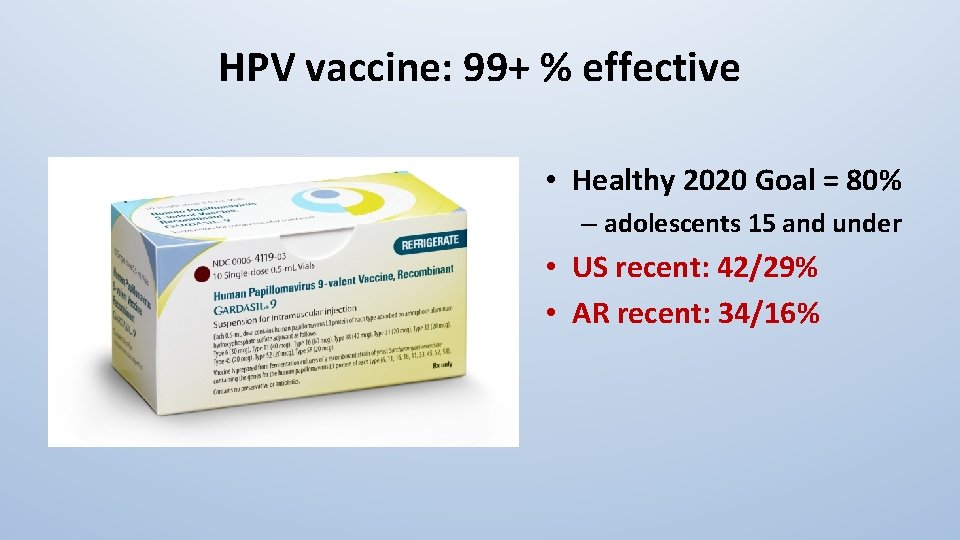
HPV vaccine: 99+ % effective • Healthy 2020 Goal = 80% – adolescents 15 and under • US recent: 42/29% • AR recent: 34/16%
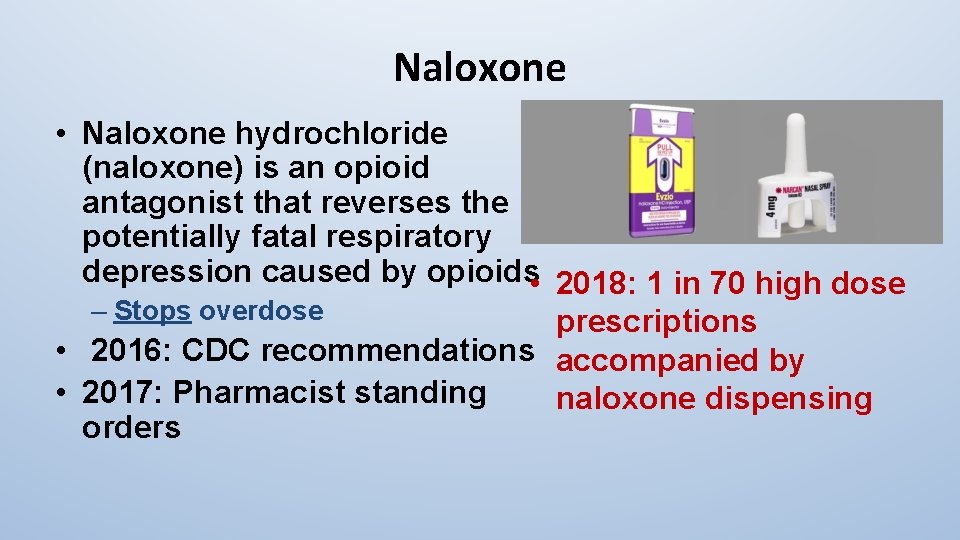
Naloxone • Naloxone hydrochloride (naloxone) is an opioid antagonist that reverses the potentially fatal respiratory depression caused by opioids • 2018: 1 in 70 high dose – Stops overdose prescriptions • 2016: CDC recommendations accompanied by • 2017: Pharmacist standing naloxone dispensing orders
Goals for today • Discuss principles of “implementation science” – What is it? Why do we need it? When do we do it? • Discuss outcomes in implementation research – Adoption/uptake, fidelity to the intervention/practice • Summarize different strategies to promote better implementation of evidence-based practices/interventions – The interventions in this kind of work/research • E. g. , education, training, prompting, incentives, mandates…
Some definitions…
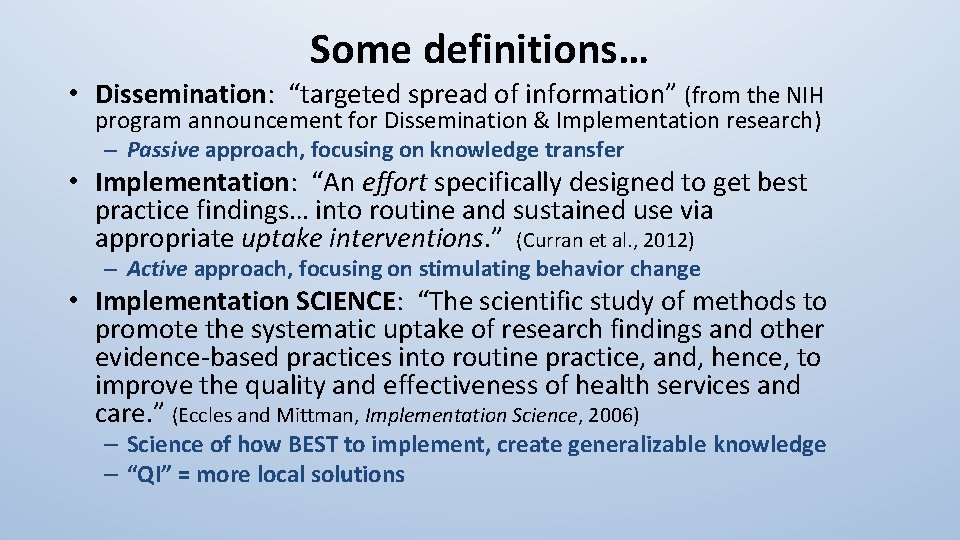
Some definitions… • Dissemination: “targeted spread of information” (from the NIH program announcement for Dissemination & Implementation research) – Passive approach, focusing on knowledge transfer • Implementation: “An effort specifically designed to get best practice findings… into routine and sustained use via appropriate uptake interventions. ” (Curran et al. , 2012) – Active approach, focusing on stimulating behavior change • Implementation SCIENCE: “The scientific study of methods to promote the systematic uptake of research findings and other evidence-based practices into routine practice, and, hence, to improve the quality and effectiveness of health services and care. ” (Eccles and Mittman, Implementation Science, 2006) – Science of how BEST to implement, create generalizable knowledge – “QI” = more local solutions
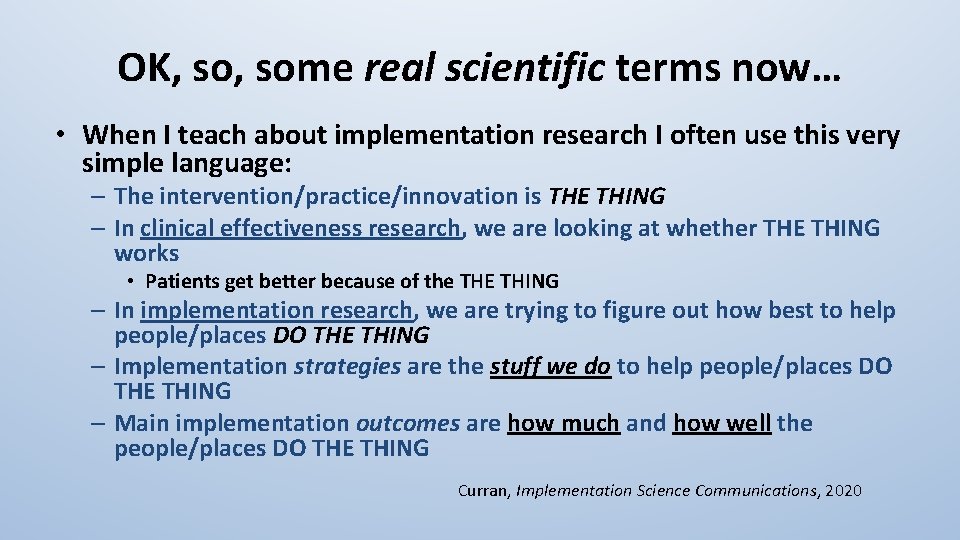
OK, some real scientific terms now… • When I teach about implementation research I often use this very simple language: – The intervention/practice/innovation is THE THING – In clinical effectiveness research, we are looking at whether THE THING works • Patients get better because of the THE THING – In implementation research, we are trying to figure out how best to help people/places DO THE THING – Implementation strategies are the stuff we do to help people/places DO THE THING – Main implementation outcomes are how much and how well the people/places DO THE THING Curran, Implementation Science Communications, 2020
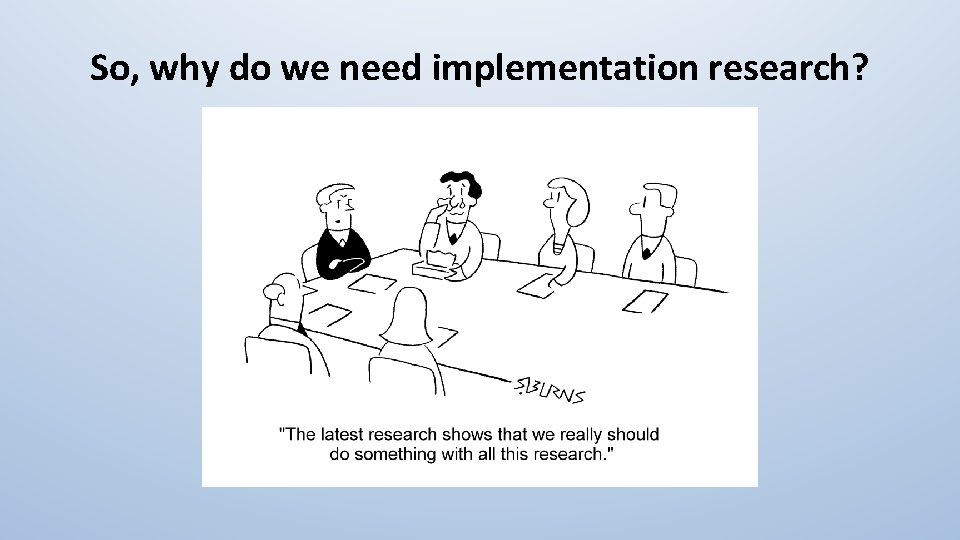
So, why do we need implementation research?
So, why do we need implementation research? • Only ~50% of patients in the US receive recommended/EB care – Wide variability across conditions and treatment: • 79% of patients receive recommended care for an age-related cataract • 11% of patients receive recommended care for alcohol use disorder • 20– 25% patients get care that is not needed or potentially harmful – So, we also need to DE-implement… • 1. 3 million people are injured annually by medication errors • Most chronic conditions have solid, evidence-based guidelines for treatment, management, and prevention, but rates of conditions such diabetes continue to rise
More… why we need this • 17 years on average from “we know this works” to “routine delivery of it” – We have been citing this same figure for years… • Dissemination ONLY of research results, clinical practice guidelines (usually driven by research findings), etc. , don’t seem to do much on their own to improve practice delivery – Except in some simpler cases… • Implementation of research findings/EBPs is a fundamental challenge for healthcare systems to optimize care, outcomes and costs
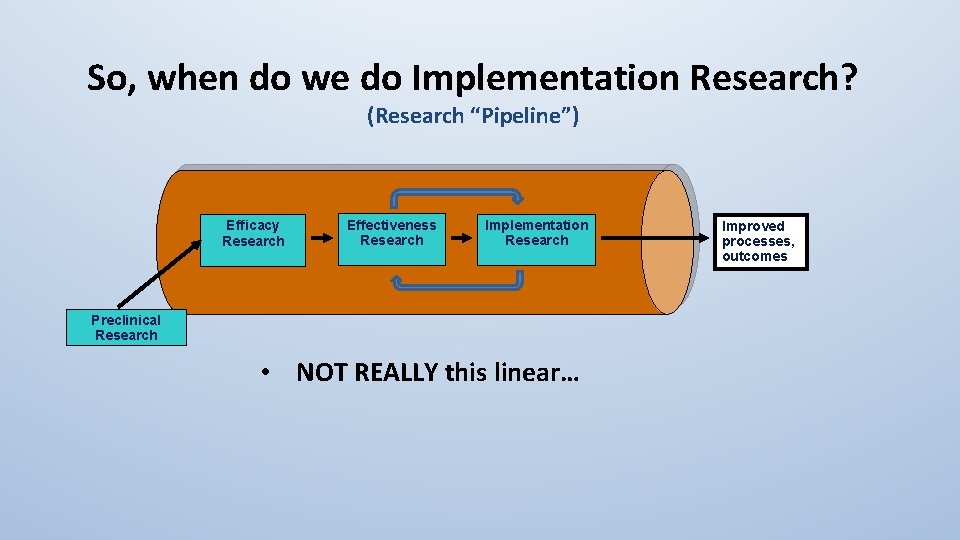
So, when do we do Implementation Research? (Research “Pipeline”) Efficacy Research Effectiveness Research Implementation Research Preclinical Research • NOT REALLY this linear… Improved processes, outcomes
What to measure in implementation research?
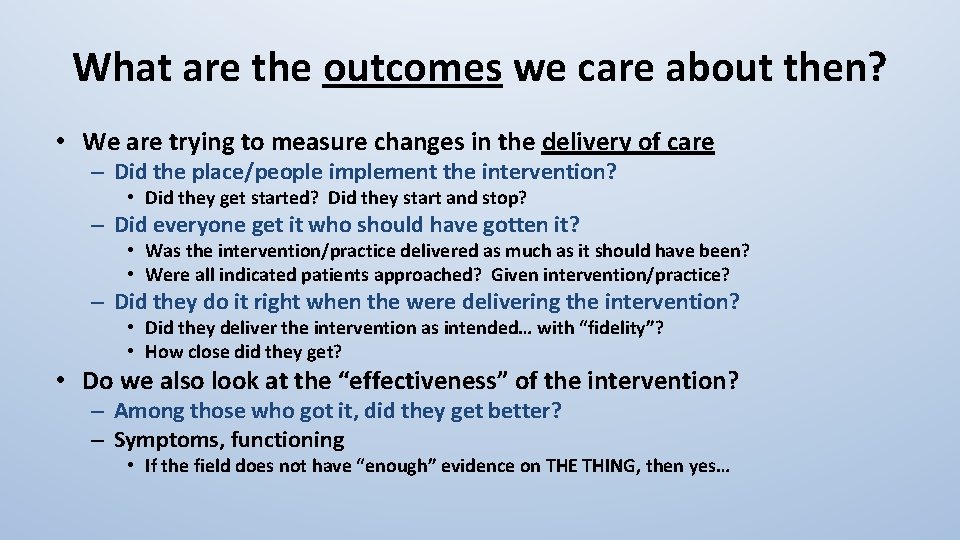
What are the outcomes we care about then? • We are trying to measure changes in the delivery of care – Did the place/people implement the intervention? • Did they get started? Did they start and stop? – Did everyone get it who should have gotten it? • Was the intervention/practice delivered as much as it should have been? • Were all indicated patients approached? Given intervention/practice? – Did they do it right when the were delivering the intervention? • Did they deliver the intervention as intended… with “fidelity”? • How close did they get? • Do we also look at the “effectiveness” of the intervention? – Among those who got it, did they get better? – Symptoms, functioning • If the field does not have “enough” evidence on THE THING, then yes…
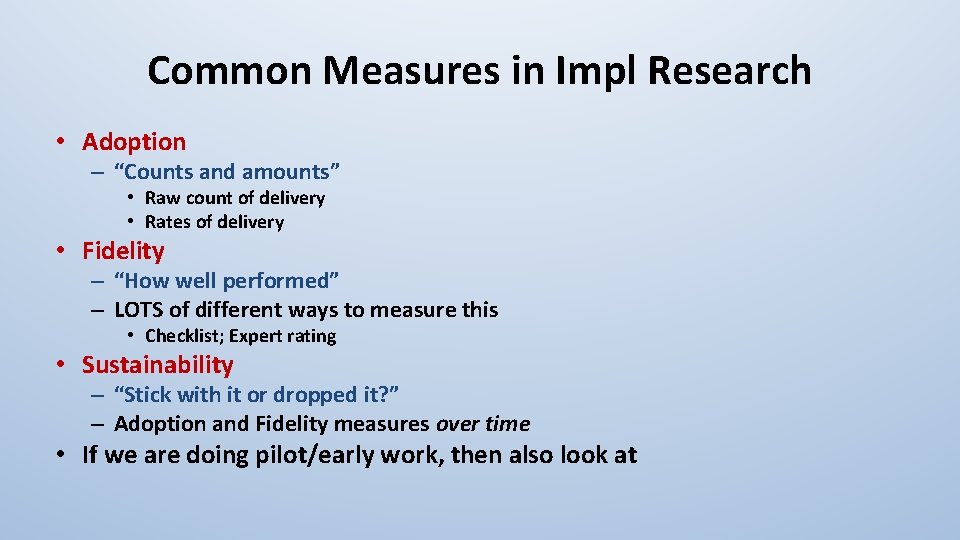
Common Measures in Impl Research • Adoption – “Counts and amounts” • Raw count of delivery • Rates of delivery • Fidelity – “How well performed” – LOTS of different ways to measure this • Checklist; Expert rating • Sustainability – “Stick with it or dropped it? ” – Adoption and Fidelity measures over time • If we are doing pilot/early work, then also look at
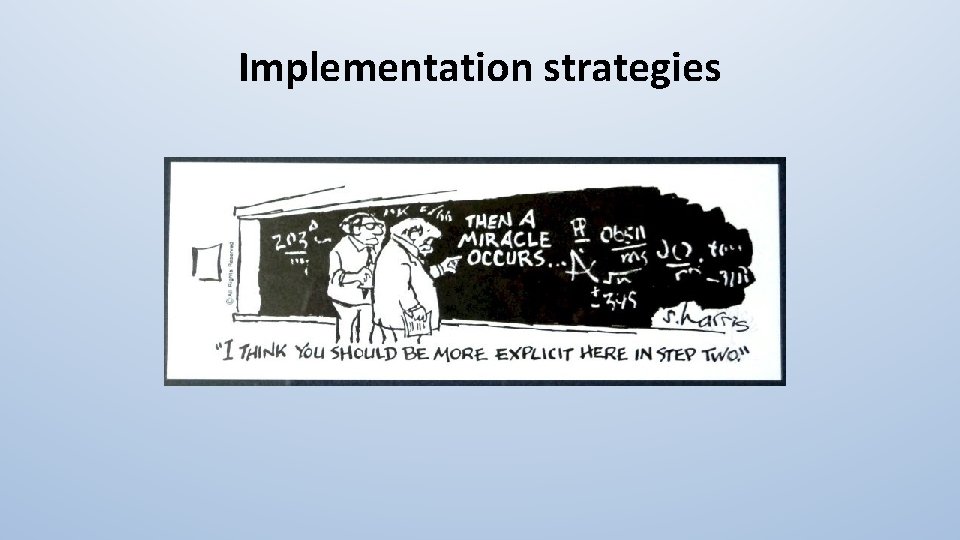
Implementation strategies
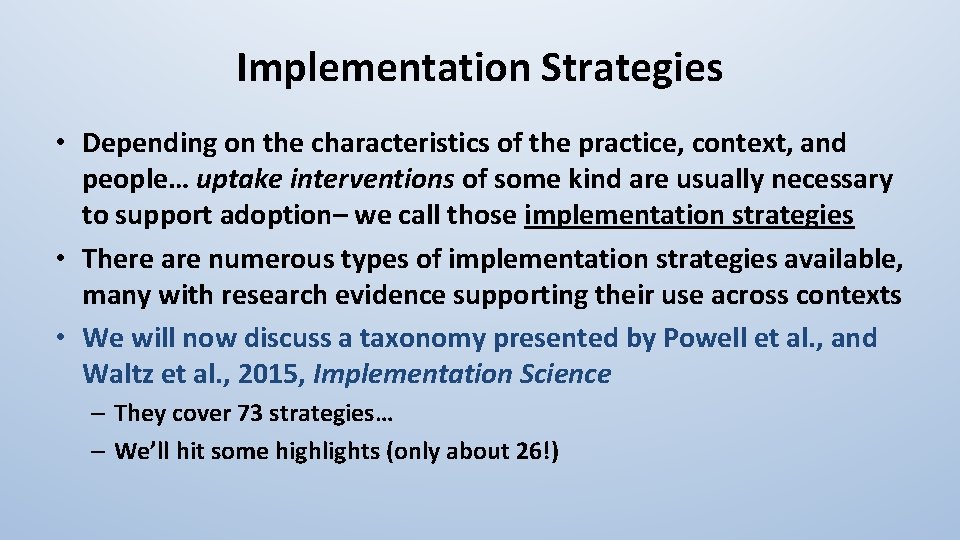
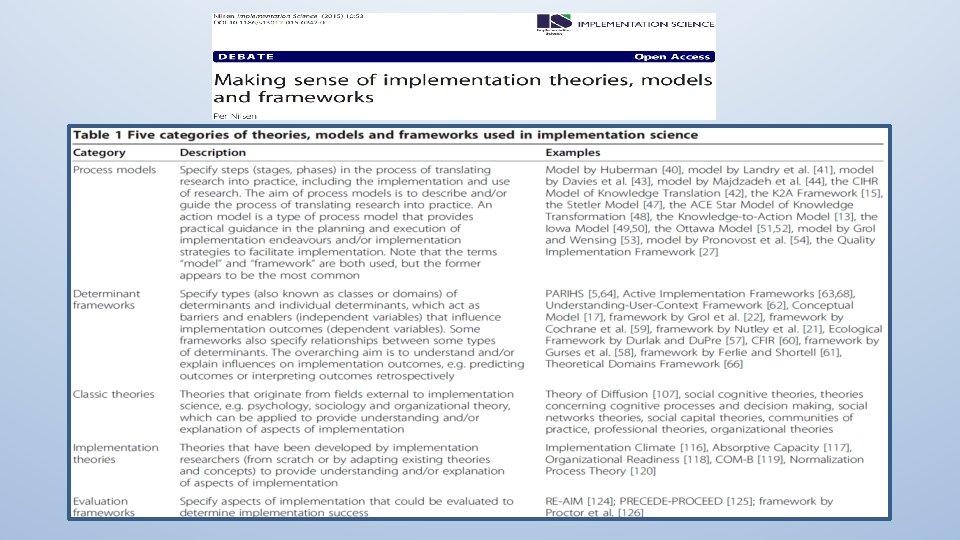
Implementation Strategies • Depending on the characteristics of the practice, context, and people… uptake interventions of some kind are usually necessary to support adoption– we call those implementation strategies • There are numerous types of implementation strategies available, many with research evidence supporting their use across contexts • We will now discuss a taxonomy presented by Powell et al. , and Waltz et al. , 2015, Implementation Science – They cover 73 strategies… – We’ll hit some highlights (only about 26!)
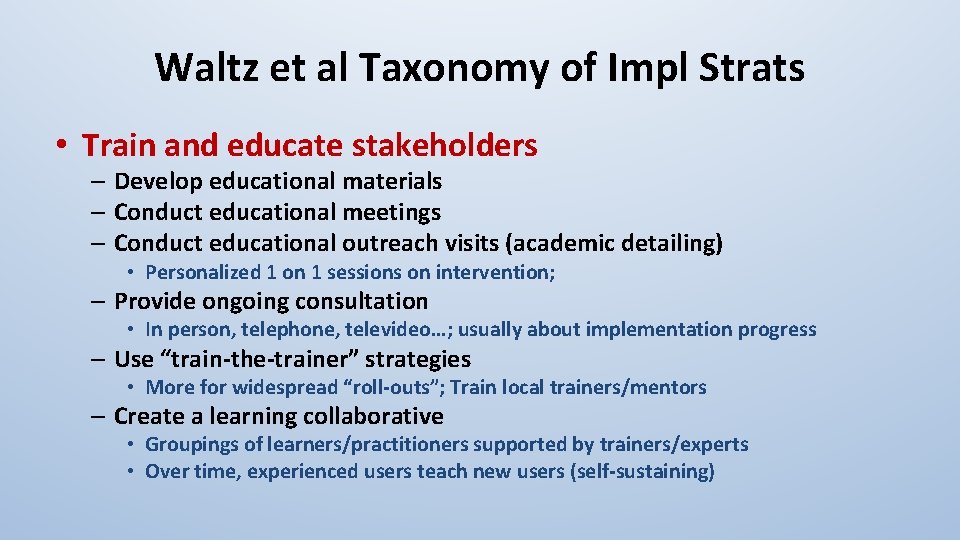
Waltz et al Taxonomy of Impl Strats • Train and educate stakeholders – Develop educational materials – Conduct educational meetings – Conduct educational outreach visits (academic detailing) • Personalized 1 on 1 sessions on intervention; – Provide ongoing consultation • In person, telephone, televideo…; usually about implementation progress – Use “train-the-trainer” strategies • More for widespread “roll-outs”; Train local trainers/mentors – Create a learning collaborative • Groupings of learners/practitioners supported by trainers/experts • Over time, experienced users teach new users (self-sustaining)
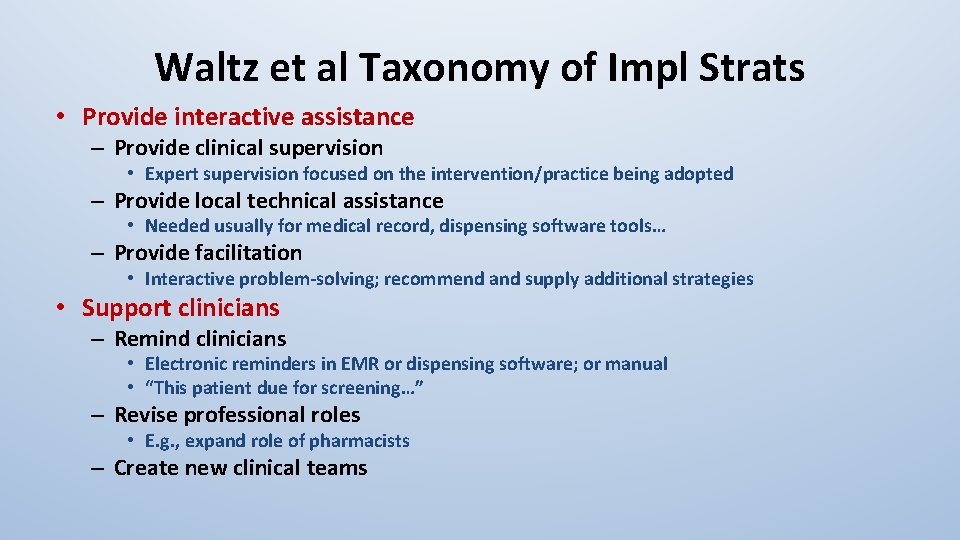
Waltz et al Taxonomy of Impl Strats • Provide interactive assistance – Provide clinical supervision • Expert supervision focused on the intervention/practice being adopted – Provide local technical assistance • Needed usually for medical record, dispensing software tools… – Provide facilitation • Interactive problem-solving; recommend and supply additional strategies • Support clinicians – Remind clinicians • Electronic reminders in EMR or dispensing software; or manual • “This patient due for screening…” – Revise professional roles • E. g. , expand role of pharmacists – Create new clinical teams
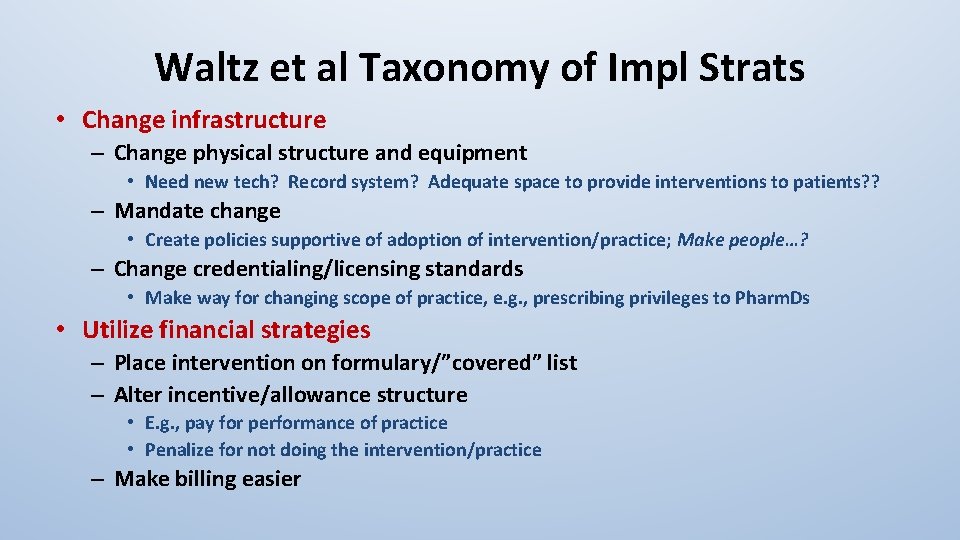
Waltz et al Taxonomy of Impl Strats • Change infrastructure – Change physical structure and equipment • Need new tech? Record system? Adequate space to provide interventions to patients? ? – Mandate change • Create policies supportive of adoption of intervention/practice; Make people…? – Change credentialing/licensing standards • Make way for changing scope of practice, e. g. , prescribing privileges to Pharm. Ds • Utilize financial strategies – Place intervention on formulary/”covered” list – Alter incentive/allowance structure • E. g. , pay for performance of practice • Penalize for not doing the intervention/practice – Make billing easier
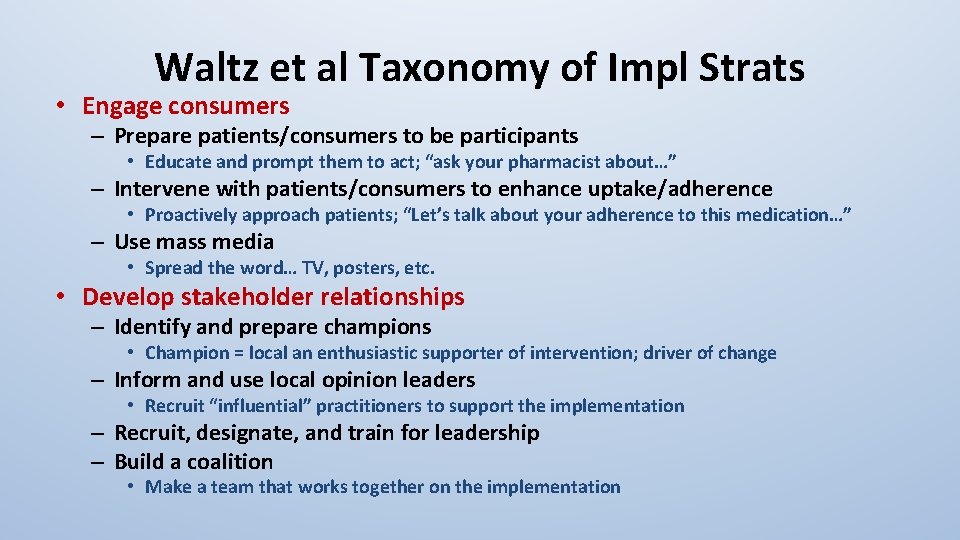
Waltz et al Taxonomy of Impl Strats • Engage consumers – Prepare patients/consumers to be participants • Educate and prompt them to act; “ask your pharmacist about…” – Intervene with patients/consumers to enhance uptake/adherence • Proactively approach patients; “Let’s talk about your adherence to this medication…” – Use mass media • Spread the word… TV, posters, etc. • Develop stakeholder relationships – Identify and prepare champions • Champion = local an enthusiastic supporter of intervention; driver of change – Inform and use local opinion leaders • Recruit “influential” practitioners to support the implementation – Recruit, designate, and train for leadership – Build a coalition • Make a team that works together on the implementation
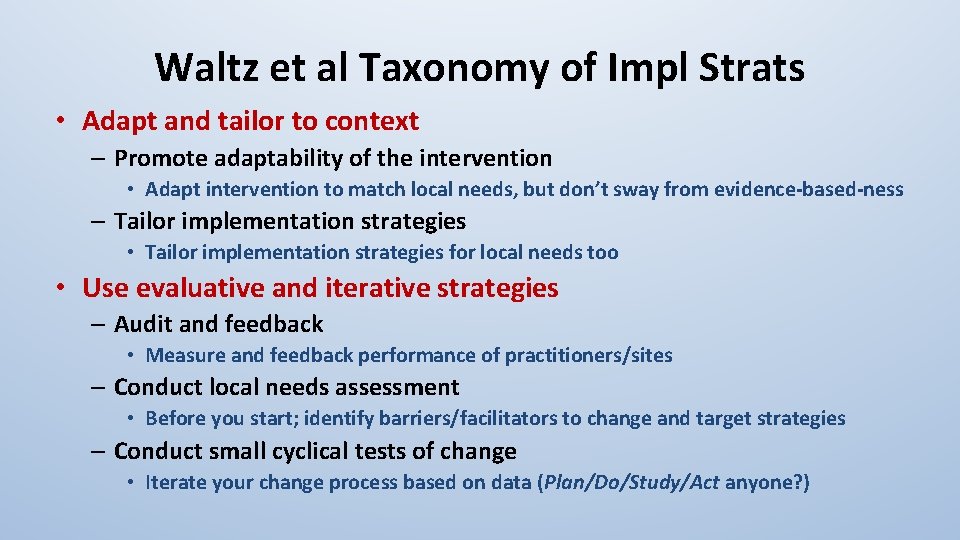
Waltz et al Taxonomy of Impl Strats • Adapt and tailor to context – Promote adaptability of the intervention • Adapt intervention to match local needs, but don’t sway from evidence-based-ness – Tailor implementation strategies • Tailor implementation strategies for local needs too • Use evaluative and iterative strategies – Audit and feedback • Measure and feedback performance of practitioners/sites – Conduct local needs assessment • Before you start; identify barriers/facilitators to change and target strategies – Conduct small cyclical tests of change • Iterate your change process based on data (Plan/Do/Study/Act anyone? )
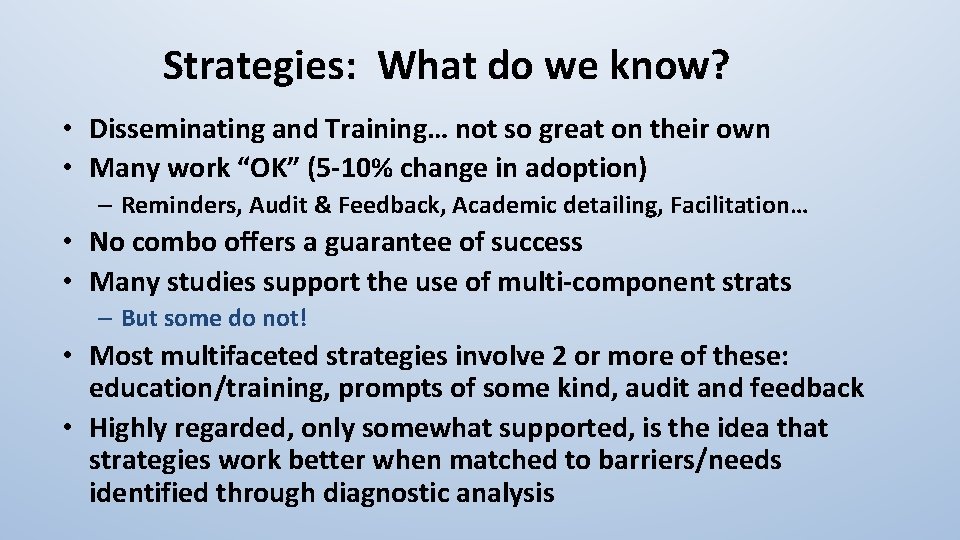
Strategies: What do we know? • Disseminating and Training… not so great on their own • Many work “OK” (5 -10% change in adoption) – Reminders, Audit & Feedback, Academic detailing, Facilitation… • No combo offers a guarantee of success • Many studies support the use of multi-component strats – But some do not! • Most multifaceted strategies involve 2 or more of these: education/training, prompts of some kind, audit and feedback • Highly regarded, only somewhat supported, is the idea that strategies work better when matched to barriers/needs identified through diagnostic analysis
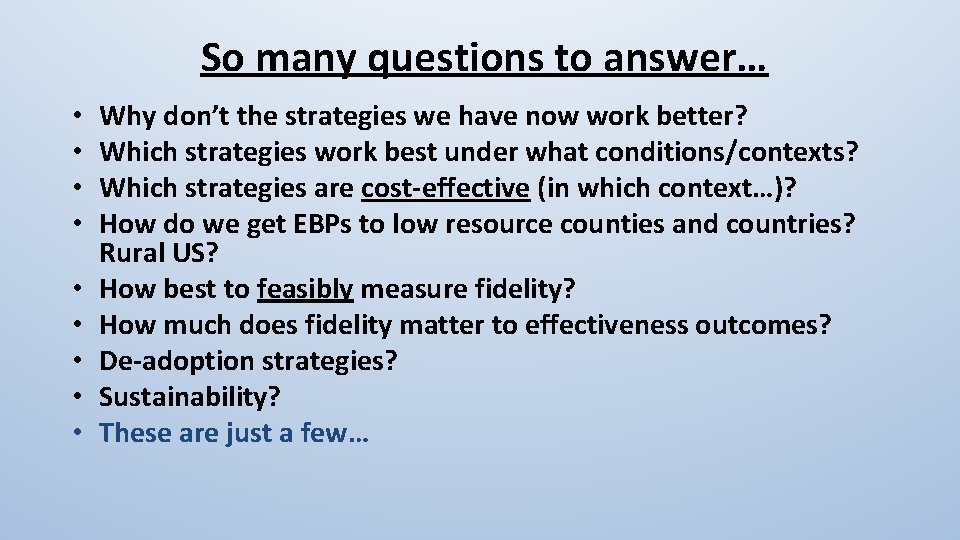
So many questions to answer… • • • Why don’t the strategies we have now work better? Which strategies work best under what conditions/contexts? Which strategies are cost-effective (in which context…)? How do we get EBPs to low resource counties and countries? Rural US? How best to feasibly measure fidelity? How much does fidelity matter to effectiveness outcomes? De-adoption strategies? Sustainability? These are just a few…
Models, Theories, Frameworks… Yeah, I know…
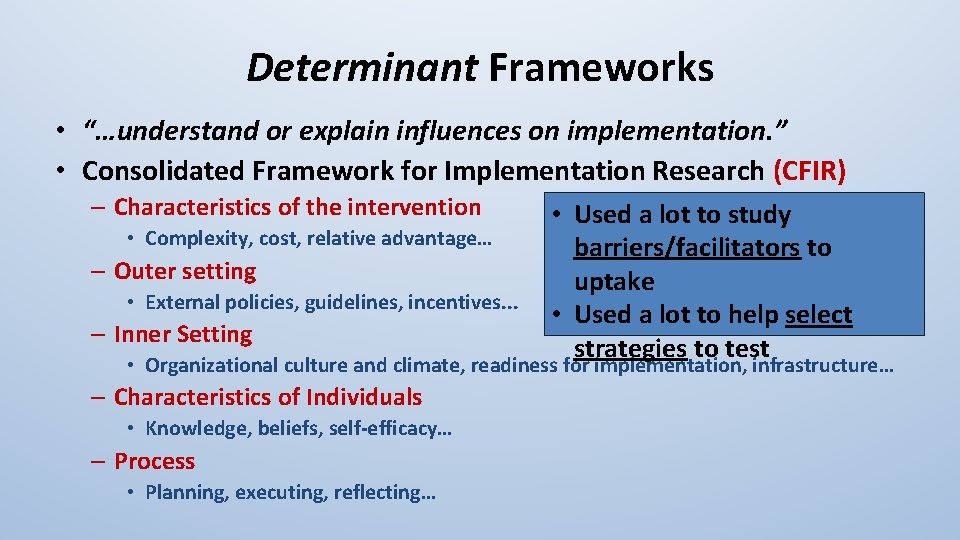
Determinant Frameworks • “…understand or explain influences on implementation. ” • Consolidated Framework for Implementation Research (CFIR) – Characteristics of the intervention • Complexity, cost, relative advantage… – Outer setting • External policies, guidelines, incentives. . . – Inner Setting • Used a lot to study barriers/facilitators to uptake • Used a lot to help select strategies to test • Organizational culture and climate, readiness for implementation, infrastructure… – Characteristics of Individuals • Knowledge, beliefs, self-efficacy… – Process • Planning, executing, reflecting…
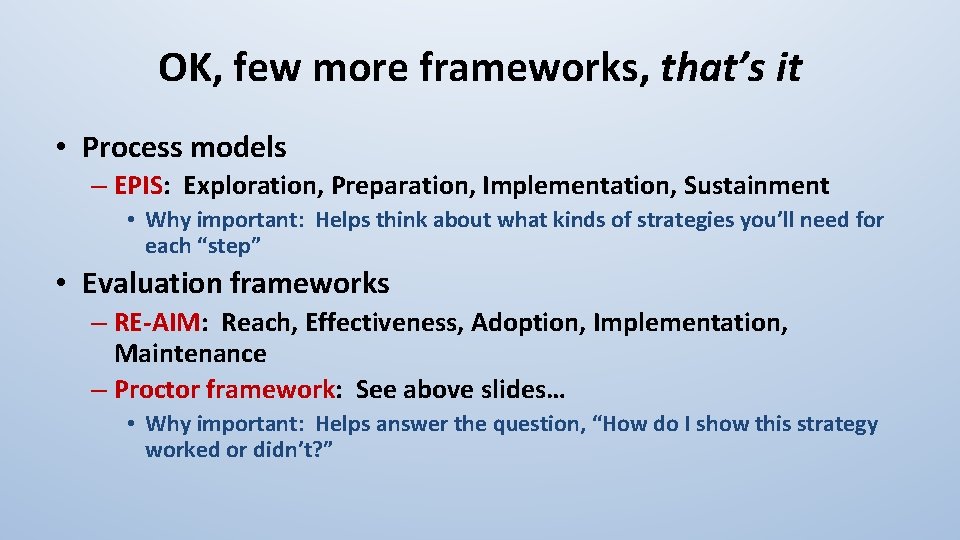
OK, few more frameworks, that’s it • Process models – EPIS: Exploration, Preparation, Implementation, Sustainment • Why important: Helps think about what kinds of strategies you’ll need for each “step” • Evaluation frameworks – RE-AIM: Reach, Effectiveness, Adoption, Implementation, Maintenance – Proctor framework: See above slides… • Why important: Helps answer the question, “How do I show this strategy worked or didn’t? ”
Selected IS Resources on Campus • HMPT 6319: Implementing Change in Clinical Practice Settings • HMPT 9329: Advanced Topics in Implementation Science • IS Scholars Program – 2 year program for clinician scientists • Monthly group consultations – Center for Implementation Research – 4 th Wednesday at 1 pm
Question, comments, heckling…
Some common designs in implementation research • Remember, these designs are assuming the traditional pipeline and that it has produced “suitable” EBPs in need of implementation support – This is not always true, but we’re leave that alone today… • In this summary, I will focus on places doing the adopting – Easier to talk about places, but many studies focus on providers • I won’t provide a detailed overview of the designs, but discuss some common ones within these categories: – Within-site designs – Between-site designs
Within-Site Designs • We use these when we want or need to expose all places to the same thing/strategy • No comparison places; common in “QI” type scenarios or pilot tests of strategies in development (research scenarios) – VERY COMMON in Community Pharmacy Practice Research • Causal inference difficult, but many real-world uses for these data – “Post-only” design • Simplest • Can be used when we know baseline use of EBP is zippo – “Pre-Post” design • Often used when some adoption has been attempted, but it has not achieved the desired level
Between-Site Designs • We use these when we want to expose places to different things/strategies • Causal inference improved when places are randomized to different exposures (not always possible tho; when not, try to “balance” places on important measures) – New Strategy vs. “implementation as usual” • Key is to choose useful “implementation as usual” • Common in healthcare settings = disseminate, plus training, plus a little technical support – New Strategy 1 vs. New Strategy 2 • “Comparative effectiveness trial” of 2 different strategies (or packages of them) • Different doses of same type of strategy (lo/hi intensity)? Different types? • “SMART” designs: start all with low intensity, then randomized non-responders to higher intensity strategy