
Introduction to Impact Models Introduction to Impact Models





- Slides: 41
Introduction to Impact Models
Introduction to Impact Models • Basic concpet Why evaluate? • Impact evaluations (Ies) are part of a broader agenda of evidencebased policy making. • Monitoring and evaluation are at the heart of evidence-based policy making. • The robust evidence generated by impact evaluations is increasingly serving as a foundation for greater accountability, innovation, and learning.
Intro… Why evaluate? … • At the global level, impact evaluations are central to building knowledge about the effectiveness of development programs by illuminating what does and does not work to reduce poverty and improve welfare. • An impact evaluation assesses the changes in the well-being of individuals that can be attributed to a particular project, program, or policy. • Impact evaluations generally estimate average impacts of a program, program modalities, or a design innovation. • Well-designed and well-implemented impact evaluations are able to provide convincing and comprehensive evidence that can be used to inform policy decisions, shape public opinion, and improve program operations.
Intro…. What is impact evaluation? • IE is one of many approaches that support evidence-based policy, including monitoring and other types of evaluation. Broadly evaluations can address three types of questions: • Descriptive questions: ask about what is taking place. They are concerned with processes, conditions, organizational relationships, and stakeholder views. • Normative questions: compare what is taking place to what should be taking place. Can apply to inputs, activities, and outputs. • Cause-and-effect questions: focus on attribution. They ask about what difference the intervention makes to outcomes.
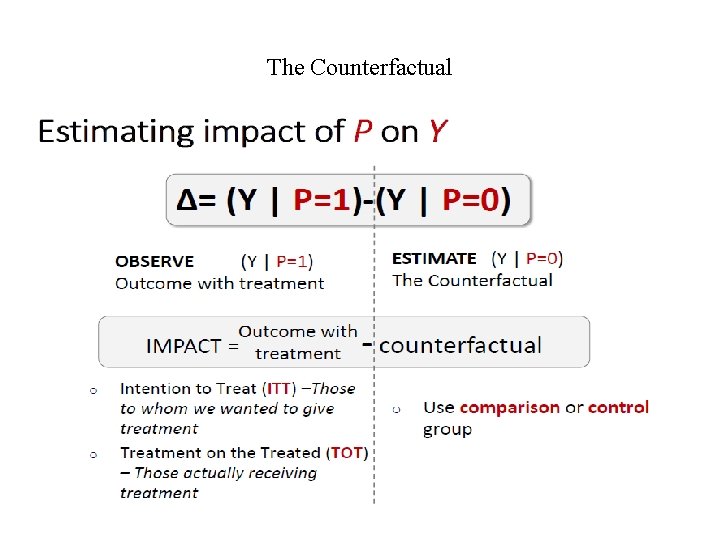
Intro… • Impact evaluations are a particular type of evaluation that seeks to answer a specific cause-and-effect question: What is the impact (or causal effect) of a program on an outcome of interest? • The focus on causality and attribution is the hallmark of impact evaluations. • All impact evaluation methods address some form of cause-and-effect question. • To be able to estimate the causal effect or impact of a program on outcomes, any impact evaluation method chosen must estimate the so-called counterfactual: that is, what the outcome would have been for program participants if they had not participated in the program.
• Impact evaluations are needed to inform policy makers on a range of decisions, from curtailing inefficient programs, to scaling up interventions that work, to adjusting program benefits, to selecting among various program alternatives. • They are most effective when applied selectively to answer important policy questions, and they are often applied to innovative pilot programs that are testing an unproven, but promising approach. • An assessment of the causal effect of a project , program or policy on beneficiaries. Uses a counterfactual… a. to estimate what the state of the beneficiaries would have been in the absence of the program (the control or comparison group), compared to the observed state of beneficiaries (the treatment group), and b. to determine intermediate or final outcomes attributable to the intervention
When to use Impact Evaluation? Evaluate impact when project is: a. b. c. Innovative Replicable/scalable Strategically relevant for reducing poverty d. Evaluation will fill knowledge gap e. Substantial policy impact Use evaluation within a program to test alternatives and improve programs.
Efficacy studies and effectiveness studies • Efficacy studies explore proof of concept, often to test the viability of a new program or a specific theory of change. • Whereas evidence from efficacy studies can be useful to test an innovative approach, the results often have limited generalizability and do not always adequately represent more general settings, which are usually the prime concern of policy makers. • Effectiveness studies provide evidence from interventions that take place in normal circumstances, using regular implementation channels and aim to produce findings that can be generalized to a large population.
The Counterfactual • We can think of the impact (Δ) of a program as the difference in outcomes (Y) for the same unit (person, household, community, and so on) with and without participation in a program. • Yet, we know that measuring the same unit in two different states at the same time is impossible. • At any given moment in time, a unit either participated in the program or did not participate. • This is called the counterfactual problem: How do we measure what would have happened if the other circumstance had prevailed?
The Counterfactual
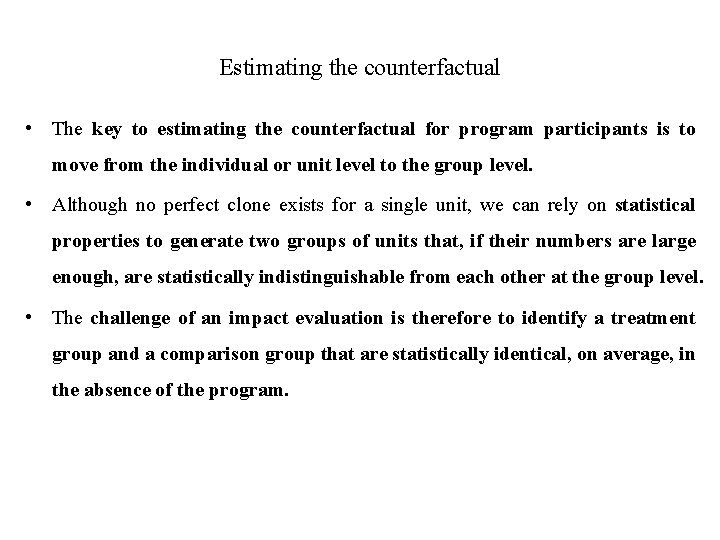
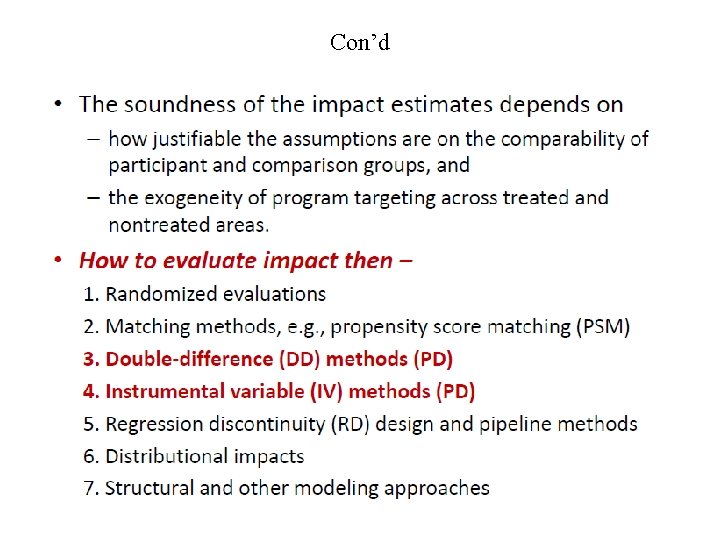
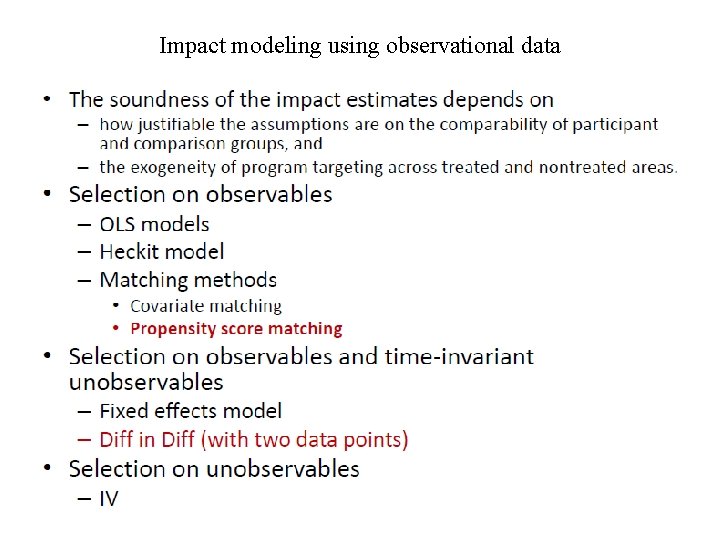
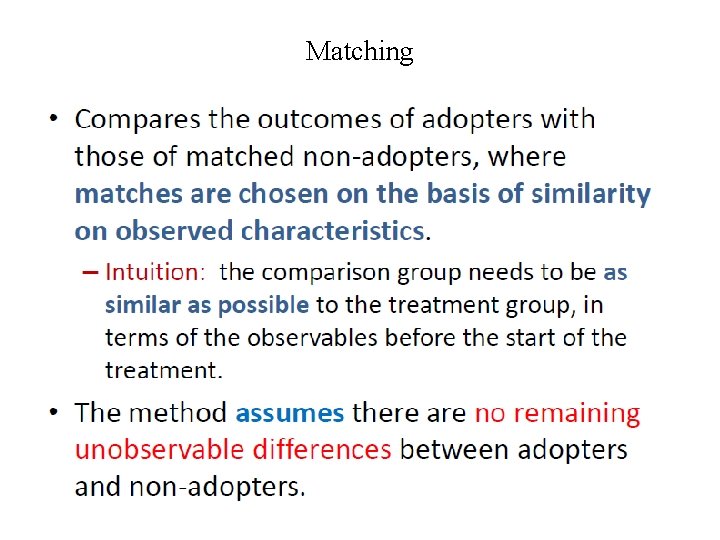
Estimating the counterfactual • The key to estimating the counterfactual for program participants is to move from the individual or unit level to the group level. • Although no perfect clone exists for a single unit, we can rely on statistical properties to generate two groups of units that, if their numbers are large enough, are statistically indistinguishable from each other at the group level. • The challenge of an impact evaluation is therefore to identify a treatment group and a comparison group that are statistically identical, on average, in the absence of the program.
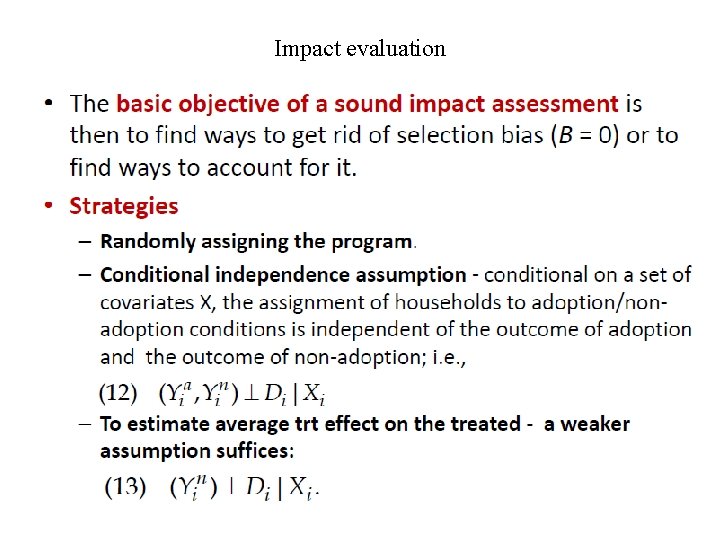
Con’d • If the two groups are identical, with the sole exception that one group participates in the program and the other does not, then we can be sure that any difference in outcomes must be due to the program. • Finding such comparison groups is the crux of any impact evaluation, regardless of what type of program is being evaluated. • Without a comparison group that yields an accurate estimate of the counterfactual, the true impact of a program cannot be established.
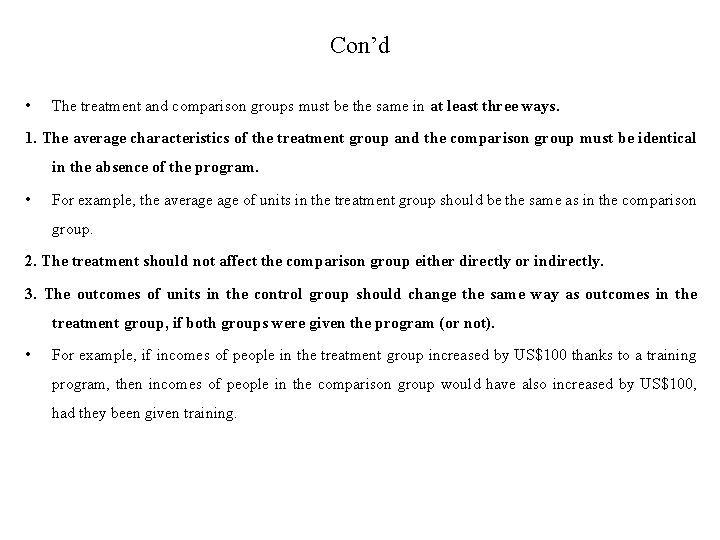
Con’d • The treatment and comparison groups must be the same in at least three ways. 1. The average characteristics of the treatment group and the comparison group must be identical in the absence of the program. • For example, the average of units in the treatment group should be the same as in the comparison group. 2. The treatment should not affect the comparison group either directly or indirectly. 3. The outcomes of units in the control group should change the same way as outcomes in the treatment group, if both groups were given the program (or not). • For example, if incomes of people in the treatment group increased by US$100 thanks to a training program, then incomes of people in the comparison group would have also increased by US$100, had they been given training.
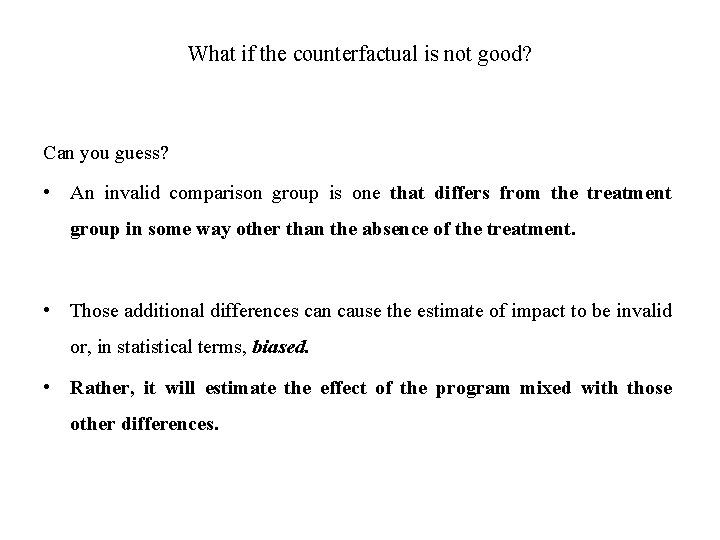
What if the counterfactual is not good? Can you guess? • An invalid comparison group is one that differs from the treatment group in some way other than the absence of the treatment. • Those additional differences can cause the estimate of impact to be invalid or, in statistical terms, biased. • Rather, it will estimate the effect of the program mixed with those other differences.
False Counterfactual
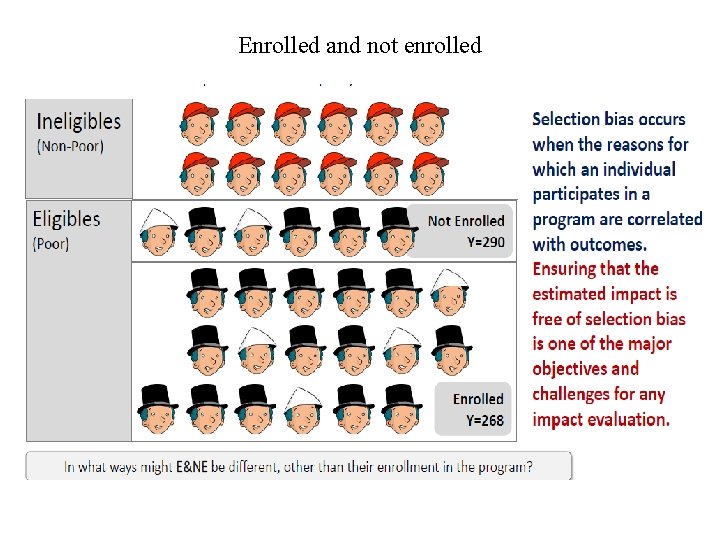
Enrolled and not enrolled
Selection bias
Observational study methods for impact assessment (PSM)
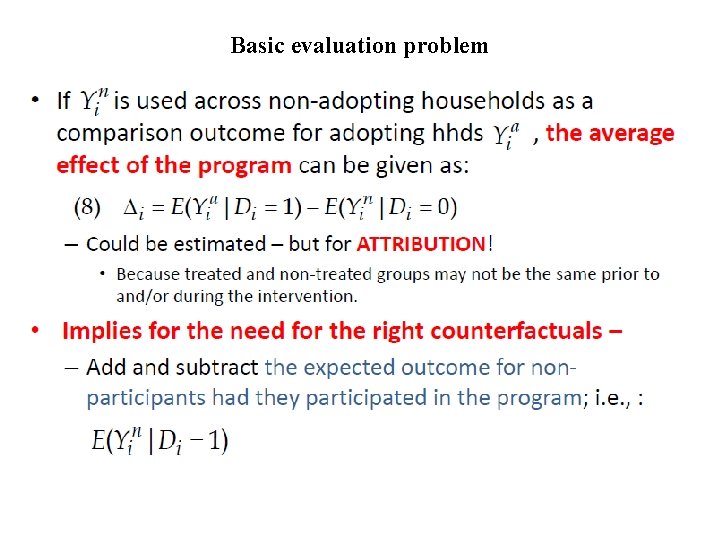
Basic evaluation problem
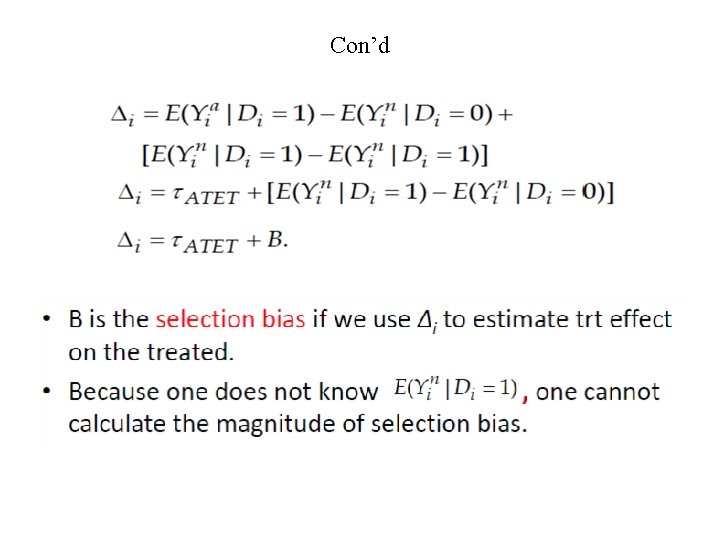
Con’d
Impact evaluation
Con’d
Impact modeling using observational data
Matching
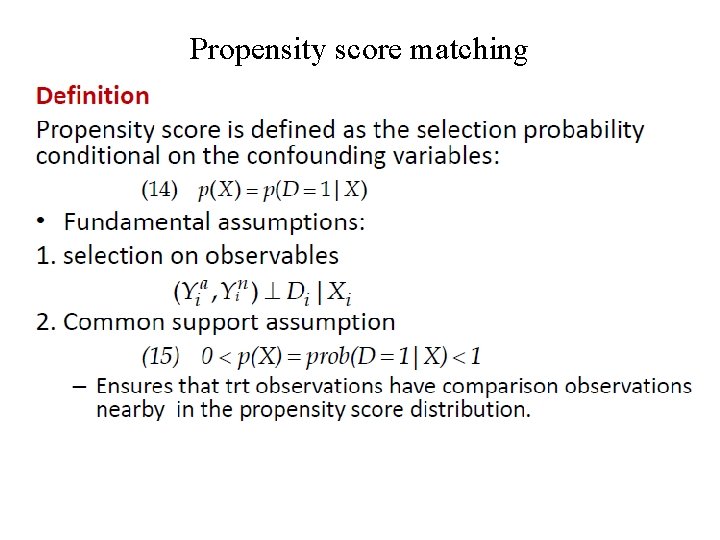
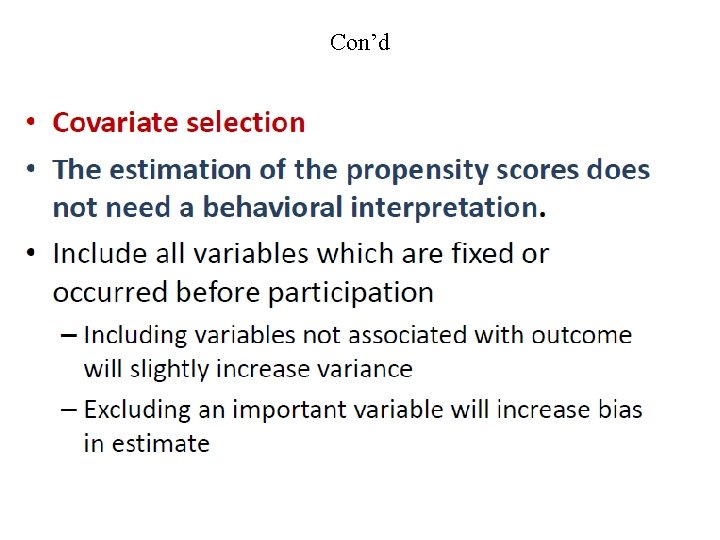
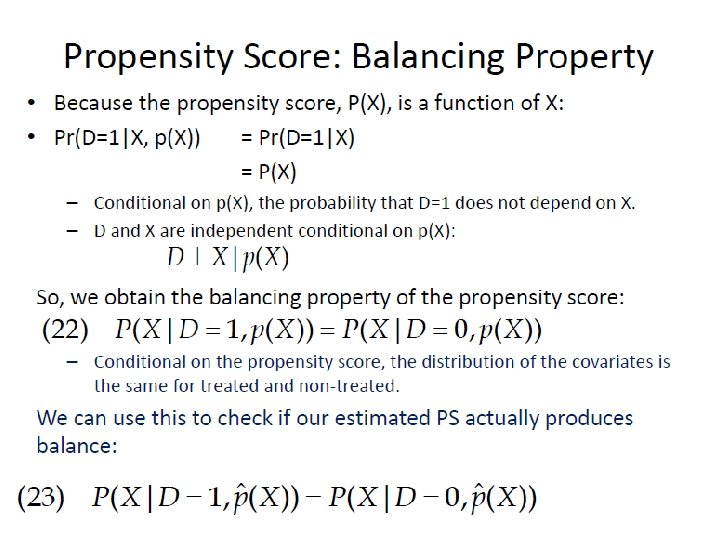
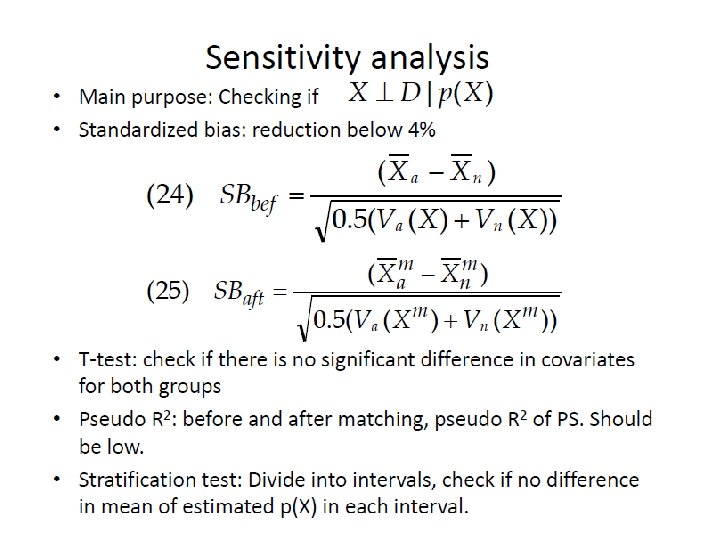
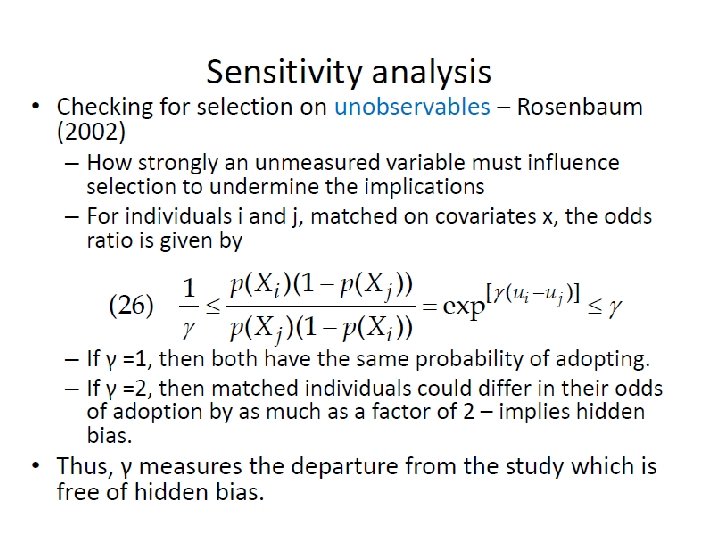
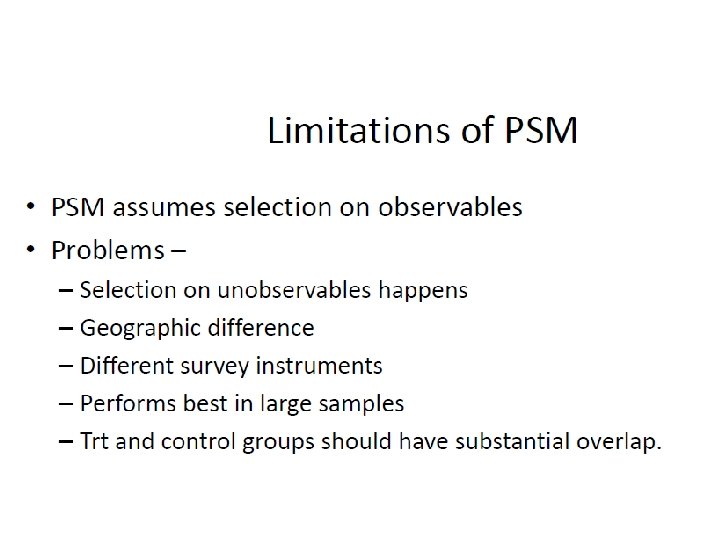
Propensity score matching
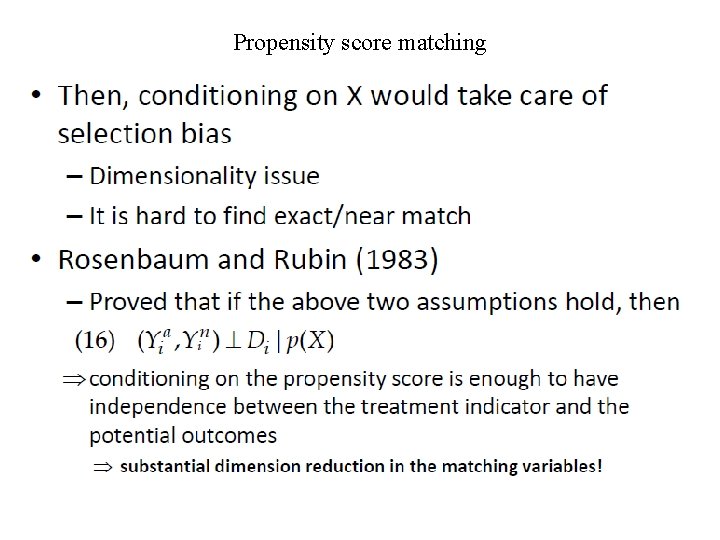
Propensity score matching
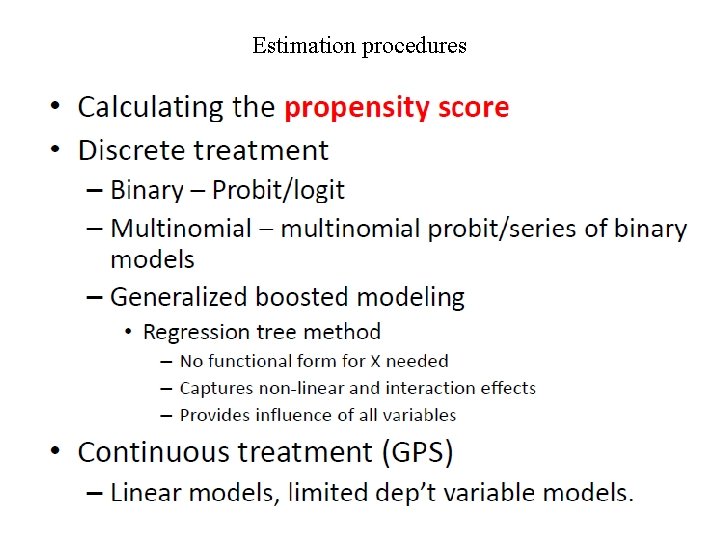
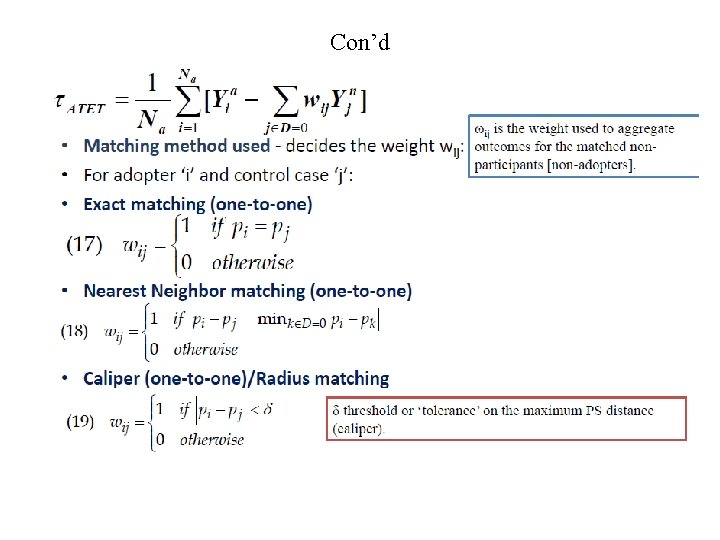
Estimation procedures
Con’d
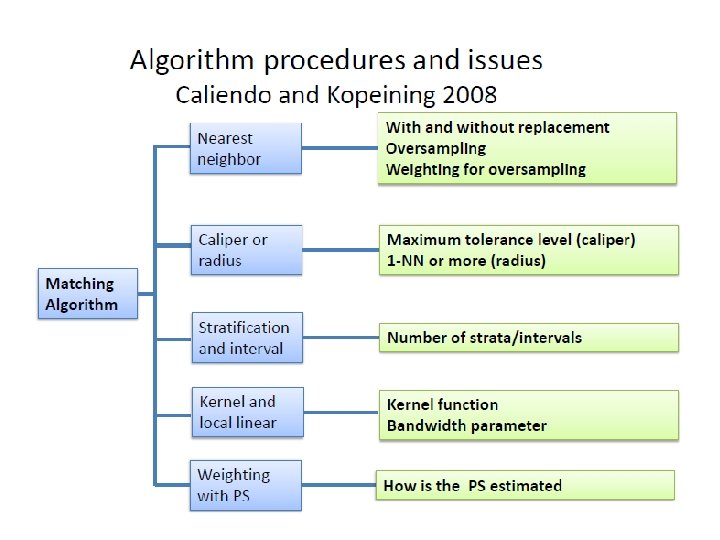
Con’d
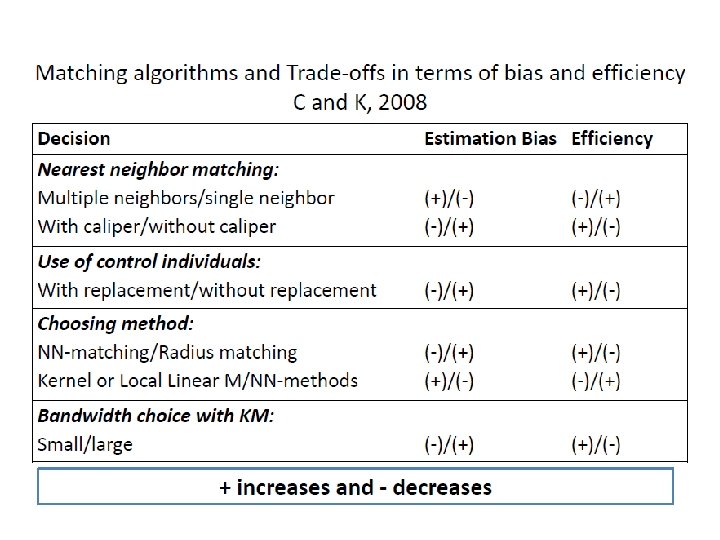
Con’d
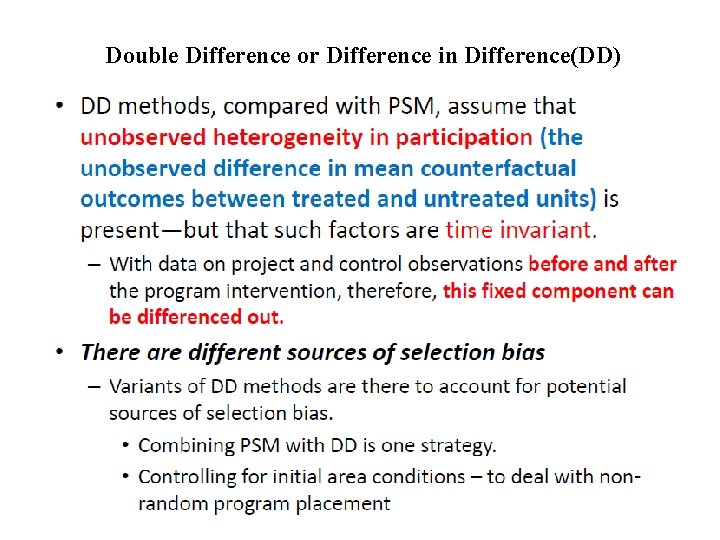
Double Difference or Difference in Difference(DD)
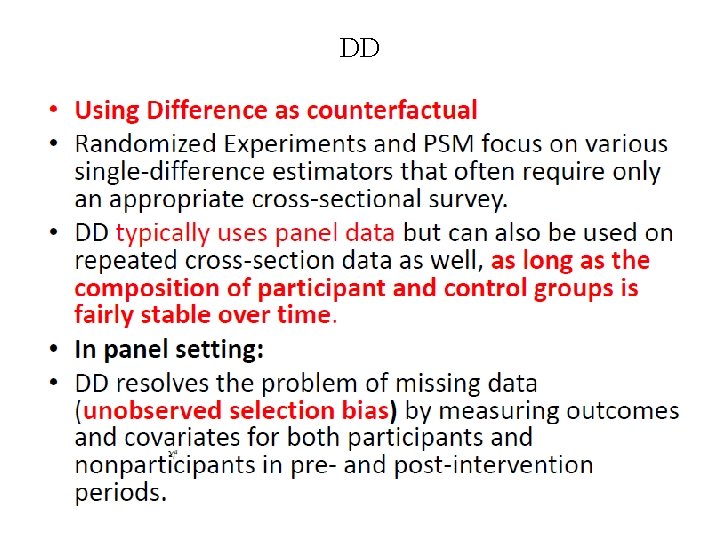
DD
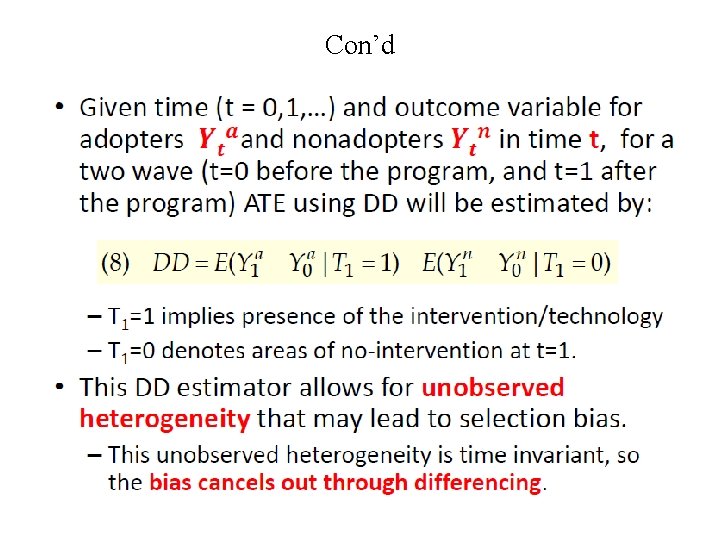
Con’d
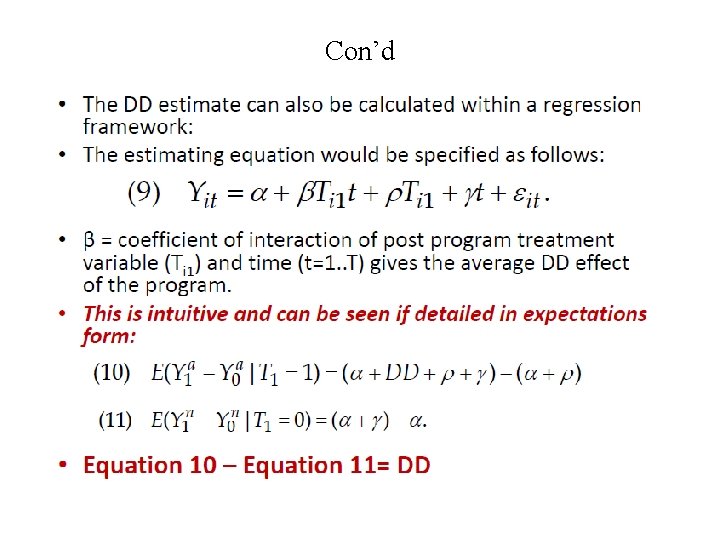
Con’d