
Introduction to Imagebased Rendering Ying Wu Electrical Engineering
Introduction to Image-based Rendering Ying Wu Electrical Engineering and Computer Science Northwestern University Evanston, IL 60208 http: //www. eecs. northwestern. edu/~yingwu
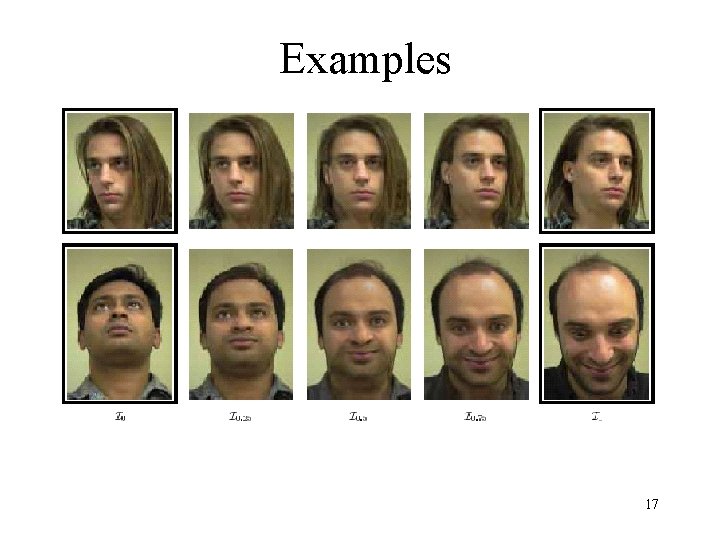
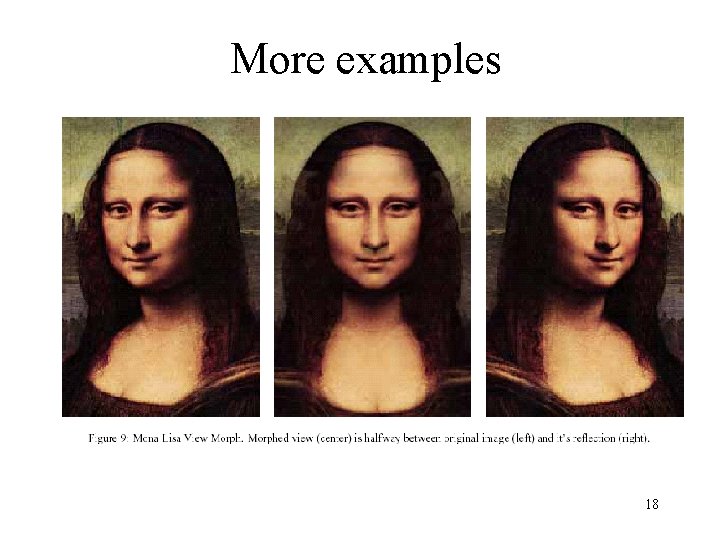
View Morphing • Seitz & Dyer SIGGRAPH’ 96 • Synthesize images in transition of two views based on two images • No 3 D shape is required 2
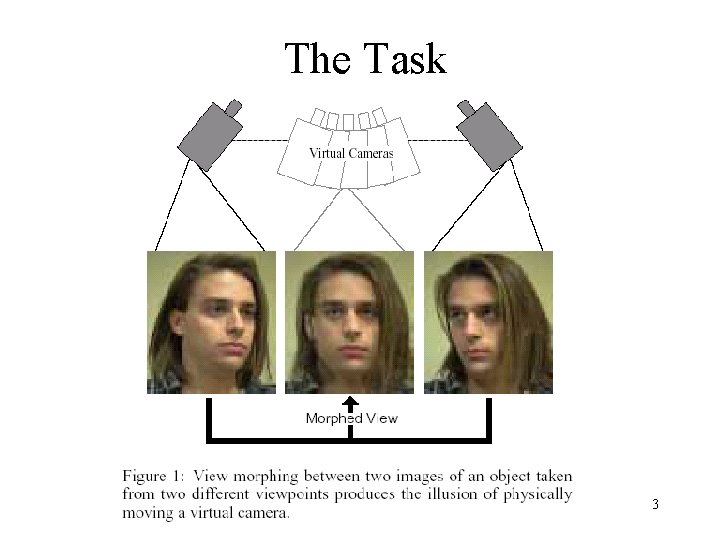
The Task 3
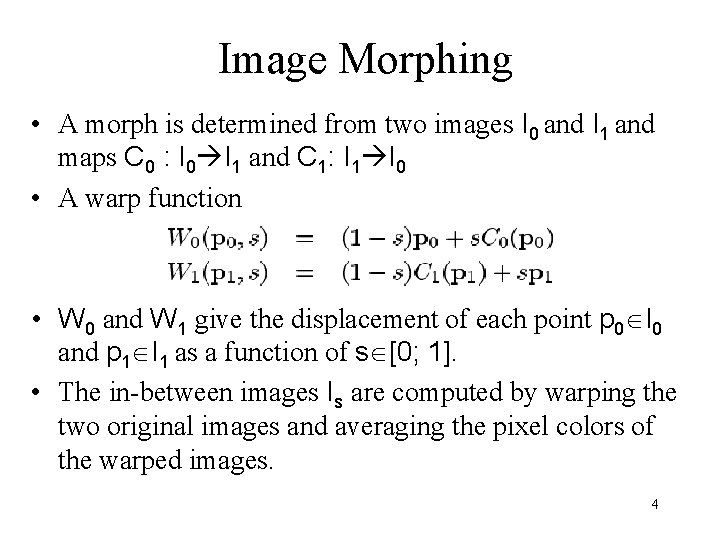
Image Morphing • A morph is determined from two images I 0 and I 1 and maps C 0 : I 0 I 1 and C 1: I 1 I 0 • A warp function • W 0 and W 1 give the displacement of each point p 0 I 0 and p 1 I 1 as a function of s [0; 1]. • The in-between images Is are computed by warping the two original images and averaging the pixel colors of the warped images. 4
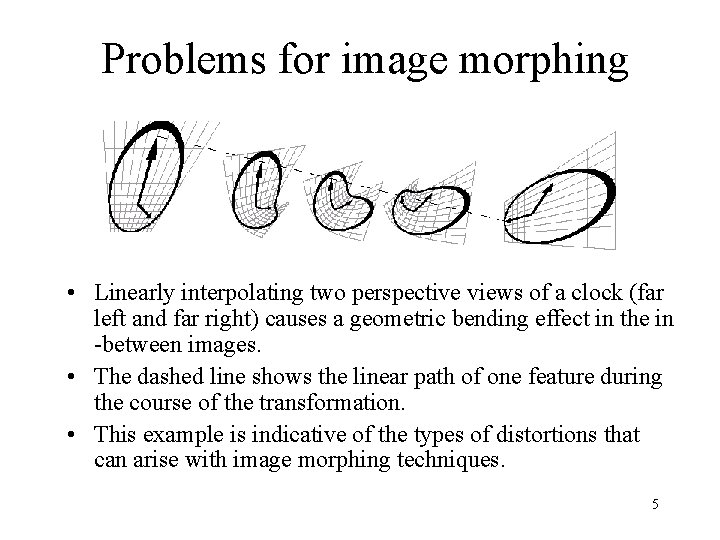
Problems for image morphing • Linearly interpolating two perspective views of a clock (far left and far right) causes a geometric bending effect in the in -between images. • The dashed line shows the linear path of one feature during the course of the transformation. • This example is indicative of the types of distortions that can arise with image morphing techniques. 5
Notations 6
Assumptions • Two images I 1 and I 2 of the same 3 D objects • Their projection matrices 1 and 2 • Pixel correspondences of the two images 7
Morphing Parallel Views 8
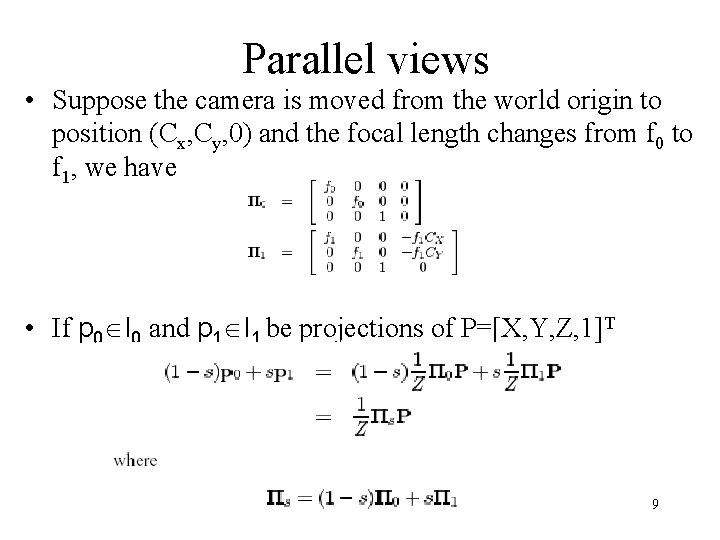
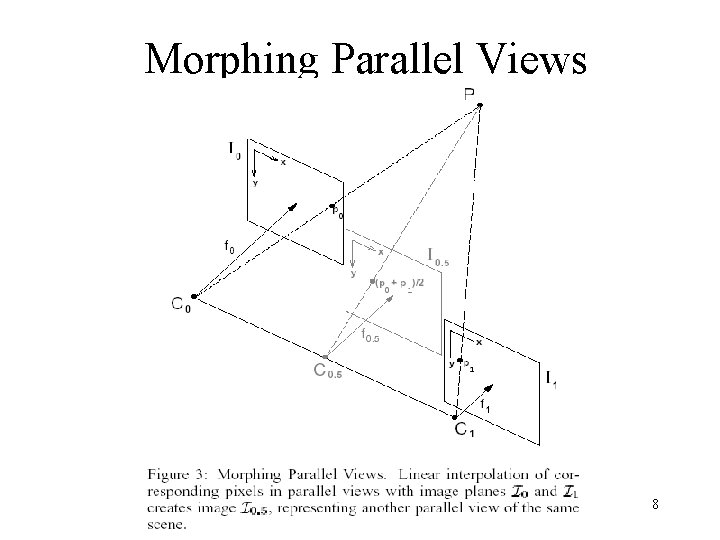
Parallel views • Suppose the camera is moved from the world origin to position (Cx, Cy, 0) and the focal length changes from f 0 to f 1, we have • If p 0 I 0 and p 1 I 1 be projections of P=[X, Y, Z, 1]T 9
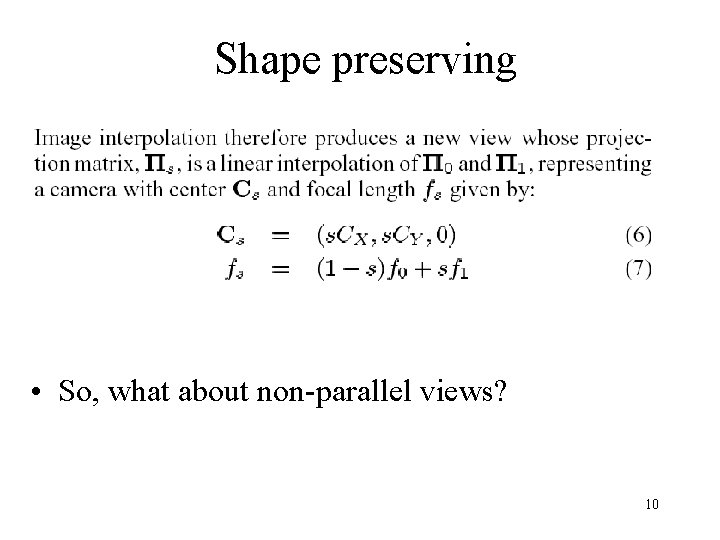
Shape preserving • So, what about non-parallel views? 10
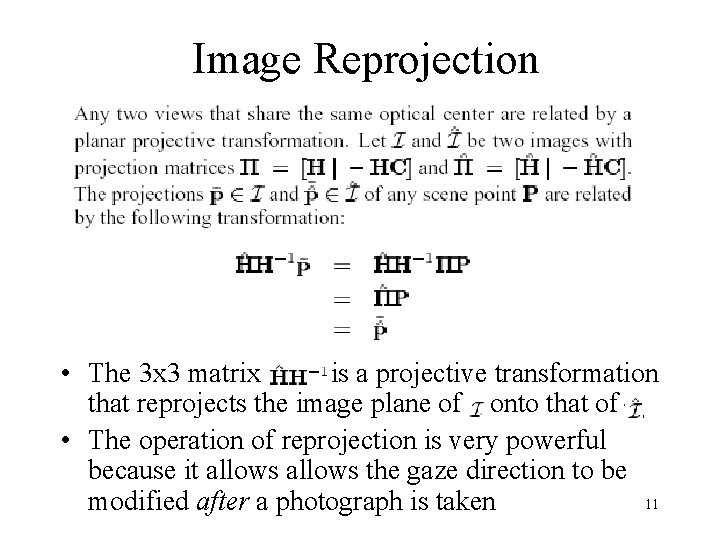
Image Reprojection • The 3 x 3 matrix is a projective transformation that reprojects the image plane of onto that of • The operation of reprojection is very powerful because it allows the gaze direction to be 11 modified after a photograph is taken
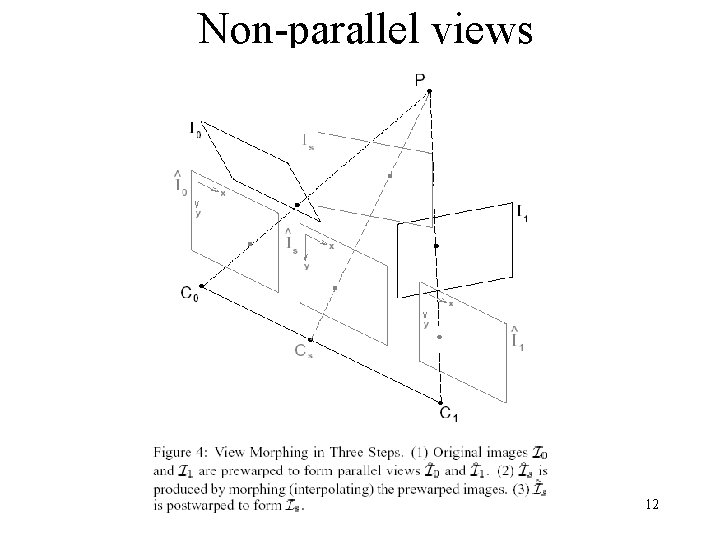
Non-parallel views 12
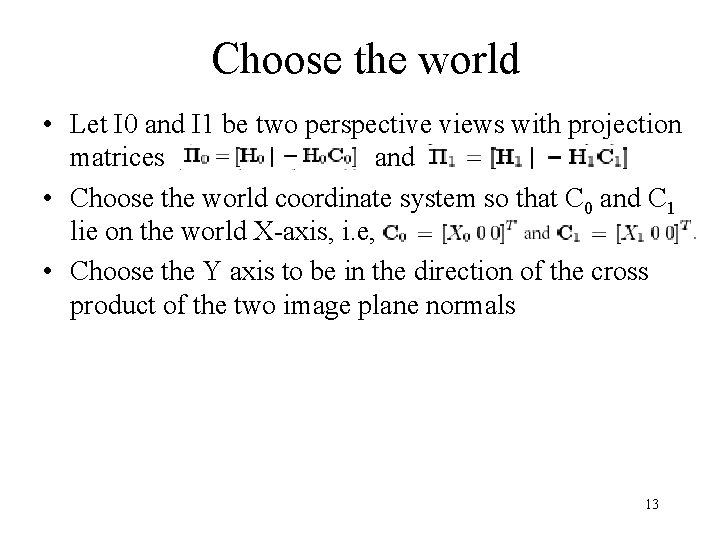
Choose the world • Let I 0 and I 1 be two perspective views with projection matrices and • Choose the world coordinate system so that C 0 and C 1 lie on the world X-axis, i. e, • Choose the Y axis to be in the direction of the cross product of the two image plane normals 13
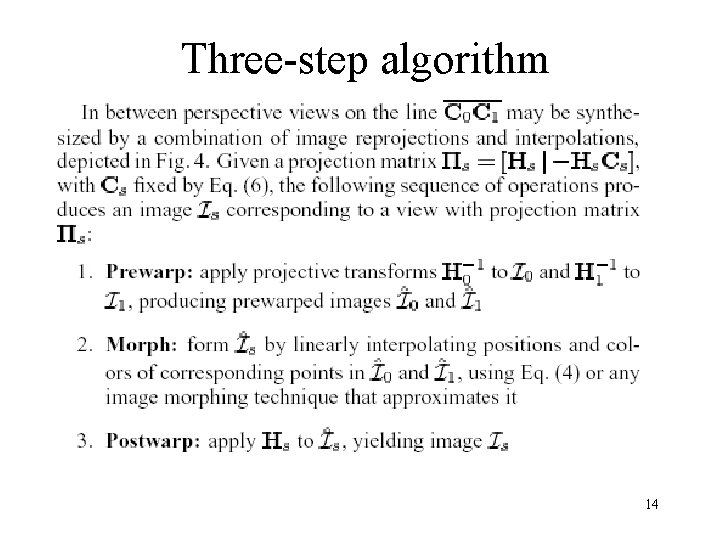
Three-step algorithm 14
Discussion • Can you see the relation of the prewarp step and the stereo rectification that we have learnt before? 15
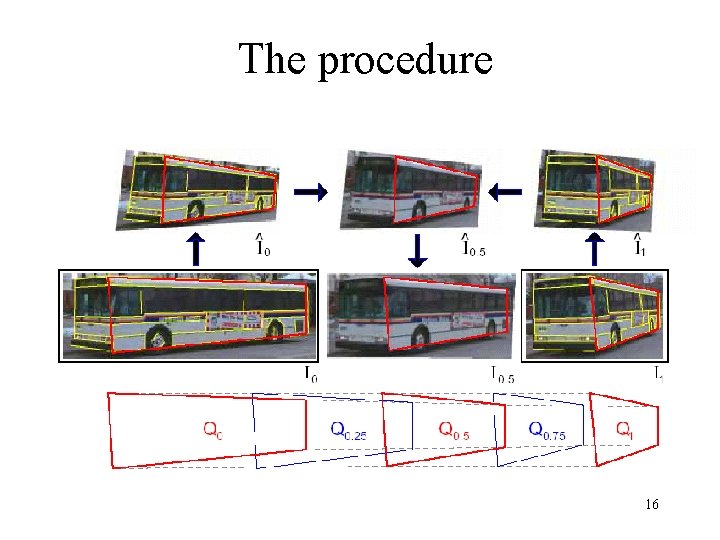
The procedure 16
Examples 17
More examples 18
- Slides: 18