
Introduction to Image Processing Course Notes Anup Basu
Introduction to Image Processing Course Notes Anup Basu, Ph. D. Professor, Dept of Computing Sc. University of Alberta
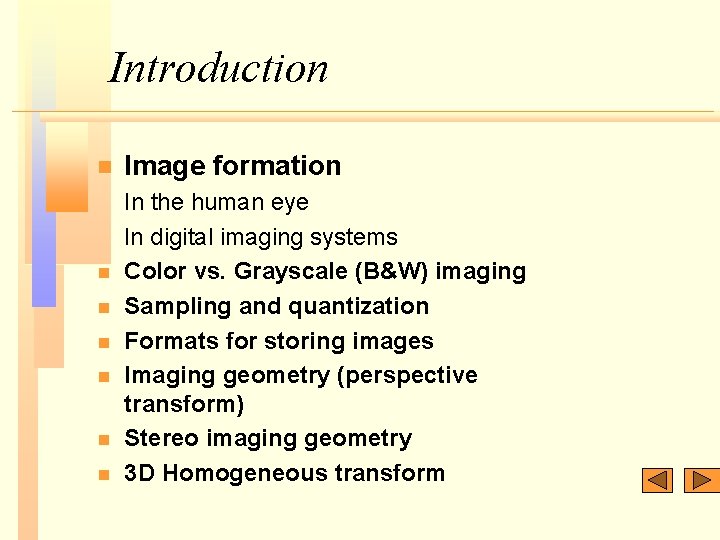
Introduction n n n Image formation In the human eye In digital imaging systems Color vs. Grayscale (B&W) imaging Sampling and quantization Formats for storing images Imaging geometry (perspective transform) Stereo imaging geometry 3 D Homogeneous transform
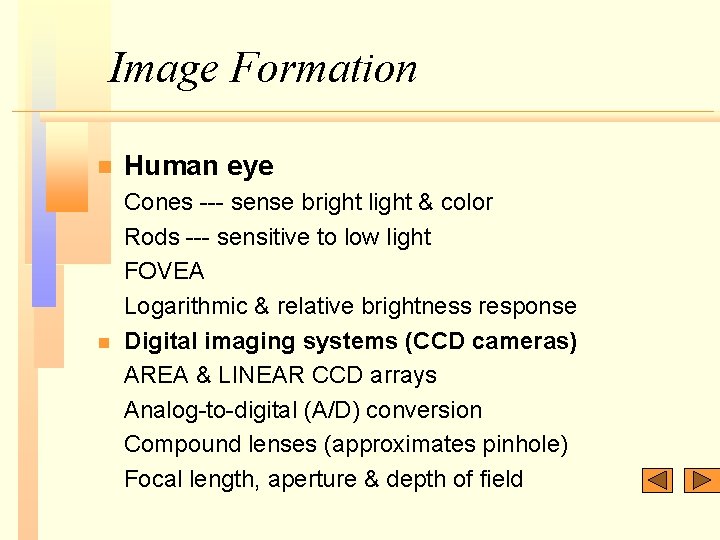
Image Formation n Human eye n Cones --- sense bright light & color Rods --- sensitive to low light FOVEA Logarithmic & relative brightness response Digital imaging systems (CCD cameras) AREA & LINEAR CCD arrays Analog-to-digital (A/D) conversion Compound lenses (approximates pinhole) Focal length, aperture & depth of field

Color vs. Grayscale imaging n n Color R, G, B representation H, S, I representation other representations Grayscale binary images (e. g. , text ) more than 2 levels

Sampling & Quantization n Sampling n Spatial vs. temporal Resolution Quantization Grayscale images Color images

Storage formats (uncompressed) n Bitmap n GIFF (graphic interchange file format) TIFF (tag interchange file format) rasterfile (Sun Microsystems) ppm, pgm, pbm (portable …) General format structure Header Body, containing pixel (picture element) values n n
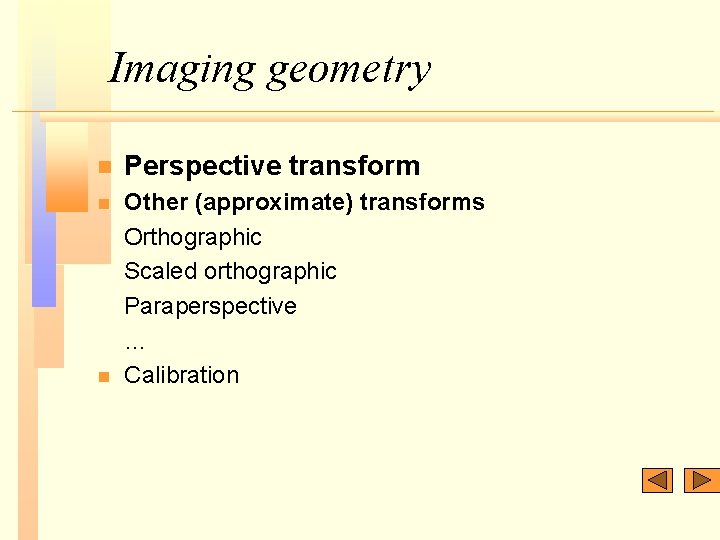
Imaging geometry n Perspective transform n Other (approximate) transforms Orthographic Scaled orthographic Paraperspective … Calibration n
Stereo geometry n Stereo camera separation n Left and right images Estimating 3 D from stereo Human stereo perception (Graphics) Computer stereo perception (Computer Vision) n n n
Stereo geometry n Stereo camera separation n Left and right images Estimating 3 D from stereo Human stereo perception (Graphics) Computer stereo perception (Computer Vision) n n n
2 & 3 D Homogeneous Transforms n Scaling; n Translation Rotation 2 D homogeneous transforms 3 D homogeneous transforms n n n
- Slides: 10