
Introduction to ICMLive Richard Body Product Sector Leader
Introduction to ICMLive Richard Body Product Sector Leader – Operational Forecasting
What is operational forecasting? § The ability to predict what is likely to happen in the future based on current/past data § Predictions based on the results of model simulations § Provides information to the user which can be used to make operational choices § It does not operate the system automatically – yet!
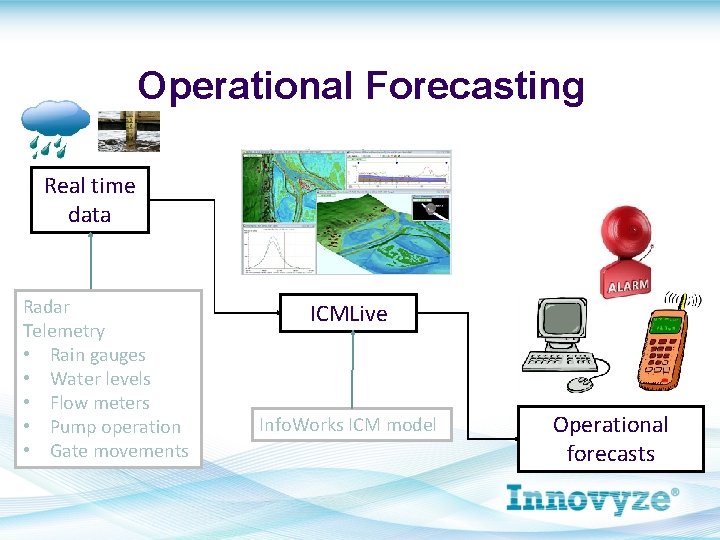
Operational Forecasting Real time data Radar Telemetry • Rain gauges • Water levels • Flow meters • Pump operation • Gate movements ICMLive Info. Works ICM model Operational forecasts
ICMLive § Links to telemetry and other data sources to receive real-time and forecast data § Runs regular automatic simulations of the Info. Works ICM model § Run interval can be reduced automatically if various criteria is met § Forecasts levels, flows & water quality across whole catchment § Generates warnings and alerts to the operator § Two interfaces: one to set up the system and one for the control room
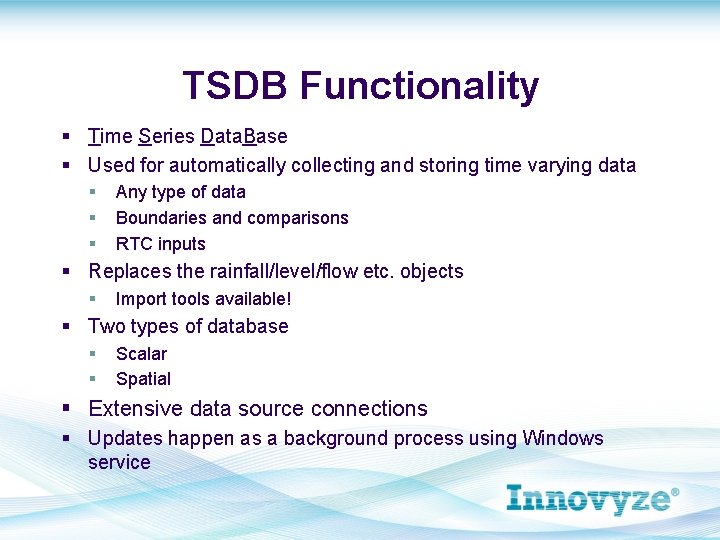
TSDB Functionality § Time Series Data. Base § Used for automatically collecting and storing time varying data § § § Any type of data Boundaries and comparisons RTC inputs § Replaces the rainfall/level/flow etc. objects § Import tools available! § Two types of database § § Scalar Spatial § Extensive data source connections § Updates happen as a background process using Windows service
Benefits § Operational Management § Assessment of control strategies § Real-time calibration § Alert and warning dissemination
EASTNEY PUMP STATION
Eastney Project Background § Project initiation § 4 D JV engaged Innovyze to build early warning system § Hydraulic model developed by MWH using Info. Works CS § Operational system designed by Innovyze using ICMLive § System goals § Forecast water levels for flood forecasting § Forecast pump operation § Forecast flows to Fort Cumberland
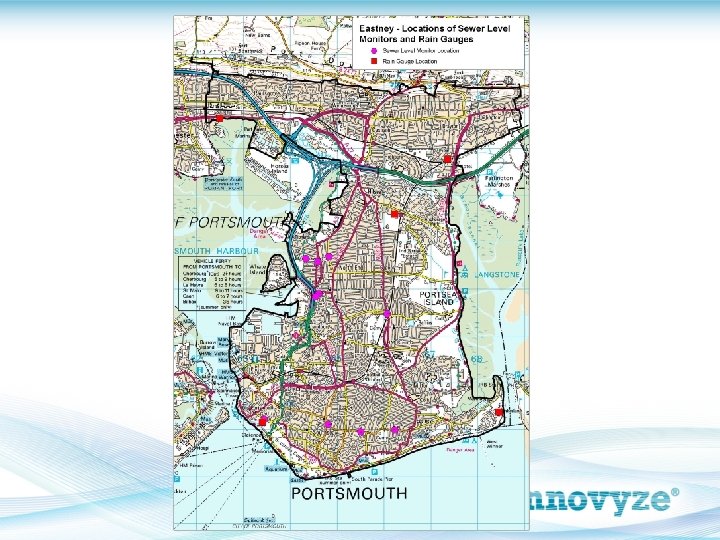
System Overview § Pumping Station located in Eastney § Four large diesel pumps § Two small diesel pumps modelled as a combined pump in IWCS § Sister pumping station (four electric pumps) § Pumping stations at Cosham, Drayton, Copnor § ICMLive system used to combine rainfall radar and gauge data with level and pump information to provide warnings of pump operation and flows § Operators able to change the pump settings in ICM model in order to improve levels of service
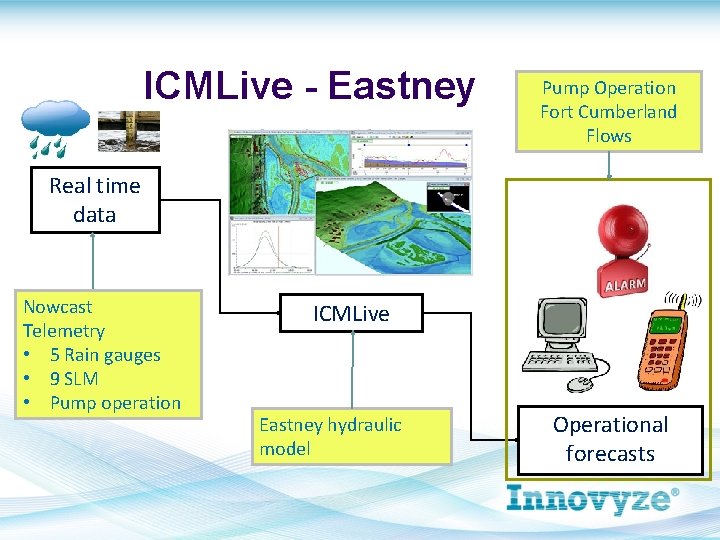
ICMLive - Eastney Pump Operation Fort Cumberland Flows Real time data Nowcast Telemetry • 5 Rain gauges • 9 SLM • Pump operation ICMLive Eastney hydraulic model Operational forecasts
Decision Support § Forecasts run every fifteen minutes § Forecast period 6 hours § Critical results § Observed/modelled levels § Pump settings – visible in map view § Radar rainfall can be overlain § Critical Points § Eastney Pumping Station § Long and short sea outfalls

THAMES WATER OPERATIONAL FORECASTING
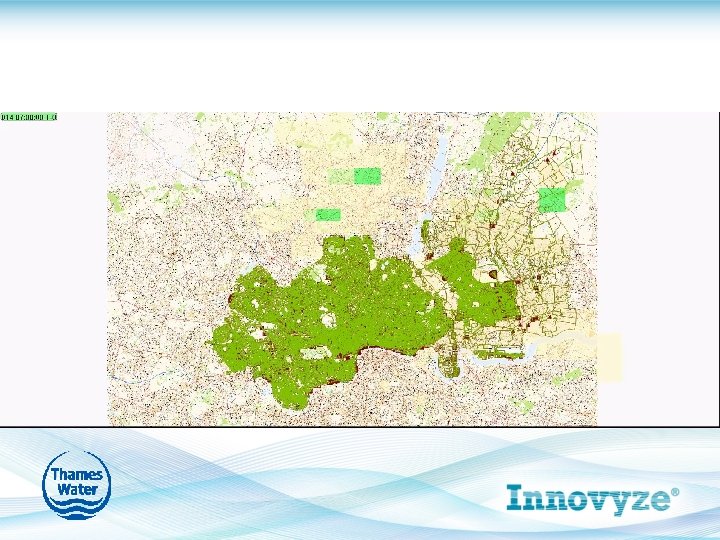
An operational forecasting system for London § ICM model combined with ICMLive forecasting software § § 3 large scale Info. Works ICM models – Beckton, Deephams & Mogden Real time radar rainfall data Forecast radar rainfall data Real time Sewer Level Monitor data § Key system criteria § § § System robustness Sufficient lead time Useful outputs
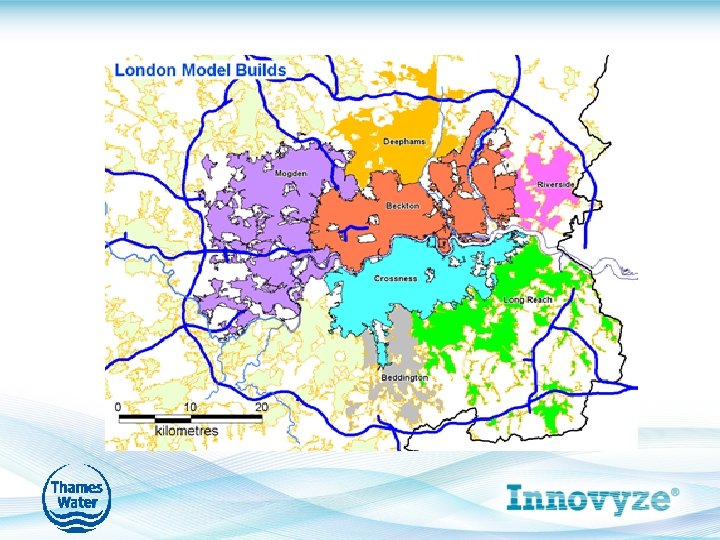
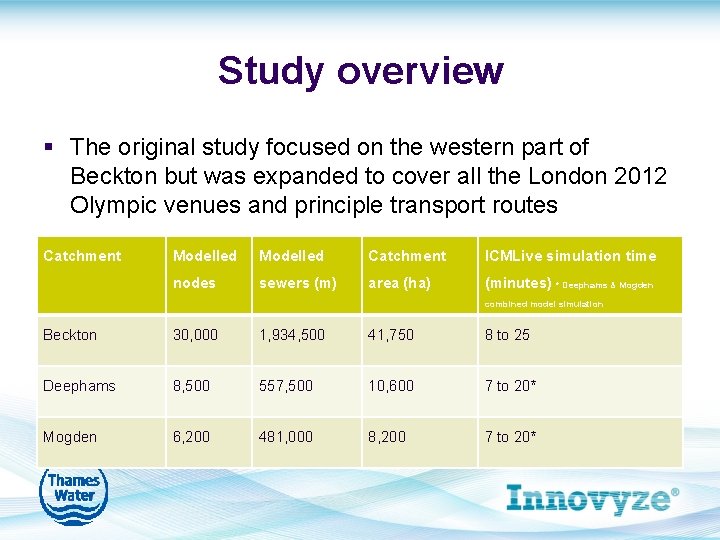
Study overview § The original study focused on the western part of Beckton but was expanded to cover all the London 2012 Olympic venues and principle transport routes Catchment Modelled Catchment ICMLive simulation time nodes sewers (m) area (ha) (minutes) * Deephams & Mogden combined model simulation Beckton 30, 000 1, 934, 500 41, 750 8 to 25 Deephams 8, 500 557, 500 10, 600 7 to 20* Mogden 6, 200 481, 000 8, 200 7 to 20*
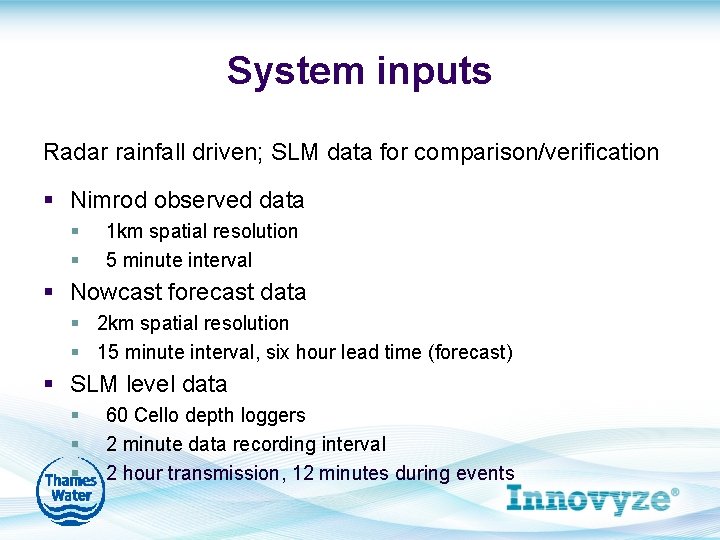
System inputs Radar rainfall driven; SLM data for comparison/verification § Nimrod observed data § § 1 km spatial resolution 5 minute interval § Nowcast forecast data § 2 km spatial resolution § 15 minute interval, six hour lead time (forecast) § SLM level data § § § 60 Cello depth loggers 2 minute data recording interval 2 hour transmission, 12 minutes during events
Thames Water objectives To understand how a live operational system could be implemented at Thames Water § § IT requirements Software configuration Alarm options, setting and notifications Operational response. What, when, where, how and who. § Make better use of existing data sets § § 12 years of Historic Nimrod radar data Sewer level sensor data § To use models as live operational tools § § Programme of London model enhancements To improve TW’s understanding how the networks are operated
Study conclusions The alarms set have worked well, but there continue to be a number of false alarms These can be minimised by § § § Greater understanding of alarm thresholds (It takes time to bed-in) Updating the model to reflect operational changes (diversions, pump outages, cleaning) Understanding the weather patterns and forecast rainfall (steady frontal weather systems are easier to forecast than convective summer thunderstorms) Alarms 6 to 3 hours out should be used as warnings Alarms 3 to 0 hours out are much more reliable Pick suitable sites where you get good data and where Operations’ response time is 1 to 2 hours
Study conclusions Dealing with predictive alarms requires a different approach and level of understanding to responding to actual alarms § Predictive asset management requires proactive rather than reactive intervention § This in turn requires a greater understanding of the § Asset § Catchment § Risk / cost of inaction § Cost benefits of positive action § Commitment and resources from the business
Study conclusions § Innovyze § § Successful partnership with Thames Water A number of software improvements have been identified and have been implemented in to ICMLive § Thames Water § § We have successfully set up a live operational system that fits within our IT systems We are making good use of our sewer level data Strengthened our relationship with Operations as we work together to understand the alarms and thresholds settings ICMLive alarm outputs will be linked into Thames Water’s new Operational control software currently in development
- Slides: 22