
Introduction to Hypothesis Testing Hypothesis Testing The general

- Slides: 19
Introduction to Hypothesis Testing
Hypothesis Testing �The general goal of a hypothesis test is to rule out chance (sampling error) as a plausible explanation for the results from a research study. �Hypothesis testing is a technique to help determine whether a specific treatment has an effect on the individuals in a population.
Hypothesis Testing Steps The following five steps outline the process of hypothesis testing and introduce some of the new terminology:
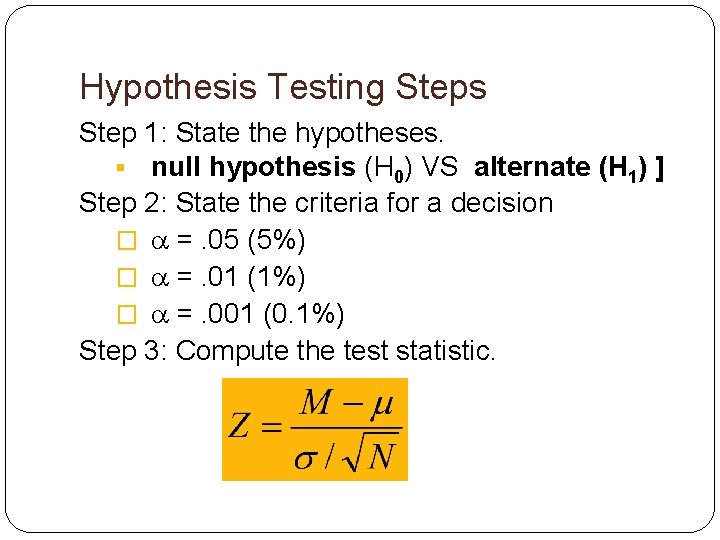
Hypothesis Testing Steps Step 1: State the hypotheses. § null hypothesis (H 0) VS alternate (H 1) ] Step 2: State the criteria for a decision � =. 05 (5%) � =. 01 (1%) � =. 001 (0. 1%) Step 3: Compute the test statistic.
Hypothesis Testing Steps Step 4: Making a statistical decision § Reject null hypothesis VS fail to reject Step 5: Stating a conclusion – stating what the results mean.
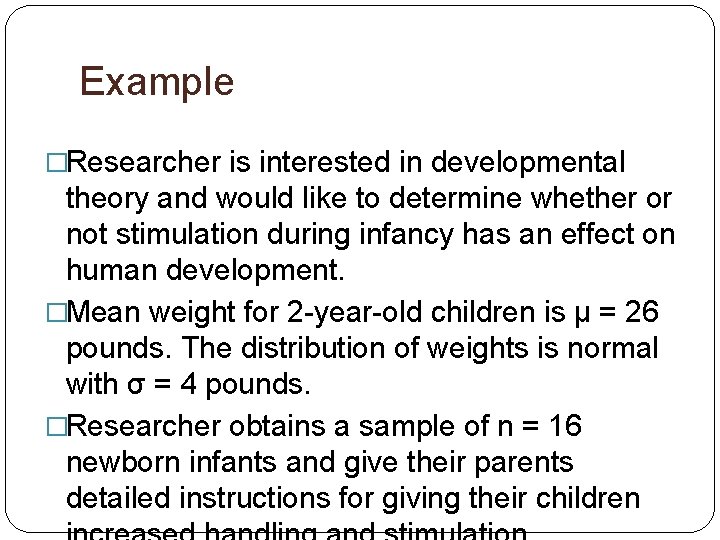
Example �Researcher is interested in developmental theory and would like to determine whether or not stimulation during infancy has an effect on human development. �Mean weight for 2 -year-old children is μ = 26 pounds. The distribution of weights is normal with σ = 4 pounds. �Researcher obtains a sample of n = 16 newborn infants and give their parents detailed instructions for giving their children
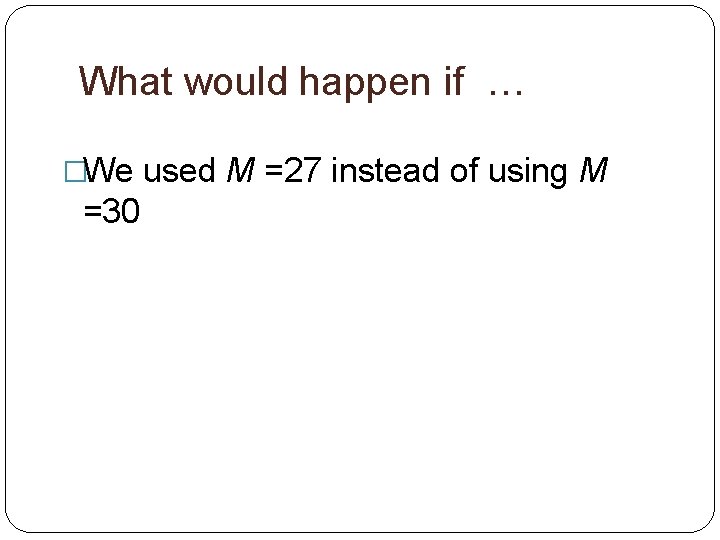
What would happen if … �We used M =27 instead of using M =30
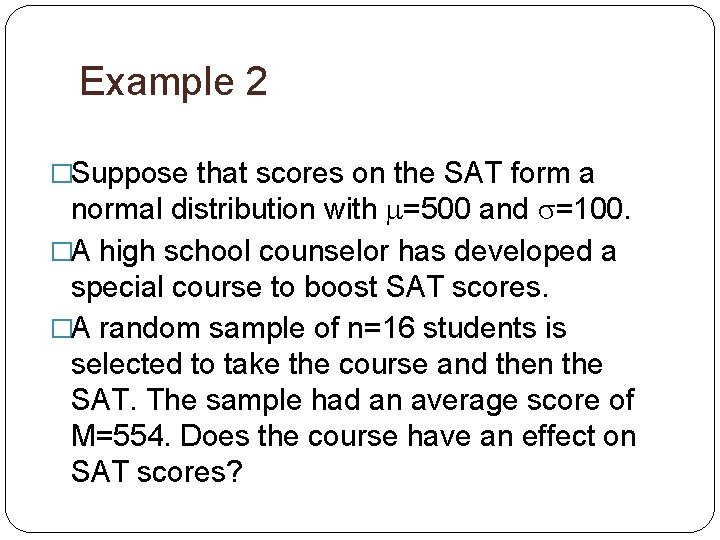
Example 2 �Suppose that scores on the SAT form a normal distribution with =500 and =100. �A high school counselor has developed a special course to boost SAT scores. �A random sample of n=16 students is selected to take the course and then the SAT. The sample had an average score of M=554. Does the course have an effect on SAT scores?
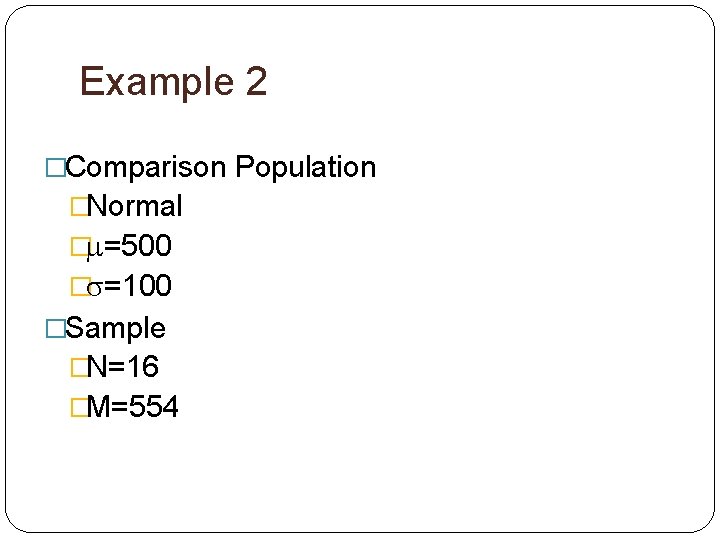
Example 2 �Comparison Population �Normal � =500 � =100 �Sample �N=16 �M=554
Introduction to Hypothesis Test – Part 2
Directional vs. Non-directional Hypotheses �Directional hypothesis test �the statistical hypotheses specify either an increase or a decrease in the population mean score. (critical region is located in one tail) �Non-Directional hypothesis test �No direction is specified
Directional vs. Non-directional Hypotheses �Changes with directional tests �When should directional vs non-directional tests be used
Type I and II errors �The researcher concludes that a treatment has an effect when in fact it does not have an effect. �Risk of a Type I error is small and is under the control of the researcher. �What are the implications of making a Type I error?
Type I and II errors �A treatment effect really does exist, but the data was such that the hypothesis failed to detect it. �The p (type II error) depends on a number of factors: �size of the effect �sample size �variability
Assumptions 1. 2. 3. 4. Random sampling – samples should be representative of the population Independent observations The value of σ is unchanged by the treatment Normal sampling distribution
Effect Size and Power
APA (2001) Publication Manual mandates. . . it is almost always necessary to include some index of effect size or strength of relationship…provide the reader not only with information about statistical significance but also with enough information to assess the magnitude of the observed effect or relationship (pp. 25 -26).
Effect Size �Why use them? Two classes of effect size measures: �Those based on correlational measures of the association between variables �Those based on standardized mean differences �Suggested rules of thumb
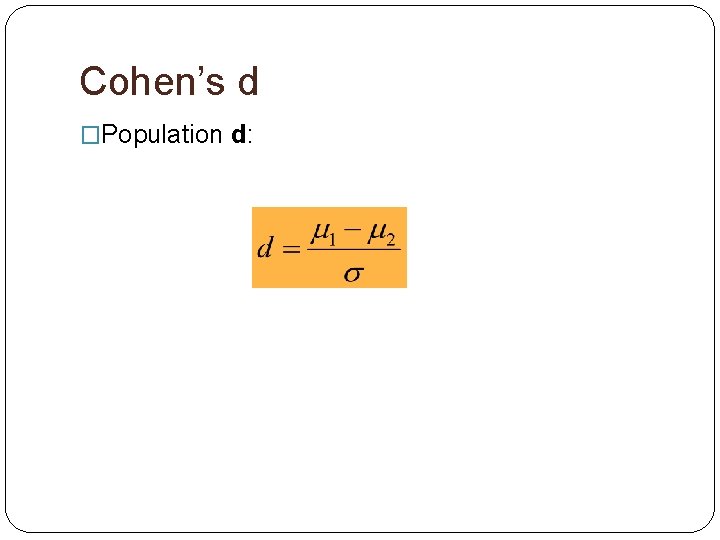
Cohen’s d �Population d: