
Introduction to Human Resource Management Introduction to HRM
- Slides: 30
Introduction to Human Resource Management
Introduction to HRM • Two questions: • Does it matter? • Why does it matter? • What is HRM? • Organization’s methods and procedures for managing people to enhance skills and motivation • Activities to enhance the organization’s ability to attract, select, retain and motivate people 2 Management 412 / Intro to HRM Fall 2008
The Death of HR ? • Traditional “personnel” function • Recordkeeping • Perceived as a dumping ground • The death of HR? • HR’s rebirth Sources: Caudron (2003); Schuler (1990); Schuler & Walker (1990); Stewart (1996); Sunoo & Laabs (1999); Ulrich (2000); Wells (2003) 3 Management 412 / Intro to HRM Fall 2008
Outsourcing HR • Would it just make more sense to outsource HR functions? • Many organizations are doing just this • Recordkeeping and administrative, perhaps • Basic functions…. . Sources: Caudron (2003); Stewart & Woods (1996); Zimmerman (April 2001) 4 Management 412 / Intro to HRM Fall 2008
Approaches to Revitalizing HR • Accounting for human resources • Managing people for competitive advantage 5 Management 412 / Intro to HRM Fall 2008
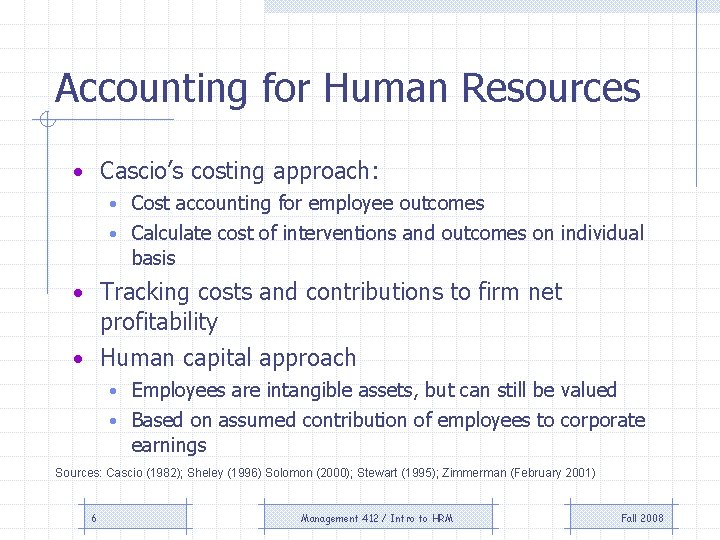
Accounting for Human Resources • Cascio’s costing approach: • Cost accounting for employee outcomes • Calculate cost of interventions and outcomes on individual basis • Tracking costs and contributions to firm net profitability • Human capital approach • Employees are intangible assets, but can still be valued • Based on assumed contribution of employees to corporate earnings Sources: Cascio (1982); Sheley (1996) Solomon (2000); Stewart (1995); Zimmerman (February 2001) 6 Management 412 / Intro to HRM Fall 2008
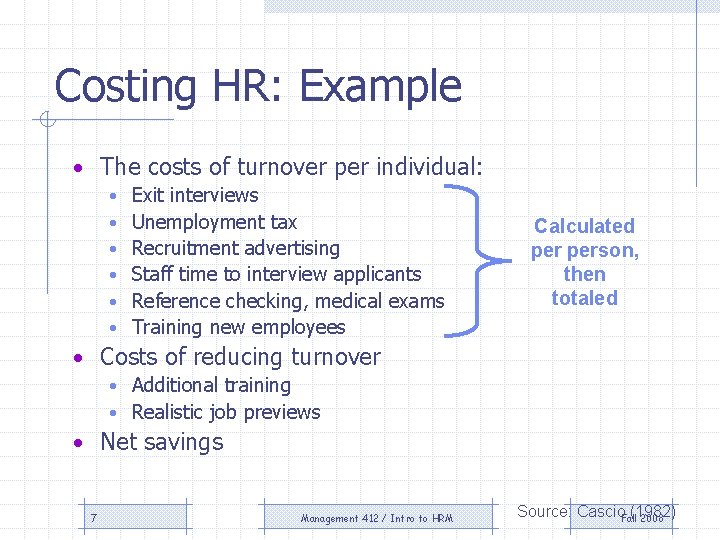
Costing HR: Example • The costs of turnover per individual: • • • Exit interviews Unemployment tax Recruitment advertising Staff time to interview applicants Reference checking, medical exams Training new employees Calculated person, then totaled • Costs of reducing turnover • Additional training • Realistic job previews • Net savings 7 Management 412 / Intro to HRM Source: Cascio. Fall(1982) 2008
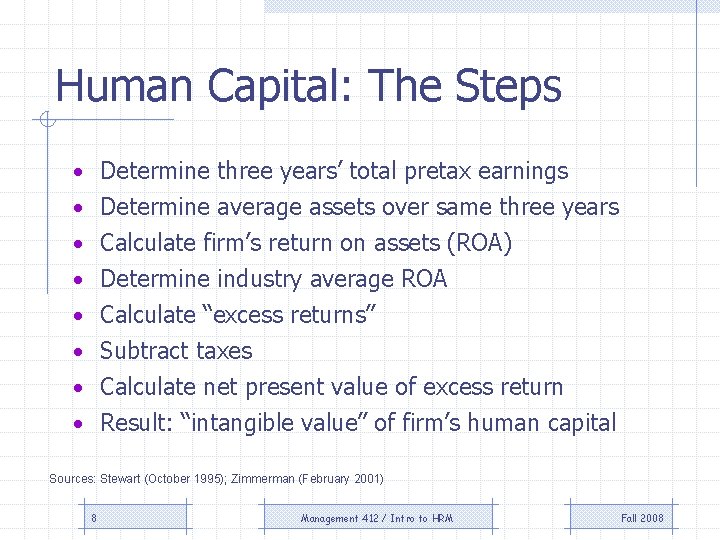
Human Capital: The Steps • Determine three years’ total pretax earnings • Determine average assets over same three years • Calculate firm’s return on assets (ROA) • Determine industry average ROA • Calculate “excess returns” • Subtract taxes • Calculate net present value of excess return • Result: “intangible value” of firm’s human capital Sources: Stewart (October 1995); Zimmerman (February 2001) 8 Management 412 / Intro to HRM Fall 2008
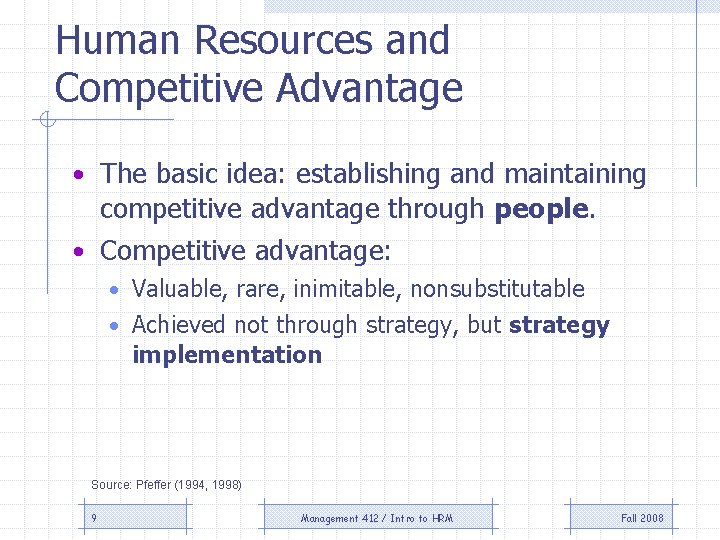
Human Resources and Competitive Advantage • The basic idea: establishing and maintaining competitive advantage through people. • Competitive advantage: • Valuable, rare, inimitable, nonsubstitutable • Achieved not through strategy, but strategy implementation Source: Pfeffer (1994, 1998) 9 Management 412 / Intro to HRM Fall 2008
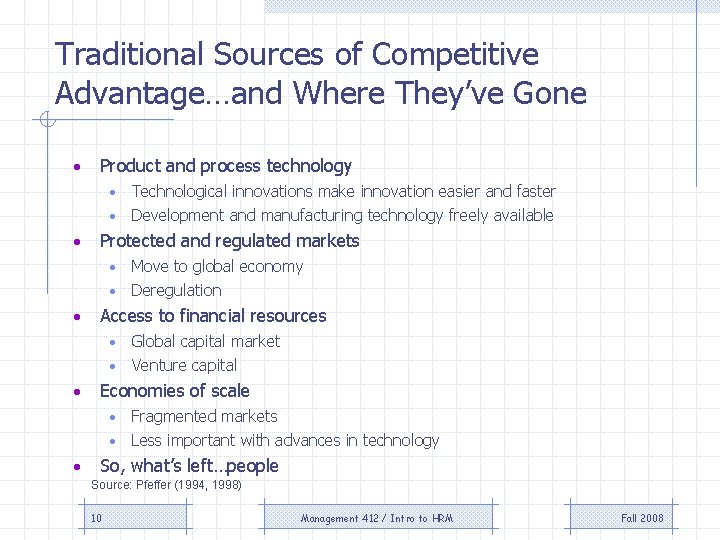
Traditional Sources of Competitive Advantage…and Where They’ve Gone • Product and process technology Technological innovations make innovation easier and faster • Development and manufacturing technology freely available • • Protected and regulated markets Move to global economy • Deregulation • • Access to financial resources Global capital market • Venture capital • • Economies of scale Fragmented markets • Less important with advances in technology • • So, what’s left…people Source: Pfeffer (1994, 1998) 10 Management 412 / Intro to HRM Fall 2008
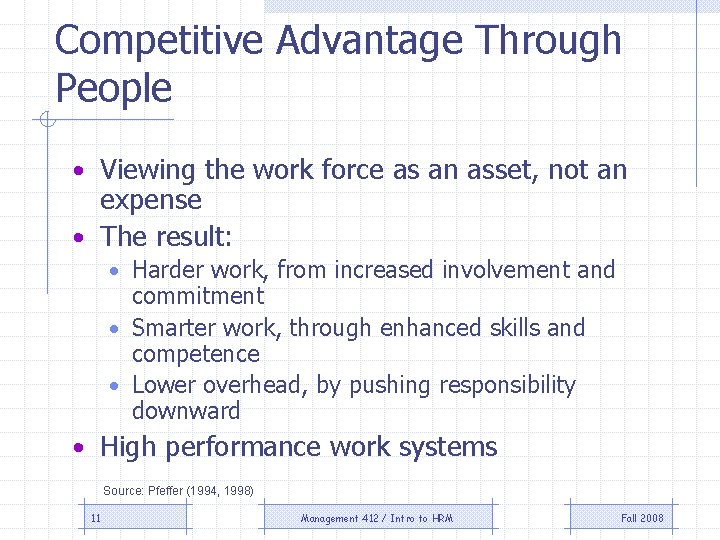
Competitive Advantage Through People • Viewing the work force as an asset, not an expense • The result: • Harder work, from increased involvement and commitment • Smarter work, through enhanced skills and competence • Lower overhead, by pushing responsibility downward • High performance work systems Source: Pfeffer (1994, 1998) 11 Management 412 / Intro to HRM Fall 2008
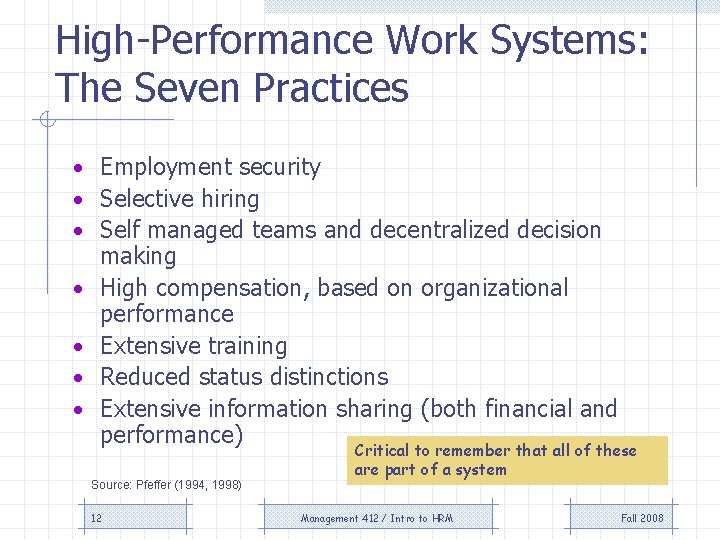
High-Performance Work Systems: The Seven Practices • Employment security • Selective hiring • Self managed teams and decentralized decision • • making High compensation, based on organizational performance Extensive training Reduced status distinctions Extensive information sharing (both financial and performance) Source: Pfeffer (1994, 1998) 12 Critical to remember that all of these are part of a system Management 412 / Intro to HRM Fall 2008
The Research Evidence • Garment manufacturing • Steel minimills • Initial public offerings 13 Management 412 / Intro to HRM Fall 2008
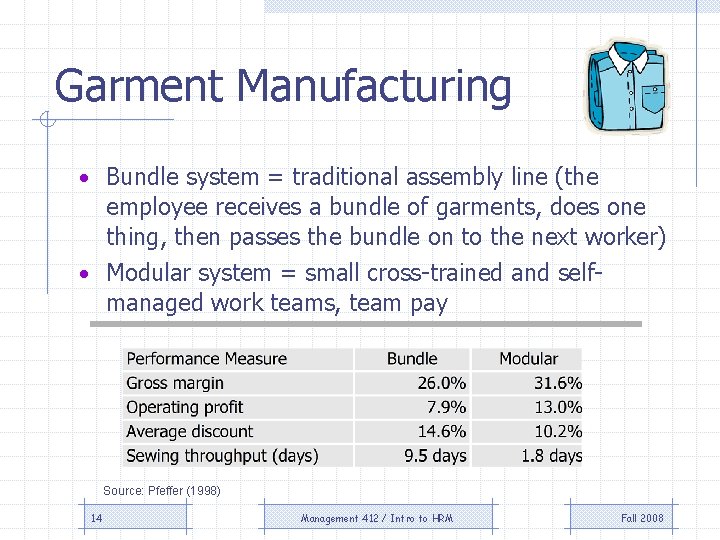
Garment Manufacturing • Bundle system = traditional assembly line (the employee receives a bundle of garments, does one thing, then passes the bundle on to the next worker) • Modular system = small cross-trained and selfmanaged work teams, team pay Source: Pfeffer (1998) 14 Management 412 / Intro to HRM Fall 2008
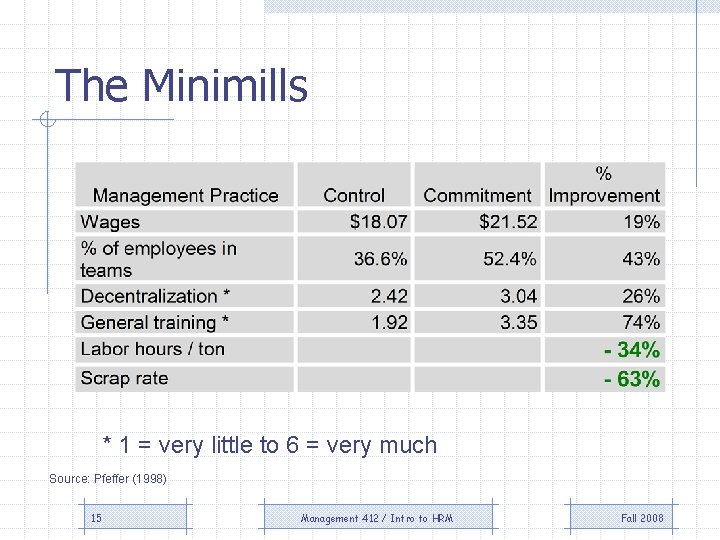
The Minimills * 1 = very little to 6 = very much Source: Pfeffer (1998) 15 Management 412 / Intro to HRM Fall 2008
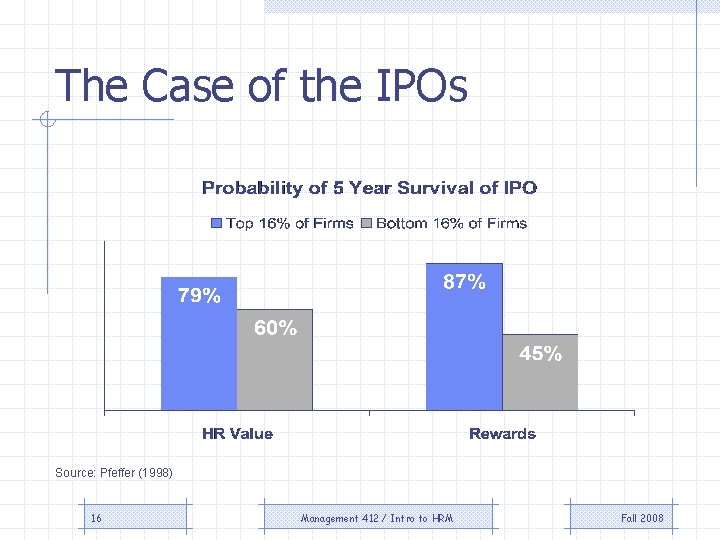
The Case of the IPOs Source: Pfeffer (1998) 16 Management 412 / Intro to HRM Fall 2008
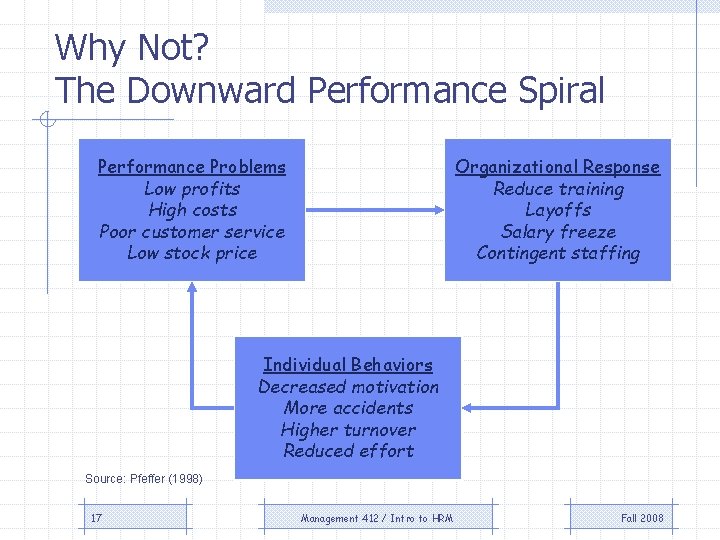
Why Not? The Downward Performance Spiral Performance Problems Low profits High costs Poor customer service Low stock price Organizational Response Reduce training Layoffs Salary freeze Contingent staffing Individual Behaviors Decreased motivation More accidents Higher turnover Reduced effort Source: Pfeffer (1998) 17 Management 412 / Intro to HRM Fall 2008
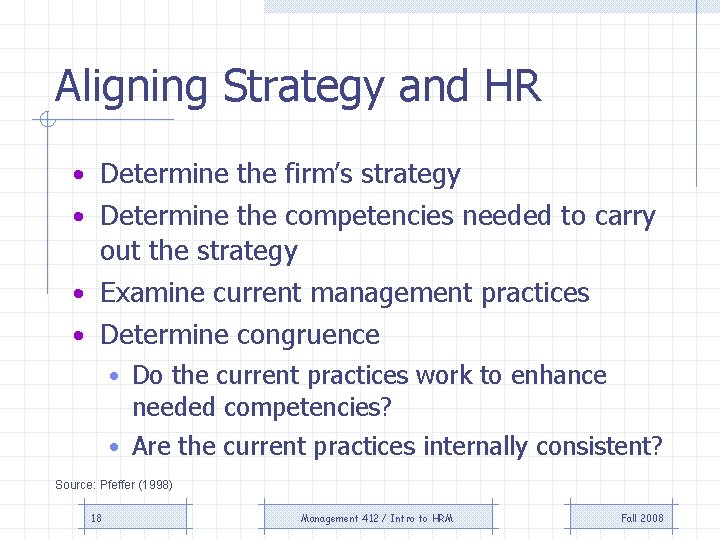
Aligning Strategy and HR • Determine the firm’s strategy • Determine the competencies needed to carry out the strategy • Examine current management practices • Determine congruence • Do the current practices work to enhance needed competencies? • Are the current practices internally consistent? Source: Pfeffer (1998) 18 Management 412 / Intro to HRM Fall 2008
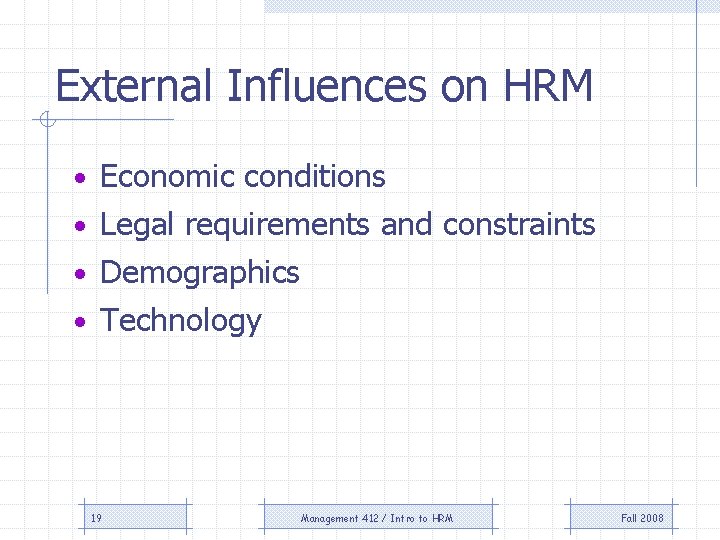
External Influences on HRM • Economic conditions • Legal requirements and constraints • Demographics • Technology 19 Management 412 / Intro to HRM Fall 2008
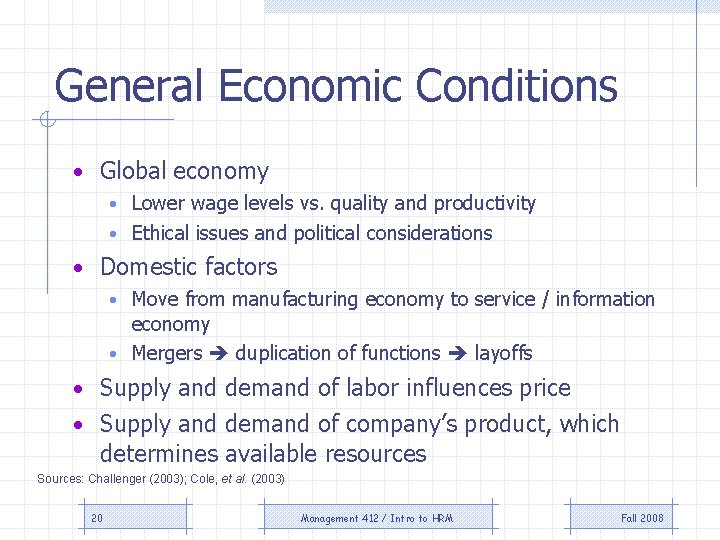
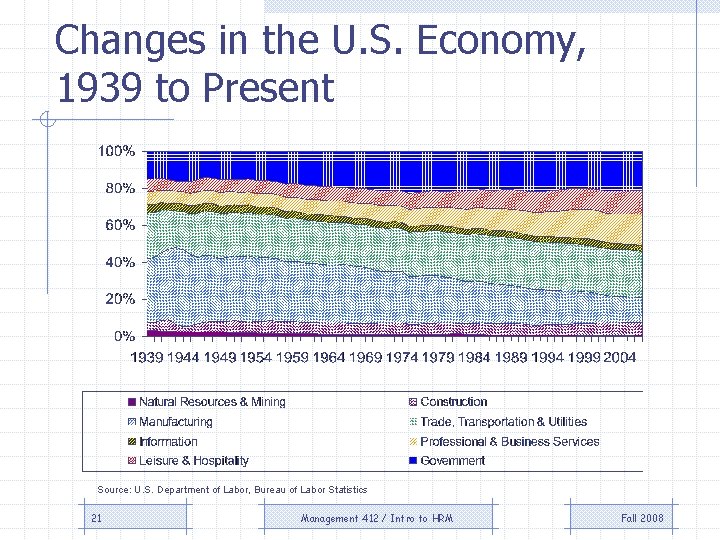
General Economic Conditions • Global economy • Lower wage levels vs. quality and productivity • Ethical issues and political considerations • Domestic factors • Move from manufacturing economy to service / information economy • Mergers duplication of functions layoffs • Supply and demand of labor influences price • Supply and demand of company’s product, which determines available resources Sources: Challenger (2003); Cole, et al. (2003) 20 Management 412 / Intro to HRM Fall 2008
Changes in the U. S. Economy, 1939 to Present Source: U. S. Department of Labor, Bureau of Labor Statistics 21 Management 412 / Intro to HRM Fall 2008
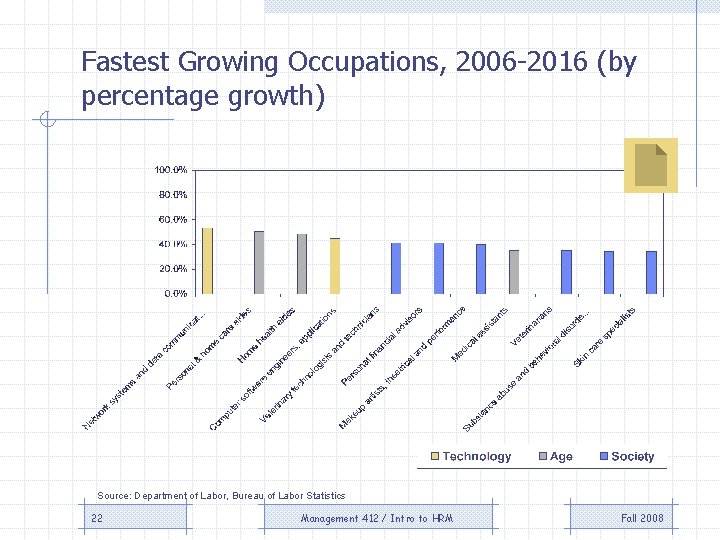
Fastest Growing Occupations, 2006 -2016 (by percentage growth) Source: Department of Labor, Bureau of Labor Statistics 22 Management 412 / Intro to HRM Fall 2008
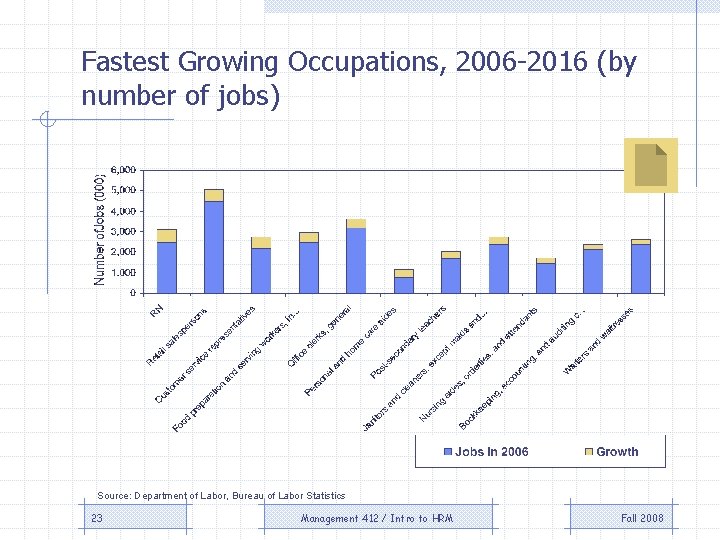
Fastest Growing Occupations, 2006 -2016 (by number of jobs) Source: Department of Labor, Bureau of Labor Statistics 23 Management 412 / Intro to HRM Fall 2008
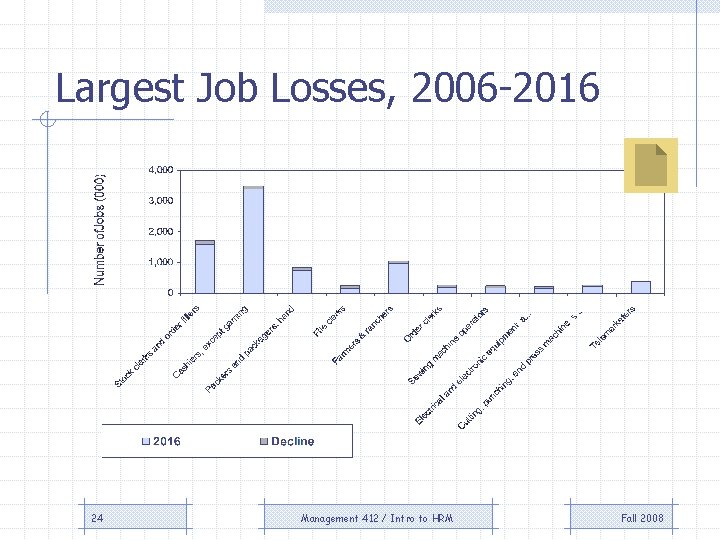
Largest Job Losses, 2006 -2016 24 Management 412 / Intro to HRM Fall 2008
Legal Requirements and Constraints • Government now an intermediary in the relationship between employers and employees • Legal requirements and constraints are usually a reflection of social attitudes and opinions 25 Management 412 / Intro to HRM Fall 2008
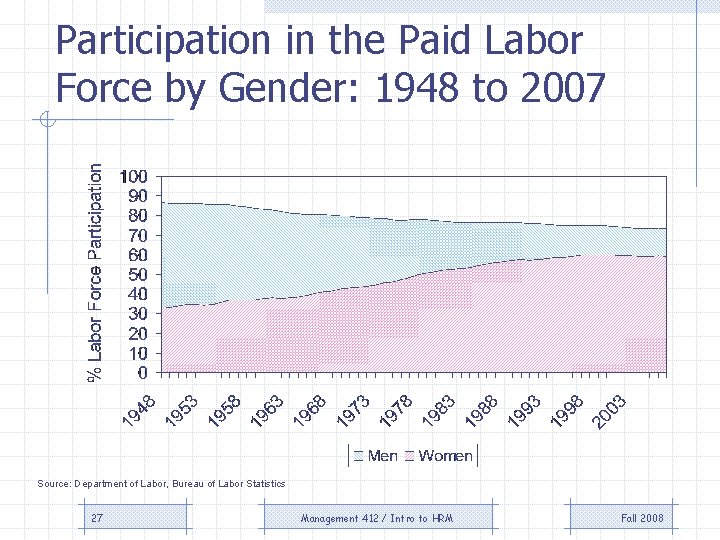
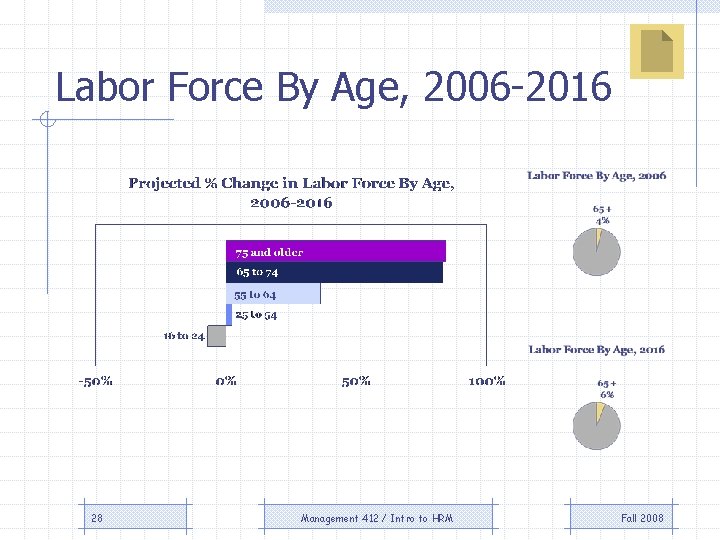
Demographics • Supply of labor (number of people, skills, etc. ) • New skills needed, but are they present in workforce? • Basic skills availability? • Different needs of different groups in the population • Increasing number of women in paid workforce • Dual-earner families • Family friendly benefits • Aging population Sources: Challenger (2003); Cole, et al. (2003) 26 Management 412 / Intro to HRM Fall 2008
Participation in the Paid Labor Force by Gender: 1948 to 2007 Source: Department of Labor, Bureau of Labor Statistics 27 Management 412 / Intro to HRM Fall 2008
Labor Force By Age, 2006 -2016 28 Management 412 / Intro to HRM Fall 2008
Technology • New jobs; old jobs vanish • Need for new skills • Need for continuous skills development • Managing the HR function • Data management • Employee communications 29 Management 412 / Intro to HRM Fall 2008
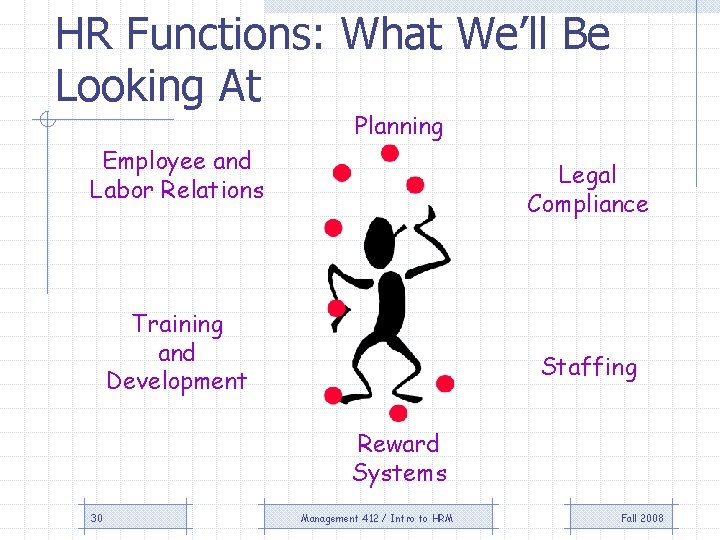
HR Functions: What We’ll Be Looking At Planning Employee and Labor Relations Legal Compliance Training and Development Staffing Reward Systems 30 Management 412 / Intro to HRM Fall 2008