
INTRODUCTION TO HRM Points to be discussed in
INTRODUCTION TO HRM. Points to be discussed in the Lecture Sessions: Ø What do we mean by HRM? ØUnderstanding the history and Functions of HRM. ØHR Policies and Procedures. ØEmerging role of HRM ØRole of HR Executives. ØChallenges to HR Professional. ØStrategic HRM.
What is Human Resource? Human resource or human capital refers to the traits people bring to the workplace –intelligence , aptitudes, commitment tacit knowledge and skills, and the ability to learn. Behaviors of a person is a function of at least four variables: Ability Motivation Role perception Situational contingencies. The relationship between individuals and their work organisation is the central importance of HRM. The employment relationship describes dynamic interlocking relations that exist between individuals and their work organisation and oriented towards:
What is Human Resource Management? HRM is resource centred, directed mainly at management needs for human resources to be provided and deployed. HRM deals with the people dimension in management. ………. . ”It encompasses those activities designed to provide for and coordinate the human resources of an organisation”. ( Byers and Rue) What is Personnel Management? “Personnel management is a series of activities which : first enables working people and the business which uses their skills to agree about the objectives and nature of their working relationships and secondly, ensures that the agreement is fulfilled”. (Torrington and Chapman, 1979
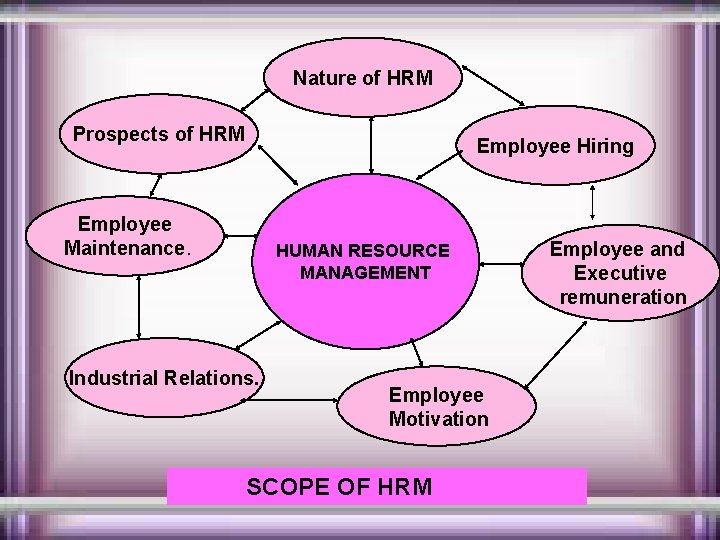
Nature of HRM Prospects of HRM Employee Hiring Employee Maintenance. HUMAN RESOURCE MANAGEMENT Industrial Relations. Employee Motivation SCOPE OF HRM Employee and Executive remuneration
q. Key features of HRM. §people as a major asset §Integration with business performance. §Emphasizes on psychological contract. §Emphasizes on learning §Focus on individuals and their motivation. §A proactive strategic management activity.
q. History of HRM. Scientific Management approach: F. W Taylor focused on the study of motions that were required for each job, the tools used, and the time needed to accomplish each task. §Managers adopt a scientific approach to design the work and carried outmost efficiently. §Economic Man Concept and Differential Piece rate system. § Separation of Planning and Doing § Standardization § Scientific training. Human Relations Approach: Elton Mayo and The Hawthorne Studies Employee productivity is also affected by social and psychological factors. §Social factors in output §Group Influence §Conflicts §Leadership §Supervision
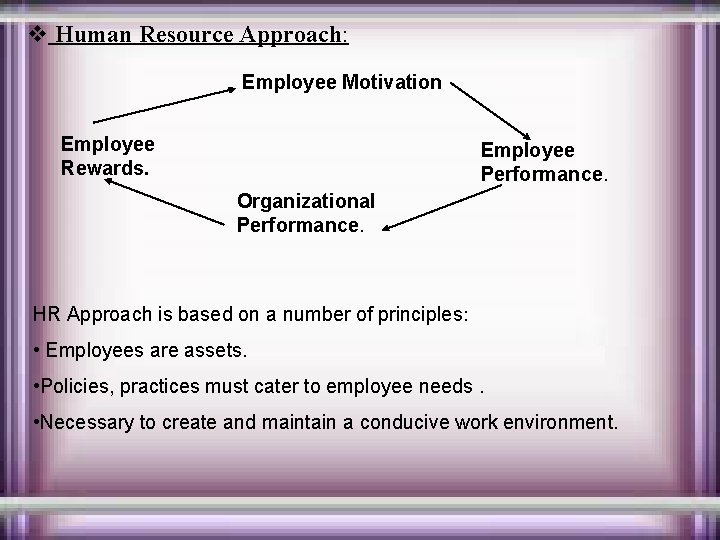
v Human Resource Approach: Employee Motivation. Employee Rewards. Employee Performance. Organizational Performance. HR Approach is based on a number of principles: • Employees are assets. • Policies, practices must cater to employee needs. • Necessary to create and maintain a conducive work environment.
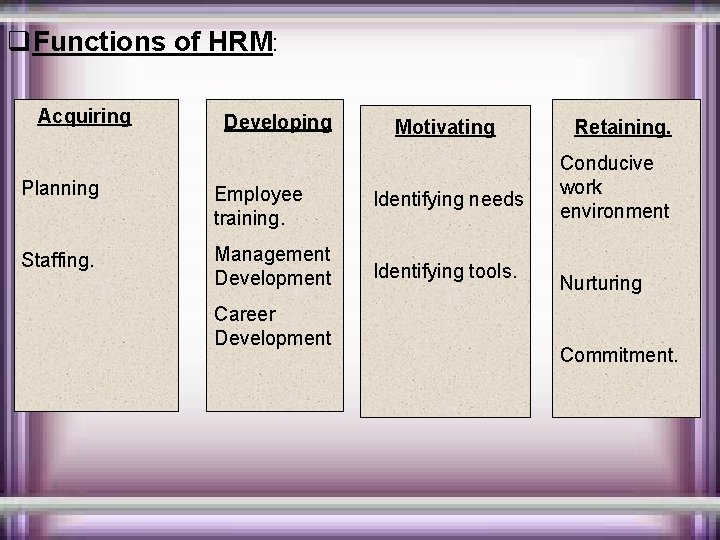
q. Functions of HRM: Acquiring Developing Motivating Planning Employee training. Identifying needs Staffing. Management Development Identifying tools. Career Development Retaining. Conducive work environment Nurturing Commitment.
HRM Functions can be broadly classified into two categories: A. Managerial Functions: § Planning § Organizing. § Staffing § Directing § Controlling. B. Operative Functions: q EMPLOYMENT Function: I. Job Analysis: job description and job specification. II. HR Planning: III. Recruitment. IV. Selection. V. Placement and Induction.
q HR Development Functions. I. Performance Appraisal. II. Training. III. Management Development. IV. Career Planning and Development. q Compensation: I. Job Evaluation. II. Wage and Salary administration. III. Incentives. IV. Bonus V. Fringe benefits. q EMPLOYEE RELATIONS.
q. Role of HR Manager. • Service Provider. • Executive. • Facilitator. • Consultant • Auditor.
q. Essentials of sound HR Policies are set of guidelines that determine the way in which employees are to be treated in the organization; They are based on organization culture, External environment and organizational objectives. 1. The HR policy should present the principle that will guide the organisation’s actions and reflect a faith in the ethical values of employees. 2. The HR policy should be formulated after considering the long range plans and needs of the organisation. 3. The HR policy must be reasonably stable but not rigid. 4. The HR policy should be formulated with due regard for the interests of all the concerned parties 5. The HR policy must be developed with the active participation and support of the management and the co operation of employees 6. The HR policy should be definite so that it is easy to understand 7. The HR policy must provide a two way communication system between the man agement and the employees. 8. The HR policy should be consistent with public policy
q. Challenges to HR Professionals. §Worker Productivity. §Quality Improvement. §The changing attitudes of Workforce. §The impact of the Government. §QWL (Quality of Work life) §Technology and training

- Slides: 14