
Introduction to HPMP Outline Background Guidelines for the

Introduction to HPMP
Outline Background Guidelines for the development of HCFC Phase-out Management Plan HPMP Content 2

Background HCFCs – group of ozone depleting substances controlled under the Montreal Protocol HCFCs have lower ozone depleting potential (ODP) than CFCs HCFCs considered as transitional substances to replace CFCs before finding non-ODS alternatives Substance CFC-11 CFC-12 Halon-1211 Halon-1301 CTC HCFC-22 HCFC-141 b Methyl Bromide ODP 1. 0 3. 0 10. 0 1. 1 0. 055 0. 11 0. 6 3

Common use of HCFCs – widely used as refrigerant and also as foam blowing agent and solvent HCFC-22 or R-22 has been the “life blood” of domestic and commercial airconditioning for many decades 4

Accelerated HCFC phase-out 19 th Meeting of Parties to the Montreal Protocol in 2007 called for the accelerated phase out of HCFCs, with specific reduction targets, as well as directions for the Executive Committee and the Parties to expedite actions that will prioritise projects and programmes to meet this phase out (Decision XIX/16 ) Baseline level is average of 2009 and 2010 5

New HCFC phase-out schedule for developing countries Freeze 2013 10% 2015 35% 2020 67. 5% 2025 100%* 2030 During 2030 -2040 allowance of 2. 5% average per annum for servicing 6
Outline Background Guidelines for the development of HCFC Phase-out Management Plan HPMP Content

Guidelines for development of HPMP – an over-arching plan to achieve total phase -out of HCFCs with flexibility to adjust such actions as technology and other cost guidelines become available, and based on the country’s needs Adopted by the Executive Committee of the Multilateral Fund at its 54 th Meeting in April 2008 (Decision 54/39) Countries are classified as ◦ those with consumption in the servicing sector only ◦ those with consumption in both servicing and manufacturing sector 8

HPMP funding guidelines Group according to consumption pattern Maximum allowable funding Countries with zero consumption of HCFC US $30, 000 Countries with consumption only of HCFC-22, or consumption below 6 ODP tonnes/year US $85, 000 Countries with medium consumption, between 6 ODP tonnes/year and 100 ODP tonnes/year US $150, 000 Countries with consumption higher than 100 ODP tonnes/year US $195, 000 Ex. Com Decision 56/16

Staged approch Countries should adopt a staged approach to implement HPMP within the framework of their over -arching strategy Stage 1 to provide concrete funding proposals to achieve freeze target in 2013 and ten percent reduction in 2015 Subsequent stage or stages can be proposed, if necessary HPMP preparation to include HCFC control measures in legislation, regulations and licensing systems 10
Guidelines for countries with servicing and/or manufacturing Countries with servicing sector only ◦ Be consistent with existing guidelines for the preparation of RMPs and TPMPs ◦ Contain commitments to achieve 2013 and 2015 control measures ◦ Include a performance-based system based on the completion of activities to receive next annual funding Countries with manufacturing sectors ◦ Follow national performance-based phase-out plan ◦ Provide starting point for aggregate reductions with annual reduction targets 11
Outline Background Guidelines for the development of HCFC Phase-out Management Plan HPMP content ◦ ◦ ◦ General information Existing policy/regulatory/institutional framework Data collection and survey Strategy and plan Project coordination and management

Guide for the Preparation of HPMPs Section I. I. 1 I. 2. 2 I. 3 I. 4. 1 I. 4. 2 II. 1 II. 2 II. 3. 1 II. 3. 2 Title Project Cover Sheet EXECUTIVE SUMMARY INTRODUCTION Background information ODS policy/legislative/regulatory and institutional framework Status of ratification of amendments to the Montreal ODS legislation/regulations Stakeholders ODS phase-out programme Enterprises converted to an HCFC technology Refrigeration servicing sector HCFC CONSUMPTION DATA Methodology and validation HCFC consumption data Sectoral distribution of HCFC-based manufacturing sector Refrigeration servicing sector Number of Pages/Paragraphs (three to four pages) (one paragraph and/or a table) (two pages) (one page) (three pages) (one page) (four pages, including tables) (five pages including tables) 13
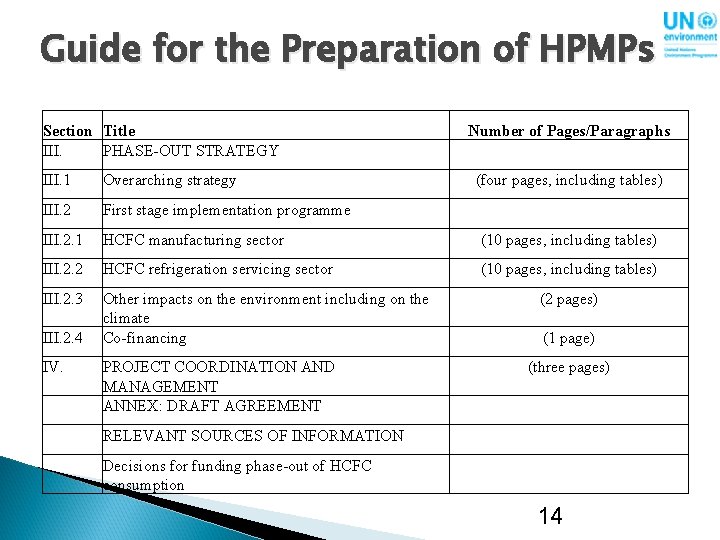
Guide for the Preparation of HPMPs Section Title III. PHASE-OUT STRATEGY Number of Pages/Paragraphs III. 1 Overarching strategy III. 2 First stage implementation programme III. 2. 1 HCFC manufacturing sector (10 pages, including tables) III. 2. 2 HCFC refrigeration servicing sector (10 pages, including tables) III. 2. 3 Other impacts on the environment including on the climate Co-financing III. 2. 4 IV. (four pages, including tables) (2 pages) (1 page) PROJECT COORDINATION AND MANAGEMENT ANNEX: DRAFT AGREEMENT (three pages) RELEVANT SOURCES OF INFORMATION Decisions for funding phase-out of HCFC consumption 14
General information Brief country background Brief review of activities undertaken so far on CFC phase-out Brief summary review of projects funded under the Multilateral Fund for CFC phaseout 15
Existing policy/regulatory and institution framework Basic ODS legislation and existing licensing system Information on existing HCFC-related policies, if any Description of stakeholder involvement in policy and regulatory interventions Information on bans on currently controlled ODS-dependent equipment Other government initiatives on accelerated HCFC phase-out 16
Data collection and surveys Description of methodology for collecting and validating data (names of institutions involved and source of data) Provide an overall view of HCFC sector HCFC supply HCFC use/consumption Information on HCFC infrastructure Forecast for HCFC use, including unconstrained demand ◦ Availability of alternatives to HCFC and prices ◦ ◦ 17
Data for refrigeration servicing Estimated number of workshops in the country and a separation into groups (large, medium, small, informal) Typical baseline equipment and education for each group Estimated number of technicians currently working in refrigeration servicing Estimated average consumption of HCFCs per workshop of each group per year Equipment needs for each group and justification Estimate of the amount of ODS to be recovered annually, if relevant 18
Strategy and plan Overall strategy to achieve the targets to meet complete phase out of HCFCs Discussion of policy instruments needed to reduce the supply of HCFCs such as import quotas and price controls Country’s plan for their implementation / enforcement of the short-term alternatives, access to alternative supplies Steps to gradually curtail HCFC demand such as legislation with regards to goods containing HCFCs 19
Strategy and plan (cont. ) Coordination with the country’s climate change, chemical management, and energy policies Identify any national legislation that may prohibit or restrict specific non-HCFC alternatives Total funding required for stage one Time frame for implementation of planned activities based on actual needs and current consumption situation 20
Strategy to reduce dependence on HCFCs for refrigeration servicing Legal and economic incentives and disincentives to reduce the dependence on HCFCs Training Public awareness activities Import controls and other sector-specific initiatives Recovery and recycling initiatives based on previous experience 21
Project coordination and management Description of management structure for the implementation of HPMP Clear indication of the roles ◦ government bodies, industry bodies, academic institutions and consultants. Responsibility and decision-making capacity and reporting responsibilities of the different parts of the management structure 22
- Slides: 22