
Introduction to HLTTop Tutorial Stephanie Beauceron IPNL Javier
Introduction to HLT-Top Tutorial Stephanie Beauceron – IPNL Javier Fernandez - Oviedo If after Tutorial you have questions, please do not hesitate to send them on: hn-cms-top-trigger (alias for CMS Top Trigger Studies) (low rate of emails) 1
Outline • What is trigger system in CMS? • What are the HLT constraints? • Tutorial Phase: - What is an HLT menu/path? - How to run an HLT menu? - Which menu should I run? • What should be done for a path integration? 2
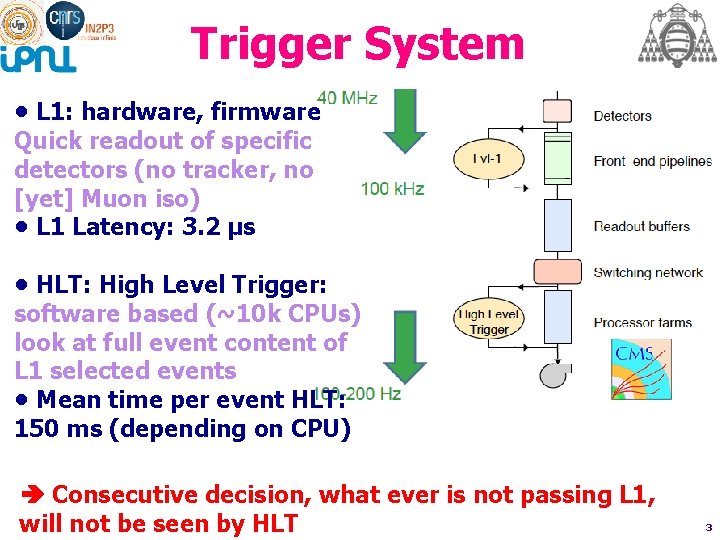
Trigger System • L 1: hardware, firmware Quick readout of specific detectors (no tracker, no [yet] Muon iso) • L 1 Latency: 3. 2 μs • HLT: High Level Trigger: software based (~10 k CPUs) look at full event content of L 1 selected events • Mean time per event HLT: 150 ms (depending on CPU) Consecutive decision, what ever is not passing L 1, will not be seen by HLT 3
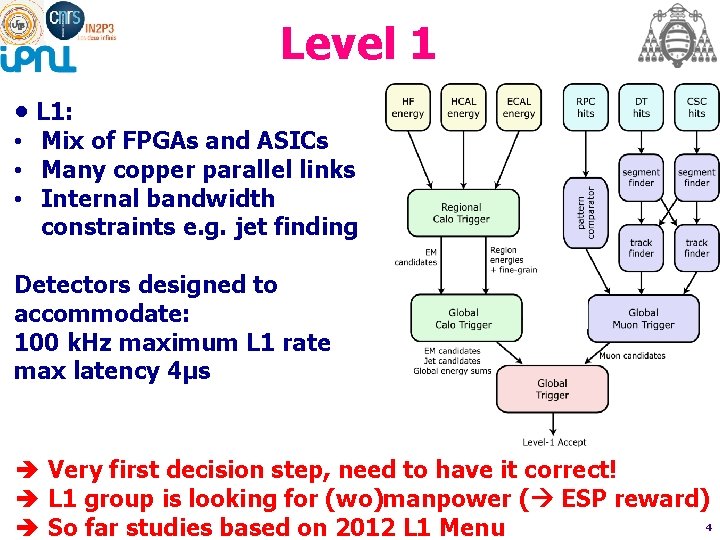
Level 1 • L 1: • Mix of FPGAs and ASICs • Many copper parallel links • Internal bandwidth constraints e. g. jet finding Detectors designed to accommodate: 100 k. Hz maximum L 1 rate max latency 4μs Very first decision step, need to have it correct! L 1 group is looking for (wo)manpower ( ESP reward) 4 So far studies based on 2012 L 1 Menu
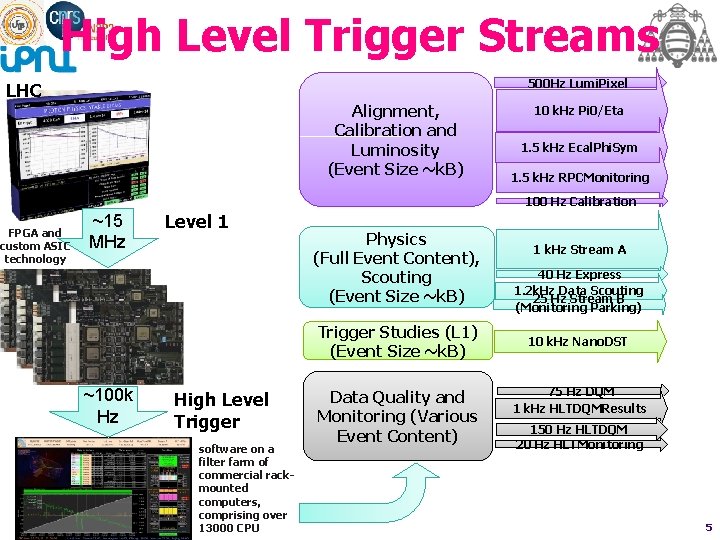
High Level Trigger Streams 500 Hz Lumi. Pixel LHC Alignment, Calibration and Luminosity (Event Size ~k. B) 10 k. Hz Pi 0/Eta 1. 5 k. Hz Ecal. Phi. Sym 1. 5 k. Hz RPCMonitoring 100 Hz Calibration FPGA and custom ASIC technology ~15 MHz Level 1 Physics (Full Event Content), Scouting (Event Size ~k. B) Trigger Studies (L 1) (Event Size ~k. B) ~100 k Hz High Level Trigger software on a filter farm of commercial rackmounted computers, comprising over 13000 CPU Data Quality and Monitoring (Various Event Content) 1 k. Hz Stream A 40 Hz Express 1. 2 k. Hz Data Scouting 25 Hz Stream B (Monitoring Parking) 10 k. Hz Nano. DST 75 Hz DQM 1 k. Hz HLTDQMResults 150 Hz HLTDQM 20 Hz HLTMonitoring 5
HLT Decision of recording or not an event based on full event information. What is seen by HLT is RAW format of event: Various electronic signal coming from each subdetector In order to decide if the event is interesting or not, need to interpret electronic signal into particles Unpacking Reconstruction of the event Selection of the event based on reconstruction infos Same principle than offline physics analysis based on the same objects! Nuance: Offline reconstruction can take as much time as needed (currently ~35 s), Online reco + Decision (ie: HLT) should be over within 150 ms (mean value)! Not possible to do exactly the same, a few approximations are performed to speed up! 6

HLT Constraints - Input rate is limited to 100 k. Hz at L 1 (not by L 1 trigger), by the limitation of the readout of the detectors (including the S-links limitation which connect the detectors with the event building) - The maximum output rate of HLT, which may matter for some test run, is limited by the write speed, and the limit is few k. Hz at the nominal event size (and depends both on the event size and rate) - The limit during nominal data taking comes from the downstream computing resources, and it is much smaller than the technical limit. So this limit is not a peak limit (events/s) but an average limit (events/day) which gets translated in events/s for convenience. Typically ~500 Hz as reco time is ~35 s per events. If event is not recorded, offline it is impossible to know the event is not there Crucial to make good decision! 7
Summary of HLT constraints HLT should reject most of the events to select only ~1 k. Hz should be split within PAGs Developing a path = rate calculation (Zeynep’s talk) HLT is taking crucial decision! New physics can be missed because no decision algorithm was designed to keep such events (by default HLT reject events) Developing a path = validation/efficiency (Kelly/Hugues’ talk) HLT should do as well as offline reconstruction with a factor 100 less time! Developing a path = time calculation (Javier’s talk) Impossible to correct HLT at posteriori! If JES at HLT or alignment is not correct, events are gone Developing a path = DQM (Federico’s talk) 8
HLT ≠ RECO Most of the difference between HLT and Reco are in tracking (where most of the time is spent) Order of the module/sequence crucial: first run what is discriminant and not time consuming. Crucial work from HLT POGs to ensure that all final objects are as close as possible to reco ones. PAGs work start from HLT object definition blessed by POG. Aim is NOT to build the exact same analysis at HLT (normally looser cuts), only to make sure to record most interesting events! Example: Looking for ttbar events, pointless to record ALL events containing W’s. Events as W+3/4 jets are enough. 9
Selection at HLT Looking for ttbar events, pointless to record ALL events containing W’s. Events as W+3/4 jets are enough. Selection should be “loose” enough to record all signal events and all events needed for background estimation (or prescale path) BUT tight enough to reduce the rate: All inclusive W lν(lepton is isolated) cannot be recorded as the rate would be ~200 Hz [at 13 Te. V] (1/5 of the full CMS bandwidth… VBF physics as all hadronics final states or searches with MET or non-isolated lepton would not be happy…). In the meantime strategy to estimate background should change (inverting isolation will be difficult) Need to share and to tighten a bit… Need to define a STRATEGY (within one PAG and over)10
Overview of L 1 EG issues A CMS collaborator concerned about Standard Model Physics at 13 Te. V in electron channel 11
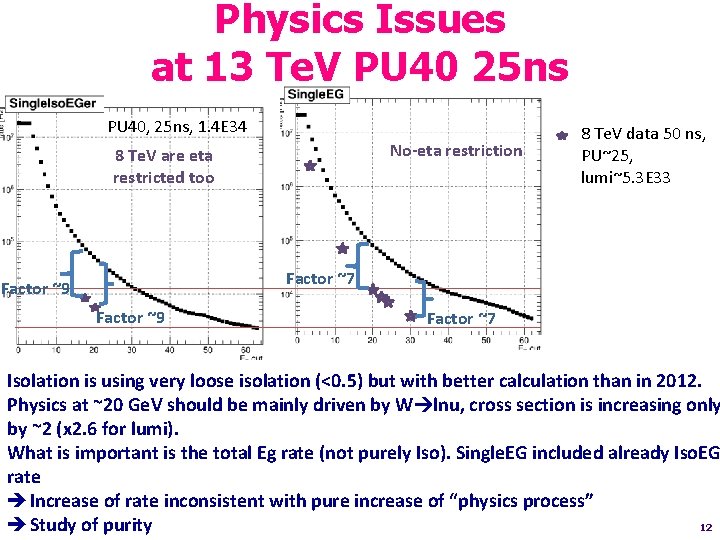
Physics Issues at 13 Te. V PU 40 25 ns PU 40, 25 ns, 1. 4 E 34 No-eta restriction 8 Te. V are eta restricted too 8 Te. V data 50 ns, PU~25, lumi~5. 3 E 33 Factor ~7 Factor ~9 Factor ~7 Isolation is using very loose isolation (<0. 5) but with better calculation than in 2012. Physics at ~20 Ge. V should be mainly driven by W lnu, cross section is increasing only by ~2 (x 2. 6 for lumi). What is important is the total Eg rate (not purely Iso). Single. EG included already Iso. EG rate Increase of rate inconsistent with pure increase of “physics process” 12 Study of purity
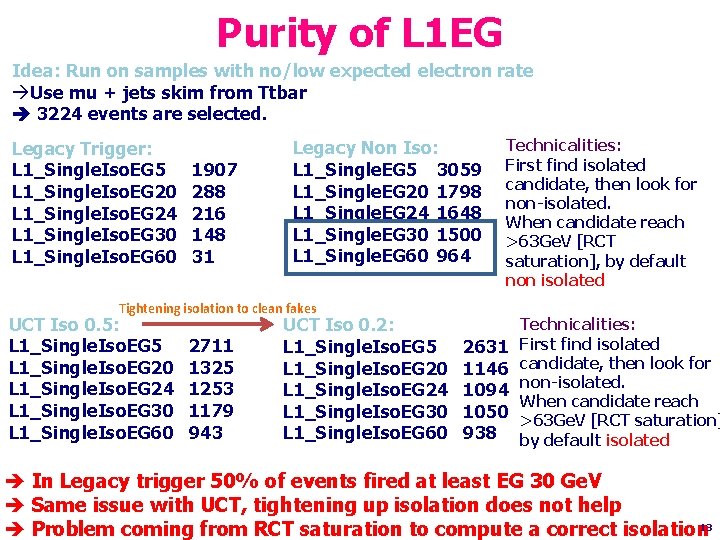
Purity of L 1 EG Idea: Run on samples with no/low expected electron rate Use mu + jets skim from Ttbar 3224 events are selected. Legacy Trigger: L 1_Single. Iso. EG 5 L 1_Single. Iso. EG 20 L 1_Single. Iso. EG 24 L 1_Single. Iso. EG 30 L 1_Single. Iso. EG 60 1907 288 216 148 31 Legacy Non Iso: L 1_Single. EG 5 3059 L 1_Single. EG 20 1798 L 1_Single. EG 24 1648 L 1_Single. EG 30 1500 L 1_Single. EG 60 964 Technicalities: First find isolated candidate, then look for non-isolated. When candidate reach >63 Ge. V [RCT saturation], by default non isolated Tightening isolation to clean fakes UCT Iso 0. 5: L 1_Single. Iso. EG 5 L 1_Single. Iso. EG 20 L 1_Single. Iso. EG 24 L 1_Single. Iso. EG 30 L 1_Single. Iso. EG 60 2711 1325 1253 1179 943 UCT Iso 0. 2: L 1_Single. Iso. EG 5 L 1_Single. Iso. EG 20 L 1_Single. Iso. EG 24 L 1_Single. Iso. EG 30 L 1_Single. Iso. EG 60 2631 1146 1094 1050 938 Technicalities: First find isolated candidate, then look for non-isolated. When candidate reach >63 Ge. V [RCT saturation] by default isolated In Legacy trigger 50% of events fired at least EG 30 Ge. V Same issue with UCT, tightening up isolation does not help Problem coming from RCT saturation to compute a correct isolation 13
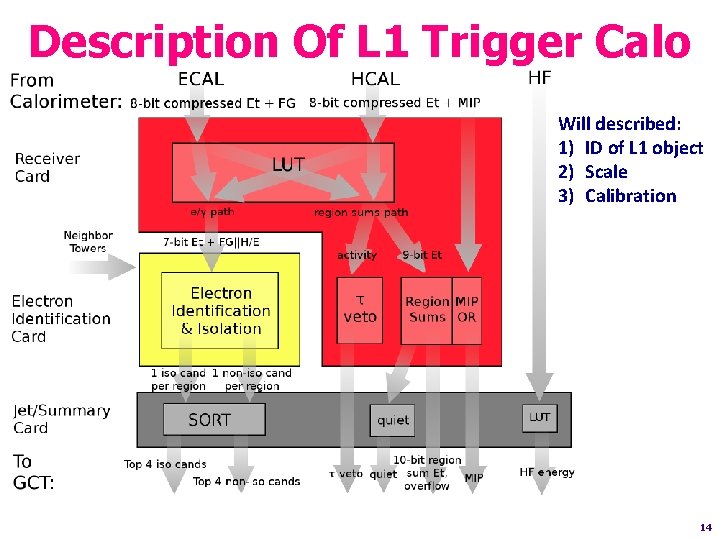
Description Of L 1 Trigger Calo Will described: 1) ID of L 1 object 2) Scale 3) Calibration 14
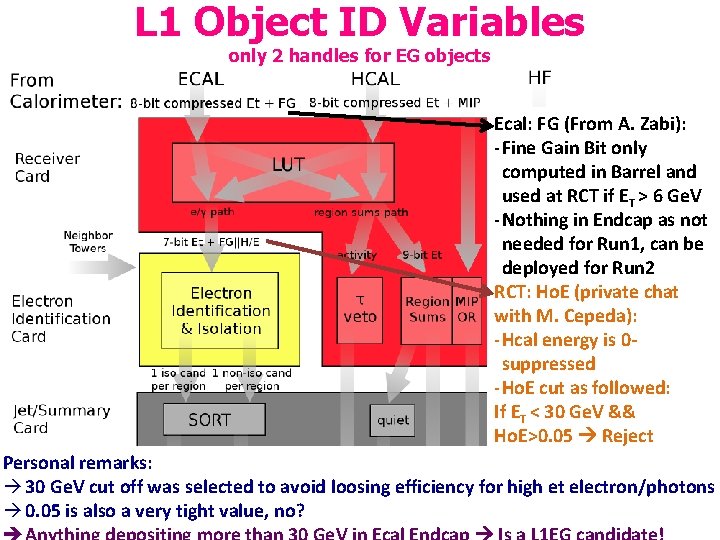
L 1 Object ID Variables only 2 handles for EG objects Ecal: FG (From A. Zabi): - Fine Gain Bit only computed in Barrel and used at RCT if ET > 6 Ge. V - Nothing in Endcap as not needed for Run 1, can be deployed for Run 2 RCT: Ho. E (private chat with M. Cepeda): - Hcal energy is 0 suppressed - Ho. E cut as followed: If ET < 30 Ge. V && Ho. E>0. 05 Reject Personal remarks: 30 Ge. V cut off was selected to avoid loosing efficiency for high et electron/photons 0. 05 is also a very tight value, no? 15
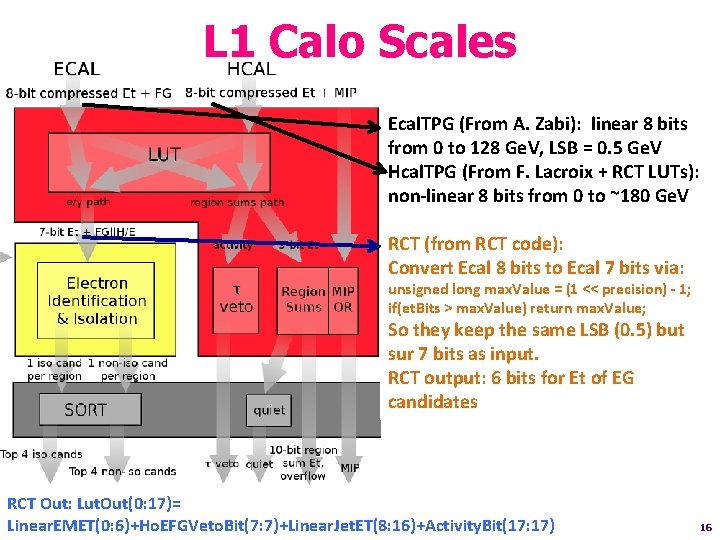
L 1 Calo Scales Ecal. TPG (From A. Zabi): linear 8 bits from 0 to 128 Ge. V, LSB = 0. 5 Ge. V Hcal. TPG (From F. Lacroix + RCT LUTs): non-linear 8 bits from 0 to ~180 Ge. V RCT (from RCT code): Convert Ecal 8 bits to Ecal 7 bits via: unsigned long max. Value = (1 << precision) - 1; if(et. Bits > max. Value) return max. Value; So they keep the same LSB (0. 5) but sur 7 bits as input. RCT output: 6 bits for Et of EG candidates RCT Out: Lut. Out(0: 17)= Linear. EMET(0: 6)+Ho. EFGVeto. Bit(7: 7)+Linear. Jet. ET(8: 16)+Activity. Bit(17: 17) 16
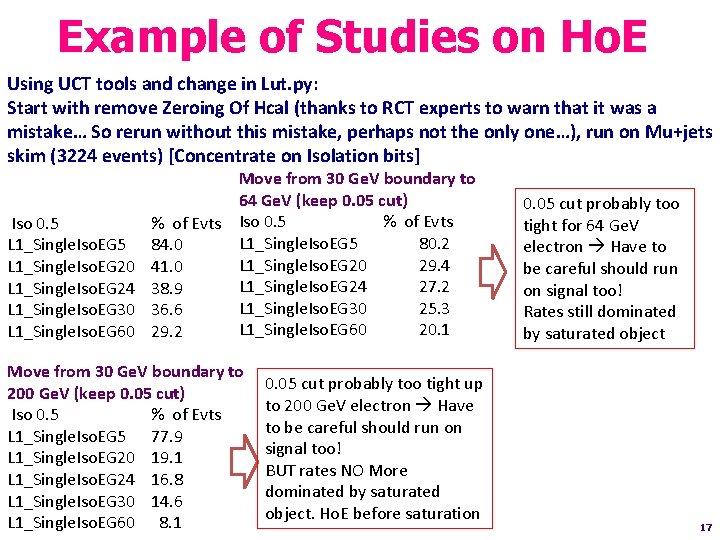
Example of Studies on Ho. E Using UCT tools and change in Lut. py: Start with remove Zeroing Of Hcal (thanks to RCT experts to warn that it was a mistake… So rerun without this mistake, perhaps not the only one…), run on Mu+jets skim (3224 events) [Concentrate on Isolation bits] Move from 30 Ge. V boundary to 64 Ge. V (keep 0. 05 cut) % of Evts Iso 0. 5 L 1_Single. Iso. EG 5 80. 2 L 1_Single. Iso. EG 5 84. 0 L 1_Single. Iso. EG 20 29. 4 L 1_Single. Iso. EG 20 41. 0 L 1_Single. Iso. EG 24 27. 2 L 1_Single. Iso. EG 24 38. 9 L 1_Single. Iso. EG 30 25. 3 L 1_Single. Iso. EG 30 36. 6 L 1_Single. Iso. EG 60 20. 1 L 1_Single. Iso. EG 60 29. 2 Move from 30 Ge. V boundary to 200 Ge. V (keep 0. 05 cut) Iso 0. 5 % of Evts L 1_Single. Iso. EG 5 77. 9 L 1_Single. Iso. EG 20 19. 1 L 1_Single. Iso. EG 24 16. 8 L 1_Single. Iso. EG 30 14. 6 L 1_Single. Iso. EG 60 8. 1 0. 05 cut probably too tight up to 200 Ge. V electron Have to be careful should run on signal too! BUT rates NO More dominated by saturated object. Ho. E before saturation 0. 05 cut probably too tight for 64 Ge. V electron Have to be careful should run on signal too! Rates still dominated by saturated object 17
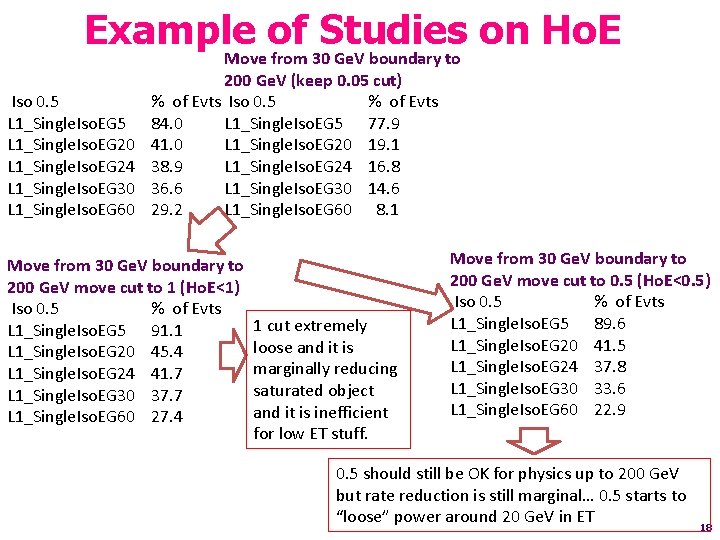
Example of Studies on Ho. E Move from 30 Ge. V boundary to Iso 0. 5 L 1_Single. Iso. EG 20 L 1_Single. Iso. EG 24 L 1_Single. Iso. EG 30 L 1_Single. Iso. EG 60 200 Ge. V (keep 0. 05 cut) % of Evts Iso 0. 5 L 1_Single. Iso. EG 5 77. 9 84. 0 L 1_Single. Iso. EG 20 19. 1 41. 0 L 1_Single. Iso. EG 24 16. 8 38. 9 L 1_Single. Iso. EG 30 14. 6 36. 6 L 1_Single. Iso. EG 60 8. 1 29. 2 Move from 30 Ge. V boundary to 200 Ge. V move cut to 1 (Ho. E<1) Iso 0. 5 % of Evts L 1_Single. Iso. EG 5 91. 1 L 1_Single. Iso. EG 20 45. 4 L 1_Single. Iso. EG 24 41. 7 L 1_Single. Iso. EG 30 37. 7 L 1_Single. Iso. EG 60 27. 4 1 cut extremely loose and it is marginally reducing saturated object and it is inefficient for low ET stuff. Move from 30 Ge. V boundary to 200 Ge. V move cut to 0. 5 (Ho. E<0. 5) Iso 0. 5 % of Evts L 1_Single. Iso. EG 5 89. 6 L 1_Single. Iso. EG 20 41. 5 L 1_Single. Iso. EG 24 37. 8 L 1_Single. Iso. EG 30 33. 6 L 1_Single. Iso. EG 60 22. 9 0. 5 should still be OK for physics up to 200 Ge. V but rate reduction is still marginal… 0. 5 starts to “loose” power around 20 Ge. V in ET 18
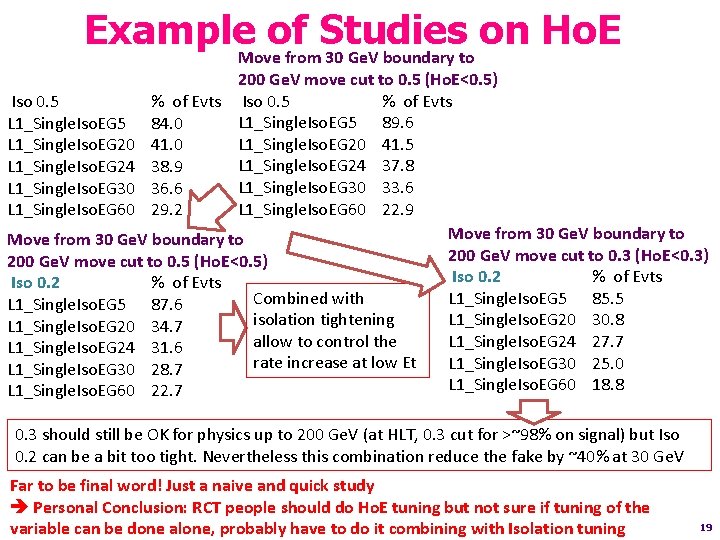
Example. Moveof Studies on Ho. E from 30 Ge. V boundary to 200 Ge. V move cut to 0. 5 (Ho. E<0. 5) % of Evts Iso 0. 5 L 1_Single. Iso. EG 5 89. 6 L 1_Single. Iso. EG 5 84. 0 L 1_Single. Iso. EG 20 41. 5 L 1_Single. Iso. EG 20 41. 0 L 1_Single. Iso. EG 24 37. 8 L 1_Single. Iso. EG 24 38. 9 L 1_Single. Iso. EG 30 33. 6 L 1_Single. Iso. EG 30 36. 6 L 1_Single. Iso. EG 60 22. 9 L 1_Single. Iso. EG 60 29. 2 Move from 30 Ge. V boundary to 200 Ge. V move cut to 0. 3 (Ho. E<0. 3) 200 Ge. V move cut to 0. 5 (Ho. E<0. 5) Iso 0. 2 % of Evts Combined with L 1_Single. Iso. EG 5 85. 5 L 1_Single. Iso. EG 5 87. 6 isolation tightening L 1_Single. Iso. EG 20 30. 8 L 1_Single. Iso. EG 20 34. 7 allow to control the L 1_Single. Iso. EG 24 27. 7 L 1_Single. Iso. EG 24 31. 6 rate increase at low Et L 1_Single. Iso. EG 30 25. 0 L 1_Single. Iso. EG 30 28. 7 L 1_Single. Iso. EG 60 18. 8 L 1_Single. Iso. EG 60 22. 7 0. 3 should still be OK for physics up to 200 Ge. V (at HLT, 0. 3 cut for >~98% on signal) but Iso 0. 2 can be a bit too tight. Nevertheless this combination reduce the fake by ~40% at 30 Ge. V Far to be final word! Just a naive and quick study Personal Conclusion: RCT people should do Ho. E tuning but not sure if tuning of the variable can be done alone, probably have to do it combining with Isolation tuning 19
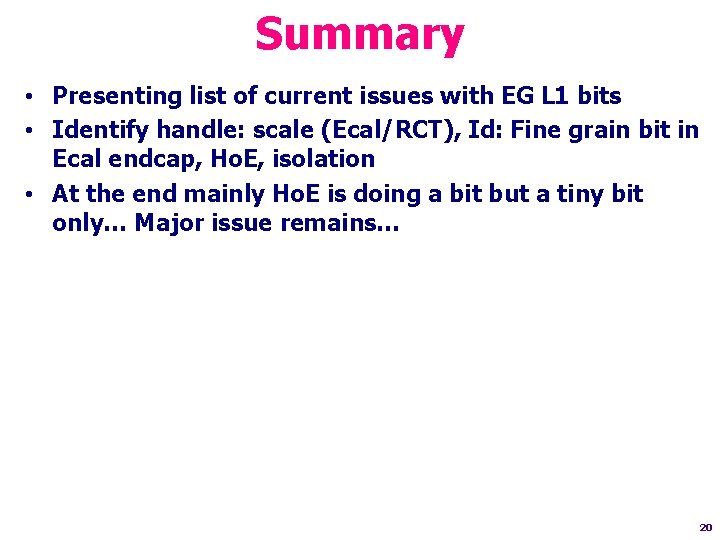
Summary • Presenting list of current issues with EG L 1 bits • Identify handle: scale (Ecal/RCT), Id: Fine grain bit in Ecal endcap, Ho. E, isolation • At the end mainly Ho. E is doing a bit but a tiny bit only… Major issue remains… 20
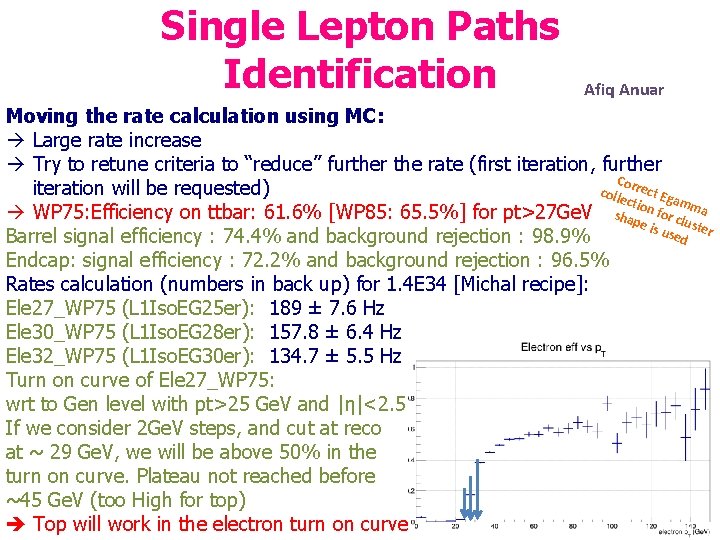
Single Lepton Paths Identification Afiq Anuar Moving the rate calculation using MC: Large rate increase Try to retune criteria to “reduce” further the rate (first iteration, further Co iteration will be requested) colle rrect Eg am cti WP 75: Efficiency on ttbar: 61. 6% [WP 85: 65. 5%] for pt>27 Ge. V shapoen for clums a te is us ed r Barrel signal efficiency : 74. 4% and background rejection : 98. 9% Endcap: signal efficiency : 72. 2% and background rejection : 96. 5% Rates calculation (numbers in back up) for 1. 4 E 34 [Michal recipe]: Ele 27_WP 75 (L 1 Iso. EG 25 er): 189 ± 7. 6 Hz Ele 30_WP 75 (L 1 Iso. EG 28 er): 157. 8 ± 6. 4 Hz Ele 32_WP 75 (L 1 Iso. EG 30 er): 134. 7 ± 5. 5 Hz Turn on curve of Ele 27_WP 75: wrt to Gen level with pt>25 Ge. V and |η|<2. 5 If we consider 2 Ge. V steps, and cut at reco at ~ 29 Ge. V, we will be above 50% in the turn on curve. Plateau not reached before ~45 Ge. V (too High for top) Top will work in the electron turn on curve 21
- Slides: 21