
Introduction to HighLevel Synthesis with Vivado HLS This

- Slides: 44
Introduction to High-Level Synthesis with Vivado HLS This material exempt per Department of Commerce license exception TSU
Objectives After completing this module, you will be able to: – Describe the high level synthesis flow – Understand the control and datapath extraction – Describe scheduling and binding phases of the HLS flow – List the priorities of directives set by Vivado HLS – List comprehensive language support in Vivado HLS – Identify steps involved in validation and verification flows Intro to HLS 11 - 2 © Copyright 2016 Xilinx
Outline Introduction to High-Level Synthesis with Vivado HLS Language Support Validation Flow Summary Intro to HLS 11 - 3 © Copyright 2016 Xilinx
Need for High-Level Synthesis Algorithmic-based approaches are getting popular due to accelerated design time and time to market (TTM) – Larger designs pose challenges in design and verification of hardware at HDL level Industry trend is moving towards hardware acceleration to enhance performance and productivity – CPU-intensive tasks can be offloaded to hardware accelerator in FPGA – Hardware accelerators require a lot of time to understand design Vivado HLS tool converts algorithmic description written in C-based design flow into hardware description (RTL) – Elevates the abstraction level from RTL to algorithms High-level synthesis is essential for maintaining design productivity for large designs Intro to HLS 11 - 4 © Copyright 2016 Xilinx
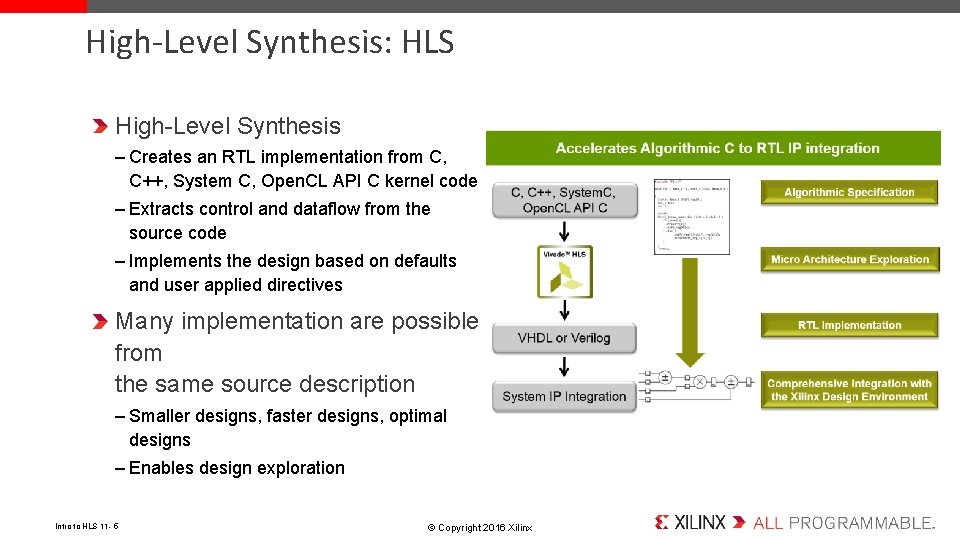
High-Level Synthesis: HLS High-Level Synthesis – Creates an RTL implementation from C, C++, System C, Open. CL API C kernel code – Extracts control and dataflow from the source code – Implements the design based on defaults and user applied directives Many implementation are possible from the same source description – Smaller designs, faster designs, optimal designs – Enables design exploration Intro to HLS 11 - 5 © Copyright 2016 Xilinx
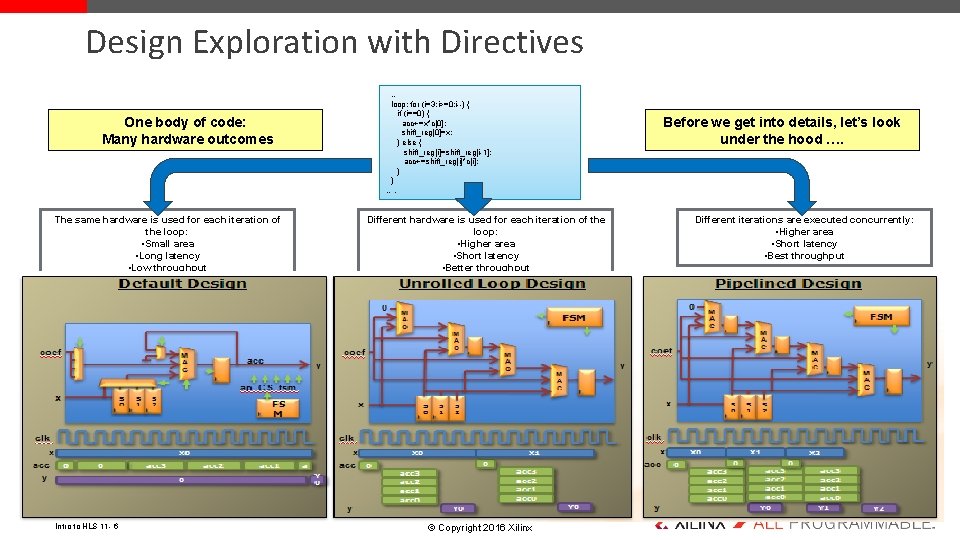
Design Exploration with Directives One body of code: Many hardware outcomes The same hardware is used for each iteration of the loop: • Small area • Long latency • Low throughput Intro to HLS 11 - 6 … loop: for (i=3; i>=0; i--) { if (i==0) { acc+=x*c[0]; shift_reg[0]=x; } else { shift_reg[i]=shift_reg[i-1]; acc+=shift_reg[i]*c[i]; } } …. Different hardware is used for each iteration of the loop: • Higher area • Short latency • Better throughput © Copyright 2016 Xilinx Before we get into details, let’s look under the hood …. Different iterations are executed concurrently: • Higher area • Short latency • Best throughput
Introduction to High-Level Synthesis How is hardware extracted from C code? – Control and datapath can be extracted from C code at the top level – The same principles used in the example can be applied to sub-functions • At some point in the top-level control flow, control is passed to a sub-function • Sub-function may be implemented to execute concurrently with the top-level and or other sub-functions How is this control and dataflow turned into a hardware design? – Vivado HLS maps this to hardware through scheduling and binding processes How is my design created? – How functions, loops, arrays and IO ports are mapped? Intro to HLS 11 - 7 © Copyright 2016 Xilinx
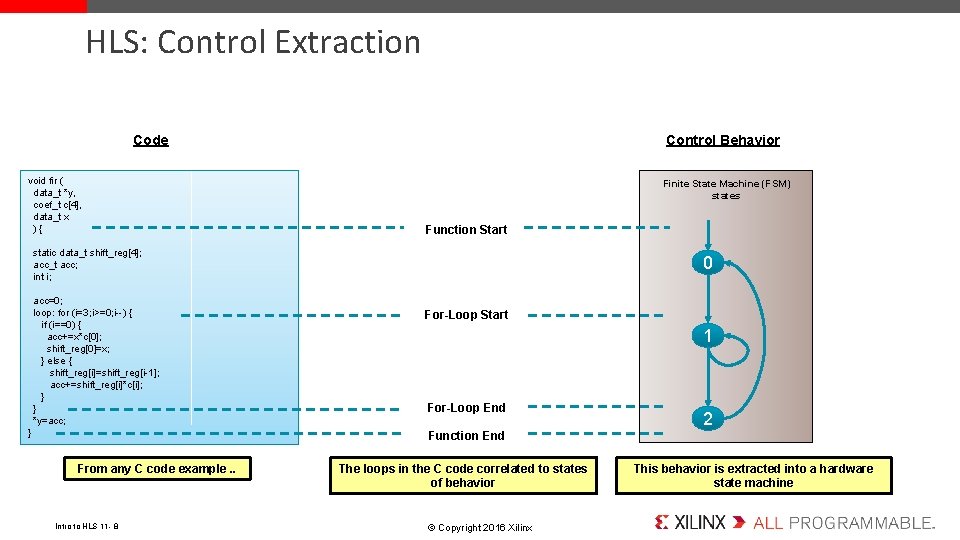
HLS: Control Extraction Code void fir ( data_t *y, coef_t c[4], data_t x ){ Control Behavior Finite State Machine (FSM) states Function Start static data_t shift_reg[4]; acc_t acc; int i; acc=0; loop: for (i=3; i>=0; i--) { if (i==0) { acc+=x*c[0]; shift_reg[0]=x; } else { shift_reg[i]=shift_reg[i-1]; acc+=shift_reg[i]*c[i]; } } *y=acc; } 0 For-Loop Start 1 For-Loop End 2 Function End From any C code example. . Intro to HLS 11 - 8 The loops in the C code correlated to states of behavior © Copyright 2016 Xilinx This behavior is extracted into a hardware state machine
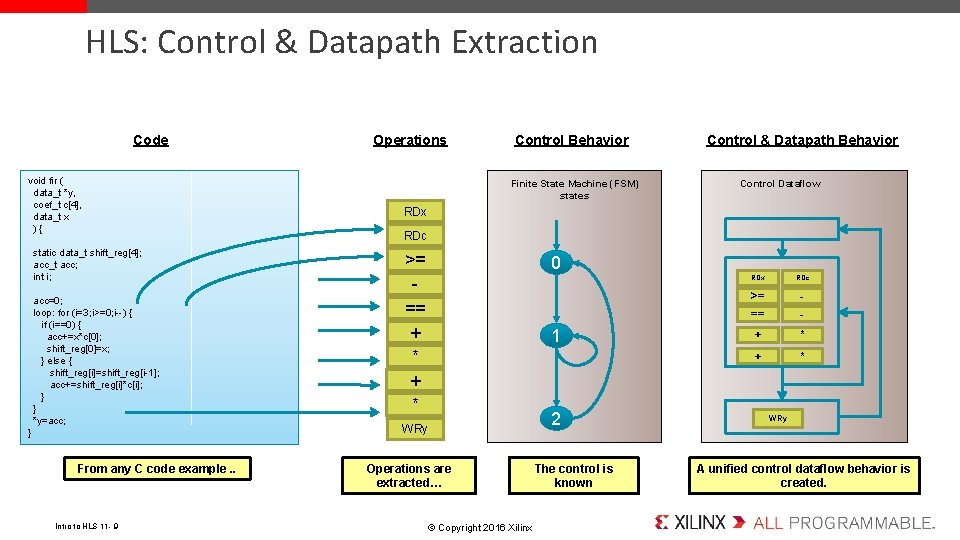
HLS: Control & Datapath Extraction Code void fir ( data_t *y, coef_t c[4], data_t x ){ static data_t shift_reg[4]; acc_t acc; int i; acc=0; loop: for (i=3; i>=0; i--) { if (i==0) { acc+=x*c[0]; shift_reg[0]=x; } else { shift_reg[i]=shift_reg[i-1]; acc+=shift_reg[i]*c[i]; } } *y=acc; } From any C code example. . Intro to HLS 11 - 9 Operations Control Behavior Finite State Machine (FSM) states Control & Datapath Behavior Control Dataflow RDx RDc >= == + * 0 1 WRy Operations are extracted… © Copyright 2016 Xilinx 2 The control is known RDx RDc >= - == - + * WRy A unified control dataflow behavior is created.
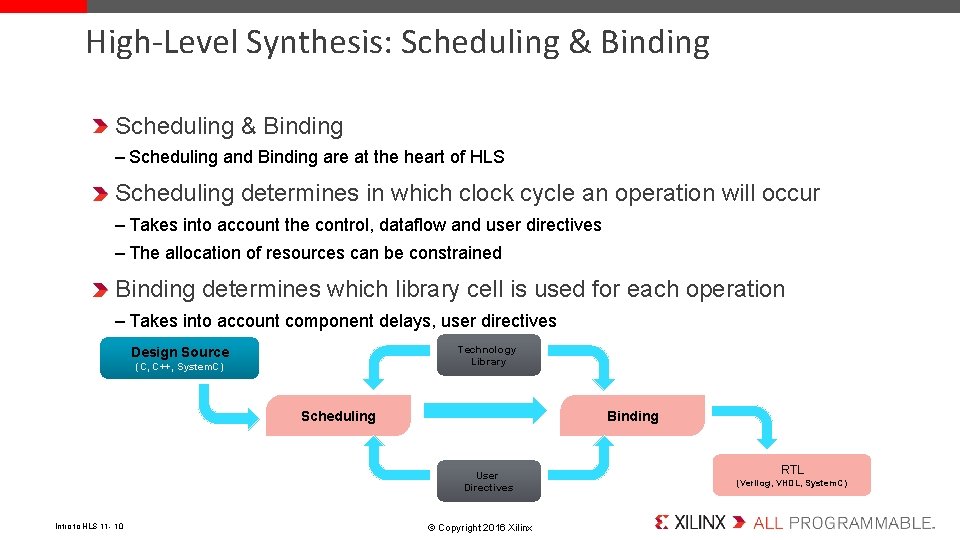
High-Level Synthesis: Scheduling & Binding – Scheduling and Binding are at the heart of HLS Scheduling determines in which clock cycle an operation will occur – Takes into account the control, dataflow and user directives – The allocation of resources can be constrained Binding determines which library cell is used for each operation – Takes into account component delays, user directives Technology Library Design Source (C, C++, System. C) Scheduling Binding User Directives Intro to HLS 11 - 10 © Copyright 2016 Xilinx RTL (Verilog, VHDL, System. C)
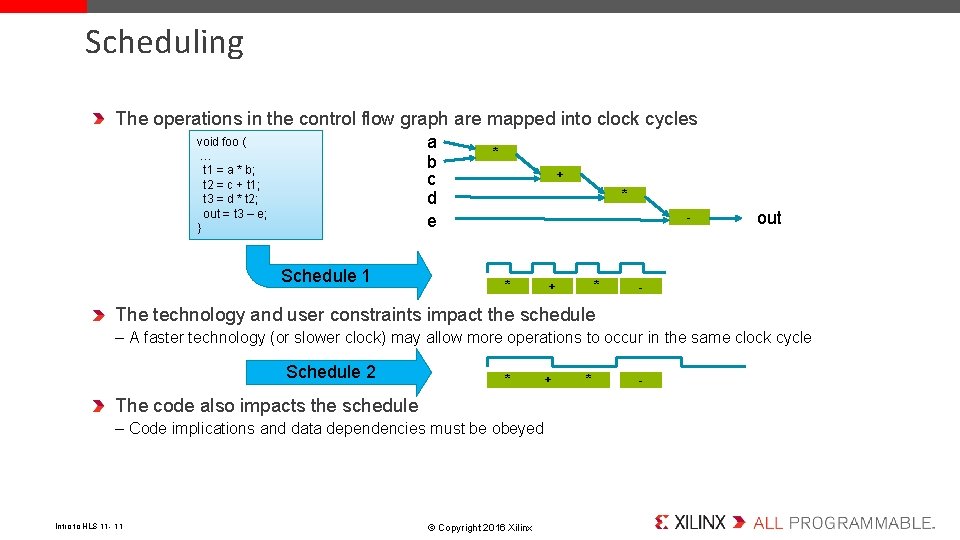
Scheduling The operations in the control flow graph are mapped into clock cycles a b c d e void foo ( … t 1 = a * b; t 2 = c + t 1; t 3 = d * t 2; out = t 3 – e; } Schedule 1 * + * - * * + out - The technology and user constraints impact the schedule – A faster technology (or slower clock) may allow more operations to occur in the same clock cycle Schedule 2 * The code also impacts the schedule – Code implications and data dependencies must be obeyed Intro to HLS 11 - 11 © Copyright 2016 Xilinx + * -
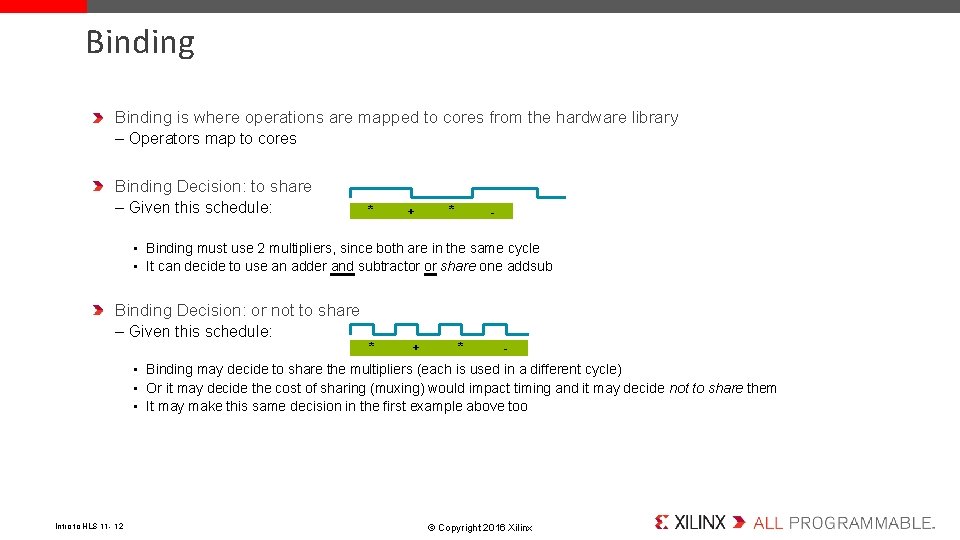
Binding is where operations are mapped to cores from the hardware library – Operators map to cores Binding Decision: to share – Given this schedule: * + * - • Binding must use 2 multipliers, since both are in the same cycle • It can decide to use an adder and subtractor or share one addsub Binding Decision: or not to share – Given this schedule: * + * - • Binding may decide to share the multipliers (each is used in a different cycle) • Or it may decide the cost of sharing (muxing) would impact timing and it may decide not to share them • It may make this same decision in the first example above too Intro to HLS 11 - 12 © Copyright 2016 Xilinx
Outline Introduction to High-Level Synthesis with Vivado HLS Language Support Validation Flow Summary Intro to HLS 11 - 13 © Copyright 2016 Xilinx
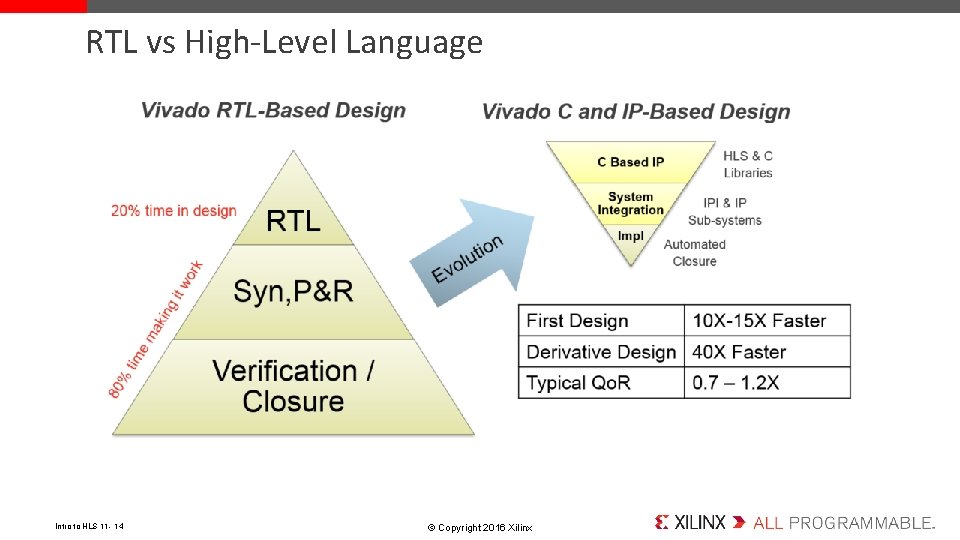
RTL vs High-Level Language Intro to HLS 11 - 14 © Copyright 2016 Xilinx
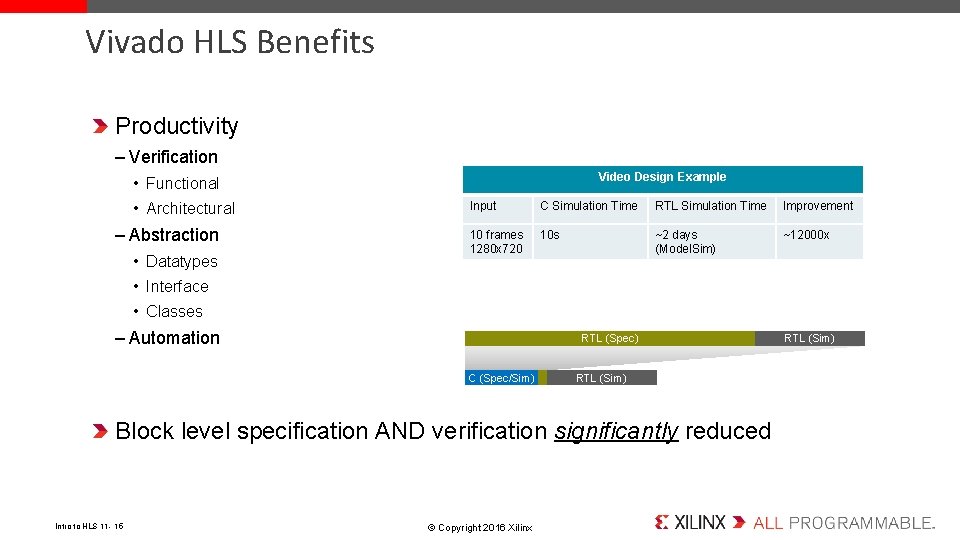
Vivado HLS Benefits Productivity – Verification Video Design Example • Functional • Architectural – Abstraction • Datatypes Input C Simulation Time RTL Simulation Time Improvement 10 frames 1280 x 720 10 s ~2 days (Model. Sim) ~12000 x • Interface • Classes – Automation RTL (Spec) C (Spec/Sim) RTL (Sim) Block level specification AND verification significantly reduced Intro to HLS 11 - 15 © Copyright 2016 Xilinx RTL (Sim)
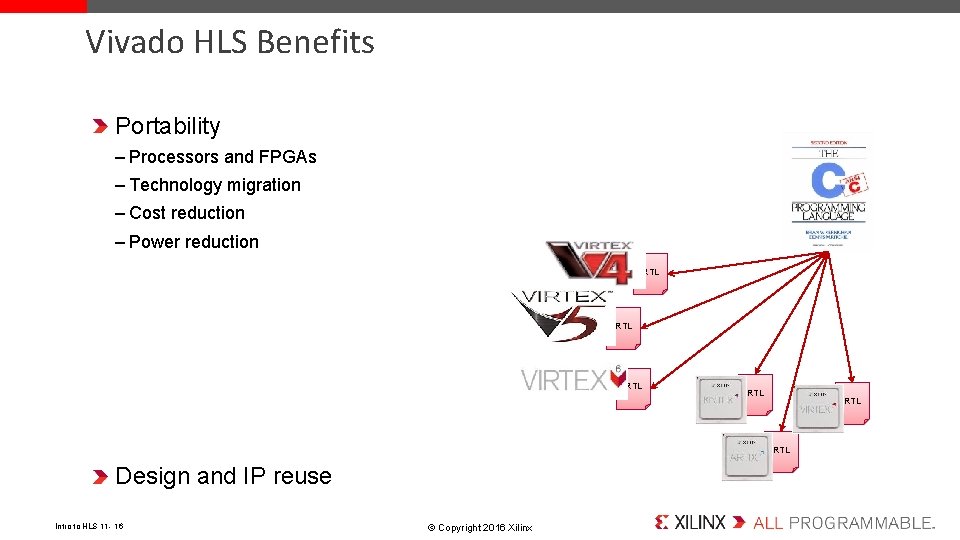
Vivado HLS Benefits Portability – Processors and FPGAs – Technology migration – Cost reduction – Power reduction RTL RTL RTL Design and IP reuse Intro to HLS 11 - 16 © Copyright 2016 Xilinx
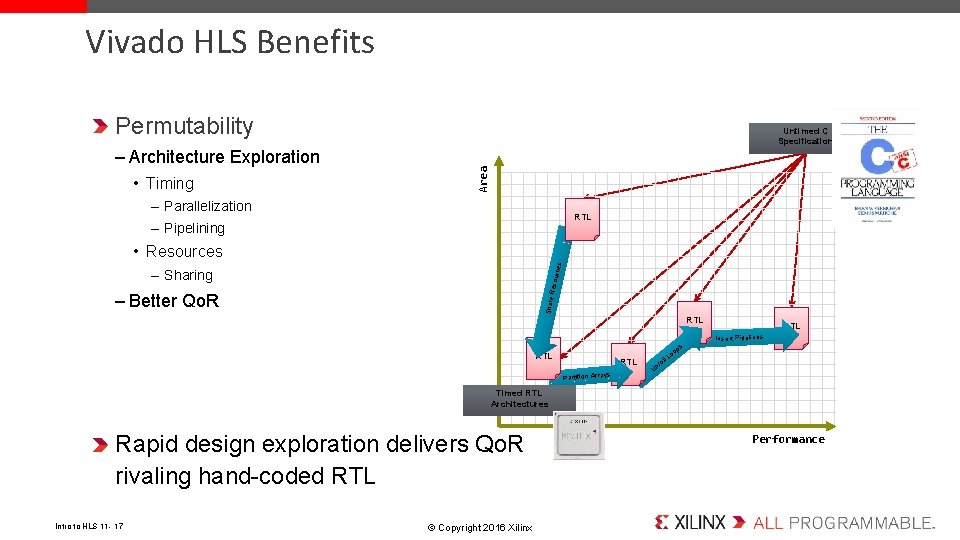
Vivado HLS Benefits Permutability • Timing Area – Architecture Exploration Untimed C Specification – Parallelization RTL – Pipelining ces • Resources Reso ur – Sharing Share – Better Qo. R RTL Insert Pipelines RTL ys Partition Arra ps oo L oll r Un Timed RTL Architectures Rapid design exploration delivers Qo. R rivaling hand-coded RTL Intro to HLS 11 - 17 © Copyright 2016 Xilinx Performance
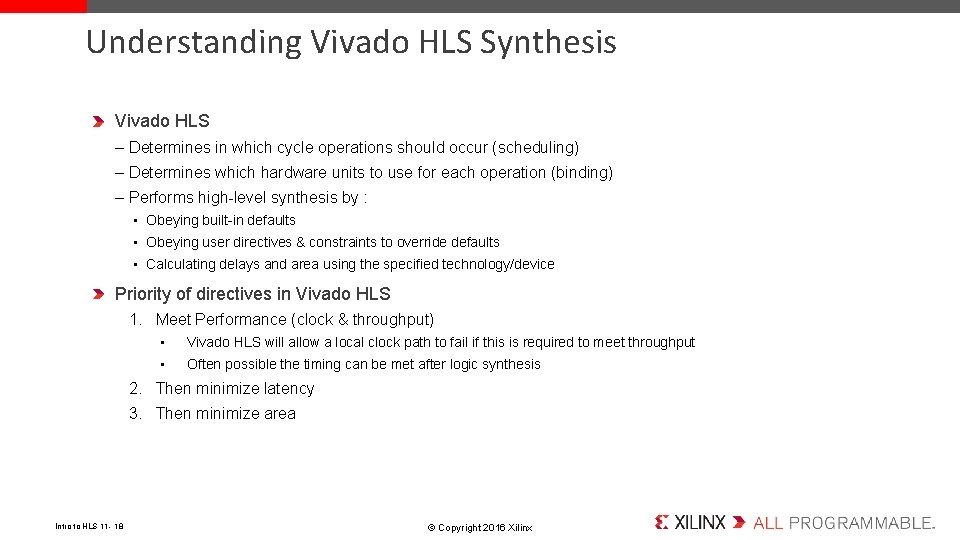
Understanding Vivado HLS Synthesis Vivado HLS – Determines in which cycle operations should occur (scheduling) – Determines which hardware units to use for each operation (binding) – Performs high-level synthesis by : • Obeying built-in defaults • Obeying user directives & constraints to override defaults • Calculating delays and area using the specified technology/device Priority of directives in Vivado HLS 1. Meet Performance (clock & throughput) • Vivado HLS will allow a local clock path to fail if this is required to meet throughput • Often possible the timing can be met after logic synthesis 2. Then minimize latency 3. Then minimize area Intro to HLS 11 - 18 © Copyright 2016 Xilinx
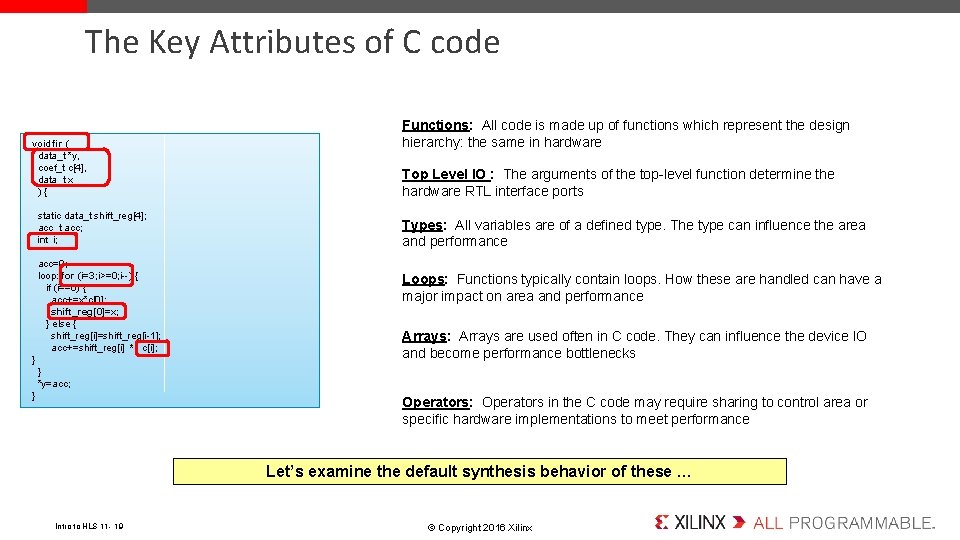
The Key Attributes of C code void fir ( data_t *y, coef_t c[4], data_t x ){ static data_t shift_reg[4]; acc_t acc; int i; acc=0; loop: for (i=3; i>=0; i--) { if (i==0) { acc+=x*c[0]; shift_reg[0]=x; } else { shift_reg[i]=shift_reg[i-1]; acc+=shift_reg[i] * c[i]; } Functions: All code is made up of functions which represent the design hierarchy: the same in hardware Top Level IO : The arguments of the top-level function determine the hardware RTL interface ports Types: All variables are of a defined type. The type can influence the area and performance Loops: Functions typically contain loops. How these are handled can have a major impact on area and performance Arrays: Arrays are used often in C code. They can influence the device IO and become performance bottlenecks } *y=acc; } Operators: Operators in the C code may require sharing to control area or specific hardware implementations to meet performance Let’s examine the default synthesis behavior of these … Intro to HLS 11 - 19 © Copyright 2016 Xilinx
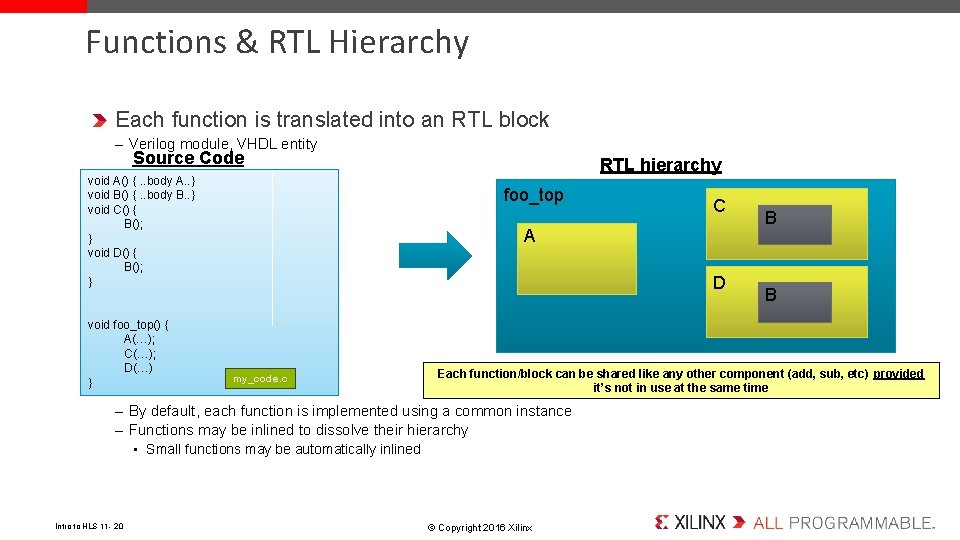
Functions & RTL Hierarchy Each function is translated into an RTL block – Verilog module, VHDL entity Source Code void A() {. . body A. . } void B() {. . body B. . } void C() { B(); } void D() { B(); } void foo_top() { A(…); C(…); D(…) } RTL hierarchy foo_top A D my_code. c B B Each function/block can be shared like any other component (add, sub, etc) provided it’s not in use at the same time – By default, each function is implemented using a common instance – Functions may be inlined to dissolve their hierarchy • Small functions may be automatically inlined Intro to HLS 11 - 20 C © Copyright 2016 Xilinx
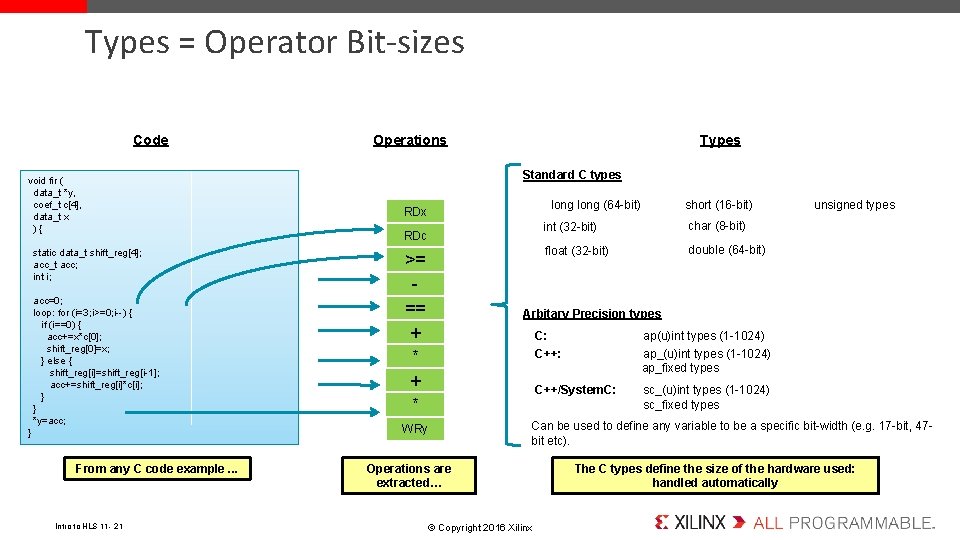
Types = Operator Bit-sizes Code void fir ( data_t *y, coef_t c[4], data_t x ){ static data_t shift_reg[4]; acc_t acc; int i; acc=0; loop: for (i=3; i>=0; i--) { if (i==0) { acc+=x*c[0]; shift_reg[0]=x; } else { shift_reg[i]=shift_reg[i-1]; acc+=shift_reg[i]*c[i]; } } *y=acc; } From any C code example. . . Intro to HLS 11 - 21 Operations Types Standard C types long (64 -bit) RDx RDc >= == + * short (16 -bit) int (32 -bit) char (8 -bit) float (32 -bit) double (64 -bit) unsigned types Arbitary Precision types WRy C: ap(u)int types (1 -1024) C++: ap_(u)int types (1 -1024) ap_fixed types C++/System. C: sc_(u)int types (1 -1024) sc_fixed types Can be used to define any variable to be a specific bit-width (e. g. 17 -bit, 47 bit etc). Operations are extracted… © Copyright 2016 Xilinx The C types define the size of the hardware used: handled automatically
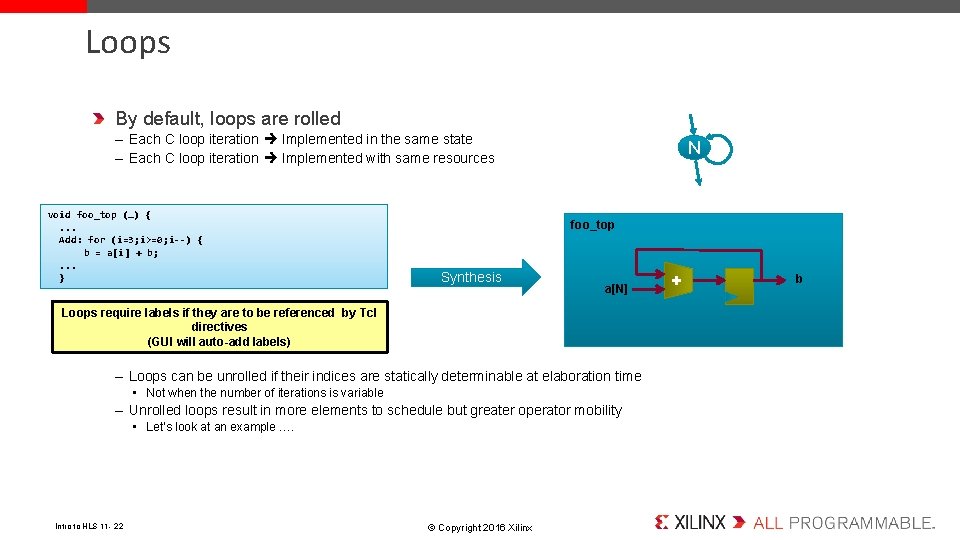
Loops By default, loops are rolled – Each C loop iteration Implemented in the same state – Each C loop iteration Implemented with same resources foo_top Synthesis a[N] Loops require labels if they are to be referenced by Tcl directives (GUI will auto-add labels) – Loops can be unrolled if their indices are statically determinable at elaboration time • Not when the number of iterations is variable – Unrolled loops result in more elements to schedule but greater operator mobility • Let’s look at an example …. Intro to HLS 11 - 22 © Copyright 2016 Xilinx + void foo_top (…) {. . . Add: for (i=3; i>=0; i--) { b = a[i] + b; . . . } N b
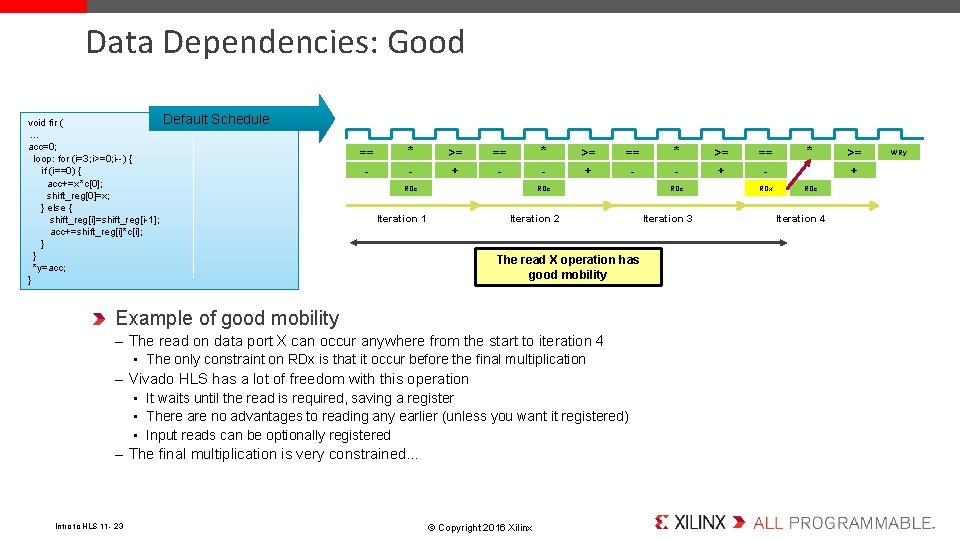
Data Dependencies: Good void fir ( … acc=0; loop: for (i=3; i>=0; i--) { if (i==0) { acc+=x*c[0]; shift_reg[0]=x; } else { shift_reg[i]=shift_reg[i-1]; acc+=shift_reg[i]*c[i]; } } *y=acc; } Default Schedule == * >= == - - + - RDc Iteration 1 RDc Iteration 2 The read X operation has good mobility Example of good mobility – The read on data port X can occur anywhere from the start to iteration 4 • The only constraint on RDx is that it occur before the final multiplication – Vivado HLS has a lot of freedom with this operation • It waits until the read is required, saving a register • There are no advantages to reading any earlier (unless you want it registered) • Input reads can be optionally registered – The final multiplication is very constrained… Intro to HLS 11 - 23 © Copyright 2016 Xilinx RDc Iteration 3 RDx * >= + RDc Iteration 4 WRy
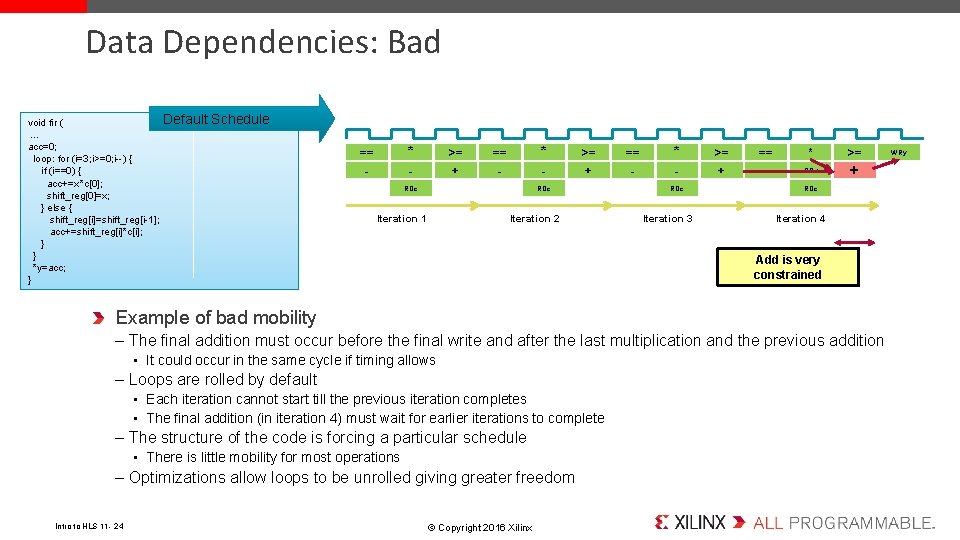
Data Dependencies: Bad void fir ( … acc=0; loop: for (i=3; i>=0; i--) { if (i==0) { acc+=x*c[0]; shift_reg[0]=x; } else { shift_reg[i]=shift_reg[i-1]; acc+=shift_reg[i]*c[i]; } } *y=acc; } Default Schedule == * >= - - + - RDx + RDc Iteration 1 Iteration 2 RDc Iteration 3 RDc Iteration 4 Add is very constrained Example of bad mobility – The final addition must occur before the final write and after the last multiplication and the previous addition • It could occur in the same cycle if timing allows – Loops are rolled by default • Each iteration cannot start till the previous iteration completes • The final addition (in iteration 4) must wait for earlier iterations to complete – The structure of the code is forcing a particular schedule • There is little mobility for most operations – Optimizations allow loops to be unrolled giving greater freedom Intro to HLS 11 - 24 © Copyright 2016 Xilinx WRy
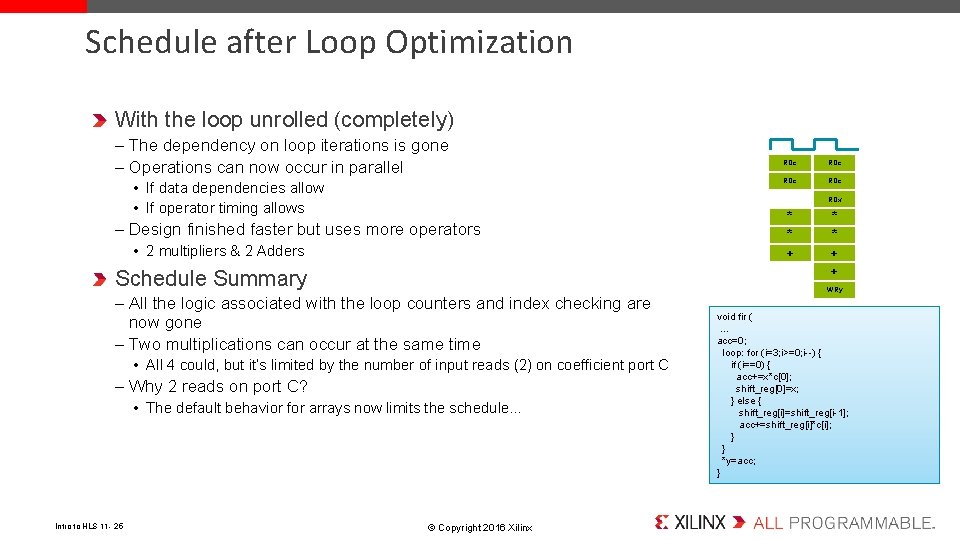
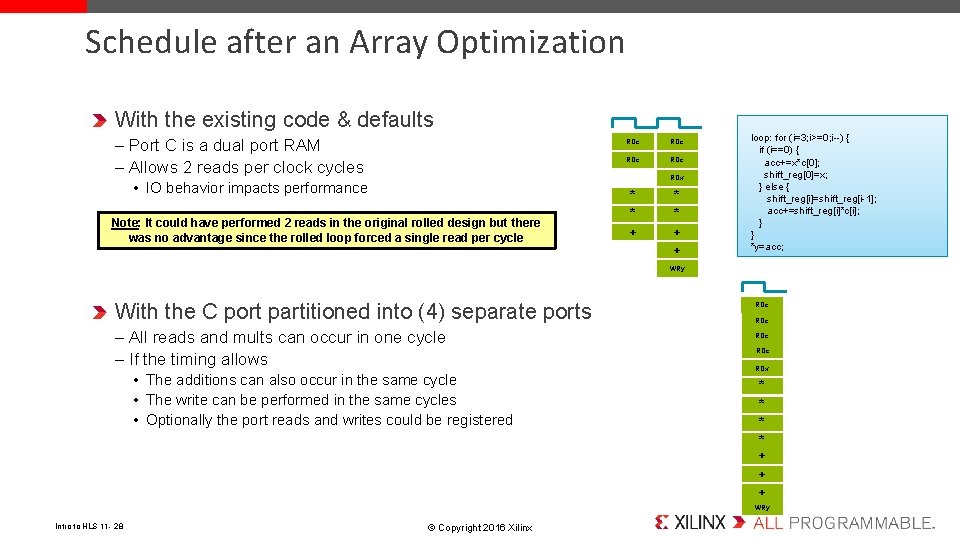
Schedule after Loop Optimization With the loop unrolled (completely) – The dependency on loop iterations is gone – Operations can now occur in parallel • If data dependencies allow • If operator timing allows RDc RDc RDx – Design finished faster but uses more operators • 2 multipliers & 2 Adders * * + + + Schedule Summary – All the logic associated with the loop counters and index checking are now gone – Two multiplications can occur at the same time • All 4 could, but it’s limited by the number of input reads (2) on coefficient port C – Why 2 reads on port C? • The default behavior for arrays now limits the schedule… Intro to HLS 11 - 25 RDc © Copyright 2016 Xilinx WRy void fir ( … acc=0; loop: for (i=3; i>=0; i--) { if (i==0) { acc+=x*c[0]; shift_reg[0]=x; } else { shift_reg[i]=shift_reg[i-1]; acc+=shift_reg[i]*c[i]; } } *y=acc; }
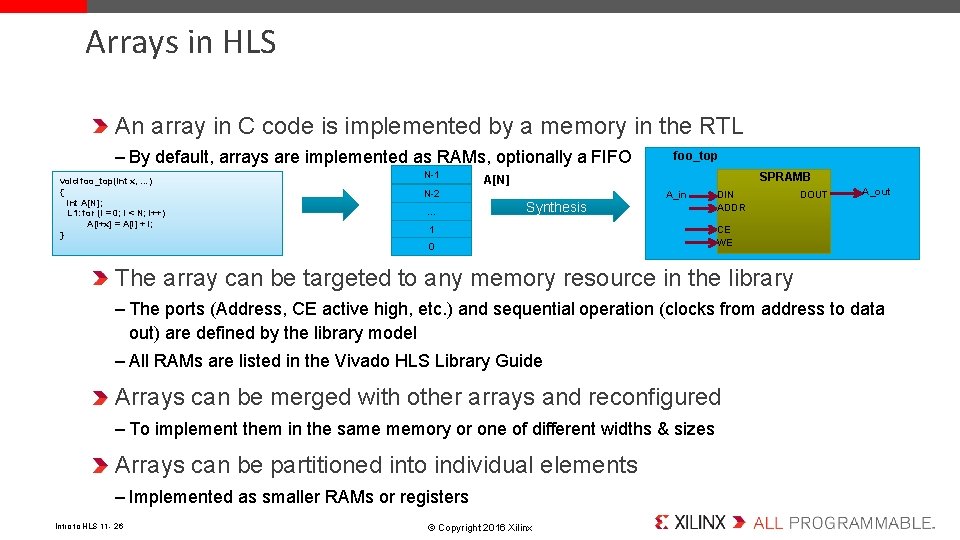
Arrays in HLS An array in C code is implemented by a memory in the RTL – By default, arrays are implemented as RAMs, optionally a FIFO void foo_top(int x, …) { int A[N]; L 1: for (i = 0; i < N; i++) A[i+x] = A[i] + i; } N-1 SPRAMB A[N] N-2 … foo_top Synthesis A_in 1 0 DIN ADDR DOUT A_out CE WE The array can be targeted to any memory resource in the library – The ports (Address, CE active high, etc. ) and sequential operation (clocks from address to data out) are defined by the library model – All RAMs are listed in the Vivado HLS Library Guide Arrays can be merged with other arrays and reconfigured – To implement them in the same memory or one of different widths & sizes Arrays can be partitioned into individual elements – Implemented as smaller RAMs or registers Intro to HLS 11 - 26 © Copyright 2016 Xilinx
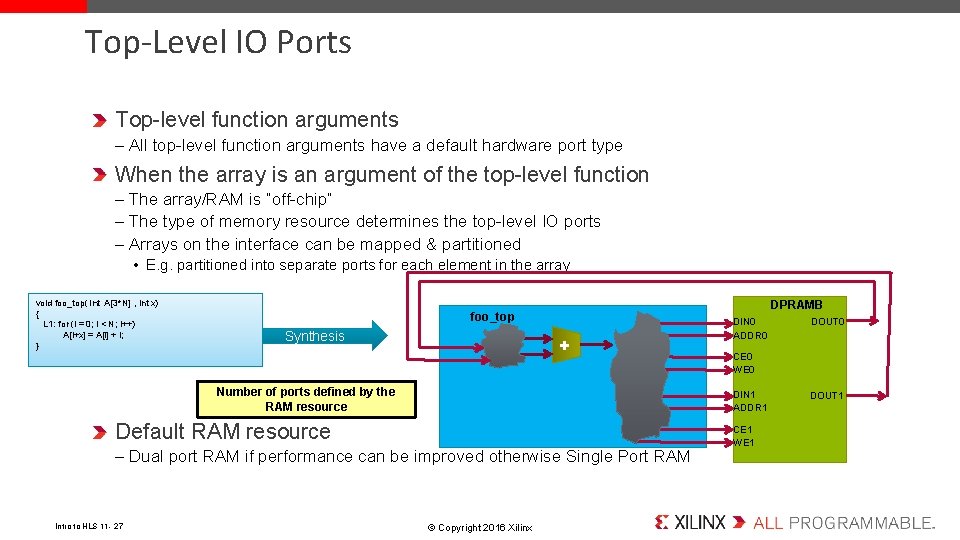
Top-Level IO Ports Top-level function arguments – All top-level function arguments have a default hardware port type When the array is an argument of the top-level function – The array/RAM is “off-chip” – The type of memory resource determines the top-level IO ports – Arrays on the interface can be mapped & partitioned • E. g. partitioned into separate ports for each element in the array DPRAMB foo_top Synthesis + void foo_top( int A[3*N] , int x) { L 1: for (i = 0; i < N; i++) A[i+x] = A[i] + i; } DIN 0 ADDR 0 DOUT 0 CE 0 WE 0 Number of ports defined by the RAM resource DIN 1 ADDR 1 Default RAM resource – Dual port RAM if performance can be improved otherwise Single Port RAM Intro to HLS 11 - 27 © Copyright 2016 Xilinx CE 1 WE 1 DOUT 1
Schedule after an Array Optimization With the existing code & defaults – Port C is a dual port RAM – Allows 2 reads per clock cycles RDc RDc RDx • IO behavior impacts performance Note: It could have performed 2 reads in the original rolled design but there was no advantage since the rolled loop forced a single read per cycle * * + + + loop: for (i=3; i>=0; i--) { if (i==0) { acc+=x*c[0]; shift_reg[0]=x; } else { shift_reg[i]=shift_reg[i-1]; acc+=shift_reg[i]*c[i]; } } *y=acc; WRy With the C port partitioned into (4) separate ports – All reads and mults can occur in one cycle – If the timing allows • The additions can also occur in the same cycle • The write can be performed in the same cycles • Optionally the port reads and writes could be registered RDc RDc RDx * * + + + WRy Intro to HLS 11 - 28 © Copyright 2016 Xilinx
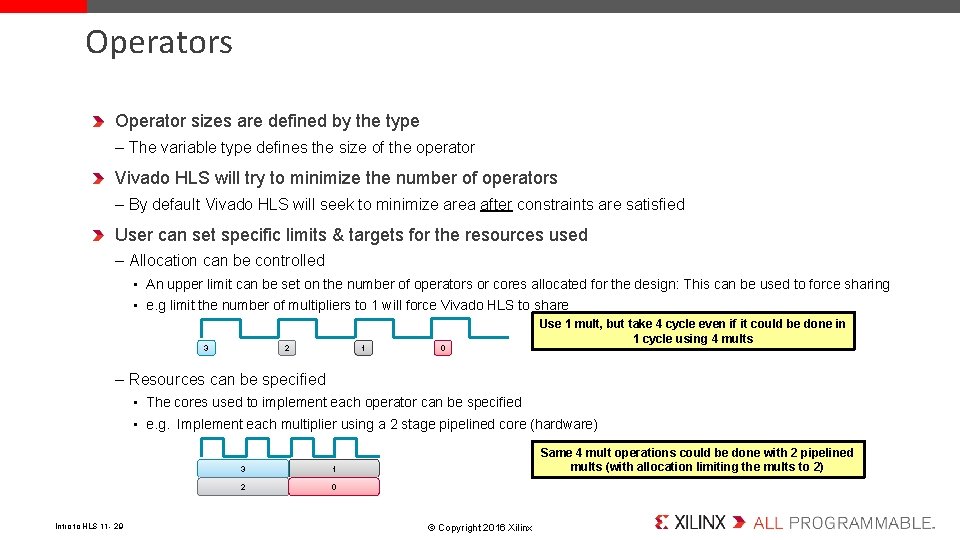
Operators Operator sizes are defined by the type – The variable type defines the size of the operator Vivado HLS will try to minimize the number of operators – By default Vivado HLS will seek to minimize area after constraints are satisfied User can set specific limits & targets for the resources used – Allocation can be controlled • An upper limit can be set on the number of operators or cores allocated for the design: This can be used to force sharing • e. g limit the number of multipliers to 1 will force Vivado HLS to share 3 2 1 0 Use 1 mult, but take 4 cycle even if it could be done in 1 cycle using 4 mults – Resources can be specified • The cores used to implement each operator can be specified • e. g. Implement each multiplier using a 2 stage pipelined core (hardware) Intro to HLS 11 - 29 3 1 2 0 Same 4 mult operations could be done with 2 pipelined mults (with allocation limiting the mults to 2) © Copyright 2016 Xilinx
Outline Introduction to High-Level Synthesis with Vivado HLS Language Support Validation Flow Summary Intro to HLS 11 - 30 © Copyright 2016 Xilinx
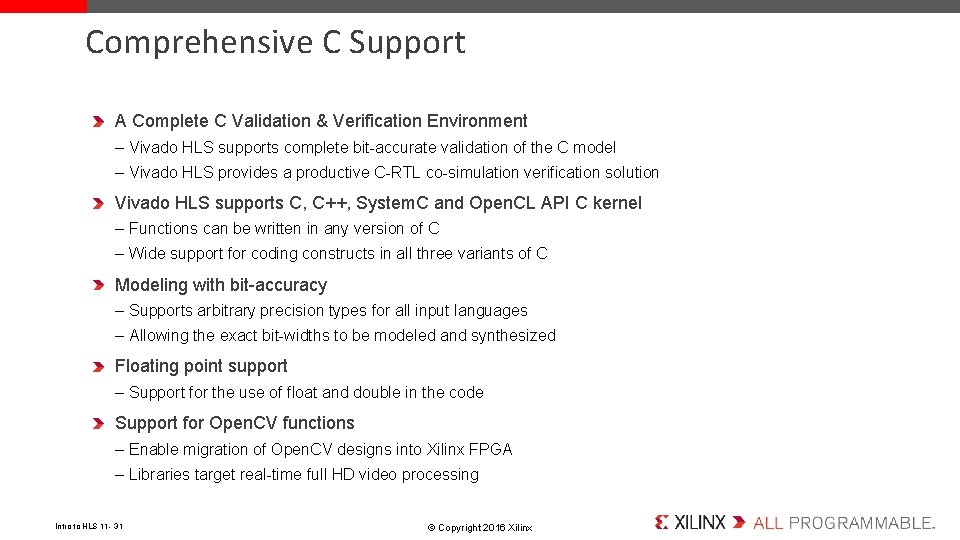
Comprehensive C Support A Complete C Validation & Verification Environment – Vivado HLS supports complete bit-accurate validation of the C model – Vivado HLS provides a productive C-RTL co-simulation verification solution Vivado HLS supports C, C++, System. C and Open. CL API C kernel – Functions can be written in any version of C – Wide support for coding constructs in all three variants of C Modeling with bit-accuracy – Supports arbitrary precision types for all input languages – Allowing the exact bit-widths to be modeled and synthesized Floating point support – Support for the use of float and double in the code Support for Open. CV functions – Enable migration of Open. CV designs into Xilinx FPGA – Libraries target real-time full HD video processing Intro to HLS 11 - 31 © Copyright 2016 Xilinx
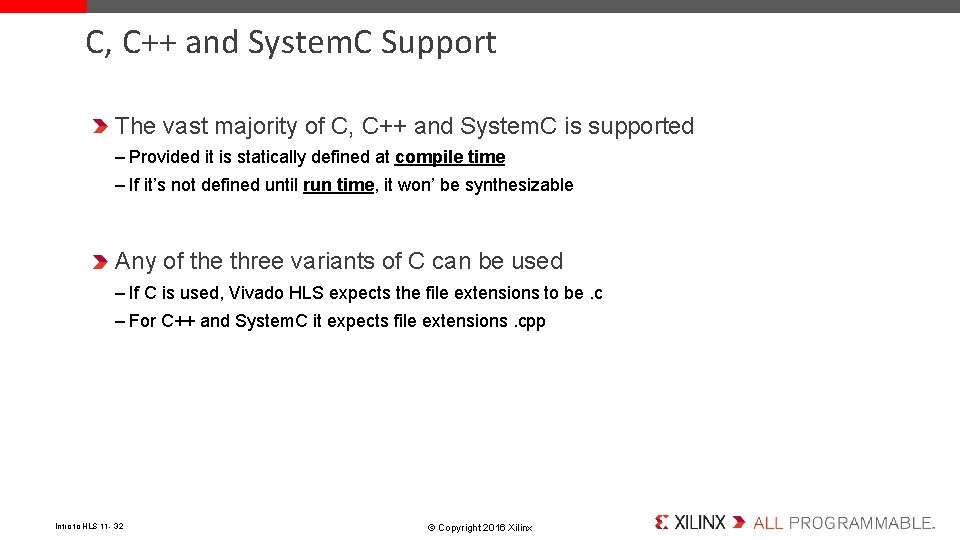
C, C++ and System. C Support The vast majority of C, C++ and System. C is supported – Provided it is statically defined at compile time – If it’s not defined until run time, it won’ be synthesizable Any of the three variants of C can be used – If C is used, Vivado HLS expects the file extensions to be. c – For C++ and System. C it expects file extensions. cpp Intro to HLS 11 - 32 © Copyright 2016 Xilinx
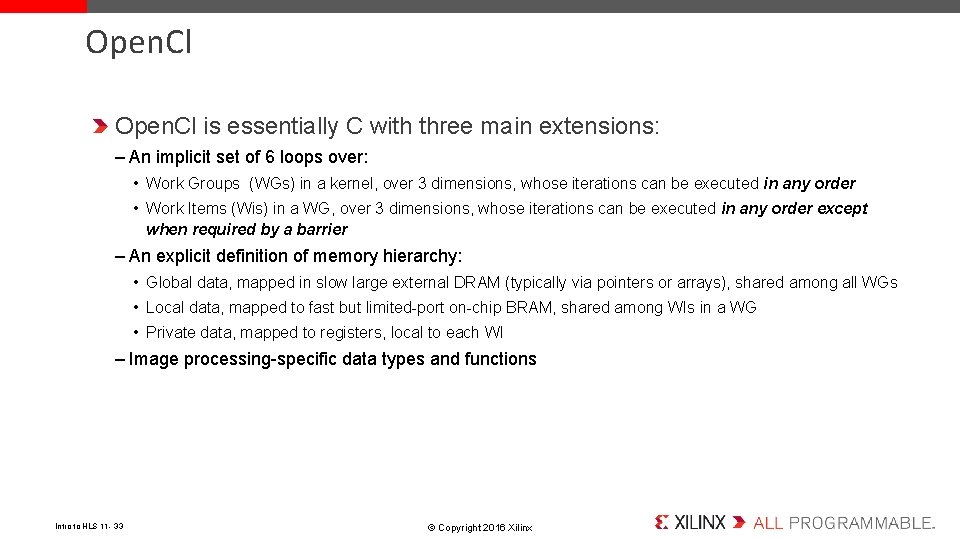
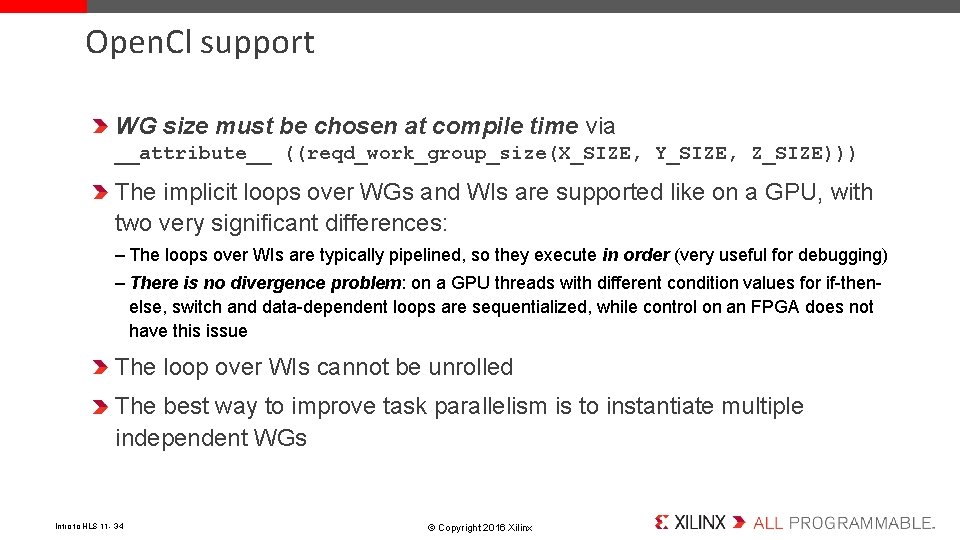
Open. Cl is essentially C with three main extensions: – An implicit set of 6 loops over: • Work Groups (WGs) in a kernel, over 3 dimensions, whose iterations can be executed in any order • Work Items (Wis) in a WG, over 3 dimensions, whose iterations can be executed in any order except when required by a barrier – An explicit definition of memory hierarchy: • Global data, mapped in slow large external DRAM (typically via pointers or arrays), shared among all WGs • Local data, mapped to fast but limited-port on-chip BRAM, shared among WIs in a WG • Private data, mapped to registers, local to each WI – Image processing-specific data types and functions Intro to HLS 11 - 33 © Copyright 2016 Xilinx
Open. Cl support WG size must be chosen at compile time via __attribute__ ((reqd_work_group_size(X_SIZE, Y_SIZE, Z_SIZE))) The implicit loops over WGs and WIs are supported like on a GPU, with two very significant differences: – The loops over WIs are typically pipelined, so they execute in order (very useful for debugging) – There is no divergence problem: on a GPU threads with different condition values for if-thenelse, switch and data-dependent loops are sequentialized, while control on an FPGA does not have this issue The loop over WIs cannot be unrolled The best way to improve task parallelism is to instantiate multiple independent WGs Intro to HLS 11 - 34 © Copyright 2016 Xilinx
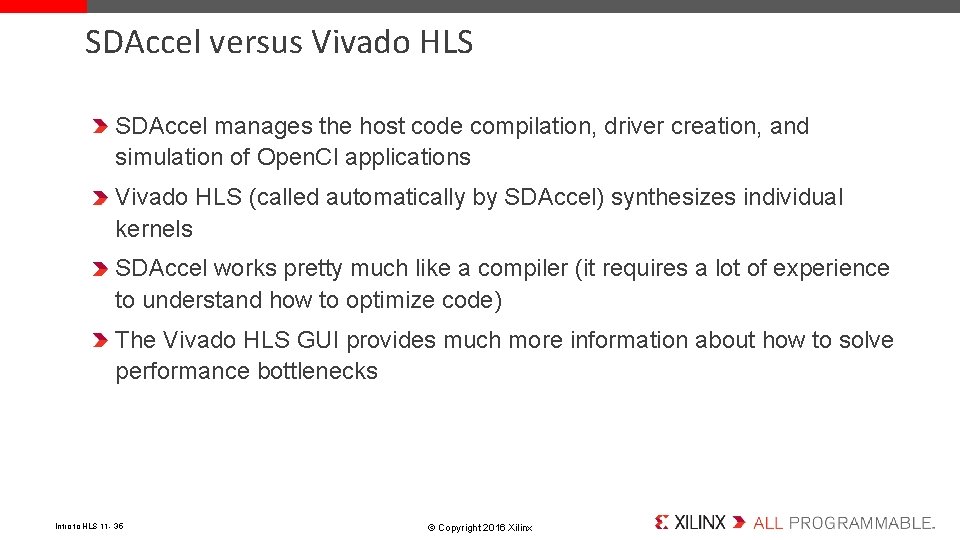
SDAccel versus Vivado HLS SDAccel manages the host code compilation, driver creation, and simulation of Open. Cl applications Vivado HLS (called automatically by SDAccel) synthesizes individual kernels SDAccel works pretty much like a compiler (it requires a lot of experience to understand how to optimize code) The Vivado HLS GUI provides much more information about how to solve performance bottlenecks Intro to HLS 11 - 35 © Copyright 2016 Xilinx
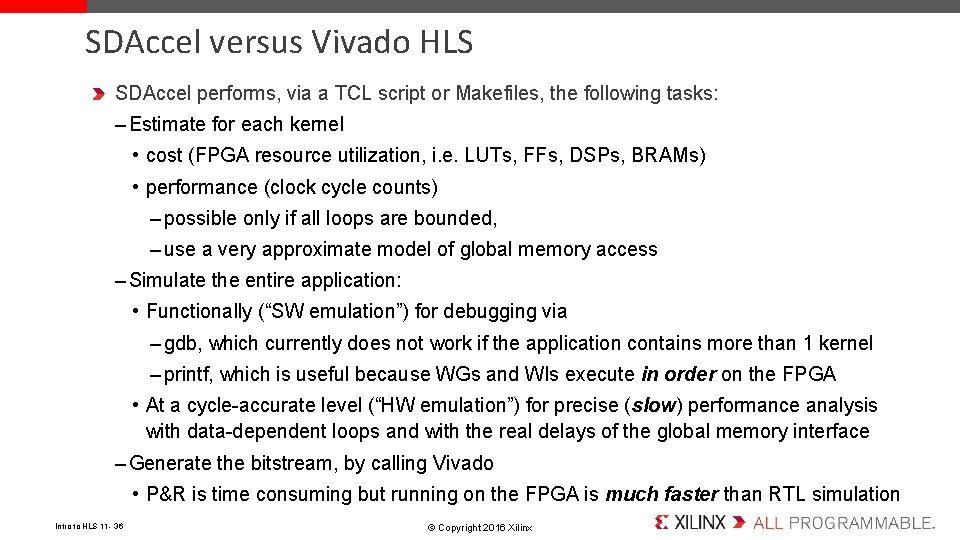
SDAccel versus Vivado HLS SDAccel performs, via a TCL script or Makefiles, the following tasks: – Estimate for each kernel • cost (FPGA resource utilization, i. e. LUTs, FFs, DSPs, BRAMs) • performance (clock cycle counts) – possible only if all loops are bounded, – use a very approximate model of global memory access – Simulate the entire application: • Functionally (“SW emulation”) for debugging via – gdb, which currently does not work if the application contains more than 1 kernel – printf, which is useful because WGs and WIs execute in order on the FPGA • At a cycle-accurate level (“HW emulation”) for precise (slow) performance analysis with data-dependent loops and with the real delays of the global memory interface – Generate the bitstream, by calling Vivado • P&R is time consuming but running on the FPGA is much faster than RTL simulation Intro to HLS 11 - 36 © Copyright 2016 Xilinx
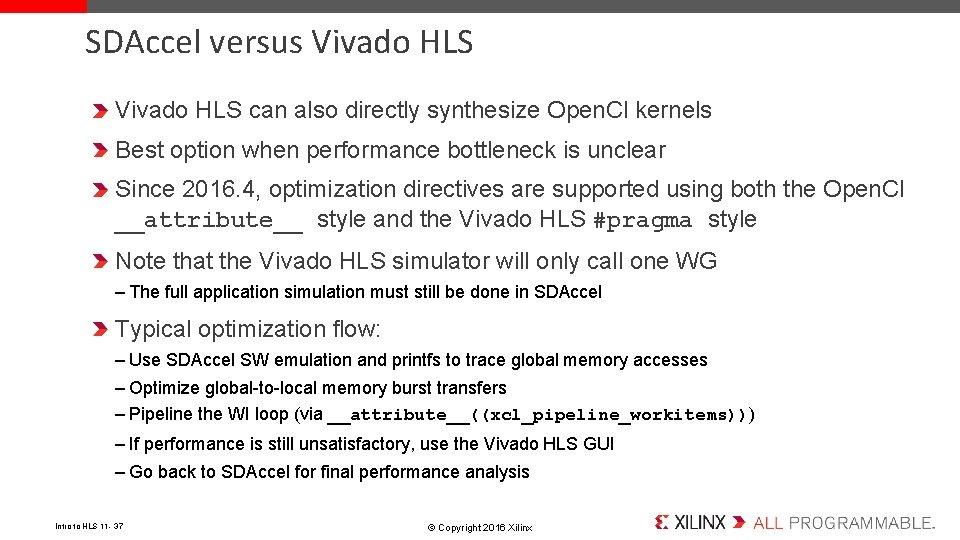
SDAccel versus Vivado HLS can also directly synthesize Open. Cl kernels Best option when performance bottleneck is unclear Since 2016. 4, optimization directives are supported using both the Open. Cl __attribute__ style and the Vivado HLS #pragma style Note that the Vivado HLS simulator will only call one WG – The full application simulation must still be done in SDAccel Typical optimization flow: – Use SDAccel SW emulation and printfs to trace global memory accesses – Optimize global-to-local memory burst transfers – Pipeline the WI loop (via __attribute__((xcl_pipeline_workitems))) – If performance is still unsatisfactory, use the Vivado HLS GUI – Go back to SDAccel for final performance analysis Intro to HLS 11 - 37 © Copyright 2016 Xilinx
Outline Introduction to High-Level Synthesis with Vivado HLS Language Support Validation Flow Summary Intro to HLS 11 - 38 © Copyright 2016 Xilinx
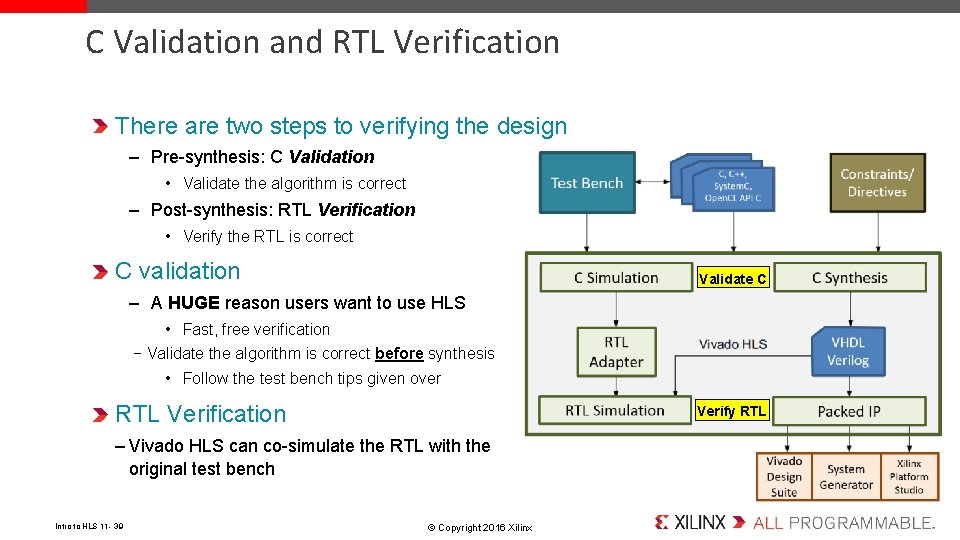
C Validation and RTL Verification There are two steps to verifying the design – Pre-synthesis: C Validation • Validate the algorithm is correct – Post-synthesis: RTL Verification • Verify the RTL is correct C validation Validate C – A HUGE reason users want to use HLS • Fast, free verification − Validate the algorithm is correct before synthesis • Follow the test bench tips given over RTL Verification Verify RTL – Vivado HLS can co-simulate the RTL with the original test bench Intro to HLS 11 - 39 © Copyright 2016 Xilinx
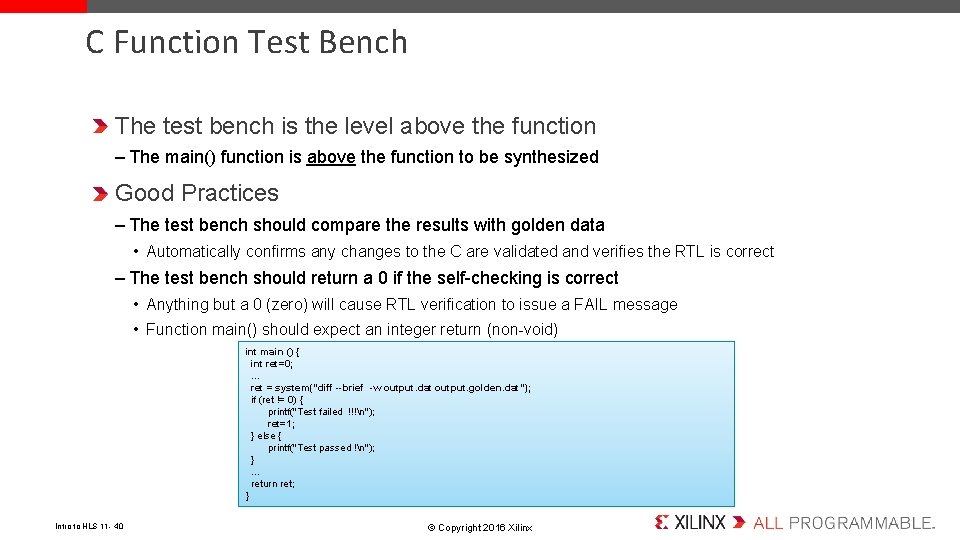
C Function Test Bench The test bench is the level above the function – The main() function is above the function to be synthesized Good Practices – The test bench should compare the results with golden data • Automatically confirms any changes to the C are validated and verifies the RTL is correct – The test bench should return a 0 if the self-checking is correct • Anything but a 0 (zero) will cause RTL verification to issue a FAIL message • Function main() should expect an integer return (non-void) int main () { int ret=0; … ret = system("diff --brief -w output. dat output. golden. dat"); if (ret != 0) { printf("Test failed !!!n"); ret=1; } else { printf("Test passed !n"); } … return ret; } Intro to HLS 11 - 40 © Copyright 2016 Xilinx
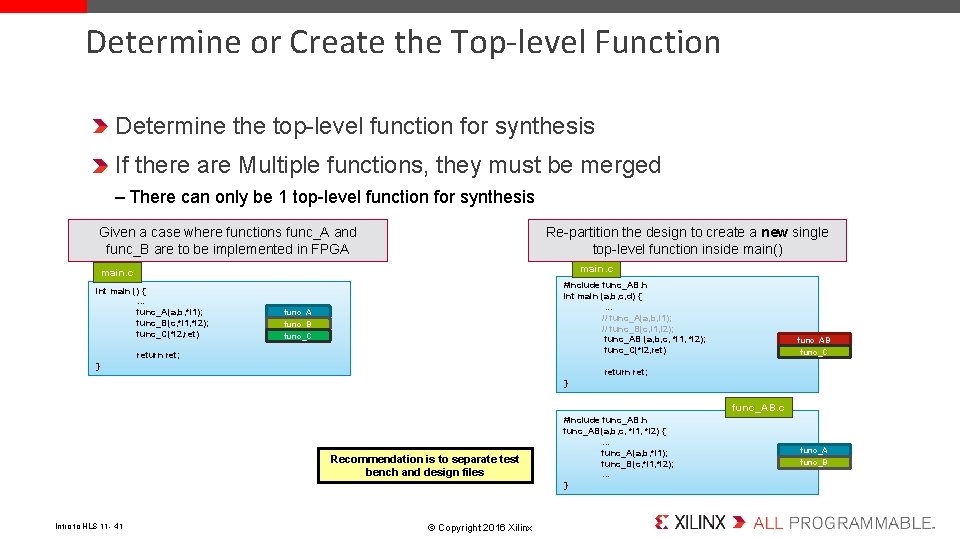
Determine or Create the Top-level Function Determine the top-level function for synthesis If there are Multiple functions, they must be merged – There can only be 1 top-level function for synthesis Given a case where functions func_A and func_B are to be implemented in FPGA Re-partition the design to create a new single top-level function inside main() main. c int main () {. . . func_A(a, b, *i 1); func_B(c, *i 1, *i 2); func_C(*i 2, ret) #include func_AB. h int main (a, b, c, d) {. . . // func_A(a, b, i 1); // func_B(c, i 1, i 2); func_AB (a, b, c, *i 1, *i 2); func_C(*i 2, ret) func_A func_B func_C return ret; } func_AB. c Recommendation is to separate test bench and design files Intro to HLS 11 - 41 © Copyright 2016 Xilinx #include func_AB. h func_AB(a, b, c, *i 1, *i 2) {. . . func_A(a, b, *i 1); func_B(c, *i 1, *i 2); … } func_A func_B
Outline Introduction to High-Level Synthesis with Vivado HLS Language Support Validation Flow Summary Intro to HLS 11 - 42 © Copyright 2016 Xilinx
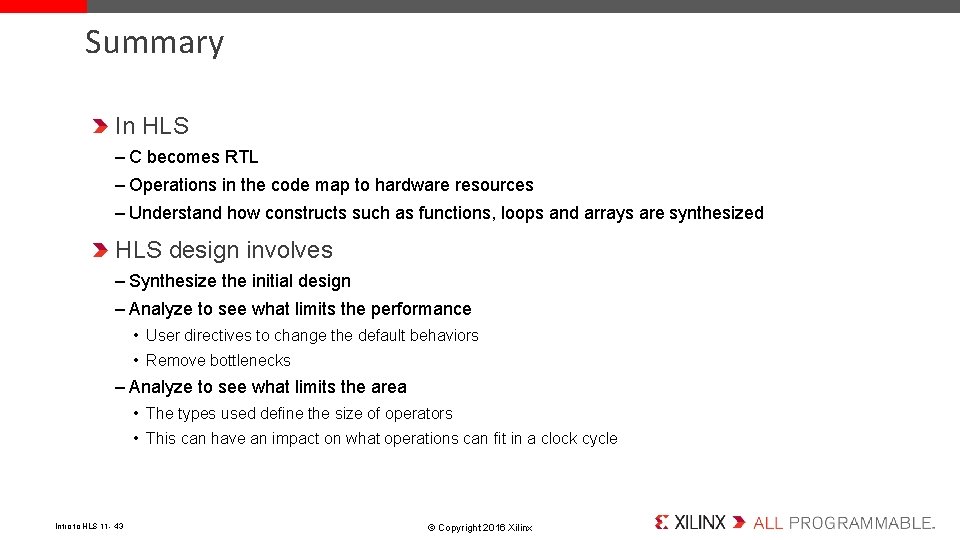
Summary In HLS – C becomes RTL – Operations in the code map to hardware resources – Understand how constructs such as functions, loops and arrays are synthesized HLS design involves – Synthesize the initial design – Analyze to see what limits the performance • User directives to change the default behaviors • Remove bottlenecks – Analyze to see what limits the area • The types used define the size of operators • This can have an impact on what operations can fit in a clock cycle Intro to HLS 11 - 43 © Copyright 2016 Xilinx
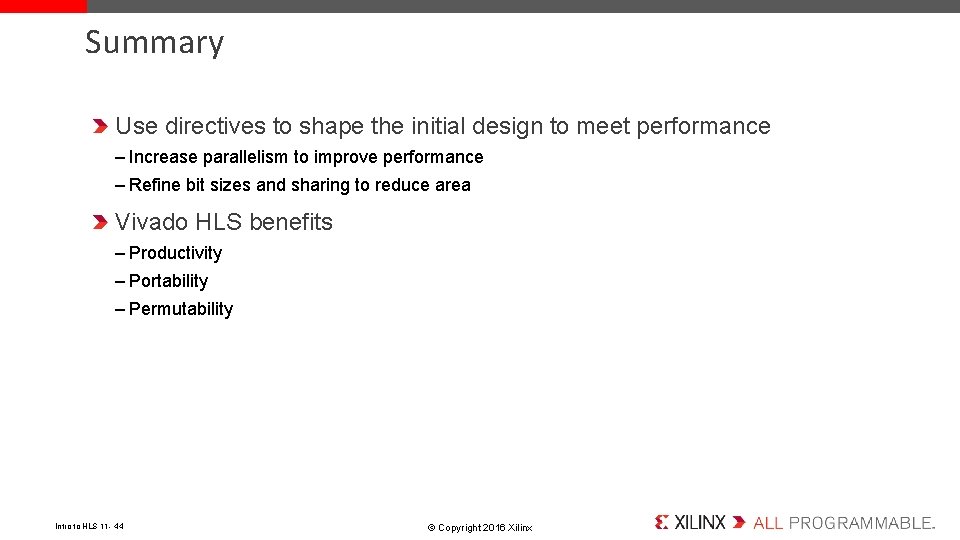
Summary Use directives to shape the initial design to meet performance – Increase parallelism to improve performance – Refine bit sizes and sharing to reduce area Vivado HLS benefits – Productivity – Portability – Permutability Intro to HLS 11 - 44 © Copyright 2016 Xilinx