
Introduction to Health Studies Health Promotion I Dennis


- Slides: 24
Introduction to Health Studies Health Promotion I Dennis Raphael School of Health Policy and Management York University, Toronto, Canada
Overview of Today’s Presentation • • • Differing Concepts of Health Promotion Canadian Contributions The Ottawa Charter for Health Promotion Current Approaches to Health Promotion Reflection: The Role of Values Class Exercise: How Should We Reduce the Incidence of Heart Disease?
Defining Health: The Medical Definition • The normal physical state, i. e. , the state of being whole and free from physical and mental disease or pain, so that the parts of the body can carry on their proper function.
Defining Health: The World Health Organization • Health is a state of complete physical, mental, and social well-being and not merely the absence of disease and infirmity. • Health is a positive concept emphasizing personal resources, as well as physical capacities.
Three Broad Concepts of Health • Medical (Traditional) • Behavioural (Lifestyle) • Socio-Environmental (Structural) • These approaches lead to different definitions of problems, different strategies, different target groups, and different people responsible for the activities of promoting health.
Concepts of Health Promotion: Medical Approach I (Traditional, Biomedical) • Health Concept is biomedical, absence of disease and/or disability • Leading Health Problems defined in terms of disease categories and physiological risk factors such as physiological deviation from the norm: CVD, AIDS, diabetes, obesity, arthritis, mental disease, hypertension, etc.
Concepts of Health Promotion: Medical Approach II • Principal Strategies: surgical interventions, drug and otherapies, health care, medically managed health behaviour change (diet, exercise, patient education, patient compliance), screening for physiological and genetic risk factors • Target: high risk individuals • General Approach: Individualized • Actors: physicians, nurses, allied health workers
Concepts of Health Promotion: Behavioural Approach I (Lifestyle, Public Health) • Health Concept is individualized, health as energy, functional ability, disease‑preventing lifestyles • Leading Health Problems defined in terms of behavioural risk factors: smoking, poor eating habits, lack of fitness, drug abuse, alcohol abuse, poor stress coping, lack of lifeskills, etc.
Concepts of Health Promotion: Behavioural Approach II • Principal Strategies: health education, social marketing, advocacy for public policies supporting lifestyle choices (e. g. smoking bans, low fat meat production, bicycle paths, ad bans) • Target: high risk groups, children and youth • General Approach: individualized, elements of societal focus as related to public policy • Actors: public health workers, illness‑related advocacy groups (e. g. , Cancer Society), governments •
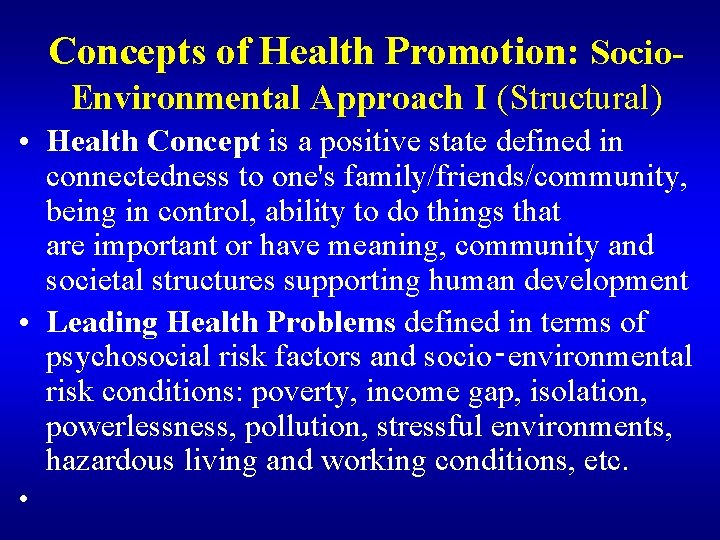
Concepts of Health Promotion: Socio. Environmental Approach I (Structural) • Health Concept is a positive state defined in connectedness to one's family/friends/community, being in control, ability to do things that are important or have meaning, community and societal structures supporting human development • Leading Health Problems defined in terms of psychosocial risk factors and socio‑environmental risk conditions: poverty, income gap, isolation, powerlessness, pollution, stressful environments, hazardous living and working conditions, etc. •
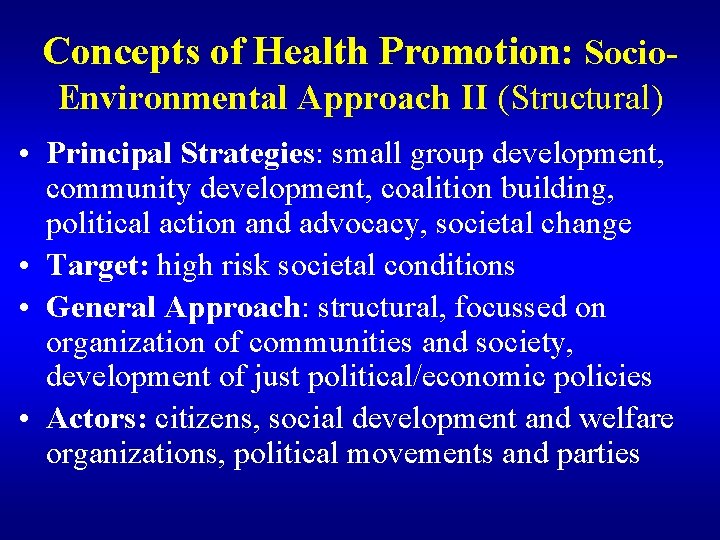
Concepts of Health Promotion: Socio. Environmental Approach II (Structural) • Principal Strategies: small group development, community development, coalition building, political action and advocacy, societal change • Target: high risk societal conditions • General Approach: structural, focussed on organization of communities and society, development of just political/economic policies • Actors: citizens, social development and welfare organizations, political movements and parties
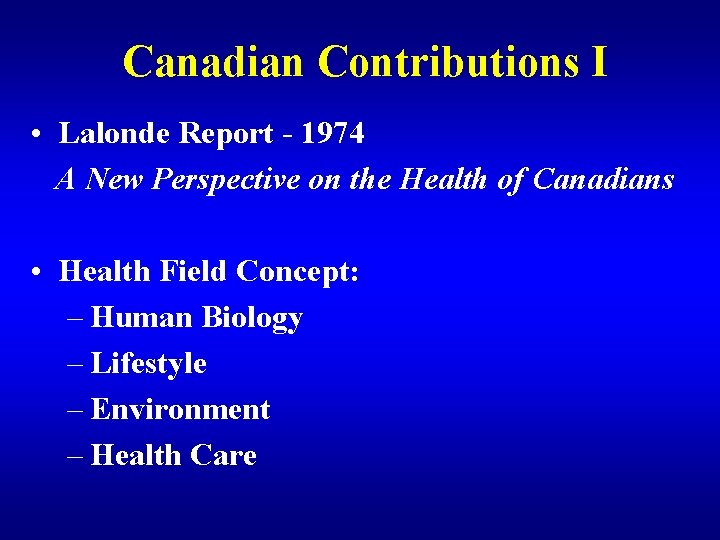
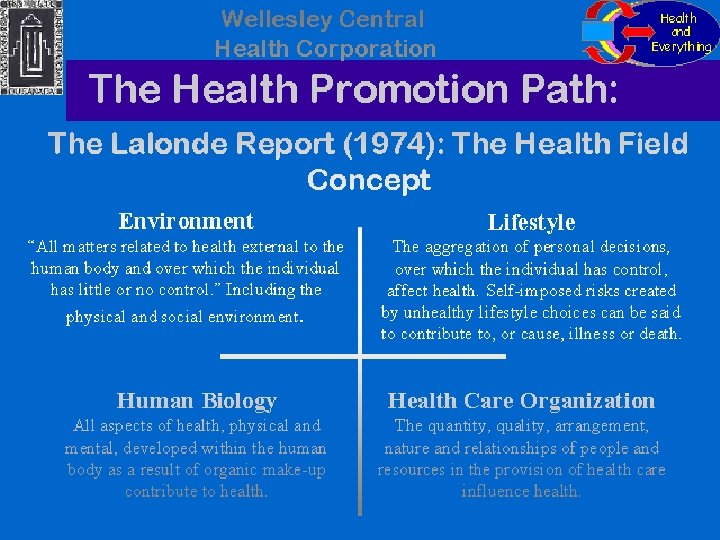
Canadian Contributions I • Lalonde Report - 1974 A New Perspective on the Health of Canadians • Health Field Concept: – Human Biology – Lifestyle – Environment – Health Care
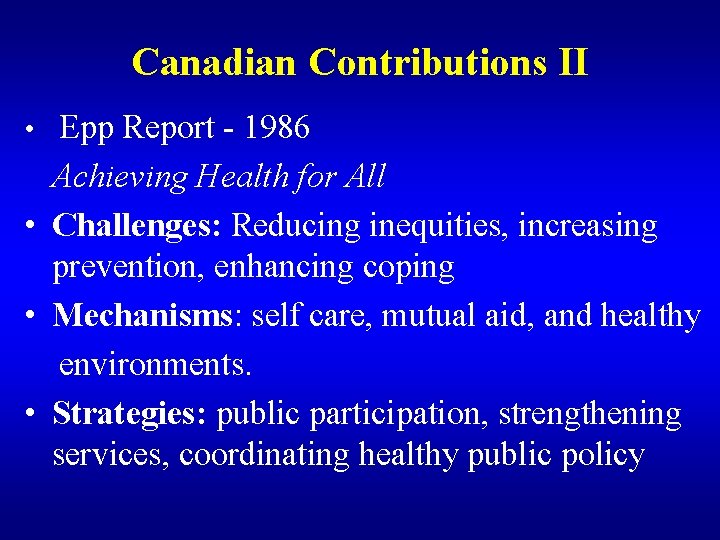
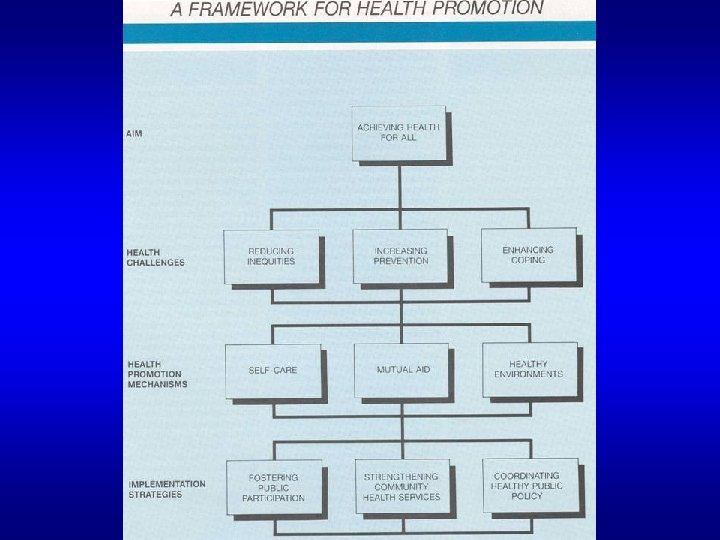
Canadian Contributions II • Epp Report - 1986 Achieving Health for All • Challenges: Reducing inequities, increasing prevention, enhancing coping • Mechanisms: self care, mutual aid, and healthy environments. • Strategies: public participation, strengthening services, coordinating healthy public policy
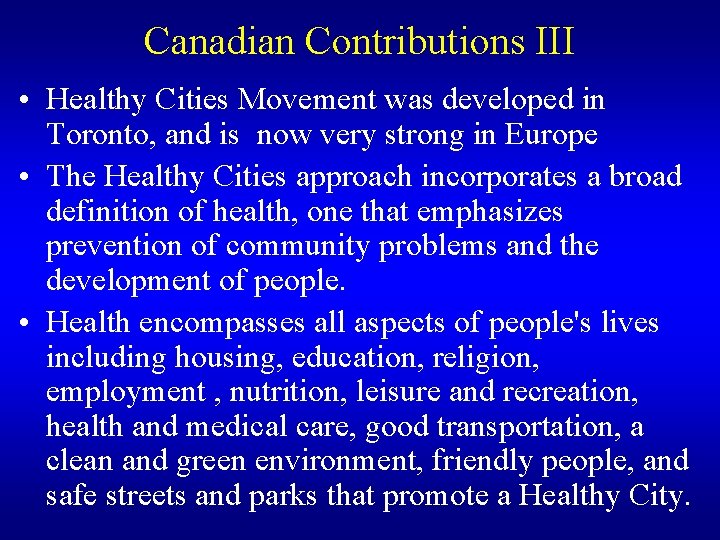
Canadian Contributions III • Healthy Cities Movement was developed in Toronto, and is now very strong in Europe • The Healthy Cities approach incorporates a broad definition of health, one that emphasizes prevention of community problems and the development of people. • Health encompasses all aspects of people's lives including housing, education, religion, employment , nutrition, leisure and recreation, health and medical care, good transportation, a clean and green environment, friendly people, and safe streets and parks that promote a Healthy City.
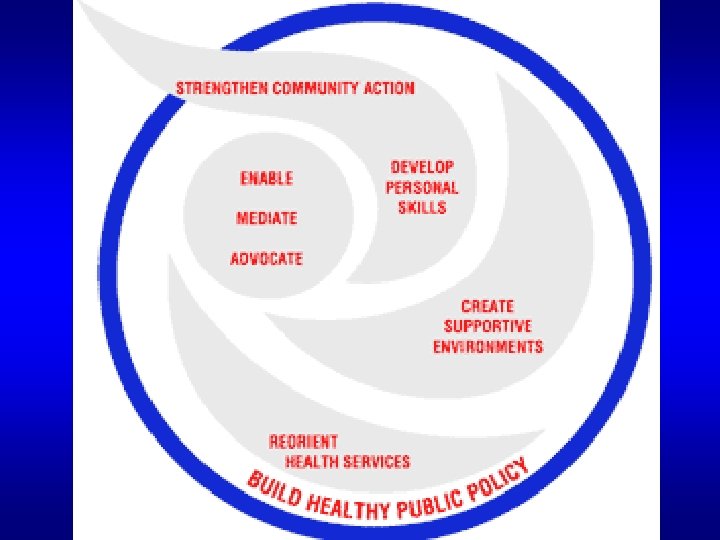
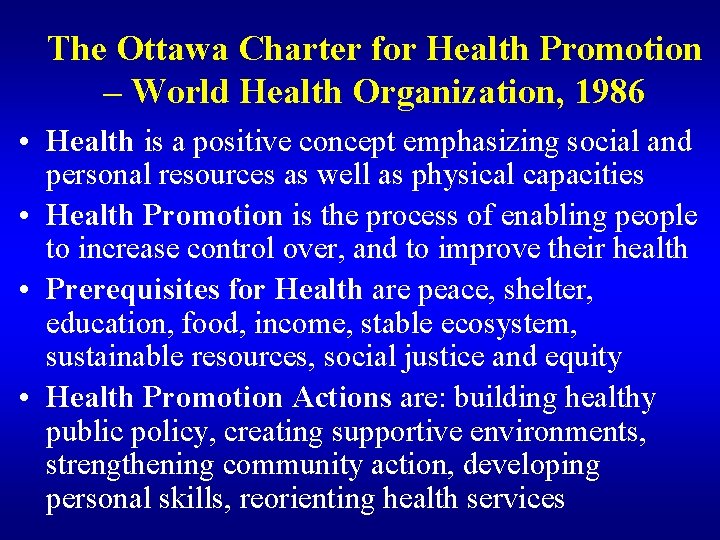
The Ottawa Charter for Health Promotion – World Health Organization, 1986 • Health is a positive concept emphasizing social and personal resources as well as physical capacities • Health Promotion is the process of enabling people to increase control over, and to improve their health • Prerequisites for Health are peace, shelter, education, food, income, stable ecosystem, sustainable resources, social justice and equity • Health Promotion Actions are: building healthy public policy, creating supportive environments, strengthening community action, developing personal skills, reorienting health services