
INTRODUCTION TO HEALTH RESEARCH PROCESS By Dr Khadija

INTRODUCTION TO HEALTH RESEARCH PROCESS By Dr. Khadija N. Abdullah Faculty of Community Health Sciences Director, UMR Peshawar Medical College
LEARNING OBJECTIVES At the end of the session the students will be able to: 1) Define health research. 2) Describe steps of conducting a health research. 3) Enlist the main components of a research proposal. 4) Enlist the main components of a research report

What is ‘research

ﻱ ﻯ ﻝﻯ ﻙ ﻡ ﺍﻝـ ﻡ ﻯ ﻥﻡ ﻯ ﺍﻝﺍﺍ ﻯ ﺍﻱﺍ ﻱﻡ ﴾۵۳, Surah, Fussilat﴿ We shall show them Our portents on the horizons and within themselves until it will be manifest unto them that it is the Truth. Doth not thy Lord suffice, since He is Witness over all things?

What is ‘research’? And what is ‘health research’? § Research is the systematic collection, analysis and interpretation of data to answer a certain question or solve a problem. § Health research is done to learn more about human health and aims to find better ways to maintain health and to prevent and treat disease.
Characteristics of research 1. It demands a clear statement of the problem. 2. It requires clear objectives and a plan. 3. It builds on existing data, using both positive and negative findings. 4. New data should be systematically collected analyzed to answer the original research objectives.
THE RESEARCH PROCESS • It is the systematic, integrated and comprehensive design or operational plan for carrying out research. • The steps are essentially sequential but general. • The research process is also called research methodology, opposed to a research method
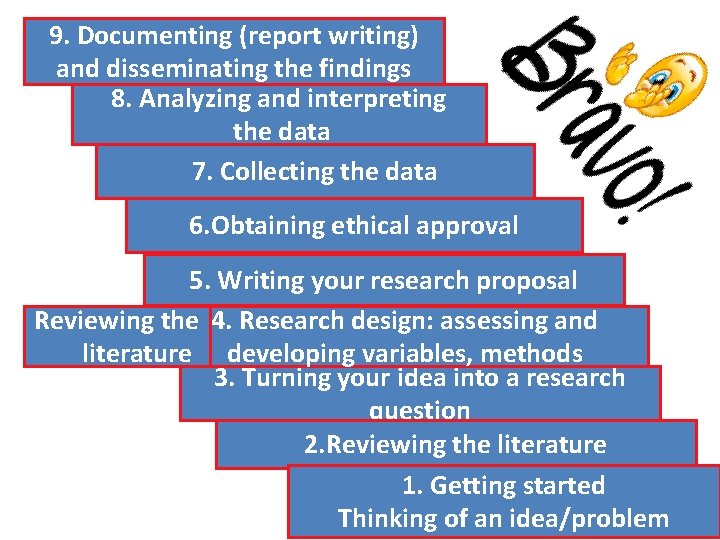
9. Documenting (report writing) and disseminating the findings 8. Analyzing and interpreting the data 7. Collecting the data 6. Obtaining ethical approval 5. Writing your research proposal Reviewing the 4. Research design: assessing and literature developing variables, methods 3. Turning your idea into a research question 2. Reviewing the literature 1. Getting started Thinking of an idea/problem
Getting started First, this must be you to decide on a research idea or a question of your choice by answering the 6 W/H questions: 1. Why? Why am I carrying out this research? The purpose 2. Whom? Who shall be the beneficiary of my research? 3. What? What is it about? The target population covered 4. How? The approach 5. Where? The setting 6. When? A feasible and realistic time period and schedule
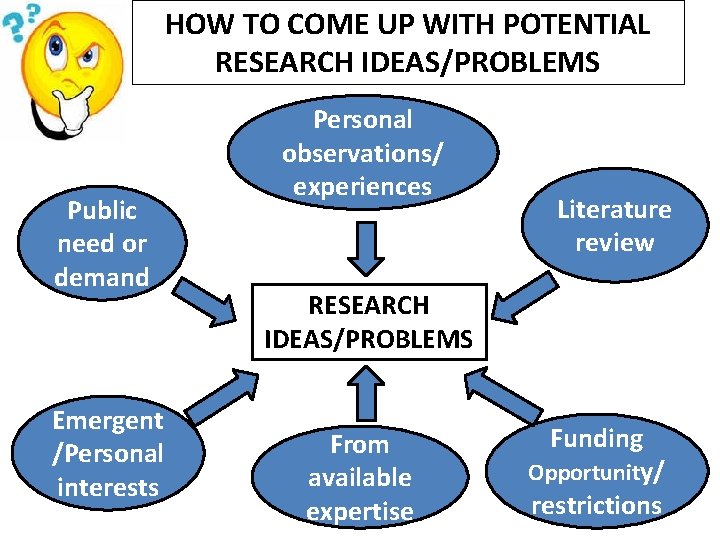
HOW TO COME UP WITH POTENTIAL RESEARCH IDEAS/PROBLEMS Public need or demand Emergent /Personal interests Personal observations/ experiences Literature review RESEARCH IDEAS/PROBLEMS From available expertise Funding Opportunity/ restrictions
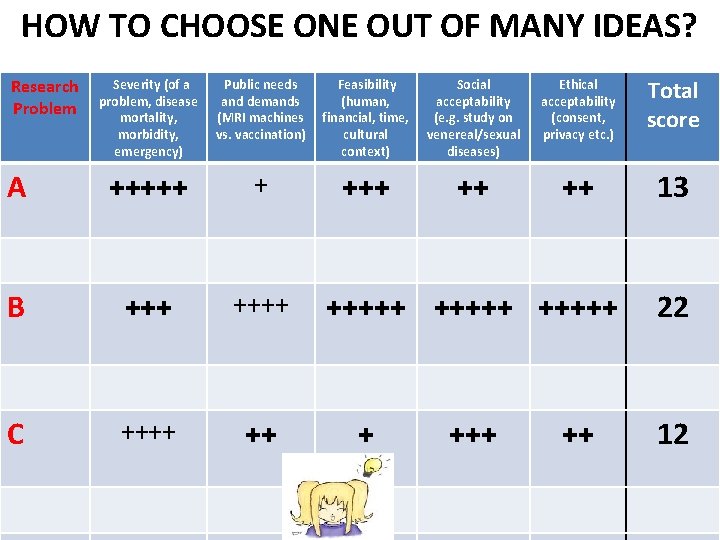
HOW TO CHOOSE ONE OUT OF MANY IDEAS? Severity (of a problem, disease mortality, morbidity, emergency) Public needs and demands (MRI machines vs. vaccination) Feasibility (human, financial, time, cultural context) Social acceptability (e. g. study on venereal/sexual diseases) Ethical acceptability (consent, privacy etc. ) Total score A +++++ ++ 13 B ++++ C ++++ ++ Research Problem +++++ + ++ 22 12
The research question Remember: There is a difference between a research topic and a research question. (Research topic, research idea, and the research theme are almost the same). You may have found your topic, but within that topic you must find a question. Research Question is a statement that identifies the phenomenon to be studied. One simple hint: It should be followed by a question mark!? “Well-crafted questions guide the systematic planning of research. Formulating your questions precisely enables you to design a study with a good chance of answering them”.

Literature Review It is a systematic survey of scholarly articles, books, and other sources (e. g. reports, dissertations, conference proceedings) that are relevant to a particular research question.
A literature review helps : • To obtain Background knowledge of the field of inquiry • To have Knowledge of the methodologies common or popular in the field; their relevance and usefulness in the setting under study • To identify gaps in existing knowledge • To avoid duplication
Components of a research proposal I. Title of the research II. Abstract III. Background including introduction, literature review, rationale, objectives and hypothesis (if any) IV. Methodology V. Work plan VI. Budget VII. Plan for utilization and dissemination of research results VIII. References IX. Annexes
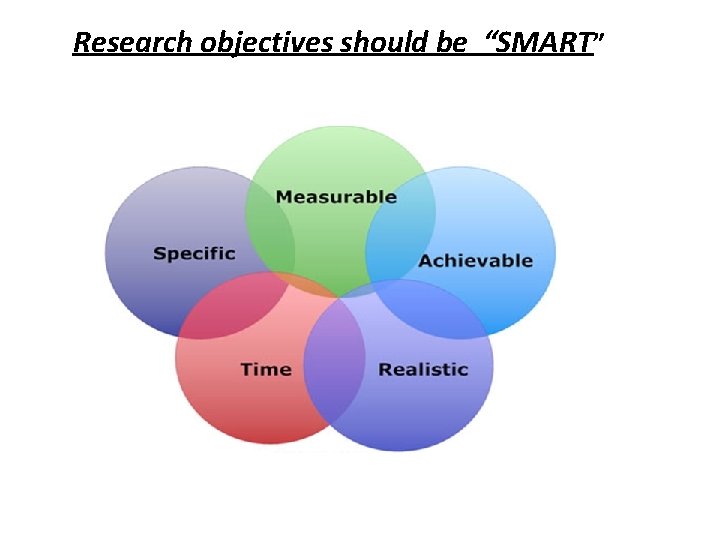
Research objectives should be “SMART”
Hypotheses (Hypothesis is singular!) These are assumptions/questions created by researchers when they speculate/pre-judge certain results. Every hypothesis includes two or more variables, and need to be examined through the research process and tested statistically. For examples: - Increase in pay reduces nurses’ turnover
METHODOLOGY The methodology section should include a description of: the study type the study variables on which data was collected the study population, sampling method and the size of the sample data-collection techniques and how the data shall be collected and by whom procedures to be used for data analysis, including statistical tests (if applicable)
Documentation of research The final research report includes: • Title Page • Abstract (maximum one page) • Introduction • Objectives • Literature review/background • Methodology • Results/findings • Discussion • Limitations of research • Conclusions & recommendations • References • Any appendix (Appendices for plural)
Any questions?

- Slides: 21