
INTRODUCTION TO HEALTH POLICY ANALYSIS Moises Cruz Neil

- Slides: 27
INTRODUCTION TO HEALTH POLICY ANALYSIS Moises Cruz & Neil Chawla 5/2/17
Overview ■ – – Purpose Think critically about public health issues Be able to read health policy literature Use the knowledge you learned here Collaborate and share information ■ – – – Structure 20 minute presentation 10 minute Q&A Equal participation from all members
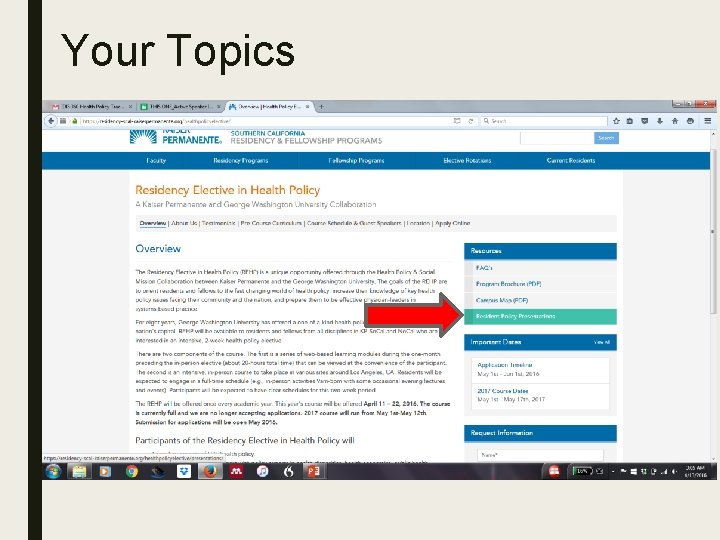
Your Topics
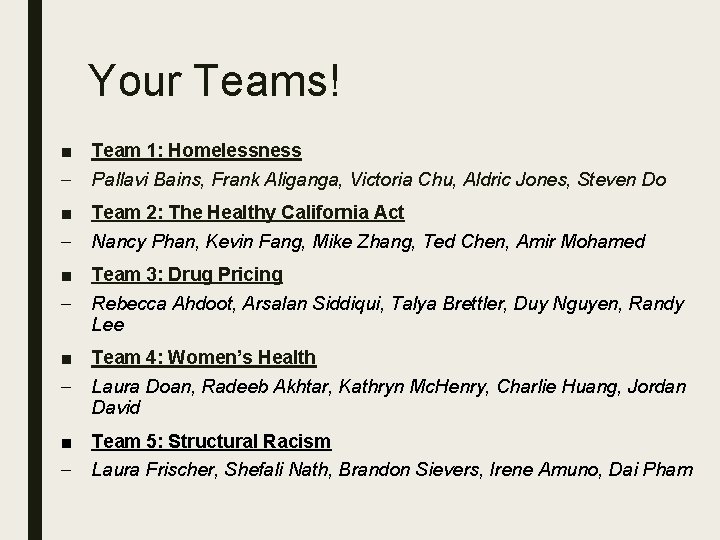
Your Teams! ■ Team 1: Homelessness – Pallavi Bains, Frank Aliganga, Victoria Chu, Aldric Jones, Steven Do ■ Team 2: The Healthy California Act – Nancy Phan, Kevin Fang, Mike Zhang, Ted Chen, Amir Mohamed ■ Team 3: Drug Pricing – Rebecca Ahdoot, Arsalan Siddiqui, Talya Brettler, Duy Nguyen, Randy Lee ■ Team 4: Women’s Health – Laura Doan, Radeeb Akhtar, Kathryn Mc. Henry, Charlie Huang, Jordan David ■ Team 5: Structural Racism – Laura Frischer, Shefali Nath, Brandon Sievers, Irene Amuno, Dai Pham
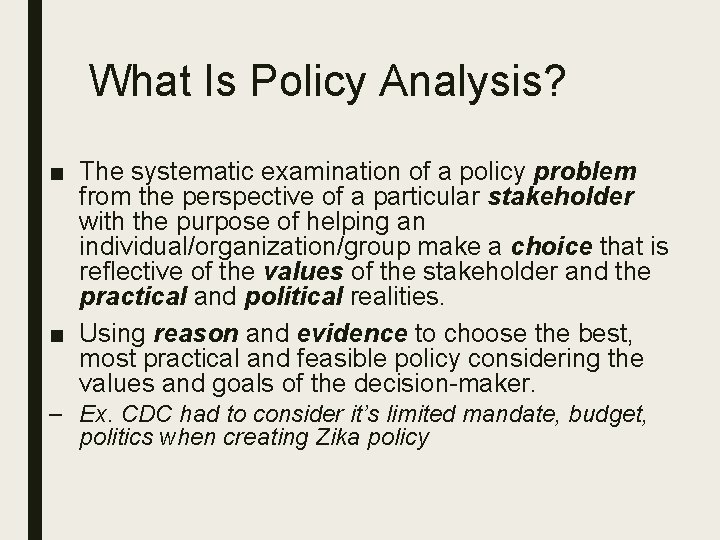
What Is Policy Analysis? ■ The systematic examination of a policy problem from the perspective of a particular stakeholder with the purpose of helping an individual/organization/group make a choice that is reflective of the values of the stakeholder and the practical and political realities. ■ Using reason and evidence to choose the best, most practical and feasible policy considering the values and goals of the decision-maker. – Ex. CDC had to consider it’s limited mandate, budget, politics when creating Zika policy
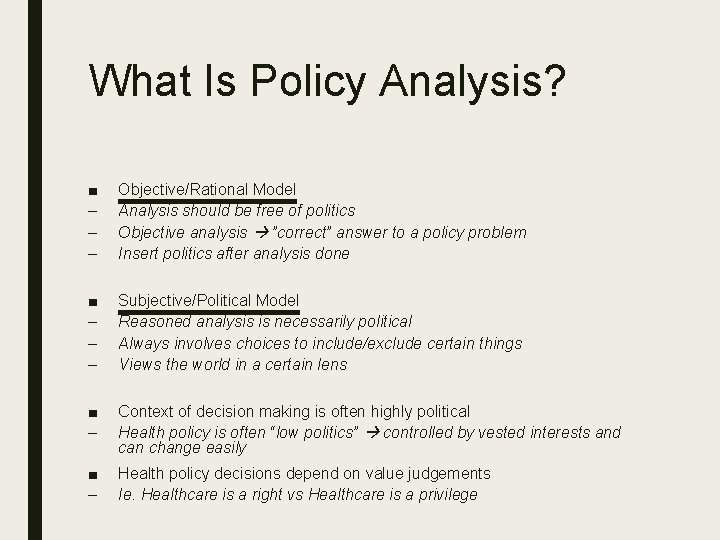
What Is Policy Analysis? ■ – – – Objective/Rational Model Analysis should be free of politics Objective analysis ”correct” answer to a policy problem Insert politics after analysis done ■ – – – Subjective/Political Model Reasoned analysis is necessarily political Always involves choices to include/exclude certain things Views the world in a certain lens ■ – Context of decision making is often highly political Health policy is often “low politics” controlled by vested interests and can change easily ■ – Health policy decisions depend on value judgements Ie. Healthcare is a right vs Healthcare is a privilege
Why Health Policy Analysis? ■ Should action be taken to address a given problem? – Sometimes the best action is inaction ■ If so, what type of action?
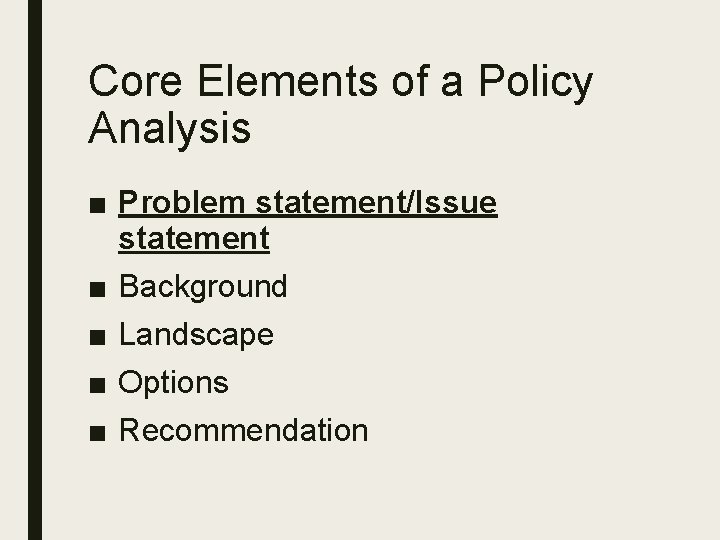
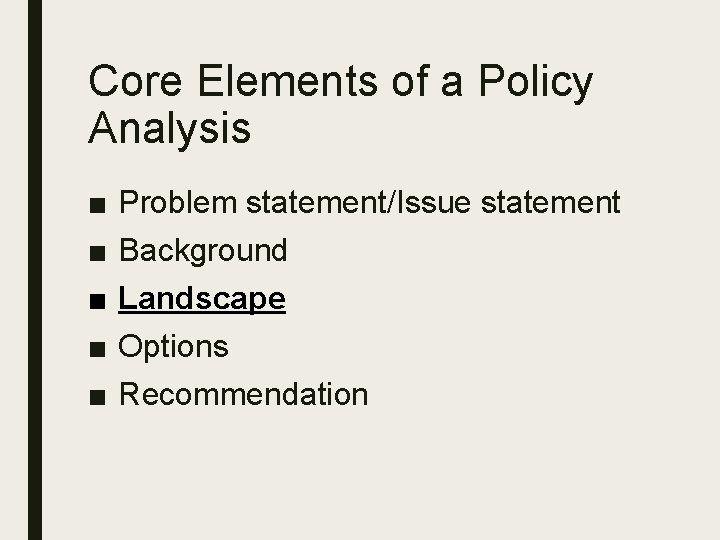
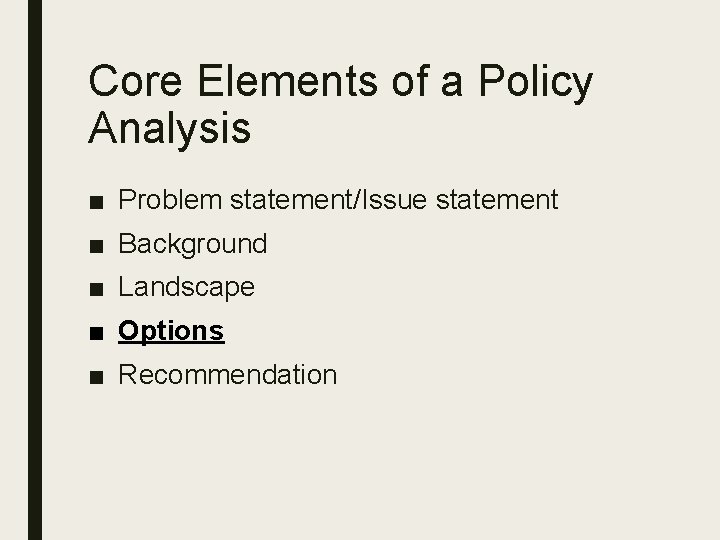
Core Elements of a Policy Analysis ■ Problem statement/Issue statement ■ Background ■ Landscape ■ Options ■ Recommendation
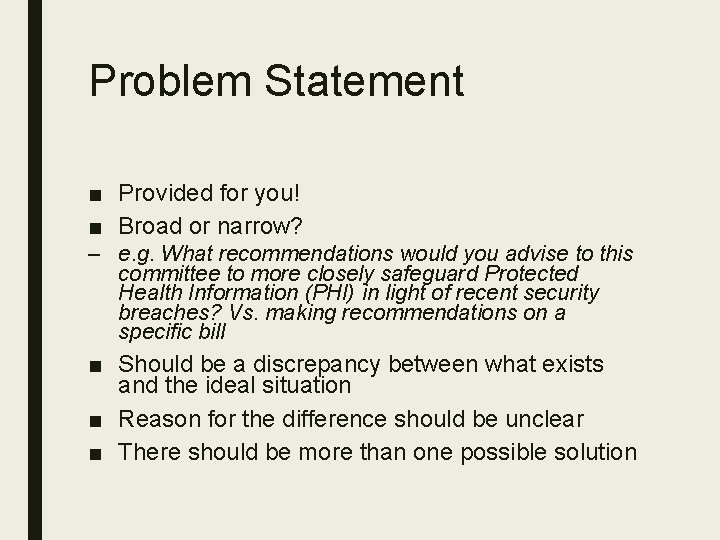
Problem Statement ■ Provided for you! ■ Broad or narrow? – e. g. What recommendations would you advise to this committee to more closely safeguard Protected Health Information (PHI) in light of recent security breaches? Vs. making recommendations on a specific bill ■ Should be a discrepancy between what exists and the ideal situation ■ Reason for the difference should be unclear ■ There should be more than one possible solution
Problem Statement ■ Question: You are advising the United States Senate Select Committee on Intelligence, which is working on legislation to help protect the privacy of personal and corporate information on the internet. What recommendations would you advise to this committee to more closely safeguard Protected Health Information (PHI) in light of recent security breaches and random threats such as the one received at Hollywood Presbyterian Medical Center in February 2016?
Core Elements of a Policy Analysis ■ ■ ■ Problem statement/Issue statement Background Landscape Options Recommendation
Background ■ ■ Detailed description of the problem Provides fact base Summarize evidence Determine magnitude of the problem – Why is this important?
Background ■ Is the problem changing? – Historical trends? – Future projections? ■ Who is affected? – Populations – Geography (national, state, city) – Affected equally?
Core Elements of a Policy Analysis ■ ■ ■ Problem statement/Issue statement Background Landscape Options Recommendation
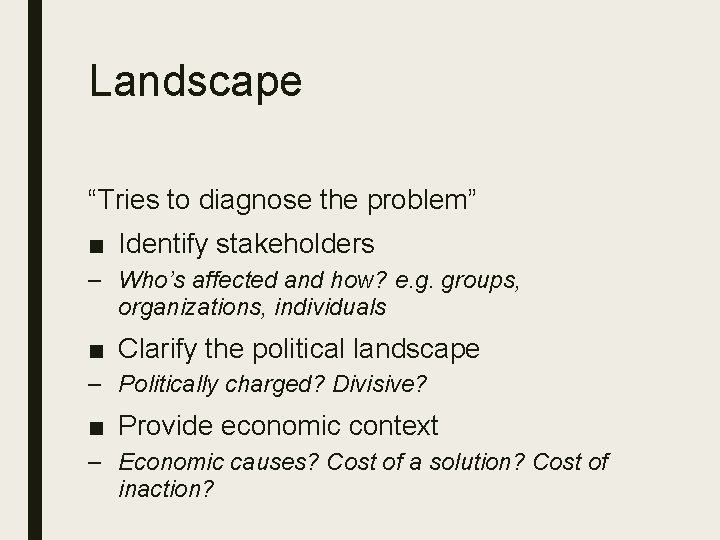
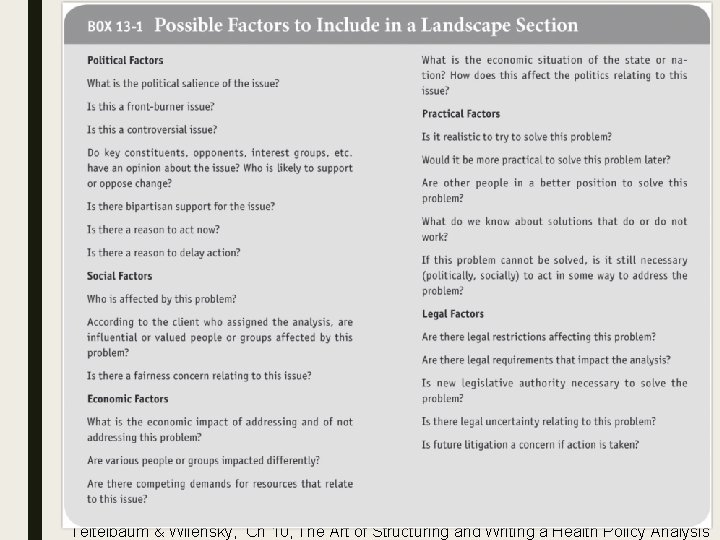
Landscape “Tries to diagnose the problem” ■ Identify stakeholders – Who’s affected and how? e. g. groups, organizations, individuals ■ Clarify the political landscape – Politically charged? Divisive? ■ Provide economic context – Economic causes? Cost of a solution? Cost of inaction?
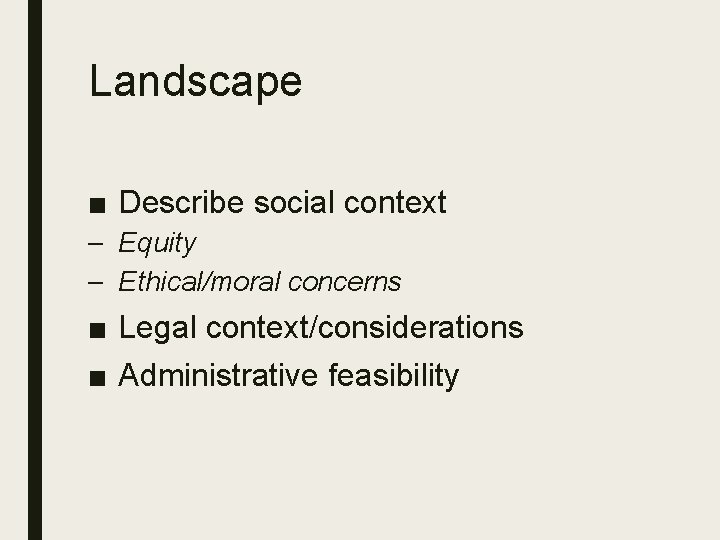
Landscape ■ Describe social context – Equity – Ethical/moral concerns ■ Legal context/considerations ■ Administrative feasibility
Teitelbaum & Wilensky, Ch 10, The Art of Structuring and Writing a Health Policy Analysis
Core Elements of a Policy Analysis ■ Problem statement/Issue statement ■ Background ■ Landscape ■ Options ■ Recommendation
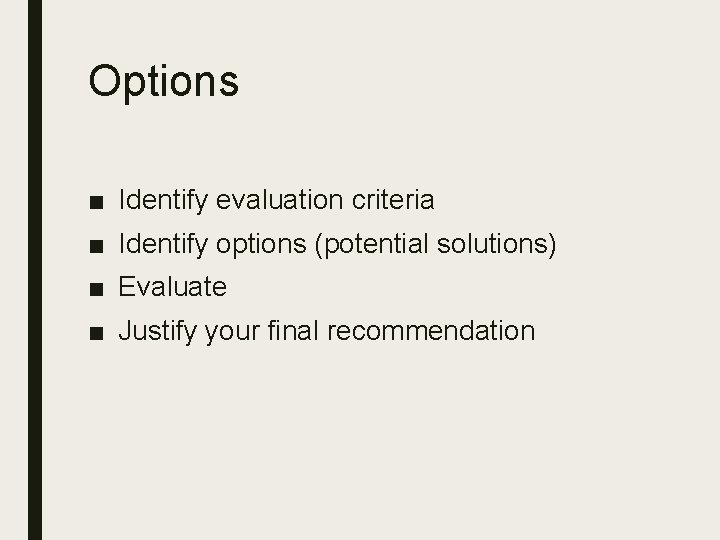
Options ■ Identify evaluation criteria ■ Identify options (potential solutions) ■ Evaluate ■ Justify your final recommendation
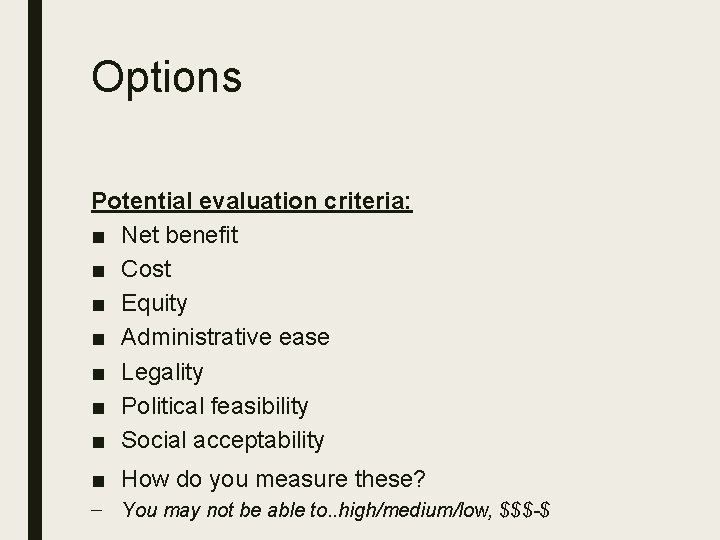
Options Potential evaluation criteria: ■ Net benefit ■ Cost ■ Equity ■ Administrative ease ■ Legality ■ Political feasibility ■ Social acceptability ■ How do you measure these? – You may not be able to. . high/medium/low, $$$-$
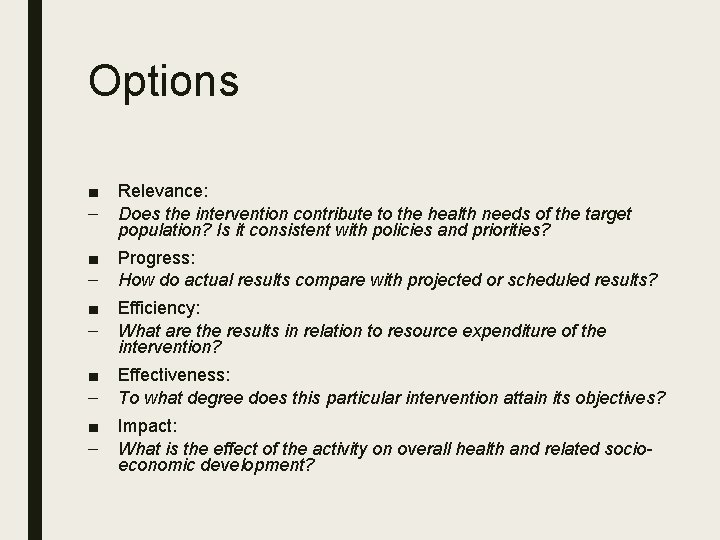
Options ■ – Relevance: Does the intervention contribute to the health needs of the target population? Is it consistent with policies and priorities? ■ – Progress: How do actual results compare with projected or scheduled results? ■ – Efficiency: What are the results in relation to resource expenditure of the intervention? ■ – Effectiveness: To what degree does this particular intervention attain its objectives? ■ – Impact: What is the effect of the activity on overall health and related socioeconomic development?
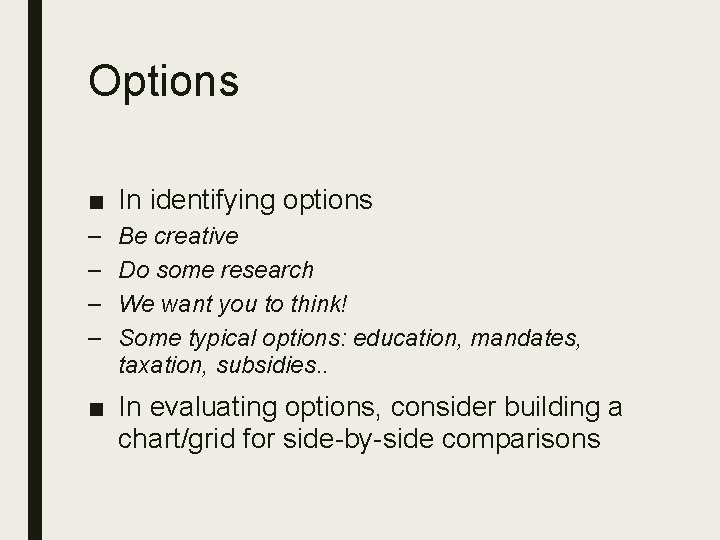
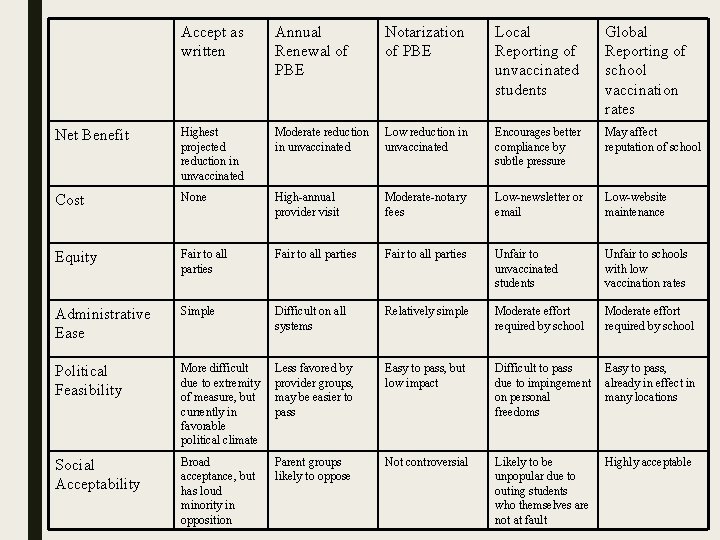
Options ■ In identifying options – – Be creative Do some research We want you to think! Some typical options: education, mandates, taxation, subsidies. . ■ In evaluating options, consider building a chart/grid for side-by-side comparisons
Accept as written Annual Renewal of PBE Notarization of PBE Local Reporting of unvaccinated students Global Reporting of school vaccination rates Net Benefit Highest projected reduction in unvaccinated Moderate reduction in unvaccinated Low reduction in unvaccinated Encourages better compliance by subtle pressure May affect reputation of school Cost None High-annual provider visit Moderate-notary fees Low-newsletter or email Low-website maintenance Equity Fair to all parties Unfair to unvaccinated students Unfair to schools with low vaccination rates Administrative Ease Simple Difficult on all systems Relatively simple Moderate effort required by school Political Feasibility More difficult due to extremity of measure, but currently in favorable political climate Less favored by provider groups, may be easier to pass Easy to pass, but low impact Difficult to pass due to impingement on personal freedoms Easy to pass, already in effect in many locations Social Acceptability Broad acceptance, but has loud minority in opposition Parent groups likely to oppose Not controversial Likely to be unpopular due to outing students who themselves are not at fault Highly acceptable
Core Elements of a Policy Analysis ■ Problem statement/Issue statement ■ Background ■ Landscape ■ Options ■ Recommendation
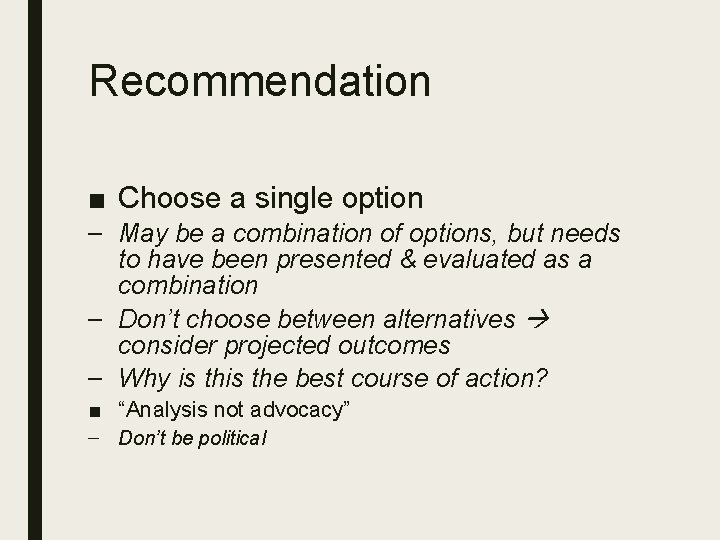
Recommendation ■ Choose a single option – May be a combination of options, but needs to have been presented & evaluated as a combination – Don’t choose between alternatives consider projected outcomes – Why is the best course of action? ■ “Analysis not advocacy” – Don’t be political
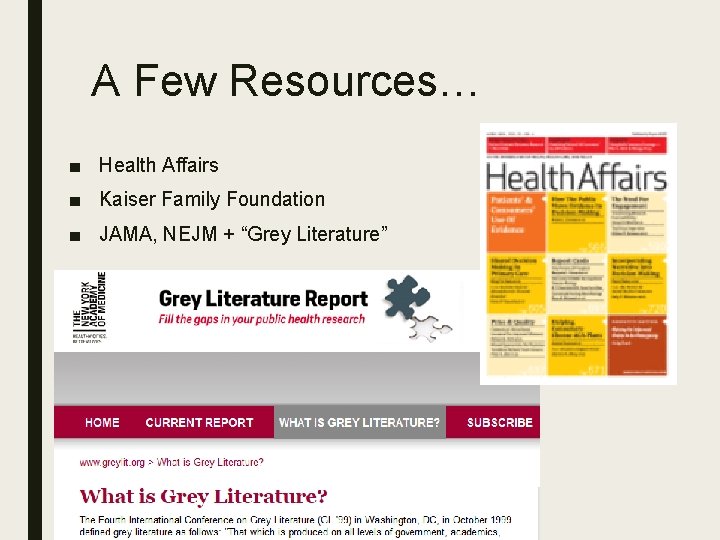
A Few Resources… ■ Health Affairs ■ Kaiser Family Foundation ■ JAMA, NEJM + “Grey Literature”
Questions?