
Introduction to Health Care and Public Health in
Introduction to Health Care and Public Health in the U. S. Delivering Health Care, Part 2 Lecture b This material (Comp 1 Unit 3) was developed by Oregon Health & Science University, funded by the Department of Health and Human Services, Office of the National Coordinator for Health Information Technology under Award Number 90 WT 0001. This work is licensed under the Creative Commons Attribution-Non. Commercial-Share. Alike 4. 0 International License. To view a copy of this license, visit http: //creativecommons. org/licenses/by-nc-sa/4. 0/.
Delivering Health Care, Part 2 Learning Objectives • Describe the organization of clinical health care delivery in the outpatient setting, and the organization of outpatient health care (Lectures a-c) • Describe the organization of ancillary health care delivery in the outpatient setting (Lecture d) • Discuss the role of different health care providers, with an emphasis on the delivery of care in an interdisciplinary setting (Lecture e) 2
Where Is Primary Care Delivered? • Primary care clinic: – Point of delivery – A medical facility • Usually, the conditions seen at a primary care clinic are not serious or life threatening • “Gateway” to health care services 3
Primary Care Medical Specialties • • Family Practice General Internal Medicine Pediatrics Obstetrics and Gynecology (OB/GYN) 4
Family Practice • Defined by American Board of Family Practice – Medical specialty that provides continuing and comprehensive health care for the individual and for the family in an outpatient setting. • Integrates biological, clinical and behavioral sciences • Encompasses all ages, both sexes, each organ system and every disease entity 5
General Internal Medicine • Doctors of internal medicine (also known as “internists”) • Focus on adult medicine • Special study and training focusing on the prevention and treatment of adult diseases. • Can be called upon to act as consultants to other physicians 6
Pediatrics • Medical care of: – Infants – Children – Adolescents • Focus: – Diagnosing, treating and preventing diseases that affect children 7
Obstetrics and Gynecology • Obstetrics (OB) – Care of women during pregnancy and immediately after childbirth • Gynecology (GYN) – Care of the female reproductive system • Preventive care is an important facet of primary care • Often same clinician provides both services 8
Specialty Care • A specialty is a branch of medicine • Physicians train in specific field – Ophthalmology – Radiology • Fellowship – Additional training in more general field – Example: o Trained in General surgery, fellowship as cardiothoracic surgeon 9
Examples of Medical Specialties • • Dermatology Pathology Radiology Nuclear Medicine Psychiatry Emergency Medicine Preventive Medicine 10
Specialty clinics • Medical specialties – Examples: o Cardiology o Immunology o Gastroenterology • Surgical specialties – Examples: o Orthopedic surgery o Neurosurgery o Plastic surgery 11
Delivery of Specialty Care Across Settings • Surgical specialists – See patients in outpatient clinics – Perform surgeries in hospitals or in outpatient surgical centers 12
Outpatient Surgical Centers • Also known as ambulatory surgical centers • Procedures performed in non-hospital location • Patients go home after brief recovery period • Surgical centers do not accommodate overnight or extended stays 13
Primary Care In Crisis? • Increasing number of older patients with complex medical issues • Inadequate coverage of preventive care services • Emphasis on documentation • Complex billing and compensation system 14
Primary Care Crisis Contributing Factors - 1 • Decreasing number of physicians practicing primary care • Supply-demand imbalance • Greater dependence on after-hours care • Increased cost of health care delivery 15
Primary Care Crisis Contributing Factors - 2 • More than 80 percent of graduating medical students carry educational debt • Specialists are better compensated than primary care physicians • Fewer U. S. graduates enter family medicine • Recent years have more positive statistics 16
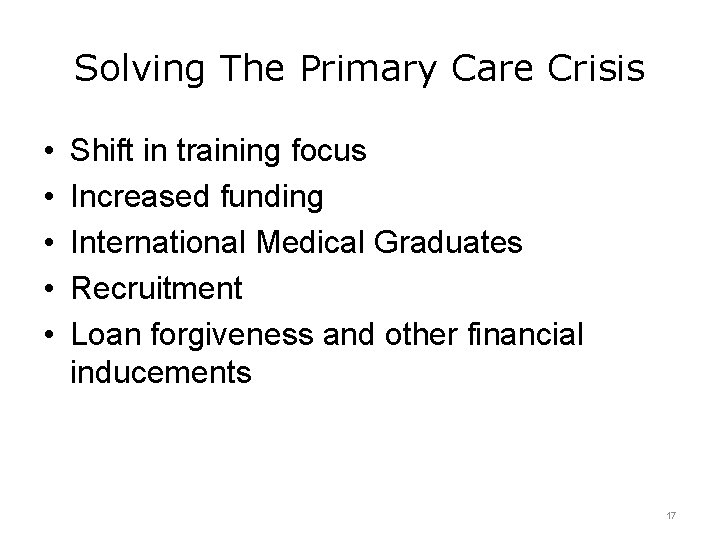
Solving The Primary Care Crisis • • • Shift in training focus Increased funding International Medical Graduates Recruitment Loan forgiveness and other financial inducements 17
Delivering Health Care, Part 2 Summary – Lecture b • • Primary care locations Primary care specialties Outpatient specialty care The primary care crisis 18
Delivering Health Care, Part 2 References – Lecture b References American Academy of Family Physicians at: http: //www. aafp. org/medical-schoolresidency/program-directors/nrmp. html. Accessed January 20, 2017. American Board of Family Practice at https: //www. theabfm. org/index. aspx. Accessed January 20, 2017. American College of Physicians at: http: //www. acponline. org/patients_families/about_internal_medicine/ Association of American Medical Colleges at: www. aamc. org. Accessed January 20, 2017. Bodenheimer T. Primary Care -- Will It Survive? N Engl J Med 2006 355: 861 -864 Karen E. Hauer, MD; Steven J. Durning, MD; et al. , KE; Durning, SJ; Kernan, WN; Fagan, MJ; Mintz, M; O'Sullivan, PS; Battistone, M; Defer, T et al. Factors Associated With Medical Students' Career Choices Regarding Internal Medicine. JAMA 300(10): 1154– 1164 19
Introduction to Health Care and Public Health in the U. S. Delivering Health Care, Part 2 Lecture b This material was developed by Oregon Health & Science University, funded by the Department of Health and Human Services, Office of the National Coordinator for Health Information Technology under Award Number 90 WT 0001. 20
- Slides: 20