
INTRODUCTION TO HAZARDOUS WASTE MANAGEMENT University of Alaska

- Slides: 56
INTRODUCTION TO HAZARDOUS WASTE MANAGEMENT University of Alaska Fairbanks Environmental, Health, Safety, and Risk Management May 2017
COURSE OUTLINE Overview of hazardous materials regulations Hazardous waste at UAF What is hazardous waste? What do I do with my hazardous waste? Emergency response 2
OVERVIEW OF HAZARDOUS MATERIALS REGULATIONS 3
HAZARDOUS MATERIALS REGULATIONS Hazardous materials are regulated by three primary government agencies: Department of Transportation (DOT) Title 49, Code of Federal Regulations (49 CFR) Occupational Safety and Health Administration (OSHA) Title 29, Code of Federal Regulations (29 CFR) Environmental Protection Agency (EPA) Title 40, Code of Federal Regulations (40 CFR) The International Fire and Building Codes also regulate hazardous materials 4
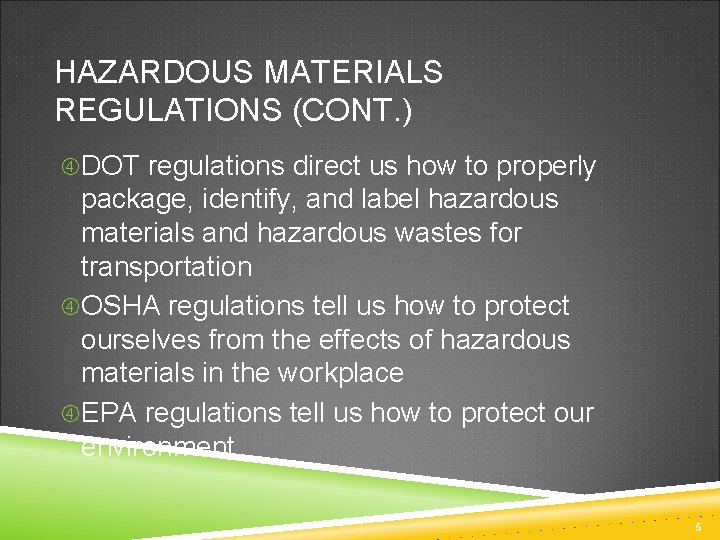
HAZARDOUS MATERIALS REGULATIONS (CONT. ) DOT regulations direct us how to properly package, identify, and label hazardous materials and hazardous wastes for transportation OSHA regulations tell us how to protect ourselves from the effects of hazardous materials in the workplace EPA regulations tell us how to protect our environment 5
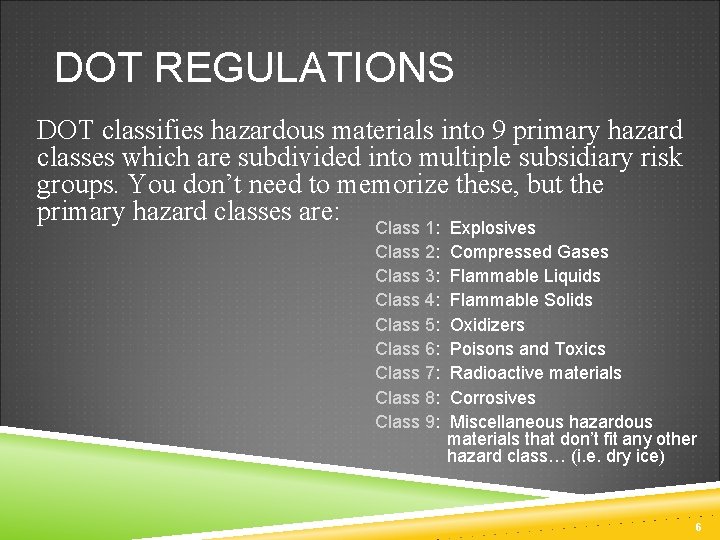
DOT REGULATIONS DOT classifies hazardous materials into 9 primary hazard classes which are subdivided into multiple subsidiary risk groups. You don’t need to memorize these, but the primary hazard classes are: Class 1: Explosives Class 2: Compressed Gases Class 3: Flammable Liquids Class 4: Flammable Solids Class 5: Oxidizers Class 6: Poisons and Toxics Class 7: Radioactive materials Class 8: Corrosives Class 9: Miscellaneous hazardous materials that don’t fit any other hazard class… (i. e. dry ice) 6
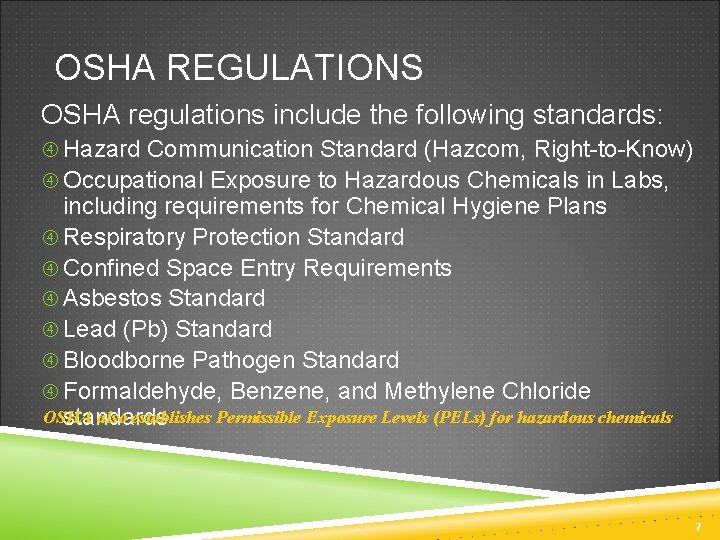
OSHA REGULATIONS OSHA regulations include the following standards: Hazard Communication Standard (Hazcom, Right-to-Know) Occupational Exposure to Hazardous Chemicals in Labs, including requirements for Chemical Hygiene Plans Respiratory Protection Standard Confined Space Entry Requirements Asbestos Standard Lead (Pb) Standard Bloodborne Pathogen Standard Formaldehyde, Benzene, and Methylene Chloride OSHA also establishes Permissible Exposure Levels (PELs) for hazardous chemicals standards 7
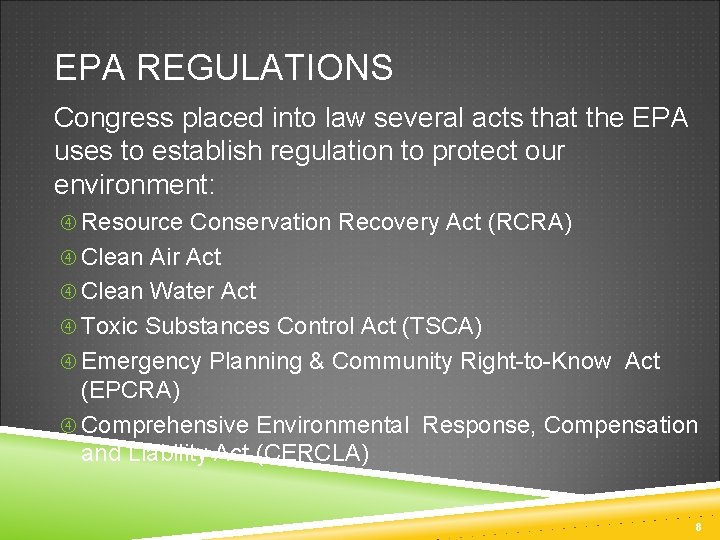
EPA REGULATIONS Congress placed into law several acts that the EPA uses to establish regulation to protect our environment: Resource Conservation Recovery Act (RCRA) Clean Air Act Clean Water Act Toxic Substances Control Act (TSCA) Emergency Planning & Community Right-to-Know Act (EPCRA) Comprehensive Environmental Response, Compensation and Liability Act (CERCLA) 8
HAZARDOUS WASTE REGULATIONS EPA regulates hazardous waste in Alaska by authority of the Resource Conservation Recovery Act. RCRA controls include: Identification of hazardous wastes Tracking wastes from “cradle to grave” Setting standards for generators of wastes, transporters of wastes, and Treatment, Storage & Disposal Facilities 9
PRIMARY RCRA REQUIREMENTS RCRA requires that you: Label containers with a description of their contents Store only the permissible volume of waste in your lab Ensure lids and caps are securely fastened at all times, (exceptions apply) Ensure all materials are properly segregated Use containers that are compatible with your waste Use intact containers (no cracks, holes, etc. ) Ensure that spills and overfills do not occur Ensure that mismanagement does not occur 10
RCRA REQUIREMENT FOR TRAINING The purpose of this training is to comply with requirements set forth by the EPA under 40 CFR 265. 16 (Personnel Training) The scope of the training is to ensure that UAF personnel who use chemicals: 1. Understand how to identify hazardous wastes 2. Understand how to package and label hazardous wastes 3. Understand how to have their hazardous materials disposed 4. Know how to respond effectively to emergencies 11
RCRA REGULATORY INSPECTIONS EPA conducts unannounced Compliance Evaluation Inspections In the past, UAF facilities have been inspected annually Our goal is to comply with all regulations 12
HAZARDOUS WASTE AT UAF An overview of sources of hazardous waste at UAF, and its ultimate fate… 13
SOURCES OF HAZARDOUS WASTE AT UAF Sources of hazardous wastes (HW) at UAF include: Research and academic laboratories Shops and repair facilities Art and theater departments Facility maintenance and grounds Power Plant operations Experimental Farm operations 14
HAZARDOUS WASTE GENERATORS The RCRA definition of a HW generator is: Any person, by site, whose act or process produces hazardous waste identified or listed in 40 CFR 261. 3. Generators are classified by the volume of HW that they produce per month: VSQG = Very Small Quantity Generator SQG = Small Quantity Generator LQG = Large Quantity Generator > 1000 kg/month non-acute hazardous waste or >1 kg/month of acute hazardous waste 15
UAF’S WASTE GENERATOR STATUS The UAF main campus is regulated as a Large Quantity Generator UAF’s extended sites are regulated as Very Small Quantity Generators Examples: Toolik Field Station, Palmer Research Farm, Kodiak Seafood & Marine Science Center, Seward Marine Center, Lena Point Fisheries Facility (Juneau) 16
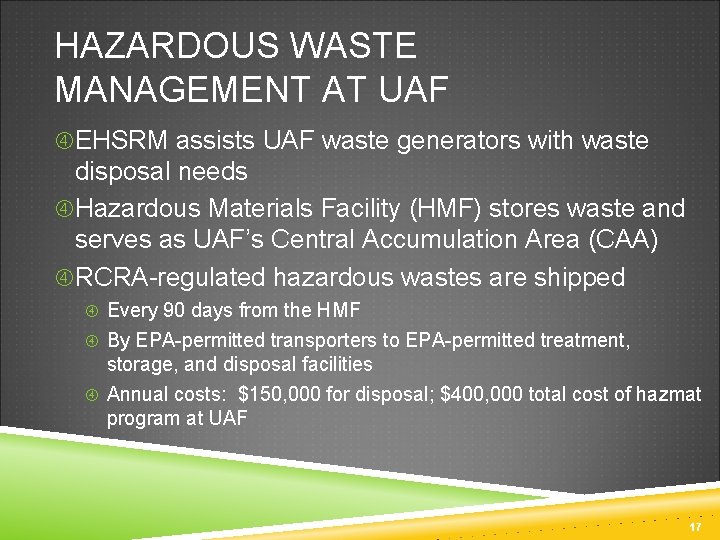
HAZARDOUS WASTE MANAGEMENT AT UAF EHSRM assists UAF waste generators with waste disposal needs Hazardous Materials Facility (HMF) stores waste and serves as UAF’s Central Accumulation Area (CAA) RCRA-regulated hazardous wastes are shipped Every 90 days from the HMF By EPA-permitted transporters to EPA-permitted treatment, storage, and disposal facilities Annual costs: $150, 000 for disposal; $400, 000 total cost of hazmat program at UAF 17
WHAT IS HAZARDOUS WASTE? 18
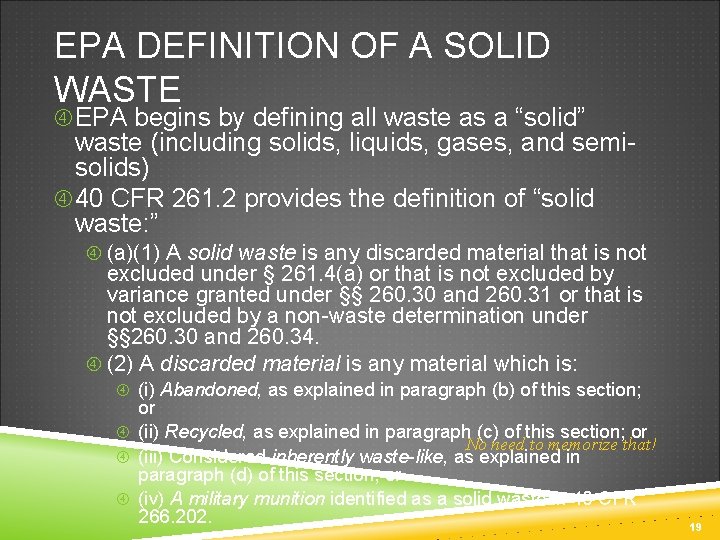
EPA DEFINITION OF A SOLID WASTE EPA begins by defining all waste as a “solid” waste (including solids, liquids, gases, and semisolids) 40 CFR 261. 2 provides the definition of “solid waste: ” (a)(1) A solid waste is any discarded material that is not excluded under § 261. 4(a) or that is not excluded by variance granted under §§ 260. 30 and 260. 31 or that is not excluded by a non-waste determination under §§ 260. 30 and 260. 34. (2) A discarded material is any material which is: (i) Abandoned, as explained in paragraph (b) of this section; or (ii) Recycled, as explained in paragraph (c) of this section; or No need to memorize that! (iii) Considered inherently waste-like, as explained in paragraph (d) of this section; or (iv) A military munition identified as a solid waste in 40 CFR 266. 202. 19
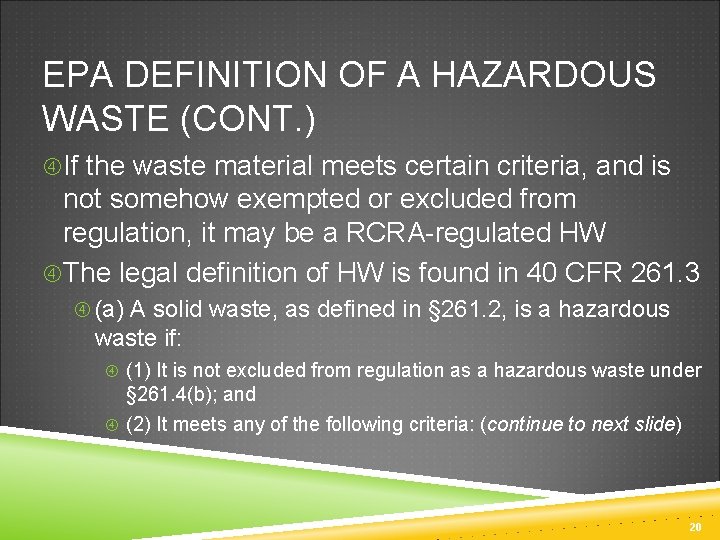
EPA DEFINITION OF A HAZARDOUS WASTE (CONT. ) If the waste material meets certain criteria, and is not somehow exempted or excluded from regulation, it may be a RCRA-regulated HW The legal definition of HW is found in 40 CFR 261. 3 (a) A solid waste, as defined in § 261. 2, is a hazardous waste if: (1) It is not excluded from regulation as a hazardous waste under § 261. 4(b); and (2) It meets any of the following criteria: (continue to next slide) 20
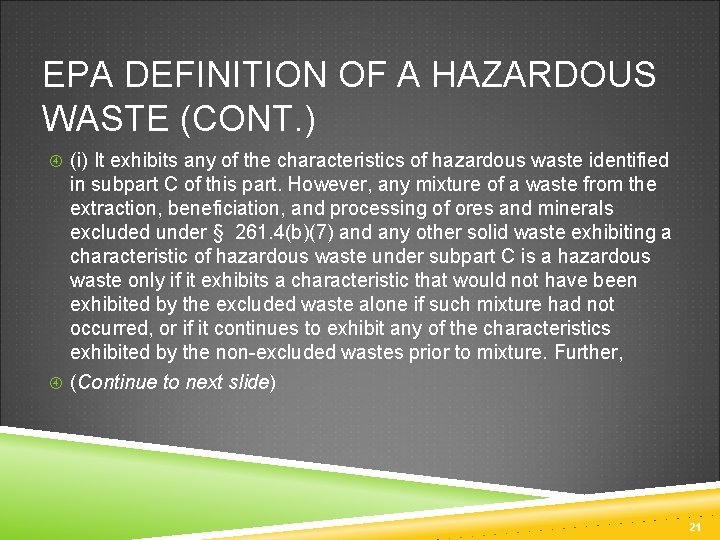
EPA DEFINITION OF A HAZARDOUS WASTE (CONT. ) (i) It exhibits any of the characteristics of hazardous waste identified in subpart C of this part. However, any mixture of a waste from the extraction, beneficiation, and processing of ores and minerals excluded under § 261. 4(b)(7) and any other solid waste exhibiting a characteristic of hazardous waste under subpart C is a hazardous waste only if it exhibits a characteristic that would not have been exhibited by the excluded waste alone if such mixture had not occurred, or if it continues to exhibit any of the characteristics exhibited by the non-excluded wastes prior to mixture. Further, (Continue to next slide) 21
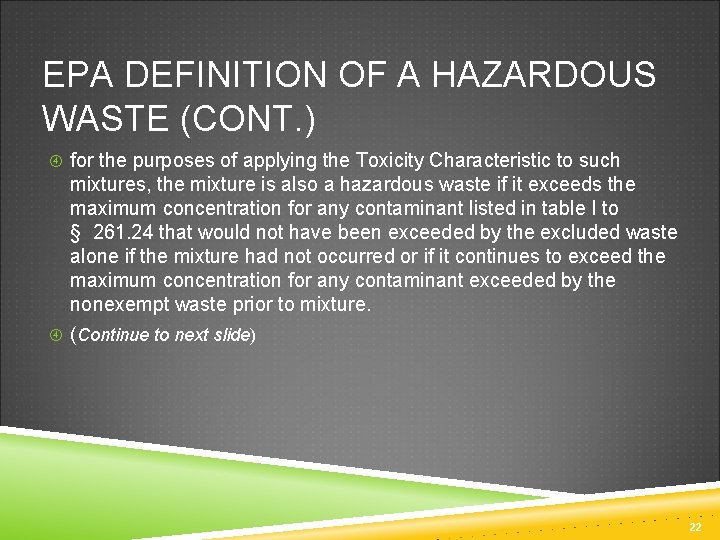
EPA DEFINITION OF A HAZARDOUS WASTE (CONT. ) for the purposes of applying the Toxicity Characteristic to such mixtures, the mixture is also a hazardous waste if it exceeds the maximum concentration for any contaminant listed in table I to § 261. 24 that would not have been exceeded by the excluded waste alone if the mixture had not occurred or if it continues to exceed the maximum concentration for any contaminant exceeded by the nonexempt waste prior to mixture. (Continue to next slide) 22
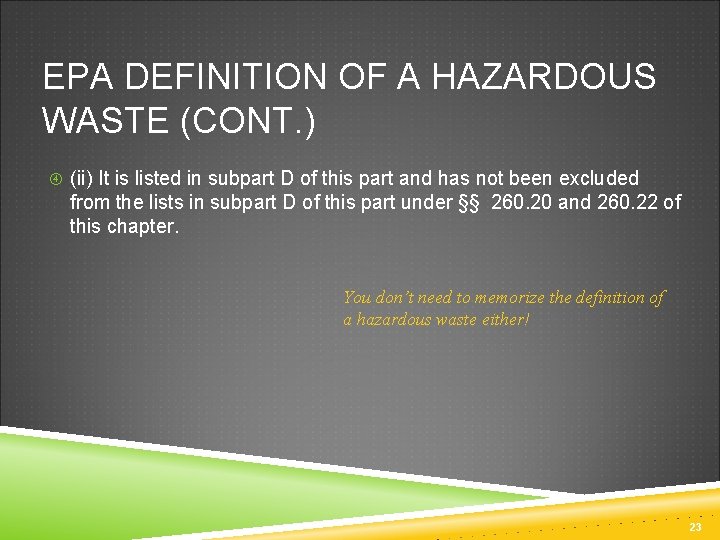
EPA DEFINITION OF A HAZARDOUS WASTE (CONT. ) (ii) It is listed in subpart D of this part and has not been excluded from the lists in subpart D of this part under §§ 260. 20 and 260. 22 of this chapter. You don’t need to memorize the definition of a hazardous waste either! 23
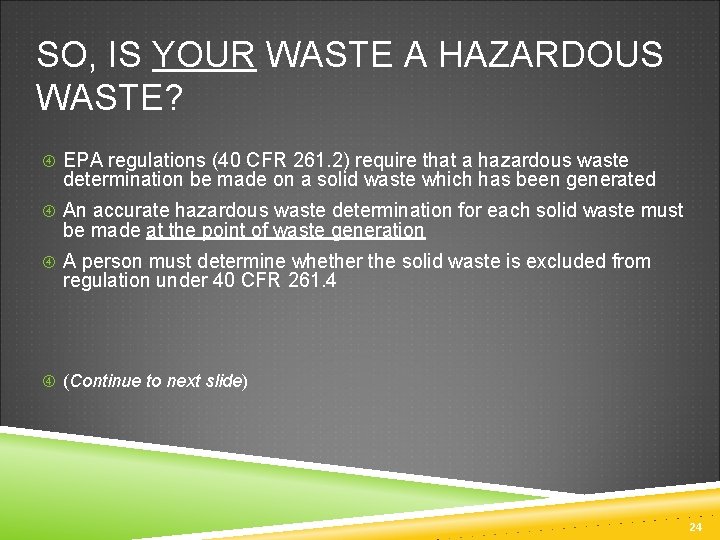
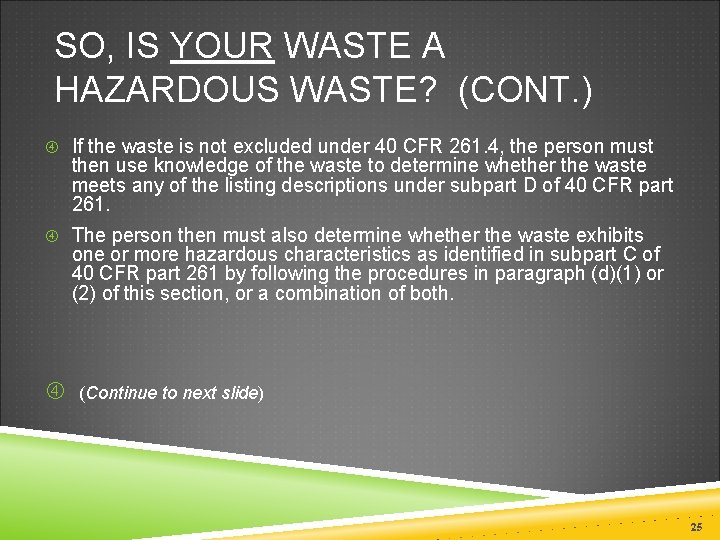
SO, IS YOUR WASTE A HAZARDOUS WASTE? EPA regulations (40 CFR 261. 2) require that a hazardous waste determination be made on a solid waste which has been generated An accurate hazardous waste determination for each solid waste must be made at the point of waste generation A person must determine whether the solid waste is excluded from regulation under 40 CFR 261. 4 (Continue to next slide) 24
SO, IS YOUR WASTE A HAZARDOUS WASTE? (CONT. ) If the waste is not excluded under 40 CFR 261. 4, the person must then use knowledge of the waste to determine whether the waste meets any of the listing descriptions under subpart D of 40 CFR part 261. The person then must also determine whether the waste exhibits one or more hazardous characteristics as identified in subpart C of 40 CFR part 261 by following the procedures in paragraph (d)(1) or (2) of this section, or a combination of both. (Continue to next slide) 25
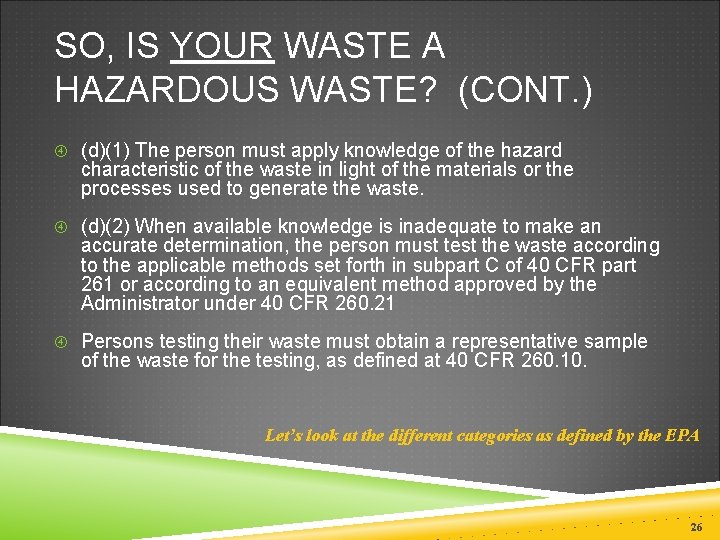
SO, IS YOUR WASTE A HAZARDOUS WASTE? (CONT. ) (d)(1) The person must apply knowledge of the hazard characteristic of the waste in light of the materials or the processes used to generate the waste. (d)(2) When available knowledge is inadequate to make an accurate determination, the person must test the waste according to the applicable methods set forth in subpart C of 40 CFR part 261 or according to an equivalent method approved by the Administrator under 40 CFR 260. 21 Persons testing their waste must obtain a representative sample of the waste for the testing, as defined at 40 CFR 260. 10. Let’s look at the different categories as defined by the EPA 26
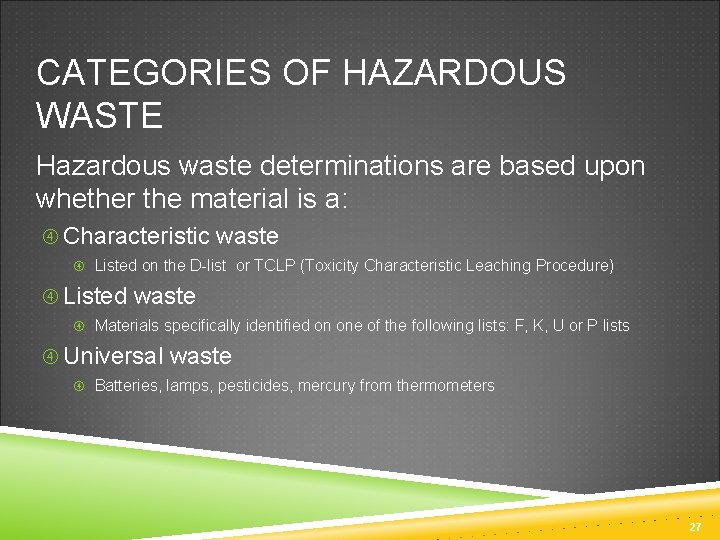
CATEGORIES OF HAZARDOUS WASTE Hazardous waste determinations are based upon whether the material is a: Characteristic waste Listed on the D-list or TCLP (Toxicity Characteristic Leaching Procedure) Listed waste Materials specifically identified on one of the following lists: F, K, U or P lists Universal waste Batteries, lamps, pesticides, mercury from thermometers 27
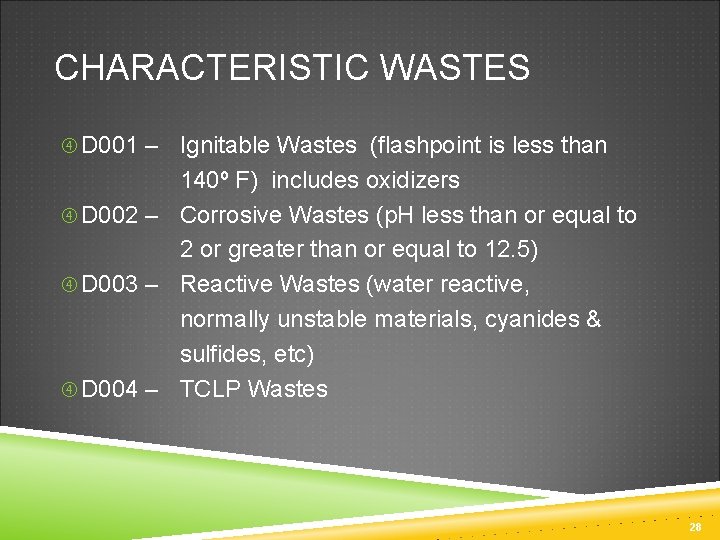
CHARACTERISTIC WASTES D 001 – D 002 – D 003 – D 004 – Ignitable Wastes (flashpoint is less than 140º F) includes oxidizers Corrosive Wastes (p. H less than or equal to 2 or greater than or equal to 12. 5) Reactive Wastes (water reactive, normally unstable materials, cyanides & sulfides, etc) TCLP Wastes 28
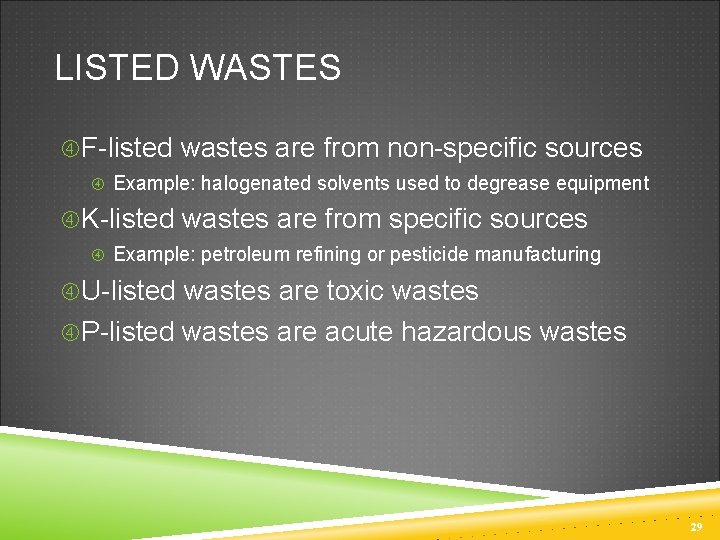
LISTED WASTES F-listed wastes are from non-specific sources Example: halogenated solvents used to degrease equipment K-listed wastes are from specific sources Example: petroleum refining or pesticide manufacturing U-listed wastes are toxic wastes P-listed wastes are acute hazardous wastes 29
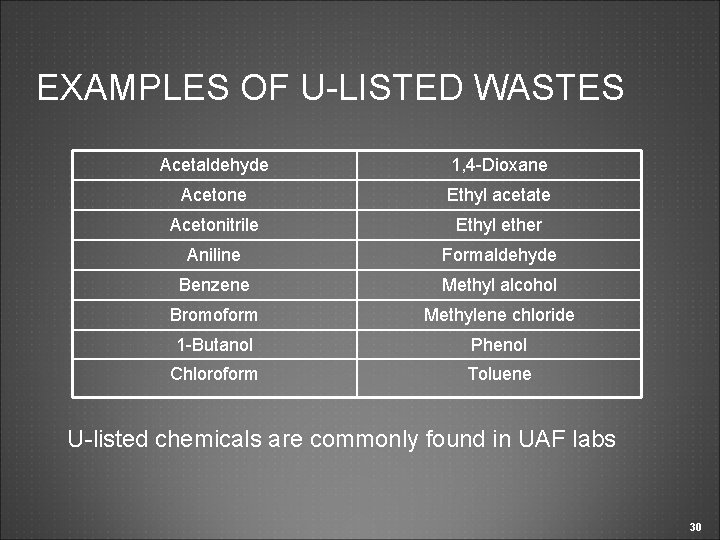
EXAMPLES OF U-LISTED WASTES Acetaldehyde 1, 4 -Dioxane Acetone Ethyl acetate Acetonitrile Ethyl ether Aniline Formaldehyde Benzene Methyl alcohol Bromoform Methylene chloride 1 -Butanol Phenol Chloroform Toluene U-listed chemicals are commonly found in UAF labs 30
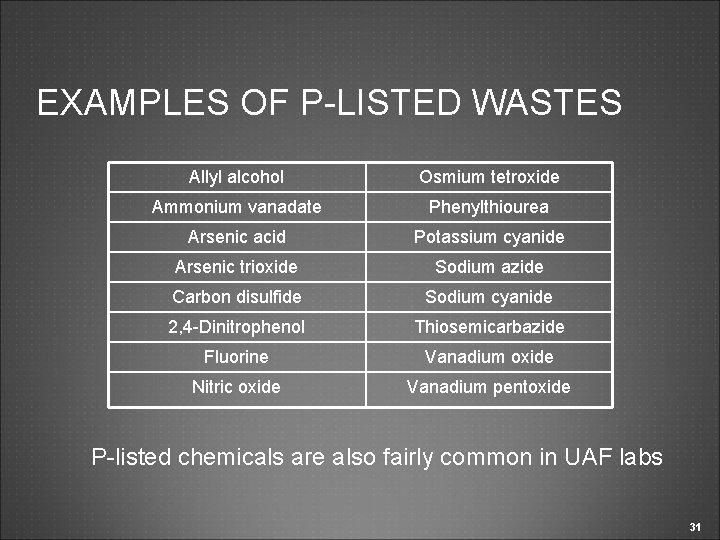
EXAMPLES OF P-LISTED WASTES Allyl alcohol Osmium tetroxide Ammonium vanadate Phenylthiourea Arsenic acid Potassium cyanide Arsenic trioxide Sodium azide Carbon disulfide Sodium cyanide 2, 4 -Dinitrophenol Thiosemicarbazide Fluorine Vanadium oxide Nitric oxide Vanadium pentoxide P-listed chemicals are also fairly common in UAF labs 31
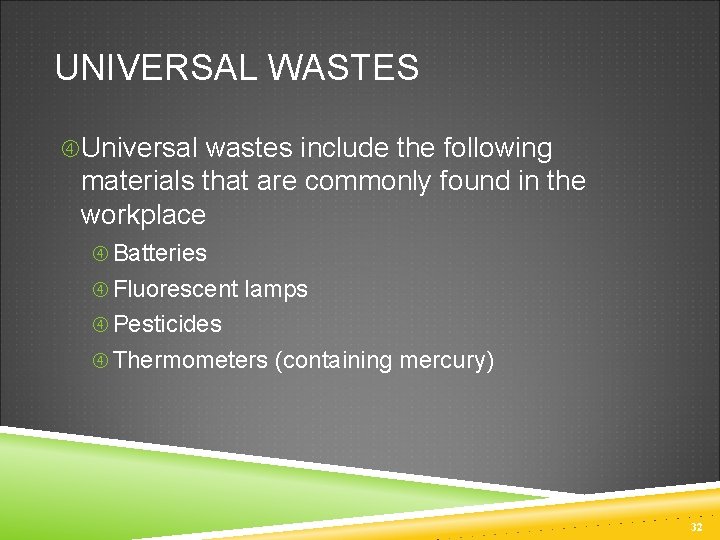
UNIVERSAL WASTES Universal wastes include the following materials that are commonly found in the workplace Batteries Fluorescent lamps Pesticides Thermometers (containing mercury) 32
UNIVERSAL WASTES: BATTERIES Used Battery collection containers (white 5 - gallon buckets) are available at many locations on campus Contact your Lab Manager, CHO, Shop Supervisor or EHSRM for more information 33
UNIVERSAL WASTES: FLUORESCENT LAMPS UAF recycles fluorescent and other lamps Lamp shipments are made periodically to Eco. Lights Northwest The Facilities Services Electric Shop does the vast majority of lamp replacement on campus EHSRM can provide lamp collection boxes and labels to you Boxes must be labeled with the words, “Universal Waste Lamps”, “Waste Lamps”, or “Used Lamps” to identify the contents 34
UNIVERSAL WASTES: PESTICIDES If you have waste pesticides: Fill out an online UAF Non-radioactive Hazardous Materials Transfer Request. Don’t know how? Go to slide #45. 35
UNIVERSAL WASTES: MERCURY THERMOMETERS If you break a mercury thermometer: DO NOT try to clean it up yourself ---- Call UAF Hazmat at 474 -5617 immediately for assistance Evacuate the area and keep traffic from walking through the spill site NEVER throw the material in the trash or dump it down the drain Don’t need your mercury thermometers or wish to exchange unbroken thermometers for similar, nonmercury thermometers, free of charge? Call EHSRM at 474 -5617 to get more information. 36
OTHER WASTE: AEROSOL CANS Aerosol cans are considered hazardous waste under the definition of “Characteristic Reactivity” 40 CFR Part 261. 23: “…. capable of detonation or explosive reaction if it is subjected to a strong initiating source or if heated under confinement. ” Often contain hazardous materials, either as the product or as the propellant Most aerosol cans, regardless of contents, can never be completely emptied of propellant Aerosol cans become a waste when… their contents are used up, malfunction (i. e. fail to spray), or when the contents are no longer needed 37
OTHER WASTES: USED OIL Used oil means: any oil that has been refined from crude oil, or any synthetic oil, that has been used and as a result of such use, is contaminated by physical or chemical impurities (40 CFR 279. 1) Used oil must be: Collected in clean containers in good condition (no leakers) Storage and transfer containers must be marked with the words “Used Oil” Never add solvents, part washer fluids, carb cleaners, or glycol to your used oil 38
OTHER WASTES: USED OIL (CONT. ) Keep the “used oil” container closed (lid in place and secured) except when adding or removing used oil If you use a funnel for transfers, the funnel must be removed when not in use and the container capped See slide #45 to make on online request to have your used oil removed 39
WASTE IN YOUR LAB What do I do with my wastes and unwanted chemicals? 40
SATELLITE ACCUMULATION AREAS Each lab that generates waste is referred to as a “Satellite Accumulation Area” (SAA) A generator may accumulate hazardous waste in containers at or near any point of generation where wastes initially accumulate which is under the control of the operator of the process generating the waste When EHSRM removes the waste from a SAA, it is transferred to the UAF Hazmat Facility or “Central Accumulation Area” 41
WASTE STORAGE LIMITS FOR SAAS For SAAs, the waste storage limits are: Up to 55 gallons of non-acute hazardous waste Up to 1 quart (liquid) or 1 kg (solid) of an acute hazardous waste (P-listed waste) 50 gallons of waste at a SAA will likely be in violation of Fire & Building Codes Note: you do not need to accumulate 55 gallons or 1 quart / 1 kg of a P-listed waste before requesting waste removal! 42
SAA CONTAINER MANAGEMENT A container holding hazardous waste must be closed at all times during accumulation, except: (i) When adding, removing, or consolidating waste; or (ii) When temporary venting of a container is necessary (A) For the properation of equipment, or (B) To prevent dangerous situations, such as build-up of extreme pressure. (Continue to next slide) 43
SAA CONTAINER MANAGEMENT (CONT. ) A generator must mark or label a container holding hazardous waste with the following: (i) The words “Hazardous Waste” and (ii) An indication of the hazards of the contents (examples include, but are not limited to, the applicable hazardous waste characteristic(s) (i. e. , ignitable, corrosive, reactive, toxic); hazard communication consistent with the Department of Transportation requirements at 49 CFR part 172 subpart E (labeling) or subpart F (placarding); a hazard statement or pictogram consistent with the Occupational Safety and Health Administration Hazard Communication Standard at 29 CFR 1910. 1200; or a chemical hazard label consistent with the National Fire Protection Association code 704). 44
TO MAKE A WASTE REMOVAL REQUEST As of April 2012, the Division of Hazardous Materials at EHSRM is using an online hazardous waste pick up request. Please discontinue using the old triplicate paper hazardous waste transfer request forms. If you have not been trained in the use of the online request, call 474 -7889 to schedule a training session. Or go to the EHSRM website for more information: http: //www. uaf. edu/safety/laboratory-safety/chemical-inventory/ Remember: There is no charge to your lab for chemical waste disposal 45
TAKE-HOME MESSAGES What you need to remember… 46
WASTES: CONTAINERS AND STORAGE Only use containers that are compatible with the materials to be collected Always label containers with a description of their contents Don’t store incompatible materials together Do not store wastes in the fume hood. Store in the appropriate storage cabinet (e. g. , flammable, acid) Provide secondary containment for liquid wastes Always keep the container closed (lid firmly secured) A funnel in an open bottle is NOT a lid Check waste storage areas regularly (weekly). Inspect containers to make sure they aren’t getting brittle or starting to crack 47
BEFORE YOU START A PROJECT Plan ahead Is there a product or procedure available that will accomplish the task w/o generating a hazardous waste? Strive for waste minimization Only make as much solution as you need Substitute less hazardous chemicals if possible Use microscale chemistry techniques Before purchasing chemicals, log onto your EHS Assistant online inventory and click on the “Surplus Chemicals” button at the top of the main page. Contact EHSRM at 474 -5617 to request transfer of surplus chemicals. 48
OTHER THINGS TO THINK ABOUT Check the P-list - if you plan to generate a P- listed waste, contact your Chemical Hygiene Officer, Lab Manager or EHSRM Never combine wastes If you don’t generate them together as part of a procedure, then do not mix them. May create hazardous reactions in the bottle (worst-case scenario), or make it more expensive for us to dispose of it (not a good scenario, but at least it didn’t blow up) 49
EMERGENCY RESPONSE Chemical spills, release of hazardous materials, fires, and evacuation 50
CHEMICAL SPILLS Report all spills to UAF Dispatch (474 -7721) or call 911 if there is an immediate threat of harm to life or property Dispatch will call EHSRM Hazmat Section or the FNSB Hazmat Team, if necessary, to request assistance with spill cleanup Depending on the nature of the spill, you may be asked to complete the UAF Oil and Hazardous Substance Spill Reporting Form (available from EHSRM) 51
CHEMICAL SPILLS (CONT. ) If you have not been trained and/or do not have the appropriate personnel protective equipment, please call for assistance! Never put yourself or others at risk to cleanup a spill! If you don’t know…don’t go 52
EMERGENCY PROCEDURES: FIRE Activate the nearest fire alarm pull station and call 911 Evacuate the building and go to the Evacuation Assembly Point or designated area of safe refuge Advise emergency personnel of anyone still inside the building Do not re-enter the building until authorized by emergency personnel 53
EMERGENCY PROCEDURES: RELEASE OF HAZARDOUS MATERIALS Call 911 in the event of an emergency or if anyone is in danger Move away from the site of the hazard to a safe location Follow the instructions of emergency personnel Alert others to stay clear of the area Notify emergency personnel if you have been exposed or have information regarding the release 54
EMERGENCY PROCEDURES: EVACUATION Know the evacuation procedures and evacuation route information for your area Evacuate the building using the nearest safe exit Do not use elevators! Take personnel belongings (keys, purses etc. , but don’t put yourself or others at risk by delaying evacuation) If possible, secure any hazardous materials or equipment Follow the directions given by emergency personnel Go to Evacuation Assembly Points (EAPs) designated on the emergency evacuation sign for the building Assist persons with disabilities Do not leave the area/campus until your status has been reported to your supervisor or instructor 55
FOR MORE INFORMATION… Environmental, Health, Safety, and Risk Management Visit our website at: www. uaf. edu/safety Or call us at 474 -5413 56