
Introduction to Hadoop Owen OMalley Yahoo Grid Team

- Slides: 22
Introduction to Hadoop Owen O’Malley Yahoo!, Grid Team owen@yahoo-inc. com
Problem • How do you scale up applications? – Run jobs processing 100’s of terabytes of data – Takes 11 days to read on 1 computer • Need lots of cheap computers – Fixes speed problem (15 minutes on 1000 computers), but… – Reliability problems • In large clusters, computers fail every day • Cluster size is not fixed • Need common infrastructure – Must be efficient and reliable CCA – Oct 2008
Solution • Open Source Apache Project • Hadoop Core includes: – Distributed File System - distributes data – Map/Reduce - distributes application • Written in Java • Runs on – Linux, Mac OS/X, Windows, and Solaris – Commodity hardware CCA – Oct 2008
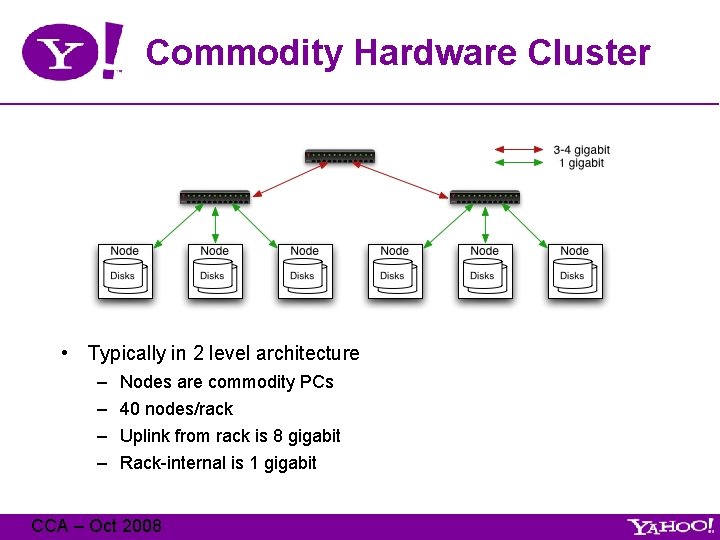
Commodity Hardware Cluster • Typically in 2 level architecture – – Nodes are commodity PCs 40 nodes/rack Uplink from rack is 8 gigabit Rack-internal is 1 gigabit CCA – Oct 2008
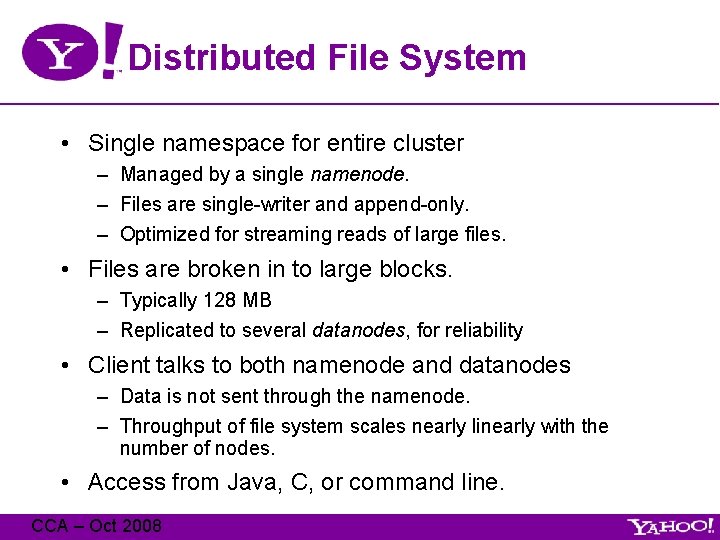
Distributed File System • Single namespace for entire cluster – Managed by a single namenode. – Files are single-writer and append-only. – Optimized for streaming reads of large files. • Files are broken in to large blocks. – Typically 128 MB – Replicated to several datanodes, for reliability • Client talks to both namenode and datanodes – Data is not sent through the namenode. – Throughput of file system scales nearly linearly with the number of nodes. • Access from Java, C, or command line. CCA – Oct 2008
Block Placement • Default is 3 replicas, but settable • Blocks are placed (writes are pipelined): – On same node – On different rack – On the other rack • Clients read from closest replica • If the replication for a block drops below target, it is automatically re-replicated. CCA – Oct 2008
Data Correctness • Data is checked with CRC 32 • File Creation – Client computes checksum per 512 byte – Data. Node stores the checksum • File access – Client retrieves the data and checksum from Data. Node – If Validation fails, Client tries other replicas • Periodic Validation CCA – Oct 2008
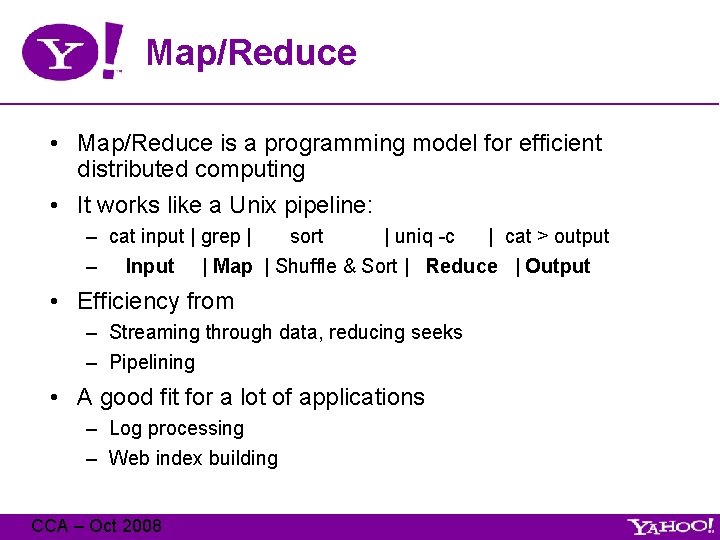
Map/Reduce • Map/Reduce is a programming model for efficient distributed computing • It works like a Unix pipeline: – cat input | grep | sort | uniq -c | cat > output – Input | Map | Shuffle & Sort | Reduce | Output • Efficiency from – Streaming through data, reducing seeks – Pipelining • A good fit for a lot of applications – Log processing – Web index building CCA – Oct 2008
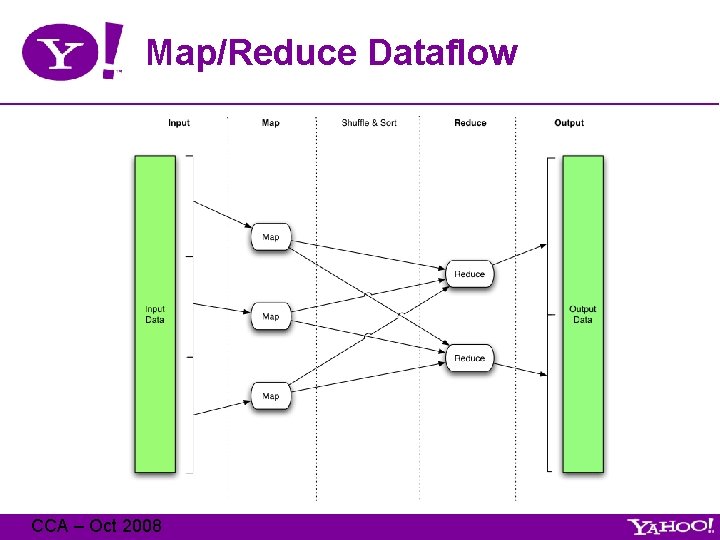
Map/Reduce Dataflow CCA – Oct 2008
Map/Reduce features • Java and C++ APIs – In Java use Objects, while in C++ bytes • Each task can process data sets larger than RAM • Automatic re-execution on failure – In a large cluster, some nodes are always slow or flaky – Framework re-executes failed tasks • Locality optimizations – Map-Reduce queries HDFS for locations of input data – Map tasks are scheduled close to the inputs when possible CCA – Oct 2008
How is Yahoo using Hadoop? • We started with building better applications – Scale up web scale batch applications (search, ads, …) – Factor out common code from existing systems, so new applications will be easier to write – Manage the many clusters we have more easily • The mission now includes research support – Build a huge data warehouse with many Yahoo! data sets – Couple it with a huge compute cluster and programming models to make using the data easy – Provide this as a service to our researchers – We are seeing great results! • Experiments can be run much more quickly in this environment CCA – Oct 2008
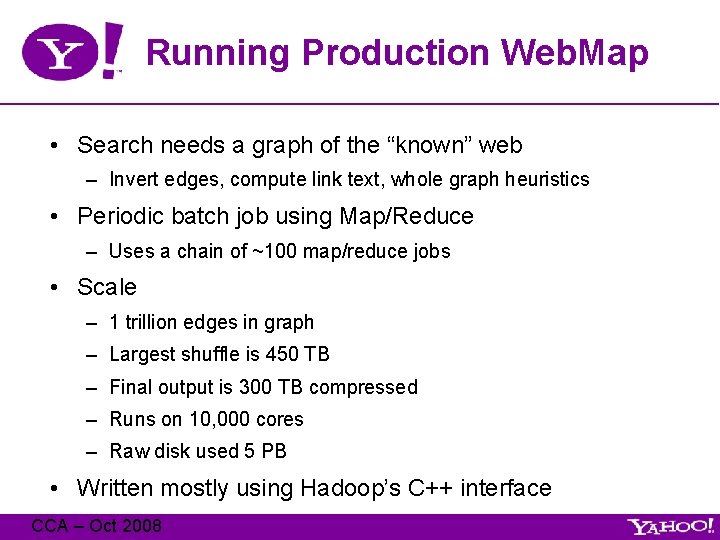
Running Production Web. Map • Search needs a graph of the “known” web – Invert edges, compute link text, whole graph heuristics • Periodic batch job using Map/Reduce – Uses a chain of ~100 map/reduce jobs • Scale – 1 trillion edges in graph – Largest shuffle is 450 TB – Final output is 300 TB compressed – Runs on 10, 000 cores – Raw disk used 5 PB • Written mostly using Hadoop’s C++ interface CCA – Oct 2008
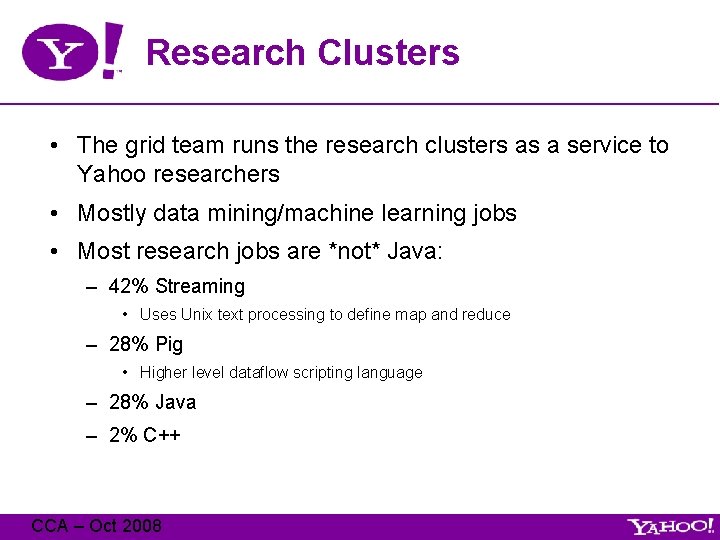
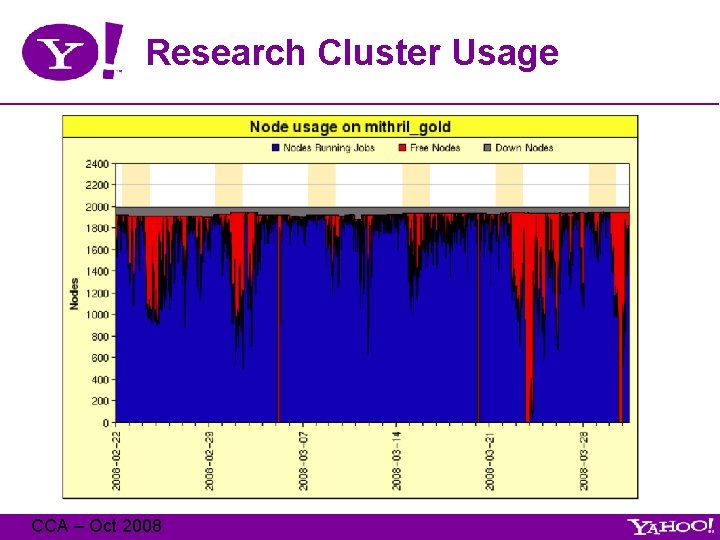
Research Clusters • The grid team runs the research clusters as a service to Yahoo researchers • Mostly data mining/machine learning jobs • Most research jobs are *not* Java: – 42% Streaming • Uses Unix text processing to define map and reduce – 28% Pig • Higher level dataflow scripting language – 28% Java – 2% C++ CCA – Oct 2008
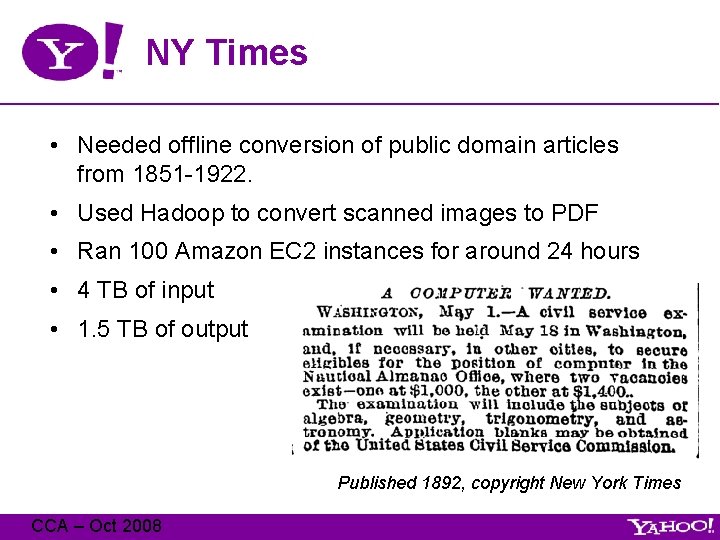
NY Times • Needed offline conversion of public domain articles from 1851 -1922. • Used Hadoop to convert scanned images to PDF • Ran 100 Amazon EC 2 instances for around 24 hours • 4 TB of input • 1. 5 TB of output Published 1892, copyright New York Times CCA – Oct 2008
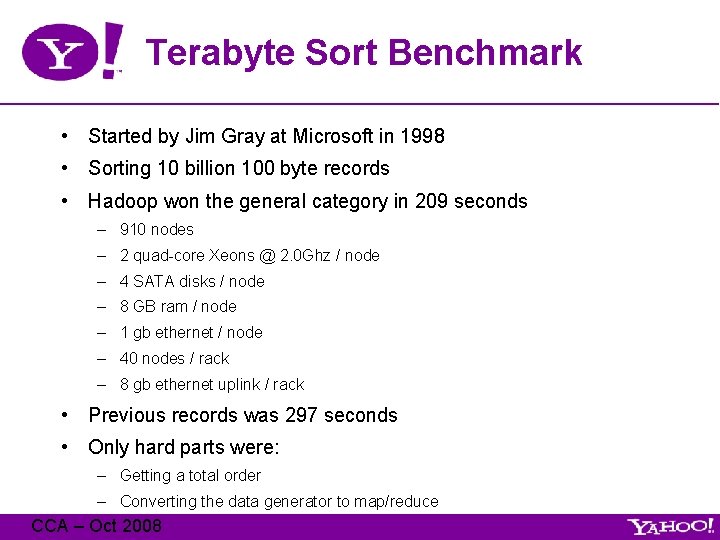
Terabyte Sort Benchmark • Started by Jim Gray at Microsoft in 1998 • Sorting 10 billion 100 byte records • Hadoop won the general category in 209 seconds – 910 nodes – 2 quad-core Xeons @ 2. 0 Ghz / node – 4 SATA disks / node – 8 GB ram / node – 1 gb ethernet / node – 40 nodes / rack – 8 gb ethernet uplink / rack • Previous records was 297 seconds • Only hard parts were: – Getting a total order – Converting the data generator to map/reduce CCA – Oct 2008
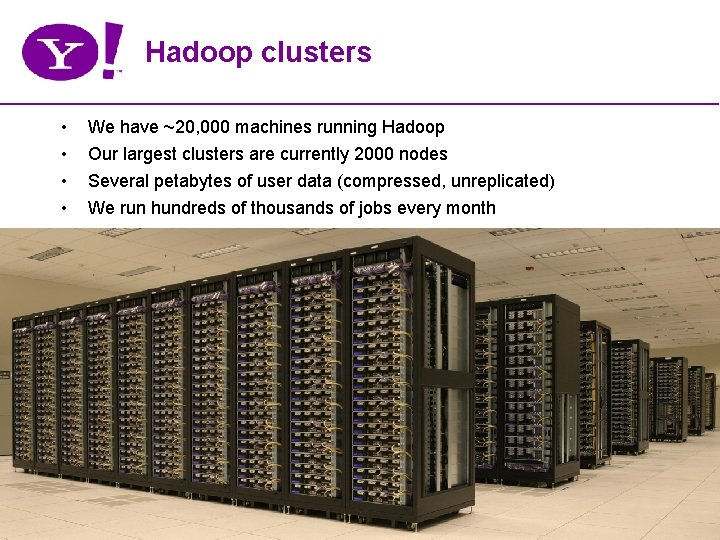
Hadoop clusters • • We have ~20, 000 machines running Hadoop Our largest clusters are currently 2000 nodes Several petabytes of user data (compressed, unreplicated) We run hundreds of thousands of jobs every month CCA – Oct 2008
Research Cluster Usage CCA – Oct 2008
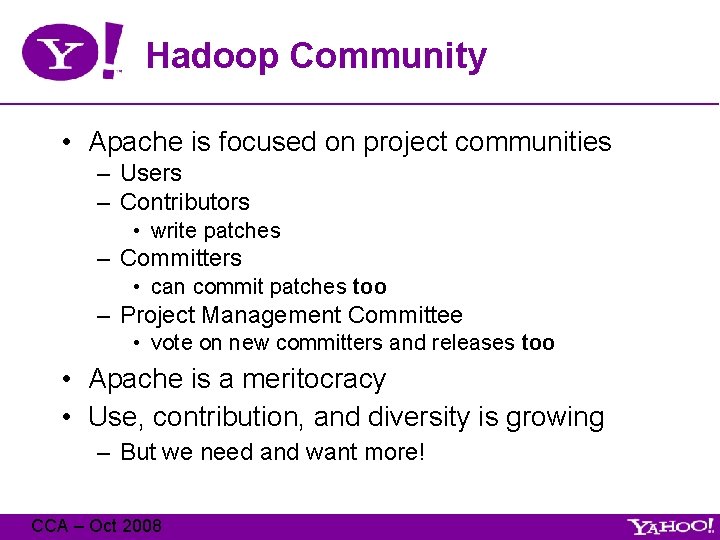
Hadoop Community • Apache is focused on project communities – Users – Contributors • write patches – Committers • can commit patches too – Project Management Committee • vote on new committers and releases too • Apache is a meritocracy • Use, contribution, and diversity is growing – But we need and want more! CCA – Oct 2008
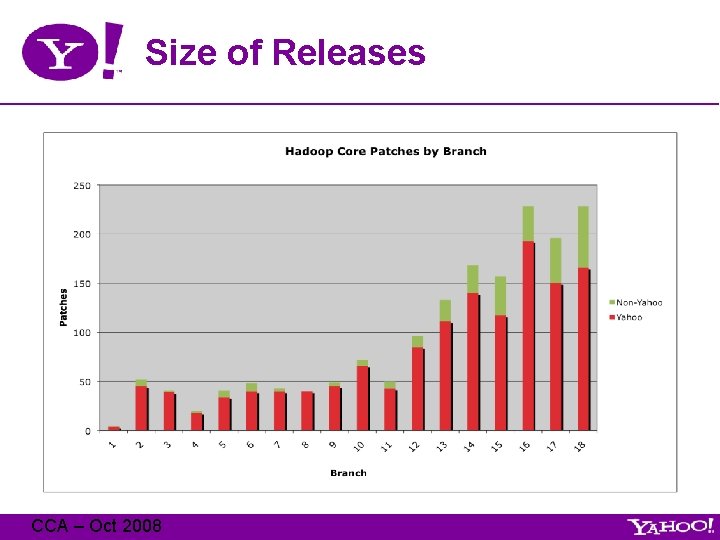
Size of Releases CCA – Oct 2008
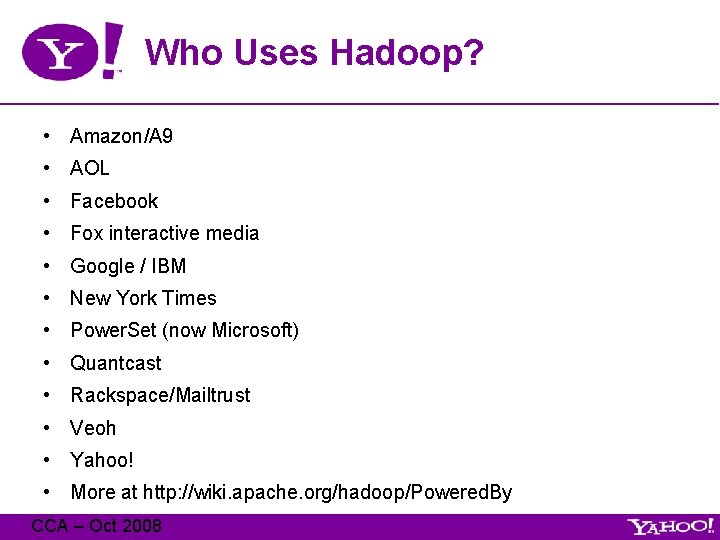
Who Uses Hadoop? • Amazon/A 9 • AOL • Facebook • Fox interactive media • Google / IBM • New York Times • Power. Set (now Microsoft) • Quantcast • Rackspace/Mailtrust • Veoh • Yahoo! • More at http: //wiki. apache. org/hadoop/Powered. By CCA – Oct 2008
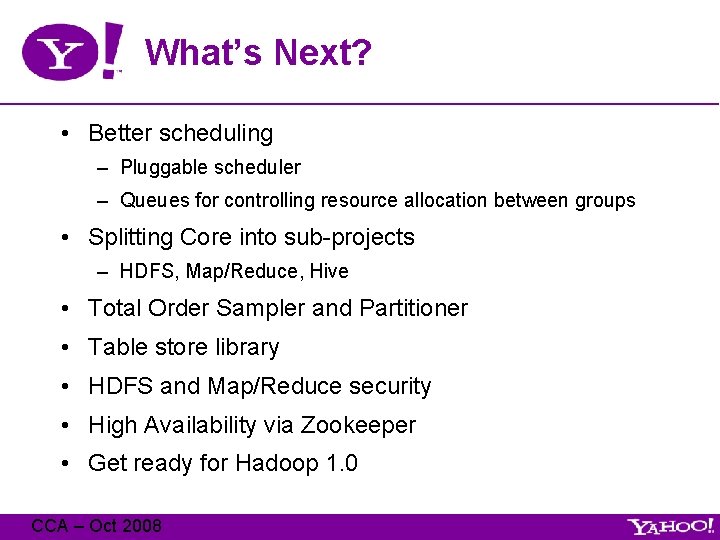
What’s Next? • Better scheduling – Pluggable scheduler – Queues for controlling resource allocation between groups • Splitting Core into sub-projects – HDFS, Map/Reduce, Hive • Total Order Sampler and Partitioner • Table store library • HDFS and Map/Reduce security • High Availability via Zookeeper • Get ready for Hadoop 1. 0 CCA – Oct 2008
Q&A • For more information: – Website: http: //hadoop. apache. org/core – Mailing lists: • core-dev@hadoop. apache • core-user@hadoop. apache – IRC: #hadoop on irc. freenode. org CCA – Oct 2008