
Introduction to H 264 AVC Video Coding Standard
![References • [1] Thomas Wiegand, Gary J. Sullivan, Gisle Bjontegaard, and Ajay Luthra “Overview](https://slidetodoc.com/presentation_image_h/730f8436f448934e564f70f657f9dca4/image-20.jpg "References • [1] Thomas Wiegand, Gary J. Sullivan, Gisle Bjontegaard, and Ajay Luthra “Overview")
- Slides: 20
Introduction to H. 264 / AVC Video Coding Standard Multimedia Systems Sharif University of Technology November 2008
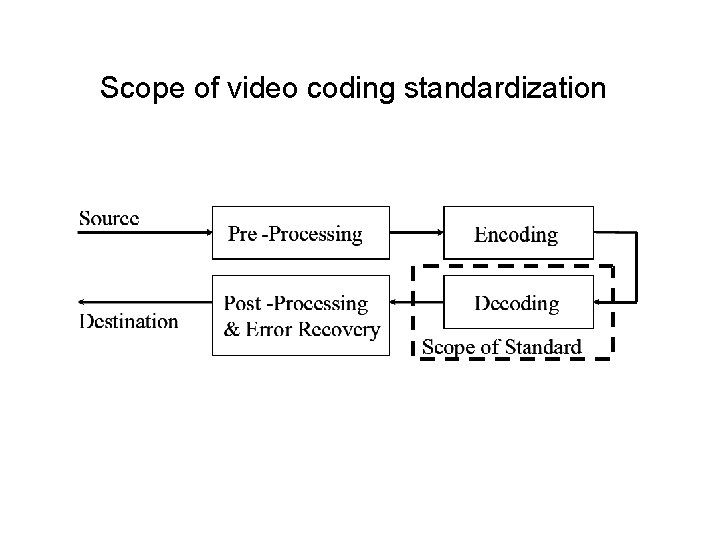
Scope of video coding standardization
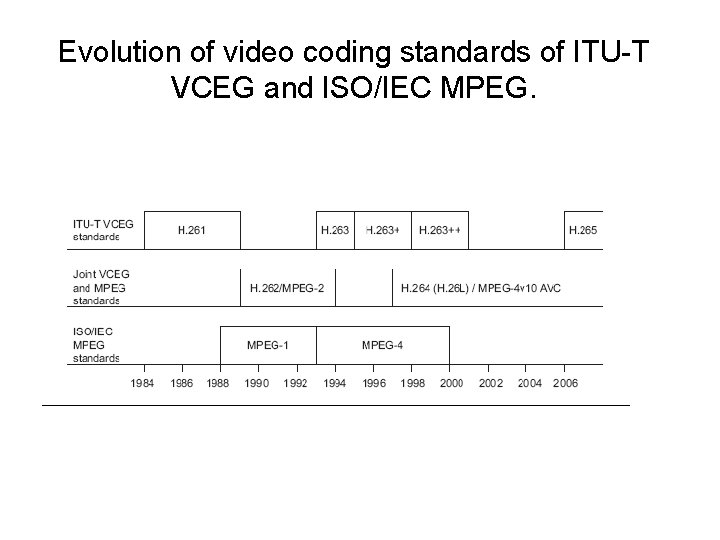
Evolution of video coding standards of ITU-T VCEG and ISO/IEC MPEG.
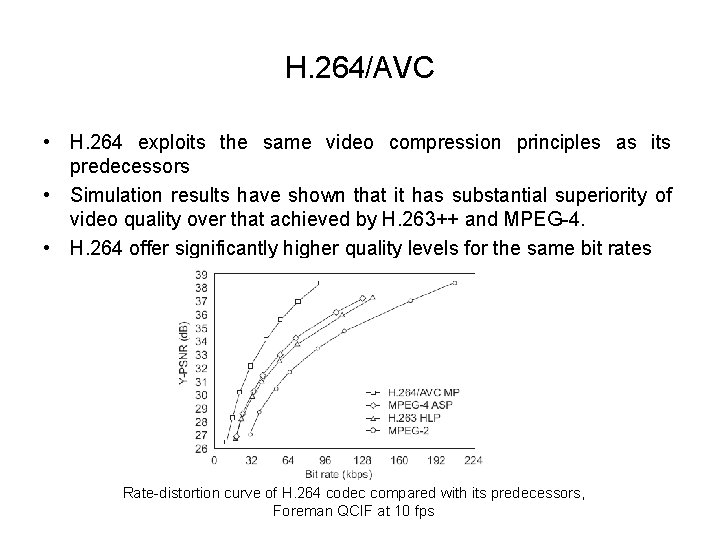
H. 264/AVC • H. 264 exploits the same video compression principles as its predecessors • Simulation results have shown that it has substantial superiority of video quality over that achieved by H. 263++ and MPEG-4. • H. 264 offer significantly higher quality levels for the same bit rates Rate-distortion curve of H. 264 codec compared with its predecessors, Foreman QCIF at 10 fps
Selected new features in H. 264 • Advanced intra-coding • Enhanced motion estimation with variable block size • Multiple reference picture • Integer block transform • Improved deblocking filter • Entropy coding • H. 264 Error Resilient Coding
H. 264 advanced intra-coding (Cont. ) • Efficient video encoders mainly use inter-frame prediction, • Use of intra-frame coding for parts of the picture is necessary to prevent error propagation • But intra-frame coding generates a large bit rate, and hence in order for H. 264 to be efficient, special attention is paid to intra-frame coding. • H. 264 takes advantage of correlations between neighboring blocks to achieve better compression in intra-coding.
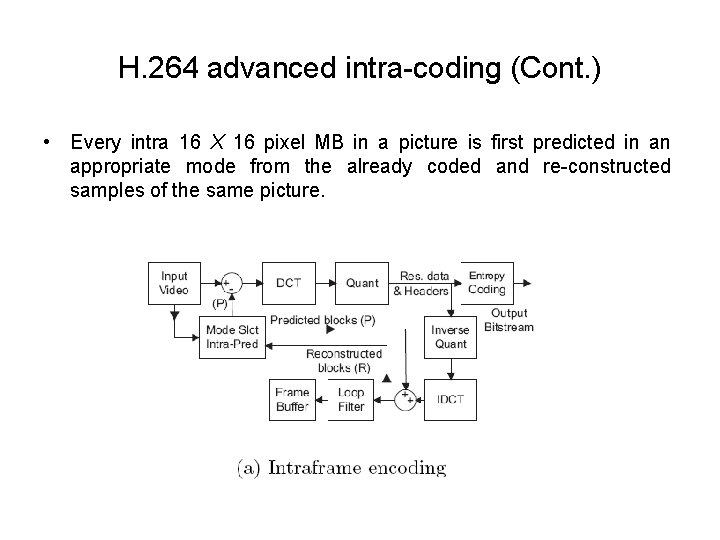
H. 264 advanced intra-coding (Cont. ) • Every intra 16 X 16 pixel MB in a picture is first predicted in an appropriate mode from the already coded and re-constructed samples of the same picture.
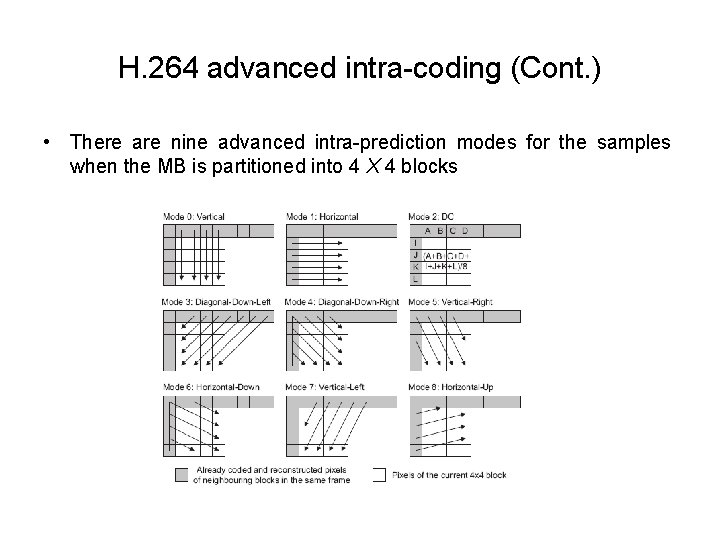
H. 264 advanced intra-coding (Cont. ) • There are nine advanced intra-prediction modes for the samples when the MB is partitioned into 4 X 4 blocks
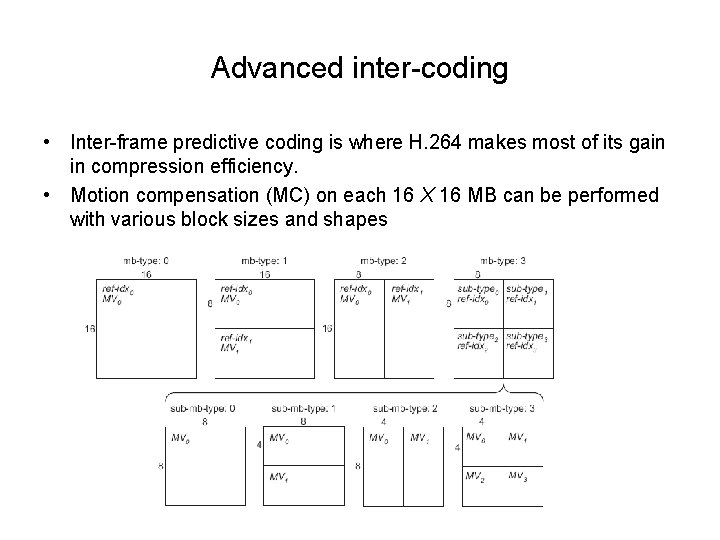
Advanced inter-coding • Inter-frame predictive coding is where H. 264 makes most of its gain in compression efficiency. • Motion compensation (MC) on each 16 X 16 MB can be performed with various block sizes and shapes
Multiple reference picture • The H. 264 standard also offers the option of using several previous pictures for prediction. • Every MB partition can have a different reference picture that is more appropriate for that particular block. – Increases the coding efficiency and produces a better subjective quality – Improve the robustness of the bitstream to channel errors
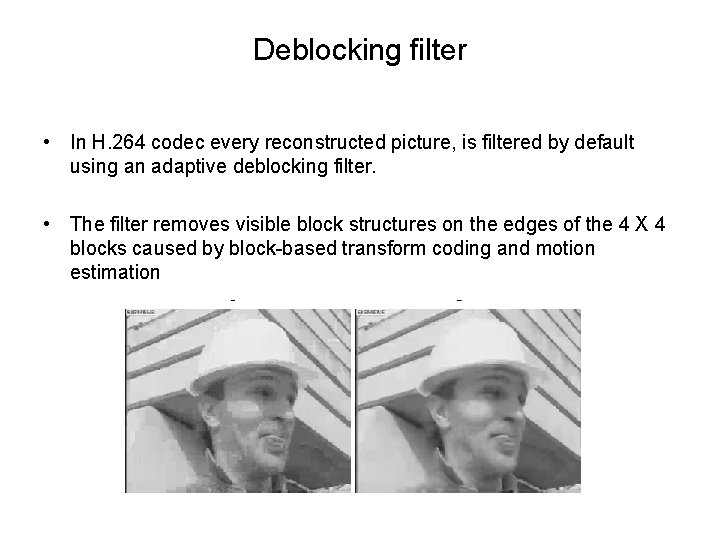
Deblocking filter • In H. 264 codec every reconstructed picture, is filtered by default using an adaptive deblocking filter. • The filter removes visible block structures on the edges of the 4 X 4 blocks caused by block-based transform coding and motion estimation
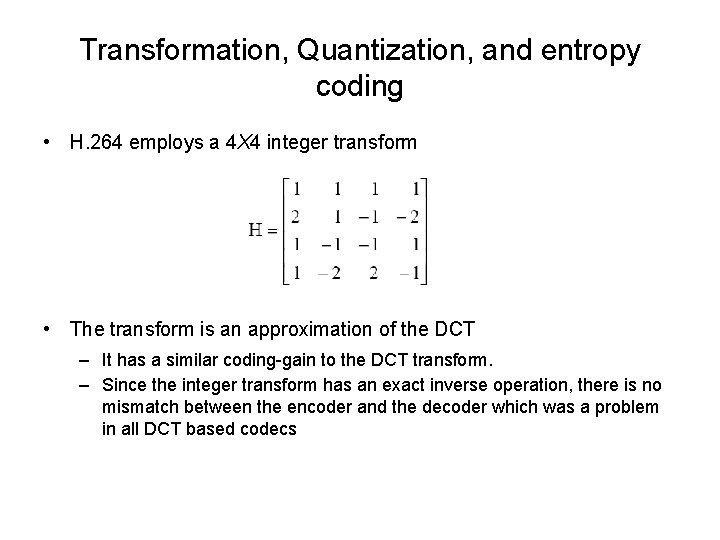
Transformation, Quantization, and entropy coding • H. 264 employs a 4 X 4 integer transform • The transform is an approximation of the DCT – It has a similar coding-gain to the DCT transform. – Since the integer transform has an exact inverse operation, there is no mismatch between the encoder and the decoder which was a problem in all DCT based codecs
Transformation, Quantization, and entropy coding (Cont. ) • A quantization parameter is used for determining the quantization of transform coefficients in H. 264/AVC. The parameter can take 52 values. • The quantized transform coefficients of a block generally are scanned in a zig-zag fashion and transmitted using entropy coding methods.
Transformation, Quantization, and entropy coding (Cont. ) • Before transmission, the generated data of all types are entropy coded. • H. 264 supports two different methods of entropy coding – context adaptive variable length coding (CAVLC) – context adaptive binary arithmetic coding (CABAC)
Transformation, Quantization, and entropy coding (Cont. ) • Their statistical distribution typically shows large values for the low frequency part decreasing to small values later in the scan for the high-frequency part. • CAVLC – The number of nonzero quantized coefficients (N) and the actual size and position of the coefficients are coded separately. • CABAC – The efficiency of entropy coding can be improved further if the Context-Adaptive Binary Arithmetic Coding (CABAC) is used – Allows the assignment of a non-integer number of bits to each symbol of an alphabet
H. 264 Error Resilient Coding • Spatial Error Propagation. – The use of entropy coding means that every coded bit within a slice requires the previous bits for its decoding. Hence, a single bit error in the transmitted stream may destroy the whole remaining coded bits of one slice • Temporal error propagation – Dependencies of consecutive pictures, as a result of inter-coding. – Damage in one frame may propagate into many future frames, even if their information is received without error.
H. 264 Error Resilient Coding (Cont. ) • First, the coded video data are grouped in network abstraction layer (NAL) units – Each NAL unit can be considered as a packet that contains an integer number of bytes including a header and a payload – The header specifies the NAL unit type and the payload contains the related data. • Data Partitioning
H. 264 Error Resilient Coding (Cont. ) • In a video sequence, each frame can be divided into several slices; each containing a flexible number of MBs. – In each slice, the arithmetic coder is aligned and the spatial predictions are reset. – Every slice in the frame is independently decodable, and therefore can be considered as a re-synchronization point that prevents spatial propagation of a probable error to the next slice.
H. 264 Error Resilient Coding (Cont. ) • Intra-updates • Multiple-reference selection
References • [1] Thomas Wiegand, Gary J. Sullivan, Gisle Bjontegaard, and Ajay Luthra “Overview of the H. 264 / AVC Video Coding Standard”, IEEE TRANSACTIONS ON CIRCUITS AND SYSTEMS FOR VIDEO TECHNOLOGY, JULY 2003. • [2] Gary J. Sullivan, Pankaj Topiwala, and Ajay Luthra, “The H. 264/AVC Advanced Video Coding Standard: Overview and Introduction to the Fidelity Range Extensions”, Presented at the SPIE Conference on Applications of Digital Image Processing XXVII Special Session on Advances in the New Emerging Standard: H. 264/AVC, August, 2004.