
Introduction to Grid Computing The Globus Project Argonne
Introduction to Grid Computing The Globus Project™ Argonne National Laboratory USC Information Sciences Institute http: //www. globus. org/ Copyright (c) 2002 University of Chicago and The University of Southern California. All Rights Reserved. Introduction to Grid Computing This presentation is licensed for use under the terms of the Globus Toolkit Public License. See http: //www. globus. org/toolkit/download/license. html for the full text of this license.
Outline l Introduction to Grid Computing l Some Definitions l Grid Architecture l The Programming Problem l The Globus Toolkit™ – Introduction, Security, Resource Management, Information Services, Data Management l Related work l Futures and Conclusions 10/30/2020 Introduction to Grid Computing 2

The Grid Problem l Flexible, secure, coordinated resource sharing among dynamic collections of individuals, institutions, and resource From “The Anatomy of the Grid: Enabling Scalable Virtual Organizations” l Enable communities (“virtual organizations”) to share geographically distributed resources as they pursue common goals -- assuming the absence of… – central location, – central control, – omniscience, – existing trust relationships. 10/30/2020 Introduction to Grid Computing 3
Elements of the Problem l Resource sharing – Computers, storage, sensors, networks, … – Sharing always conditional: issues of trust, policy, negotiation, payment, … l Coordinated problem solving – Beyond client-server: distributed data analysis, computation, collaboration, … l Dynamic, multi-institutional virtual orgs – Community overlays on classic org structures – Large or small, static or dynamic 10/30/2020 Introduction to Grid Computing 4

The Globus Project™ Making Grid computing a reality l l l Close collaboration with real Grid projects in science and industry Development and promotion of standard Grid protocols to enable interoperability and shared infrastructure Development and promotion of standard Grid software APIs and SDKs to enable portability and code sharing The Globus Toolkit™: Open source, reference software base for building grid infrastructure and applications Global Grid Forum: Development of standard protocols and APIs for Grid computing 10/30/2020 Introduction to Grid Computing 5

Some Definitions Introduction to Grid Computing

Some Important Definitions l Resource l Network protocol l Network enabled service l Application Programmer Interface (API) l Software Development Kit (SDK) 10/30/2020 Introduction to Grid Computing 7
Resource l An entity that is to be shared – E. g. , computers, storage, data, software l Does not have to be a physical entity – E. g. , Condor pool, distributed file system, … l Defined in terms of interfaces, not devices – E. g. scheduler such as LSF and PBS define a compute resource – Open/close/read/write define access to a distributed file system, e. g. NFS, AFS, DFS 10/30/2020 Introduction to Grid Computing 8
Network Protocol l A formal description of message formats and a set of rules for message exchange – Rules may define sequence of message exchanges – Protocol may define state-change in endpoint, e. g. , file system state change l Good protocols designed to do one thing – Protocols can be layered l Examples of protocols – IP, TCP, TLS (was SSL), HTTP, Kerberos 10/30/2020 Introduction to Grid Computing 9

Network Enabled Services l Implementation of a protocol that defines a set of capabilities – Protocol defines interaction with service – All services require protocols – Not all protocols are used to provide services (e. g. IP, TLS) l Examples: FTP and Web servers FTP Server 10/30/2020 Web Server FTP Telnet Protocol HTTP Protocol TCP Protocol IP Protocol TLS Protocol Introduction to Grid Computing 10

Application Programming Interface l A specification for a set of routines to facilitate application development – Refers to definition, not implementation – E. g. , there are many implementations of MPI l Spec often language-specific (or IDL) – Routine name, number, order and type of arguments; mapping to language constructs – Behavior or function of routine l Examples – GSS API (security), MPI (message passing) 10/30/2020 Introduction to Grid Computing 11
Software Development Kit l A particular instantiation of an API l SDK consists of libraries and tools – Provides implementation of API specification l Can have multiple SDKs for an API l Examples of SDKs – MPICH, Motif Widgets 10/30/2020 Introduction to Grid Computing 12
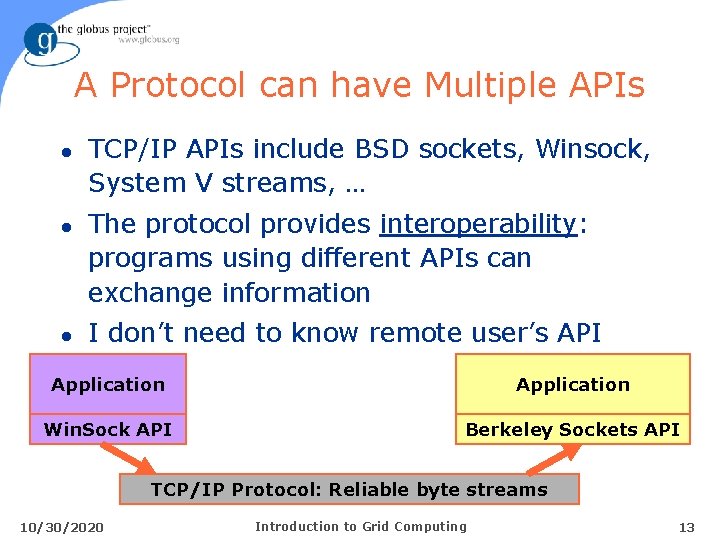
A Protocol can have Multiple APIs l l l TCP/IP APIs include BSD sockets, Winsock, System V streams, … The protocol provides interoperability: programs using different APIs can exchange information I don’t need to know remote user’s API Application Win. Sock API Berkeley Sockets API TCP/IP Protocol: Reliable byte streams 10/30/2020 Introduction to Grid Computing 13
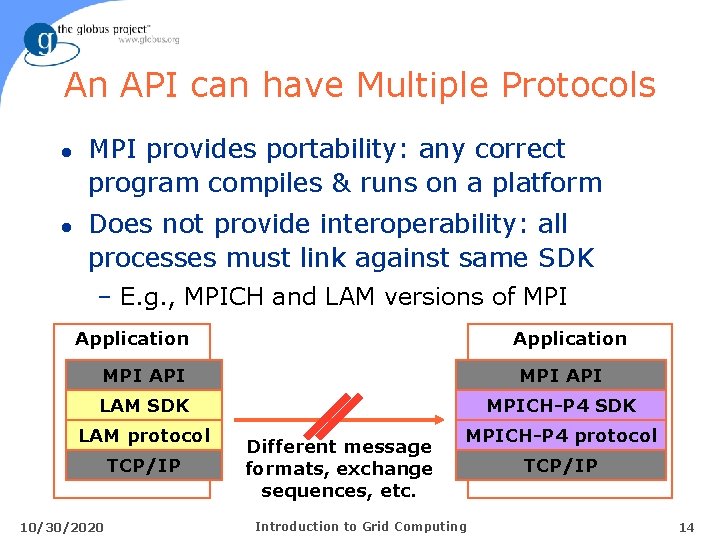
An API can have Multiple Protocols l l MPI provides portability: any correct program compiles & runs on a platform Does not provide interoperability: all processes must link against same SDK – E. g. , MPICH and LAM versions of MPI Application MPI API LAM SDK MPICH-P 4 SDK LAM protocol TCP/IP 10/30/2020 Different message formats, exchange sequences, etc. MPICH-P 4 protocol Introduction to Grid Computing TCP/IP 14
APIs and Protocols are Both Important l Standard APIs/SDKs are important – They enable application portability – But w/o standard protocols, interoperability is hard (every SDK speaks every protocol? ) l Standard protocols are important – Enable cross-site interoperability – Enable shared infrastructure – But w/o standard APIs/SDKs, application portability is hard (different platforms access protocols in different ways) 10/30/2020 Introduction to Grid Computing 15

Grid Architecture Introduction to Grid Computing

Why Discuss Architecture? l Descriptive – Provide a common vocabulary for use when describing Grid systems l Guidance – Identify key areas in which services are required l Prescriptive – Define standard “Intergrid” protocols and APIs to facilitate creation of interoperable Grid systems and portable applications 10/30/2020 Introduction to Grid Computing 17
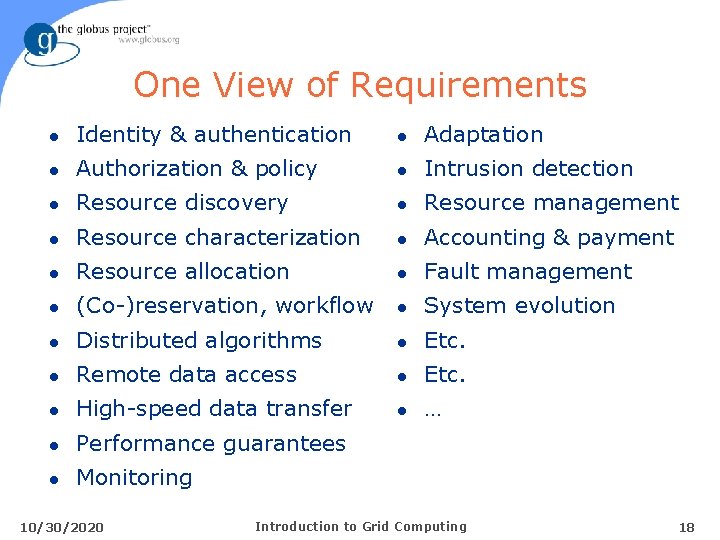
One View of Requirements l Identity & authentication l Adaptation l Authorization & policy l Intrusion detection l Resource discovery l Resource management l Resource characterization l Accounting & payment l Resource allocation l Fault management l (Co-)reservation, workflow l System evolution l Distributed algorithms l Etc. l Remote data access l Etc. l High-speed data transfer l … l Performance guarantees l Monitoring 10/30/2020 Introduction to Grid Computing 18

Another View: “Three Obstacles to Making Grid Computing Routine” 1) New approaches to problem solving – Data Grids, distributed computing, peer-topeer, collaboration grids, … 2) Structuring and writing programs – Abstractions, tools Programming Problem 3) Enabling resource sharing across distinct institutions – 10/30/2020 Systems Problem Resource discovery, access, reservation, allocation; authentication, authorization, policy; communication; fault detection and notification; … Introduction to Grid Computing 19
The Systems Problem: Resource Sharing Mechanisms That … l l Address security and policy concerns of resource owners and users Are flexible enough to deal with many resource types and sharing modalities Scale to large number of resources, many participants, many program components Operate efficiently when dealing with large amounts of data & computation 10/30/2020 Introduction to Grid Computing 21
Aspects of the Systems Problem 1) Need for interoperability when different groups want to share resources – Diverse components, policies, mechanisms – E. g. , standard notions of identity, means of communication, resource descriptions 2) Need for shared infrastructure services to avoid repeated development, installation – E. g. , one port/service/protocol for remote access to computing, not one per tool/appln – E. g. , Certificate Authorities: expensive to run l A common need for protocols & services 10/30/2020 Introduction to Grid Computing 22

Hence, a Protocol-Oriented View of Grid Architecture, that Emphasizes … l Development of Grid protocols & services – Protocol-mediated access to remote resources – New services: e. g. , resource brokering – “On the Grid” = speak Intergrid protocols – Mostly (extensions to) existing protocols l Development of Grid APIs & SDKs – Interfaces to Grid protocols & services – Facilitate application development by supplying higher-level abstractions l The (hugely successful) model is the Internet 10/30/2020 Introduction to Grid Computing 23
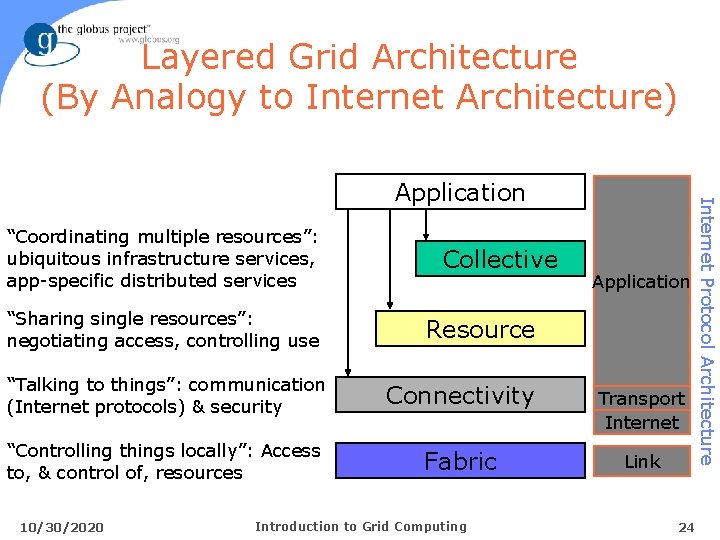
Layered Grid Architecture (By Analogy to Internet Architecture) “Coordinating multiple resources”: ubiquitous infrastructure services, app-specific distributed services “Sharing single resources”: negotiating access, controlling use Collective Application Resource “Talking to things”: communication (Internet protocols) & security Connectivity Transport Internet “Controlling things locally”: Access to, & control of, resources Fabric Link 10/30/2020 Introduction to Grid Computing 24 Internet Protocol Architecture Application

Protocols, Services, and APIs Occur at Each Level Applications Languages/Frameworks Collective Service APIs and SDKs Collective Services Resource APIs and SDKs Resource Services Collective Service Protocols Resource Service Protocols Connectivity APIs Connectivity Protocols Local Access APIs and Protocols Fabric Layer 10/30/2020 Introduction to Grid Computing 25
Important Points l Built on Internet protocols & services – Communication, routing, name resolution, etc. l “Layering” here is conceptual, does not imply constraints on who can call what – Protocols/services/APIs/SDKs will, ideally, be largely self-contained – Some things are fundamental: e. g. , communication and security – But, advantageous for higher-level functions to use common lower-level functions 10/30/2020 Introduction to Grid Computing 26
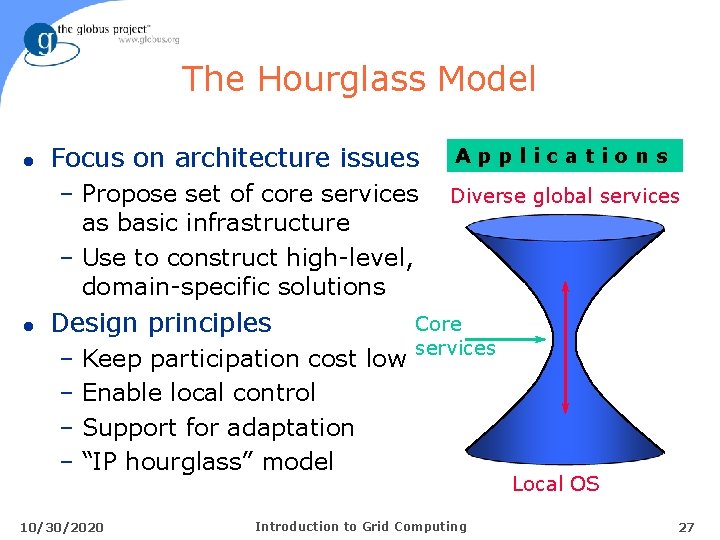
The Hourglass Model l l Focus on architecture issues Applications – Propose set of core services as basic infrastructure – Use to construct high-level, domain-specific solutions Diverse global services Design principles – Keep participation cost low – Enable local control – Support for adaptation – “IP hourglass” model 10/30/2020 Core services Introduction to Grid Computing Local OS 27
Fabric Layer Protocols & Services l Just what you would expect: the diverse mix of resources that may be shared – Individual computers, Condor pools, file systems, archives, metadata catalogs, networks, sensors, etc. l l Few constraints on low-level technology: connectivity and resource level protocols form the “neck in the hourglass” Defined by interfaces not physical characteristics 10/30/2020 Introduction to Grid Computing 28
Connectivity Layer Protocols & Services l Communication – Internet protocols: IP, DNS, routing, etc. l Security: Grid Security Infrastructure (GSI) – Uniform authentication, authorization, and message protection mechanisms in multiinstitutional setting – Single sign-on, delegation, identity mapping – Public key technology, SSL, X. 509, GSS-API – Supporting infrastructure: Certificate Authorities, certificate & key management, … GSI: www. gridforum. org/security/gsi 10/30/2020 Introduction to Grid Computing 29
GT 2 Resource Layer Protocols & Services l Grid Resource Allocation Management (GRAM) – Remote allocation, reservation, monitoring, control of compute resources l Grid. FTP protocol (FTP extensions) – High-performance data access & transport l Grid Resource Information Service (GRIS) – Access to structure & state information l l Others emerging: Catalog access, code repository access, accounting, etc. All built on connectivity layer: GSI & IP 10/30/2020 GRAM, Grid. FTP, GRIS: www. globus. org Introduction to Grid Computing 30
GT 2 Collective Layer Protocols & Services l Index servers aka metadirectory services – Custom views on dynamic resource collections assembled by a community l Resource brokers (e. g. , Condor Matchmaker) – Resource discovery and allocation l Replica catalogs l Replication services l Co-reservation and co-allocation services l Workflow management services l Etc. 10/30/2020 Condor: www. cs. wisc. edu/condor Introduction to Grid Computing 31

The Programming Problem Introduction to Grid Computing
Common Toolkit Underneath l l Each programming environment should not have to implement the protocols and services from scratch! Rather, want to share common code that… – Implements core functionality > SDKs that can be used to construct a large variety of services and clients > Standard services that can be easily deployed – Is robust, well-architected, self-consistent – Is open source, with broad input l Which leads us to the Globus Toolkit™… 10/30/2020 Introduction to Grid Computing 33

Introduction to the Globus Toolkit™ Introduction to Grid Computing
Globus Toolkit™ l A software toolkit addressing key technical problems in the development of Grid enabled tools, services, and applications – Offer a modular “bag of technologies” – Enable incremental development of gridenabled tools and applications – Implement standard Grid protocols and APIs – Make available under liberal open source license 10/30/2020 Introduction to Grid Computing 35
General Approach l Define Grid protocols & APIs – Protocol-mediated access to remote resources – Integrate and extend existing standards – “On the Grid” = speak “Intergrid” protocols l Develop a reference implementation – Open source Globus Toolkit – Client and server SDKs, services, tools, etc. l Grid-enable wide variety of tools – Globus Toolkit, FTP, SSH, Condor, SRB, MPI, … l Learn through deployment and applications 10/30/2020 Introduction to Grid Computing 36

Key Protocols l The Globus Toolkit™ centers around four key protocols – Connectivity layer: > Security: Grid Security Infrastructure (GSI) – Resource layer: > Resource Management > Information Services > Data Transfer l Also key collective layer protocols – Info Services, Replica Management, etc. 10/30/2020 Introduction to Grid Computing 37
Grid Security Infrastructure (GSI) l l Globus Toolkit implements GSI protocols and APIs, to address Grid security needs GSI protocols extends standard public key protocols – Standards: X. 509 & SSL/TLS – Extensions: X. 509 Proxy Certificates & Delegation l GSI extends standard GSS-API 10/30/2020 Introduction to Grid Computing 38
Resource Management l l l The Grid Resource Allocation Management (GRAM) protocol and client API allows programs to be started and managed on remote resources, despite local heterogeneity Resource Specification Language (RSL) is used to communicate requirements A layered architecture allows applicationspecific resource brokers and co-allocators to be defined in terms of GRAM services – Integrated with Condor, PBS, MPICH-G 2, … 10/30/2020 Introduction to Grid Computing 39
Information Services l GT 2 – MDS (GRIS/GIIS) – Based on LDAP protocol l GT 3 – Service Data Elements – From the OGSI spec 10/30/2020 Introduction to Grid Computing 40

Data Access & Transfer l l Grid. FTP: extended version of popular FTP protocol for Grid data access and transfer Secure, efficient, reliable, flexible, extensible, parallel, concurrent, e. g. : – Third-party data transfers, partial file transfers – Parallelism, striping (e. g. , on PVFS) – Reliable, recoverable data transfers l Reference implementations – Existing clients and servers: wuftpd, globus-url-copy – Flexible, extensible libraries in Globus Toolkit 10/30/2020 Introduction to Grid Computing 41

Summary l l The Grid problem: Resource sharing & coordinated problem solving in dynamic, multiinstitutional virtual organizations Grid architecture emphasizes systems problem – Protocols & services, to facilitate interoperability and shared infrastructure services l Globus Toolkit™: APIs, SDKs, and tools which implement Grid protocols & services – Provides basic software infrastructure for suite of tools addressing the programming problem 10/30/2020 Introduction to Grid Computing 42
- Slides: 41