
Introduction to Graphs What is a Graph Some
- Slides: 12
Introduction to Graphs • What is a Graph? • Some Example applications of Graphs. • Graph Terminologies. • Representation of Graphs. – Adjacency Matrix. – Adjacency Lists. – Simple Lists • Review Questions.
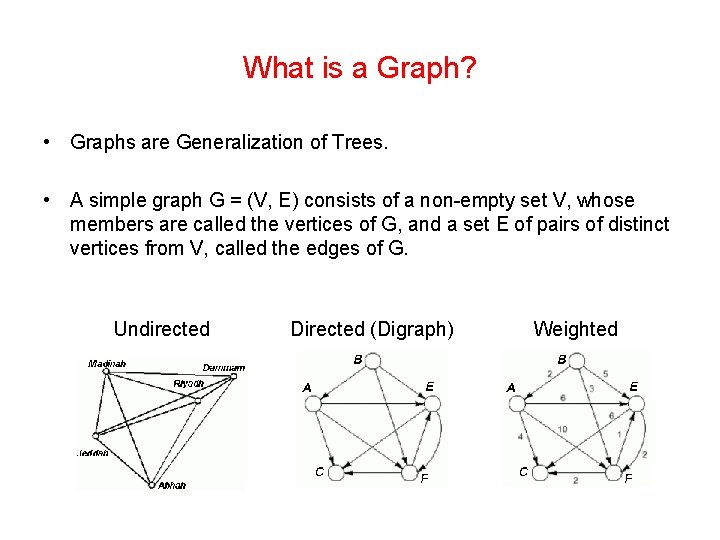
What is a Graph? • Graphs are Generalization of Trees. • A simple graph G = (V, E) consists of a non-empty set V, whose members are called the vertices of G, and a set E of pairs of distinct vertices from V, called the edges of G. Undirected Directed (Digraph) Weighted
Some Example Applications of Graph • Finding the least congested route between two phones, given connections between switching stations. • Determining if there is a way to get from one page to another, just by following links. • Finding the shortest path from one city to another. • As a traveling sales-person, finding the cheapest path that passes through all the cities that the sales person must visit. • Determining an ordering of courses so that prerequisite courses are always taken first.
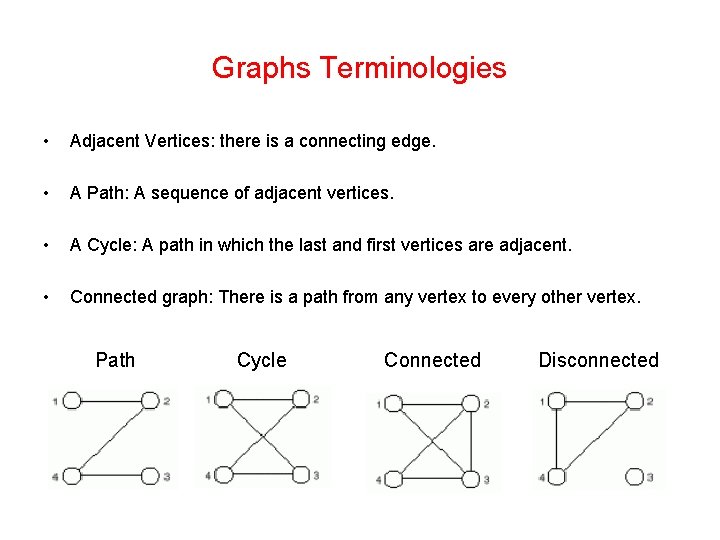
Graphs Terminologies • Adjacent Vertices: there is a connecting edge. • A Path: A sequence of adjacent vertices. • A Cycle: A path in which the last and first vertices are adjacent. • Connected graph: There is a path from any vertex to every other vertex. Path Cycle Connected Disconnected
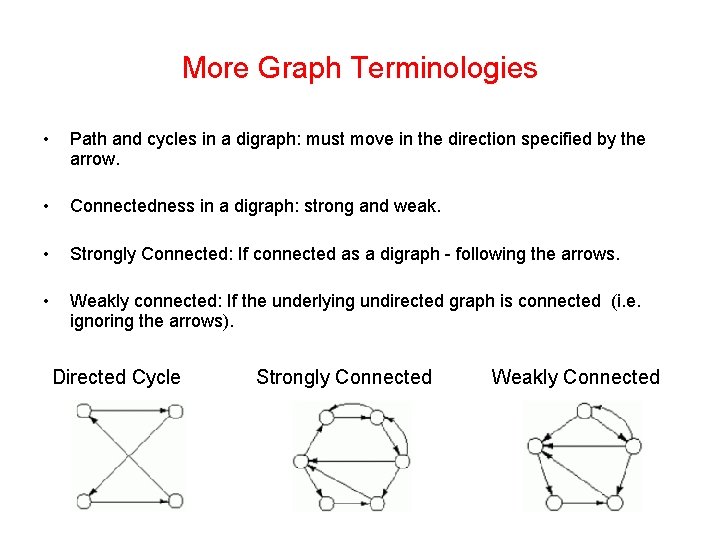
More Graph Terminologies • Path and cycles in a digraph: must move in the direction specified by the arrow. • Connectedness in a digraph: strong and weak. • Strongly Connected: If connected as a digraph - following the arrows. • Weakly connected: If the underlying undirected graph is connected (i. e. ignoring the arrows). Directed Cycle Strongly Connected Weakly Connected
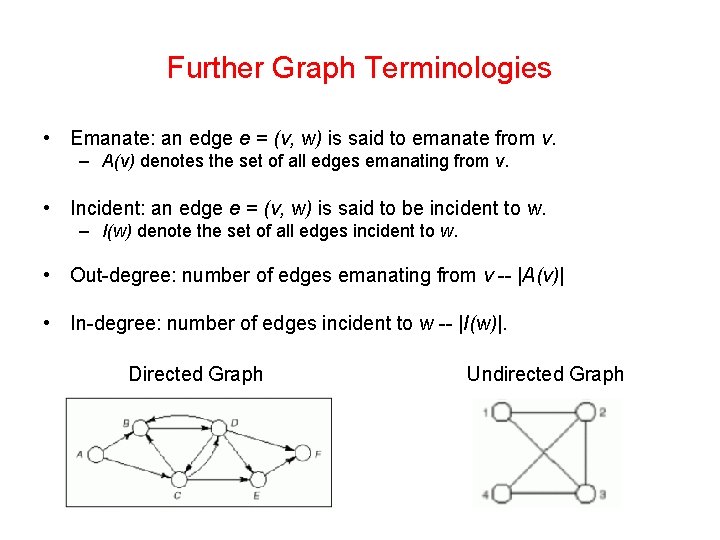
Further Graph Terminologies • Emanate: an edge e = (v, w) is said to emanate from v. – A(v) denotes the set of all edges emanating from v. • Incident: an edge e = (v, w) is said to be incident to w. – I(w) denote the set of all edges incident to w. • Out-degree: number of edges emanating from v -- |A(v)| • In-degree: number of edges incident to w -- |I(w)|. Directed Graph Undirected Graph
Graph Representations • For vertices: – an array or a linked list can be used • For edges: – Adjacency Matrix (Two-dimensional array) – Adjacency List (One-dimensional array of linked lists) – Linked List (one list only)
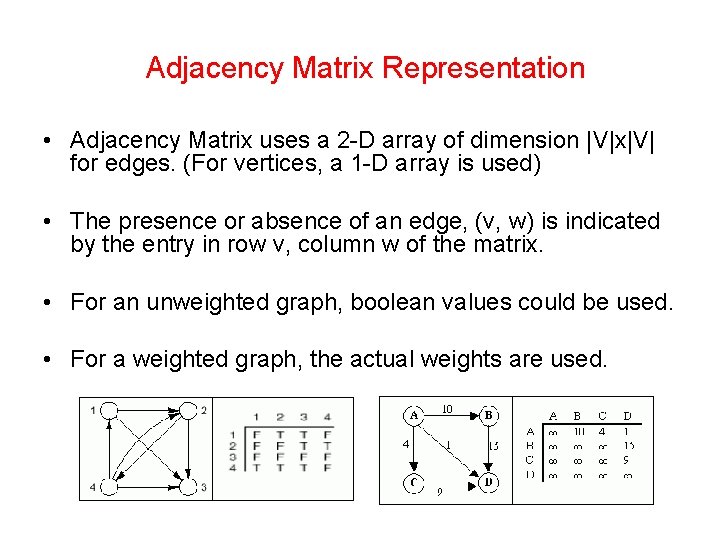
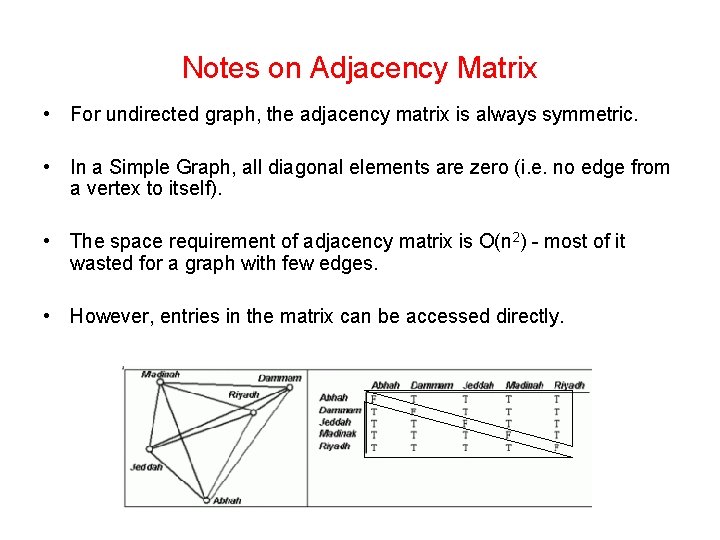
Adjacency Matrix Representation • Adjacency Matrix uses a 2 -D array of dimension |V|x|V| for edges. (For vertices, a 1 -D array is used) • The presence or absence of an edge, (v, w) is indicated by the entry in row v, column w of the matrix. • For an unweighted graph, boolean values could be used. • For a weighted graph, the actual weights are used.
Notes on Adjacency Matrix • For undirected graph, the adjacency matrix is always symmetric. • In a Simple Graph, all diagonal elements are zero (i. e. no edge from a vertex to itself). • The space requirement of adjacency matrix is O(n 2) - most of it wasted for a graph with few edges. • However, entries in the matrix can be accessed directly.
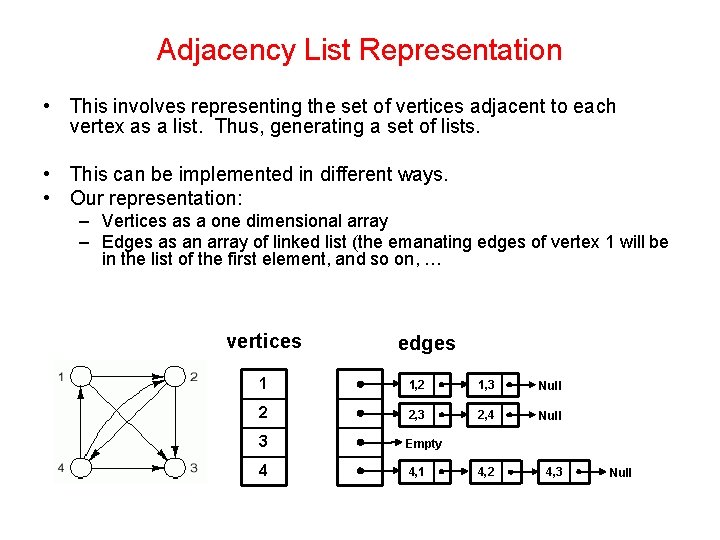
Adjacency List Representation • This involves representing the set of vertices adjacent to each vertex as a list. Thus, generating a set of lists. • This can be implemented in different ways. • Our representation: – Vertices as a one dimensional array – Edges as an array of linked list (the emanating edges of vertex 1 will be in the list of the first element, and so on, … vertices edges 1 1, 2 1, 3 Null 2 2, 3 2, 4 Null 3 Empty 4 4, 1 4, 2 4, 3 Null
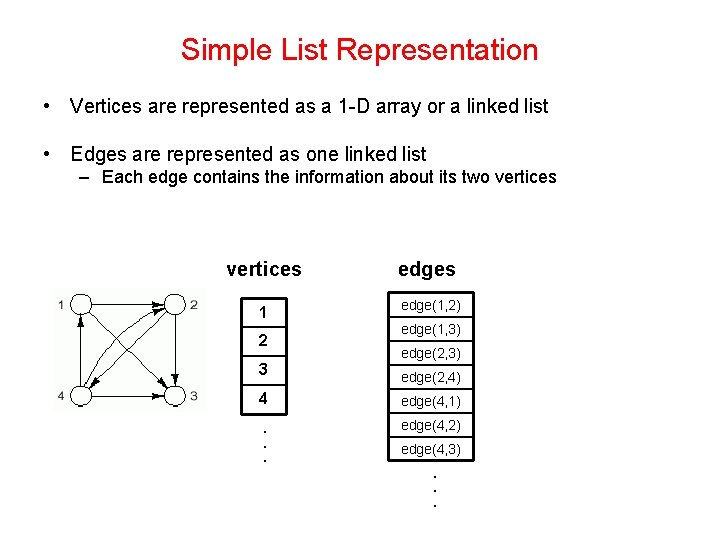
Simple List Representation • Vertices are represented as a 1 -D array or a linked list • Edges are represented as one linked list – Each edge contains the information about its two vertices edges 1 edge(1, 2) 2 edge(1, 3) edge(2, 3) 3 edge(2, 4) 4 edge(4, 1) . . . edge(4, 2) edge(4, 3). . .
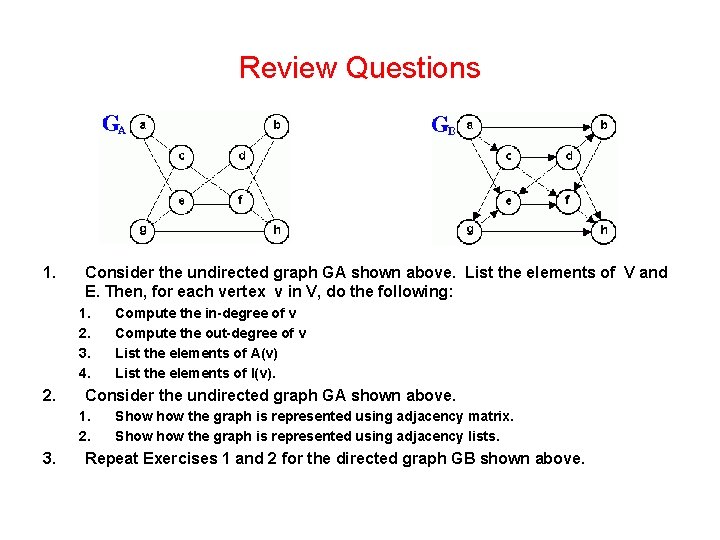
Review Questions 1. Consider the undirected graph GA shown above. List the elements of V and E. Then, for each vertex v in V, do the following: 1. 2. 3. 4. 2. Consider the undirected graph GA shown above. 1. 2. 3. Compute the in-degree of v Compute the out-degree of v List the elements of A(v) List the elements of I(v). Show the graph is represented using adjacency matrix. Show the graph is represented using adjacency lists. Repeat Exercises 1 and 2 for the directed graph GB shown above.