
Introduction to Geometric Sequences and Series 23 May
- Slides: 20
Introduction to Geometric Sequences and Series 23 May 2011
Investigation: ¢ Find the next 3 terms of each sequence: {3, 6, 12, 24, …} l {32, 16, 8, 4, …} l
Geometric Sequences that increase or decrease by multiplying the previous term by a fixed number ¢ This fixed number is called r or the common ratio ¢
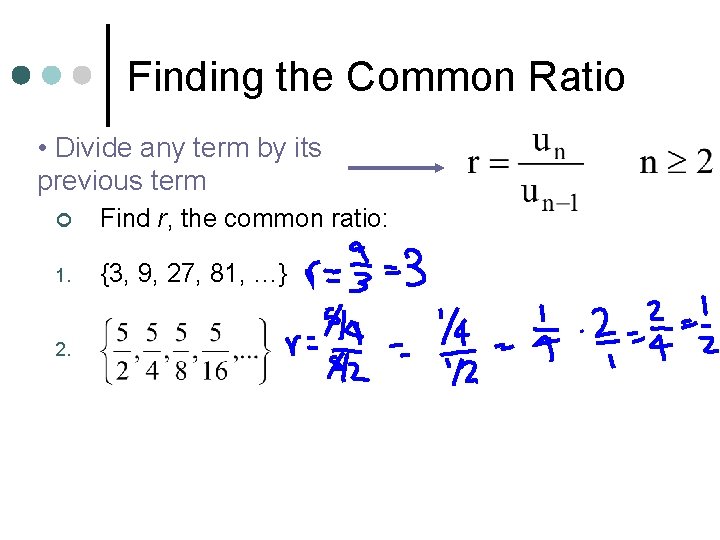
Finding the Common Ratio • Divide any term by its previous term ¢ Find r, the common ratio: 1. {3, 9, 27, 81, …} 2.
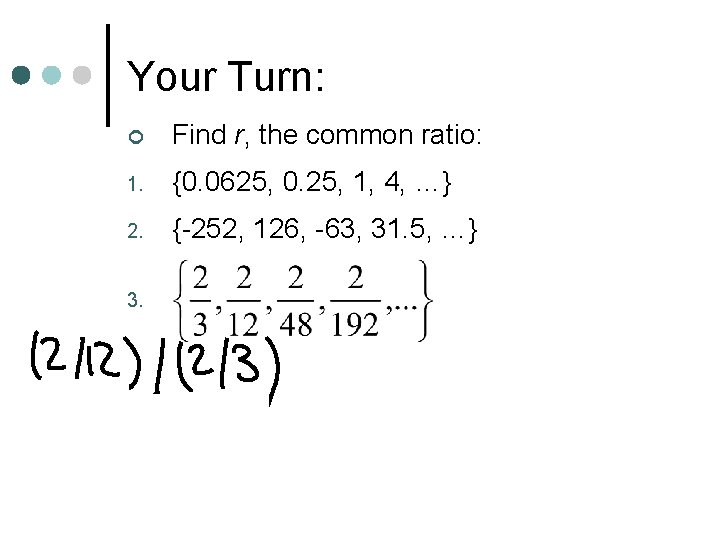
Your Turn: ¢ Find r, the common ratio: 1. {0. 0625, 0. 25, 1, 4, …} 2. {-252, 126, -63, 31. 5, …} 3.
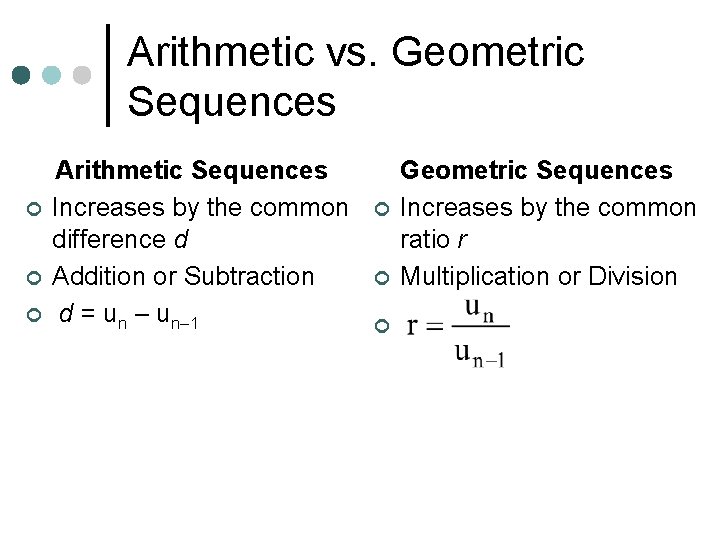
Arithmetic vs. Geometric Sequences ¢ ¢ ¢ Arithmetic Sequences Increases by the common difference d Addition or Subtraction d = un – un– 1 ¢ ¢ ¢ Geometric Sequences Increases by the common ratio r Multiplication or Division
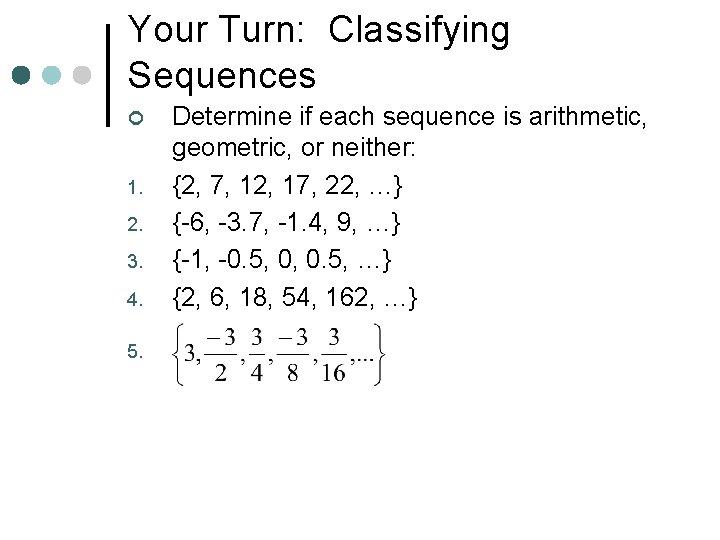
Your Turn: Classifying Sequences ¢ 1. 2. 3. 4. 5. Determine if each sequence is arithmetic, geometric, or neither: {2, 7, 12, 17, 22, …} {-6, -3. 7, -1. 4, 9, …} {-1, -0. 5, 0, 0. 5, …} {2, 6, 18, 54, 162, …}
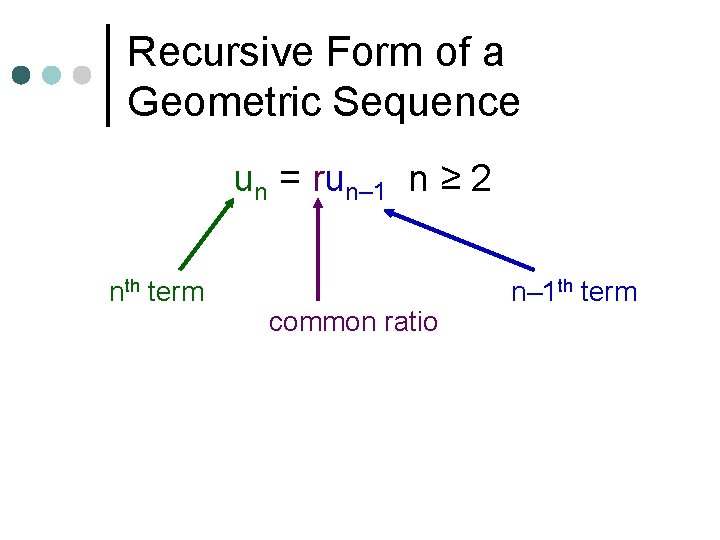
Recursive Form of a Geometric Sequence un = run– 1 n ≥ 2 nth term common ratio n– 1 th term
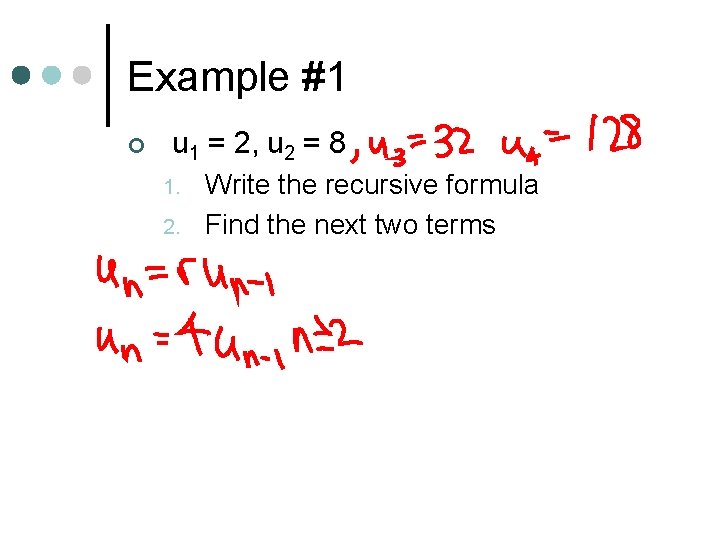
Example #1 ¢ u 1 = 2, u 2 = 8 1. 2. Write the recursive formula Find the next two terms
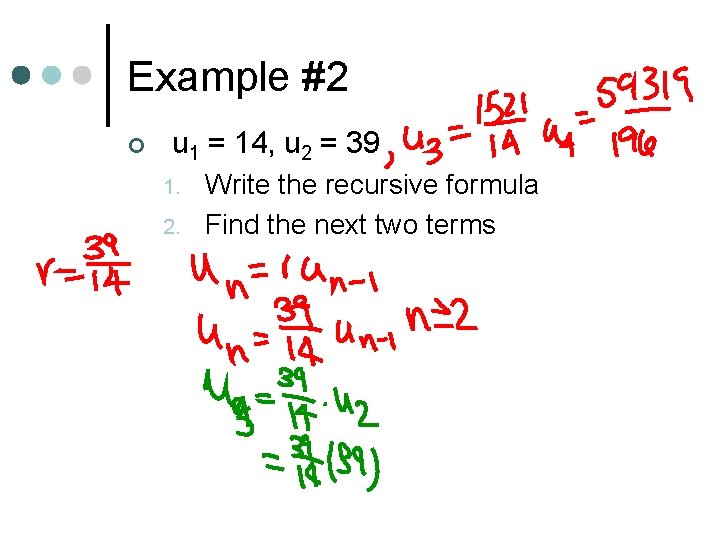
Example #2 ¢ u 1 = 14, u 2 = 39 1. 2. Write the recursive formula Find the next two terms
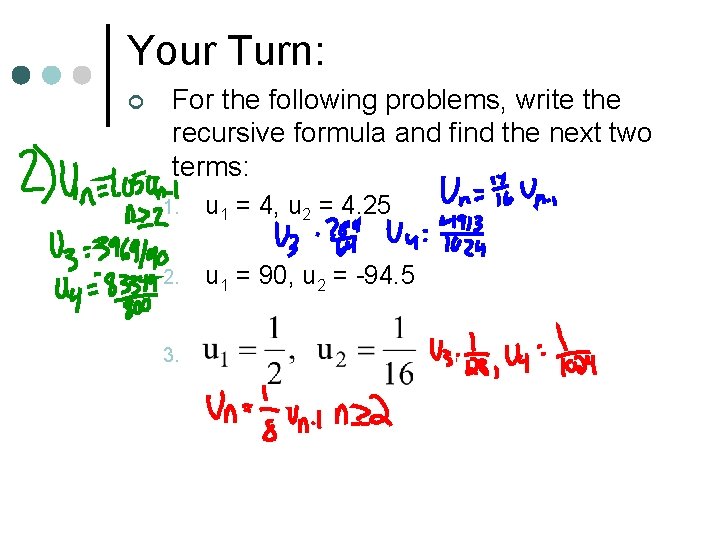
Your Turn: ¢ For the following problems, write the recursive formula and find the next two terms: 1. u 1 = 4, u 2 = 4. 25 2. u 1 = 90, u 2 = -94. 5 3.
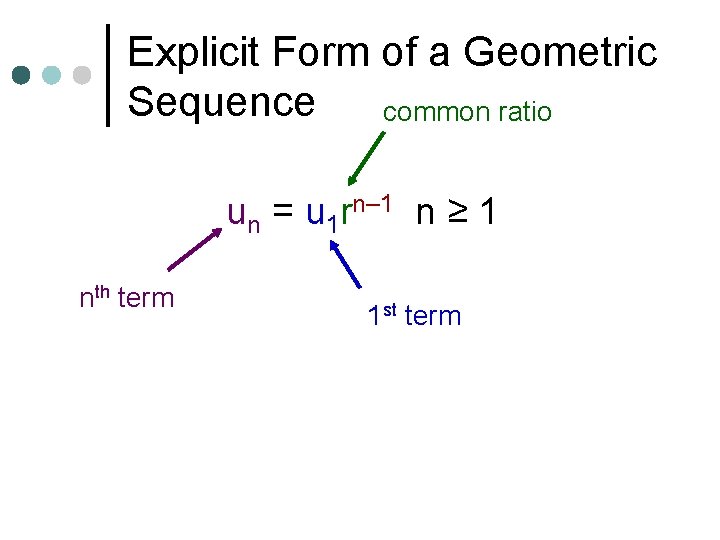
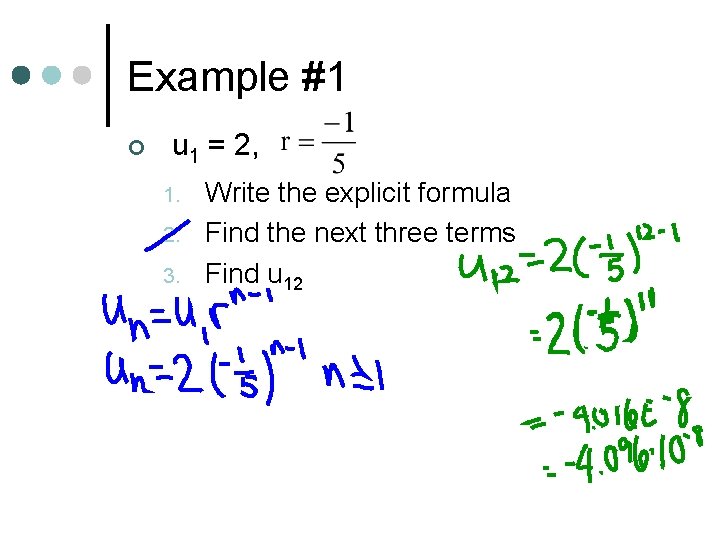
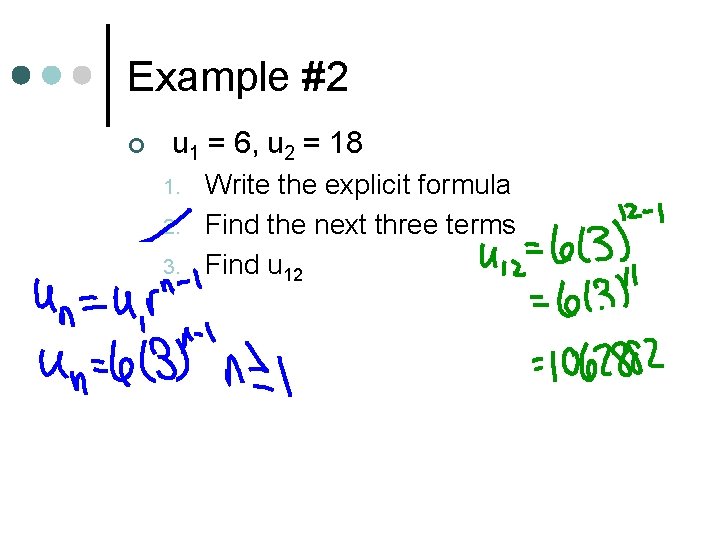
Explicit Form of a Geometric Sequence common ratio un = u 1 rn– 1 n ≥ 1 nth term 1 st term
Example #1 ¢ u 1 = 2, 1. 2. 3. Write the explicit formula Find the next three terms Find u 12
Example #2 ¢ u 1 = 6, u 2 = 18 1. 2. 3. Write the explicit formula Find the next three terms Find u 12
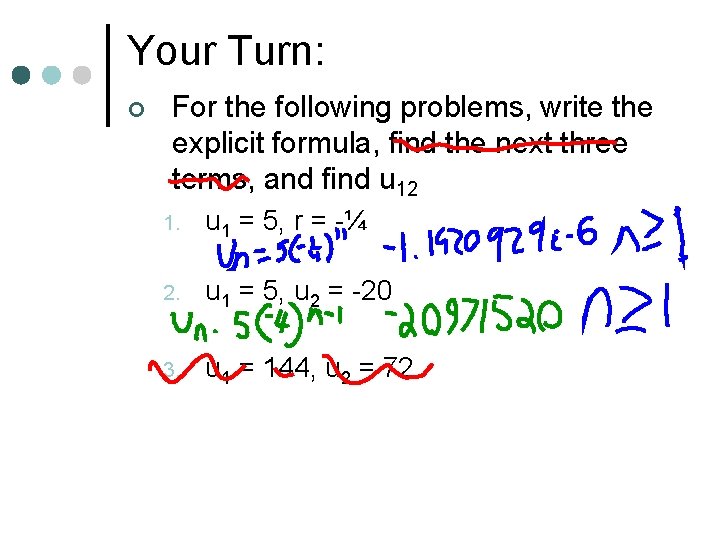
Your Turn: ¢ For the following problems, write the explicit formula, find the next three terms, and find u 12 1. u 1 = 5, r = -¼ 2. u 1 = 5, u 2 = -20 3. u 1 = 144, u 2 = 72
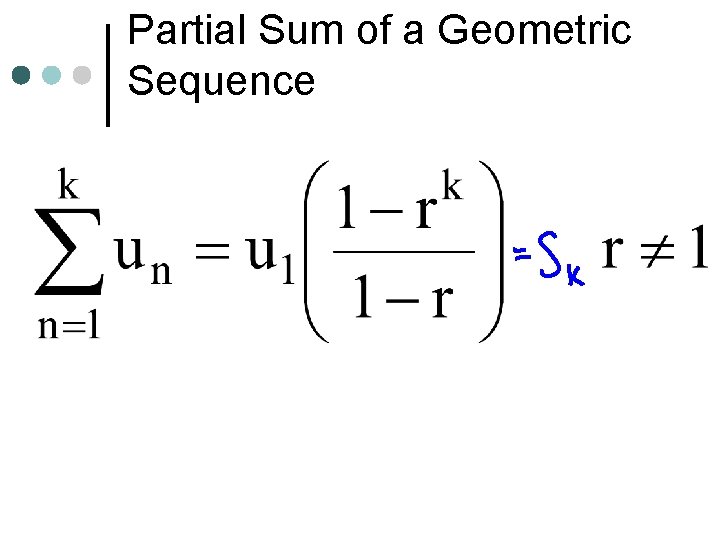
Partial Sum of a Geometric Sequence
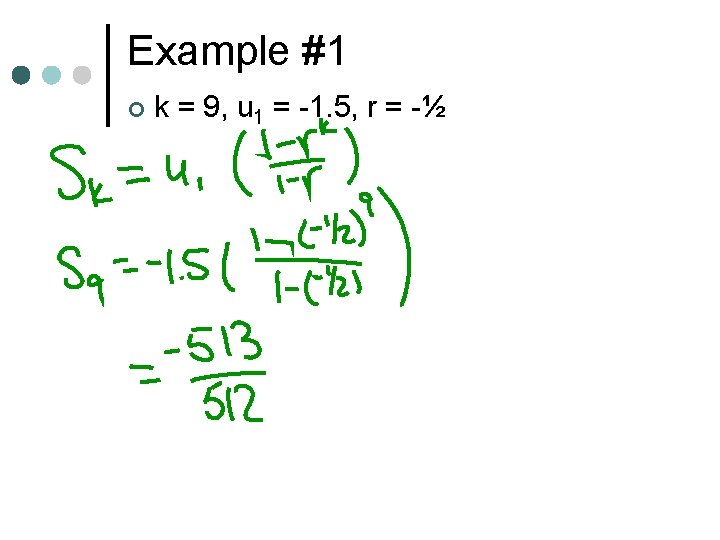
Example #1 ¢ k = 9, u 1 = -1. 5, r = -½
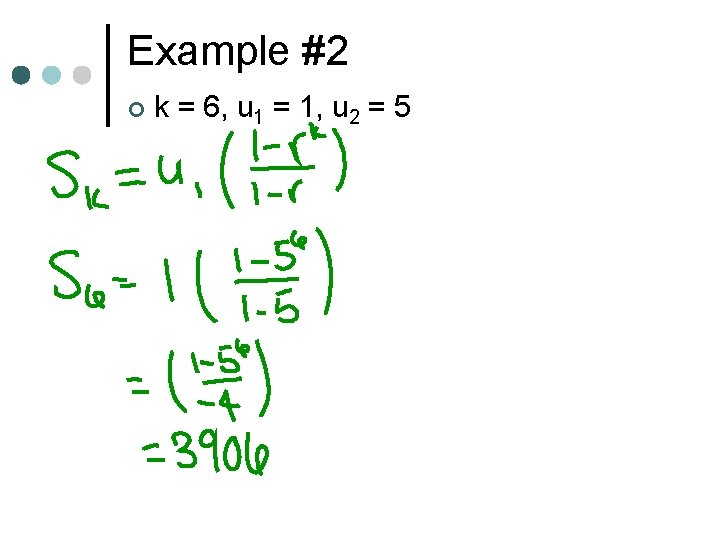
Example #2 ¢ k = 6, u 1 = 1, u 2 = 5
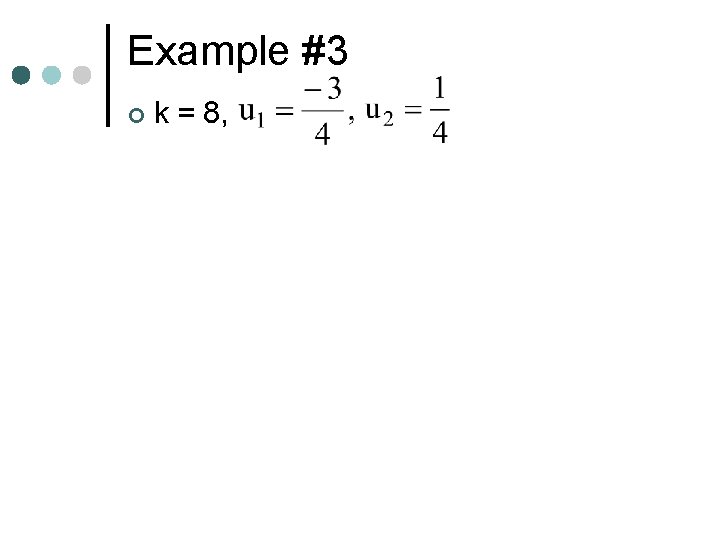
Example #3 ¢ k = 8,
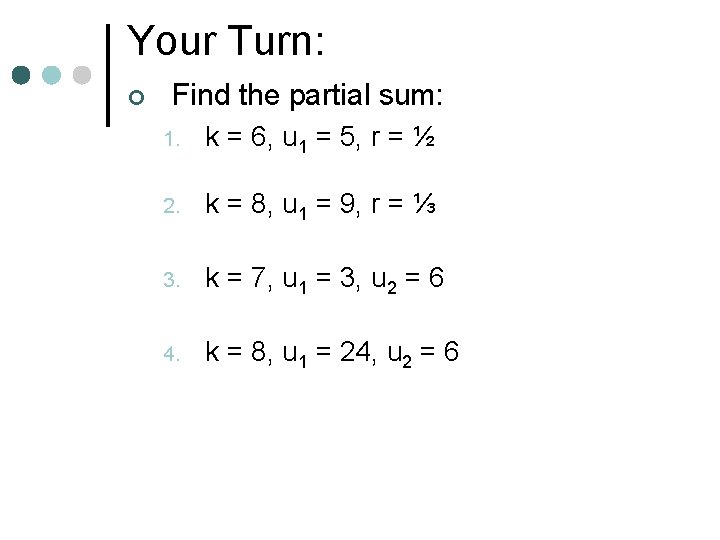
Your Turn: ¢ Find the partial sum: 1. k = 6, u 1 = 5, r = ½ 2. k = 8, u 1 = 9, r = ⅓ 3. k = 7, u 1 = 3, u 2 = 6 4. k = 8, u 1 = 24, u 2 = 6