
Introduction to Geometric Proof Logical Reasoning and Conditional


- Slides: 18
Introduction to Geometric Proof Logical Reasoning and Conditional Statements
Geometry involves deductive reasoning. It uses facts, definitions, accepted properties, and laws of logic to form a logical argument. Writing a geometric proof is a good way to practice logical reasoning! A proof is a logical argument that shows a statement is true. It can be in the form of a twocolumn proof, a flowchart proof, a paragraph proof, an algebraic proof, or even proof without words.
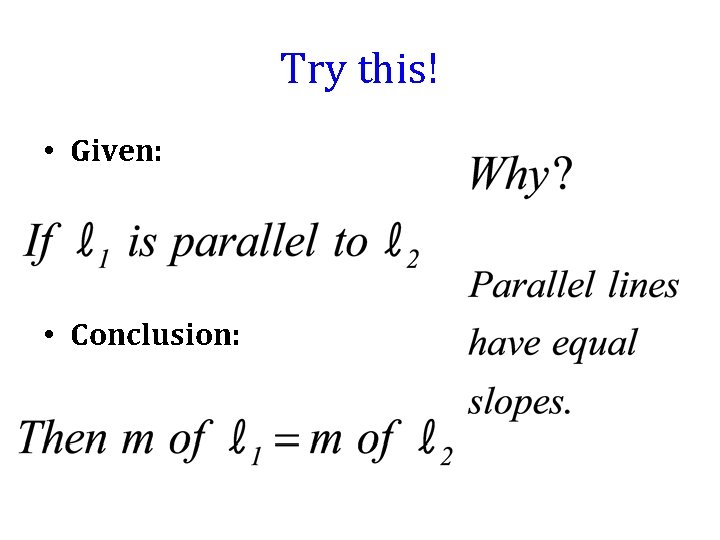
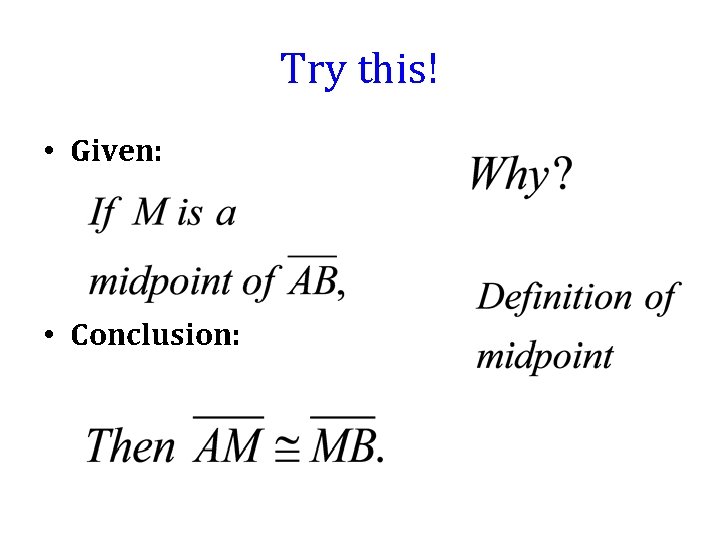
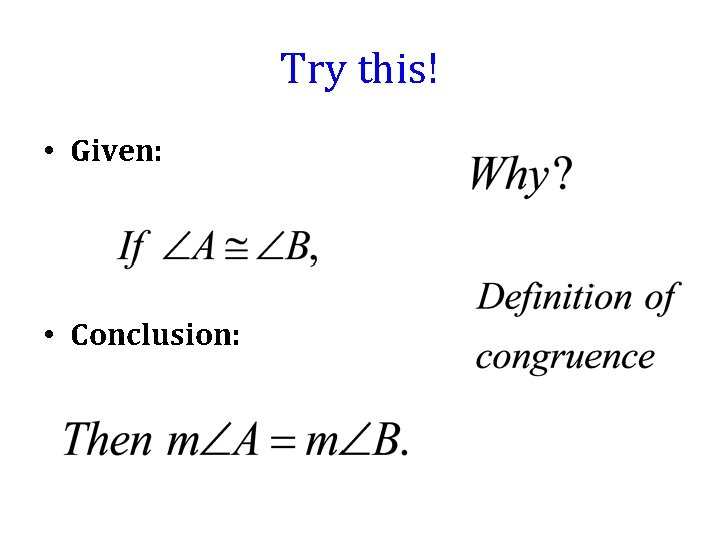
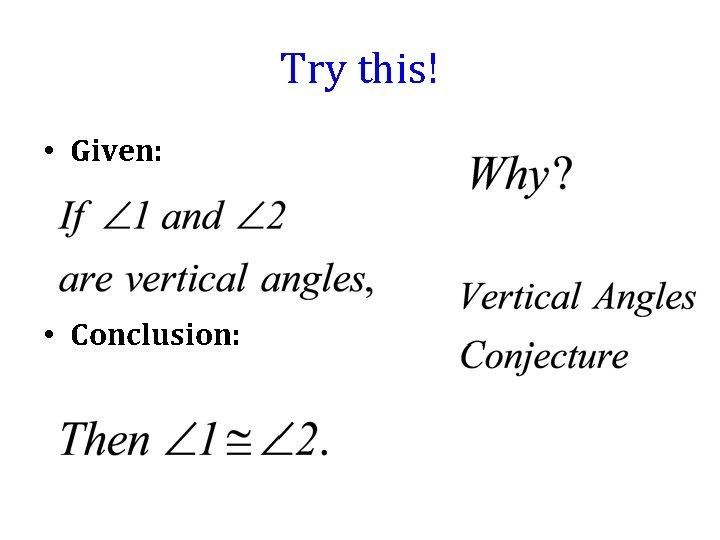
Logical Reasoning • Making logical statements or conclusions based on given conditions • Statements are justified by definitions, postulates, theorems or “conjectures” • Example: If _________ , then __________. Why is this always true?
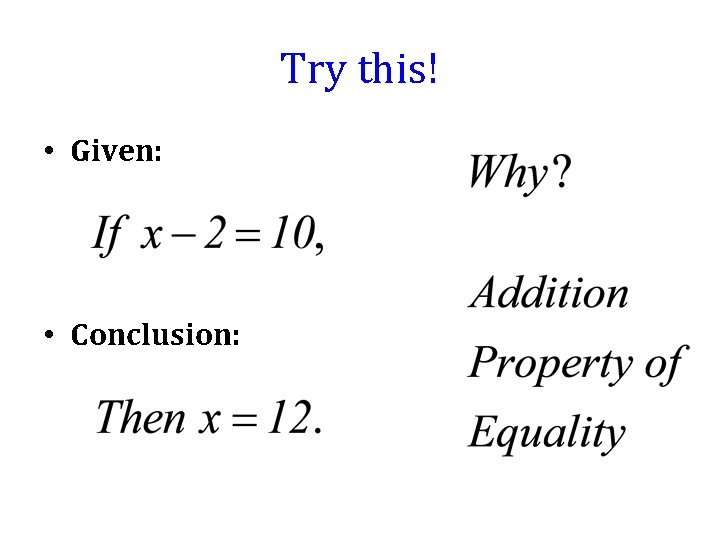
Try this! • Given: • Conclusion:
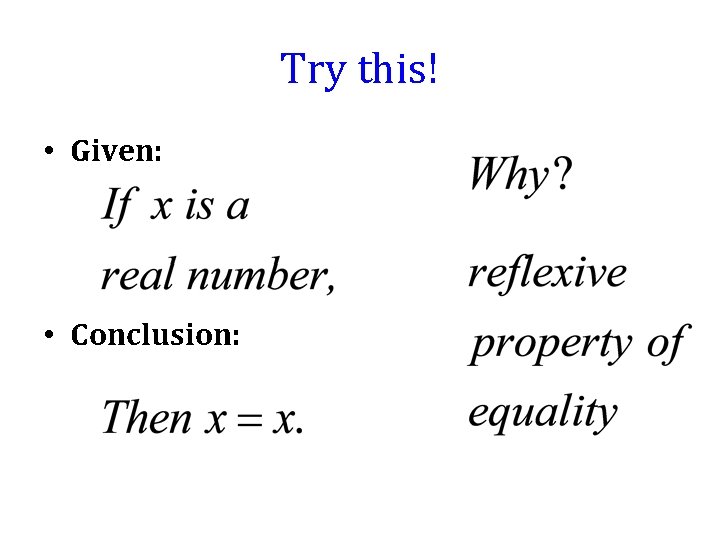
Try this! • Given: • Conclusion:
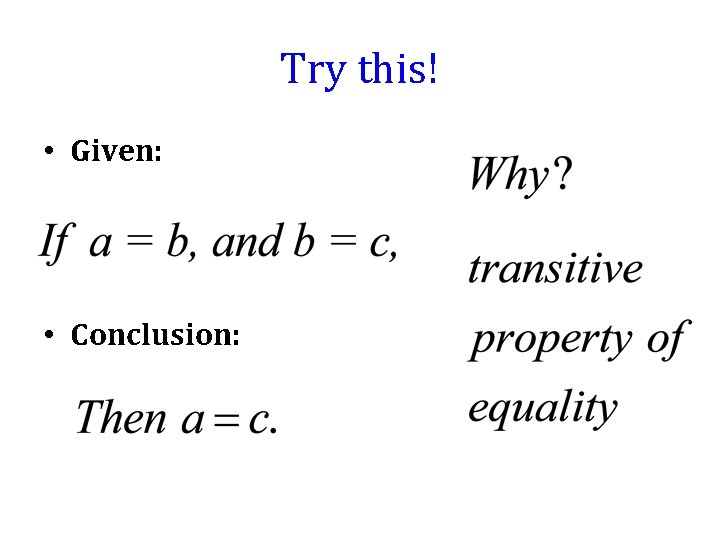
Try this! • Given: • Conclusion:
Try this! • Given: • Conclusion:
Try this! • Given: • Conclusion:
Try this! • Given: • Conclusion:
Try this! • Given: • Conclusion:
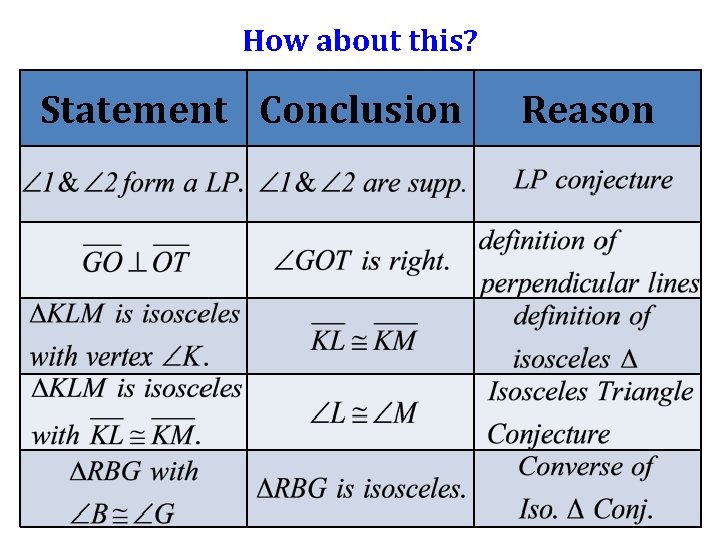
How about this? Statement Conclusion Reason
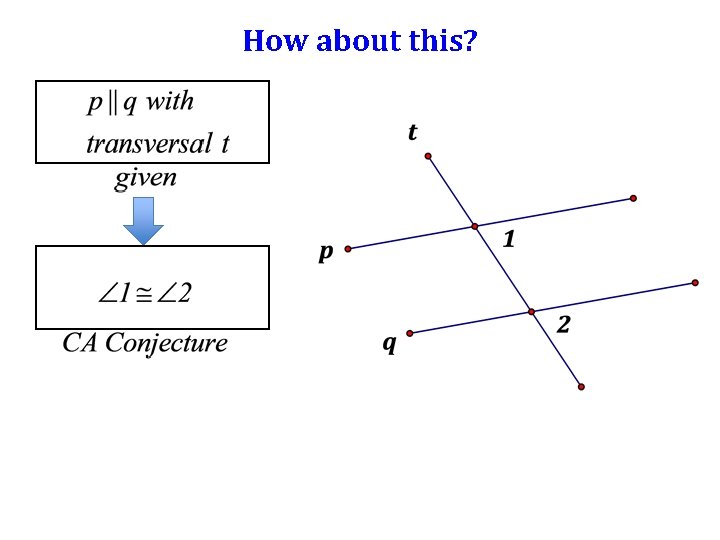
How about this?
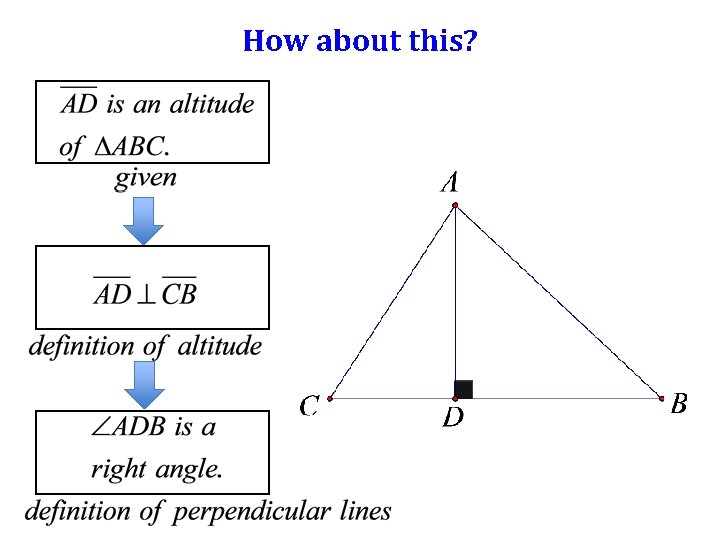
How about this?
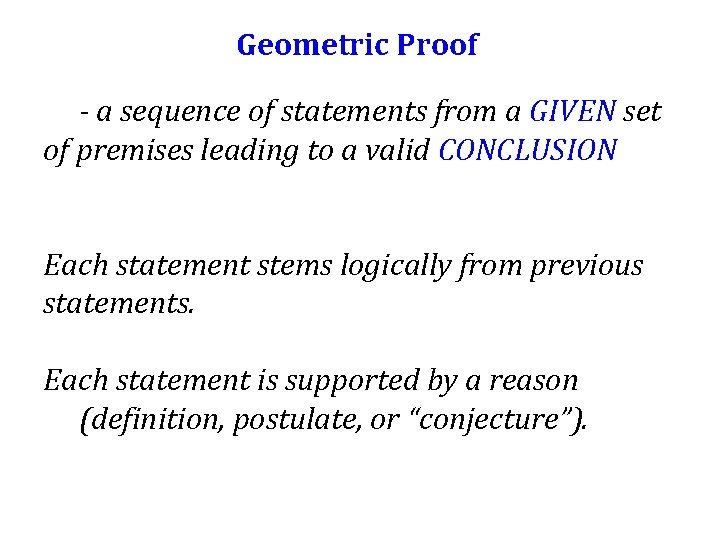
Geometric Proof - a sequence of statements from a GIVEN set of premises leading to a valid CONCLUSION Each statement stems logically from previous statements. Each statement is supported by a reason (definition, postulate, or “conjecture”).
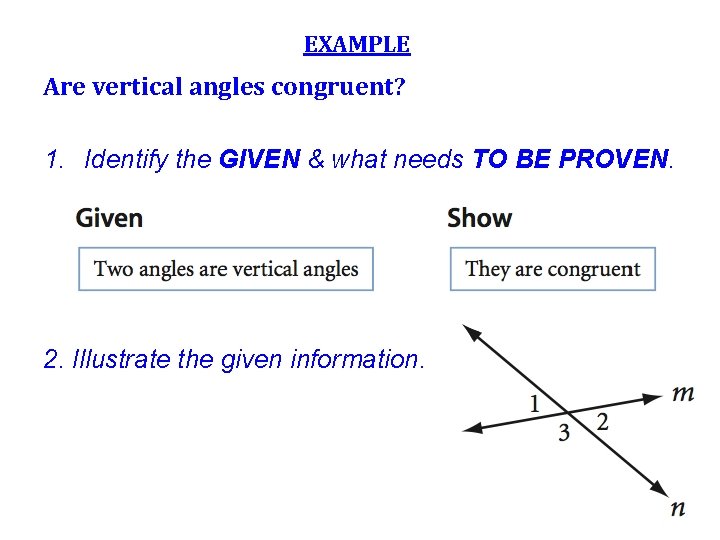
EXAMPLE Are vertical angles congruent? 1. Identify the GIVEN & what needs TO BE PROVEN. 2. Illustrate the given information.
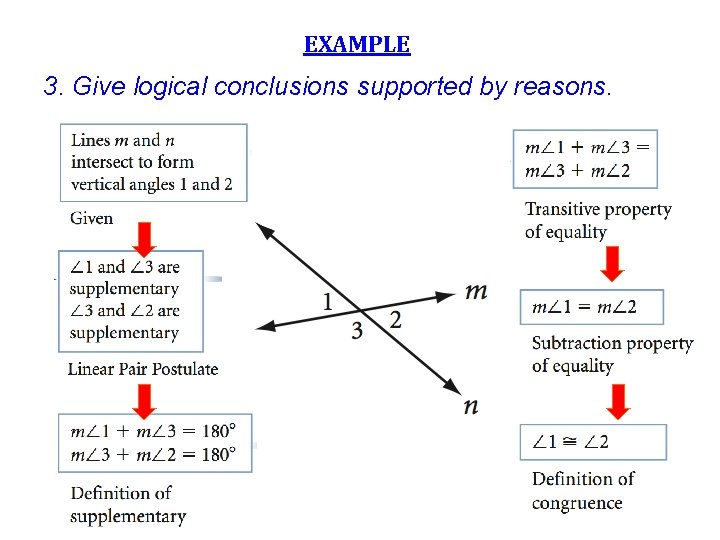
EXAMPLE 3. Give logical conclusions supported by reasons.
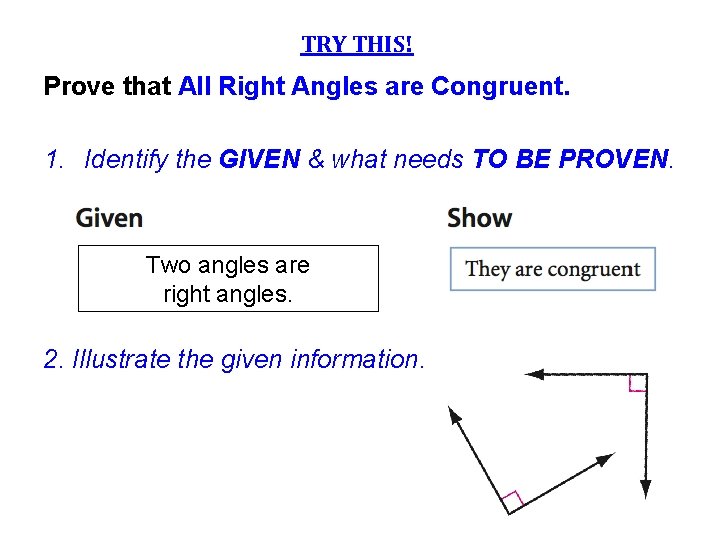
TRY THIS! Prove that All Right Angles are Congruent. 1. Identify the GIVEN & what needs TO BE PROVEN. Two angles are right angles. 2. Illustrate the given information.
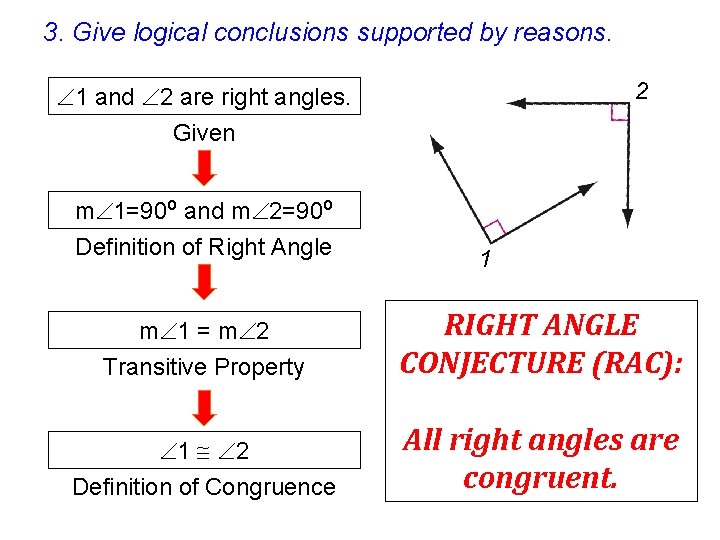
3. Give logical conclusions supported by reasons. 2 1 and 2 are right angles. Given m 1=90 o and m 2=90 o Definition of Right Angle 1 m 1 = m 2 Transitive Property RIGHT ANGLE CONJECTURE (RAC): 1 2 Definition of Congruence All right angles are congruent.