
Introduction to Geography People Places and Environment 6
- Slides: 66
Introduction to Geography People, Places, and Environment, 6 e Carl Dahlman William H. Renwick Chapter 8: The Geography of Languages and Religions Holly Barcus, Morehead State University And Joe Naumann, UMSL
Language & Religion • Two most important forces that bond and define human cultures • Two most important factors defining culture regions 2
Defining Language • Pronunciation and combination of words used to communicate within a group of people • Important cultural index • Structures individual perception of world 3
Language Regions • Dialects – Minor variations within a language • Standard language – Following formal rule of diction and grammar • Official language – Primary language for any given country – Defacto or Dejure? • Lingua franca – Current language of international discourse 4
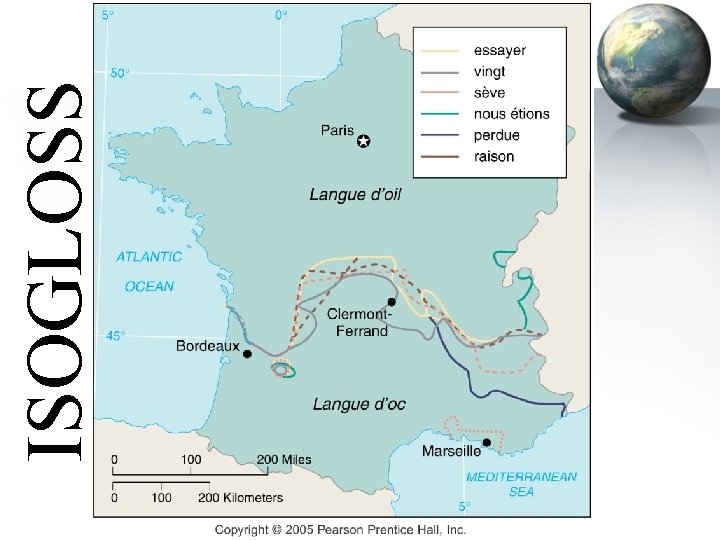
Linguistic Geography • The study of different dialects across space • Speech community – a group of people who speak together • Isoglosses – Frequently parallel physical landscape features • Geographical dialect continuum 5
ISOGLOSS
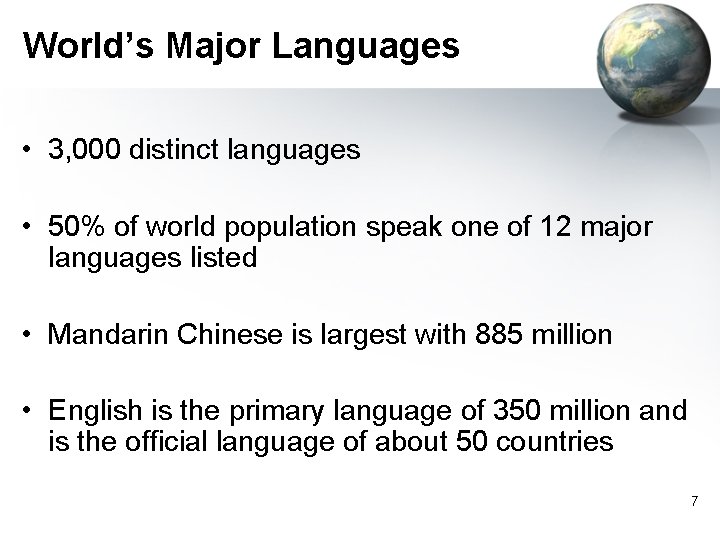
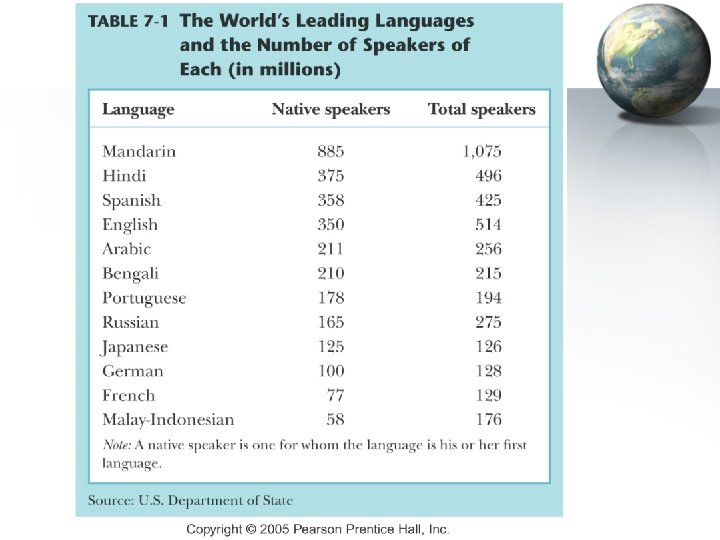
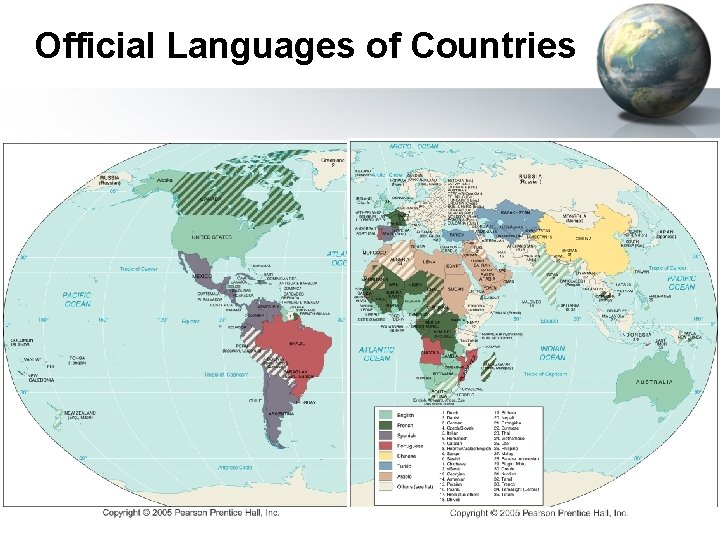
World’s Major Languages • 3, 000 distinct languages • 50% of world population speak one of 12 major languages listed • Mandarin Chinese is largest with 885 million • English is the primary language of 350 million and is the official language of about 50 countries 7
Official Languages of Countries
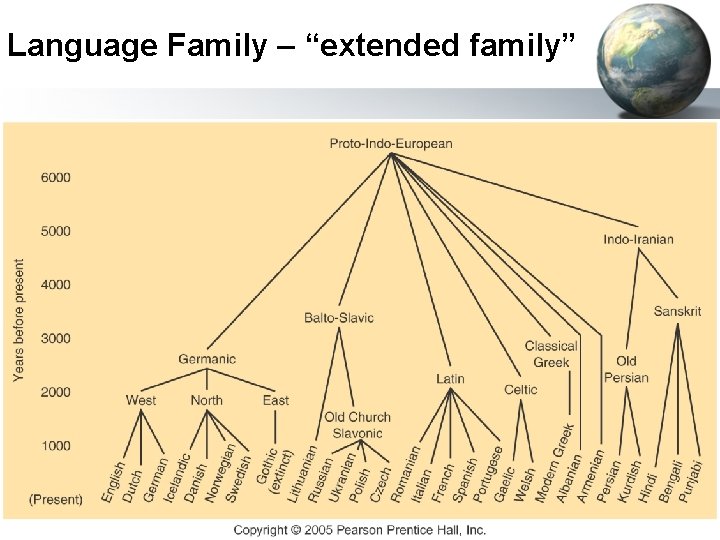
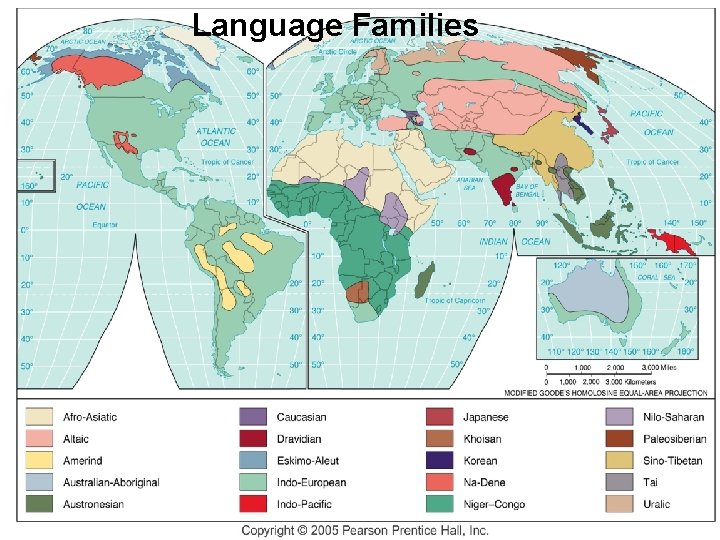
Language Development • Protolanguage – Common ancestor to any group of today’s languages • Language family – Languages related by descent from a common protolanguage – Members of the same language family may not be mutually intelligible • Cognates – words related somewhat like cousins – i. e. reign or royal (English) & Rajah (Hindi) • Etymology – study of word origins 10
Indo-European Language Family • Identified by Sir William Jones, 1786 – Proto-Indo-European • Common ancestor of many modern languages • Grimm’s Law – Set forth by Jacob Grimm of the Brothers Grimm – Accounts for sound shifts as language family differentiated. 11
Language Family – “extended family”
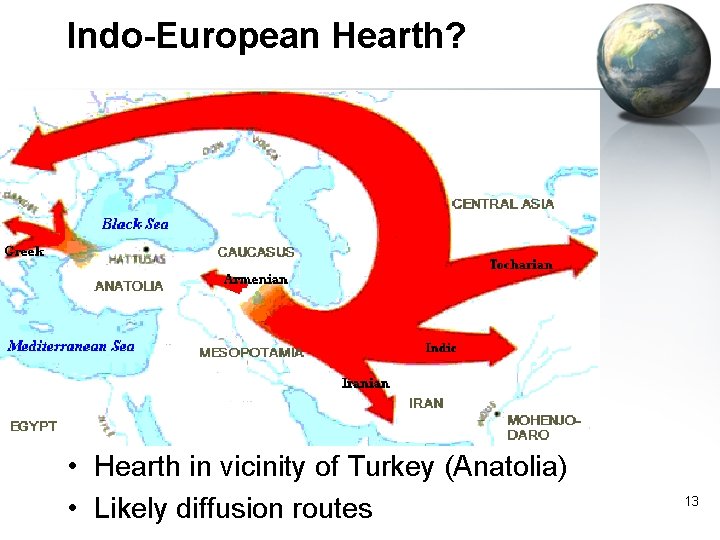
Indo-European Hearth? • Hearth in vicinity of Turkey (Anatolia) • Likely diffusion routes 13
Language Families
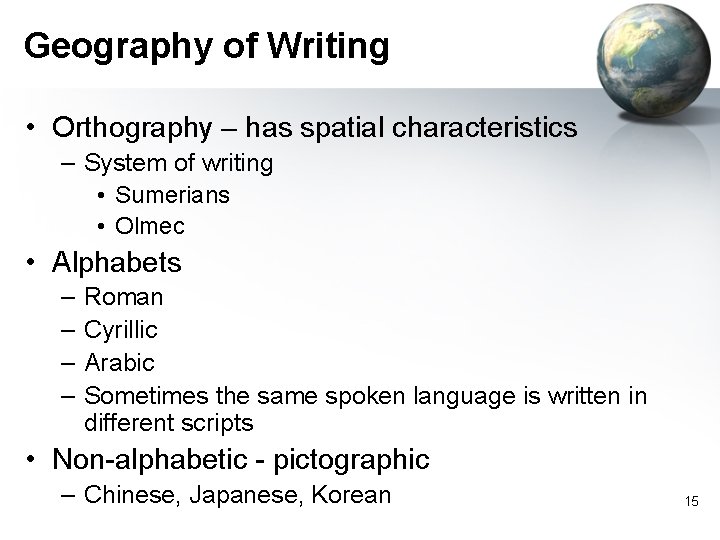
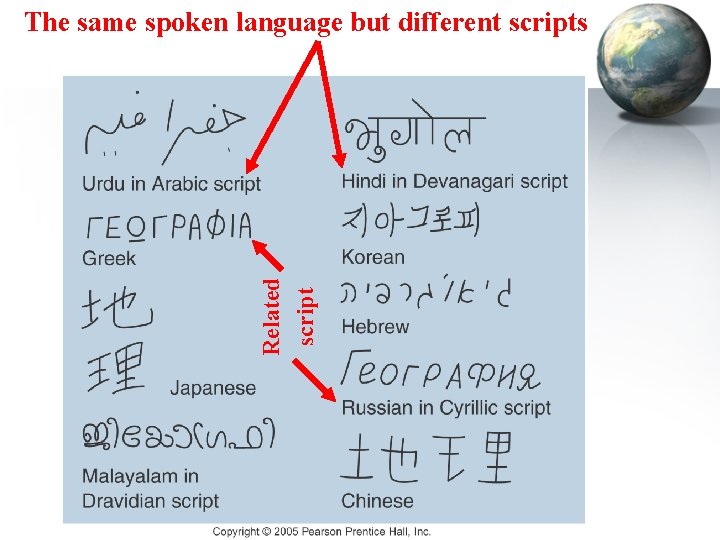
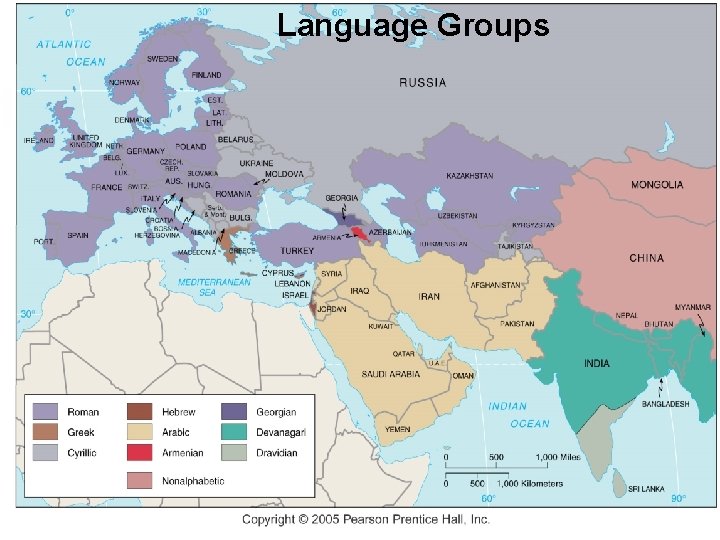
Geography of Writing • Orthography – has spatial characteristics – System of writing • Sumerians • Olmec • Alphabets – – Roman Cyrillic Arabic Sometimes the same spoken language is written in different scripts • Non-alphabetic - pictographic – Chinese, Japanese, Korean 15
Related script The same spoken language but different scripts
Language Groups
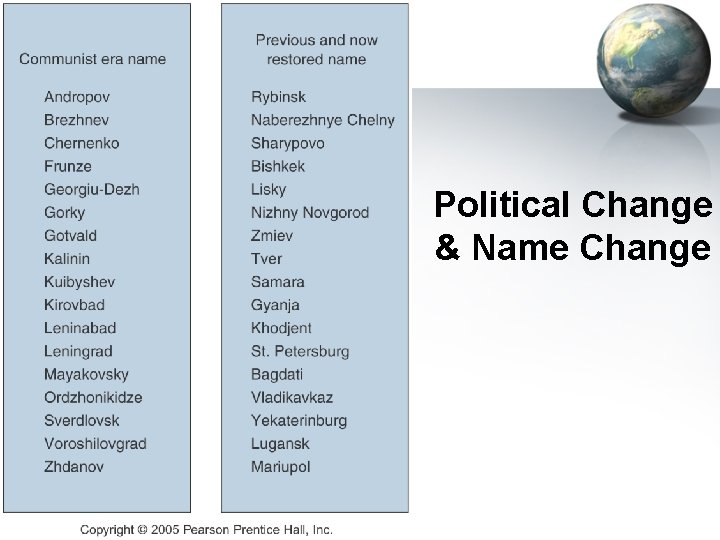
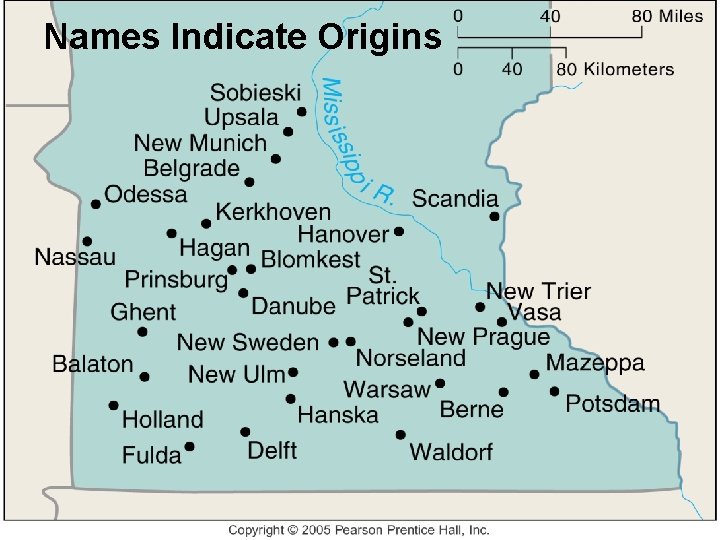
Toponymy • The study of place names • Consists of: – Natural features – Origins/values of inhabitants – Belief structures, religions – Current or past heroes 18
Political Change & Name Change
Names Indicate Origins
Linguistic Differentiation • National languages – Imposed or encouraged by government with varying success – De facto or de jure • Nation building – Philological nationalism • Belief that mother tongues have given birth to nations. • Postcolonial societies – Imposed official languages by colonial ruler • Not spoken by locals 21
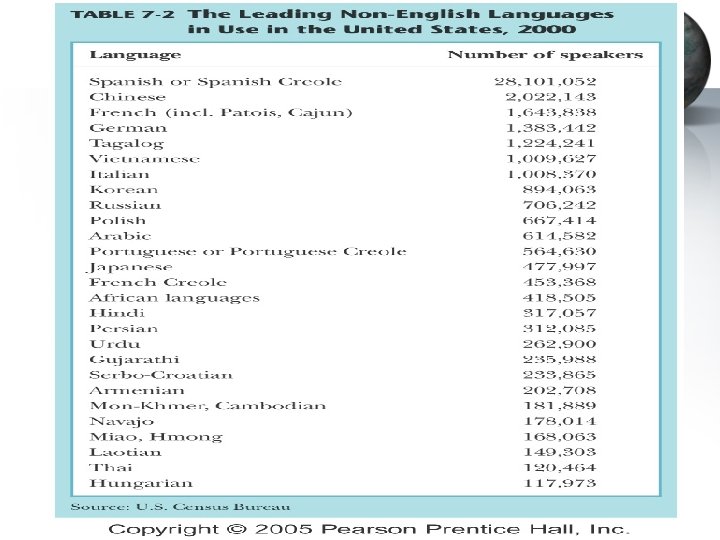
Multiple Language States • Polyglot states – Having multiple official languages – Can promote political devolution • United States – English always lingua franca – Three major dialects in 13 colonies – Non-English languages – English is de facto official language, not de jure 22
World’s Major Religions • Systems of beliefs guiding behavior – Orthopraxy (correctness of action or practice) • Behavior oriented – Orthodoxy (“correctness” of belief or verbal expression) • Theological/philosophical • Fundamentalism -- the strict maintenance of the ancient or essential doctrines of any religion or ideology. • Secularism -- a philosophy or world view that stresses human values without reference to religion or spirituality 24
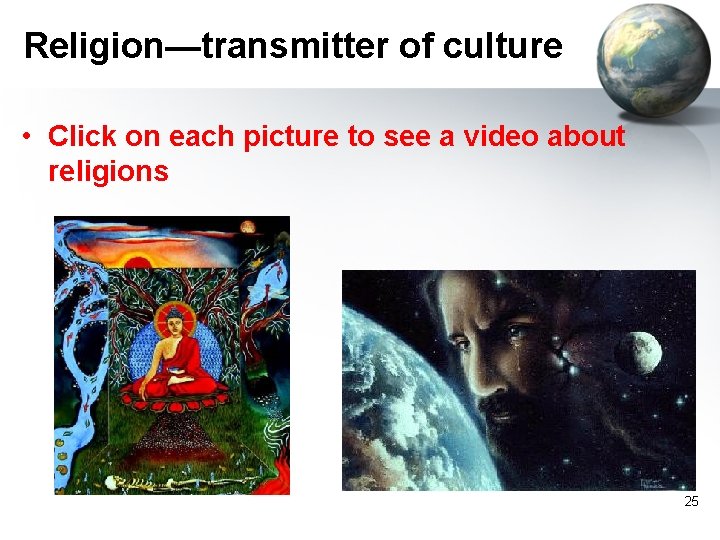
Religion—transmitter of culture • Click on each picture to see a video about religions 25
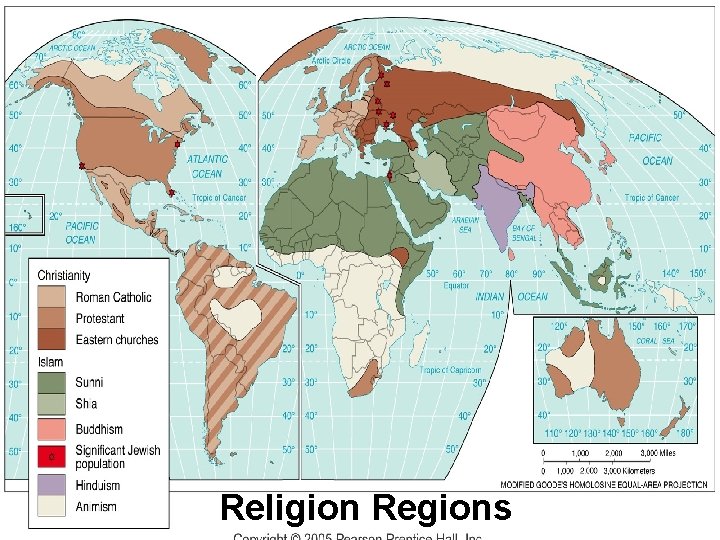
Religion Regions
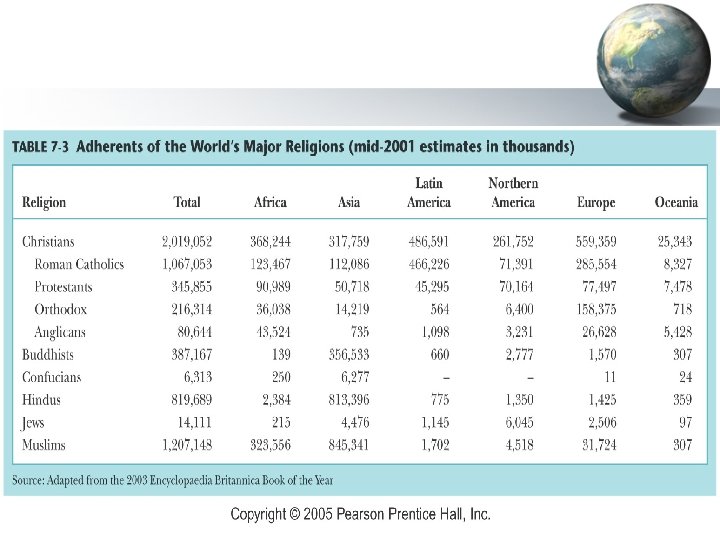
Religions • Classification and Distribution of Religions – Universalizing: Christianity, Islam, Buddhism all proselytize – Christianity is the most widespread – In Africa, Islam is the fastest growing • In Sub. Saharan Africa - Christianity – Ethnic: Judaism, Hinduism, Shintoism • Tribal (traditional) – small-size ethnic 28
Major Religions: Commonalities • • • Religions have a tendency to splinter Have a founder or key figure Have scriptures Have rituals Have structures for prayer or religious rituals • Teach a form of the Golden Rule • Prize Peace 29
• Click the symbol to see the video about the Golden Rule and the desire for peace in religions. 30
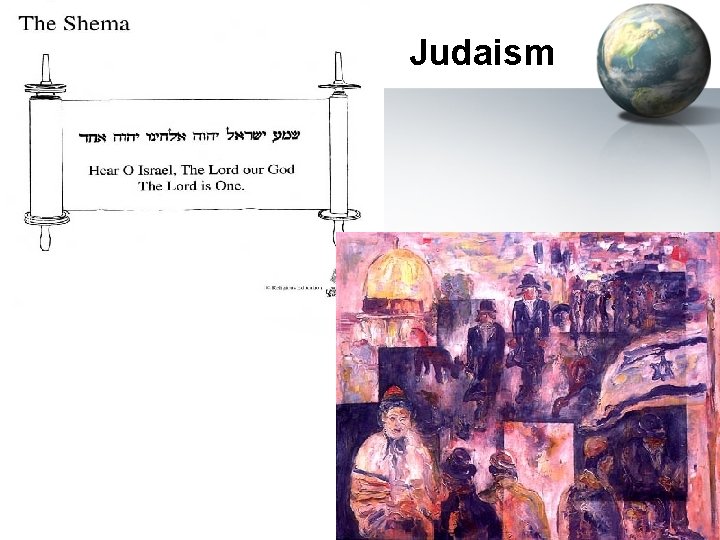
Judaism 31
Judaism • • 14 million adherents Monotheistic (claims to the oldest one) Based on covenant with Abraham Scriptures: Torah – 5 books of the “Law” – Genesis, Exodus, Leviticus, Numbers, Deuteronomy • Sects – Orthodox, Conservative, Reform • Israel – More Jews in New York City than in Isreal – Homeland for Jewish people – Created 1948 – Conflict between Israel and Palestine 32
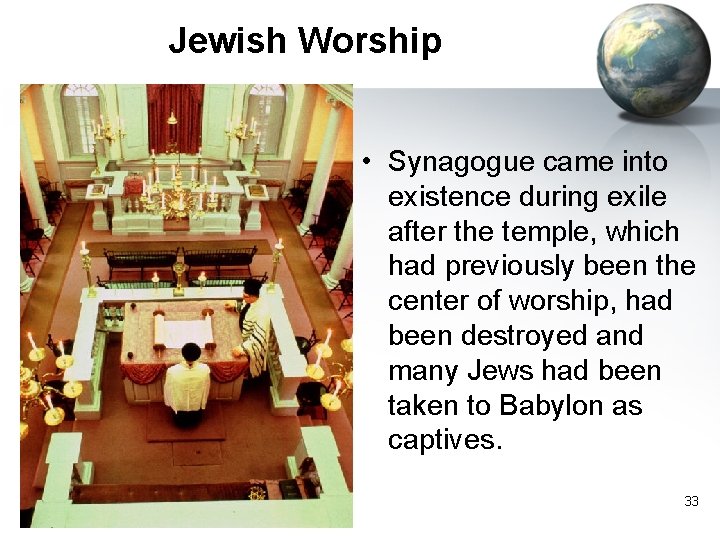
Jewish Worship • Synagogue came into existence during exile after the temple, which had previously been the center of worship, had been destroyed and many Jews had been taken to Babylon as captives. 33
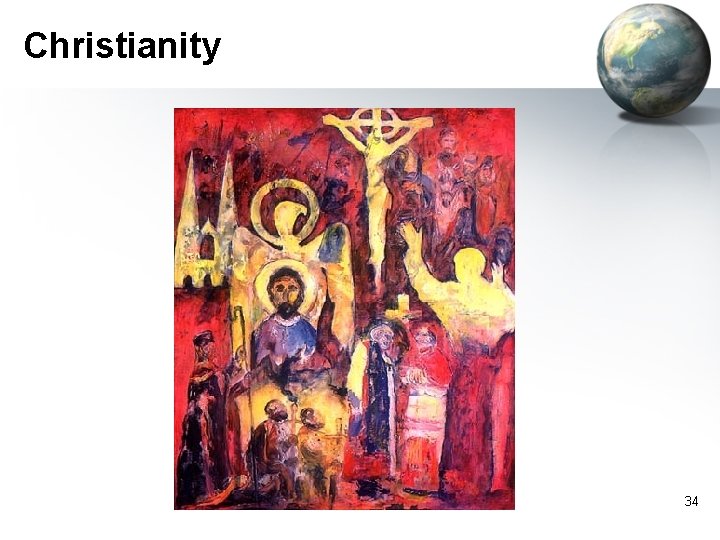
Christianity 34
Christianity • Emerged from Judaism – Jesus was a Jew! • Coptic Church – Founded in Alexandria in CE 41 – Still present in Egypt and Ethiopia • Official religion of Roman Empire – 312 CE – Facilitated geographical spread – Model for its bureaucratic structure • • Split with Eastern Orthodox 11 th century CE Dark Ages – preserver of European culture Protestant Reformation 1517 CE Significant growth in Africa, Asia and Latin America 35
Christian Fundamentals • Areas of almost complete agreement – Sacraments of Baptism & Matrimony – Monotheism involving one God in a trinity of persons (referred to as a mystery) – Blessing and sharing bread and wine at least in memory of Jesus sacrifice – Jesus was/is 100% God and 100% human – Salvation comes from belief in and acceptance of Jesus as one’s savior – There will be a second coming at the end of time 36
Christian Denominations • Coptic • Eastern Orthodox – Greek, Serbian, Russian, Armenian, etc. • Roman Catholic – Latin Rite & Greek Rite – Largest single denomination in the USA • Protestant – hundreds of denominations – Luther, Calvin, Zwingli, etc. • Peripheral – significant differences from the mainstream Christian denominations – Mormon, Jehova Witnesses, etc. 37
Islam 38
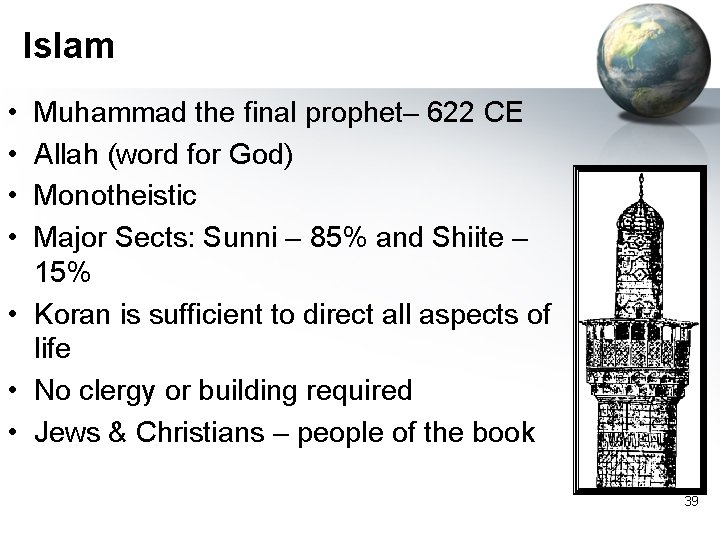
Islam • • Muhammad the final prophet– 622 CE Allah (word for God) Monotheistic Major Sects: Sunni – 85% and Shiite – 15% • Koran is sufficient to direct all aspects of life • No clergy or building required • Jews & Christians – people of the book 39
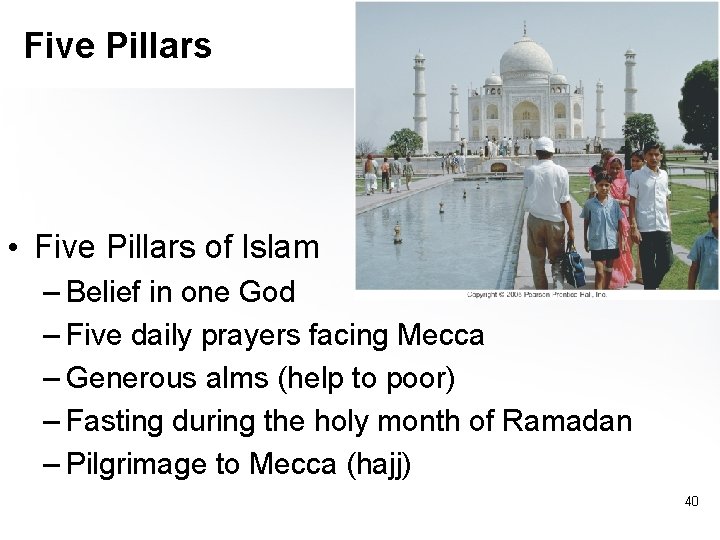
Five Pillars • Five Pillars of Islam – Belief in one God – Five daily prayers facing Mecca – Generous alms (help to poor) – Fasting during the holy month of Ramadan – Pilgrimage to Mecca (hajj) 40
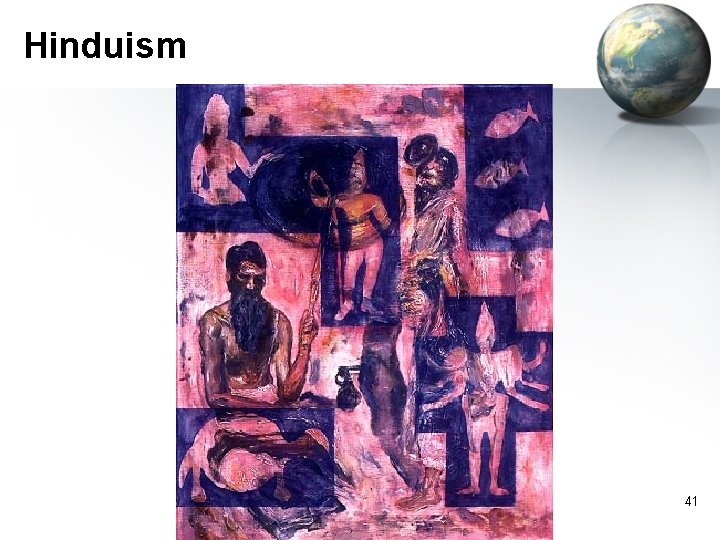
Hinduism 41
• Hinduism – – Most ancient religious tradition in Asia (world? ) Vedas – Hindu sacred texts May be viewed as monothestic Castes • Brahman, priestly • Kshatriya, warrior/ruler • Vaisya, tradesman and farmer • Sudra, servant and laborer – Untouchables (de facto 5 th caste) – Central belief is in reincarnation • Transmigration of the soul • Cycles of creation – birth to death to birth • Role of dharma & karma • Effect on diet 42
Characteristics of Hinduism • No clergy or religious requirements – • No real splintering or sects – Can be practices in many ways & at many levels so there was no need to “split off. ” • No concept of a personal God • Each individual is seeking to comprehend the ultimate reality while living out his/her dharma with the goal of union with Brahman once the cycle of reincarnation is ended. 43
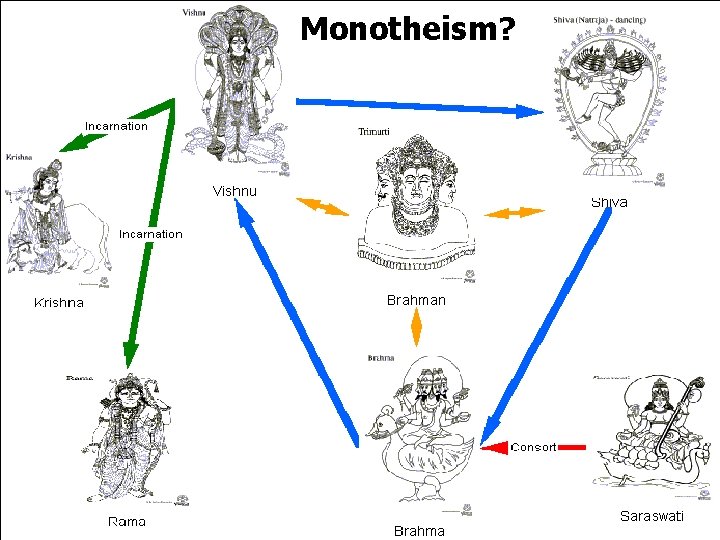
Monotheism? 44
Sikhism 45
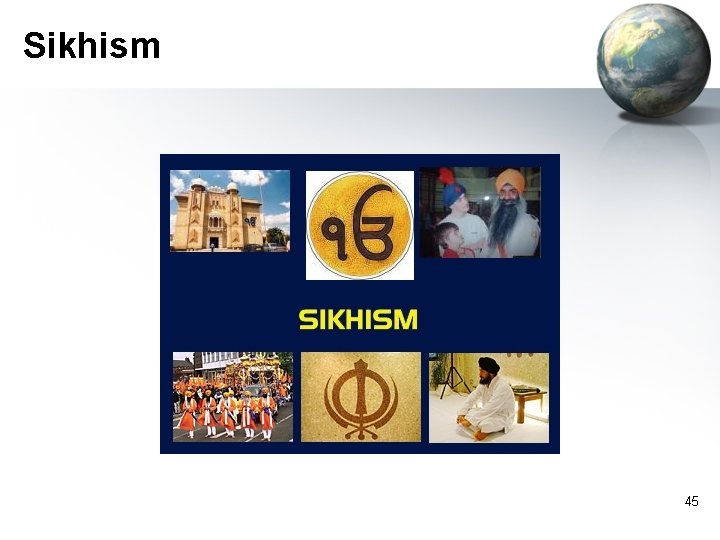
Sikhism • Sikhism (attempt to reconcile Islam & Hinduism) – Offshoot of Hinduism – Centered around the Punjab area – Guru Nanak 46
Buddhism 47
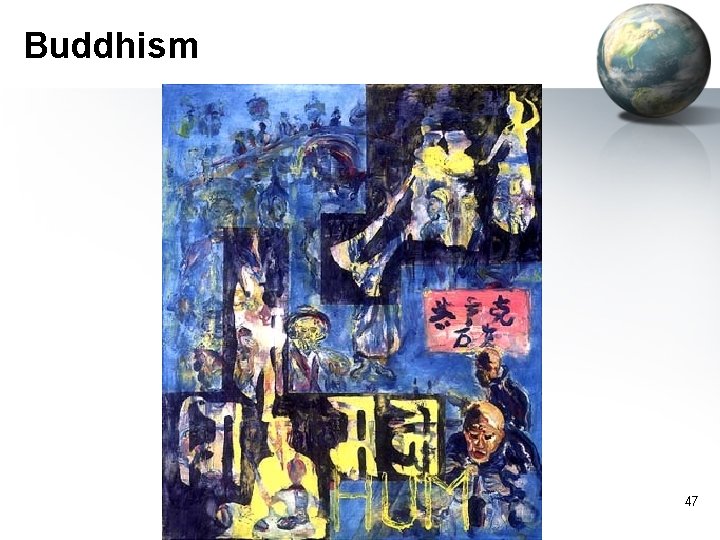
Buddhism • Siddhartha Gautama – Kshatriya Caste • Buddha – Enlightened One • Four Noble Truths – Life involves suffering – Cause of suffering is desire – Elimination of desire ends suffering – Right thinking and behavior eliminate desire • Diffused from India 48
Buddhism • Nirvana – Buddhism is a way of living that achieves release from reincarnation and suffering • God is not knowable, so is, therefore, not a major concern in Buddhism • Buddha (Siddhartha Gautama) rejected the caste system 49
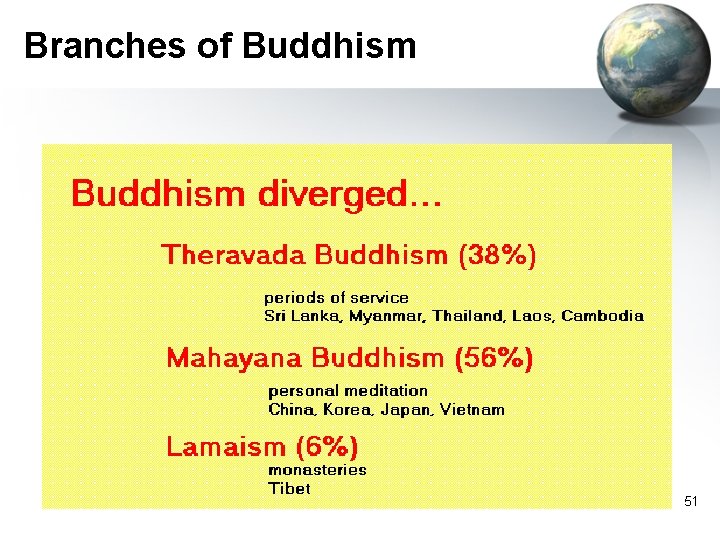
Buddhism • Scriptures: Vinaya (discipline) – expanded later • Branches: – Theravada (south) – monk seeks own deliverance – Mahayana (north) – role of bodhisattvas & ritual – Tibetan Lamaism – example of syncretism 50
Branches of Buddhism 51
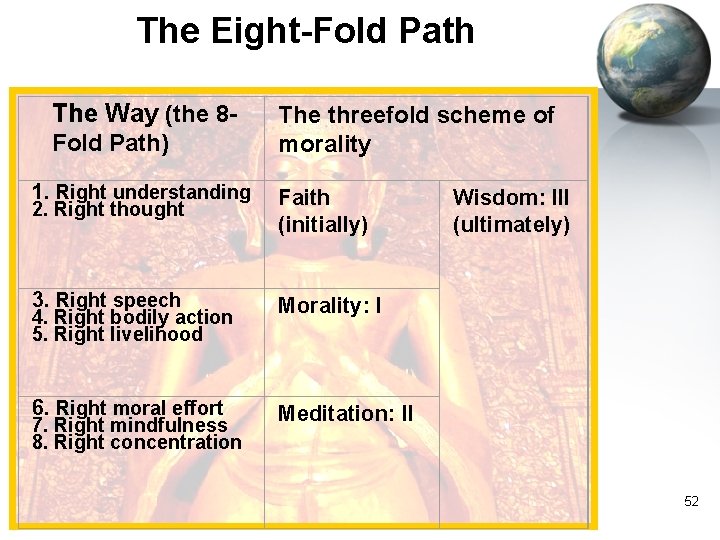
The Eight-Fold Path The Way (the 8 Fold Path) The threefold scheme of morality 1. Right understanding 2. Right thought Faith (initially) 3. Right speech Morality: I 6. Right moral effort Meditation: II 4. Right bodily action 5. Right livelihood 7. Right mindfulness 8. Right concentration Wisdom: III (ultimately) 52
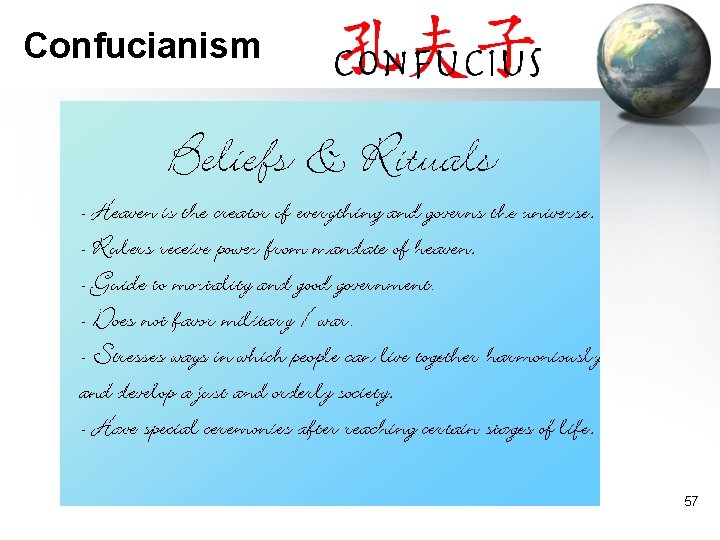
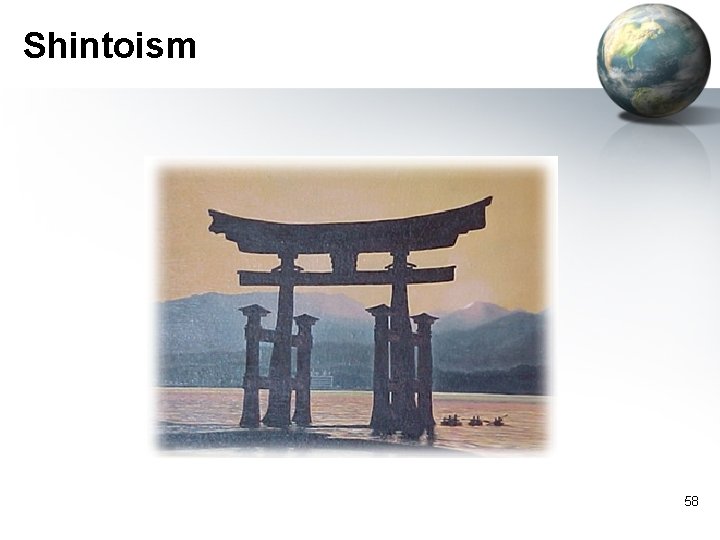
Other Religions • Eastern Religions – Confucianism – China – Taoism – China – Shinto – Japan – Zoroastrianism – Iran – Baha'i – Iran • Animism and Shamanism – Animism • Belief in influence of spirits or spiritual forces in all creation – Shamanism • Shaman 53
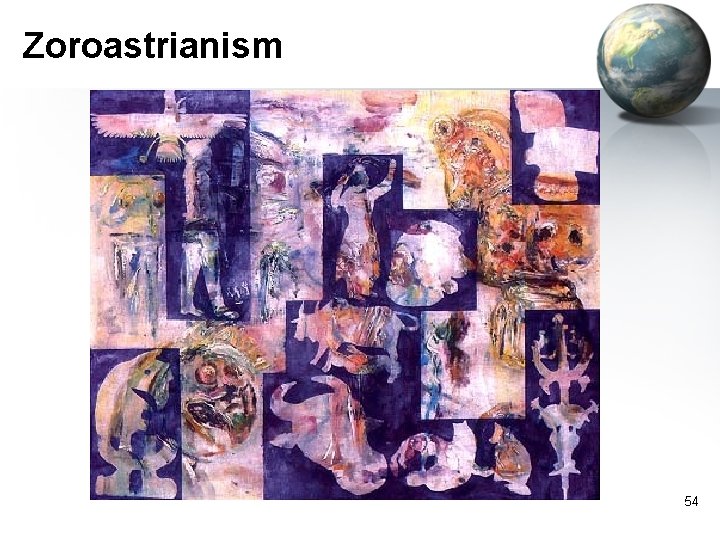
Zoroastrianism 54
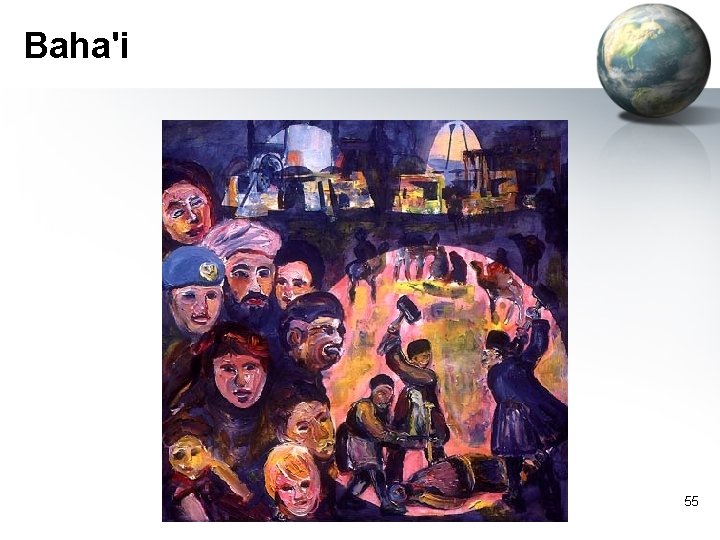
Baha'i 55
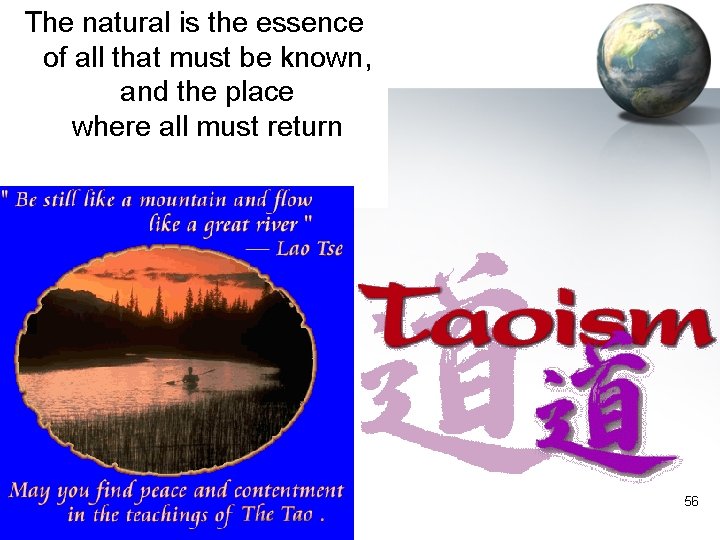
The natural is the essence Taoism of all that must be known, and the place where all must return 56
Confucianism 57
Shintoism 58
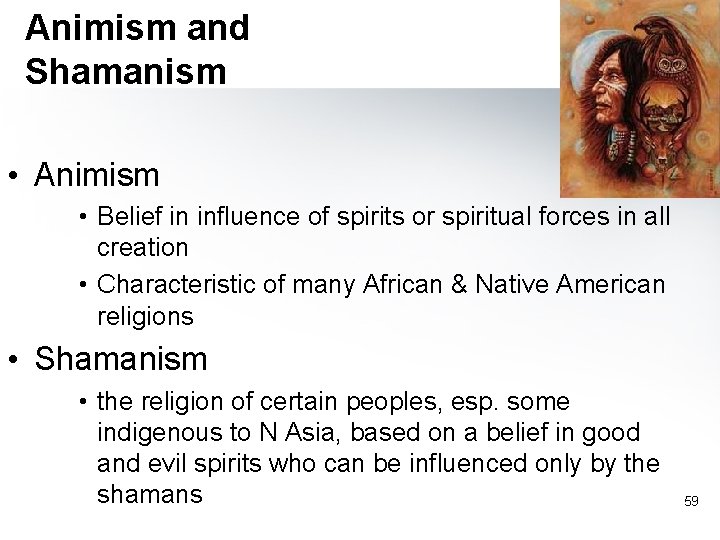
Animism and Shamanism • Animism • Belief in influence of spirits or spiritual forces in all creation • Characteristic of many African & Native American religions • Shamanism • the religion of certain peoples, esp. some indigenous to N Asia, based on a belief in good and evil spirits who can be influenced only by the shamans 59
Religion & Politics • Freedom of religion – Historically the exception rather than the “rule. ” • Theocracy – Church rules directly – government based on “scriptures. ” • Separation of church and state – Islamic fundamentalists oppose it – favor theocracy – Instituted by United States Constitution to preserve religious freedom. • Terrorism – unacceptable resort of those who feel marginalized – usually more about power than it is 60 about religion (emotional excuse for violence)
Social Impact of Religion • Gender roles – Women’s rights, duties, obligations, opportunities, etc. – Patriarchal or matriarchal societies • Diet and food preparation restrictions – Kosher – ruled relate to how acceptable food is prepared – Pork – forbidden to Jews & Muslims – Beef – unacceptable to Hindus – many are vegetarians – Alcohol – forbidden to Muslims • Ethics and morals – Guidelines for the “good” life • Schools and social and medical institutions 61
Economic Impact • Burial practices – costs – Time constraints – Disposal methods & preparations • Protestantism and capitalis – “Protestant work ethic. ” – version of Calvinism • Catholic Church and capitalism – Usury was considered sinful in the early church – Individualism with a social conscience • Confucianism verses individualism 62
Religion and Environment • Burial practices – Health considerations in India • Origin of the world – All have some creation story which usually indicates the place of humans in that creation • Relationship with nature – Exploitive approach – Christianity in practice rather in teaching – Adaptive approach – Animism and most “Eastern” religions 63
Other Differences • Nature of God – Diest – Personal • Relation to others – Naturally ecumenical – Universalizing – emphasis on proselytizing – Ethnic – no emphasis on proselytizing 64
Multi-religious State • Where two religions compete to write the laws, a means of working together is needed to avoid possible conflict – N. Ireland & Canada – Lebanon – Philippines – Nigeria, Sudan, – Division of India in 1948 – Sri Lanka 65
End of Chapter 7 66