
Introduction to Geography Arthur Getis Judith Getis Jerome

- Slides: 37
Introduction to Geography Arthur Getis, Judith Getis, & Jerome D. Fellmann
Part Two: The Culture. Environment Tradition Chapter 6 – Population Geography Chapter 7 – Cultural Geography Chapter 8 – Spatial Interaction Chapter 9 – Political Geography
Part II l Concentrates upon the “people” portion of geography’s environment-culture-people relationship l Its theme is people and the collective and personal cultural landscapes they create or envision
Population Geography Chapter 6
Overview l l l l l Introduction Population Growth Some Population Definitions The Demographic Transition The Demographic Equation World Population Distribution Population Density Population Data and Projections Population Controls Population Prospects
Introduction l Demography l l The statistical study of human population Population geography l l Focuses on the number, composition, and distribution of humans in relation to variations in the conditions of earth space Spatial analysis
Population Growth l Occurs when number of births in a given period exceeds number of deaths l World population l l l 1999 – 6 billion 2011 – will pass 7 billion Annual increase of 74 -75 million l Annual increases have been declining
Population Growth l UN projections (2006) l l l Many demographers l l l 9. 2 billion in 2050 9. 4 -9. 5 billion by 2100 Predict population peak between 8 and 9 billion, followed by population decline Future growth will occur in developing countries Spaceship Earth
Some Population Definitions l Population measures are made more meaningful by rates and cohort measures l l Rates l Frequency of occurrence during a specified time period Cohort l Population group unified by a common characteristic, such as age
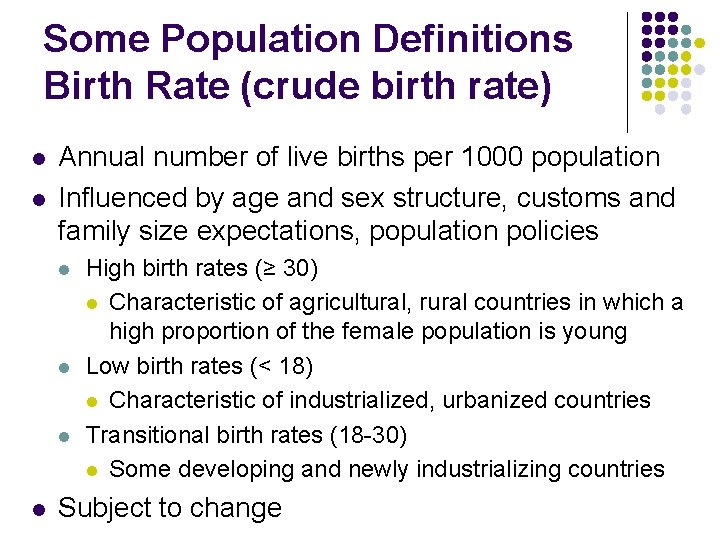
Some Population Definitions Birth Rate (crude birth rate) l l Annual number of live births per 1000 population Influenced by age and sex structure, customs and family size expectations, population policies l l High birth rates (≥ 30) l Characteristic of agricultural, rural countries in which a high proportion of the female population is young Low birth rates (< 18) l Characteristic of industrialized, urbanized countries Transitional birth rates (18 -30) l Some developing and newly industrializing countries Subject to change
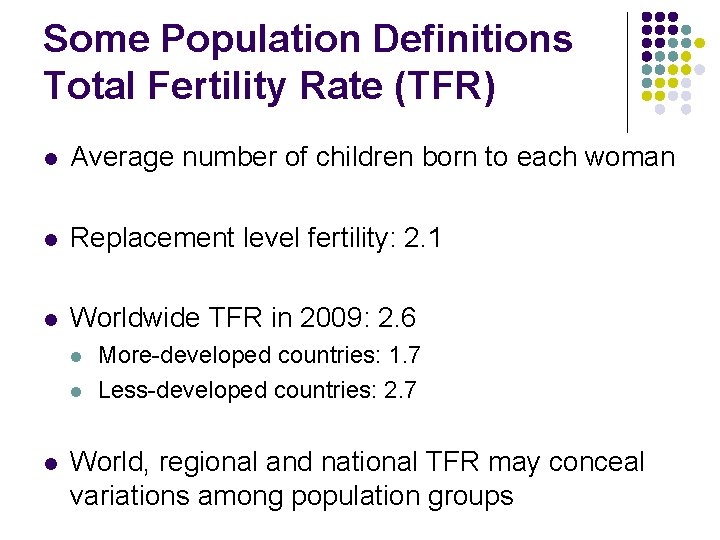
Some Population Definitions Total Fertility Rate (TFR) l Average number of children born to each woman l Replacement level fertility: 2. 1 l Worldwide TFR in 2009: 2. 6 l l l More-developed countries: 1. 7 Less-developed countries: 2. 7 World, regional and national TFR may conceal variations among population groups
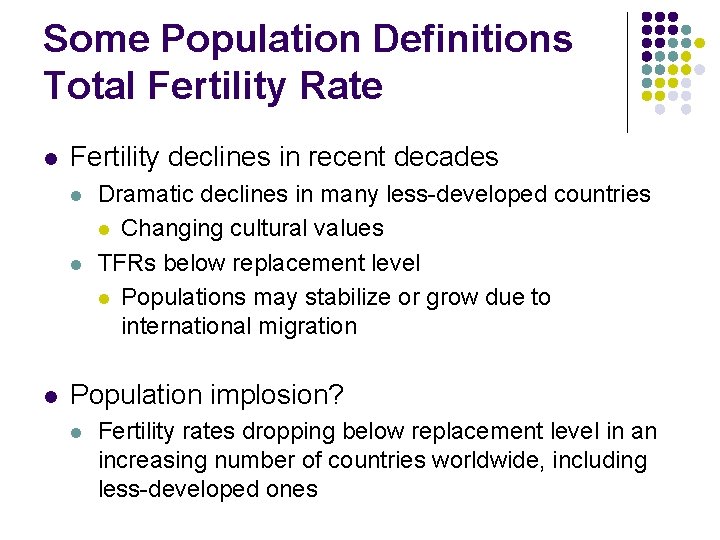
Some Population Definitions Total Fertility Rate l Fertility declines in recent decades l l l Dramatic declines in many less-developed countries l Changing cultural values TFRs below replacement level l Populations may stabilize or grow due to international migration Population implosion? l Fertility rates dropping below replacement level in an increasing number of countries worldwide, including less-developed ones
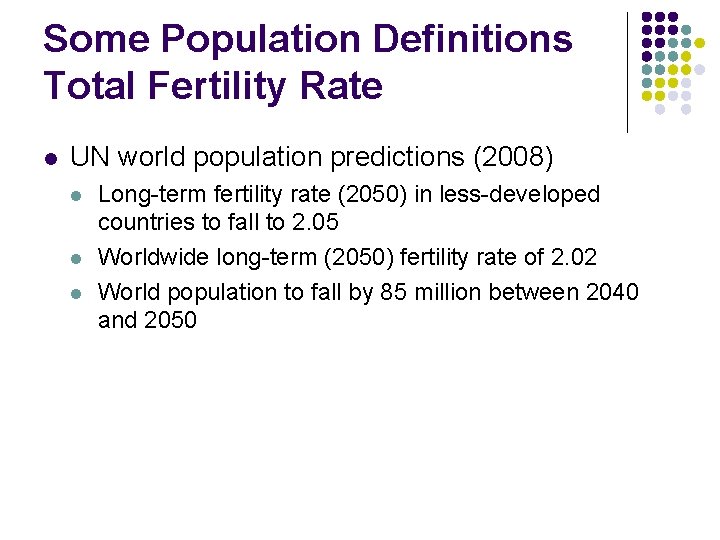
Some Population Definitions Total Fertility Rate l UN world population predictions (2008) l l l Long-term fertility rate (2050) in less-developed countries to fall to 2. 05 Worldwide long-term (2050) fertility rate of 2. 02 World population to fall by 85 million between 2040 and 2050
Some Population Definitions Crude Death Rate l Annual number of deaths per 1000 population l In the past, varied with levels of development l l Dramatic reductions in in less-developed countries l As a group, death rates now lower than in moredeveloped countries l Reduction does not extend to infant or maternal mortality rates Influenced by age structure of a country’s population
Some Population Definitions Crude Death Rate l Zero population growth l l Births plus immigration equal deaths plus emigration Social and economic consequences
Some Population Definitions Mortality Rates l Maternal mortality rate l l Maternal deaths per 100, 000 live births Single greatest health disparity between developed and developing countries Vast majority of maternal deaths in developing world are preventable Infant mortality rate l l Ratio of deaths of infants aged 1 year or under per 1000 live births Significant declines in modern times (better health services)
Some Population Definitions Death Rates l Modern medicine and sanitation have increased life expectancy l l Regional variation in benefits HIV/AIDS l l Forecast to become history’s worst-ever epidemic Sub-Saharan Africa has been hit hardest l Average life expectancy has been cut l Food insecurity is rising l Total population by 2015 is projected to be 60 million less than it would have been without the disease l Total population still expected to grow (high fertility rates)
Some Population Definitions Population Pyramids l Means of comparing populations l Graphic depiction of the age and sex composition of a population l Types of population profiles l l Rapid growth Slow growth Decline Disrupted growth
Some Population Definitions Population Pyramids l Enable demographers to forecast future population levels l l Reliability of projections decreases with increasing length of forecast Population profile influences demands on a country’s social and economic systems l Dependency ratio l Number of economic dependents that each 100 persons in the productive years (aged 15 -64) must support
Population Definitions: Natural Increase and Doubling Time l Rate of natural increase l l l Birth rate minus death rate, expressed as a percentage Excludes migration Doubling time l l l Time it takes for a population to double if current growth rate remains constant l Rule of 72 (divide 72 by growth rate) l World doubling time at 2009 growth rate = 60 years J-curve l Depicts exponential (geometric) growth Can be affected by immigration
The Demographic Transition l Model of the effect of economic development on population growth l l l Stage 1: High birth and death rates Stage 2: High birth rates and declining death rates Stage 3: Declining birth rates and low death rates Stage 4: Low birth and death rates Stage 5: Death rates exceed birth rates Devised to describe the population history of Western Europe, may not reflect prospects of contemporary developing countries
The Demographic Transition A Divided World Converging l The population history of Europe was not relevant to developing countries of middle & late 20 th Century l l Many remained in the second stage Introduction of Western technologies of medicine and public health to developing countries quickly lowered death rates, corresponding reductions in birth rates did not immediately follow and world populations soared
The Demographic Transition A Divided World Converging l Many observers point to a continuing and growing demographic divide l l l One side: high population growth countries Other side: wealthy states with low birth rates Established patterns of both high- and lowfertility regions tend to be self-reinforcing
The Demographic Equation l Regional population change is a function of natural change and net migration l Population relocation l l Can relieve pressures of rapid population growth Immigration impacts both: l l Demographic equation and Population structures of origin and destination countries l Emigrant groups are skewed in favor of young singles
World Population Distribution l Uneven population distribution l l Almost 90% live north of the equator l 2/3 of total between 20° and 60° N A large majority occupies a small part of the land People congregate in lowland areas Continental margins have the densest settlement; yet latitude, aridity and elevation limit attractiveness of many seafront locations
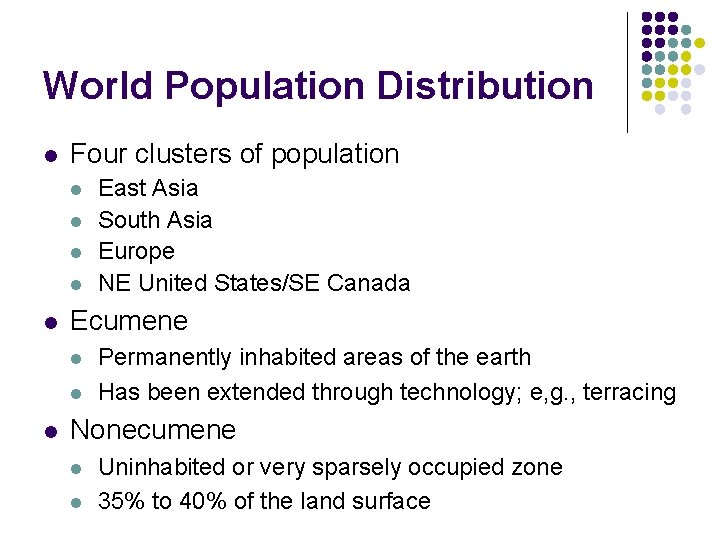
World Population Distribution l Four clusters of population l l l Ecumene l l l East Asia South Asia Europe NE United States/SE Canada Permanently inhabited areas of the earth Has been extended through technology; e, g. , terracing Nonecumene l l Uninhabited or very sparsely occupied zone 35% to 40% of the land surface
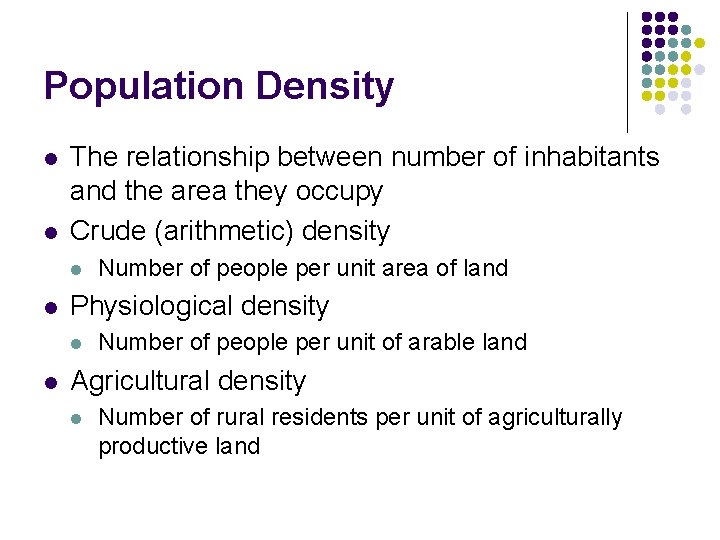
Population Density l l The relationship between number of inhabitants and the area they occupy Crude (arithmetic) density l l Physiological density l l Number of people per unit area of land Number of people per unit of arable land Agricultural density l Number of rural residents per unit of agriculturally productive land
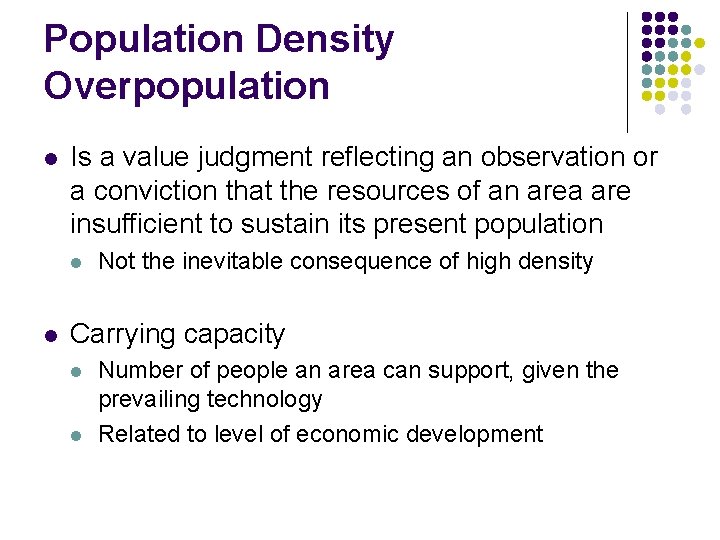
Population Density Overpopulation l Is a value judgment reflecting an observation or a conviction that the resources of an area are insufficient to sustain its present population l l Not the inevitable consequence of high density Carrying capacity l l Number of people an area can support, given the prevailing technology Related to level of economic development
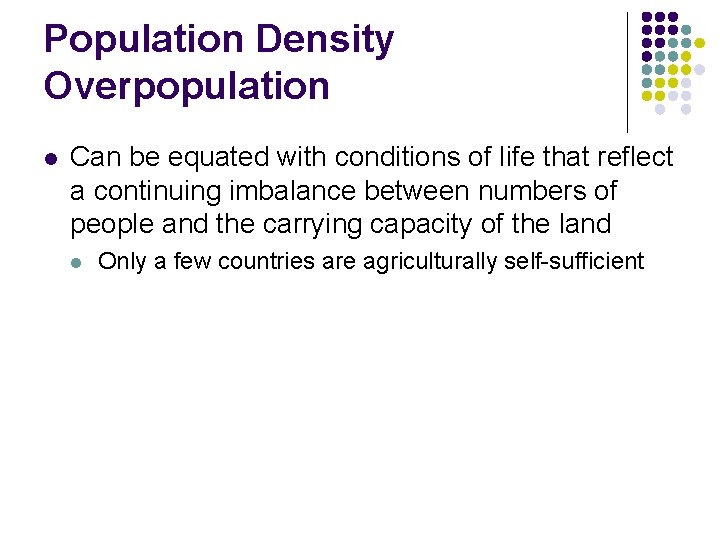
Population Density Overpopulation l Can be equated with conditions of life that reflect a continuing imbalance between numbers of people and the carrying capacity of the land l Only a few countries are agriculturally self-sufficient
Population Density Urbanization l l Transformation from rural to urban status Rapid growth of cities in developing countries l l l UN projections – Nearly all world population increase between 2000 and 2030 will be in urban areas of developing countries Reduction of arable land Problems in densely populated cities in developing countries l Lack of housing, jobs, education, health and social services
Population Data and Projections l Population data l l l Sources: United Nations, World Bank, Population Reference Bureau, national censuses and sample surveys May be inaccurate Population projections l l Estimates of future population size, age and sex composition Based on current data which may be suspect Not predictions High, medium, and low projections may be given
Population Controls l Thomas Robert Malthus (1766 -1834) l l Unchecked population increases geometrically (2, 4, 8, 16, ) food production increases arithmetically (2, 3, 4, 5) Equilibrium must be achieved between numbers and resources l l Overpopulation will result in a dieback l J-curve converted to S-curve l Top of S-curve represents a population size consistent with and supportable by exploitable resource base Homeostatic plateau l Population that is equivalent to carrying capacity
Population Controls l Neo-Malthusianism l l Advocacy of population control programs to improve prosperity and well-being l Many countries have adopted family planning programs Cornucopians l l l Human minds and skills are world’s ultimate resource base Believe population growth is a stimulus to development Malthus failed to recognize importance of technology in raising carrying capacity of the earth
Population Controls l Third view l l Scientific and technical ingenuity to enhance food production does not automatically appear If further advances are made, not all countries or regions have social and political will or capacity to take advantage of them
Population Prospects l Global fertility and birth rates appear to be falling to an extent not anticipated by pessimistic Malthusians and at a pace that suggests a peaking of world populations sooner – and at lower totals – than previously projected l Population (demographic) momentum l Numbers of births continue to grow as fertility rates per woman decline l High concentration of people in the childbearing years
Population Prospects l Aging l l Rapidly aging populations in industrialized economies as well as in developing world l Result of transition from high to low levels of fertility and mortality l Considered irreversible Pace is much faster in developing countries l Will have less time to adjust to consequences of that aging § Consequences will be experienced at lower levels of personal and national income and economic strength
Population Prospects l Aging l l Potential support ratio = number of persons aged 1564 per one citizen aged 65 or older l Potential support ratio has steadily fallen § 1950 – 12 workers § 2000 – 9 workers § 2050 – Projected to drop to 4 workers Increasing burdens and obligations on working-age populations