
INTRODUCTION TO GENETICS REMEMBERCHARACTERISTICS OF LIVING THINGS made
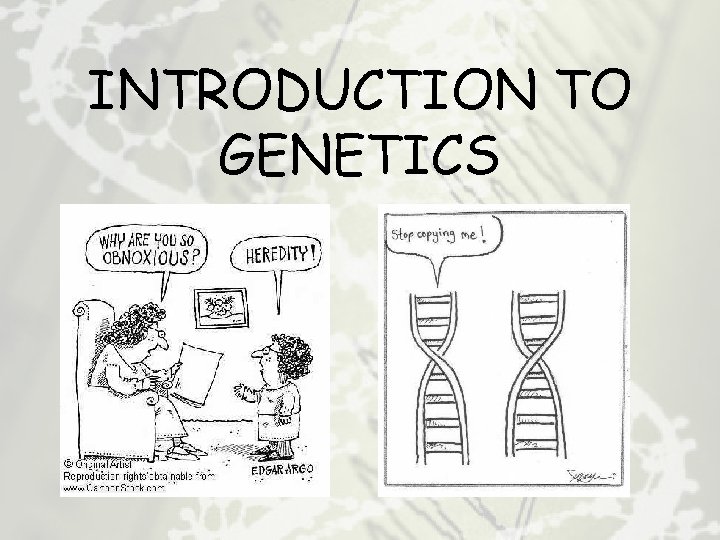
INTRODUCTION TO GENETICS
REMEMBER…CHARACTERISTICS OF LIVING THINGS made up of units called cells reproduce based on a universal genetic code (DNA) grow and develop obtain and use materials and energy (metabolism) respond to their environment (adapt) maintain a stable internal environment (homeostasis) taken as a group, organisms evolve
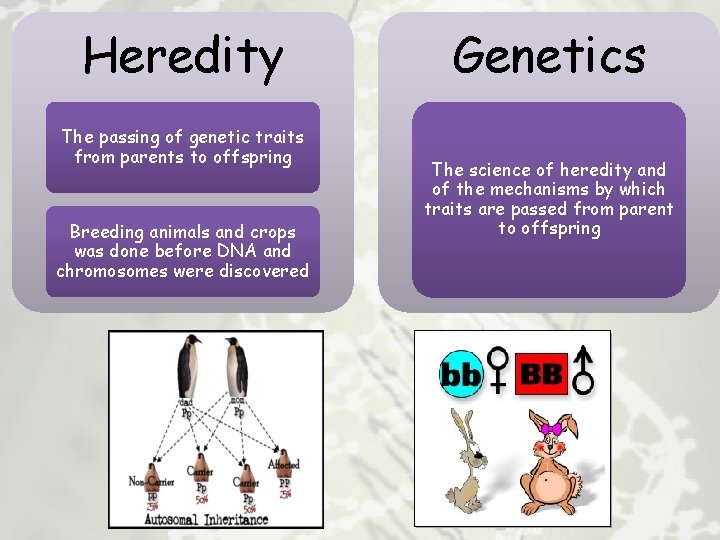
Heredity The passing of genetic traits from parents to offspring Breeding animals and crops was done before DNA and chromosomes were discovered Genetics The science of heredity and of the mechanisms by which traits are passed from parent to offspring

INHERITANCE OF CHROMOSOMES • Remember: Offspring get their chromosomes from their parents. • On the chromosomes passed from Mom and Dad to offspring are genes that determine traits. meiosis egg fertilization sperm zygote
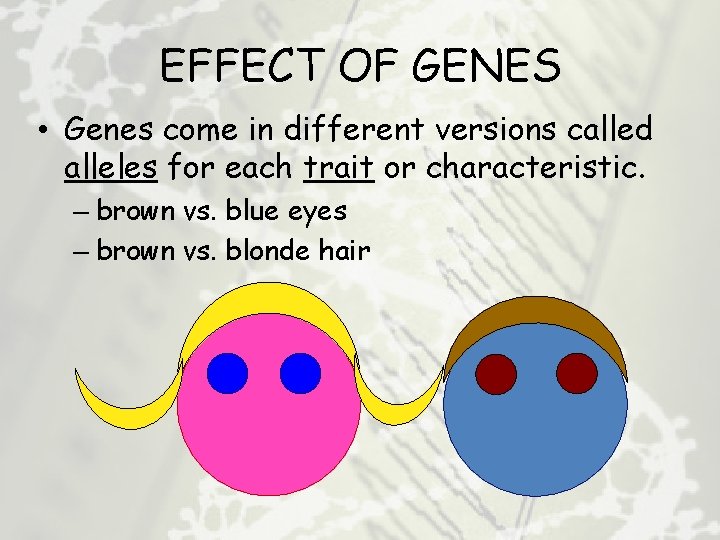
EFFECT OF GENES • Genes come in different versions called alleles for each trait or characteristic. – brown vs. blue eyes – brown vs. blonde hair
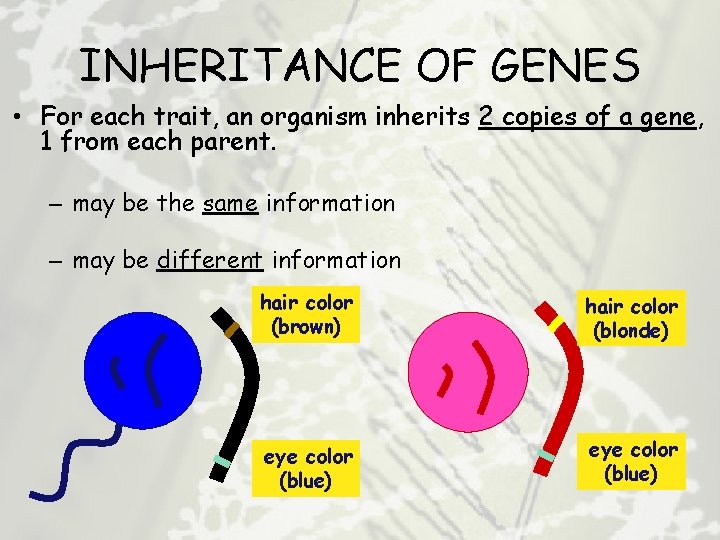
INHERITANCE OF GENES • For each trait, an organism inherits 2 copies of a gene, 1 from each parent. – may be the same information – may be different information hair color (brown) hair color (blonde) eye color (blue)
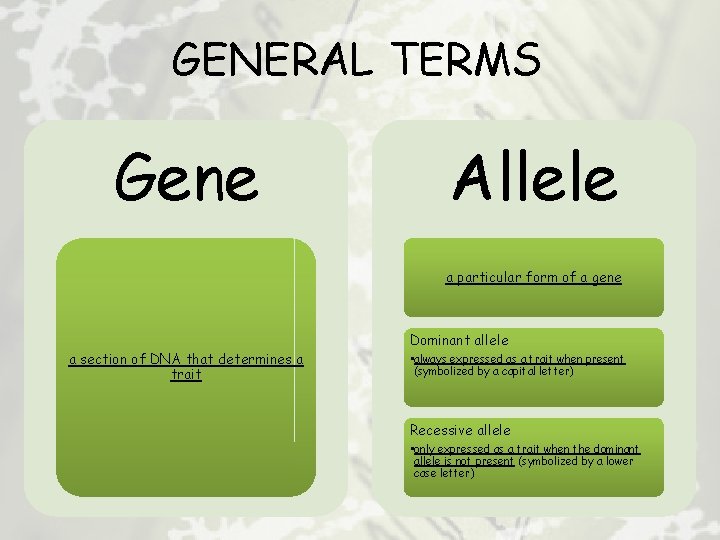
GENERAL TERMS Gene Allele a particular form of a gene a section of DNA that determines a trait Dominant allele • always expressed as a trait when present (symbolized by a capital letter) Recessive allele • only expressed as a trait when the dominant allele is not present (symbolized by a lower case letter)
GENOME • All of an organism’s genetic material • Unless you have an identical twin, you have a unique genome that determines all of your traits!
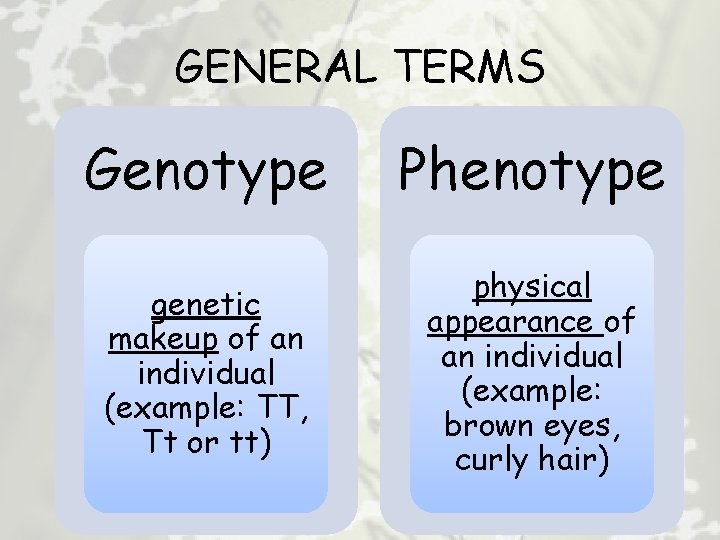
GENERAL TERMS Genotype Phenotype genetic makeup of an individual (example: TT, Tt or tt) physical appearance of an individual (example: brown eyes, curly hair)
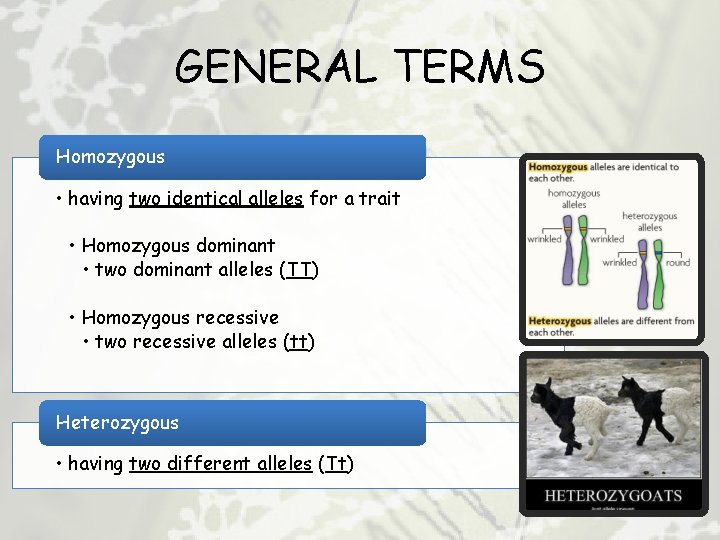
GENERAL TERMS Homozygous • having two identical alleles for a trait • Homozygous dominant • two dominant alleles (TT) • Homozygous recessive • two recessive alleles (tt) Heterozygous • having two different alleles (Tt)
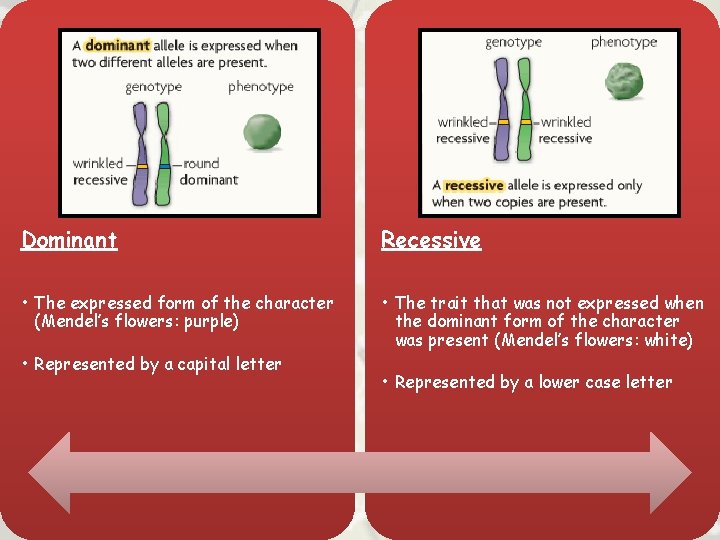
Dominant Recessive • The expressed form of the character (Mendel’s flowers: purple) • The trait that was not expressed when the dominant form of the character was present (Mendel’s flowers: white) • Represented by a capital letter • Represented by a lower case letter
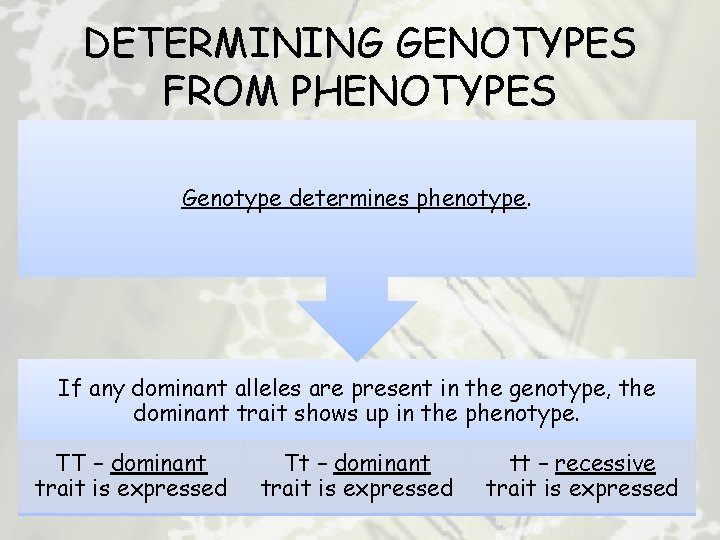
DETERMINING GENOTYPES FROM PHENOTYPES Genotype determines phenotype. If any dominant alleles are present in the genotype, the dominant trait shows up in the phenotype. TT – dominant trait is expressed Tt – dominant trait is expressed tt – recessive trait is expressed
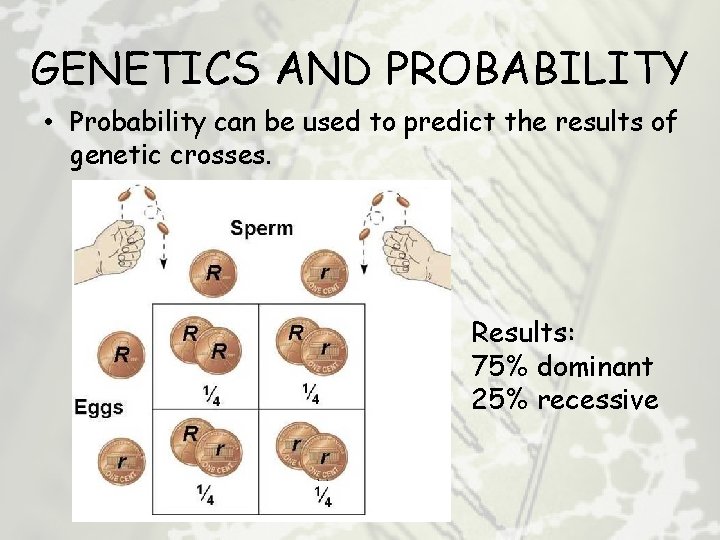
GENETICS AND PROBABILITY • Probability can be used to predict the results of genetic crosses. Results: 75% dominant 25% recessive
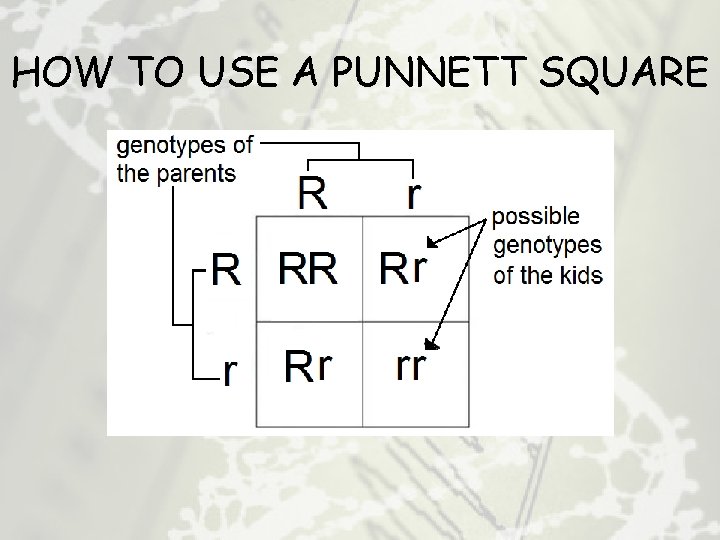
HOW TO USE A PUNNETT SQUARE
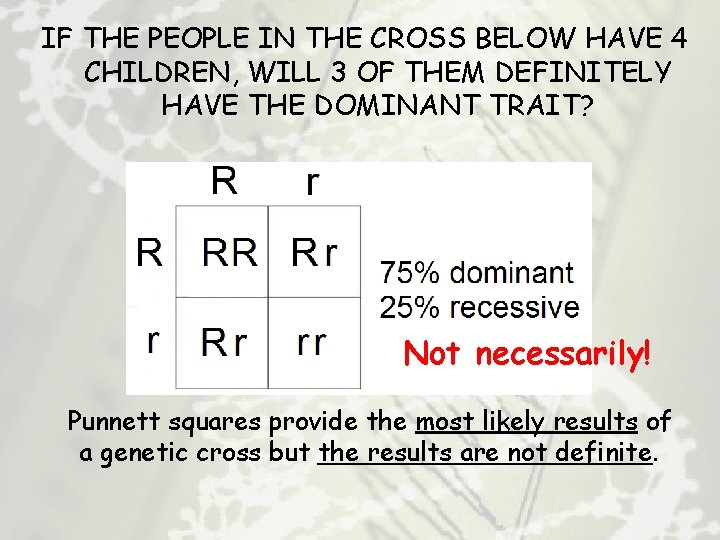
IF THE PEOPLE IN THE CROSS BELOW HAVE 4 CHILDREN, WILL 3 OF THEM DEFINITELY HAVE THE DOMINANT TRAIT? Not necessarily! Punnett squares provide the most likely results of a genetic cross but the results are not definite.
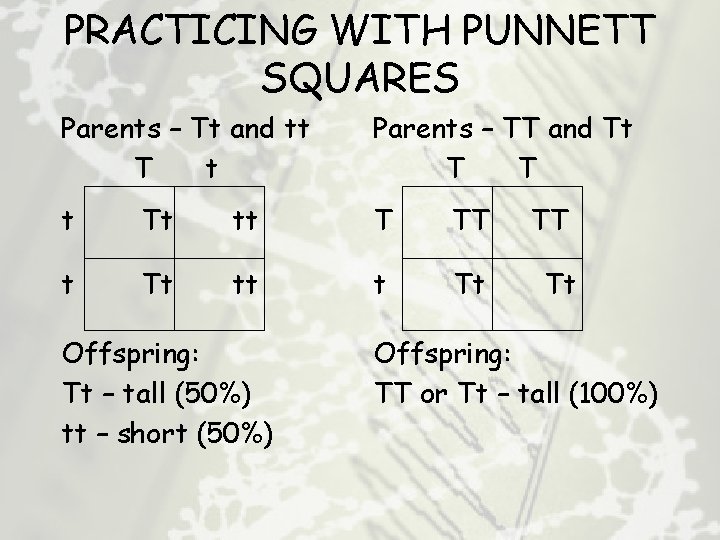
PRACTICING WITH PUNNETT SQUARES Parents – Tt and tt T t Parents – TT and Tt T T t Tt tt T TT TT t Tt tt t Tt Tt Offspring: Tt – tall (50%) tt – short (50%) Offspring: TT or Tt – tall (100%)
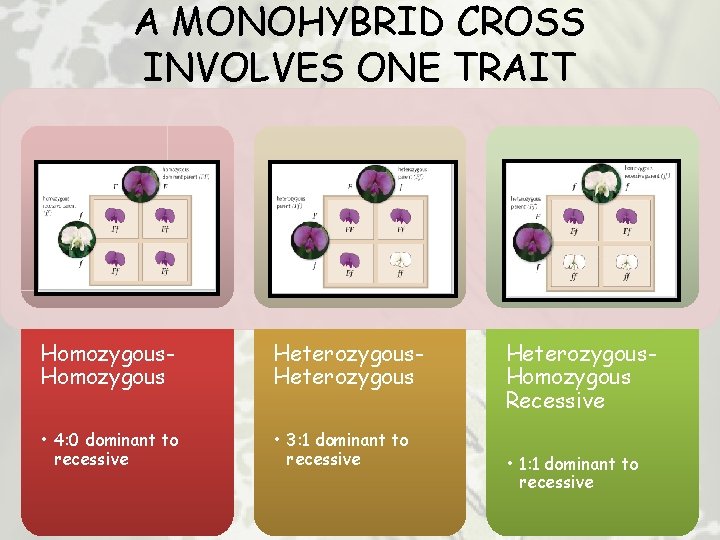
A MONOHYBRID CROSS INVOLVES ONE TRAIT Homozygous Heterozygous • 4: 0 dominant to recessive • 3: 1 dominant to recessive Heterozygous. Homozygous Recessive • 1: 1 dominant to recessive
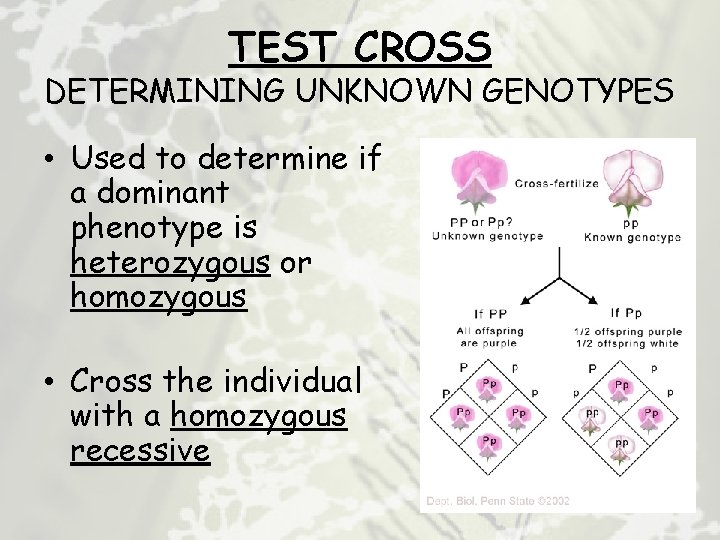
TEST CROSS DETERMINING UNKNOWN GENOTYPES • Used to determine if a dominant phenotype is heterozygous or homozygous • Cross the individual with a homozygous recessive
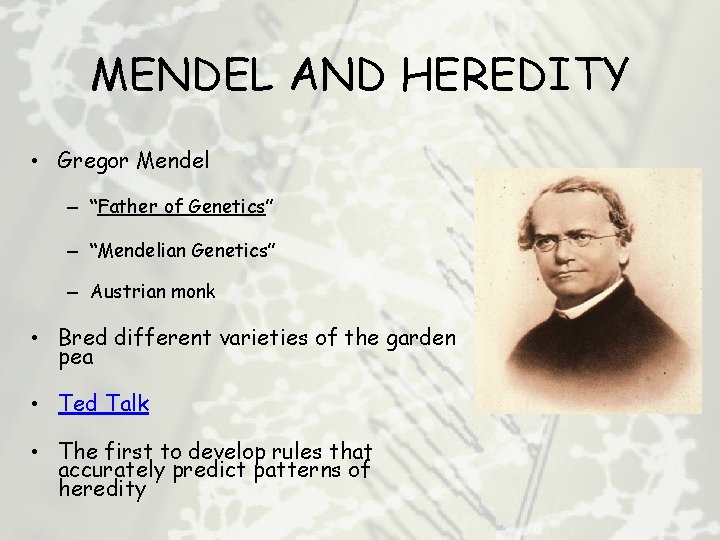
MENDEL AND HEREDITY • Gregor Mendel – “Father of Genetics” – “Mendelian Genetics” – Austrian monk • Bred different varieties of the garden pea • Ted Talk • The first to develop rules that accurately predict patterns of heredity
MENDEL’S DATA REVEALED PATTERNS OF INHERITANCE
MENDEL LAID THE GROUNDWORK FOR GENETICS • Before Mendel people thought offspring were a “blend” of their parents • Example: a tall plant crossed with a short plant would get a medium plant…wrong!
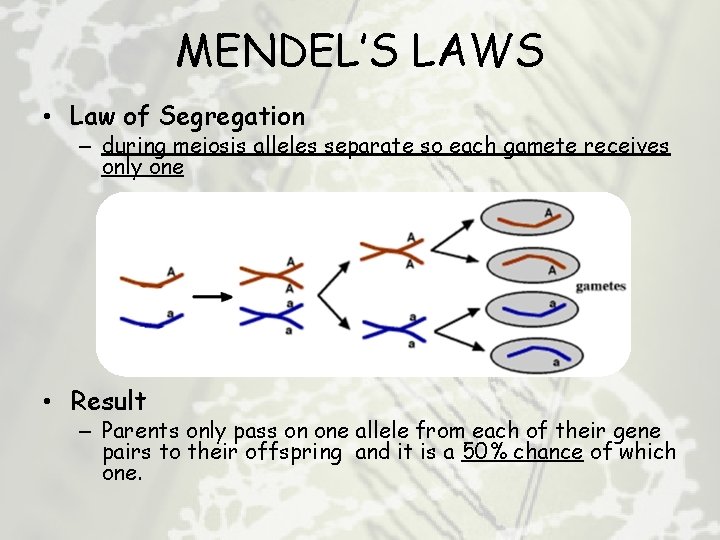
MENDEL’S LAWS • Law of Segregation – during meiosis alleles separate so each gamete receives only one • Result – Parents only pass on one allele from each of their gene pairs to their offspring and it is a 50% chance of which one.
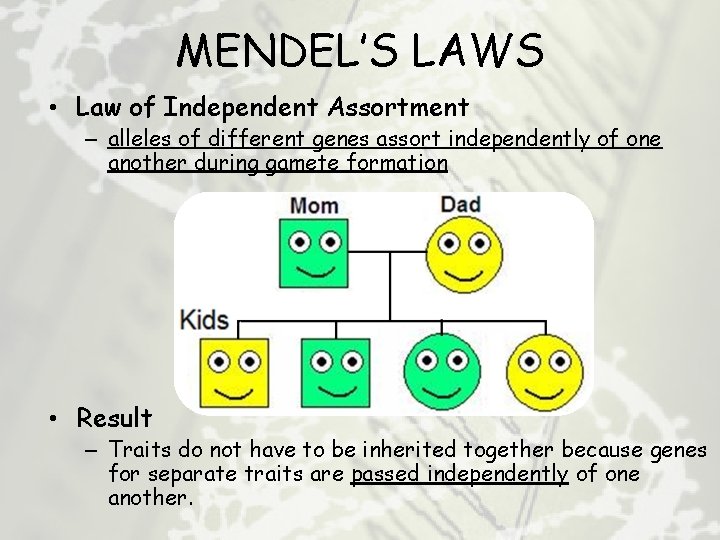
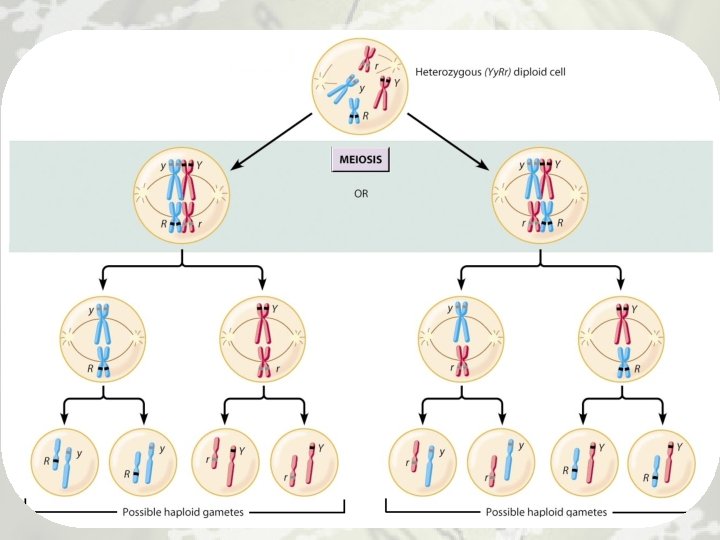
MENDEL’S LAWS • Law of Independent Assortment – alleles of different genes assort independently of one another during gamete formation • Result – Traits do not have to be inherited together because genes for separate traits are passed independently of one another.
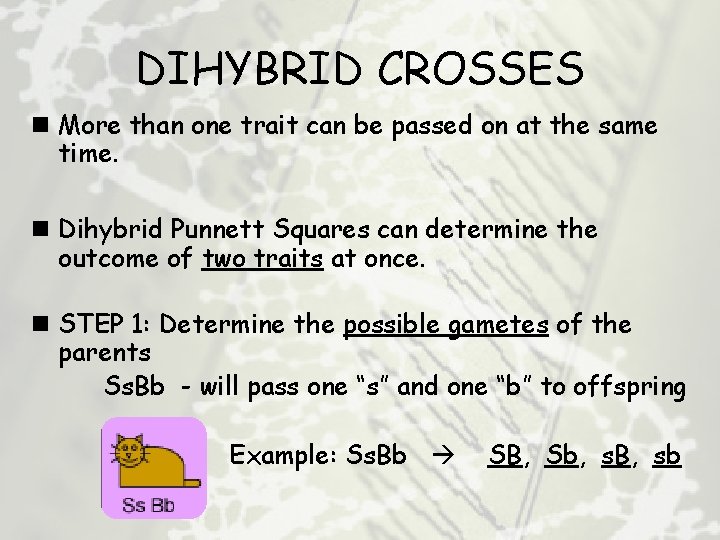
DIHYBRID CROSSES n More than one trait can be passed on at the same time. n Dihybrid Punnett Squares can determine the outcome of two traits at once. n STEP 1: Determine the possible gametes of the parents Ss. Bb - will pass one “s” and one “b” to offspring Example: Ss. Bb SB, Sb, s. B, sb
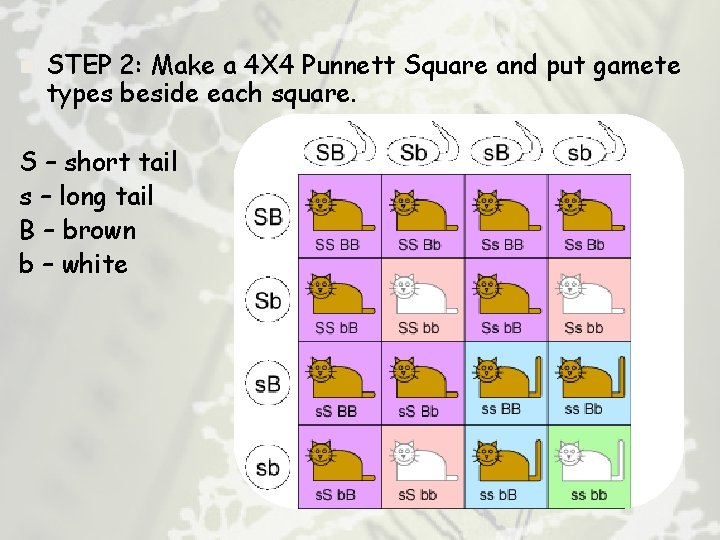
n STEP 2: Make a 4 X 4 Punnett Square and put gamete types beside each square. S – short tail s – long tail B – brown b – white
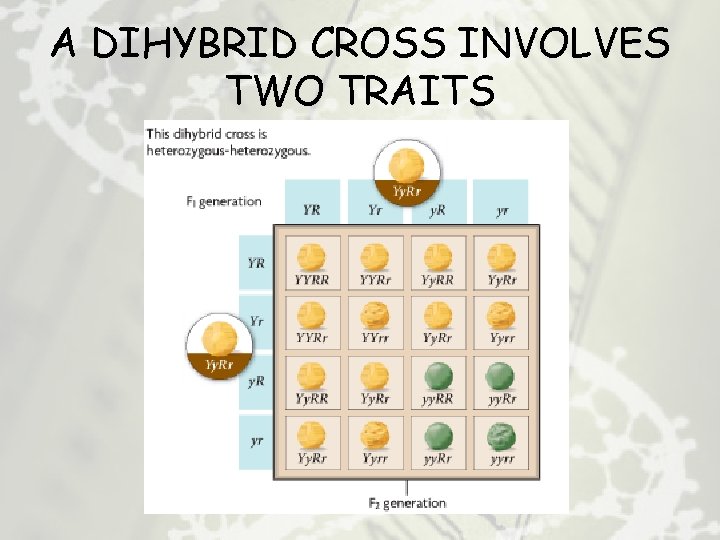
A DIHYBRID CROSS INVOLVES TWO TRAITS
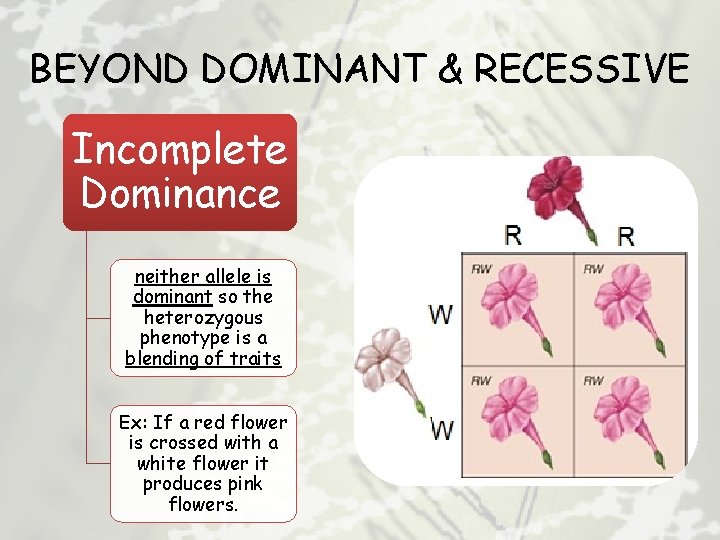
BEYOND DOMINANT & RECESSIVE Incomplete Dominance neither allele is dominant so the heterozygous phenotype is a blending of traits Ex: If a red flower is crossed with a white flower it produces pink flowers.
INCOMPLETE DOMINANCE • In some organisms an individual displays a phenotype that is intermediate between the two parents • Examples – Snapdragon flowers: red and white flowers produce pink flowers – Caucasian child: parent with curly hair and parent with straight hair has wavy hair
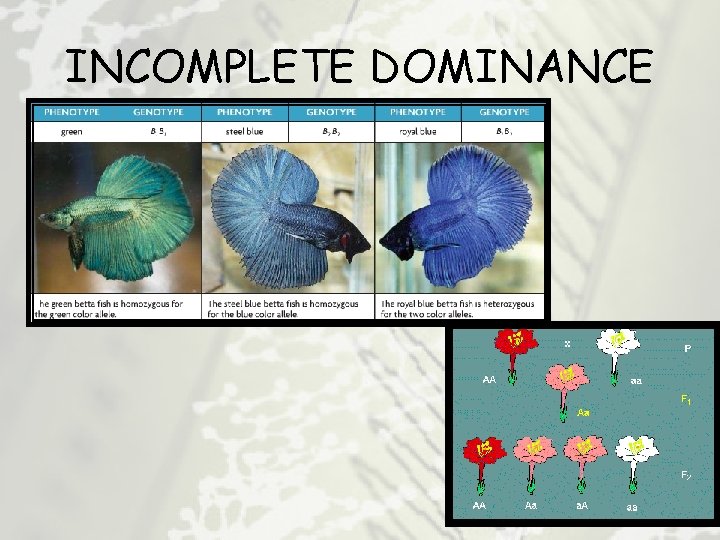
INCOMPLETE DOMINANCE
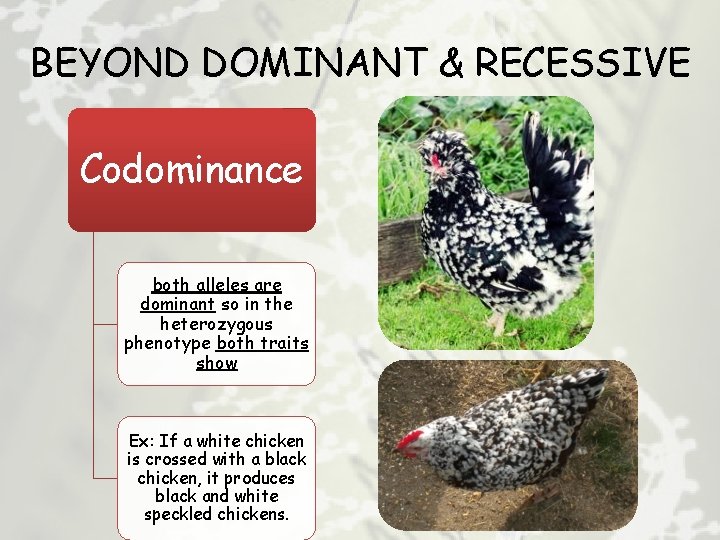
BEYOND DOMINANT & RECESSIVE Codominance both alleles are dominant so in the heterozygous phenotype both traits show Ex: If a white chicken is crossed with a black chicken, it produces black and white speckled chickens.
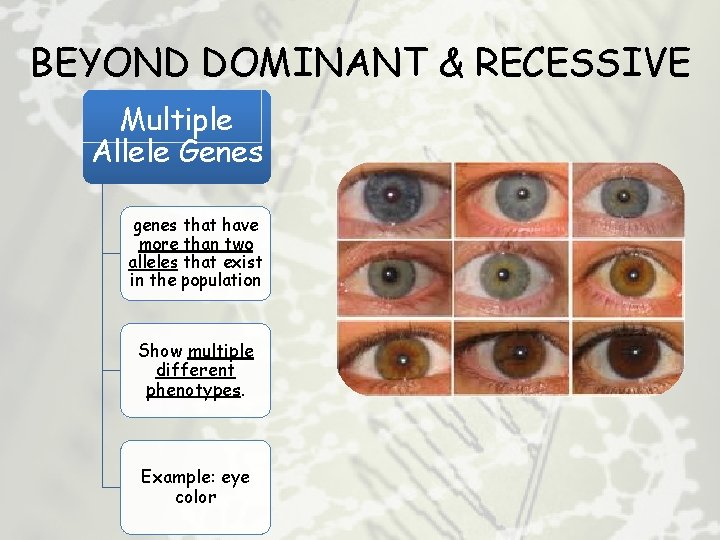
BEYOND DOMINANT & RECESSIVE Multiple Allele Genes genes that have more than two alleles that exist in the population Show multiple different phenotypes. Example: eye color
MULTIPLE ALLELES • Genes with three or more alleles • i. e. blood type in humans • ABO blood types are determined by 3 alleles • IA, IB, and i
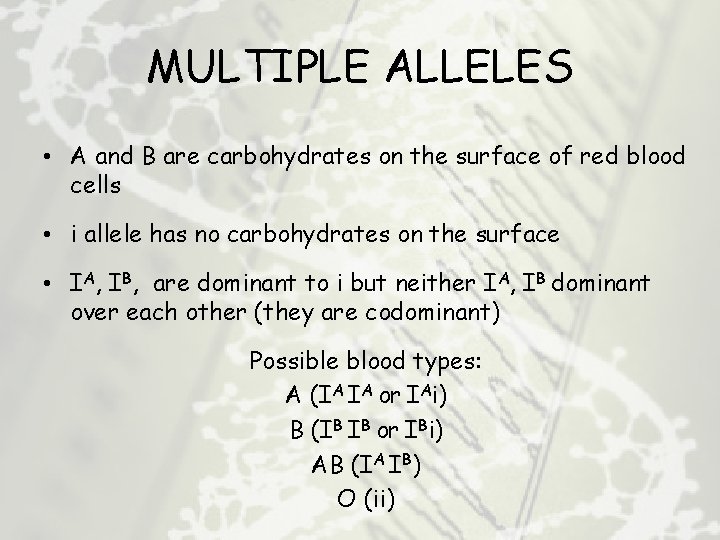
MULTIPLE ALLELES • A and B are carbohydrates on the surface of red blood cells • i allele has no carbohydrates on the surface • IA, IB, are dominant to i but neither IA, IB dominant over each other (they are codominant) Possible blood types: A (IA IA or IAi) B (IB IB or IBi) AB (IA IB) O (ii)
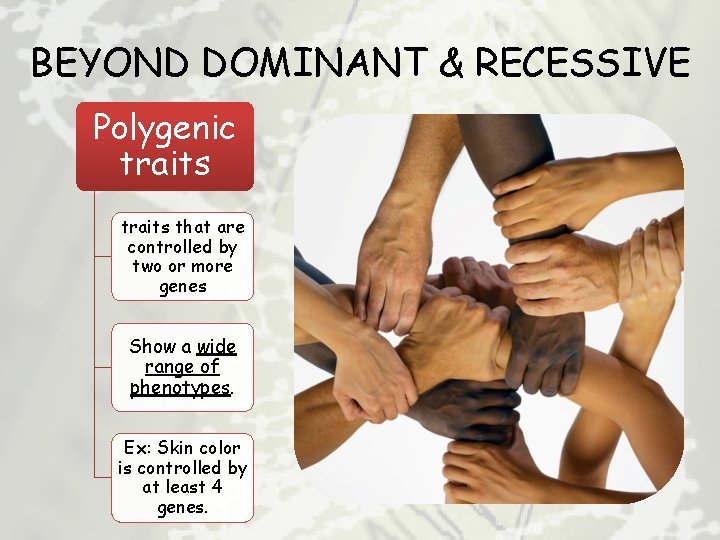
BEYOND DOMINANT & RECESSIVE Polygenic traits that are controlled by two or more genes Show a wide range of phenotypes. Ex: Skin color is controlled by at least 4 genes.
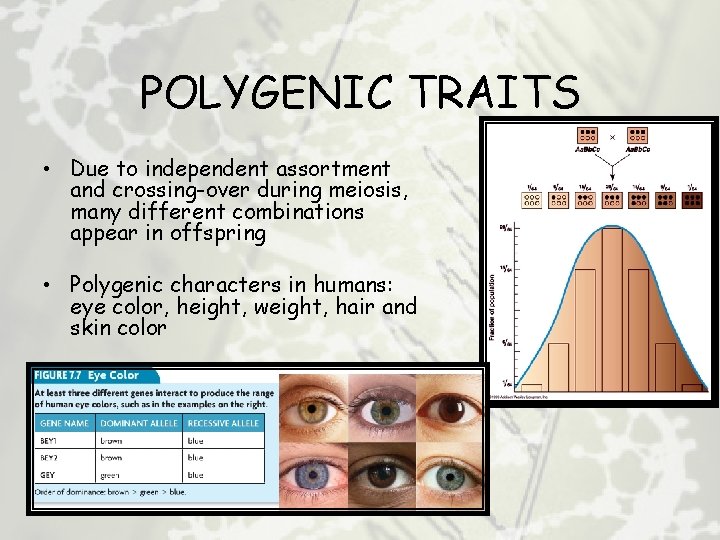
POLYGENIC TRAITS • Due to independent assortment and crossing-over during meiosis, many different combinations appear in offspring • Polygenic characters in humans: eye color, height, weight, hair and skin color
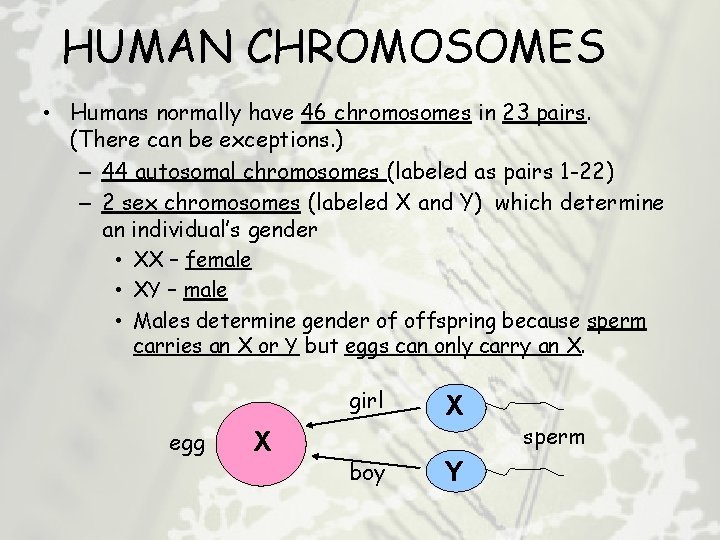
HUMAN CHROMOSOMES • Humans normally have 46 chromosomes in 23 pairs. (There can be exceptions. ) – 44 autosomal chromosomes (labeled as pairs 1 -22) – 2 sex chromosomes (labeled X and Y) which determine an individual’s gender • XX – female • XY – male • Males determine gender of offspring because sperm carries an X or Y but eggs can only carry an X. girl egg X boy X Y sperm
SEX LINKAGE OR X-LINKED TRAITS Genes found on the X chromosome are said to be sex linked or X linked. Examples: • Colorblindness: recessive, X-linked, causes an inability to distinguish between certain colors • Hemophilia: recessive, X-linked, impairs the ability to clot the blood following injury These traits are much more commonly seen in males.
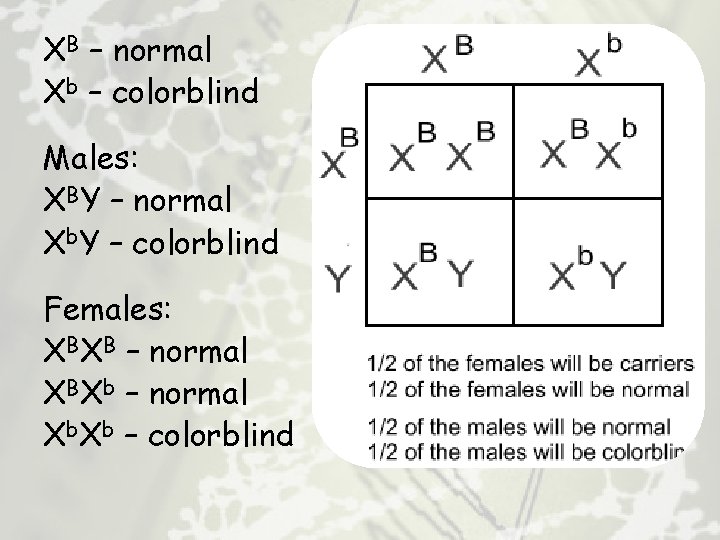
XB – normal Xb – colorblind Males: XBY – normal Xb. Y – colorblind Females: XBXB – normal XBXb – normal Xb. Xb – colorblind
GENETIC TRAITS AND DISORDERS Genetic Disorders disorders that have a genetic basis Examples: Huntington’s Disease: dominant disease, causes nervous system degeneration beginning in the 30’s-40’s Cystic Fibrosis: recessive disease, causes thick build up of mucus in organs Sickle Cell Anemia: recessive disease, causes blood cells to change shape when not enough oxygen
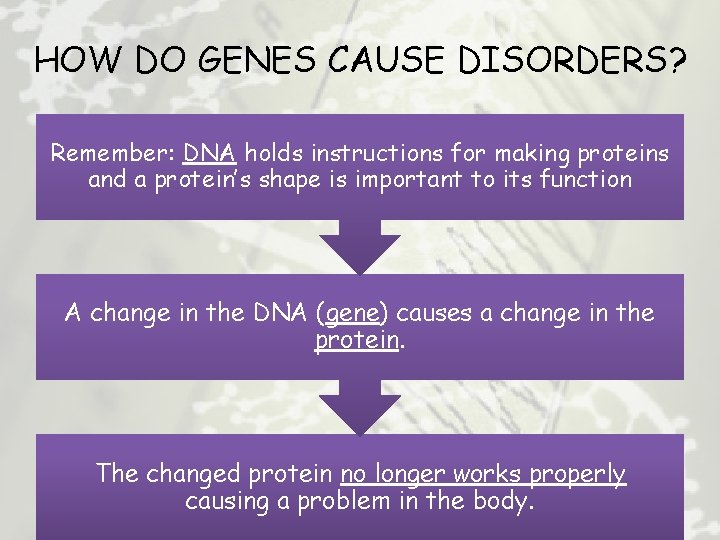
HOW DO GENES CAUSE DISORDERS? Remember: DNA holds instructions for making proteins and a protein’s shape is important to its function A change in the DNA (gene) causes a change in the protein. The changed protein no longer works properly causing a problem in the body.
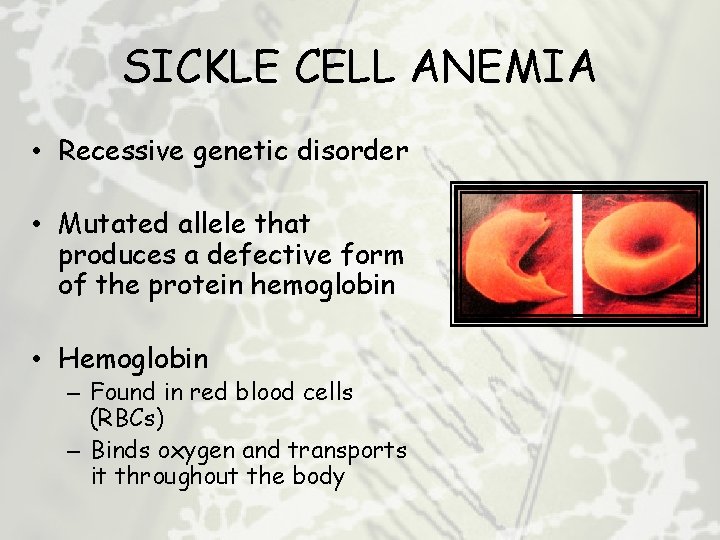
SICKLE CELL ANEMIA • Recessive genetic disorder • Mutated allele that produces a defective form of the protein hemoglobin • Hemoglobin – Found in red blood cells (RBCs) – Binds oxygen and transports it throughout the body
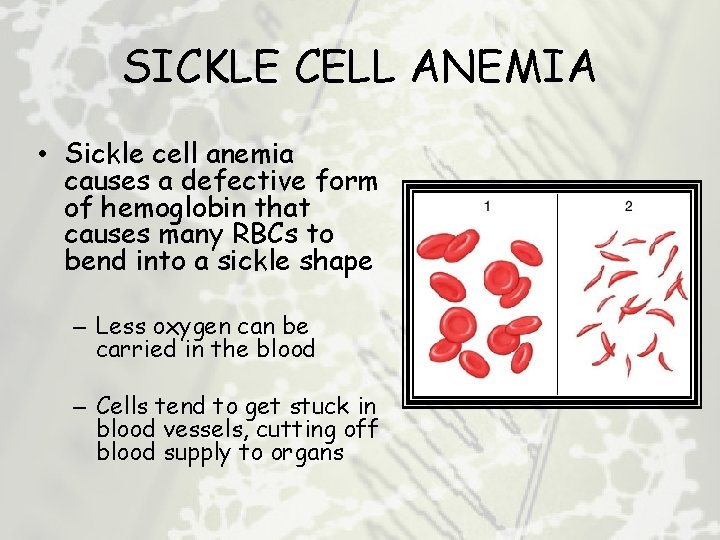
SICKLE CELL ANEMIA • Sickle cell anemia causes a defective form of hemoglobin that causes many RBCs to bend into a sickle shape – Less oxygen can be carried in the blood – Cells tend to get stuck in blood vessels, cutting off blood supply to organs
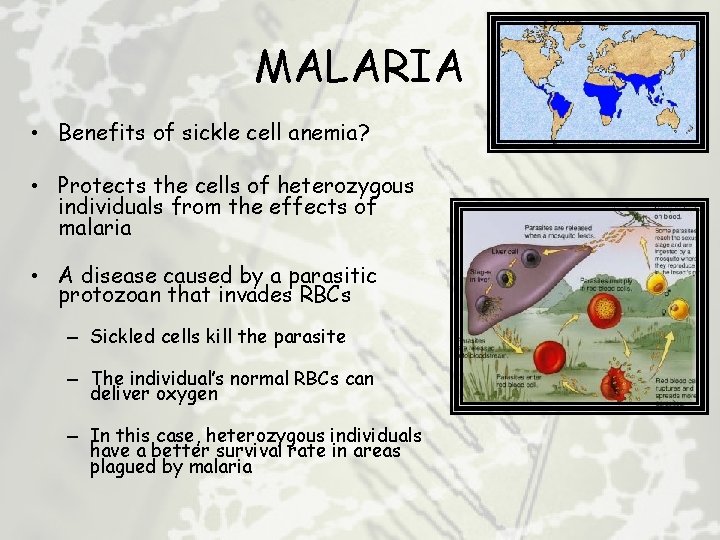
MALARIA • Benefits of sickle cell anemia? • Protects the cells of heterozygous individuals from the effects of malaria • A disease caused by a parasitic protozoan that invades RBCs – Sickled cells kill the parasite – The individual’s normal RBCs can deliver oxygen – In this case, heterozygous individuals have a better survival rate in areas plagued by malaria
CYSTIC FIBROSIS (CF) • Most common fatal, hereditary, recessive disorder amongst Caucasians – 1/25 Caucasian individuals has at least one copy of a defective gene that makes a protein necessary to move chloride into and out of cells – 1/2, 500 Caucasian infants in the USA is homozygous for the cf allele
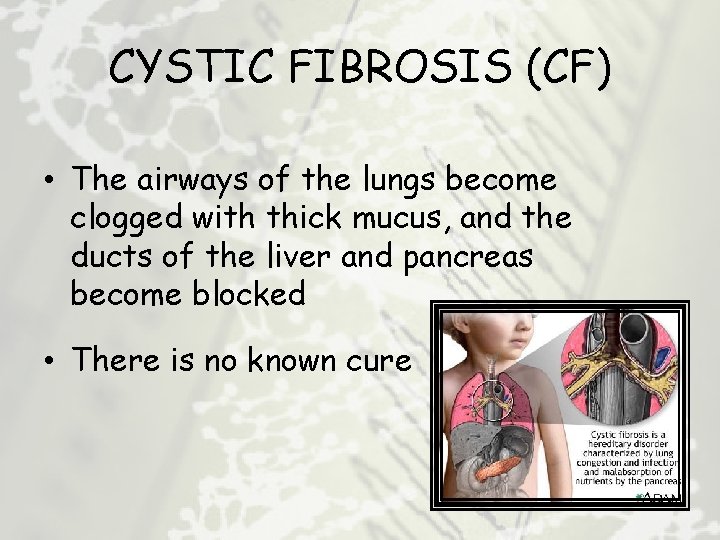
CYSTIC FIBROSIS (CF) • The airways of the lungs become clogged with thick mucus, and the ducts of the liver and pancreas become blocked • There is no known cure
DISORDERS CAUSED BY DOMINANT ALLELES ARE FAR LESS COMMON THAN RECESSIVE DISORDERS
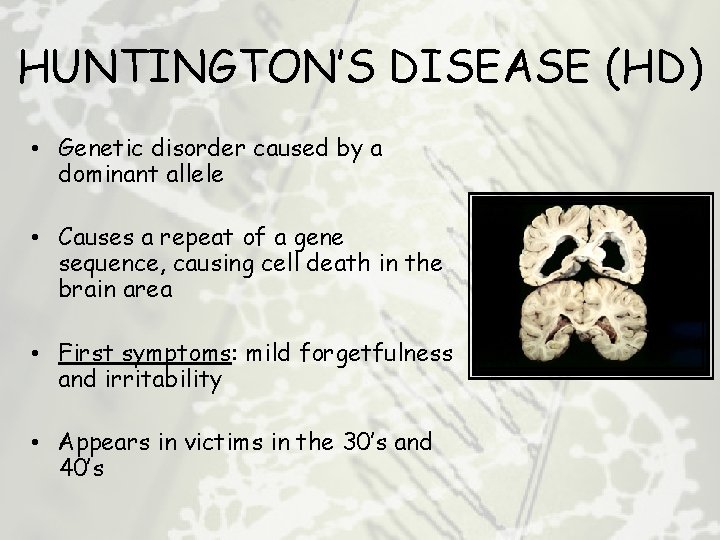
HUNTINGTON’S DISEASE (HD) • Genetic disorder caused by a dominant allele • Causes a repeat of a gene sequence, causing cell death in the brain area • First symptoms: mild forgetfulness and irritability • Appears in victims in the 30’s and 40’s
HUNTINGTON’S DISEASE (HD) • Secondary symptoms: loss of muscle control, uncontrollable physical spasms, severe mental illness…eventually death • Most people do not know they have the disease until after they have had children • Unknowingly the gene is passed on
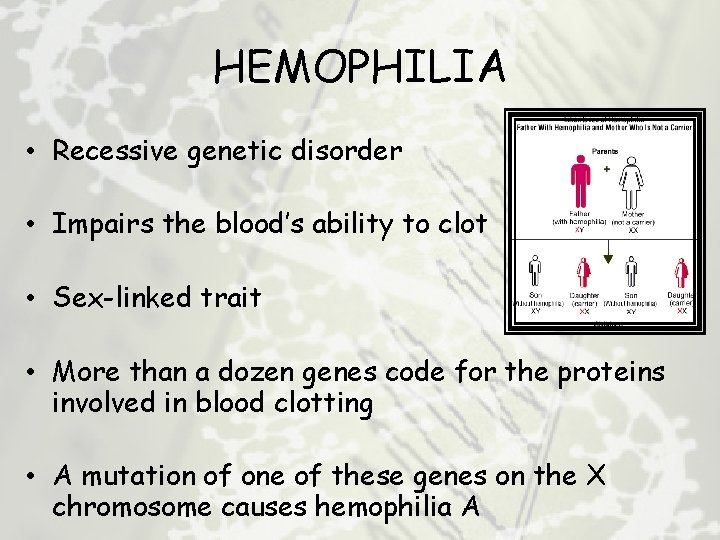
HEMOPHILIA • Recessive genetic disorder • Impairs the blood’s ability to clot • Sex-linked trait • More than a dozen genes code for the proteins involved in blood clotting • A mutation of one of these genes on the X chromosome causes hemophilia A
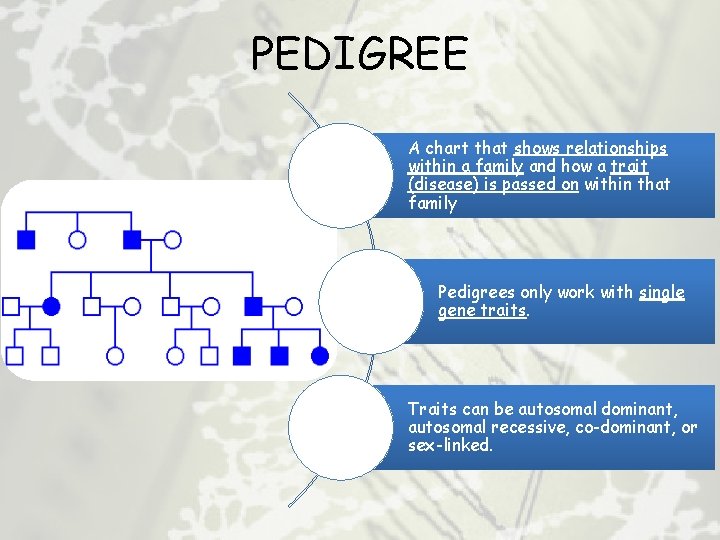
PEDIGREE A chart that shows relationships within a family and how a trait (disease) is passed on within that family Pedigrees only work with single gene traits. Traits can be autosomal dominant, autosomal recessive, co-dominant, or sex-linked.
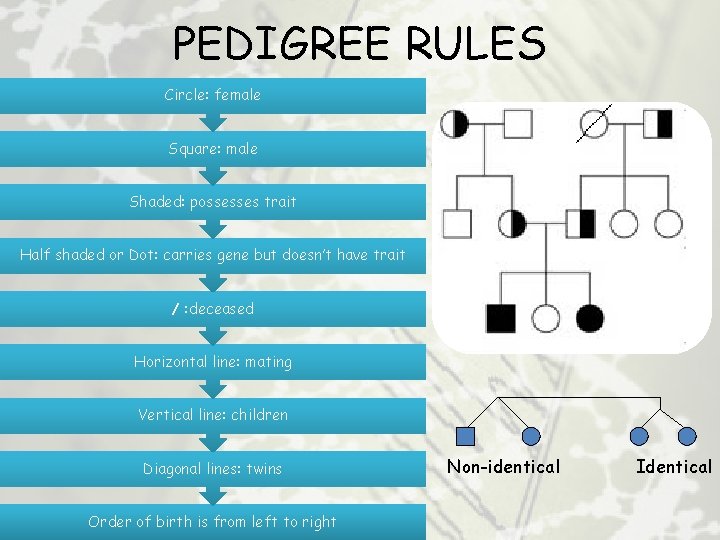
PEDIGREE RULES Circle: female Square: male Shaded: possesses trait Half shaded or Dot: carries gene but doesn’t have trait / : deceased Horizontal line: mating Vertical line: children Diagonal lines: twins Order of birth is from left to right Non-identical Identical
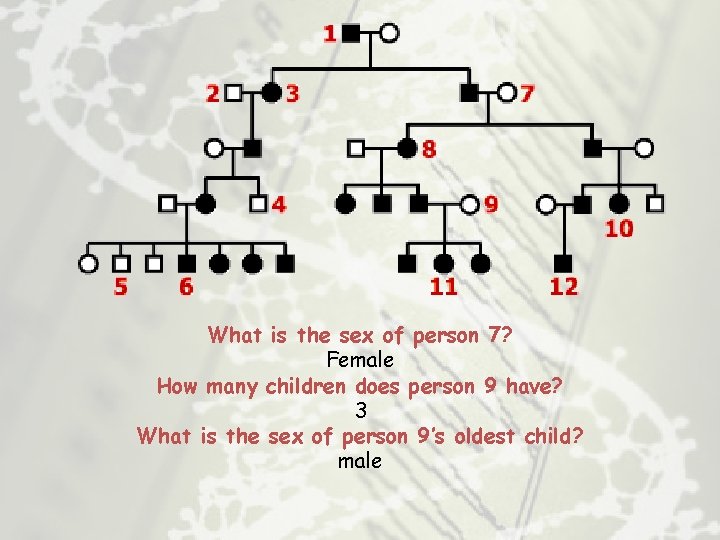
What is the sex of person 7? Female How many children does person 9 have? 3 What is the sex of person 9’s oldest child? male
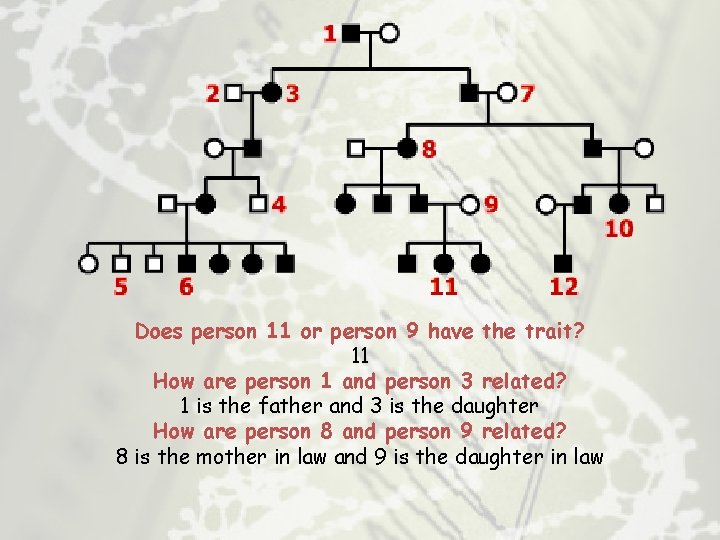
Does person 11 or person 9 have the trait? 11 How are person 1 and person 3 related? 1 is the father and 3 is the daughter How are person 8 and person 9 related? 8 is the mother in law and 9 is the daughter in law
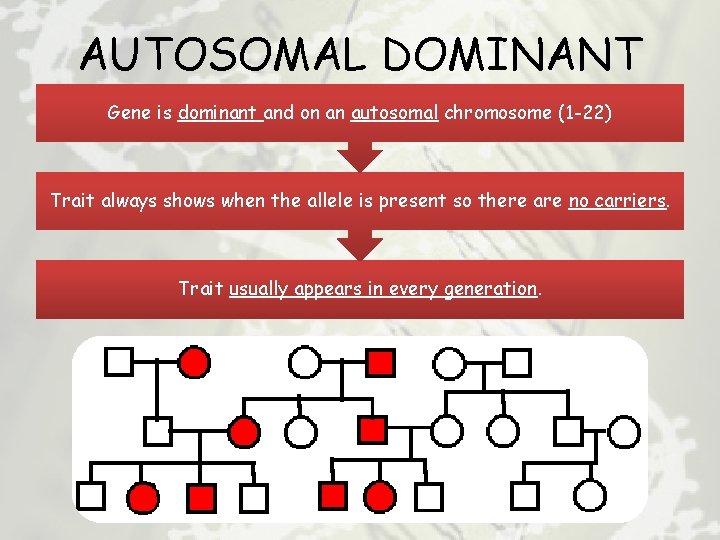
AUTOSOMAL DOMINANT Gene is dominant and on an autosomal chromosome (1 -22) Trait always shows when the allele is present so there are no carriers. Trait usually appears in every generation.
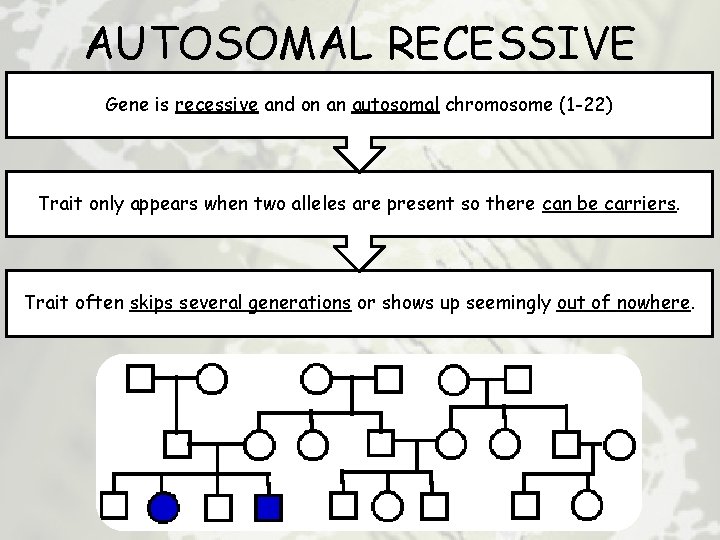
AUTOSOMAL RECESSIVE Gene is recessive and on an autosomal chromosome (1 -22) Trait only appears when two alleles are present so there can be carriers. Trait often skips several generations or shows up seemingly out of nowhere.
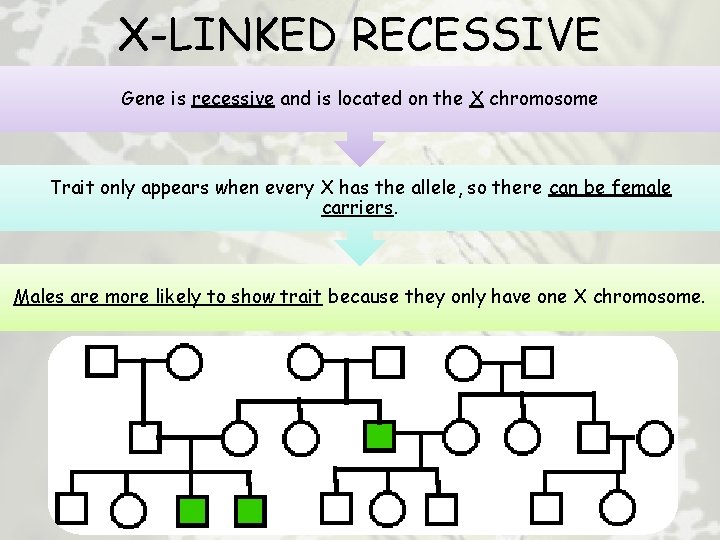
X-LINKED RECESSIVE Gene is recessive and is located on the X chromosome Trait only appears when every X has the allele, so there can be female carriers. Males are more likely to show trait because they only have one X chromosome.
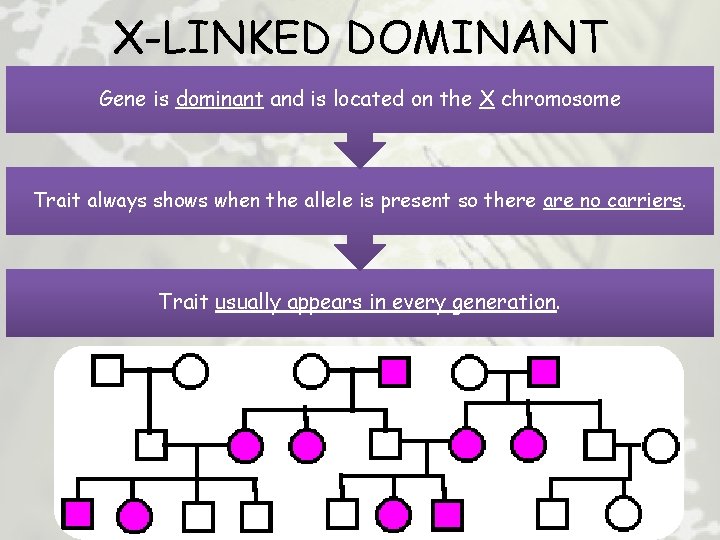
X-LINKED DOMINANT Gene is dominant and is located on the X chromosome Trait always shows when the allele is present so there are no carriers. Trait usually appears in every generation.
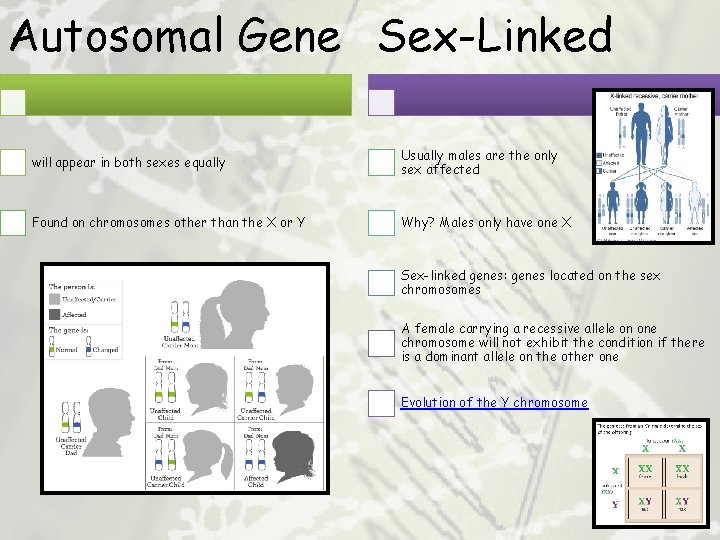
Autosomal Gene Sex-Linked will appear in both sexes equally Usually males are the only sex affected Found on chromosomes other than the X or Y Why? Males only have one X Sex-linked genes: genes located on the sex chromosomes A female carrying a recessive allele on one chromosome will not exhibit the condition if there is a dominant allele on the other one Evolution of the Y chromosome
CHROMOSOMAL DISORDERS • A disorder resulting from a defect or change in a large portion or whole chromosome How do chromosomal disorders happen?
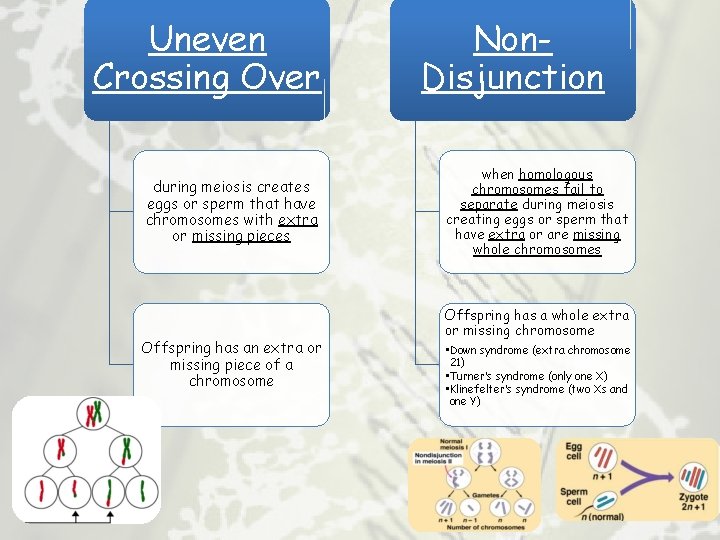
Uneven Crossing Over during meiosis creates eggs or sperm that have chromosomes with extra or missing pieces Offspring has an extra or missing piece of a chromosome Non. Disjunction when homologous chromosomes fail to separate during meiosis creating eggs or sperm that have extra or are missing whole chromosomes Offspring has a whole extra or missing chromosome • Down syndrome (extra chromosome 21) • Turner’s syndrome (only one X) • Klinefelter’s syndrome (two Xs and one Y)
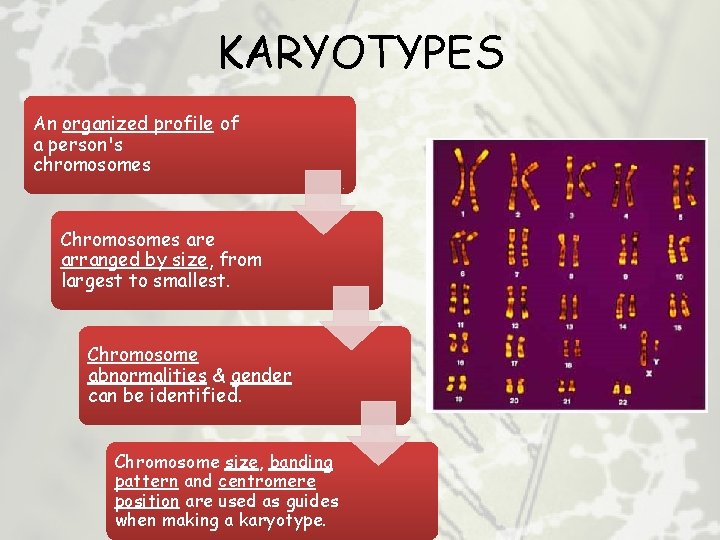
KARYOTYPES An organized profile of a person's chromosomes Chromosomes are arranged by size, from largest to smallest. Chromosome abnormalities & gender can be identified. Chromosome size, banding pattern and centromere position are used as guides when making a karyotype.
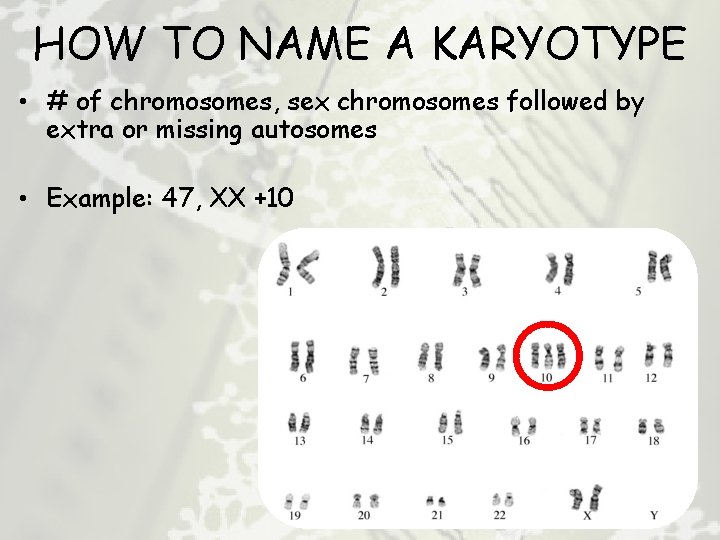
HOW TO NAME A KARYOTYPE • # of chromosomes, sex chromosomes followed by extra or missing autosomes • Example: 47, XX +10
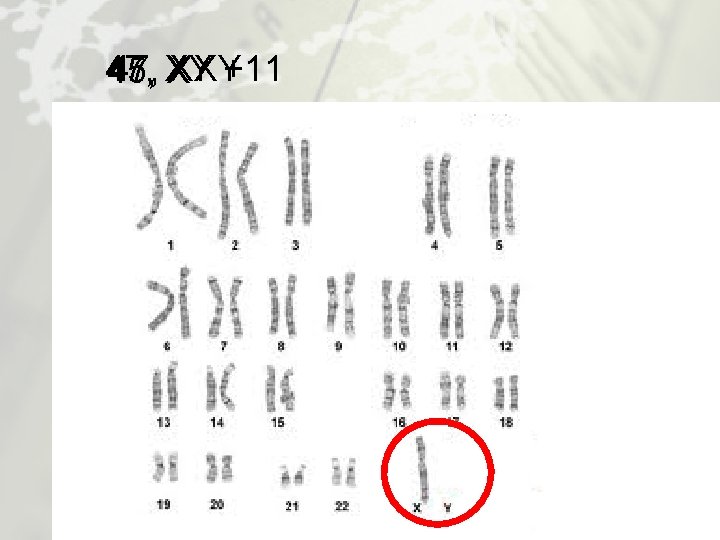
47, XY XXY 47, +11 45, X
HUMAN MOLECULAR GENETICS Genetic tests: • Diagnose genetic disorders • (available for 100’s of disorders) • Prenatal-detection • Check for carriers of a disorder (can then determine chances of passing on a disorder) New treatments and therapies are being worked on for many genetic disorders. Gene therapy – bad genes that cause disorders are replaced with good genes or are changed to work properly
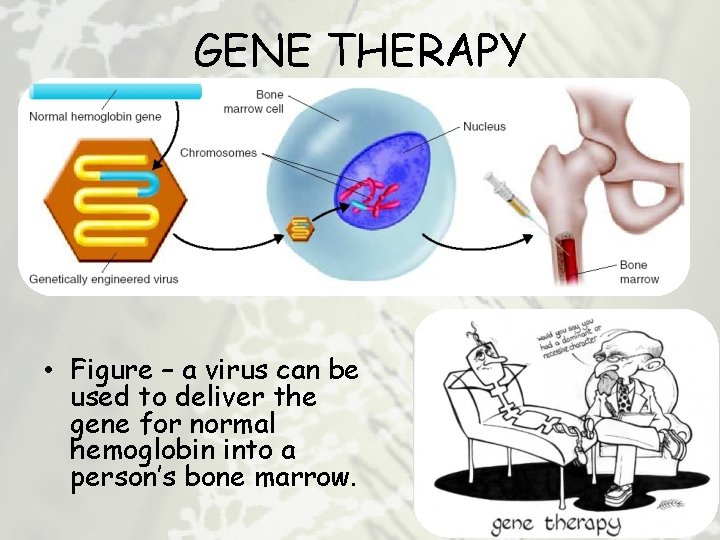
GENE THERAPY • Figure – a virus can be used to deliver the gene for normal hemoglobin into a person’s bone marrow.
ETHICS – YOU DECIDE! IT WOULD BE MARVELOUS TO BE ABLE TO CURE GENETIC DISEASES, BUT… If human cells can be manipulated to cure diseases, should biologists try to engineer taller people or change their eye color, hair texture, sex, blood group, or appearance? What will happen to the human species if we gain the opportunity to design our bodies? What will the consequences be if biologists develop the ability to clone human beings by making identical copies of their cells?
REMEMBER…CHARACTERISTICS OF LIVING THINGS made up of units called cells reproduce based on a universal genetic code (DNA) grow and develop obtain and use materials and energy (metabolism) respond to their environment (adapt) maintain a stable internal environment (homeostasis) taken as a group, organisms evolve
- Slides: 68