
Introduction to Genetics Dr Abid Ali Department of
Introduction to Genetics Dr. Abid Ali Department of Biochemistry
Learning Objectives • • • At the end of lecture students will be able to Describe Mendel’s Law Discuss Punnett Squares Know about Pedigree Chart State DNA & RNA structure
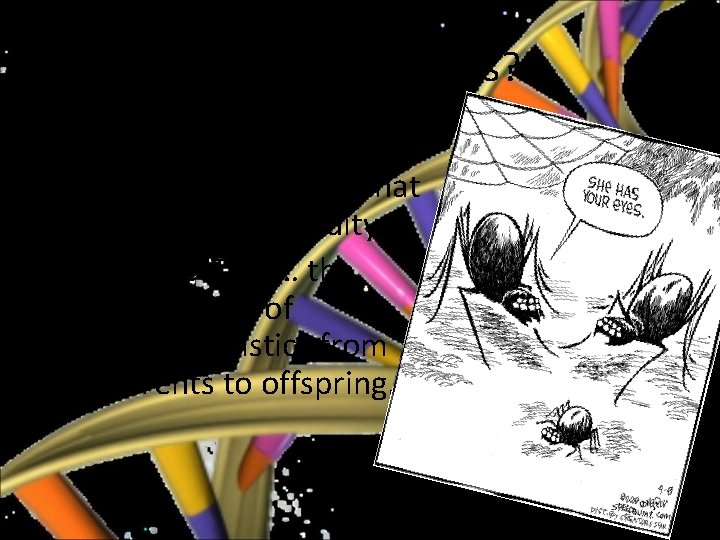
Mendelian Genetics What is genetics? • GENETICS is the branch of Biology that deals with heredity. • HEREDITY is… the passing on of characteristics from parents to offspring.
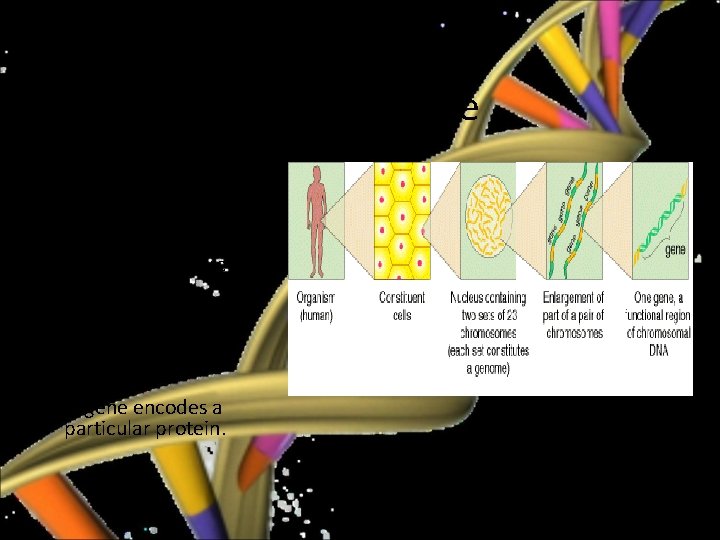
Chromosome • All living organisms consist of cells. • In each cell there is chromosomes. • Chromosomes are strings of DNA • Chromosome consists of genes, blocks of DNA. Each gene encodes a particular protein.
Chromosome • Each gene has its own position in the chromosome. • This position is called locus. • Complete set of genetic material (all chromosomes) is called genome. • Particular set of genes in genome is called genotype. • The genotype is with later development after birth base for the organism's phenotype, its physical and mental characteristics, such as eye color, intelligence etc.
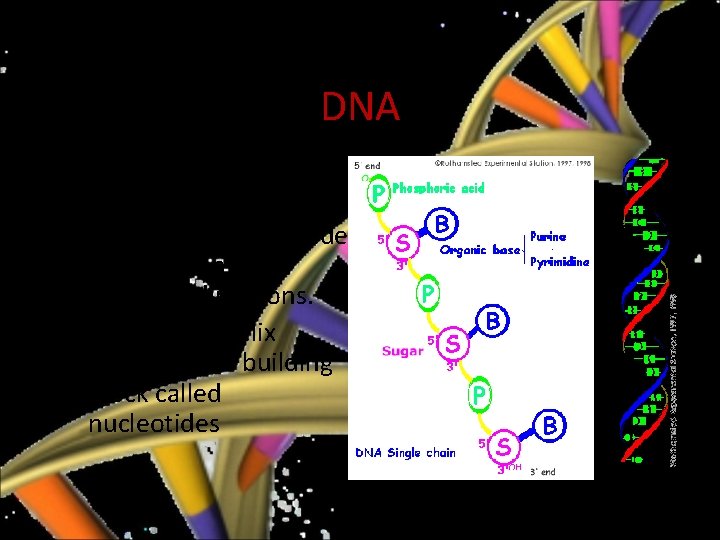
DNA • DNA is a double helix composed of two intertwined nucleotide chains oriented in opposite directions. • The double helix composed of building block called nucleotides
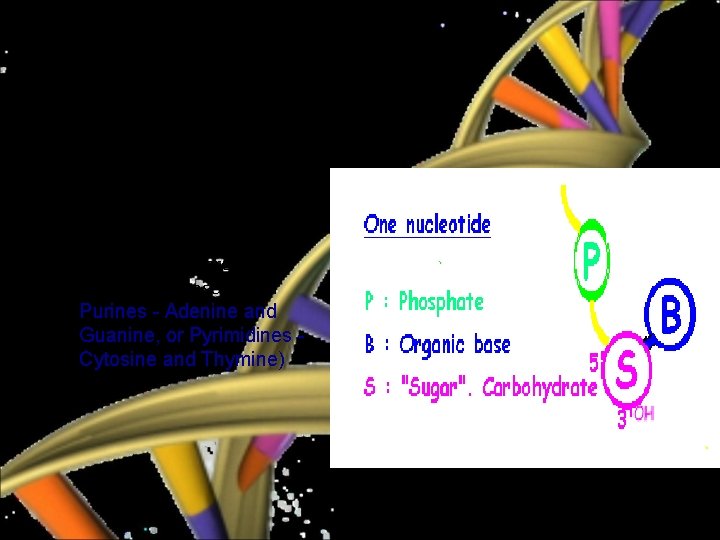
DNA • Each nucleotides consist : – – – Phosphate group Deoxyribose sugar molecule One of four different nitrogenous bases either Purines - Adenine and Guanine, or Pyrimidines Cytosine and Thymine)
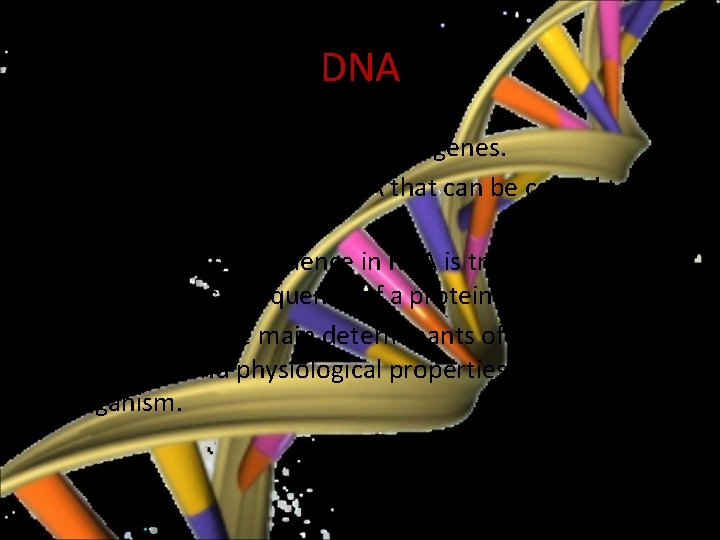
DNA • The functional units of DNA are genes. • A gene is a segment of DNA that can be copied to make RNA. • The nucleotide sequence in RNA is translated into the amino acid sequence of a protein. • Proteins are the main determinants of the basic structural and physiological properties of an organism.
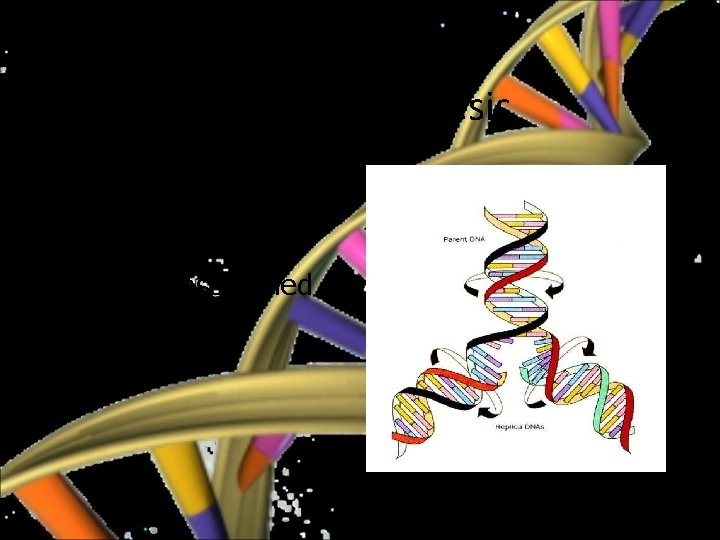
Protein synthesis • DNA is duplicated before a cell divides • A process called replication
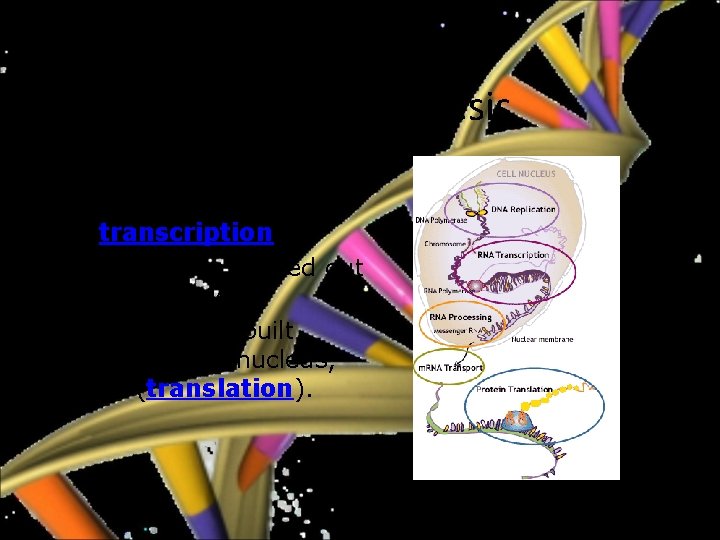
Protein synthesis • Genes are transcribed into RNA (transcription). • m. RNA Transported out of the nucleus • proteins are built Outside the nucleus, the (translation).
• TERMS USED IN GENETICS
What is a Trait? • A trait is a specific characteristic that varies from one individual to another. – Examples: Brown hair, blue eyes, tall, curly
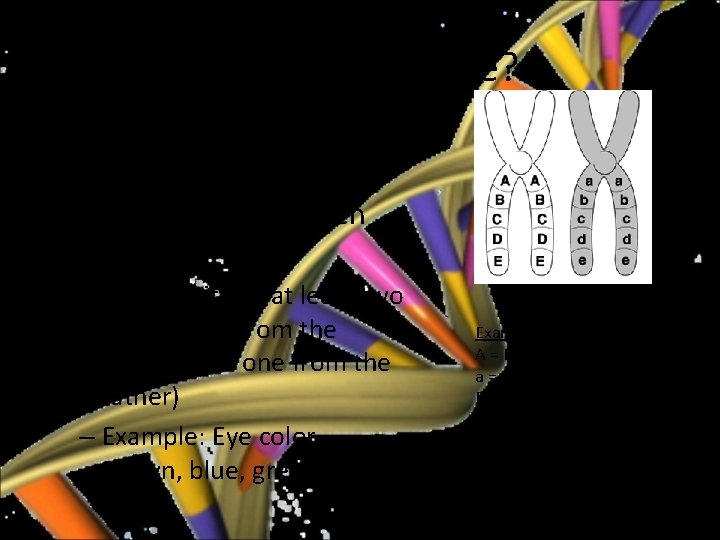
What is an Allele? • Alleles are the different possibilities for a given trait. – Every trait has at least two alleles (one from the mother and one from the father) – Example: Eye color – Brown, blue, green, hazel Examples of Alleles: A = Brown Eyes a = Blue Eyes B = Green Eyes b = Hazel Eyes
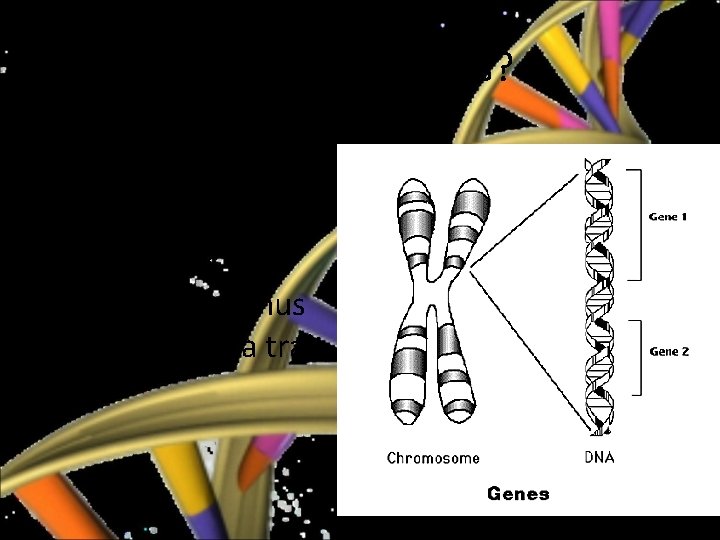
What are Genes? • Genes are the sequence of DNA that codes for a protein and thus determines a trait.
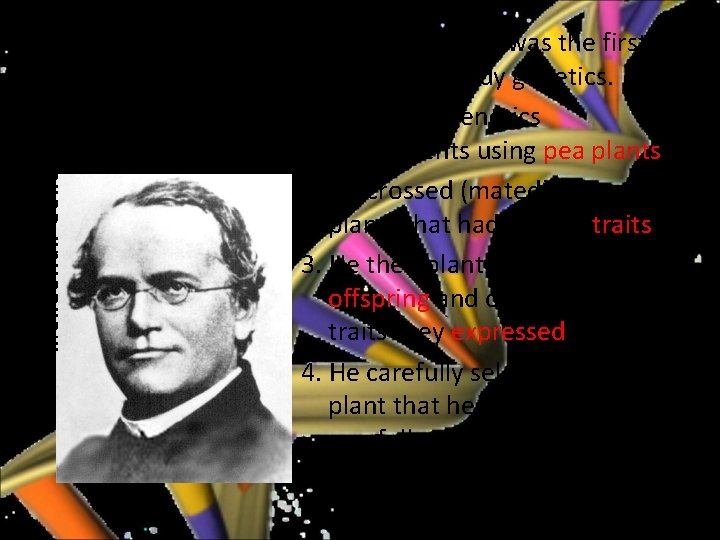
Mendelian Genetics GREGOR MENDEL • Gregor Mendel was the first person to study genetics. 1. He did his genetics experiments using pea plants. 2. He crossed (mated) two pea plants that had certain traits. 3. He then planted their offspring and observed what traits they expressed. 4. He carefully selected each plant that he used and carefully reviewed the results.
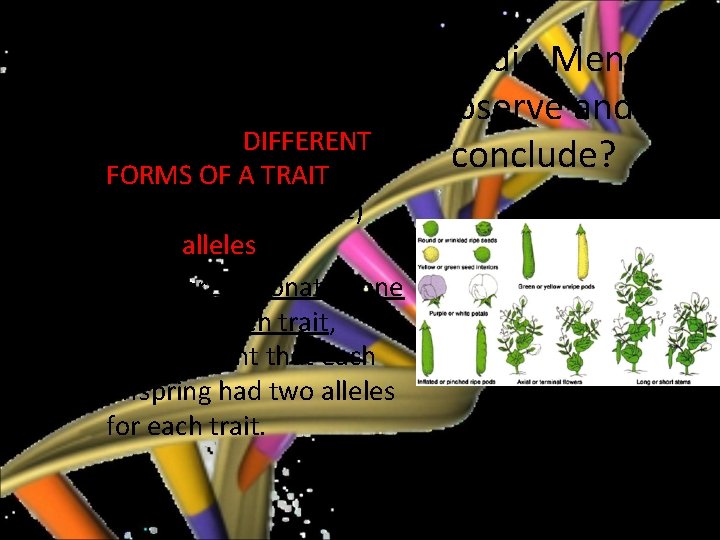
Mendelian Genetics What did Mendel observe and conclude? • Mendel observed that there were DIFFERENT FORMS OF A TRAIT (controlled by a gene) called alleles. • Each parent donated one allele for each trait, which meant that each offspring had two alleles for each trait.
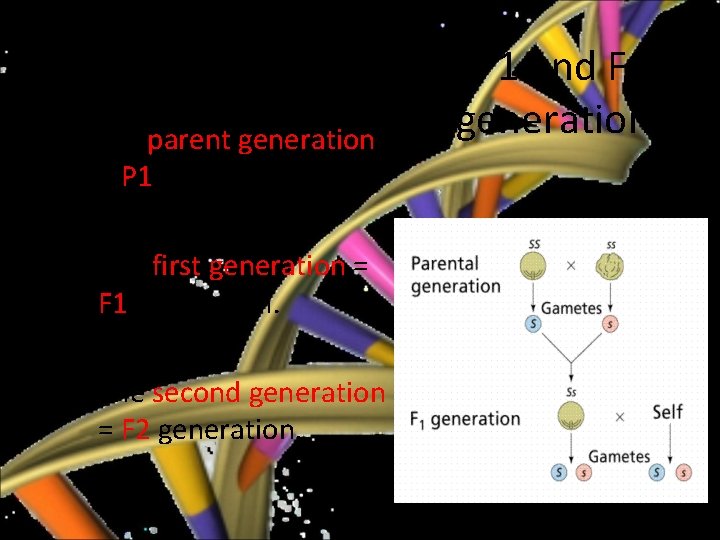
Mendelian Genetics • In a cross (mating) between organisms, the parent generation = P 1 generation. • The first generation = F 1 generation. • The second generation = F 2 generation. P 1 and F 1 generations
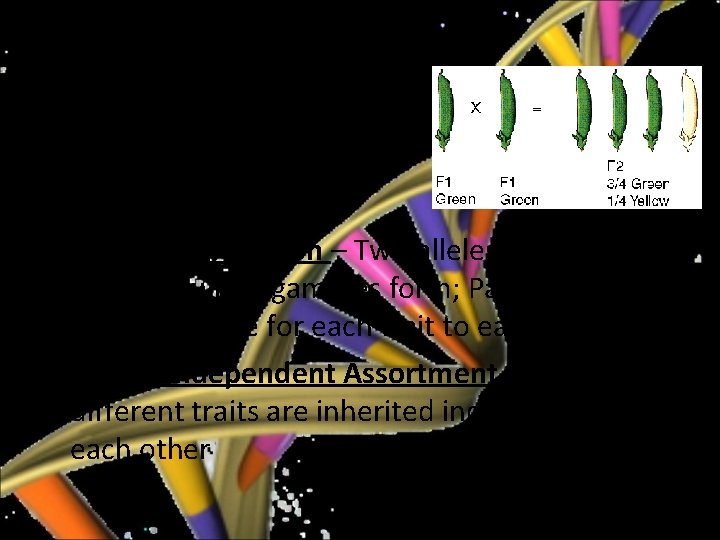
Mendel’s Conclusions 1. Law of Segregation – Two alleles for each trait separate when gametes form; Parents pass only one allele for each trait to each offspring 2. Law of Independent Assortment – Genes for different traits are inherited independently of each other
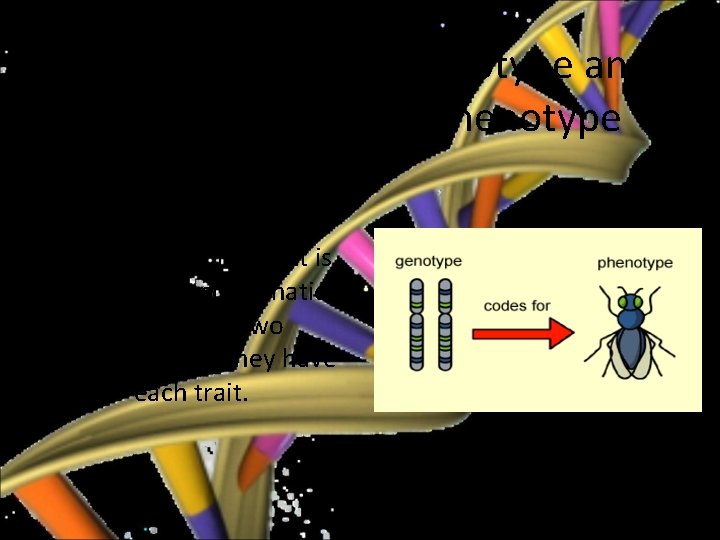
Mendelian Genetics • The phenotype an organisms appearance and behavior (how the trait expresses itself). • The genotype for an offspring or parent is the gene combinations or the set of two alleles that they have for each trait. Genotype and Phenotype
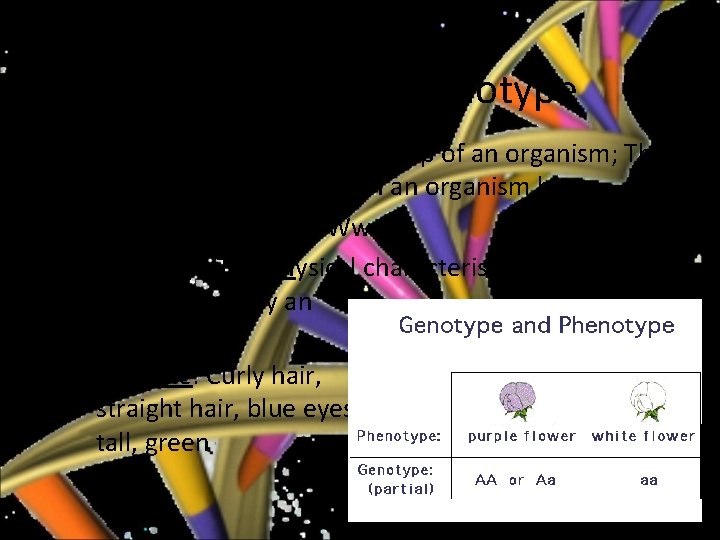
Genotype vs. Phenotype • Genotype – The genetic makeup of an organism; The gene (or allele) combination an organism has. – Example: Tt, ss, GG, Ww • Phenotype – The physical characteristics of an organism; The way an organism looks – Example: Curly hair, straight hair, blue eyes, tall, green
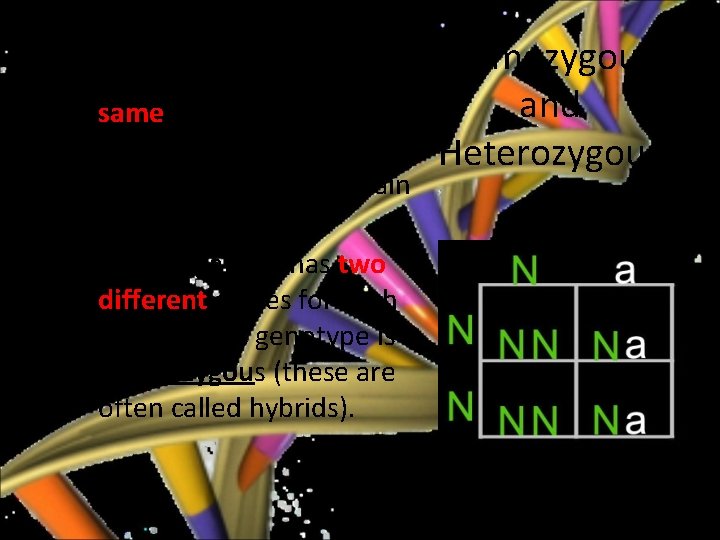
Mendelian Genetics • If the alleles are the same for a trait then the organism’s genotype is homozygous for a certain trait. • If the organism has two different alleles for each trait then its genotype is heterozygous (these are often called hybrids). Homozygous and Heterozygous
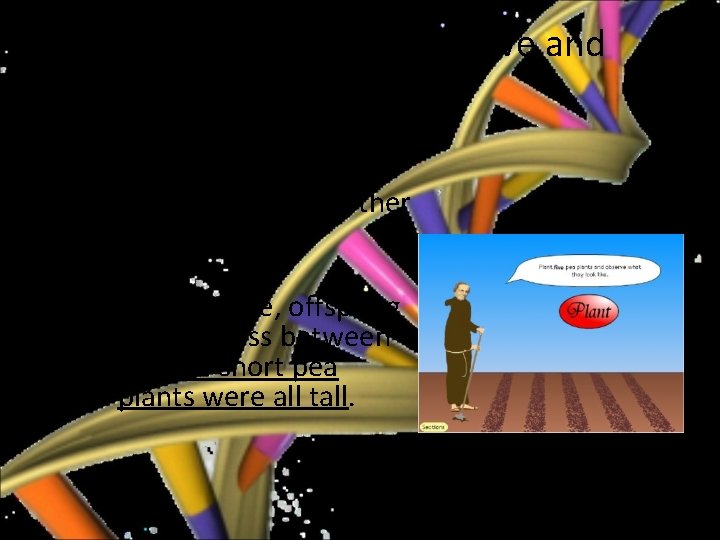
Mendelian Genetics What did Mendel observe and conclude? • Mendel noticed that some traits masked the expression of other traits. • For example, offspring from a cross between tall and short pea plants were all tall.
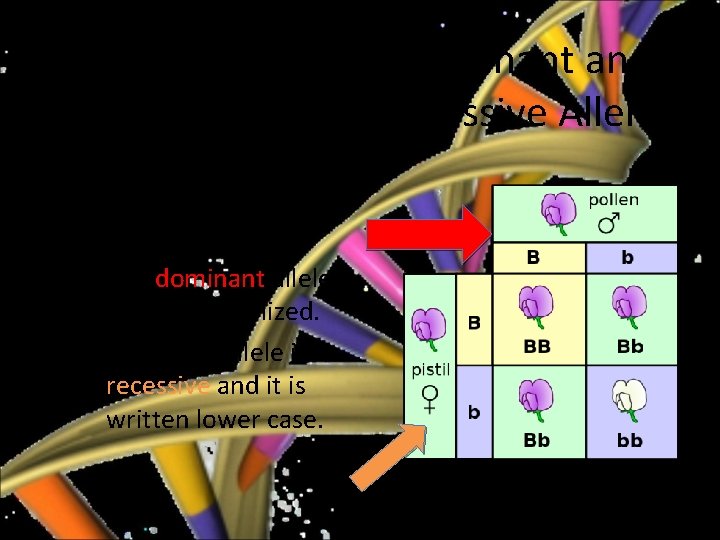
Mendelian Genetics • Dominant and Mendel came up with his Recessive Alleles rule of dominance : an allele that masks the expression of another allele is dominant. • The dominant allele is usually capitalized. • The other allele is recessive and it is written lower case.
Mendelian Genetics How it works…. • For example, the allele for a tall pea plant is dominant over the allele for short pea plants. • The dominant allele is expressed when the organism is: – homozygous =TT or – heterozygous =Tt • The recessive allele for a trait is expressed only when the organism is – Homozygous for recessive= tt
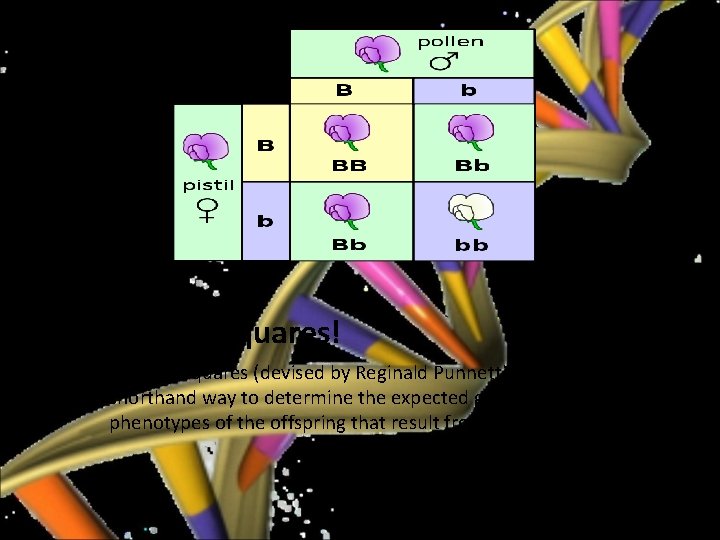
Punnet Squares! Punnett squares (devised by Reginald Punnett) give us a shorthand way to determine the expected genotypes and phenotypes of the offspring that result from a cross.
Punnet Squares What can we do with a Punnet Square? • FROM THIS, YOU CAN CALCULATE: – the numbers of each genotype and phenotype. – the probability of an offspring having a certain phenotype. – And how many offspring should exhibit a certain form of each trait by multiplying the number of offspring by the probability that they will have a certain trait.
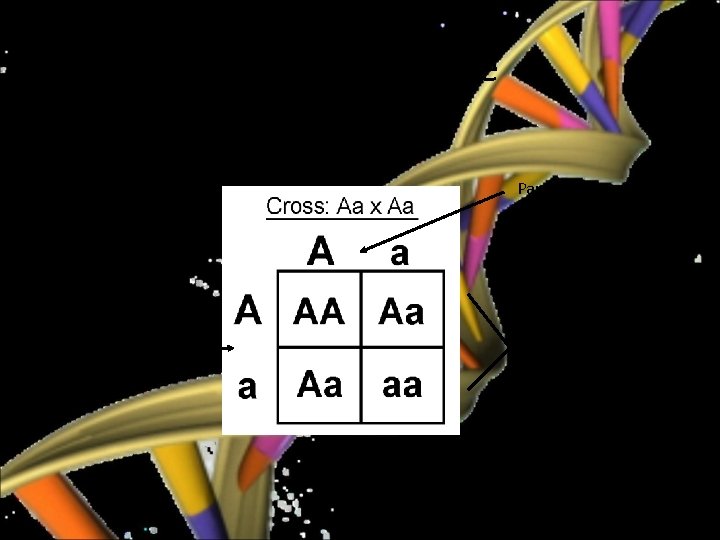
Punnett Square Parent Offspring
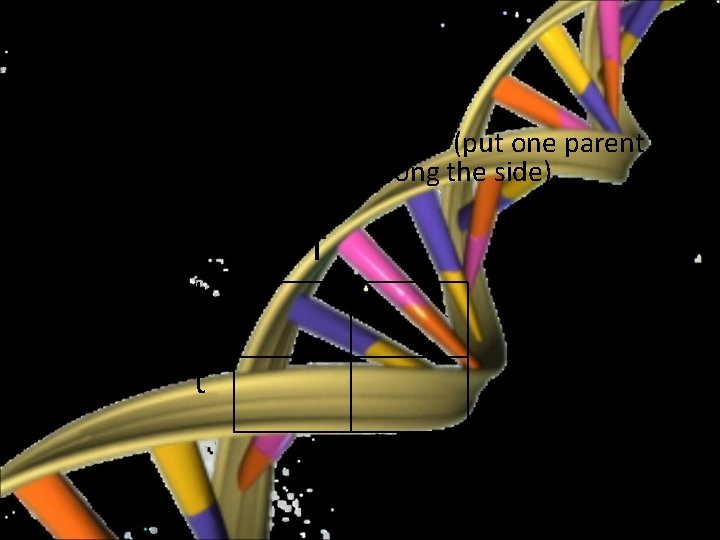
Tt x tt Step One: Set Up Punnett Square (put one parent on the top and the other along the side) t t T t
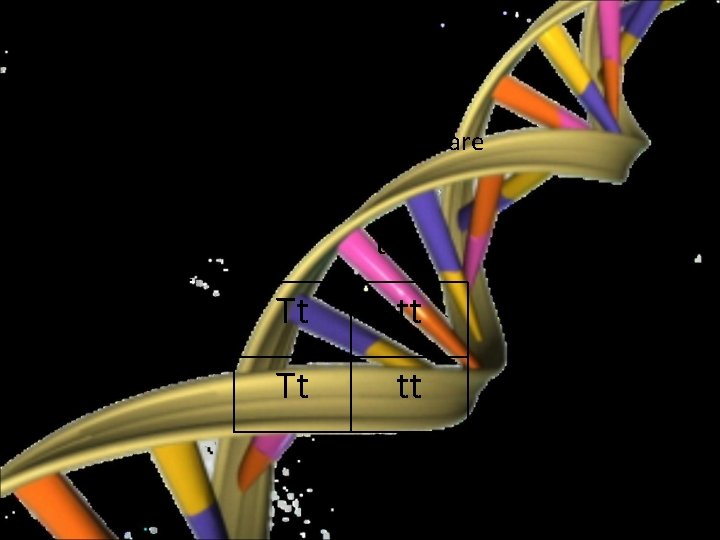
Tt x tt Step Two: Complete the Punnett Square t t Tt tt
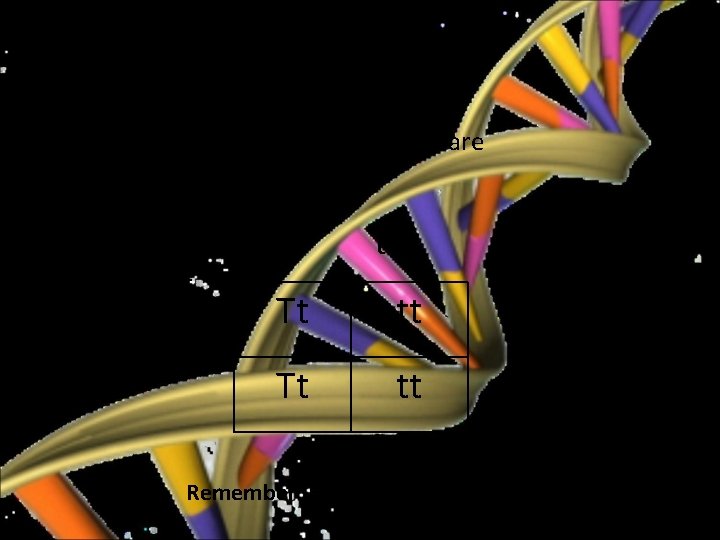
Tt x tt Step Two: Complete the Punnett Square t t Tt tt Remember: Each box is 25% Genotype: Tt - 2 (50%) tt - 2 (50%) Phenotype: 50% Tall 50% Short
Pedigree Charts • The family tree of genetics
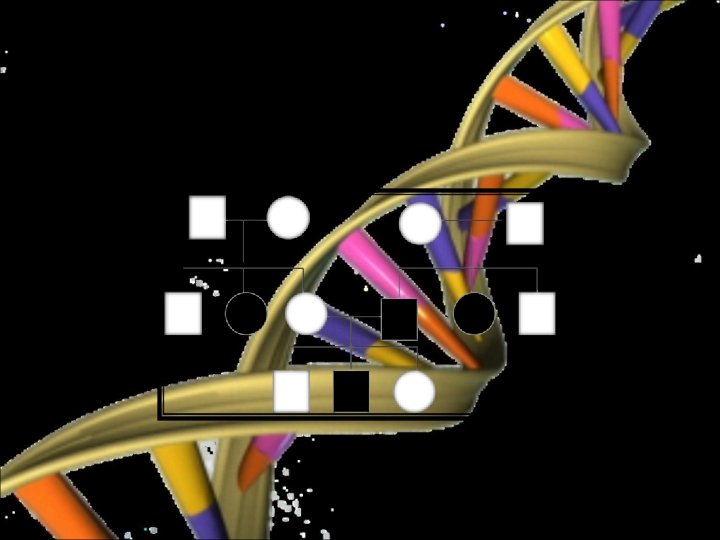
• A pedigree is a chart of the genetic history of family over several generations. • Scientists or a genetic counselor would find out about your family history and make this chart to analyze.
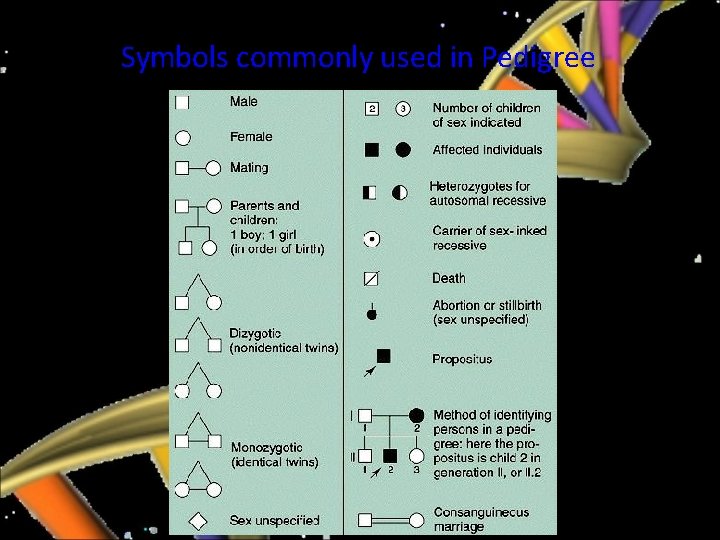
Symbols commonly used in Pedigree
Interpreting a Pedigree Chart 2. Determine whether the disorder is dominant or recessive. – If the disorder is dominant, one of the parents must have the disorder. – If the disorder is recessive, neither parent has to have the disorder because they can be heterozygous.
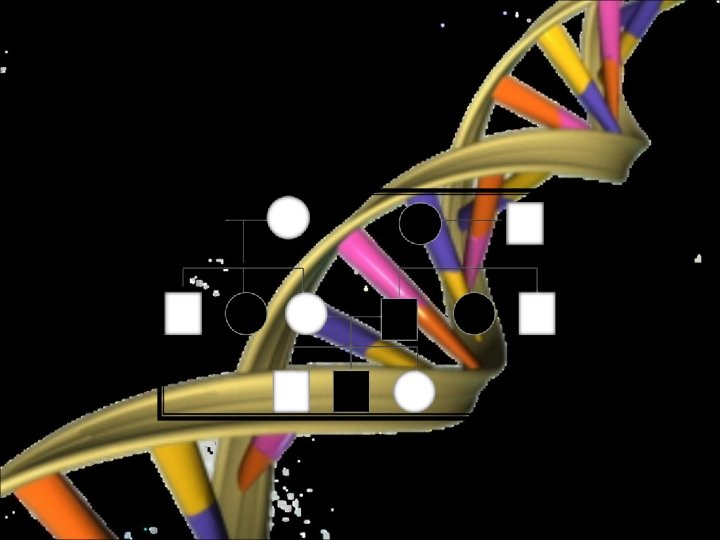
Dominant
Recessive
• Autosome = all chromosomes are called autosomes except sex chromosomes • Humans normally have 22 pairs of autosomes (44 autosomes) in each cell, together with 2 sex chromosomes • A single abnormal gene on one of the first 22 nonsex (autosomal) chromosomes from either parent can cause an autosomal disorder.
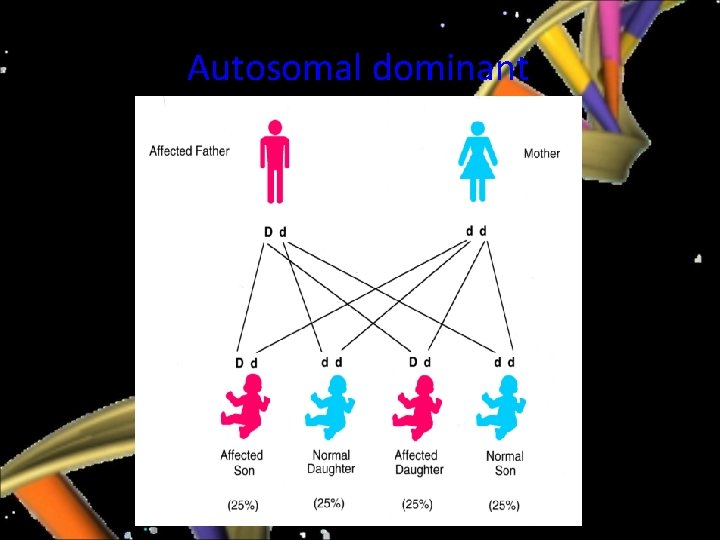
Autosomal dominant
Structure of DNA and RNA
Nucleic Acids • There are two kinds of nucleic acids in cells: 1) ribonucleic acids (RNA) 2) deoxyribonucleic acids (DNA) • Both RNA and DNA are polymers built from monomers called nucleotides. • A nucleotide is composed of: – a base, a monosaccharide, and a phosphate.
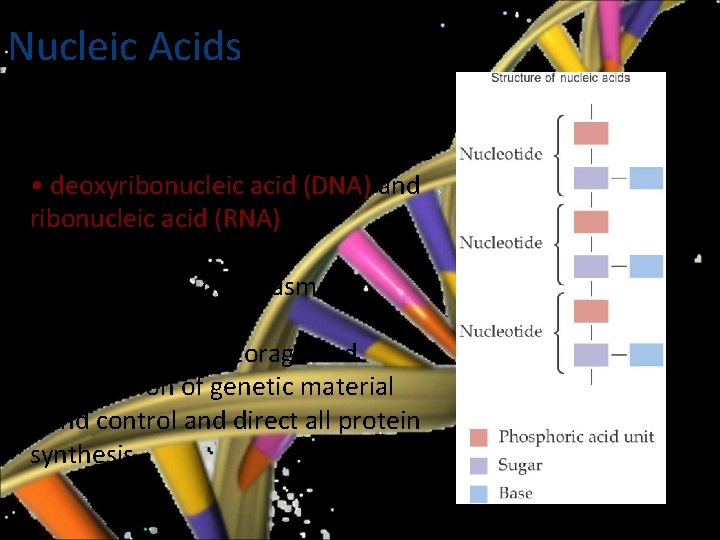
Nucleic Acids • made up of nucleotides • found in all living cells except RBC • deoxyribonucleic acid (DNA) and ribonucleic acid (RNA) • DNA is in the nucleus • RNA is in the cytoplasm • function in the storage and transmission of genetic material • And control and direct all protein synthesis
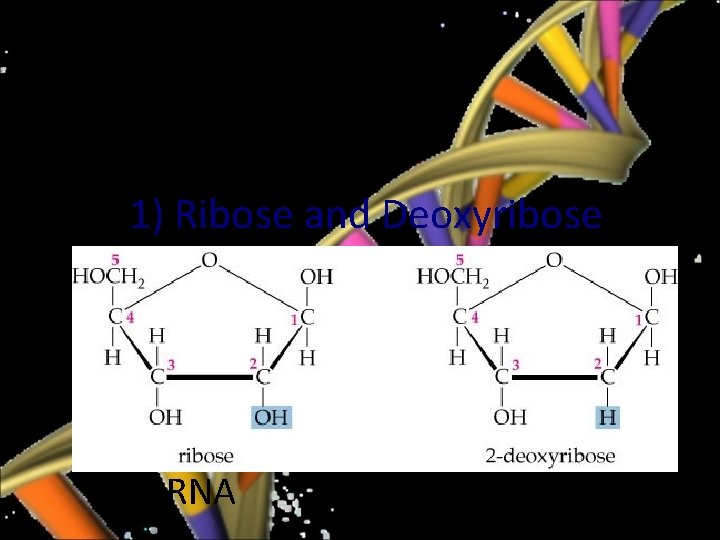
-each nucleotide contains 1) a sugar 2) a base 3) phosphoric acid unit 1) Ribose and Deoxyribose RNA DNA
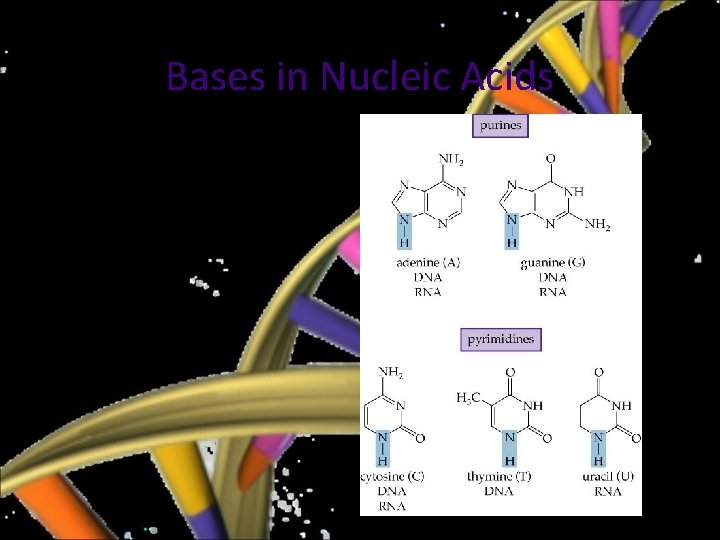
Bases in Nucleic Acids Bases for DNA: A, G, C, T Bases for RNA: A, G, C, U
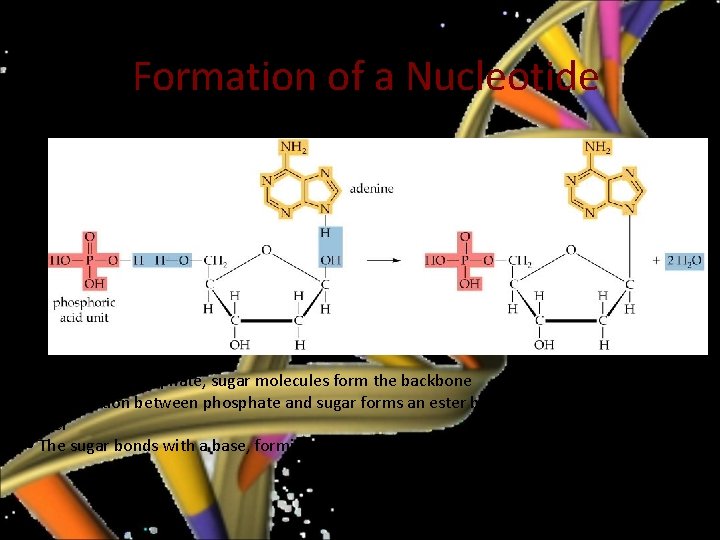
Formation of a Nucleotide • Alternating phosphate, sugar molecules form the backbone • The reaction between phosphate and sugar forms an ester bond with the elimination of water • The sugar bonds with a base, forming tertiary amine, with the elimination of water
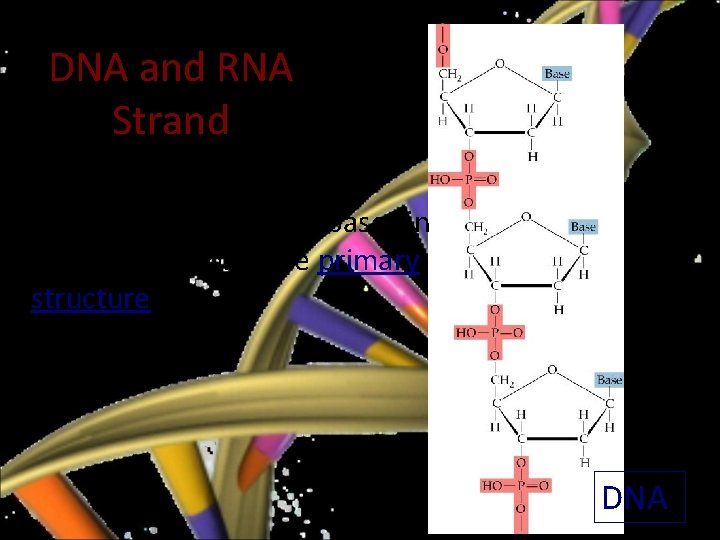
DNA and RNA Strand • The sequence of the bases in DNA or RNA form the primary structure DNA
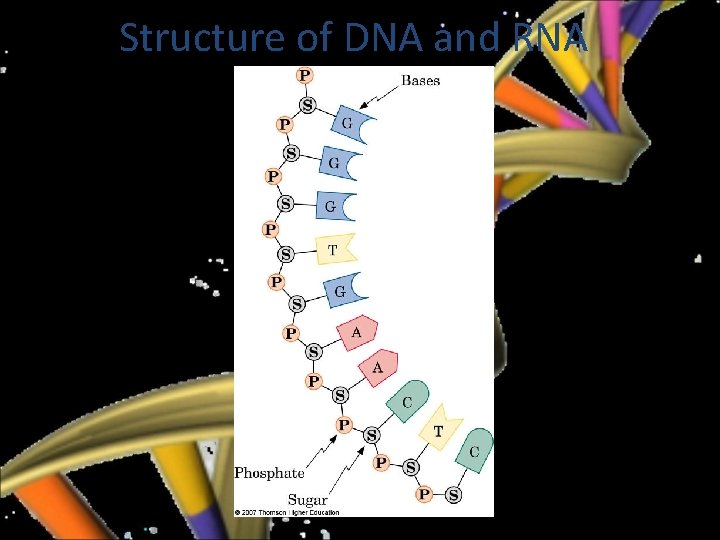
Structure of DNA and RNA
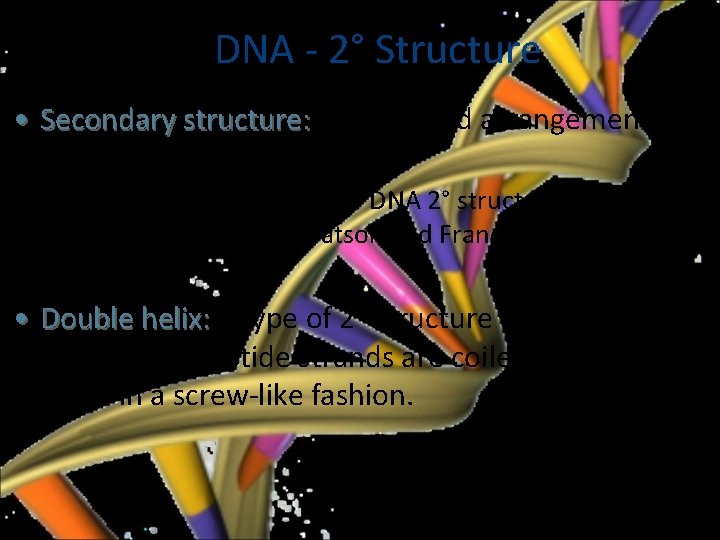
DNA - 2° Structure • Secondary structure: the ordered arrangement of nucleic acid strands. – the double helix model of DNA 2° structure was proposed by James Watson and Francis Crick in 1953. • Double helix: a type of 2° structure of DNA in which two polynucleotide strands are coiled around each other in a screw-like fashion.
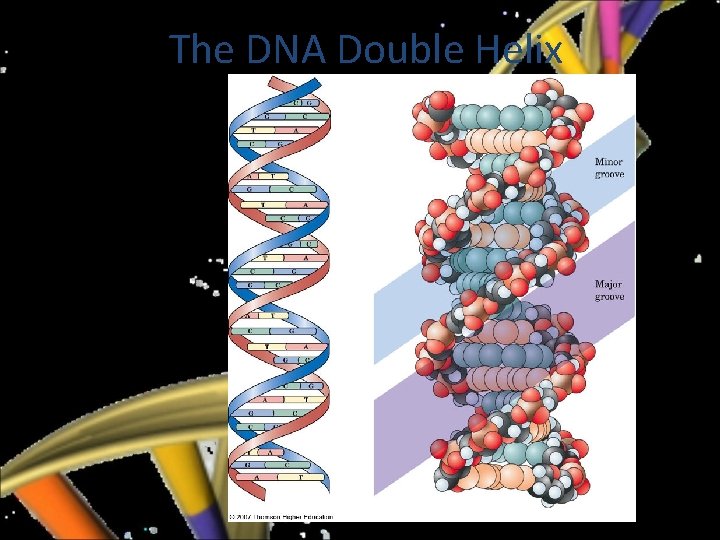
The DNA Double Helix • Figure 25. 4 Threedimensional structure of a DNA double helix.
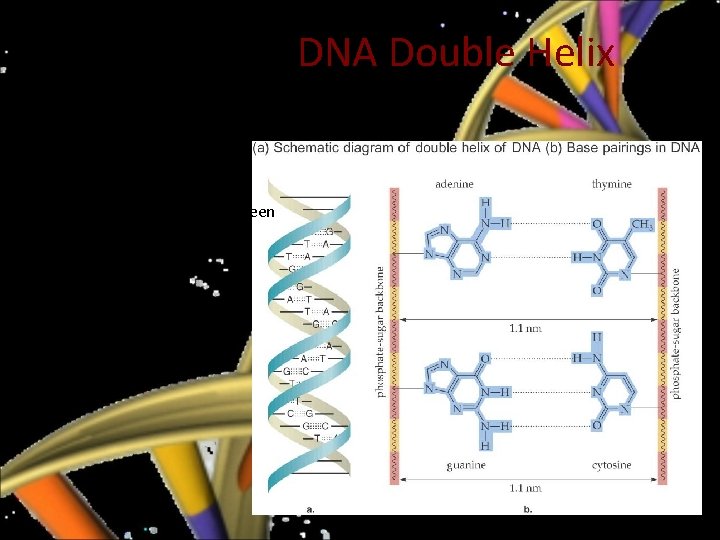
• Like a spiral staircase: -the phosphate sugar backbone represents the hand rail, the bases represent the steps • Hydrogen bonding occurs between the bases…. . For DNA: A bonds with T C bonds with G For RNA: A bonds with U C bonds with G DNA Double Helix
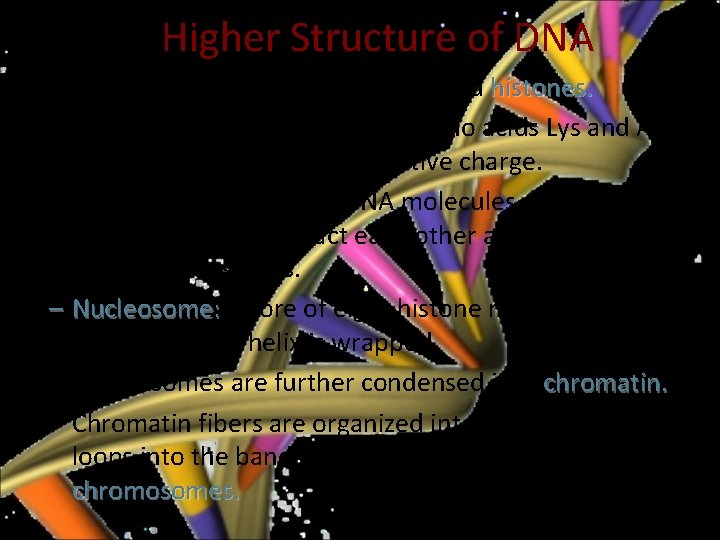
Higher Structure of DNA – DNA is coiled around proteins called histones. – Histones are rich in the basic amino acids Lys and Arg, whose side chains have a positive charge. – The negatively-charged DNA molecules and positivelycharged histones attract each other and form units called nucleosomes. – Nucleosome: a core of eight histone molecules around which the DNA helix is wrapped. – Nucleosomes are further condensed into chromatin. – Chromatin fibers are organized into loops, and the loops into the bands that provide the superstructure of chromosomes.
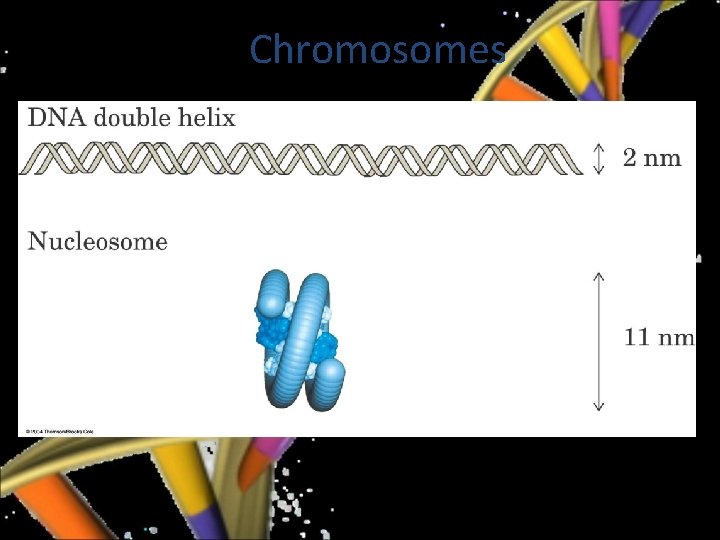
Chromosomes
DNA and RNA • The three differences in structure between DNA and RNA are: – DNA bases are A, G, C, and T; the RNA bases are A, G, C, and U. – The sugar in DNA is deoxyribose; deoxyribose in RNA it is ribose. – DNA is always double stranded; stranded there are several kinds of RNA, most of which are single-stranded.
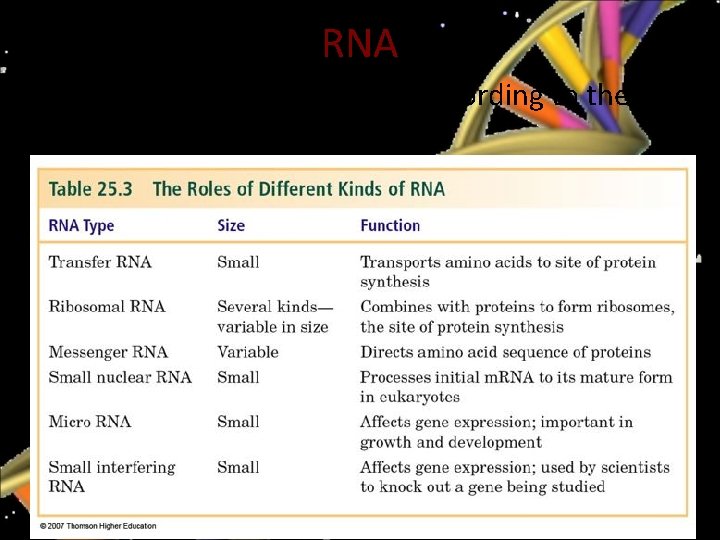
RNA • RNA molecules are classified according to their structure and function.
Genes, Exons, and Introns Gene: A segment of DNA that carries a base sequence that directs the synthesis of a particular protein, t. RNA, or m. RNA. – There are many genes in one DNA molecule. Exon: A section of DNA that, when transcribed, codes for a protein or RNA. Intron: A section of DNA that does not code for anything functional.
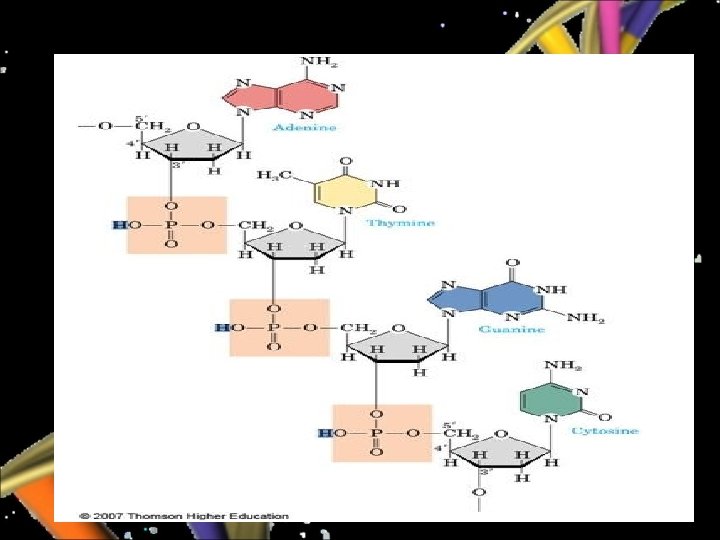
Structure of RNA • There are three Major types of RNA in the process of protein synthesis. • r. RNA • t. RNA • m. RNA • Like DNA these three types of RNA are unbranched polymeric molecules composed of nucleoside monophosphate joined together by 3— 5 phosphodiester bonds
• However, RNA differ from DNA in Several ways • RNA are smaller than DNA • Contain ribose in place of deoxyribose • Contain uracil inplace of thymine • Exist as single strand
Ribosomal RNA • r. RNAs are found in association with several proteins as components of the ribosomes— the complex structures that serve as the sites for protein synthesis.
Transfer RNA • t. RNAs are the smallest (4 S) of the three major types of RNA molecules. There is at least one specific type of t. RNA molecule for each of the 20 amino acids commonly found in proteins.
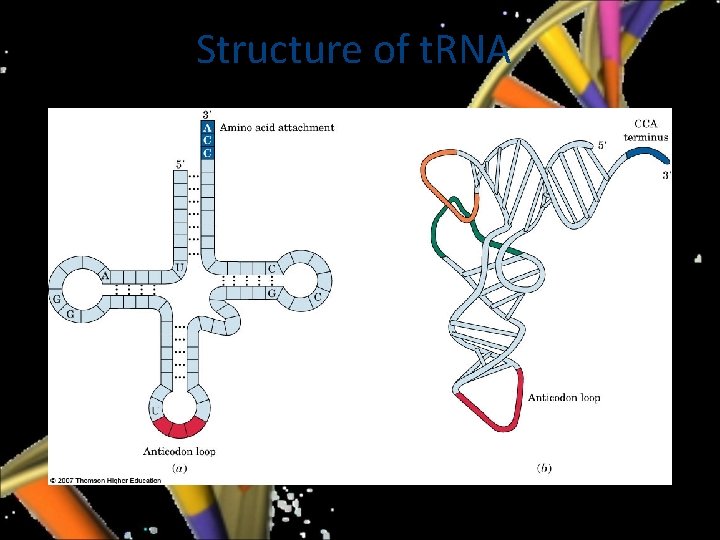
Structure of t. RNA
Messenger RNA • The m. RNA carries genetic information from the nuclear DNA to the cytosol, where it is used as the template for protein synthesis.
Practice Questions
• 1. When two alleles are the same they are a. Hybrid b. Heterozygous c. Genetic Cross d. Homozygous
Key: D a) a hybrid, or crossbreed, is the result of combining the qualities of two organisms of different breeds, varieties, species or genera through sexual reproduction b) An organism which has two different alleles of the gene is called heterozygous. c) The deliberate breeding of two different individuals that results in offspring that carry part of the genetic material of each parent. d) An organism in which the two copies of the gene are identical that is, have the same allele is called homozygous for that gene.
2. R is the allele for brown hair and r is the allele for blonde hair. What color hair would a person with Rr have? a. black b. brown c. Golden d. blonde
Key: B • Black is not present in the gene • Brown is present in the dominant ‘R’ allele. Dominant allele is the characteristics of an individual. • Golden is not present in the gene • Blonde is present in the recessive ‘r’ allele
3. A black cow and brown bull are mated. Each is homozygous and black is dominant to brown. What is the chances that the offspring will be brown? a. 25% b. 50% c. 75% d. 0%
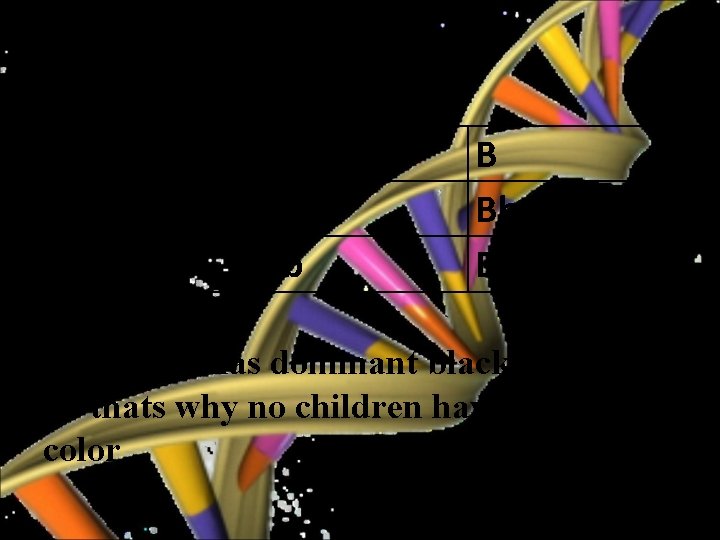
Key: D b b B Bb Bb Each gene has dominant black allele (B). So thats why no children have brown color
4. One cat is heterozygous, long hair (Rr), and it mate carries homozygous short hair (rr). What is the probability of the offspring having short hair? a. 50% b. 100% c. 25% d. 75%
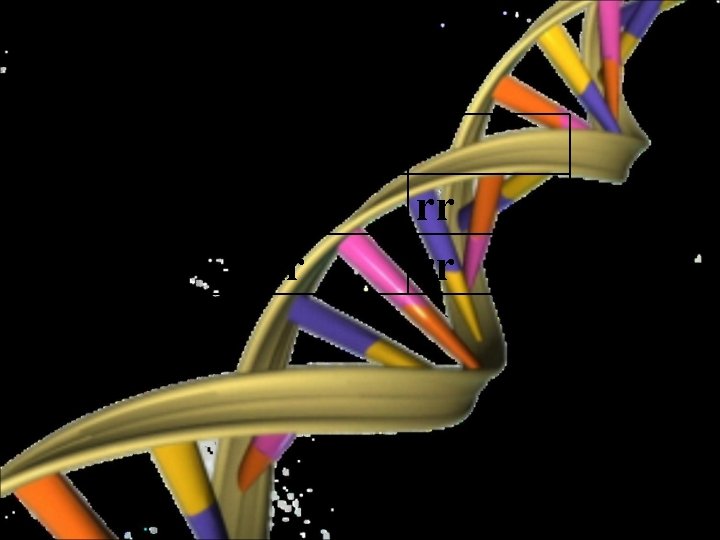
Key: a r r R Rr Rr r rr rr
5. What is the study of heredity called? a. Environmental b. Natural Selection c. Genetics d. Evolution
Key: C a) Environmental factor is any factor, abiotic or biotic, that influences living organisms. b) Natural selection is the differential survival and reproduction of individuals due to differences in phenotype. c) The study of heredity in biology is Genetics d) Evolution is the change in the characteristics of a species over several generations and relies on the process of natural selection.
- Slides: 73