
INTRODUCTION TO GENETICS DNA STRUCTURE FUNCTION PHA Biology
INTRODUCTION TO GENETICS DNA: STRUCTURE & FUNCTION PHA Biology 9 Moretti/ Dickson
Bio 9 B: Tuesday, 2. 2. 10 Title: DNA Structure & Function Homework: Read pages 297 -299 and take active reading notes. Summarize how DNA replicates! Do Now: Study the diagram of Genetic Information in Cells. Answer the Fill-in-the-Blanks on the back of the diagram Today’s Objectives: Explain how DNA, genes, nucleotides, and chromosomes relate to each other. Describe the structure of DNA.
Intro to Genetics: DNA Structure & Function Genetics: the study of heredity What determines an organism’s traits (characteristics)? How are traits passed on from one cell to another, and from parents to offspring? DNA: the molecule that carries genetic information DNA has two important functions: Replicate – make exact copies of itself so it can be passed on Carry instructions for making proteins that determine your traits DNA is found in all cells (in the nucleus in eukaryotic cells) Objectives for Class: • Explain how DNA, genes, nucleotides, and chromosomes relate to each other. • Describe the structure of DNA.
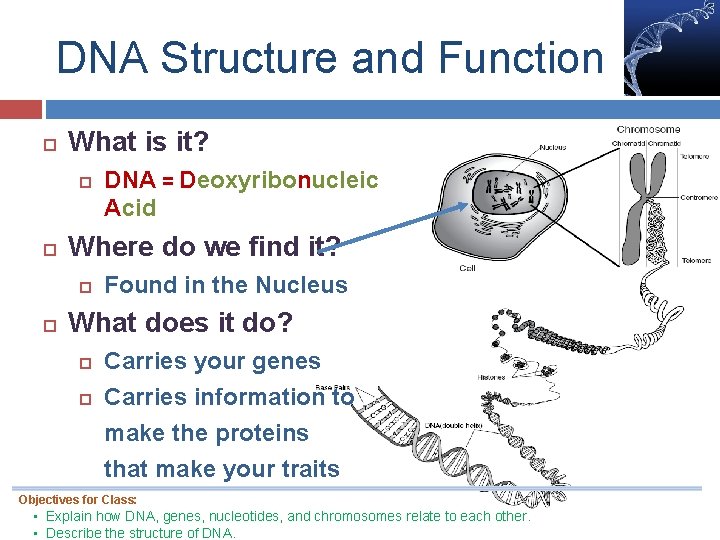
DNA Structure and Function What is it? Where do we find it? DNA = Deoxyribonucleic Acid Found in the Nucleus What does it do? Carries your genes Carries information to make the proteins that make your traits Objectives for Class: • Explain how DNA, genes, nucleotides, and chromosomes relate to each other. • Describe the structure of DNA.
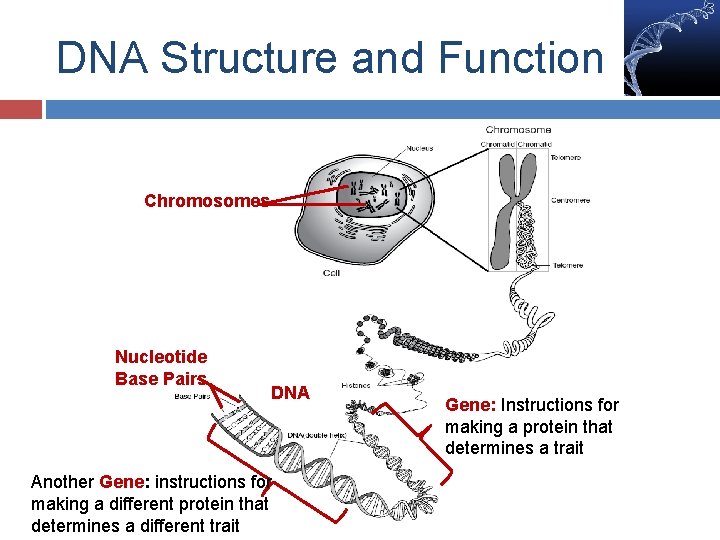
DNA Structure and Function Chromosomes Nucleotide Base Pairs DNA Another Gene: instructions for making a different protein that determines a different trait Gene: Instructions for making a protein that determines a trait
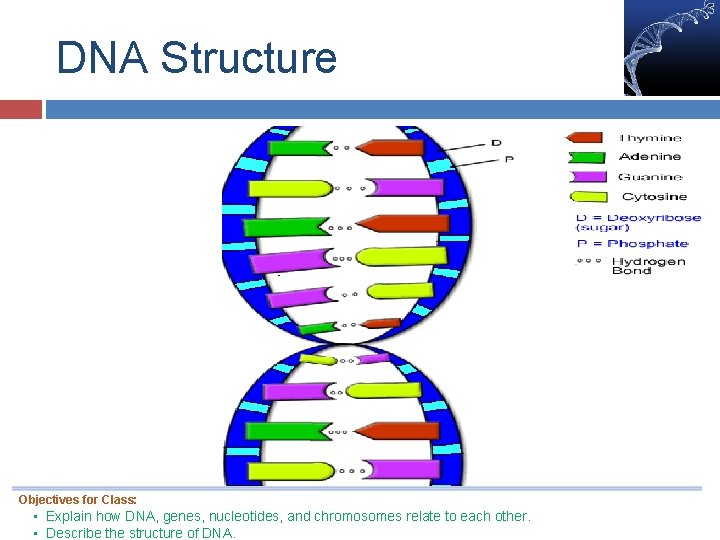
DNA Structure Objectives for Class: • Explain how DNA, genes, nucleotides, and chromosomes relate to each other. • Describe the structure of DNA.
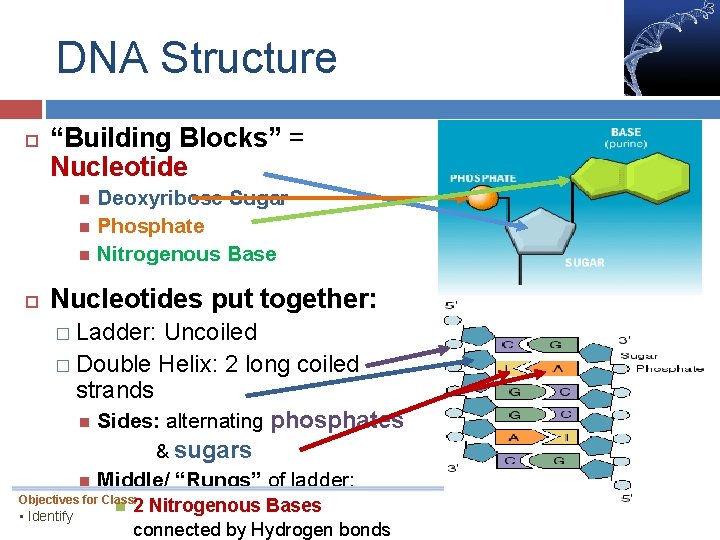
DNA Structure “Building Blocks” = Nucleotide Deoxyribose Sugar Phosphate Nitrogenous Base Nucleotides put together: � Ladder: Uncoiled � Double Helix: 2 long coiled strands Sides: alternating phosphates & sugars Middle/ “Rungs” of ladder: Objectives for Class: • Identify 2 Nitrogenous Bases connected by Hydrogen bonds
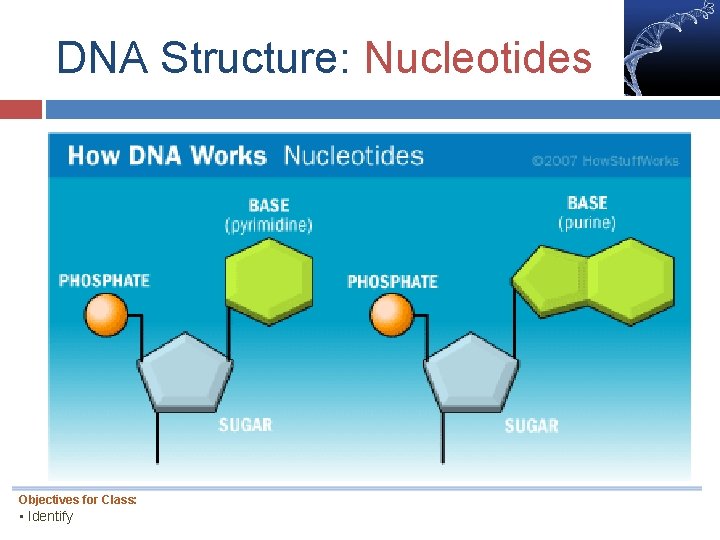
DNA Structure: Nucleotides Objectives for Class: • Identify
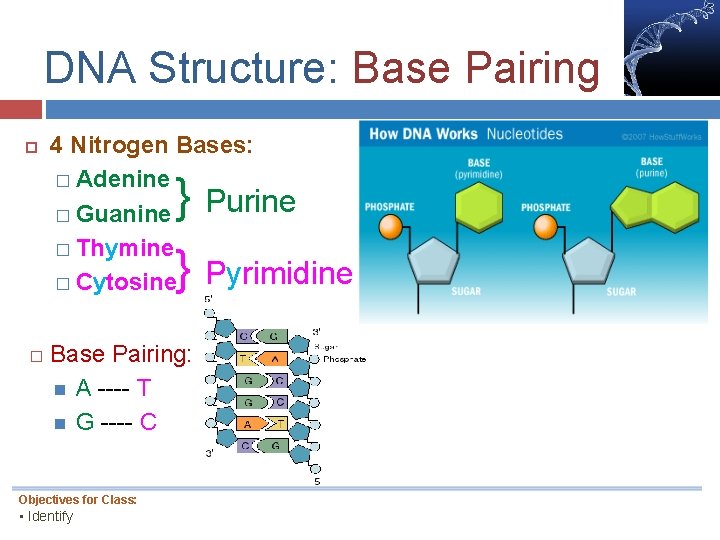
DNA Structure: Base Pairing 4 Nitrogen Bases: � Adenine Purine � Guanine � Thymine Pyrimidine � Cytosine } } � Base Pairing: A ---- T G ---- C Objectives for Class: • Identify
Bio 9 B: Thursday, 2. 4. 10 Title: DNA Structure & Function Homework: Complete Discussion Questions for lab. Do Now: Today’s Objectives: Double Block Explain how DNA, genes, nucleotides, and chromosomes relate to each other. Describe the structure of DNA. Explain WHY DNA must replicate and the 3 steps of HOW DNA replicates.
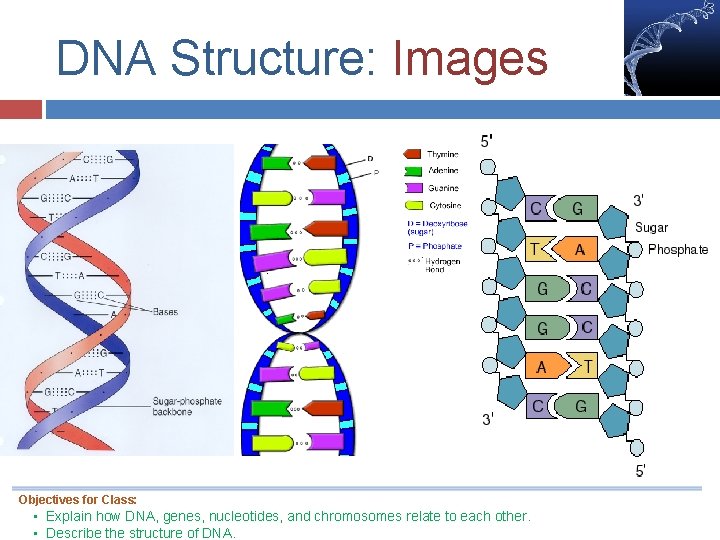
DNA Structure: Images Objectives for Class: • Explain how DNA, genes, nucleotides, and chromosomes relate to each other. • Describe the structure of DNA.
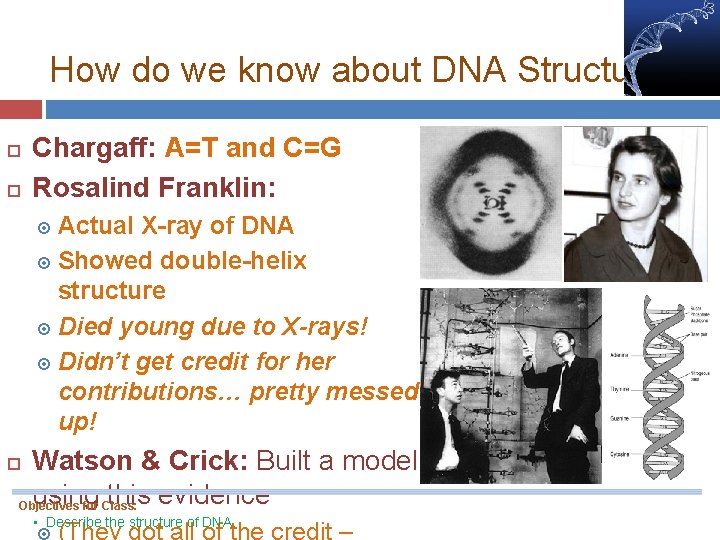
How do we know about DNA Structure? Chargaff: A=T and C=G Rosalind Franklin: Actual X-ray of DNA Showed double-helix structure Died young due to X-rays! Didn’t get credit for her contributions… pretty messed up! Watson & Crick: Built a model using this evidence Objectives for Class: • Describe the structure of DNA. (They got all of the credit –
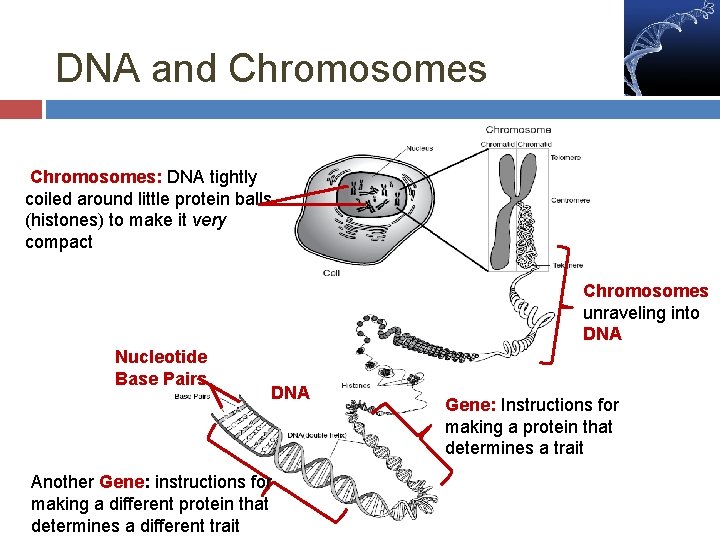
DNA and Chromosomes: DNA tightly coiled around little protein balls (histones) to make it very compact Chromosomes unraveling into DNA Nucleotide Base Pairs DNA Another Gene: instructions for making a different protein that determines a different trait Gene: Instructions for making a protein that determines a trait
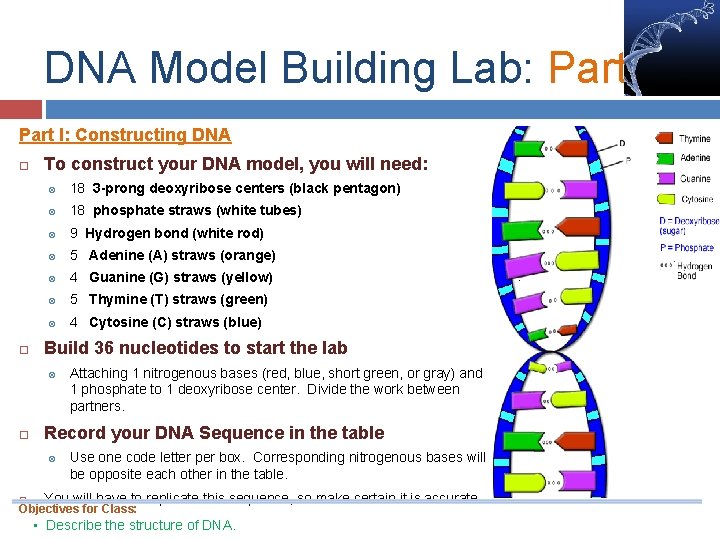
DNA Model Building Lab: Part I: Constructing DNA To construct your DNA model, you will need: 18 3 -prong deoxyribose centers (black pentagon) 18 phosphate straws (white tubes) 9 Hydrogen bond (white rod) 5 Adenine (A) straws (orange) 4 Guanine (G) straws (yellow) 5 Thymine (T) straws (green) 4 Cytosine (C) straws (blue) Build 36 nucleotides to start the lab Record your DNA Sequence in the table Attaching 1 nitrogenous bases (red, blue, short green, or gray) and 1 phosphate to 1 deoxyribose center. Divide the work between partners. Use one code letter per box. Corresponding nitrogenous bases will be opposite each other in the table. You will have to replicate this sequence, so make certain it is accurate. Objectives for Class: • Describe the structure of DNA.
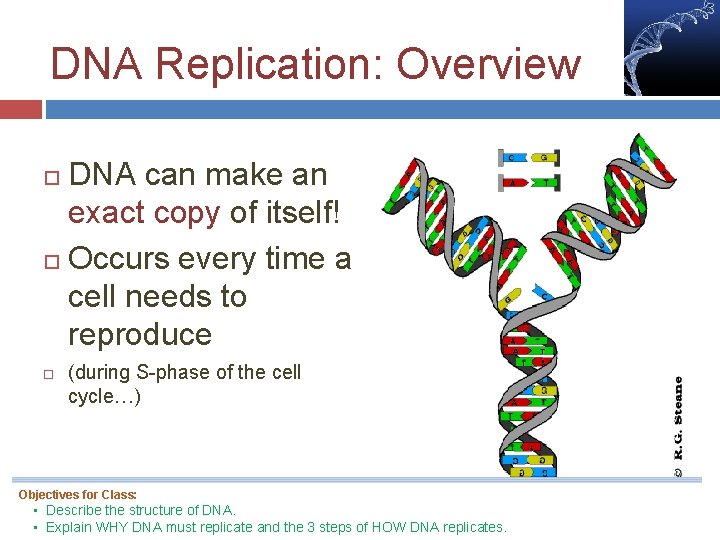
DNA Replication: Overview DNA can make an exact copy of itself! Occurs every time a cell needs to reproduce (during S-phase of the cell cycle…) Objectives for Class: • Describe the structure of DNA. • Explain WHY DNA must replicate and the 3 steps of HOW DNA replicates.
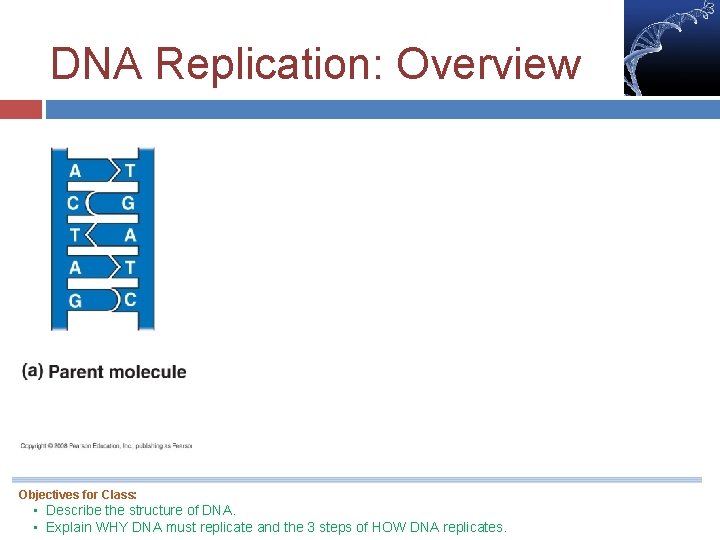
DNA Replication: Overview Objectives for Class: • Describe the structure of DNA. • Explain WHY DNA must replicate and the 3 steps of HOW DNA replicates.
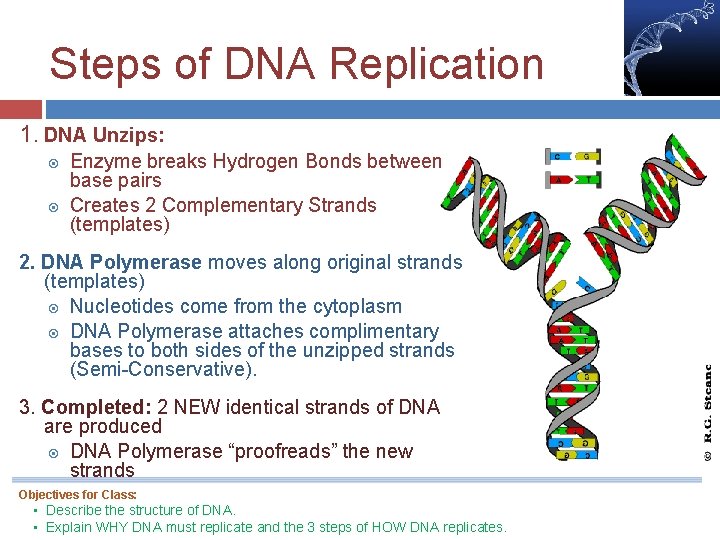
Steps of DNA Replication 1. DNA Unzips: Enzyme breaks Hydrogen Bonds between base pairs Creates 2 Complementary Strands (templates) 2. DNA Polymerase moves along original strands (templates) Nucleotides come from the cytoplasm DNA Polymerase attaches complimentary bases to both sides of the unzipped strands (Semi-Conservative). 3. Completed: 2 NEW identical strands of DNA are produced DNA Polymerase “proofreads” the new strands Objectives for Class: • Describe the structure of DNA. • Explain WHY DNA must replicate and the 3 steps of HOW DNA replicates.
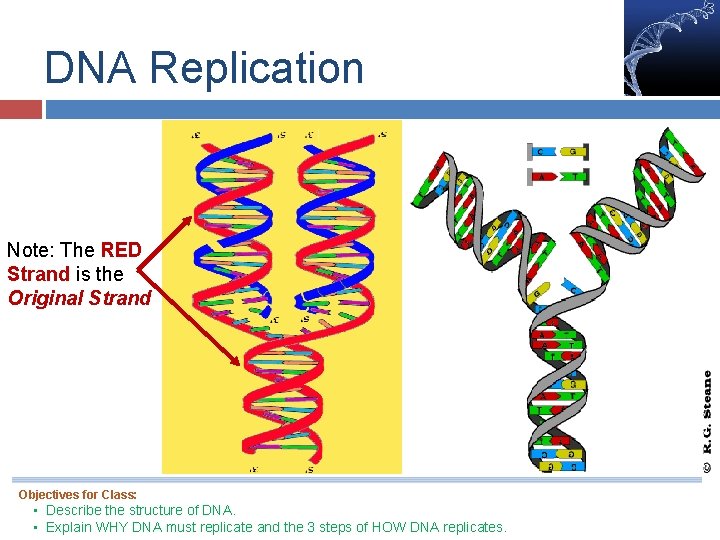
DNA Replication Note: The RED Strand is the Original Strand Objectives for Class: • Describe the structure of DNA. • Explain WHY DNA must replicate and the 3 steps of HOW DNA replicates.
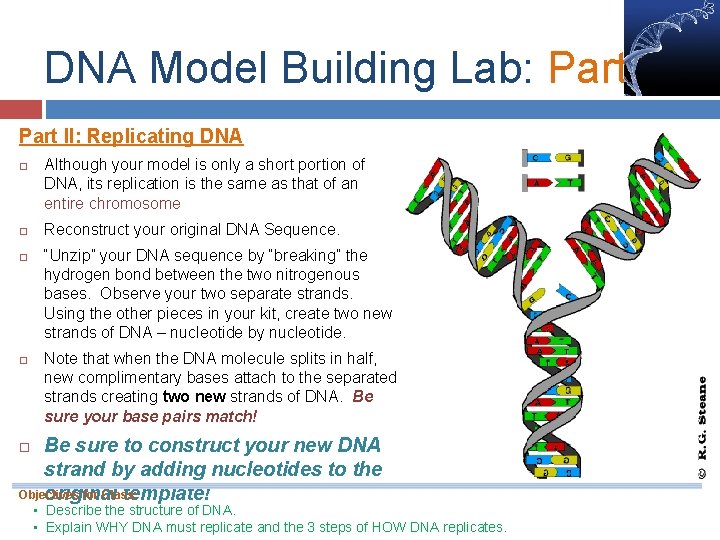
DNA Model Building Lab: Part II: Replicating DNA Although your model is only a short portion of DNA, its replication is the same as that of an entire chromosome Reconstruct your original DNA Sequence. “Unzip” your DNA sequence by “breaking” the hydrogen bond between the two nitrogenous bases. Observe your two separate strands. Using the other pieces in your kit, create two new strands of DNA – nucleotide by nucleotide. Note that when the DNA molecule splits in half, new complimentary bases attach to the separated strands creating two new strands of DNA. Be sure your base pairs match! Be sure to construct your new DNA strand by adding nucleotides to the Objectives for Class: original template! • Describe the structure of DNA. • Explain WHY DNA must replicate and the 3 steps of HOW DNA replicates.
- Slides: 19