
Introduction to Genetics A Brief History In the
Introduction to Genetics
A Brief History In the past, people did not understand how traits were inherited, but there were many guesses based on things that could be observed. Two theories emerged: � Blending Theory: offspring are a straight mix � Particulate Theory: traits are inherited as “particles”, offspring receive a “piece” from each parent, some pieces may hide the others. Golden Doodle
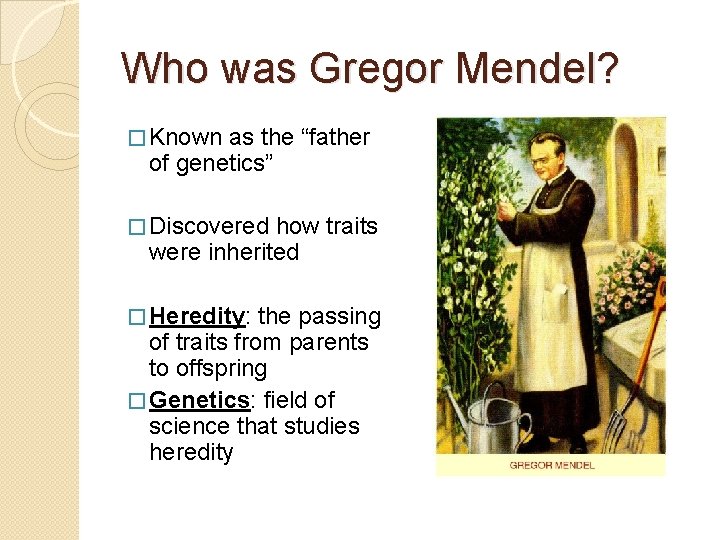
Who was Gregor Mendel? � Known as the “father of genetics” � Discovered how traits were inherited � Heredity: the passing of traits from parents to offspring � Genetics: field of science that studies heredity
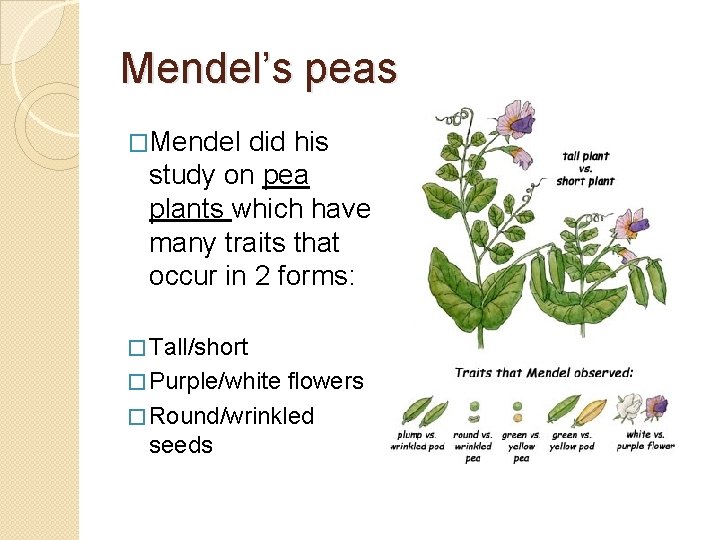
Mendel’s peas �Mendel did his study on pea plants which have many traits that occur in 2 forms: � Tall/short � Purple/white flowers � Round/wrinkled seeds
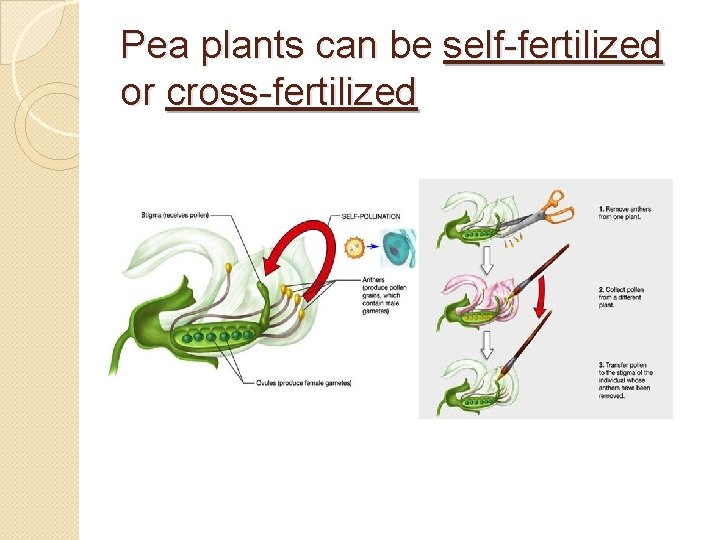
Pea plants can be self-fertilized or cross-fertilized

True-Breeding vs Hybrids �True-Breeding Plants: always create offspring that look like themselves �Hybrids: offspring of true-breeding plants Tall x Short = Hybrid
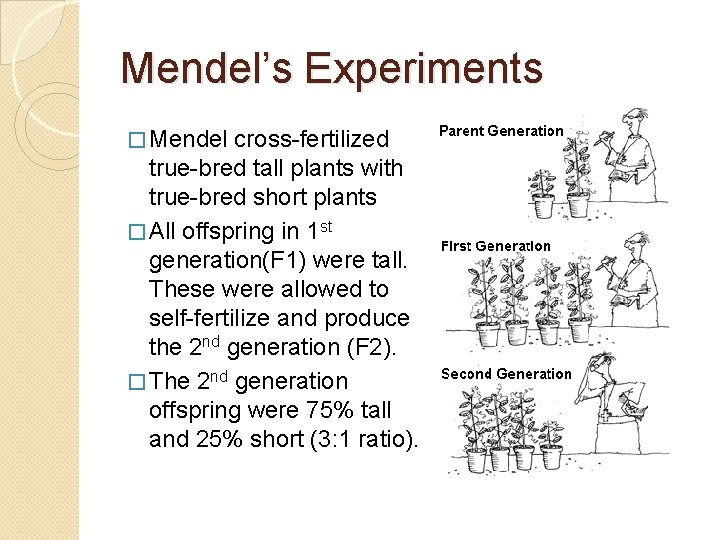
Mendel’s Experiments � Mendel cross-fertilized true-bred tall plants with true-bred short plants � All offspring in 1 st generation(F 1) were tall. These were allowed to self-fertilize and produce the 2 nd generation (F 2). � The 2 nd generation offspring were 75% tall and 25% short (3: 1 ratio).
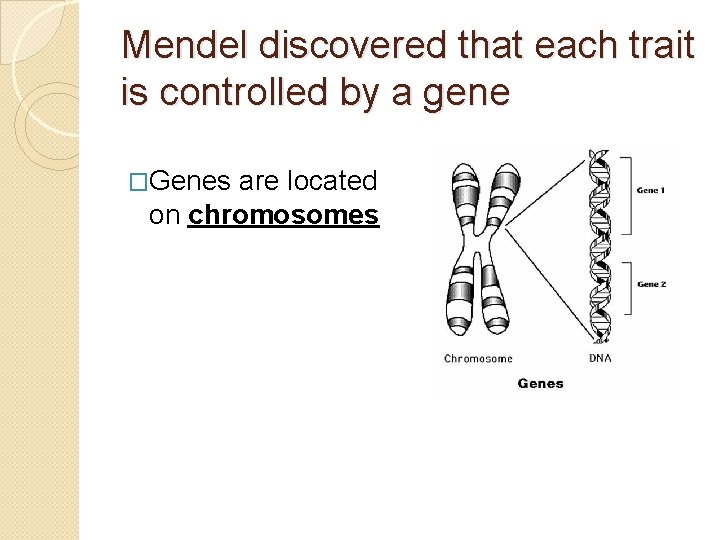
Mendel discovered that each trait is controlled by a gene �Genes are located on chromosomes
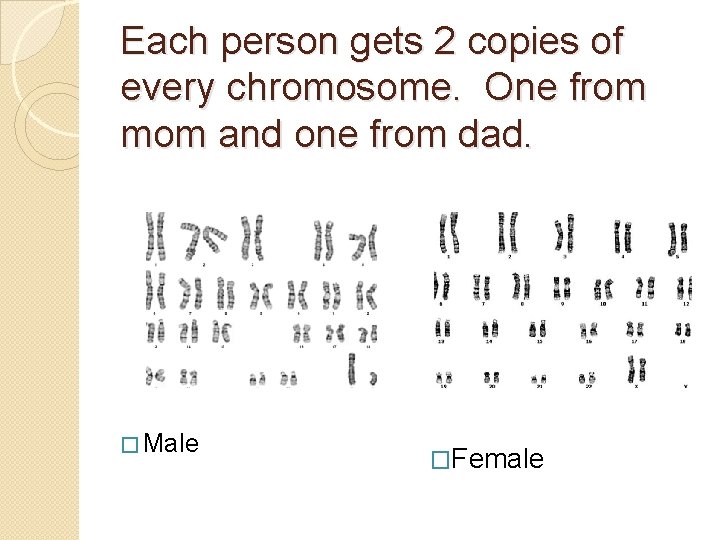
Each person gets 2 copies of every chromosome. One from mom and one from dad. � Male �Female
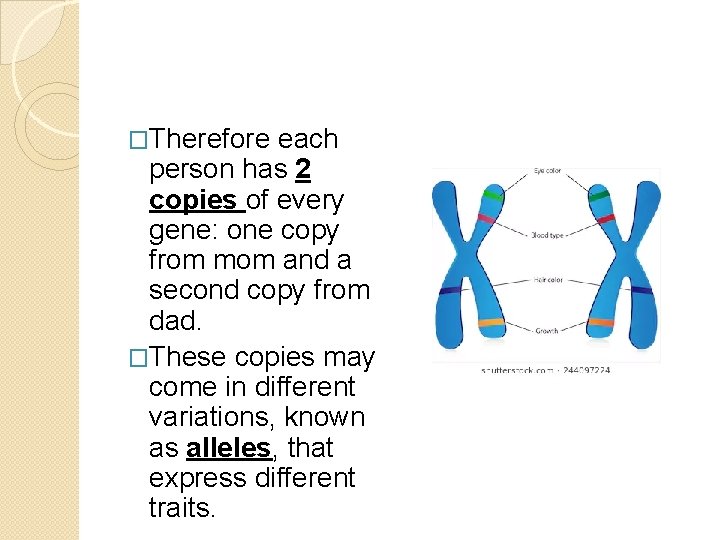
�Therefore each person has 2 copies of every gene: one copy from mom and a second copy from dad. �These copies may come in different variations, known as alleles, that express different traits.
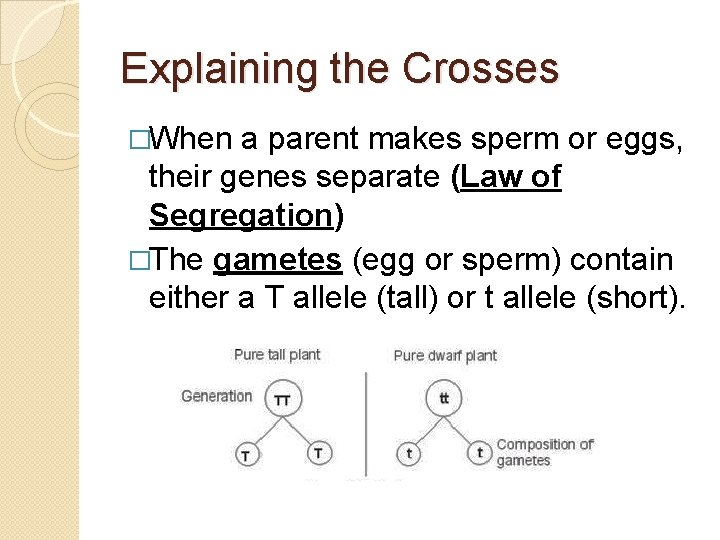
Explaining the Crosses �When a parent makes sperm or eggs, their genes separate (Law of Segregation) �The gametes (egg or sperm) contain either a T allele (tall) or t allele (short).
Dominant vs Recessive �Not every allele pulls even weight! There are dominant and recessive alleles. �Dominant alleles hide recessive ones! �Single genes are represented by a single letter �Dominant: Capital (E. g. G) �Recessive: lower case (E. g. g) �E. g. If G =green and g = yellow, then Gg = green (G hides g)
Homozygous vs Heterozygous �Individuals with both alleles of the same type are called homozygous �Individuals with different forms of the alleles are called heterozygous BB – homozygous dominant Bb – heterozygous bb – homozygous recessive
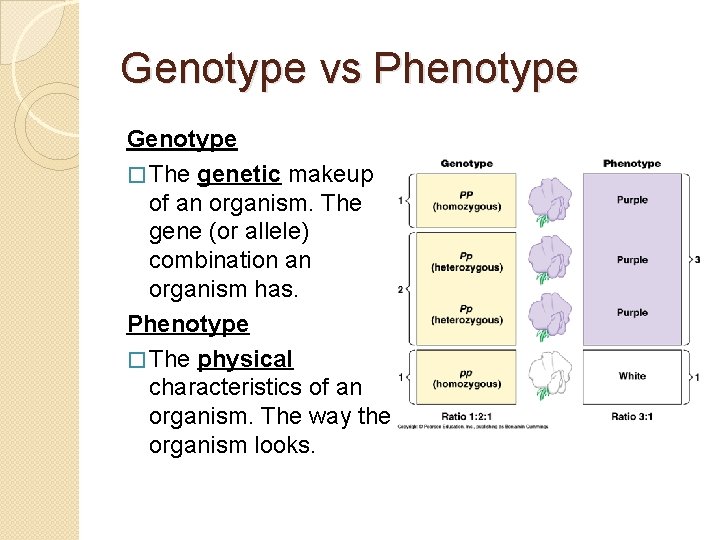
Genotype vs Phenotype Genotype � The genetic makeup of an organism. The gene (or allele) combination an organism has. Phenotype � The physical characteristics of an organism. The way the organism looks.
Punnett Squares �Mendel applied the laws of probability to determine the likelihood that an offspring will have a particular gene �A Punnett square is a method used to predict the chance of various possible genotypes. �It shows all possible gene combinations in offspring of parents with a known genetic makeup.
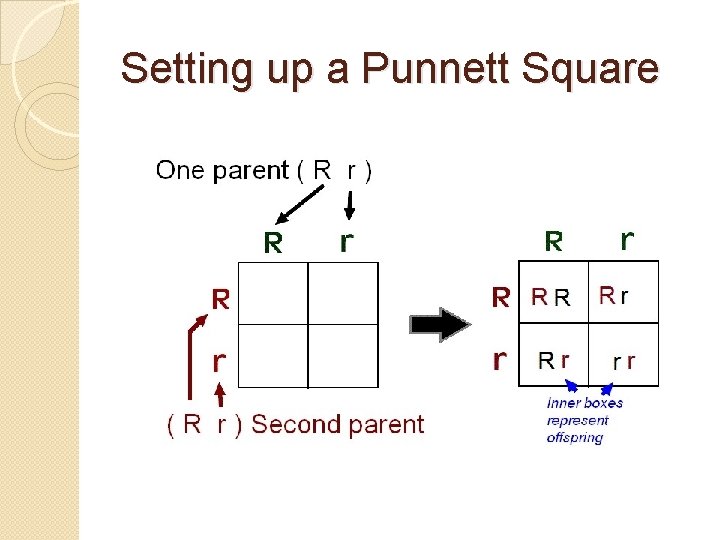
Setting up a Punnett Square
Practice Questions 1. A one-eyed purple people eater is crossed with a two-eyed purple people eater. All of their offspring have two eyes. Which trait is dominant? 2. Use the letter E to represent the gene. What are the 3 possible genotypes for this trait?
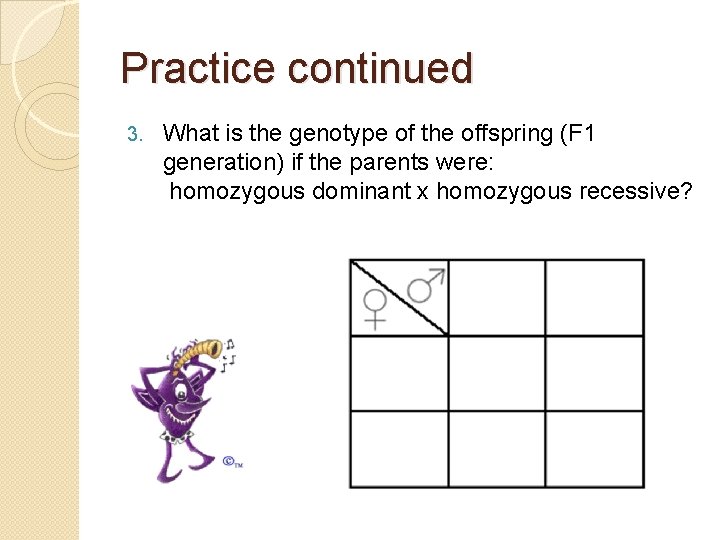
Practice continued 3. What is the genotype of the offspring (F 1 generation) if the parents were: homozygous dominant x homozygous recessive?
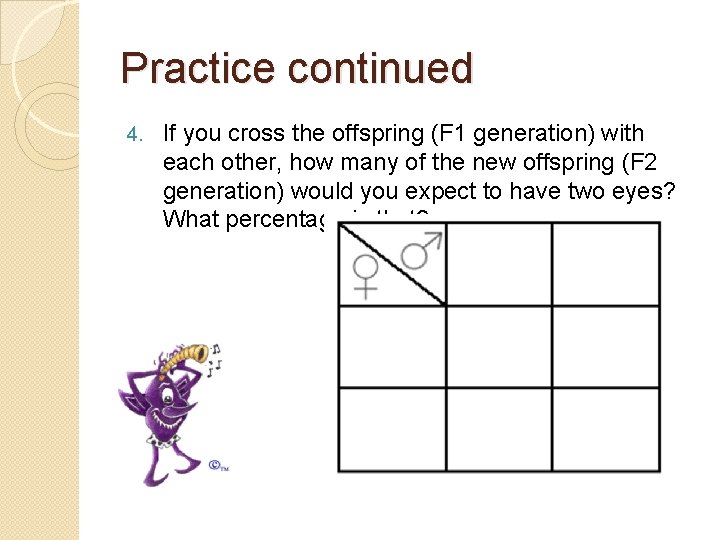
Practice continued 4. If you cross the offspring (F 1 generation) with each other, how many of the new offspring (F 2 generation) would you expect to have two eyes? What percentage is that?
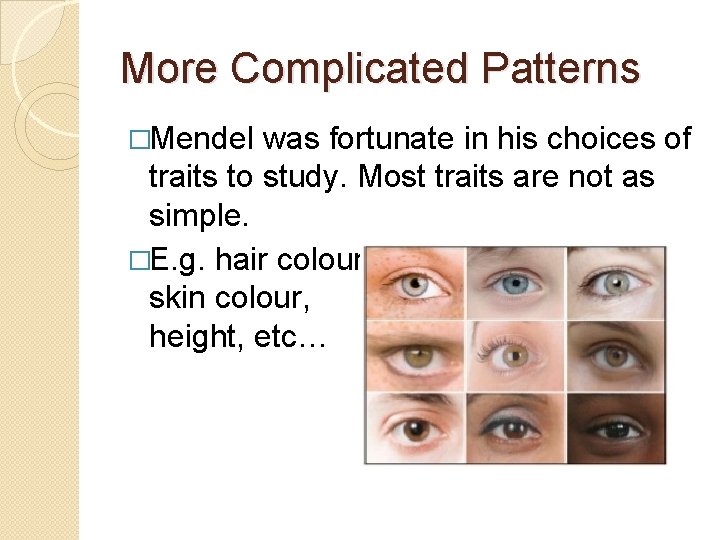
More Complicated Patterns �Mendel was fortunate in his choices of traits to study. Most traits are not as simple. �E. g. hair colour, skin colour, height, etc…
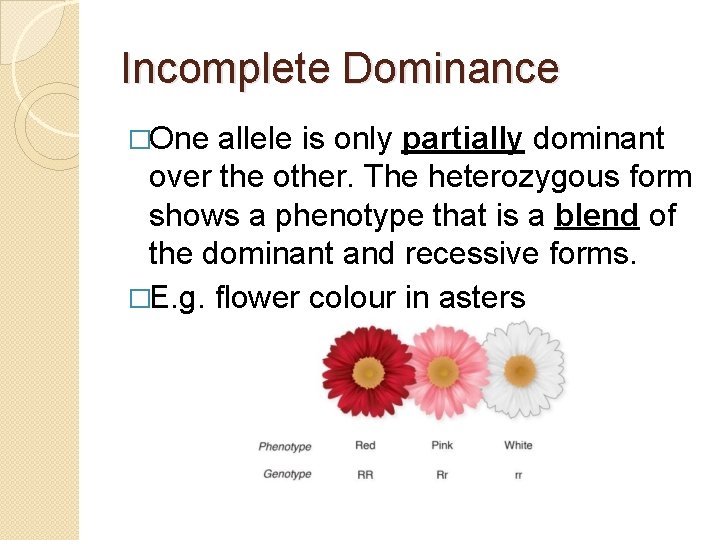
Incomplete Dominance �One allele is only partially dominant over the other. The heterozygous form shows a phenotype that is a blend of the dominant and recessive forms. �E. g. flower colour in asters
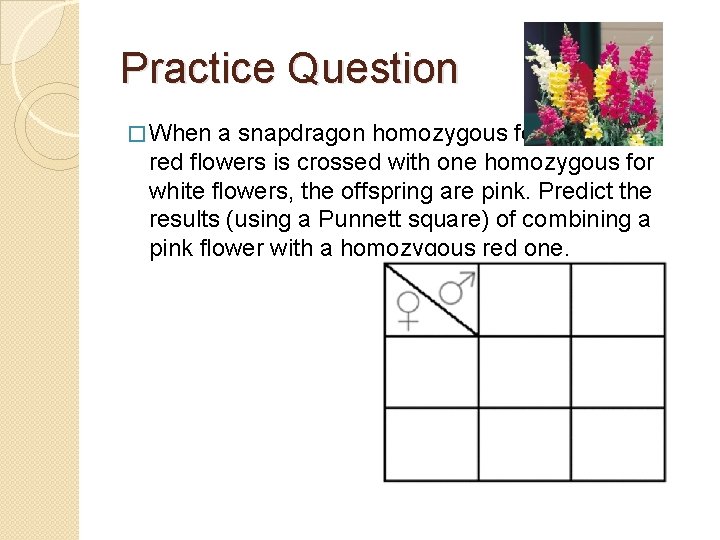
Practice Question � When a snapdragon homozygous for red flowers is crossed with one homozygous for white flowers, the offspring are pink. Predict the results (using a Punnett square) of combining a pink flower with a homozygous red one.
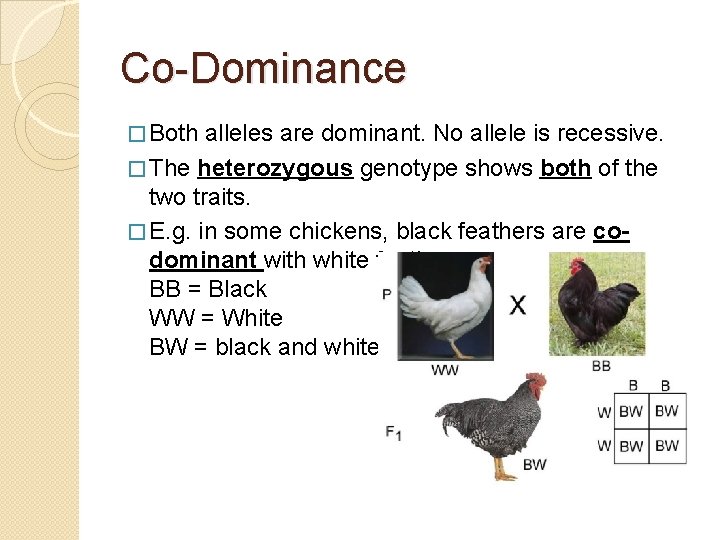
Co-Dominance � Both alleles are dominant. No allele is recessive. � The heterozygous genotype shows both of the two traits. � E. g. in some chickens, black feathers are codominant with white feathers. BB = Black WW = White BW = black and white
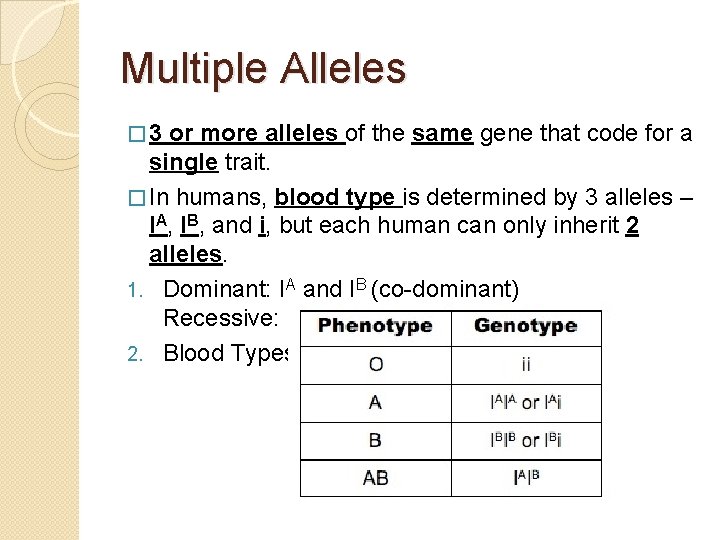
Multiple Alleles � 3 or more alleles of the same gene that code for a single trait. � In humans, blood type is determined by 3 alleles – IA, IB, and i, but each human can only inherit 2 alleles. 1. Dominant: IA and IB (co-dominant) Recessive: i 2. Blood Types:
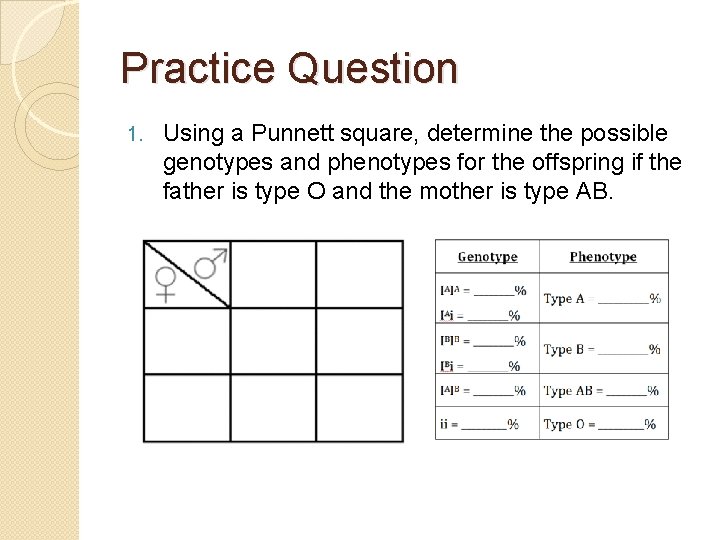
Practice Question 1. Using a Punnett square, determine the possible genotypes and phenotypes for the offspring if the father is type O and the mother is type AB.
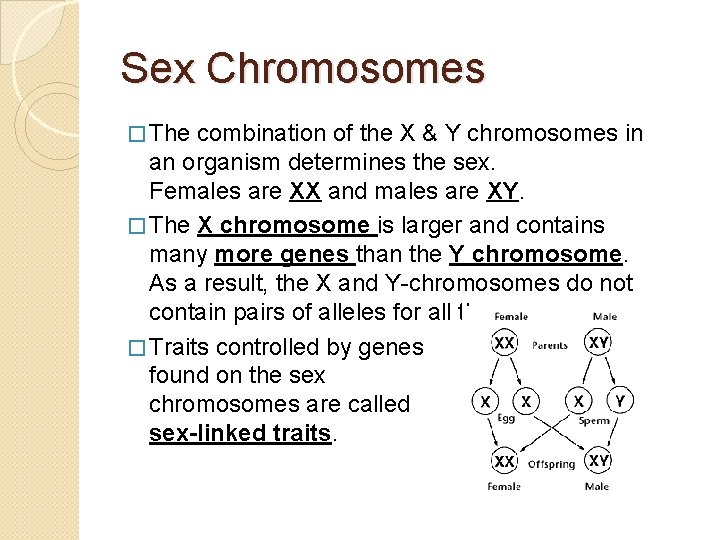
Sex Chromosomes � The combination of the X & Y chromosomes in an organism determines the sex. Females are XX and males are XY. � The X chromosome is larger and contains many more genes than the Y chromosome. As a result, the X and Y-chromosomes do not contain pairs of alleles for all the same genes. � Traits controlled by genes found on the sex chromosomes are called sex-linked traits.
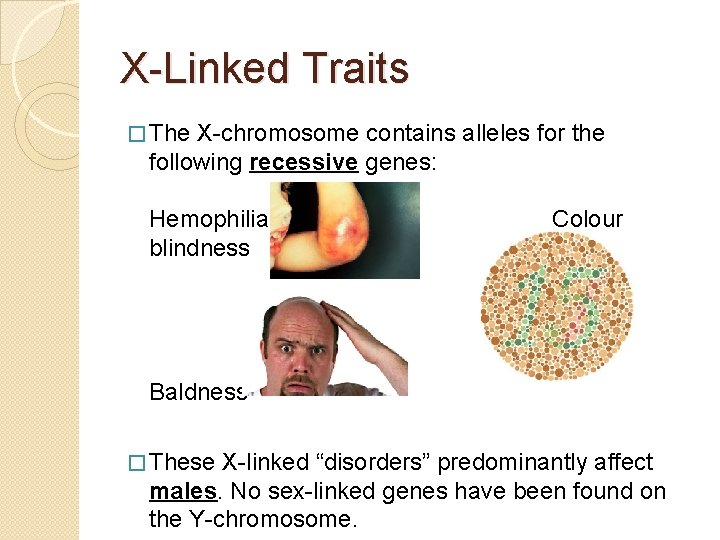
X-Linked Traits � The X-chromosome contains alleles for the following recessive genes: Hemophilia blindness Colour Baldness � These X-linked “disorders” predominantly affect males. No sex-linked genes have been found on the Y-chromosome.
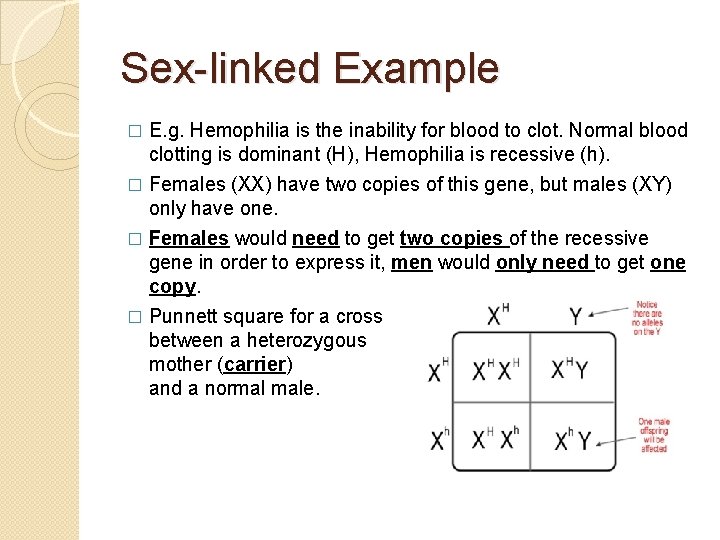
Sex-linked Example � E. g. Hemophilia is the inability for blood to clot. Normal blood clotting is dominant (H), Hemophilia is recessive (h). Females (XX) have two copies of this gene, but males (XY) only have one. � Females would need to get two copies of the recessive gene in order to express it, men would only need to get one copy. � Punnett square for a cross between a heterozygous mother (carrier) and a normal male. �
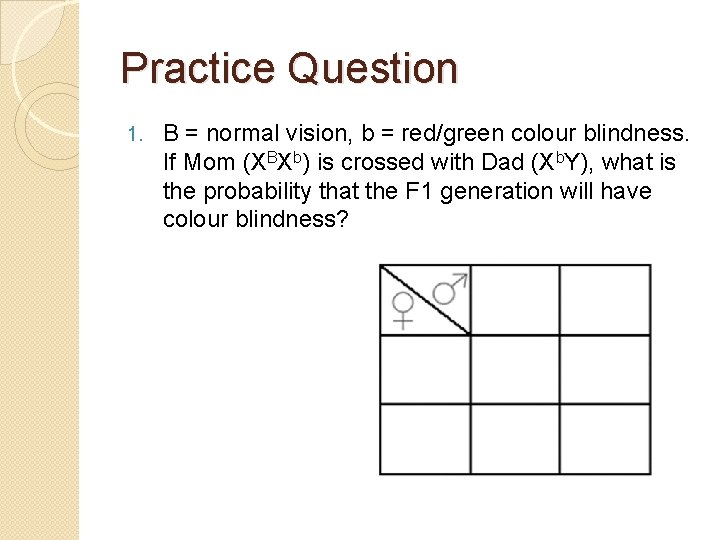
Practice Question 1. B = normal vision, b = red/green colour blindness. If Mom (XBXb) is crossed with Dad (Xb. Y), what is the probability that the F 1 generation will have colour blindness?
What is a Pedigree? �A chart that uses symbols to represent people and lines to represent relationships within a family over several generations. �Often used to determine the mode of inheritance (dominant, recessive, etc…) of traits and genetic diseases.
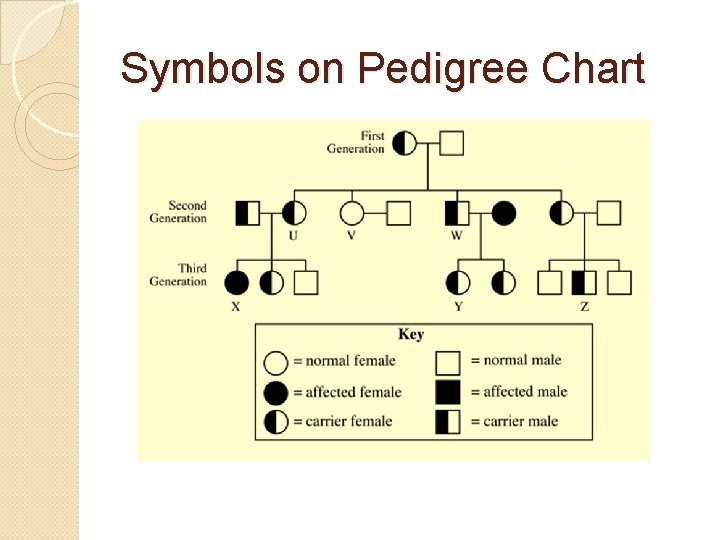
Symbols on Pedigree Chart
- Slides: 31