
Introduction to Gases States of Matter Kinetic Molecular
- Slides: 17
Introduction to Gases States of Matter, Kinetic Molecular Theory, Temperature, Pressure, and Dalton’s Law
States of Matter Solid: state in which matter holds a definite shape and volume. Ø The particles are closely packed together and held rigidly in place. Ø The particles have a very strong attraction to each other. Ø Solids are considered to be a compressed state of matter (the particles cannot be pushed closer together).
States of Matter Liquid: state in which matter does not hold a definite shape but occupies a definite volume. Ø The particles are still very close together, but have the freedom to change places or “flow” past each other. Ø The particles have strong attractions to each other, but not as strong as solids. Ø Liquids are considered to be a compressed state of matter. Ø
States of Matter Ø Ø Ø Ø Gas: state in which matter has no definite shape or volume. The volume of the container is the volume of the gas sample. The particles are very far apart (relatively speaking) and have little or no attraction for each other. The particles are in constant, random motion. Different gases can move through each other rapidly in a process called diffusion. Gases are matter so they do have mass. Gases exert pressure through collisions between the gas particles and their container. The pressure is dependent on the temperature of the gas. The representative particles of a gas may be atoms (He, Ne, Ra) or molecules (O 2, CH 4, N 2, H 2). Gases are easily compressed (the particles can be pushed closer together).
States of Matter Ø Plasma: fourth state of matter, ionized gases. Example: interior of the sun
Measuring Gases Ø In order to describe a gas sample completely and then make predictions about the behavior under changed conditions, it is important to deal with the values of four variables: Ø amount of substance (moles) Ø volume Ø temperature Ø pressure.
Measuring Gases Ø Amount of substance (n) – the quantity of a given gas sample is expressed in terms of moles of gas. It can also be related to the number of particles present. Ø Remember 22. 4 L of any gas is 1 mole (only at STP though!)
Measuring Gases Ø Volume (V) – the space occupied by matter Ø A gas will uniformly fill any container in which it is placed, therefore the volume of a sample of gas is equal to the volume of the container. Ø Memorize the following conversions: 1 L = 1 dm 3 = 1000 m. L = 1000 cm 3
Measuring Gases Temperature (T) – the average kinetic energy of the particles of a substance. The motion of gas particles increases as the temperature increases. The temperature of a gas is usually measured with a thermometer. Ø Fahrenheit (°F) – scale of temperature commonly used in the U. S. The freezing point of water is 32°F and the boiling point is 212°F. Ø Celsius (°C) – scale of temperature that is more compatible with the metric system. The freezing point of water is 0°C and the boiling point is 100°C. Ø
Measuring Gases Ø Ø Ø Kelvin (K) – scale of temperature that is the SI standard. The freezing point of water is 273 K and the boiling point is 373 K. No degree sign (°) is used with Kelvin temperatures. There are no negative temperatures on the Kelvin scale. One degree of Kelvin temperature is equal to one degree of Celsius temperature. Absolute zero or 0 K is the point at which all motion stops. All calculations involving gases should be made using the Kelvin scale.
Measuring Gases Conversion between Fahrenheit and Celsius: (you do not need to memorize these) °C = (°F – 32) 1. 8 °F = (1. 8 °C) + 32 Ø Conversion between Kelvin and Celsius: (you MUST memorize these) °C = K – 273 K = °C + 273 Standard temperature: 0°C or 273 K (MEMORIZE this) Ø
Measuring Gases Pressure – force per unit area; the collisions of gas particles with the container walls exerts an outward push or force on the wall (if a space or volume is lacking measurable gas pressure it is called a vacuum – it is lacking matter). Ø Units of gas pressure – atmospheres (atm), mm. Hg or torr, pascals, and kilopascals Ø Ø Standard pressure: 1 atm = 760 mm. Hg (torr) = 101. 325 k. Pa (Memorize this!!!) Ø Ø Barometers – instruments used to measure atmospheric pressure Manometer – instrument used measure the pressure of a gas in a closed container; similar to a barometer; example: blood pressure cuff
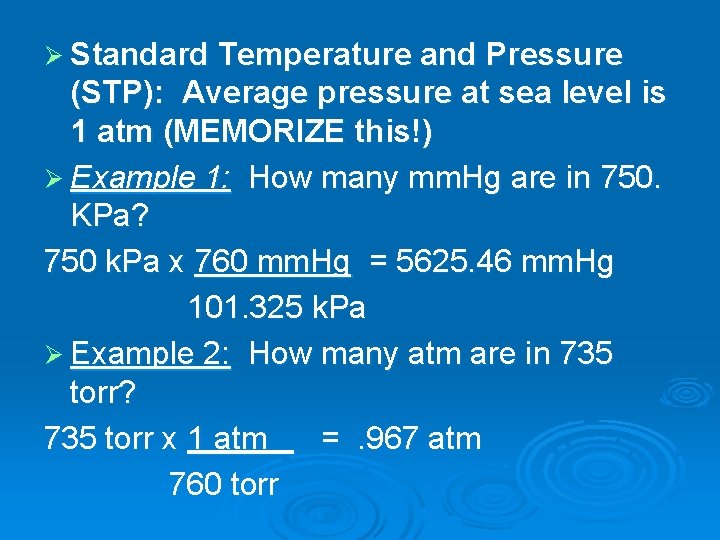
Ø Standard Temperature and Pressure (STP): Average pressure at sea level is 1 atm (MEMORIZE this!) Ø Example 1: How many mm. Hg are in 750. KPa? 750 k. Pa x 760 mm. Hg = 5625. 46 mm. Hg 101. 325 k. Pa Ø Example 2: How many atm are in 735 torr? 735 torr x 1 atm =. 967 atm 760 torr
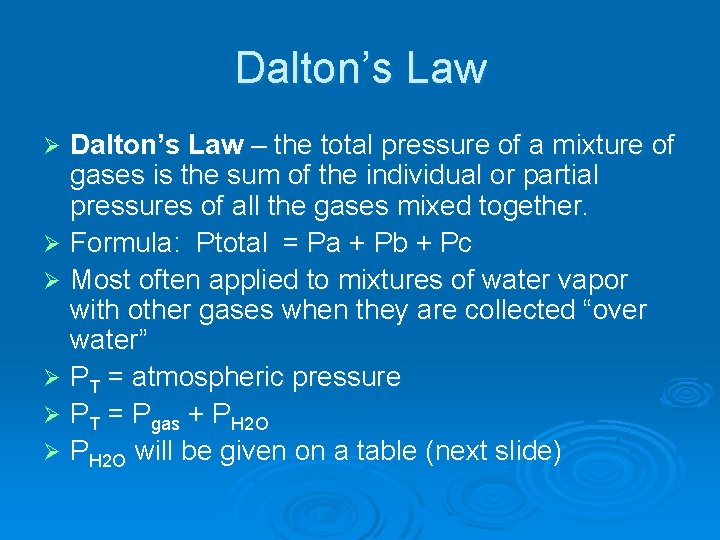
Dalton’s Law – the total pressure of a mixture of gases is the sum of the individual or partial pressures of all the gases mixed together. Ø Formula: Ptotal = Pa + Pb + Pc Ø Most often applied to mixtures of water vapor with other gases when they are collected “over water” Ø PT = atmospheric pressure Ø PT = Pgas + PH 2 O Ø PH 2 O will be given on a table (next slide) Ø
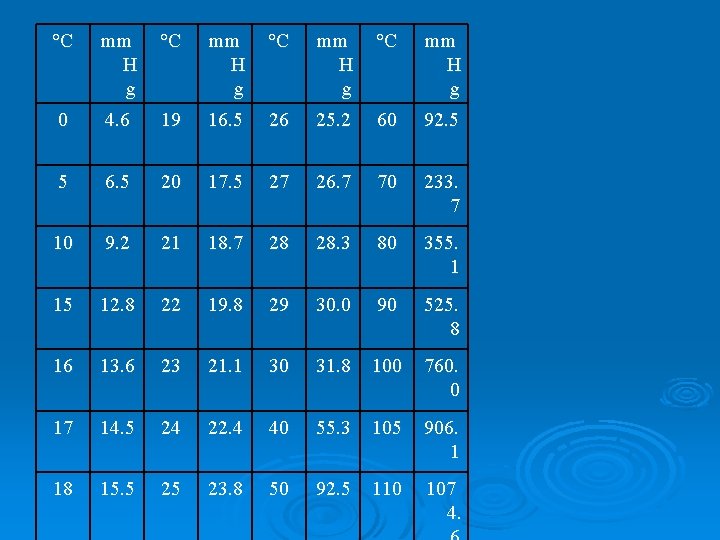
°C mm H g 0 4. 6 19 16. 5 26 25. 2 60 92. 5 5 6. 5 20 17. 5 27 26. 7 70 233. 7 10 9. 2 21 18. 7 28 28. 3 80 355. 1 15 12. 8 22 19. 8 29 30. 0 90 525. 8 16 13. 6 23 21. 1 30 31. 8 100 760. 0 17 14. 5 24 22. 4 40 55. 3 105 906. 1 18 15. 5 25 23. 8 50 92. 5 110 107 4.
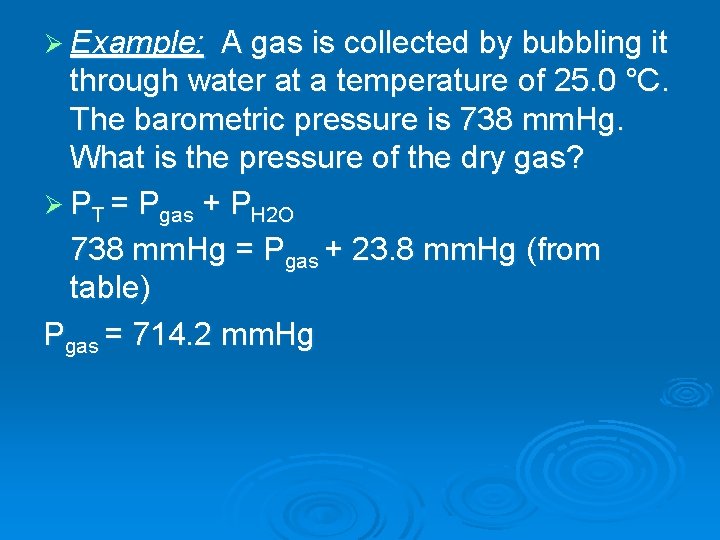
Ø Example: A gas is collected by bubbling it through water at a temperature of 25. 0 °C. The barometric pressure is 738 mm. Hg. What is the pressure of the dry gas? Ø PT = Pgas + PH 2 O 738 mm. Hg = Pgas + 23. 8 mm. Hg (from table) Pgas = 714. 2 mm. Hg
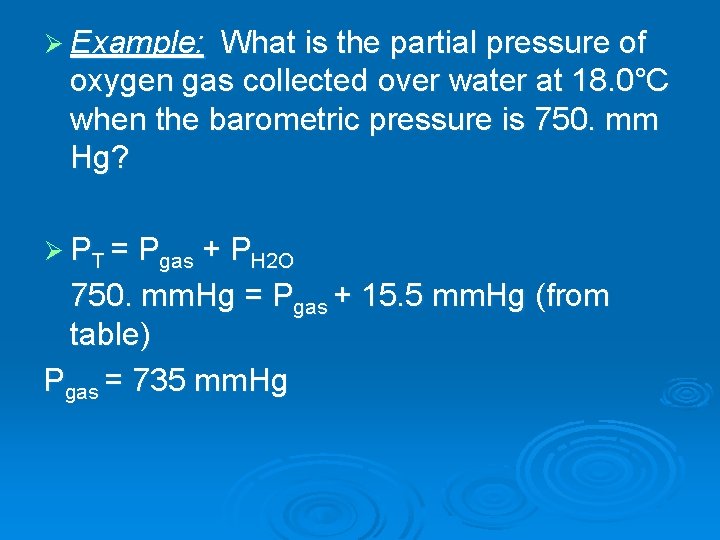
Ø Example: What is the partial pressure of oxygen gas collected over water at 18. 0°C when the barometric pressure is 750. mm Hg? Ø PT = Pgas + PH 2 O 750. mm. Hg = Pgas + 15. 5 mm. Hg (from table) Pgas = 735 mm. Hg