
Introduction to Gases About Gases Gases are the
Introduction to Gases
About Gases • Gases are the most understood form of matter. • Even though different gases have different chemical properties, they tend to exhibit similar physical properties • This situation arises because gas molecules expand to fill a given space, and are relatively far apart from one another. A volume of gas consists mostly of empty space. Thus, each gas atom/molecule behaves as if the others are not there.
Pressure • The most readily measured properties of a gas are its temperature, volume, and pressure • Pressure describes the force that a gas exerts on an area, A. P = F/A • The image below shows gas molecules inside of a cubic container. The gas molecules strike against the walls of the container. These collisions are the source of the pressure.
Atmospheric Pressure • You and I are currently experiencing an attractive force that pulls us toward the center of the earth (gravity). • Gas molecules in the atmosphere also experience gravity. • Because of their small masses and thermal energies, gas molecules can somewhat counteract gravity, which is why gases don’t just sit on the surface • Nonetheless, gravity causes the gases in the atmosphere to “press down” on the surface. This is atmospheric pressure.
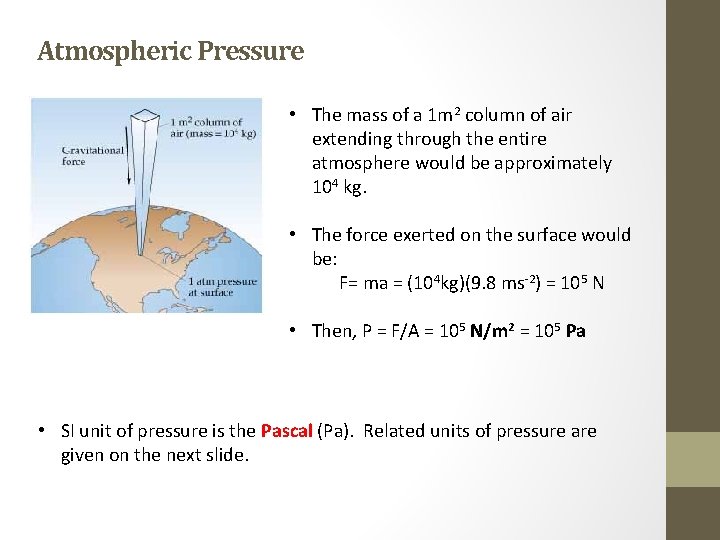
Atmospheric Pressure • The mass of a 1 m 2 column of air extending through the entire atmosphere would be approximately 104 kg. • The force exerted on the surface would be: F= ma = (104 kg)(9. 8 ms-2) = 105 N • Then, P = F/A = 105 N/m 2 = 105 Pa • SI unit of pressure is the Pascal (Pa). Related units of pressure are given on the next slide.

Units of Pressure The most commonly used unit is the atmosphere, which describes the pressure exerted by air on the surface at sea level
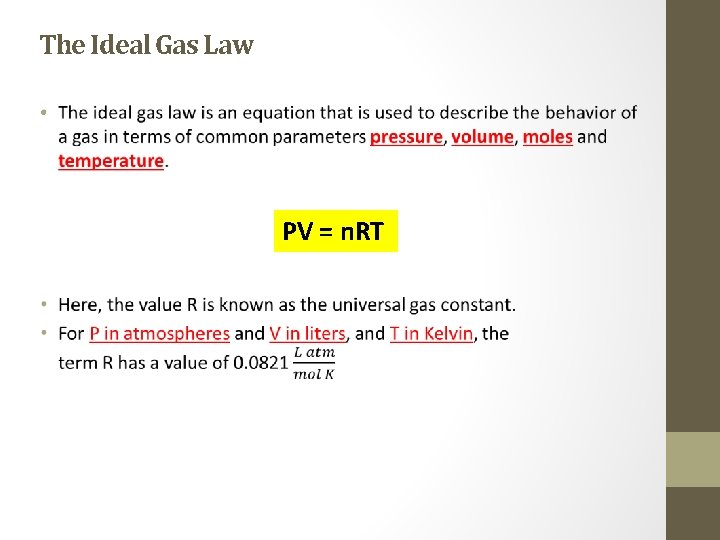
The Ideal Gas Law • PV = n. RT
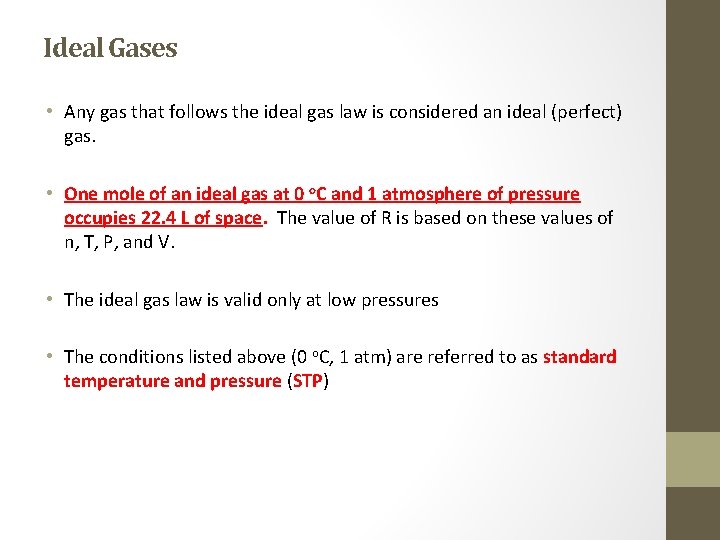
Ideal Gases • Any gas that follows the ideal gas law is considered an ideal (perfect) gas. • One mole of an ideal gas at 0 o. C and 1 atmosphere of pressure occupies 22. 4 L of space. The value of R is based on these values of n, T, P, and V. • The ideal gas law is valid only at low pressures • The conditions listed above (0 o. C, 1 atm) are referred to as standard temperature and pressure (STP)
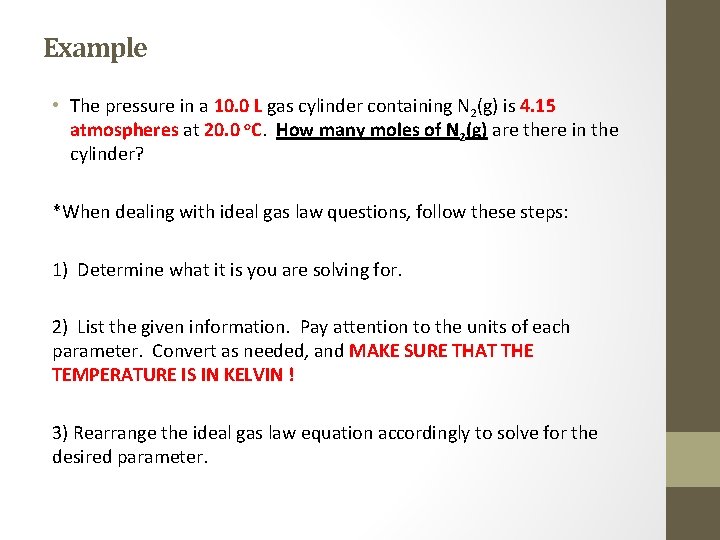
Example • The pressure in a 10. 0 L gas cylinder containing N 2(g) is 4. 15 atmospheres at 20. 0 o. C. How many moles of N 2(g) are there in the cylinder? *When dealing with ideal gas law questions, follow these steps: 1) Determine what it is you are solving for. 2) List the given information. Pay attention to the units of each parameter. Convert as needed, and MAKE SURE THAT THE TEMPERATURE IS IN KELVIN ! 3) Rearrange the ideal gas law equation accordingly to solve for the desired parameter.
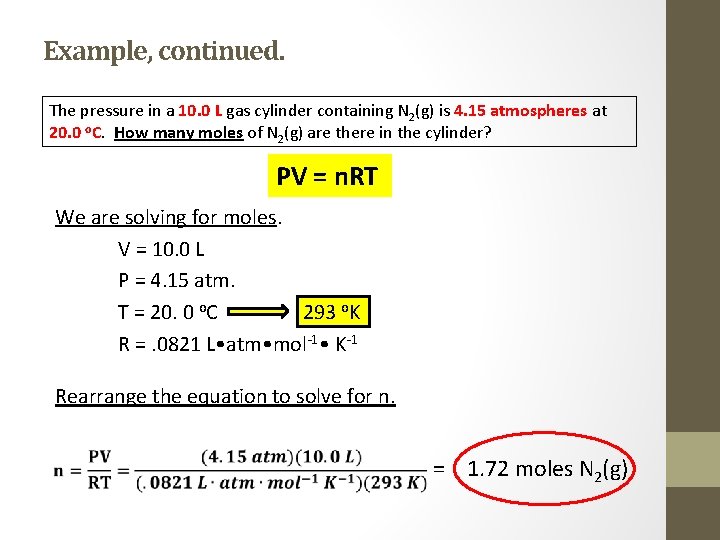
Example, continued. The pressure in a 10. 0 L gas cylinder containing N 2(g) is 4. 15 atmospheres at 20. 0 o. C. How many moles of N 2(g) are there in the cylinder? PV = n. RT We are solving for moles. V = 10. 0 L P = 4. 15 atm. T = 20. 0 o. C 293 o. K R =. 0821 L • atm • mol-1 • K-1 Rearrange the equation to solve for n. = 1. 72 moles N 2(g)
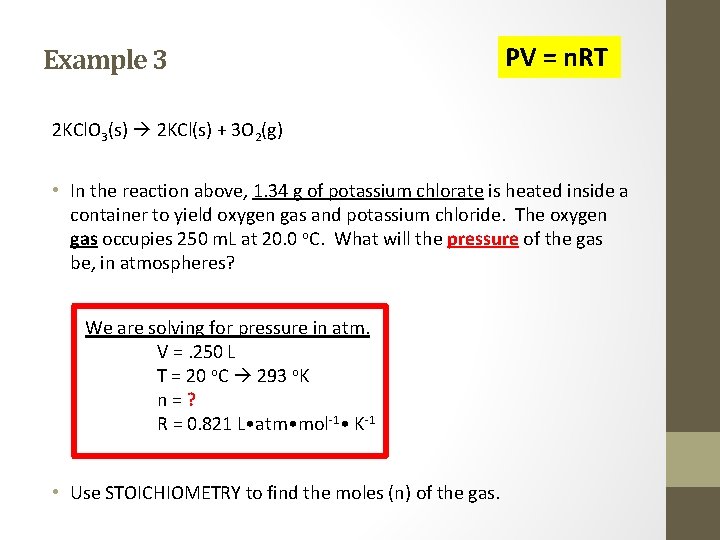
Example 3 PV = n. RT 2 KCl. O 3(s) 2 KCl(s) + 3 O 2(g) • In the reaction above, 1. 34 g of potassium chlorate is heated inside a container to yield oxygen gas and potassium chloride. The oxygen gas occupies 250 m. L at 20. 0 o. C. What will the pressure of the gas be, in atmospheres? We are solving for pressure in atm. V =. 250 L T = 20 o. C 293 o. K n = ? R = 0. 821 L • atm • mol-1 • K-1 • Use STOICHIOMETRY to find the moles (n) of the gas.
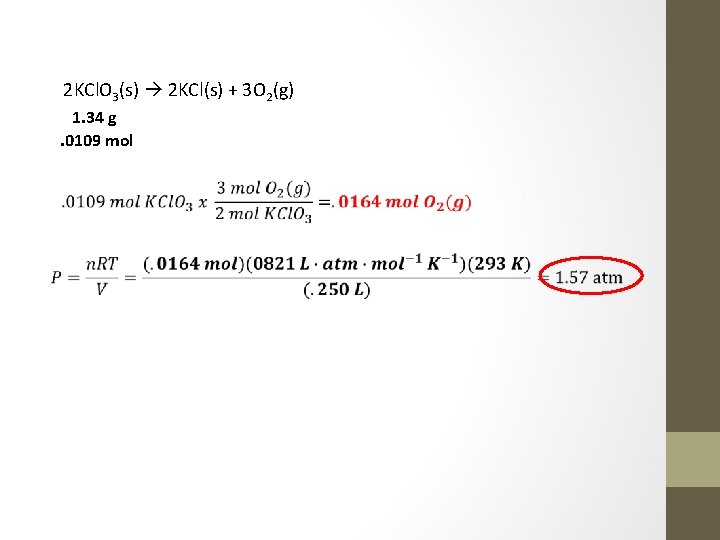
2 KCl. O 3(s) 2 KCl(s) + 3 O 2(g) 1. 34 g. 0109 mol
- Slides: 12